
Electrodes and Potentiometry Introduction 1 Potentiometry Use of

- Slides: 8
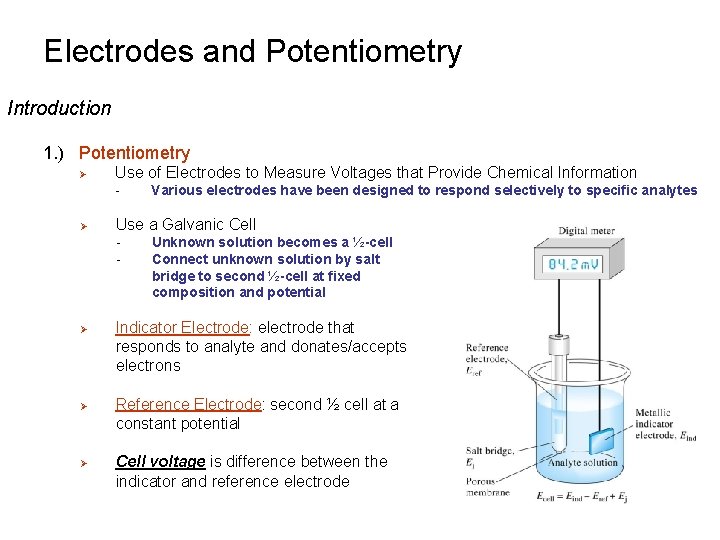
Electrodes and Potentiometry Introduction 1. ) Potentiometry Ø Use of Electrodes to Measure Voltages that Provide Chemical Information - Ø Use a Galvanic Cell - Ø Ø Ø Various electrodes have been designed to respond selectively to specific analytes Unknown solution becomes a ½-cell Connect unknown solution by salt bridge to second ½-cell at fixed composition and potential Indicator Electrode: electrode that responds to analyte and donates/accepts electrons Reference Electrode: second ½ cell at a constant potential Cell voltage is difference between the indicator and reference electrode
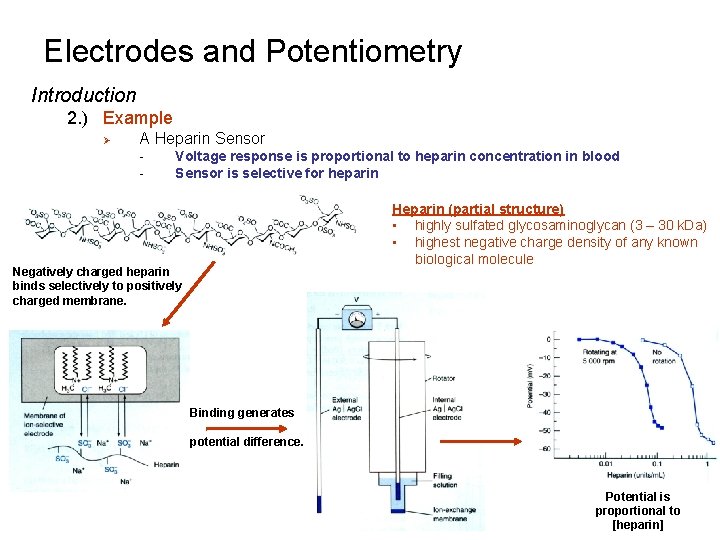
Electrodes and Potentiometry Introduction 2. ) Example Ø A Heparin Sensor - Voltage response is proportional to heparin concentration in blood Sensor is selective for heparin Heparin (partial structure) • highly sulfated glycosaminoglycan (3 – 30 k. Da) • highest negative charge density of any known biological molecule Negatively charged heparin binds selectively to positively charged membrane. Binding generates potential difference. Potential is proportional to [heparin]
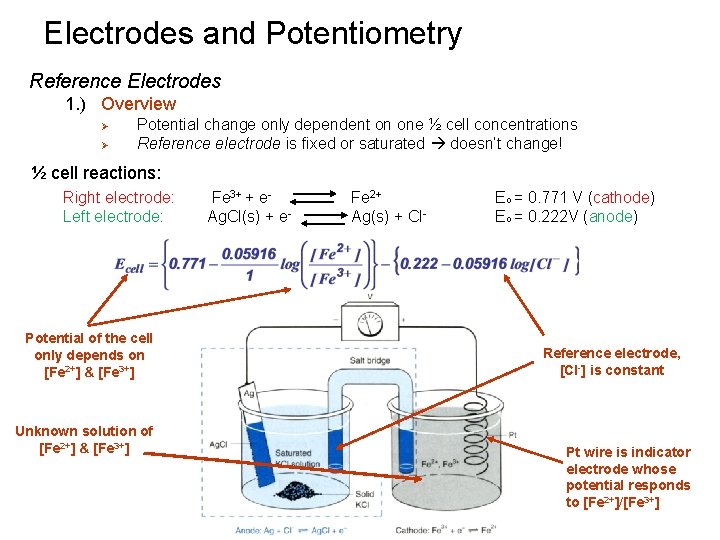
Electrodes and Potentiometry Reference Electrodes 1. ) Overview Ø Ø Potential change only dependent on one ½ cell concentrations Reference electrode is fixed or saturated doesn’t change! ½ cell reactions: Right electrode: Left electrode: Potential of the cell only depends on [Fe 2+] & [Fe 3+] Unknown solution of [Fe 2+] & [Fe 3+] Fe 3+ + e. Ag. Cl(s) + e- Fe 2+ Ag(s) + Cl- Eo = 0. 771 V (cathode) Eo = 0. 222 V (anode) Reference electrode, [Cl-] is constant Pt wire is indicator electrode whose potential responds to [Fe 2+]/[Fe 3+]
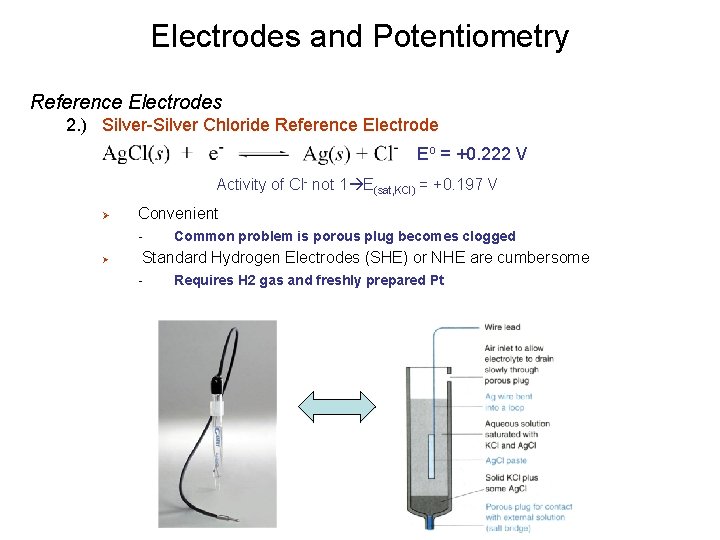
Electrodes and Potentiometry Reference Electrodes 2. ) Silver-Silver Chloride Reference Electrode Eo = +0. 222 V Activity of Cl- not 1 E(sat, KCl) = +0. 197 V Ø Convenient - Ø Common problem is porous plug becomes clogged Standard Hydrogen Electrodes (SHE) or NHE are cumbersome - Requires H 2 gas and freshly prepared Pt
Electrodes and Potentiometry Reference Electrodes 3. ) Saturated Calomel Reference Electrode (S. C. E) Eo = +0. 268 V Activity of Cl- not 1 E(sat, KCl) = +0. 241 V Ø Ø Saturated KCl maintains constant [Cl-] even with some evaporation But, S. C. E. requires handling of Hg (l) - Ø Toxicity issues Thus, Ag/Ag. Cl reference electrodes are more commonly used!
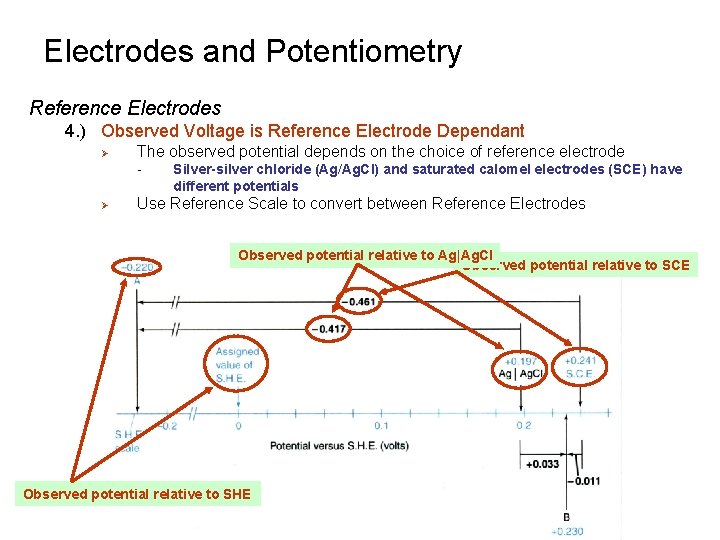
Electrodes and Potentiometry Reference Electrodes 4. ) Observed Voltage is Reference Electrode Dependant Ø The observed potential depends on the choice of reference electrode - Ø Silver-silver chloride (Ag/Ag. Cl) and saturated calomel electrodes (SCE) have different potentials Use Reference Scale to convert between Reference Electrodes Observed potential relative to Ag|Ag. Cl Observed potential relative to SCE Observed potential relative to SHE
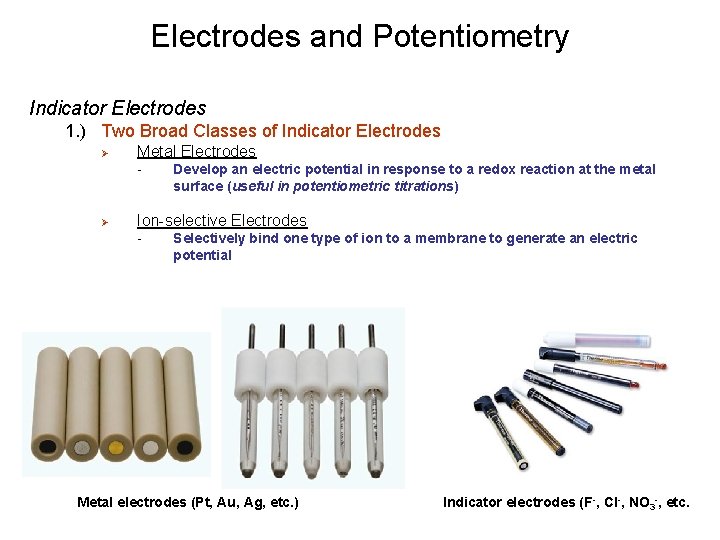
Electrodes and Potentiometry Indicator Electrodes 1. ) Two Broad Classes of Indicator Electrodes Ø Metal Electrodes - Ø Develop an electric potential in response to a redox reaction at the metal surface (useful in potentiometric titrations) Ion-selective Electrodes - Selectively bind one type of ion to a membrane to generate an electric potential Metal electrodes (Pt, Au, Ag, etc. ) Indicator electrodes (F-, Cl-, NO 3 -, etc.
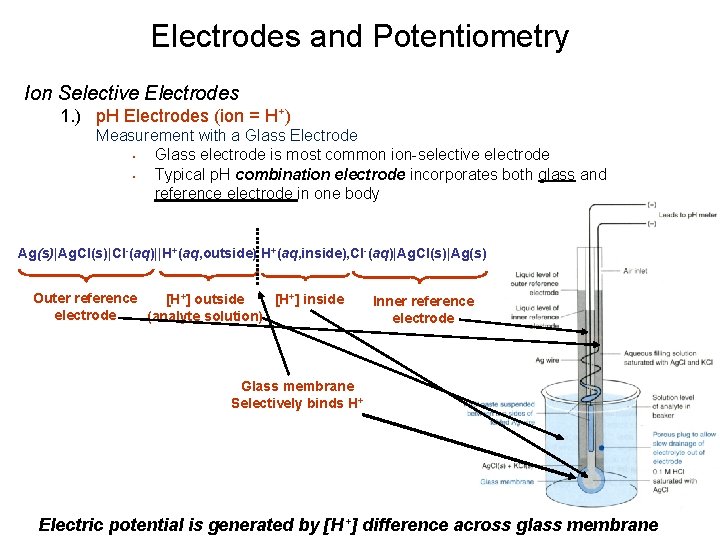
Electrodes and Potentiometry Ion Selective Electrodes 1. ) p. H Electrodes (ion = H+) Measurement with a Glass Electrode • Glass electrode is most common ion-selective electrode • Typical p. H combination electrode incorporates both glass and reference electrode in one body Ag(s)|Ag. Cl(s)|Cl-(aq)||H+(aq, outside) H+(aq, inside), Cl-(aq)|Ag. Cl(s)|Ag(s) Outer reference [H+] outside [H+] inside electrode (analyte solution) Inner reference electrode Glass membrane Selectively binds H+ Electric potential is generated by [H+] difference across glass membrane