
Electrochemistry The study of the interchange between chemical
Electrochemistry The study of the interchange between chemical and electrical energy

Oxidation-Reduction Reactions • “Redox” reactions involve the transfer of electrons (e-) • Reduction: gain e • Oxidation: lose e“LEO the lion says, ‘GER’” “OIL RIG” • Use oxidation states to keep track of the e-
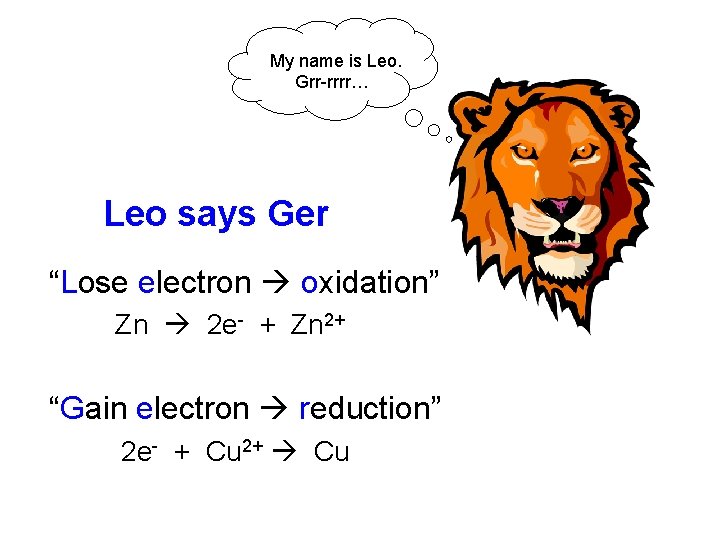
My name is Leo. Grr-rrrr… Leo says Ger “Lose electron oxidation” Zn 2 e- + Zn 2+ “Gain electron reduction” 2 e- + Cu 2+ Cu
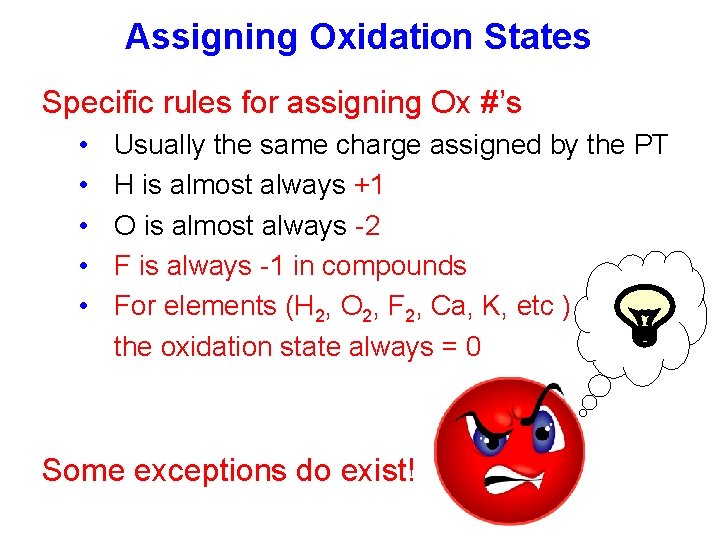
Assigning Oxidation States Specific rules for assigning Ox #’s • • • Usually the same charge assigned by the PT H is almost always +1 O is almost always -2 F is always -1 in compounds For elements (H 2, O 2, F 2, Ca, K, etc ) the oxidation state always = 0 Some exceptions do exist!
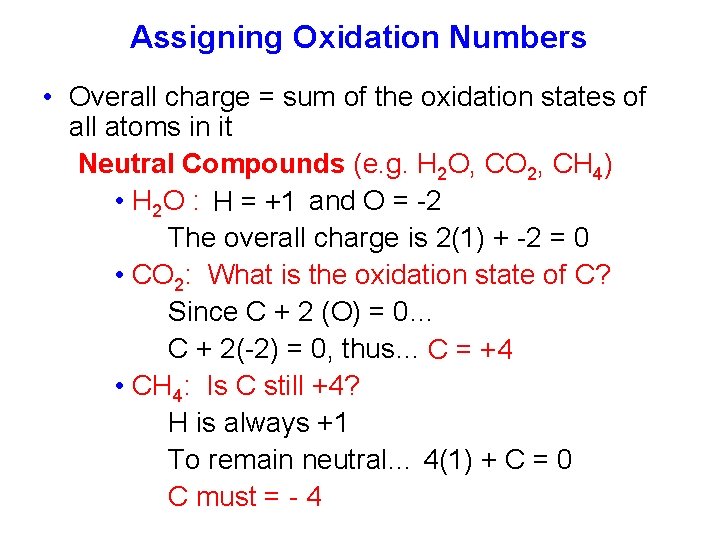
Assigning Oxidation Numbers • Overall charge = sum of the oxidation states of all atoms in it Neutral Compounds (e. g. H 2 O, CO 2, CH 4) • H 2 O : H = +1 and O = -2 The overall charge is 2(1) + -2 = 0 • CO 2: What is the oxidation state of C? Since C + 2 (O) = 0… C + 2(-2) = 0, thus… C = +4 • CH 4: Is C still +4? H is always +1 To remain neutral… 4(1) + C = 0 C must = - 4
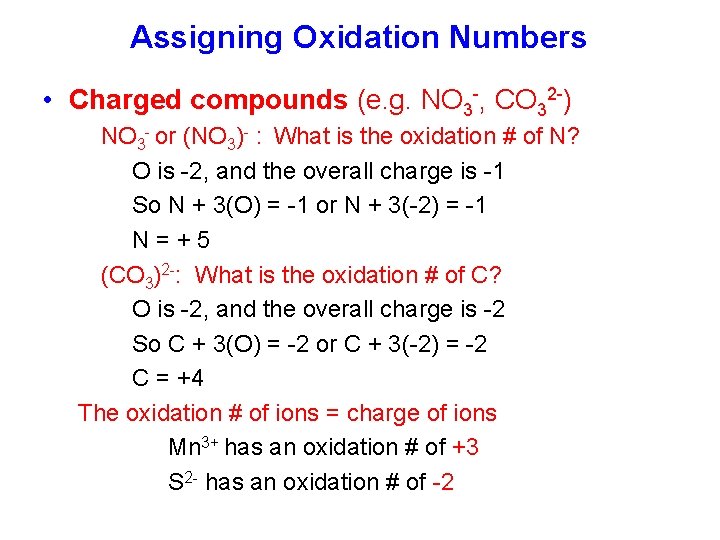
Assigning Oxidation Numbers • Charged compounds (e. g. NO 3 -, CO 32 -) NO 3 - or (NO 3)- : What is the oxidation # of N? O is -2, and the overall charge is -1 So N + 3(O) = -1 or N + 3(-2) = -1 N=+5 (CO 3)2 -: What is the oxidation # of C? O is -2, and the overall charge is -2 So C + 3(O) = -2 or C + 3(-2) = -2 C = +4 The oxidation # of ions = charge of ions Mn 3+ has an oxidation # of +3 S 2 - has an oxidation # of -2
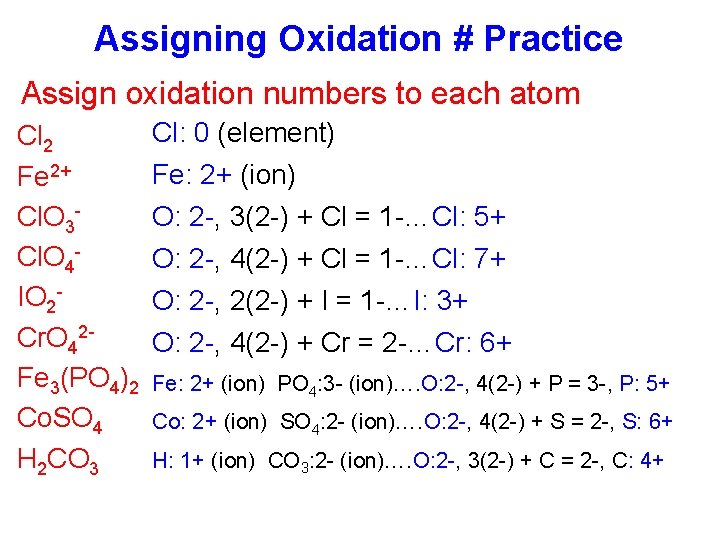
Assigning Oxidation # Practice Assign oxidation numbers to each atom Cl 2 Fe 2+ Cl. O 3 Cl. O 4 IO 2 Cr. O 42 Fe 3(PO 4)2 Co. SO 4 H 2 CO 3 Cl: 0 (element) Fe: 2+ (ion) O: 2 -, 3(2 -) + Cl = 1 -…Cl: 5+ O: 2 -, 4(2 -) + Cl = 1 -…Cl: 7+ O: 2 -, 2(2 -) + I = 1 -…I: 3+ O: 2 -, 4(2 -) + Cr = 2 -…Cr: 6+ Fe: 2+ (ion) PO 4: 3 - (ion)…. O: 2 -, 4(2 -) + P = 3 -, P: 5+ Co: 2+ (ion) SO 4: 2 - (ion)…. O: 2 -, 4(2 -) + S = 2 -, S: 6+ H: 1+ (ion) CO 3: 2 - (ion)…. O: 2 -, 3(2 -) + C = 2 -, C: 4+
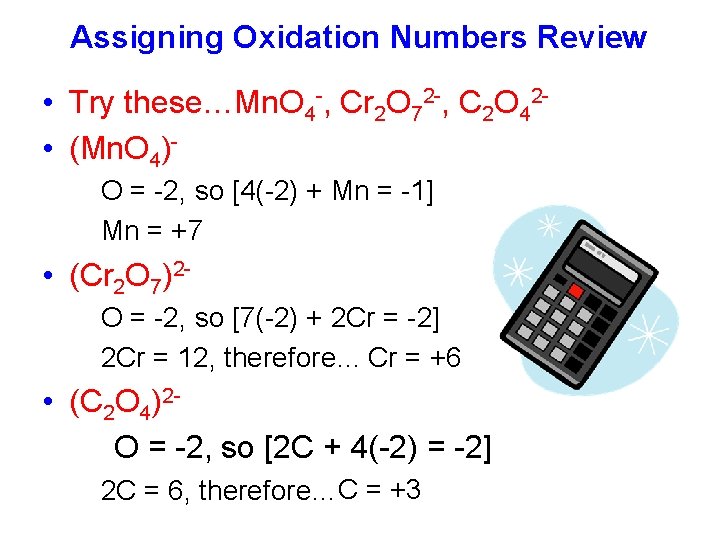
Assigning Oxidation Numbers Review • Try these…Mn. O 4 -, Cr 2 O 72 -, C 2 O 42 • (Mn. O 4)O = -2, so [4(-2) + Mn = -1] Mn = +7 • (Cr 2 O 7)2 O = -2, so [7(-2) + 2 Cr = -2] 2 Cr = 12, therefore… Cr = +6 • (C 2 O 4)2 O = -2, so [2 C + 4(-2) = -2] 2 C = 6, therefore…C = +3
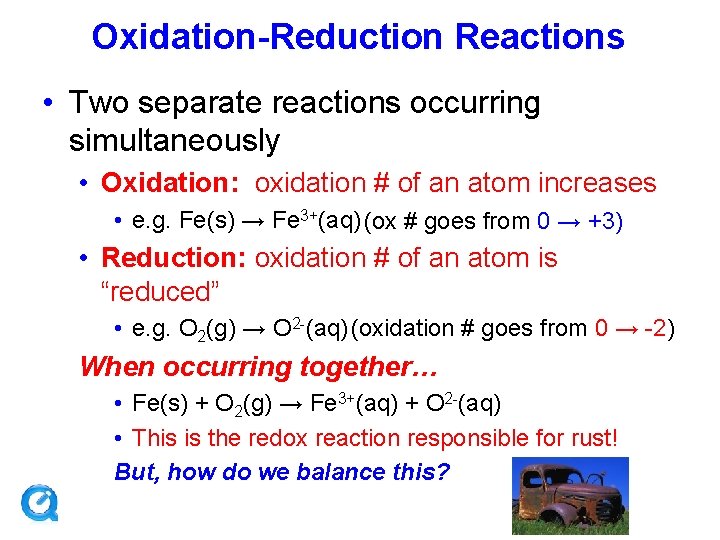
Oxidation-Reduction Reactions • Two separate reactions occurring simultaneously • Oxidation: oxidation # of an atom increases • e. g. Fe(s) → Fe 3+(aq) (ox # goes from 0 → +3) • Reduction: oxidation # of an atom is “reduced” • e. g. O 2(g) → O 2 -(aq) (oxidation # goes from 0 → -2) When occurring together… • Fe(s) + O 2(g) → Fe 3+(aq) + O 2 -(aq) • This is the redox reaction responsible for rust! But, how do we balance this?
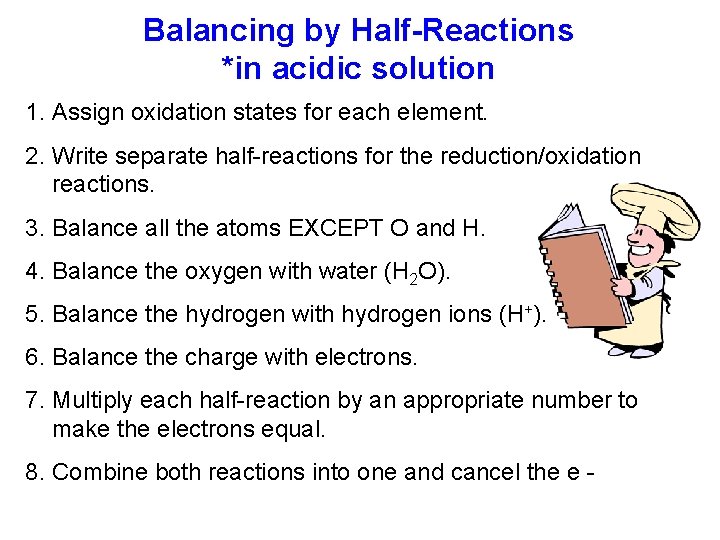
Balancing by Half-Reactions *in acidic solution 1. Assign oxidation states for each element. 2. Write separate half-reactions for the reduction/oxidation reactions. 3. Balance all the atoms EXCEPT O and H. 4. Balance the oxygen with water (H 2 O). 5. Balance the hydrogen with hydrogen ions (H+). 6. Balance the charge with electrons. 7. Multiply each half-reaction by an appropriate number to make the electrons equal. 8. Combine both reactions into one and cancel the e -
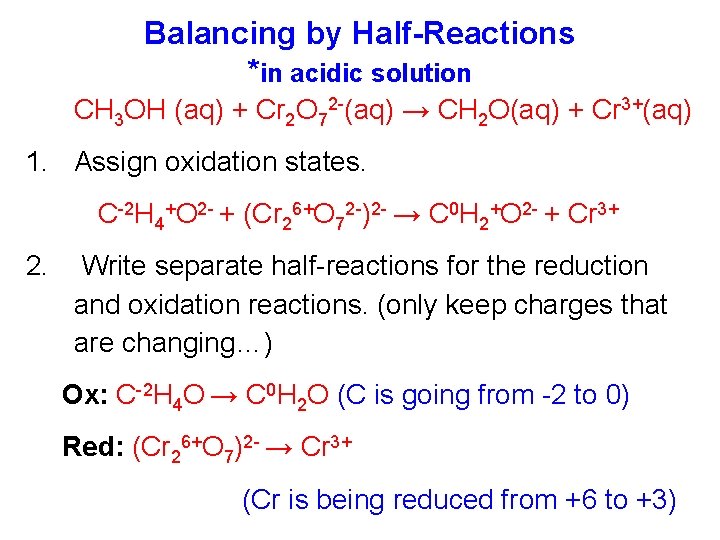
Balancing by Half-Reactions *in acidic solution CH 3 OH (aq) + Cr 2 O 72 -(aq) → CH 2 O(aq) + Cr 3+(aq) 1. Assign oxidation states. C-2 H 4+O 2 - + (Cr 26+O 72 -)2 - → C 0 H 2+O 2 - + Cr 3+ 2. Write separate half-reactions for the reduction and oxidation reactions. (only keep charges that are changing…) Ox: C-2 H 4 O → C 0 H 2 O (C is going from -2 to 0) Red: (Cr 26+O 7)2 - → Cr 3+ (Cr is being reduced from +6 to +3)

Balancing the Oxidation… Ox: C 2 -H 4 O → C 0 H 2 O + 2 H+ + 2 e- 3. For each half reaction, balance all the atoms EXCEPT O and H. Carbon is already balanced! 4. Balance the oxygen by adding water (H 2 O). Oxygen is already balanced! 5. Balance the hydrogen by adding hydrogen ions (H+) 6. Balance the charge by adding electrons. …use the oxidation state as a guide
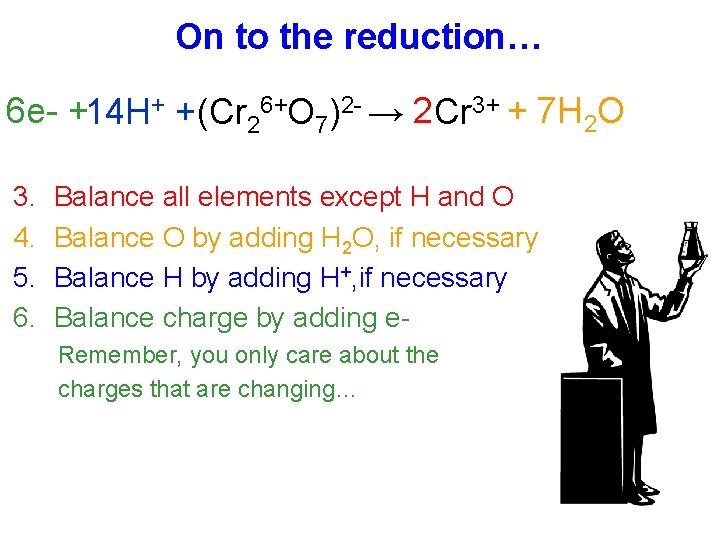
On to the reduction… 6 e- +14 H+ + (Cr 26+O 7)2 - → 2 Cr 3+ + 7 H 2 O 3. 4. 5. 6. Balance all elements except H and O Balance O by adding H 2 O, if necessary Balance H by adding H+, if necessary Balance charge by adding e. Remember, you only care about the charges that are changing…
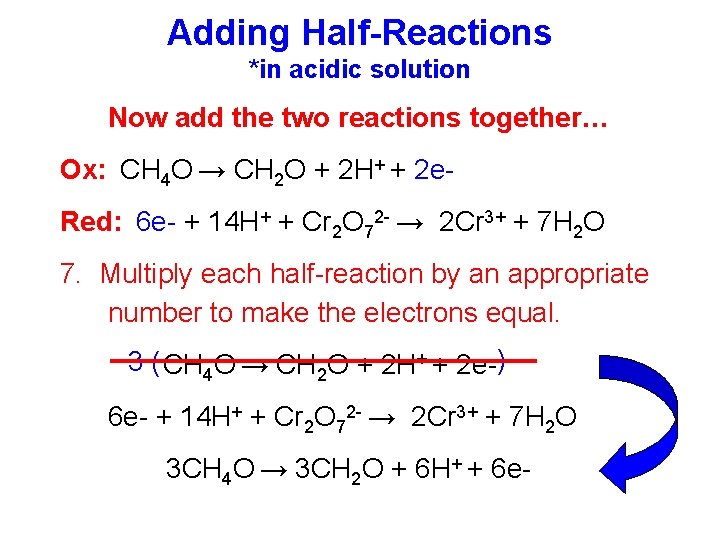
Adding Half-Reactions *in acidic solution Now add the two reactions together… Ox: CH 4 O → CH 2 O + 2 H+ + 2 e. Red: 6 e- + 14 H+ + Cr 2 O 72 - → 2 Cr 3+ + 7 H 2 O 7. Multiply each half-reaction by an appropriate number to make the electrons equal. 3 ( CH 4 O → CH 2 O + 2 H+ + 2 e-) 6 e- + 14 H+ + Cr 2 O 72 - → 2 Cr 3+ + 7 H 2 O 3 CH 4 O → 3 CH 2 O + 6 H+ + 6 e-
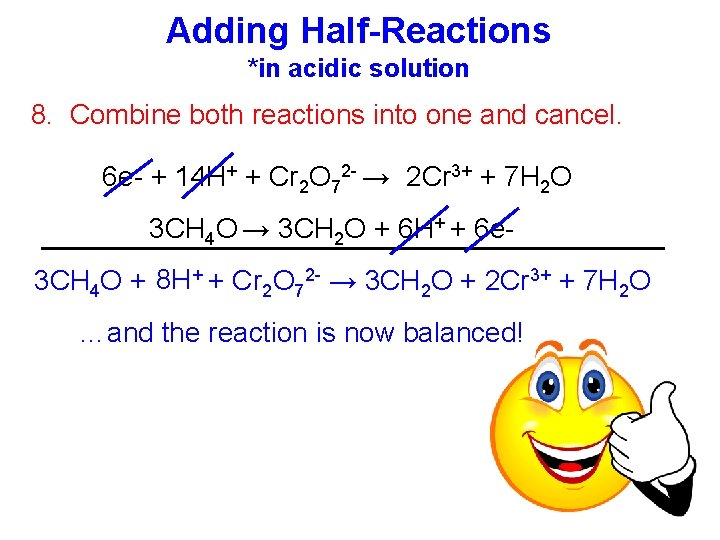
Adding Half-Reactions *in acidic solution 8. Combine both reactions into one and cancel. 6 e- + 14 H+ + Cr 2 O 72 - → 2 Cr 3+ + 7 H 2 O 3 CH 4 O → 3 CH 2 O + 6 H+ + 6 e 3 CH 4 O + 8 H+ + Cr 2 O 72 - → 3 CH 2 O + 2 Cr 3+ + 7 H 2 O …and the reaction is now balanced!
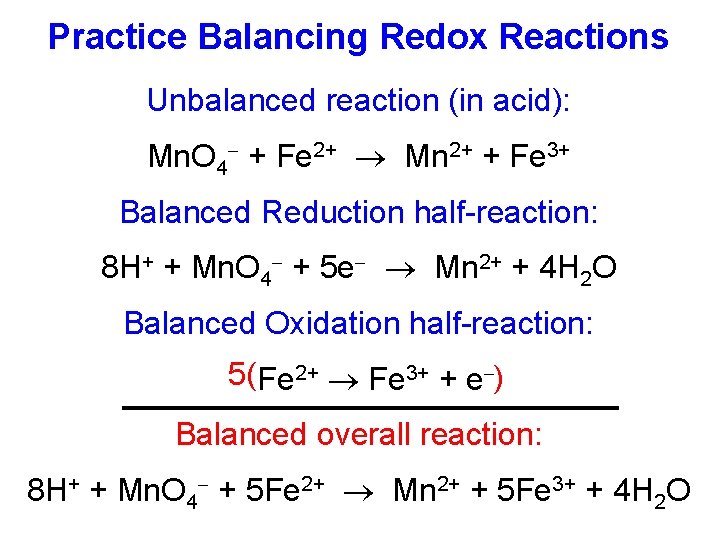
Practice Balancing Redox Reactions Unbalanced reaction (in acid): Mn. O 4 + Fe 2+ Mn 2+ + Fe 3+ Balanced Reduction half-reaction: 8 H+ + Mn. O 4 + 5 e Mn 2+ + 4 H 2 O Balanced Oxidation half-reaction: 5(Fe 2+ Fe 3+ + e ) Balanced overall reaction: 8 H+ + Mn. O 4 + 5 Fe 2+ Mn 2+ + 5 Fe 3+ + 4 H 2 O
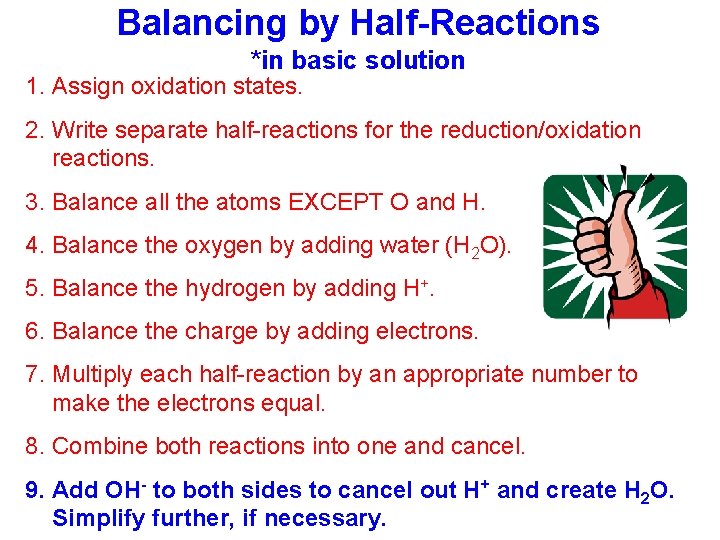
Balancing by Half-Reactions *in basic solution 1. Assign oxidation states. 2. Write separate half-reactions for the reduction/oxidation reactions. 3. Balance all the atoms EXCEPT O and H. 4. Balance the oxygen by adding water (H 2 O). 5. Balance the hydrogen by adding H+. 6. Balance the charge by adding electrons. 7. Multiply each half-reaction by an appropriate number to make the electrons equal. 8. Combine both reactions into one and cancel. 9. Add OH- to both sides to cancel out H+ and create H 2 O. Simplify further, if necessary.
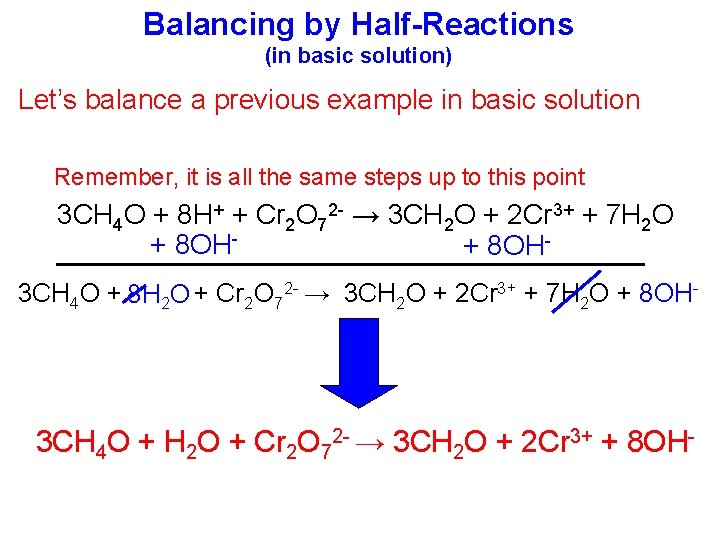
Balancing by Half-Reactions (in basic solution) Let’s balance a previous example in basic solution Remember, it is all the same steps up to this point 3 CH 4 O + 8 H+ + Cr 2 O 72 - → 3 CH 2 O + 2 Cr 3+ + 7 H 2 O + 8 OH 3 CH 4 O + 8 H 2 O + Cr 2 O 72 - → 3 CH 2 O + 2 Cr 3+ + 7 H 2 O + 8 OH- 3 CH 4 O + H 2 O + Cr 2 O 72 - → 3 CH 2 O + 2 Cr 3+ + 8 OH-
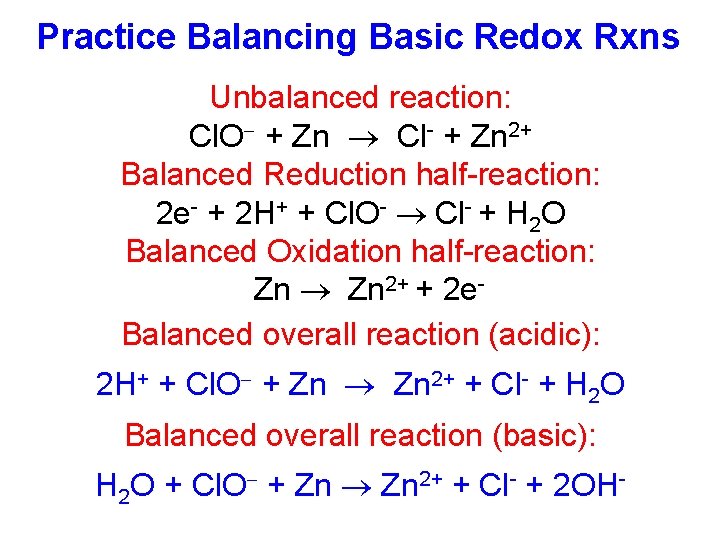
Practice Balancing Basic Redox Rxns Unbalanced reaction: Cl. O + Zn Cl- + Zn 2+ Balanced Reduction half-reaction: 2 e- + 2 H+ + Cl. O- Cl- + H 2 O Balanced Oxidation half-reaction: Zn 2+ + 2 e. Balanced overall reaction (acidic): 2 H+ + Cl. O + Zn 2+ + Cl- + H 2 O Balanced overall reaction (basic): H 2 O + Cl. O + Zn 2+ + Cl- + 2 OH-
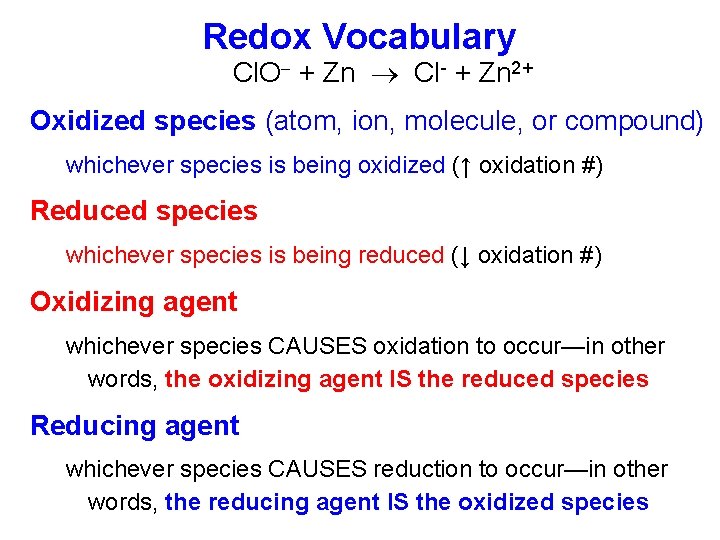
Redox Vocabulary Cl. O + Zn Cl- + Zn 2+ Oxidized species (atom, ion, molecule, or compound) whichever species is being oxidized (↑ oxidation #) Reduced species whichever species is being reduced (↓ oxidation #) Oxidizing agent whichever species CAUSES oxidation to occur—in other words, the oxidizing agent IS the reduced species Reducing agent whichever species CAUSES reduction to occur—in other words, the reducing agent IS the oxidized species
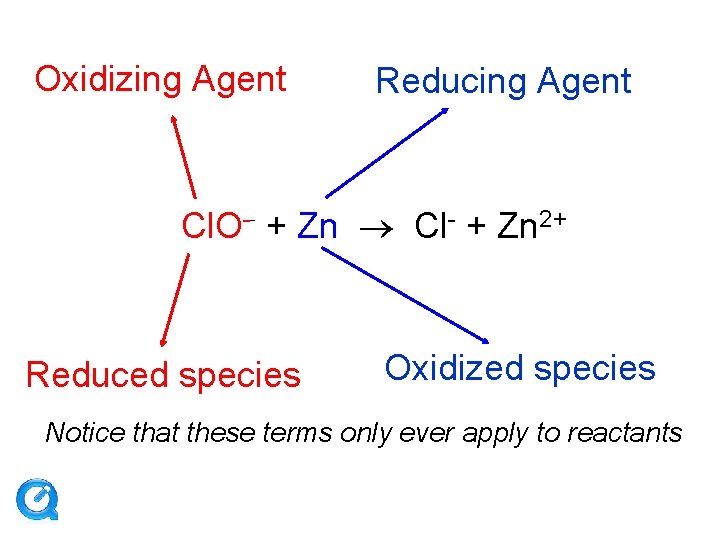
Oxidizing Agent Reducing Agent Cl. O - + Zn Cl- + Zn 2+ Reduced species Oxidized species Notice that these terms only ever apply to reactants
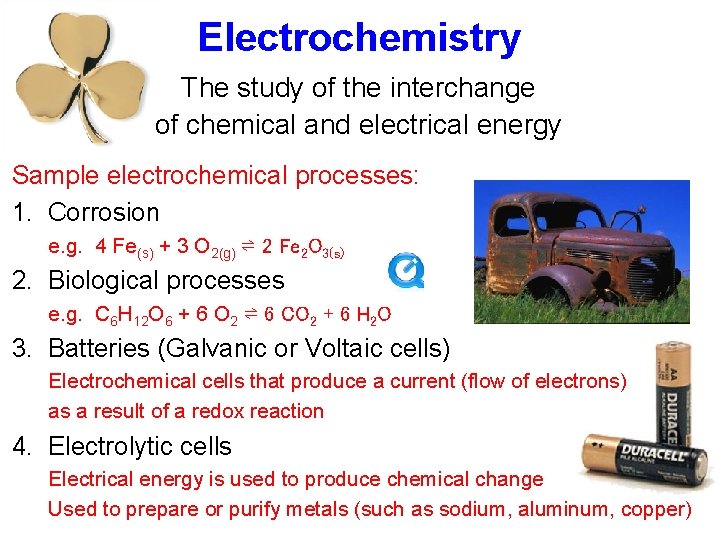
Electrochemistry The study of the interchange of chemical and electrical energy Sample electrochemical processes: 1. Corrosion e. g. 4 Fe(s) + 3 O 2(g) ⇌ 2 Fe 2 O 3(s) 2. Biological processes e. g. C 6 H 12 O 6 + 6 O 2 ⇌ 6 CO 2 + 6 H 2 O 3. Batteries (Galvanic or Voltaic cells) Electrochemical cells that produce a current (flow of electrons) as a result of a redox reaction 4. Electrolytic cells Electrical energy is used to produce chemical change Used to prepare or purify metals (such as sodium, aluminum, copper)
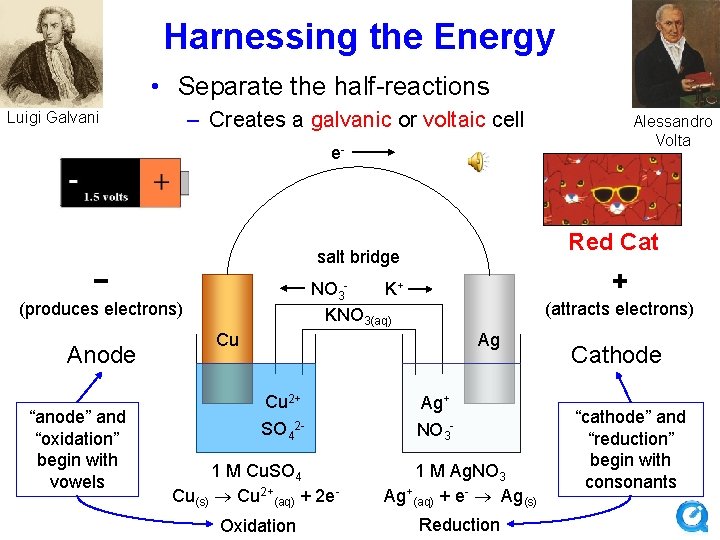
Harnessing the Energy • Separate the half-reactions – Creates a galvanic or voltaic cell Luigi Galvani Alessandro Volta e- − “anode” and “oxidation” begin with vowels + NO 3 K+ KNO 3(aq) (produces electrons) Anode Red Cat salt bridge (attracts electrons) Cu Ag Cu 2+ Ag+ SO 42 - NO 3 - 1 M Cu. SO 4 Cu(s) Cu 2+(aq) + 2 e- 1 M Ag. NO 3 Ag+(aq) + e- Ag(s) Oxidation Reduction Cathode “cathode” and “reduction” begin with consonants
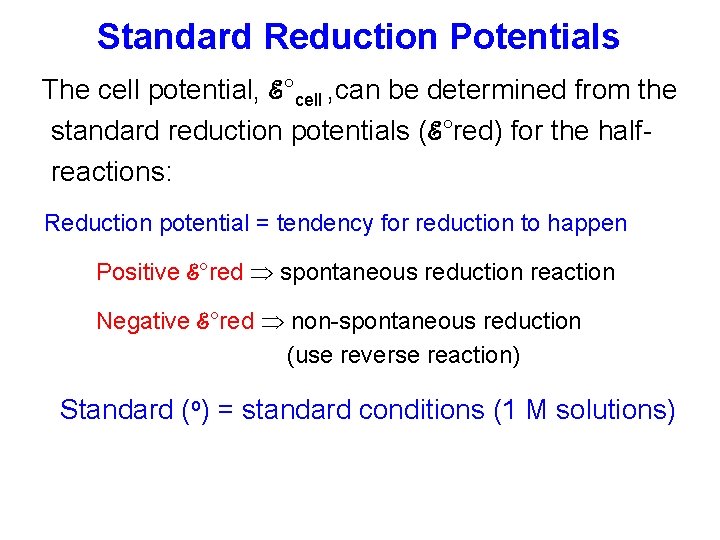
Standard Reduction Potentials The cell potential, ℰ°cell , can be determined from the standard reduction potentials (ℰ°red) for the halfreactions: Reduction potential = tendency for reduction to happen Positive ℰ°red spontaneous reduction reaction Negative ℰ°red non-spontaneous reduction (use reverse reaction) Standard (o) = standard conditions (1 M solutions)
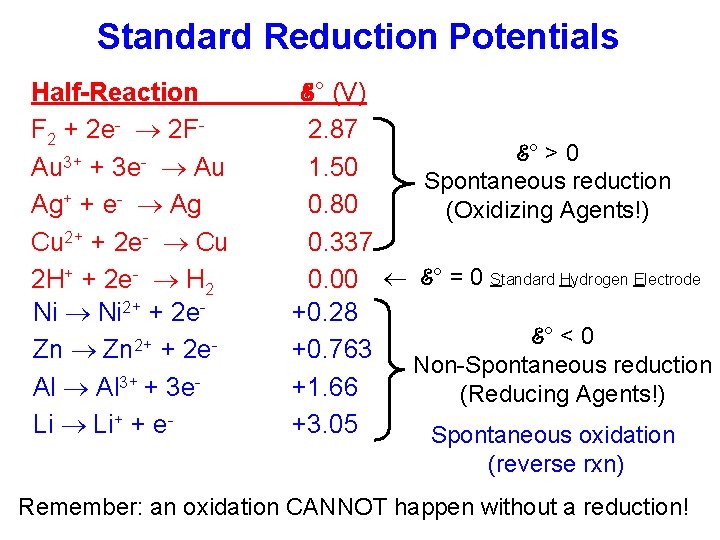
Standard Reduction Potentials Half-Reaction F 2 + 2 e- 2 FAu 3+ + 3 e- Au Ag+ + e- Ag Cu 2+ + 2 e- Cu 2 H+ + 2 e- H 2 Ni 2+ +Ni 2 e 2+- + 2 e Ni- Zn 2+ +Zn + 2 e 2 e 2+ Zn. Al 3+ + Al 3 e 3+- + 3 e. Al. Li+ + e. Li- + ℰ° (V) 2. 87 ℰ° > 0 1. 50 Spontaneous reduction 0. 80 (Oxidizing Agents!) 0. 337 0. 00 ℰ° = 0 Standard Hydrogen Electrode +0. 28 -0. 28 ℰ° < 0 +0. 763 -0. 763 Non-Spontaneous reduction +1. 66 -1. 66 (Reducing Agents!) +3. 05 -3. 05 Spontaneous oxidation (reverse rxn) Remember: an oxidation CANNOT happen without a reduction!
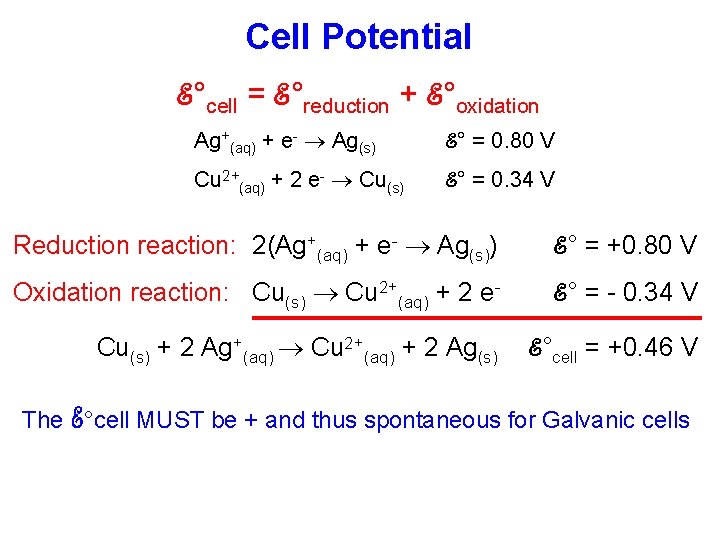
Cell Potential ℰ°cell = ℰ°reduction + ℰ°oxidation Ag+(aq) + e- Ag(s) ℰ° = 0. 80 V Cu 2+(aq) + 2 e- Cu(s) ℰ° = 0. 34 V Reduction reaction: 2(Ag+(aq) + e- Ag(s)) ℰ° = +0. 80 V Oxidation reaction: Cu(s) Cu 2+(aq) + 2 e- ℰ° = - 0. 34 V Cu(s) + 2 Ag+(aq) Cu 2+(aq) + 2 Ag(s) ℰ°cell = +0. 46 V The ℰ°cell MUST be + and thus spontaneous for Galvanic cells
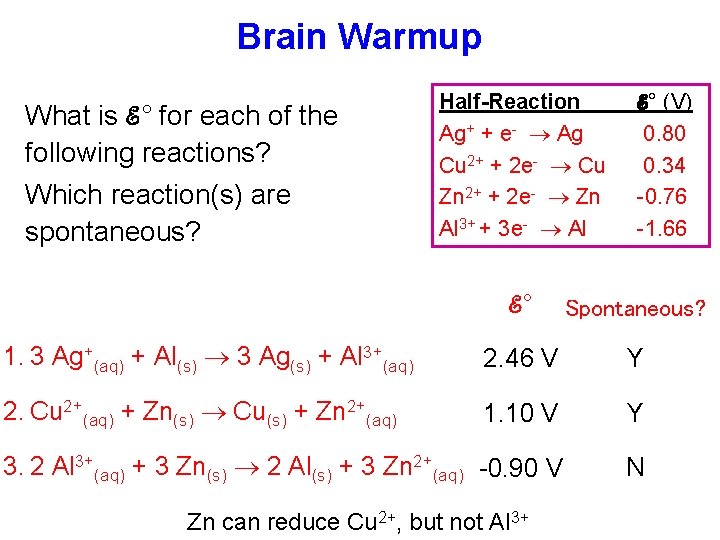
Brain Warmup What is ℰ° for each of the following reactions? Which reaction(s) are spontaneous? Half-Reaction Ag+ + e- Ag Cu 2+ + 2 e- Cu Zn 2+ + 2 e- Zn Al 3+ + 3 e- Al ℰ° (V) 0. 80 0. 34 -0. 76 -1. 66 ℰ° Spontaneous? 1. 3 Ag+(aq) + Al(s) 3 Ag(s) + Al 3+(aq) 2. 46 V Y 2. Cu 2+(aq) + Zn(s) Cu(s) + Zn 2+(aq) 1. 10 V Y 3. 2 Al 3+(aq) + 3 Zn(s) 2 Al(s) + 3 Zn 2+(aq) -0. 90 V N Zn can reduce Cu 2+, but not Al 3+
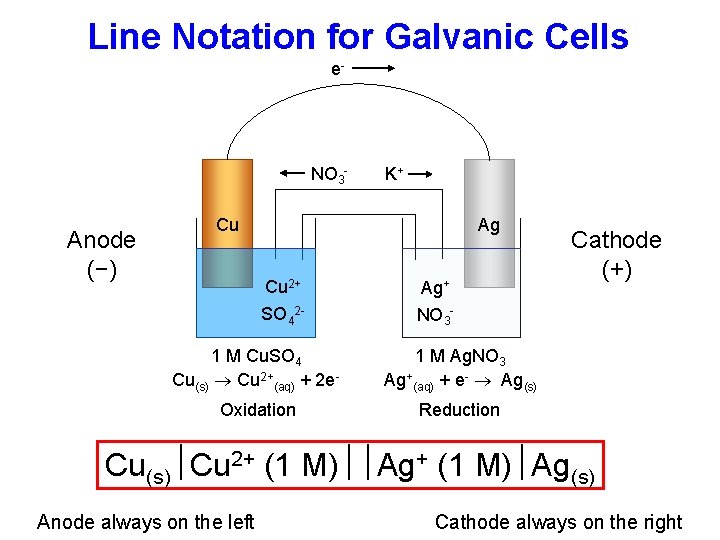
Line Notation for Galvanic Cells e- NO 3 - Anode (−) K+ Cu Ag Cu 2+ Ag+ SO 42 - NO 3 - 1 M Cu. SO 4 Cu(s) Cu 2+(aq) + 2 e- 1 M Ag. NO 3 Ag+(aq) + e- Ag(s) Oxidation Reduction Cathode (+) Cu(s) Cu 2+ (1 M) Ag(s) Anode always on the left Cathode always on the right
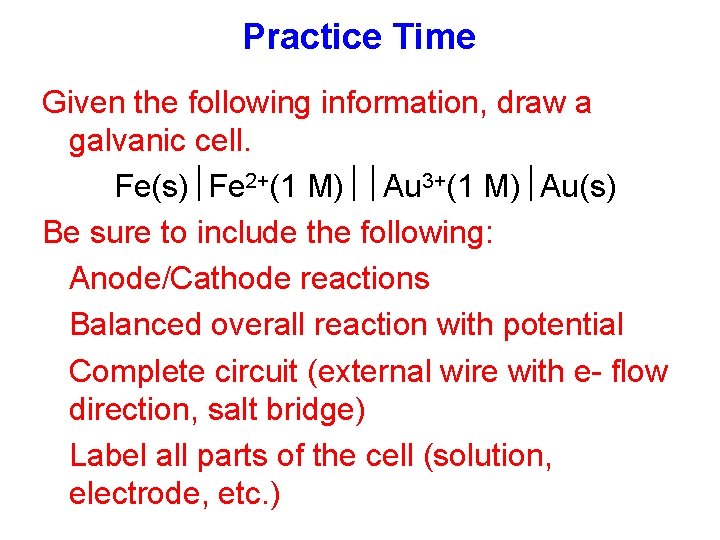
Practice Time Given the following information, draw a galvanic cell. Fe(s) Fe 2+(1 M) Au 3+(1 M) Au(s) Be sure to include the following: Anode/Cathode reactions Balanced overall reaction with potential Complete circuit (external wire with e- flow direction, salt bridge) Label all parts of the cell (solution, electrode, etc. )
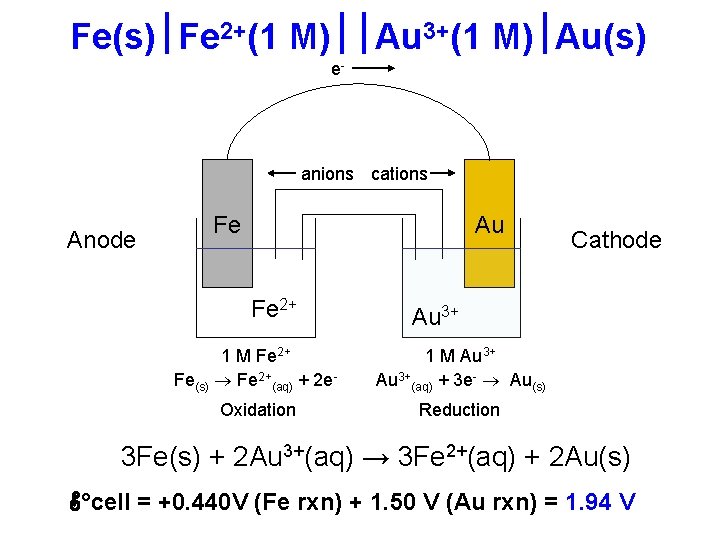
Fe(s) Fe 2+(1 M) Au 3+(1 M) Au(s) e- anions cations Anode Fe Au Fe 2+ Cathode Au 3+ 1 M Fe 2+ Fe(s) Fe 2+(aq) + 2 e- 1 M Au 3+(aq) + 3 e- Au(s) Oxidation Reduction 3 Fe(s) + 2 Au 3+(aq) → 3 Fe 2+(aq) + 2 Au(s) ℰ°cell = +0. 440 V (Fe rxn) + 1. 50 V (Au rxn) = 1. 94 V
Practice Time Given the following information, draw a galvanic cell. C(gr) Cr 2+(1 M), Cr 3+(1 M) Cl-(1 M) Cl 2(g) Pt(s) Be sure to include the following: Anode/Cathode reactions Balanced overall reaction with potential Complete circuit (external wire with e- flow direction, salt bridge) Label all parts of the cell (solution, electrode, etc. )
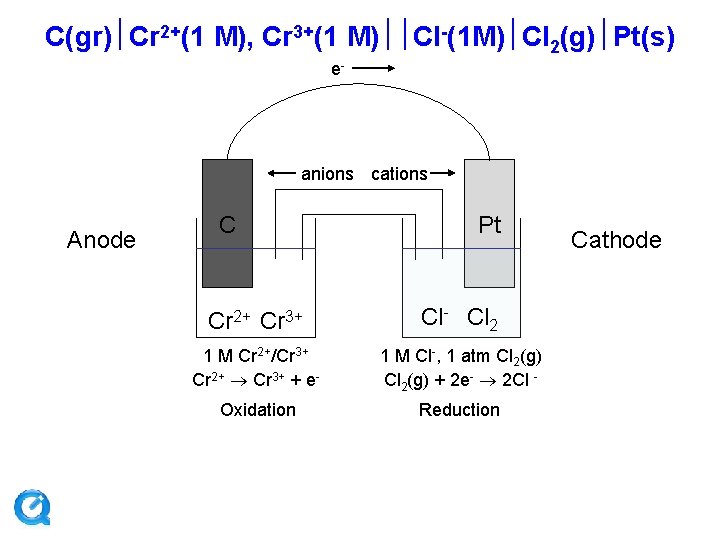
C(gr) Cr 2+(1 M), Cr 3+(1 M) Cl-(1 M) Cl 2(g) Pt(s) e- anions cations Anode C Pt Cr 2+ Cr 3+ Cl- Cl 2 1 M Cr 2+/Cr 3+ Cr 2+ Cr 3+ + e- 1 M Cl-, 1 atm Cl 2(g) + 2 e- 2 Cl - Oxidation Reduction Cathode
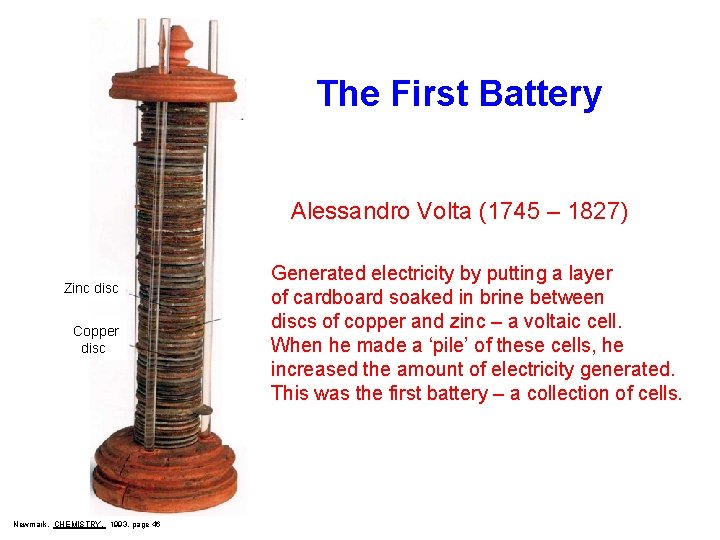
The First Battery Alessandro Volta (1745 – 1827) Zinc disc Copper disc Newmark, CHEMISTRY, 1993, page 46 Generated electricity by putting a layer of cardboard soaked in brine between discs of copper and zinc – a voltaic cell. When he made a ‘pile’ of these cells, he increased the amount of electricity generated. This was the first battery – a collection of cells.
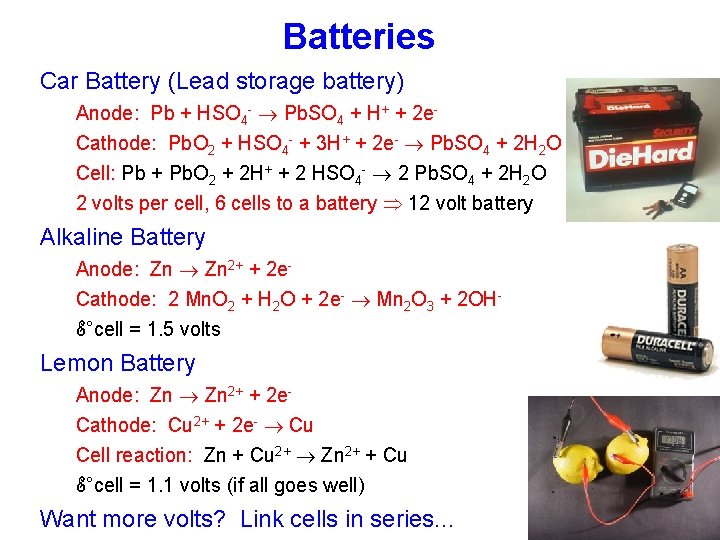
Batteries Car Battery (Lead storage battery) Anode: Pb + HSO 4 - Pb. SO 4 + H+ + 2 e. Cathode: Pb. O 2 + HSO 4 - + 3 H+ + 2 e- Pb. SO 4 + 2 H 2 O Cell: Pb + Pb. O 2 + 2 H+ + 2 HSO 4 - 2 Pb. SO 4 + 2 H 2 O 2 volts per cell, 6 cells to a battery 12 volt battery Alkaline Battery Anode: Zn 2+ + 2 e. Cathode: 2 Mn. O 2 + H 2 O + 2 e- Mn 2 O 3 + 2 OHℰ°cell = 1. 5 volts Lemon Battery Anode: Zn 2+ + 2 e. Cathode: Cu 2+ + 2 e- Cu Cell reaction: Zn + Cu 2+ Zn 2+ + Cu ℰ°cell = 1. 1 volts (if all goes well) Want more volts? Link cells in series. . .
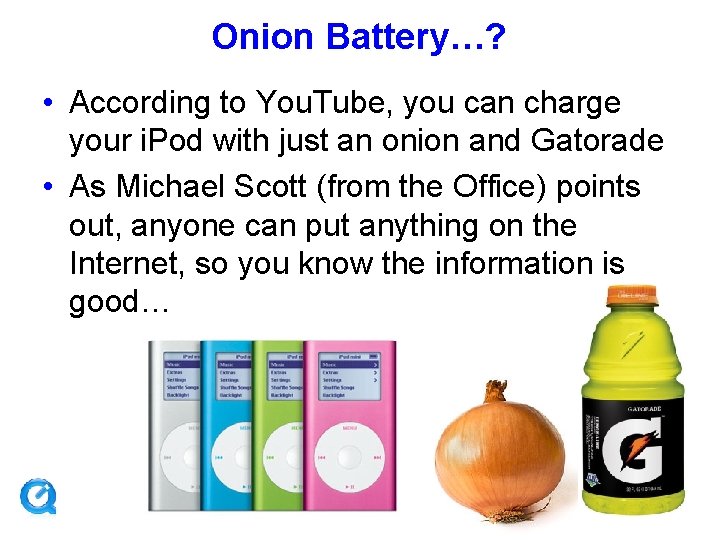
Onion Battery…? • According to You. Tube, you can charge your i. Pod with just an onion and Gatorade • As Michael Scott (from the Office) points out, anyone can put anything on the Internet, so you know the information is good…
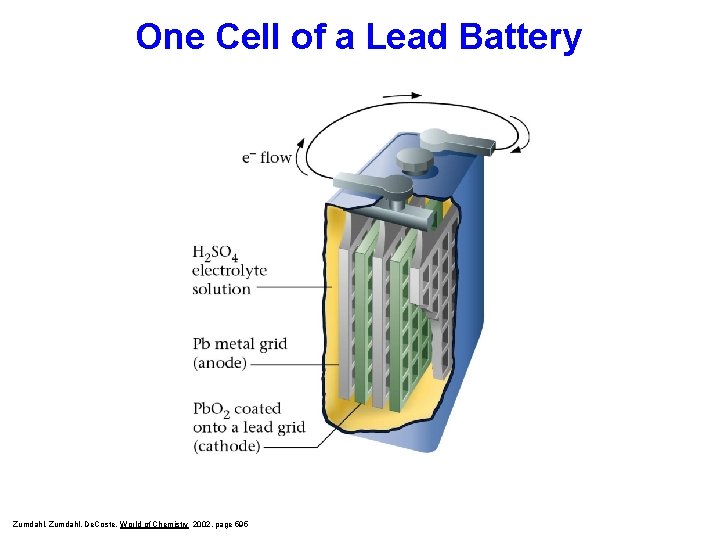
One Cell of a Lead Battery Zumdahl, De. Coste, World of Chemistry 2002, page 595
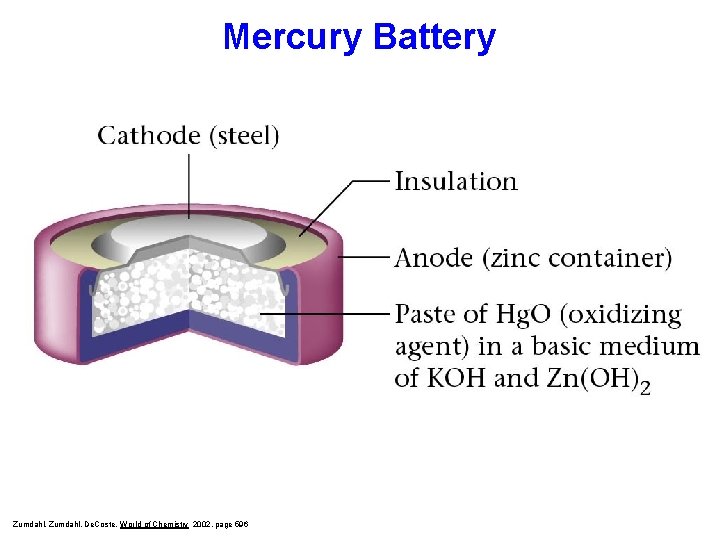
Mercury Battery Zumdahl, De. Coste, World of Chemistry 2002, page 596
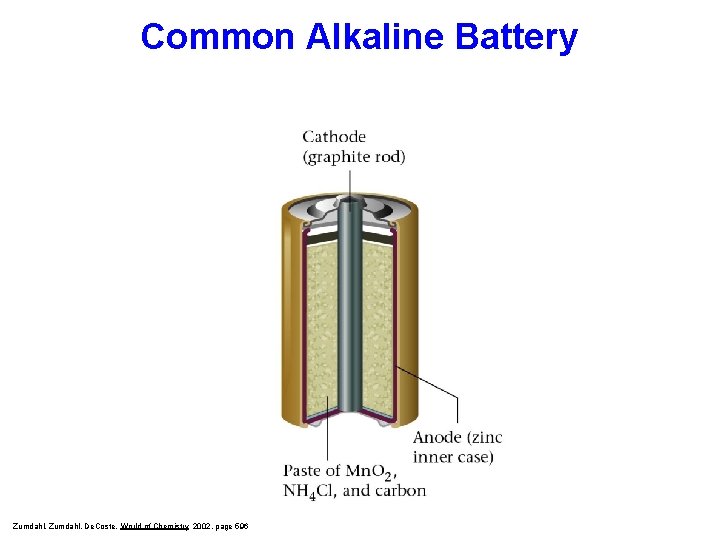
Common Alkaline Battery Zumdahl, De. Coste, World of Chemistry 2002, page 596
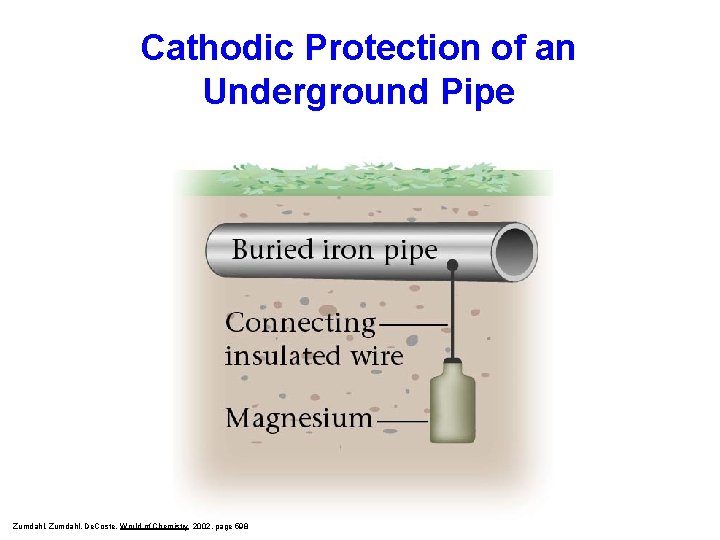
Cathodic Protection of an Underground Pipe Zumdahl, De. Coste, World of Chemistry 2002, page 598
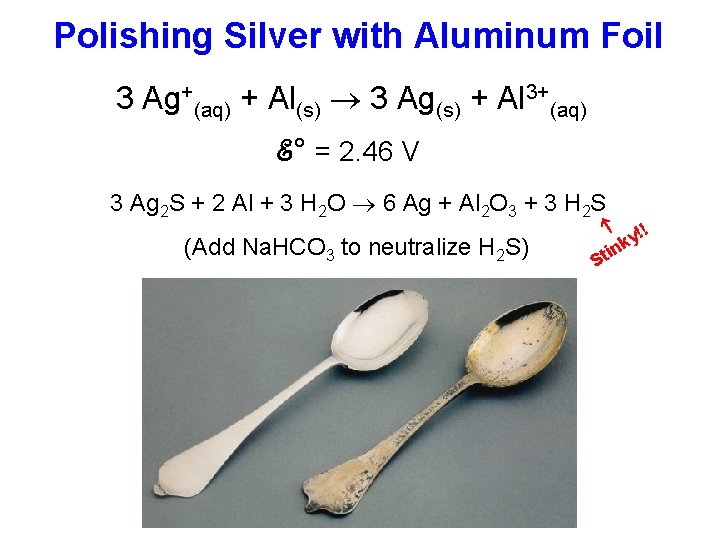
Polishing Silver with Aluminum Foil 3 Ag+(aq) + Al(s) 3 Ag(s) + Al 3+(aq) ℰ° = 2. 46 V 3 Ag 2 S + 2 Al + 3 H 2 O 6 Ag + Al 2 O 3 + 3 H 2 S (Add Na. HCO 3 to neutralize H 2 S) !! ky n i St
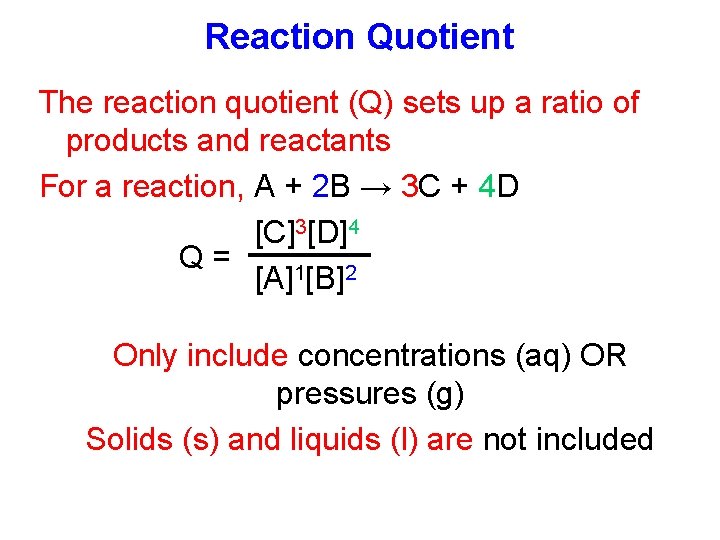
Reaction Quotient The reaction quotient (Q) sets up a ratio of products and reactants For a reaction, A + 2 B → 3 C + 4 D [C]3[D]4 Q= [A]1[B]2 Only include concentrations (aq) OR pressures (g) Solids (s) and liquids (l) are not included
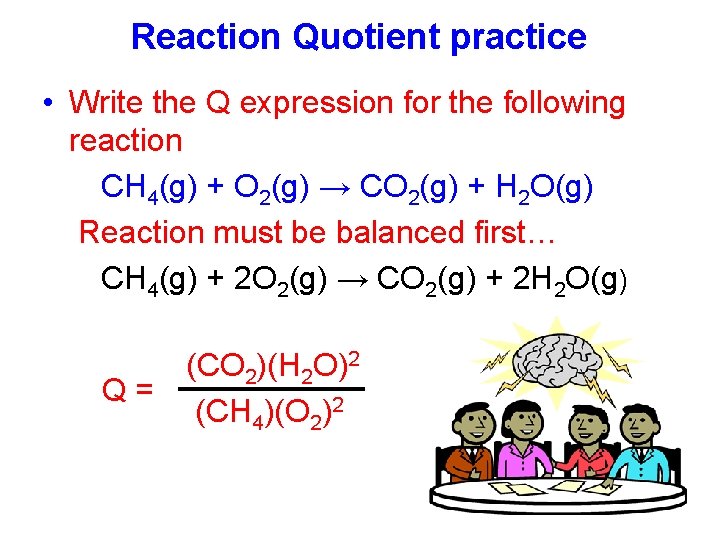
Reaction Quotient practice • Write the Q expression for the following reaction CH 4(g) + O 2(g) → CO 2(g) + H 2 O(g) Reaction must be balanced first… CH 4(g) + 2 O 2(g) → CO 2(g) + 2 H 2 O(g) (CO 2)(H 2 O)2 Q= (CH 4)(O 2)2
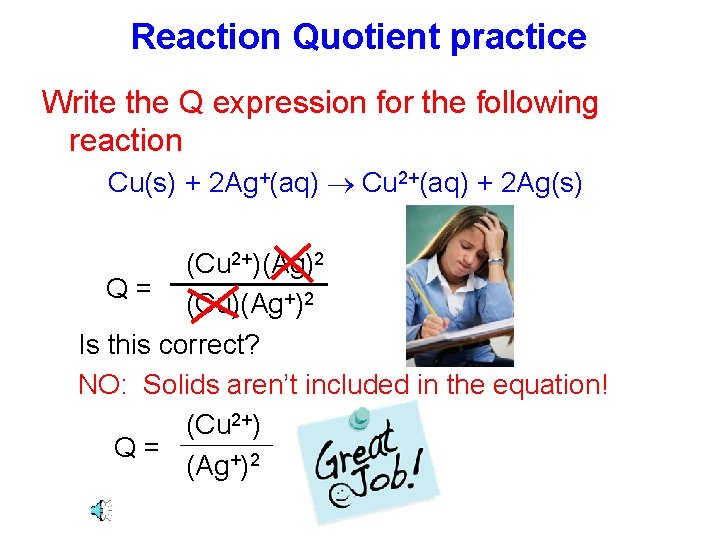
Reaction Quotient practice Write the Q expression for the following reaction Cu(s) + 2 Ag+(aq) Cu 2+(aq) + 2 Ag(s) (Cu 2+)(Ag)2 Q= (Cu)(Ag+)2 Is this correct? NO: Solids aren’t included in the equation! (Cu 2+) Q= (Ag+)2
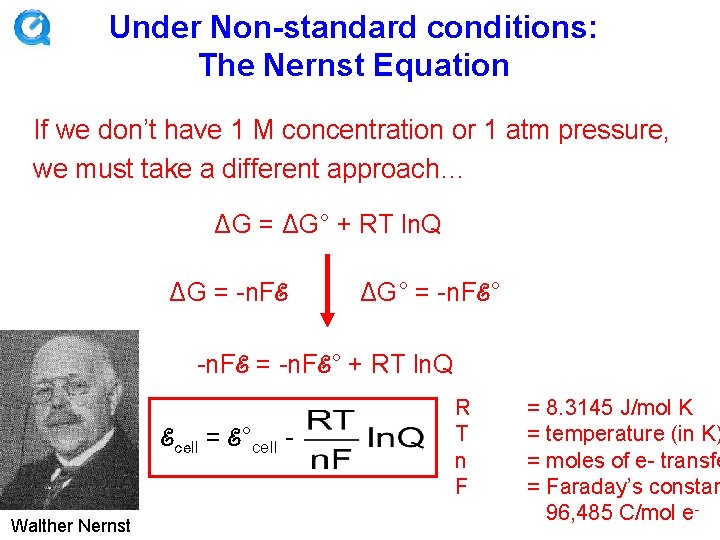
Under Non-standard conditions: The Nernst Equation If we don’t have 1 M concentration or 1 atm pressure, we must take a different approach… ΔG = ΔG° + RT ln. Q ΔG = -n. Fℰ ΔG° = -n. Fℰ° -n. Fℰ = -n. Fℰ° + RT ln. Q ℰcell = ℰ°cell Walther Nernst R T n F = 8. 3145 J/mol K = temperature (in K) = moles of e- transfe = Faraday’s constan 96, 485 C/mol e-
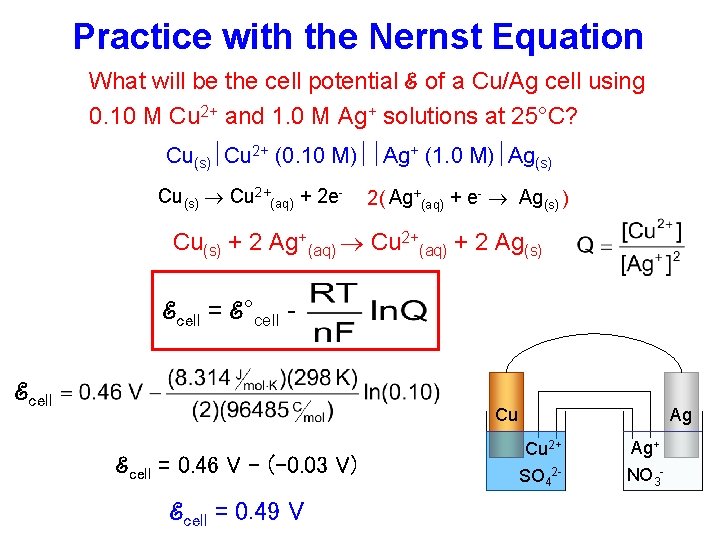
Practice with the Nernst Equation What will be the cell potential ℰ of a Cu/Ag cell using 0. 10 M Cu 2+ and 1. 0 M Ag+ solutions at 25°C? Cu(s) Cu 2+ (0. 10 M) Ag+ (1. 0 M) Ag(s) Cu(s) Cu 2+(aq) + 2 e- 2( Ag+(aq) + e- Ag(s) ) Cu(s) + 2 Ag+(aq) Cu 2+(aq) + 2 Ag(s) ℰcell = ℰ°cell ℰcell Cu ℰcell = 0. 46 V – (-0. 03 V) ℰcell = 0. 49 V Ag Cu 2+ Ag+ SO 42 - NO 3 -
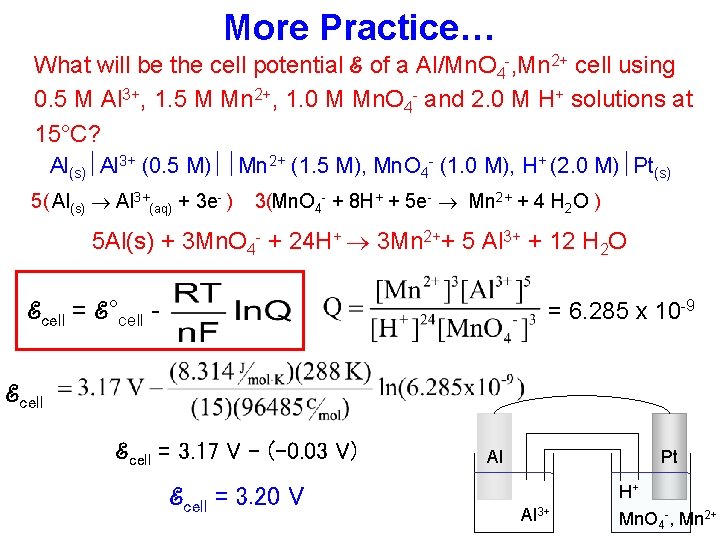
More Practice… What will be the cell potential ℰ of a Al/Mn. O 4 -, Mn 2+ cell using 0. 5 M Al 3+, 1. 5 M Mn 2+, 1. 0 M Mn. O 4 - and 2. 0 M H+ solutions at 15°C? Al(s) Al 3+ (0. 5 M) Mn 2+ (1. 5 M), Mn. O 4 - (1. 0 M), H+ (2. 0 M) Pt(s) 5( Al(s) Al 3+(aq) + 3 e- ) 3(Mn. O 4 - + 8 H+ + 5 e- Mn 2+ + 4 H 2 O ) 5 Al(s) + 3 Mn. O 4 - + 24 H+ 3 Mn 2++ 5 Al 3+ + 12 H 2 O ℰcell = ℰ°cell - = 6. 285 x 10 -9 ℰcell = 3. 17 V – (-0. 03 V) ℰcell = 3. 20 V Al Pt H+ Al 3+ Mn. O 4 -, Mn 2+
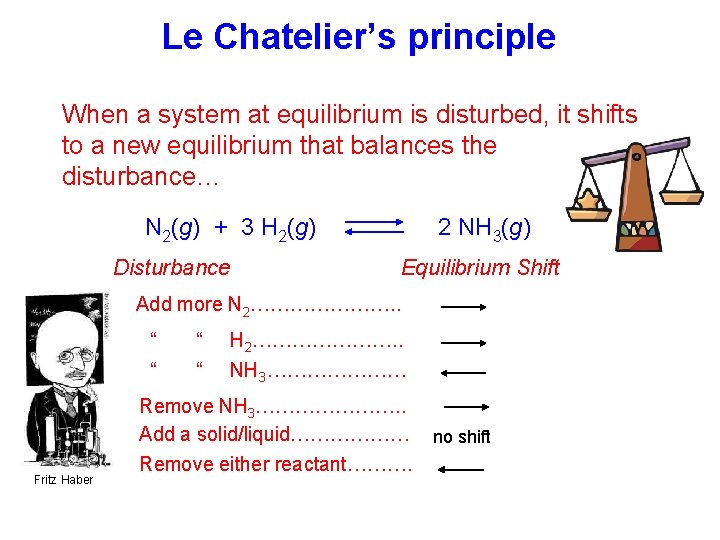
Le Chatelier’s principle When a system at equilibrium is disturbed, it shifts to a new equilibrium that balances the disturbance… N 2(g) + 3 H 2(g) Disturbance 2 NH 3(g) Equilibrium Shift Add more N 2…………………. . Fritz Haber “ “ H 2…………………. . “ “ NH 3………………… Remove NH 3…………………. . Add a solid/liquid……………… Remove either reactant………. no shift
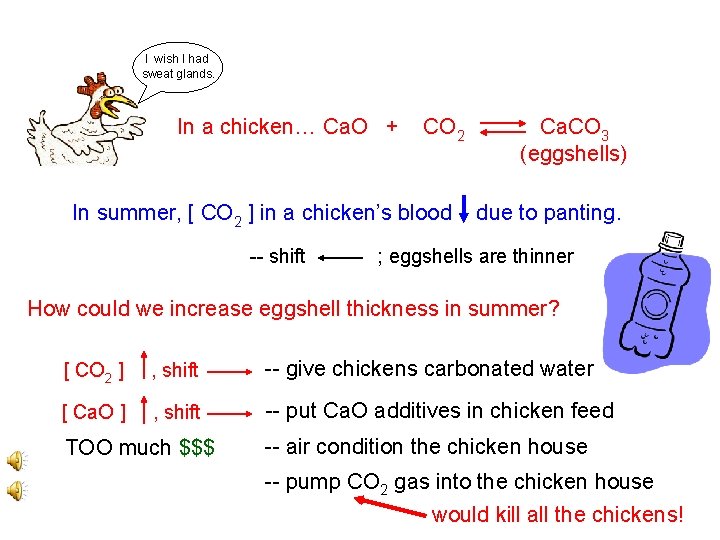
I wish I had sweat glands. In a chicken… Ca. O + CO 2 In summer, [ CO 2 ] in a chicken’s blood -- shift Ca. CO 3 (eggshells) due to panting. ; eggshells are thinner How could we increase eggshell thickness in summer? [ CO 2 ] , shift -- give chickens carbonated water [ Ca. O ] , shift -- put Ca. O additives in chicken feed TOO much $$$ -- air condition the chicken house -- pump CO 2 gas into the chicken house would kill all the chickens!
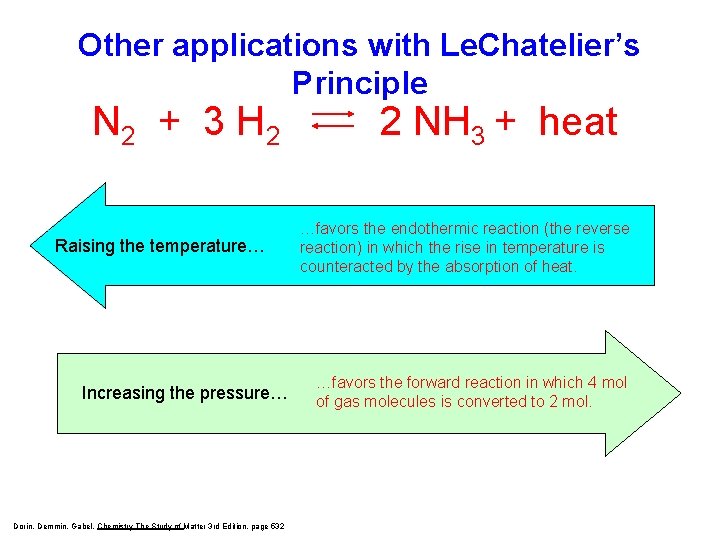
Other applications with Le. Chatelier’s Principle N 2 + 3 H 2 Raising the temperature… Increasing the pressure… Dorin, Demmin, Gabel, Chemistry The Study of Matter 3 rd Edition, page 532 2 NH 3 + heat …favors the endothermic reaction (the reverse reaction) in which the rise in temperature is counteracted by the absorption of heat. …favors the forward reaction in which 4 mol of gas molecules is converted to 2 mol.
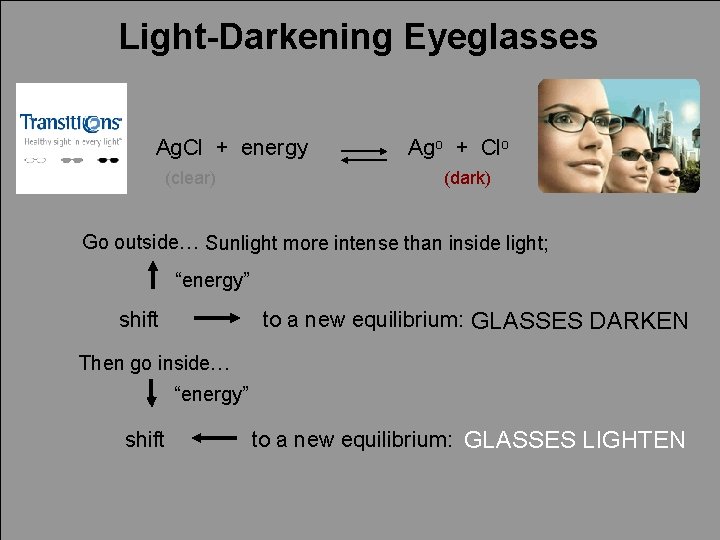
Light-Darkening Eyeglasses Ag. Cl + energy (clear) Ago + Clo (dark) Go outside… Sunlight more intense than inside light; “energy” shift to a new equilibrium: GLASSES DARKEN Then go inside… “energy” shift to a new equilibrium: GLASSES LIGHTEN
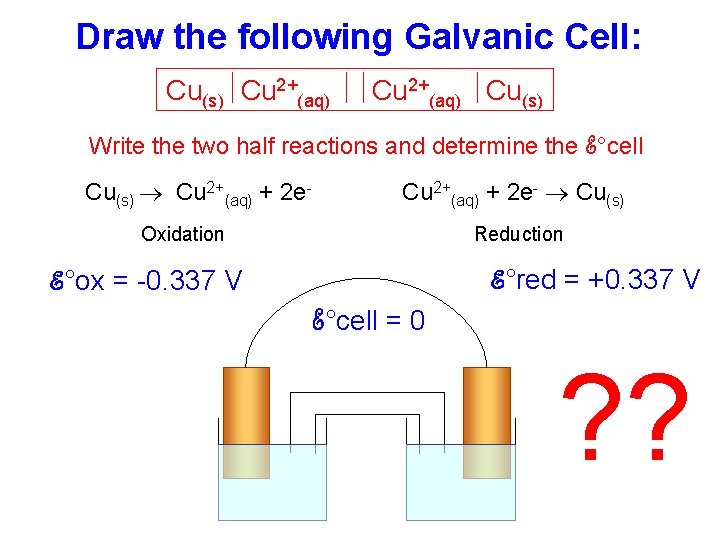
Draw the following Galvanic Cell: Cu(s) Cu 2+(aq) Cu(s) Write the two half reactions and determine the ℰ°cell Cu(s) Cu 2+(aq) + 2 e- Cu(s) Reduction Oxidation ℰ°red = +0. 337 V ℰ°ox = -0. 337 V ℰ°cell = 0 ? ?
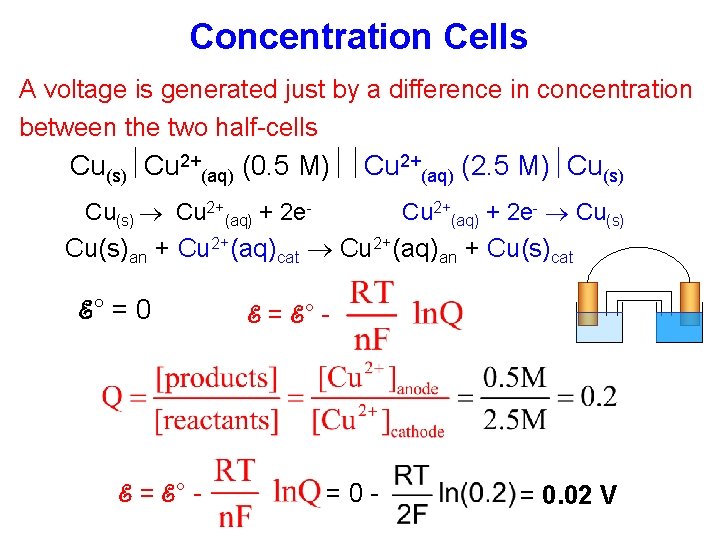
Concentration Cells A voltage is generated just by a difference in concentration between the two half-cells Cu(s) Cu 2+(aq) (0. 5 M) Cu 2+(aq) (2. 5 M) Cu(s) Cu 2+(aq) + 2 e- Cu(s)an + Cu 2+(aq)cat Cu 2+(aq)an + Cu(s)cat ℰ° = 0 ℰ = ℰ° - =0 - = 0. 02 V
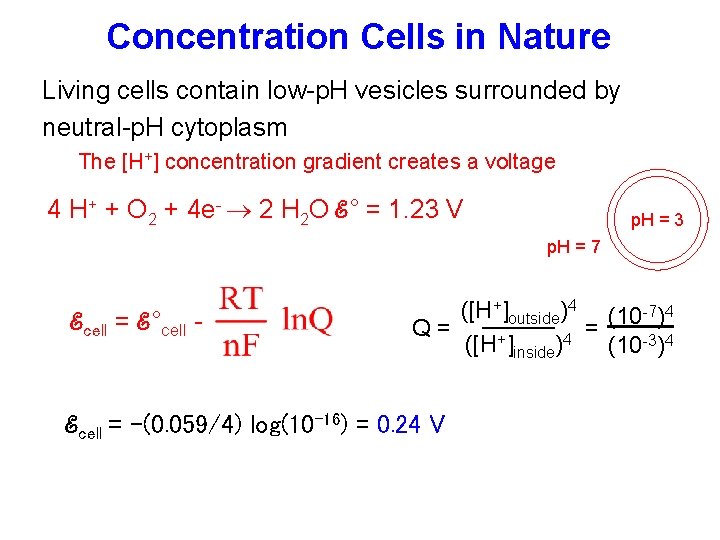
Concentration Cells in Nature Living cells contain low-p. H vesicles surrounded by neutral-p. H cytoplasm The [H+] concentration gradient creates a voltage 4 H+ + O 2 + 4 e- 2 H 2 O ℰ° = 1. 23 V p. H = 3 p. H = 7 ℰcell = ℰ°cell - ([H+]outside)4 (10 -7)4 Q= = ([H+]inside)4 (10 -3)4 ℰcell = -(0. 059/4) log(10 -16) = 0. 24 V
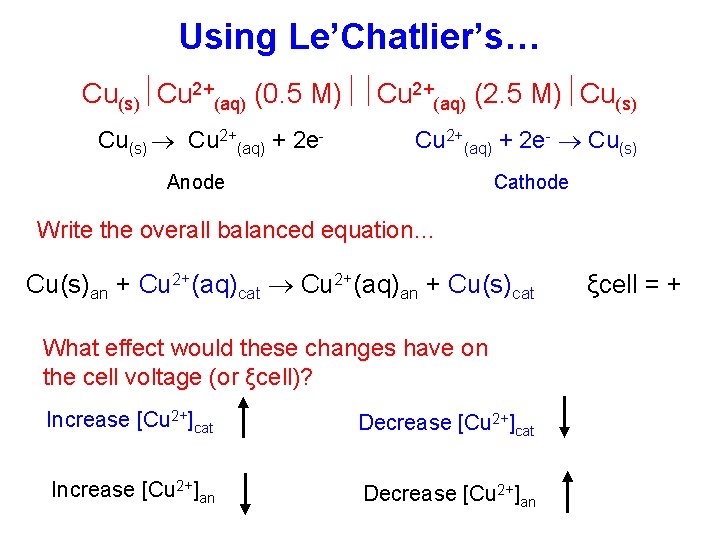
Using Le’Chatlier’s… Cu(s) Cu 2+(aq) (0. 5 M) Cu 2+(aq) (2. 5 M) Cu(s) Cu 2+(aq) + 2 e- Cu(s) Cathode Anode Write the overall balanced equation… Cu(s)an + Cu 2+(aq)cat Cu 2+(aq)an + Cu(s)cat What effect would these changes have on the cell voltage (or ξcell)? Increase [Cu 2+]cat Decrease [Cu 2+]cat Increase [Cu 2+]an Decrease [Cu 2+]an ξcell = +
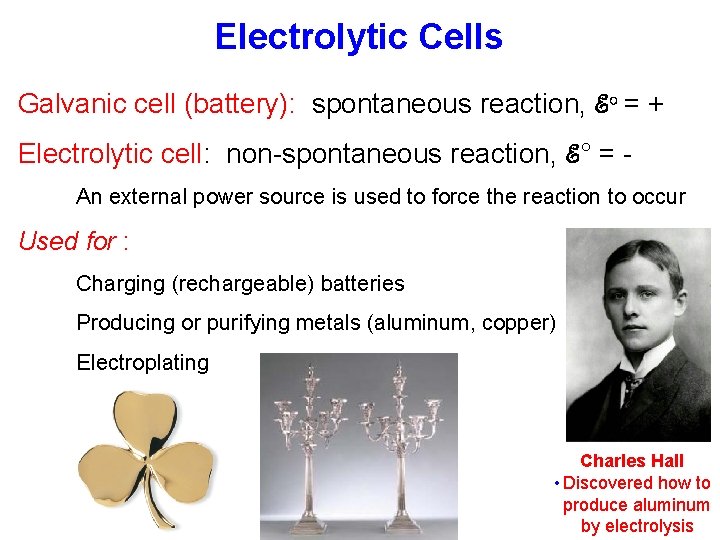
Electrolytic Cells Galvanic cell (battery): spontaneous reaction, ℰo = + Electrolytic cell: non-spontaneous reaction, ℰ° = An external power source is used to force the reaction to occur Used for : Charging (rechargeable) batteries Producing or purifying metals (aluminum, copper) Electroplating Charles Hall • Discovered how to produce aluminum by electrolysis
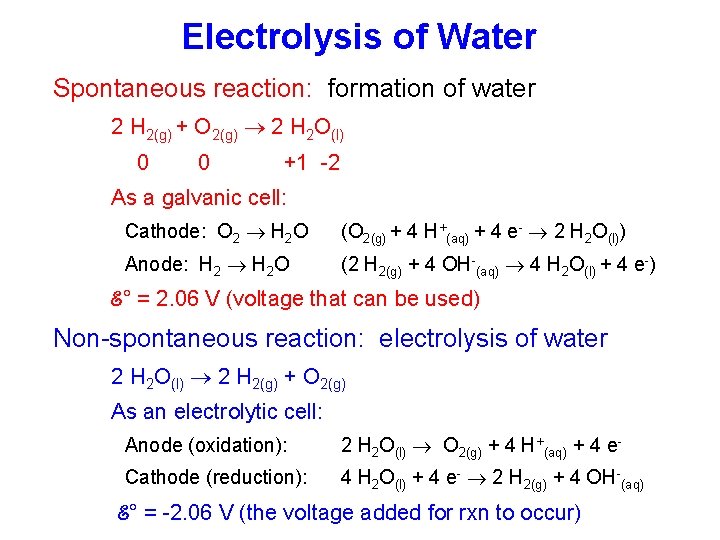
Electrolysis of Water Spontaneous reaction: formation of water 2 H 2(g) + O 2(g) 2 H 2 O(l) 0 0 +1 -2 As a galvanic cell: Cathode: O 2 H 2 O (O 2(g) + 4 H+(aq) + 4 e- 2 H 2 O(l)) Anode: H 2 O (2 H 2(g) + 4 OH-(aq) 4 H 2 O(l) + 4 e-) ℰ° = 2. 06 V (voltage that can be used) Non-spontaneous reaction: electrolysis of water 2 H 2 O(l) 2 H 2(g) + O 2(g) As an electrolytic cell: Anode (oxidation): 2 H 2 O(l) O 2(g) + 4 H+(aq) + 4 e- Cathode (reduction): 4 H 2 O(l) + 4 e- 2 H 2(g) + 4 OH-(aq) ℰ° = -2. 06 V (the voltage added for rxn to occur)

Electrolysis of Water 2 H 2 O(l) 2 H 2(g) + O 2(g) ℰ° = -2. 06 V e- → − + ← e- Pt electrodes Battery > 2. 06 V Anode (oxidation): 2 H 2 O O 2 + 4 H + + 4 e Produces: 1 mol O 2 gas Acid (H+) Cathode (reduction): 4 H 2 O + 4 e- 2 H 2 + 4 OHProduces: 2 mol H 2 gas Base (OH-)
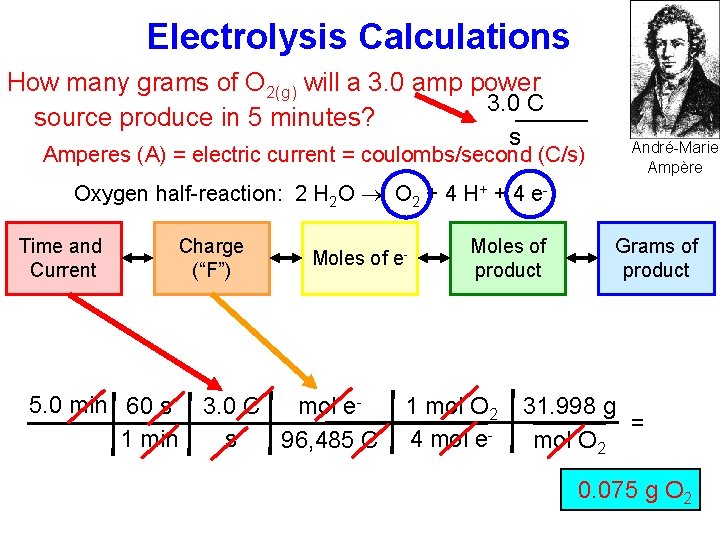
Electrolysis Calculations How many grams of O 2(g) will a 3. 0 amp power 3. 0 C source produce in 5 minutes? s Amperes (A) = electric current = coulombs/second (C/s) André-Marie Ampère Oxygen half-reaction: 2 H 2 O O 2 + 4 H+ + 4 e. Time and Current 5. 0 min 60 s 1 min Charge (“F”) Moles of e- 3. 0 C mol es 96, 485 C Moles of product 1 mol O 2 4 mol e- Grams of product 31. 998 g = mol O 2 0. 075 g O 2
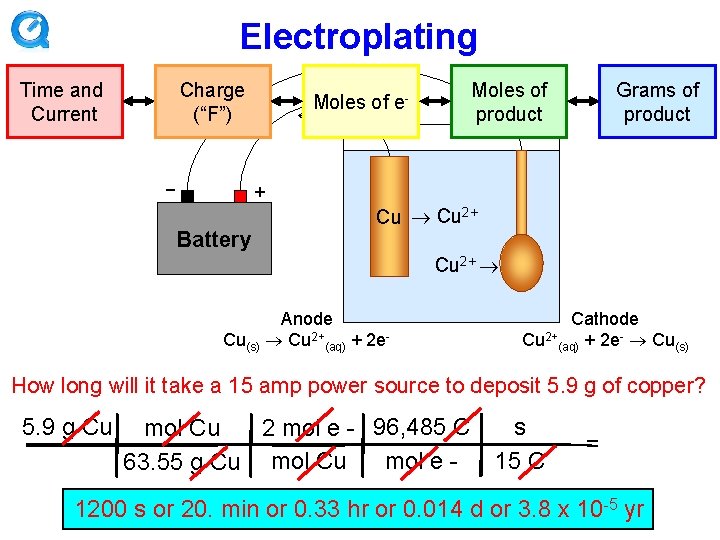
Electroplating Time and Current e- → Charge (“F”) − Moles of product Moles of e - ←e Grams of product + Battery Cu 2+ Anode Cu(s) Cu 2+(aq) + 2 e- Cathode Cu 2+(aq) + 2 e- Cu(s) How long will it take a 15 amp power source to deposit 5. 9 g of copper? 5. 9 g Cu 2 mol e - 96, 485 C mol Cu mol e 63. 55 g Cu mol Cu s 15 C = 1200 s or 20. min or 0. 33 hr or 0. 014 d or 3. 8 x 10 -5 yr
Electric Vehicle Charging Stations Bloomington-Normal, IL (as of 5/8/12) Level II charger = full charge 6 -8 hrs Level III = 80% charge 25 min Free of charge (so far…) First hour parking free • City Hall Annex (6 units) • Fire HQ (1 unit) • Public Works (1 unit) • Marriott Deck (2 units) • College Ave. Parking Deck (3 units) • Heartland C. C. (2 units) Mitsubishi commerical • ISU (2 units) • City of Bloomington (2 units…Lincoln Deck) • IWU (2 units) • CIRA (2 units) • Commerce Bank (1 unit) • Constitution Trail Center (2 units) • Holiday Inn Express (1 unit) • Advocate Bro. Menn (3 units) The New Normal
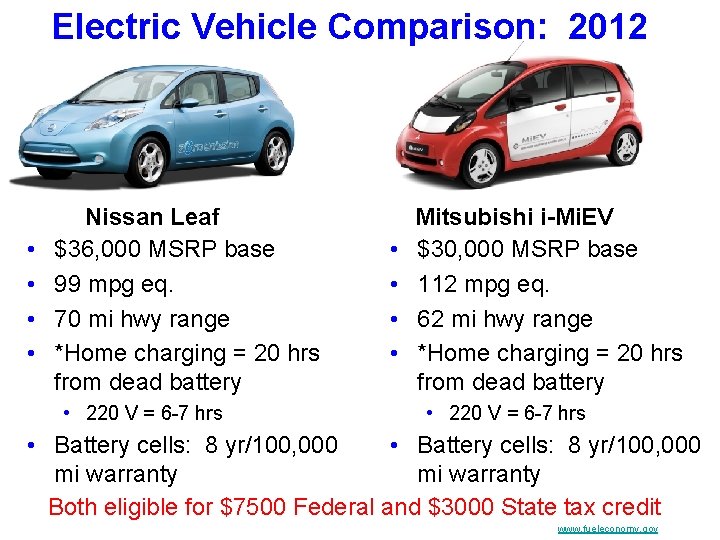
Electric Vehicle Comparison: 2012 • • Nissan Leaf $36, 000 MSRP base 99 mpg eq. 70 mi hwy range *Home charging = 20 hrs from dead battery • 220 V = 6 -7 hrs • • Mitsubishi i-Mi. EV $30, 000 MSRP base 112 mpg eq. 62 mi hwy range *Home charging = 20 hrs from dead battery • 220 V = 6 -7 hrs • Battery cells: 8 yr/100, 000 mi warranty Both eligible for $7500 Federal and $3000 State tax credit www. fueleconomy. gov
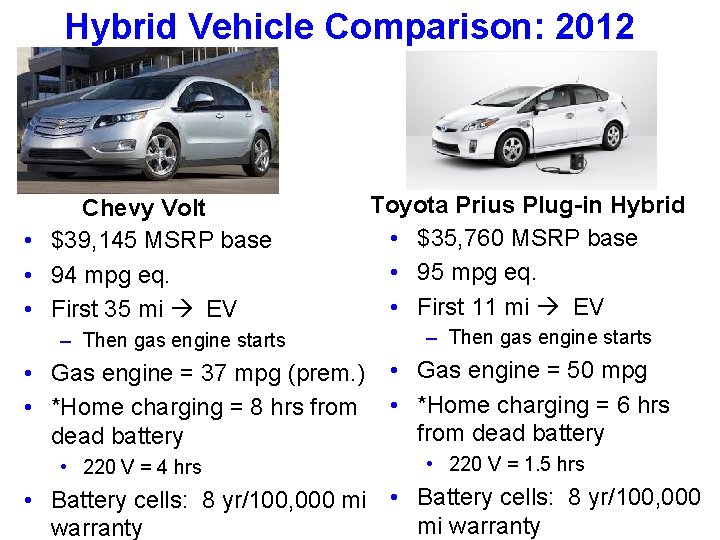
Hybrid Vehicle Comparison: 2012 Chevy Volt • $39, 145 MSRP base • 94 mpg eq. • First 35 mi EV – Then gas engine starts • Gas engine = 37 mpg (prem. ) • *Home charging = 8 hrs from dead battery • 220 V = 4 hrs Toyota Prius Plug-in Hybrid • $35, 760 MSRP base • 95 mpg eq. • First 11 mi EV – Then gas engine starts • Gas engine = 50 mpg • *Home charging = 6 hrs from dead battery • 220 V = 1. 5 hrs • Battery cells: 8 yr/100, 000 mi warranty
- Slides: 62