
Electrochemistry Remember Anode electrode in the halfcell where
Electrochemistry

Remember… �Anode: electrode in the half-cell where oxidation takes place �Metal electrode atoms are oxidized and become aqueous ions �Anions must flow from the salt bridge into this half cell to balance out the addition of new metal ions
Remember… �Cathode: electrode in the half-cell where reduction takes place �Metal ions become neutral atoms �Cations must flow from the salt bridge into this half cell to balance loss of metal ions
Remember… �Electrons flow through the wire from the anode towards the cathode �Anions flow from the salt bridge into the anode half-cell �Cations flow from the salt bridge into the cathode half-cell
Remember… �The flow of electrons through the wire is referred to as “current” �Electric current is measured in amperes (or “amps”) �If either the wire or salt bridge are removed, current ceases to flow
A few terms… �Potential = the force exerted on the electrons in a wire or other conductor causing them to flow �Measured as “volts”; often referred to as “voltage”
A few terms… �Reduction potential: ◦ The potential for a half cell to undergo reduction ◦ Metal ions become neutral metal atoms ◦ Measured in “volts”
A few terms… �When two half-cells are connected by a wire and salt bridge, the half-cell with the greater reduction potential gets reduced �The other half-cell gets oxidized
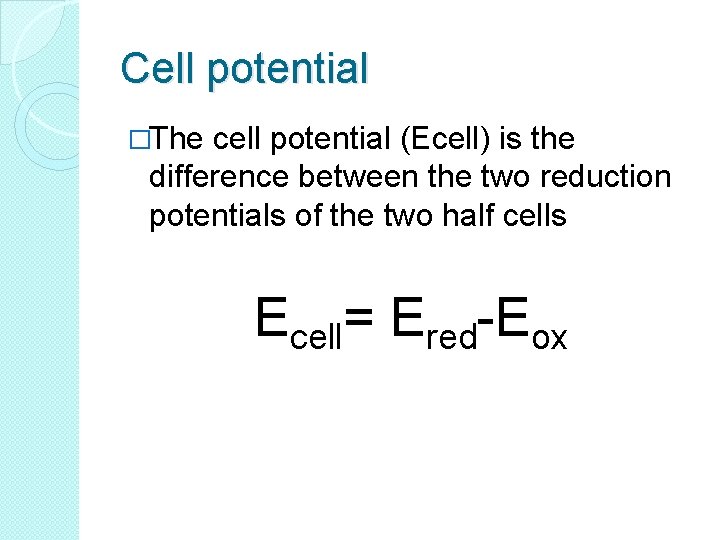
Cell potential �The cell potential (Ecell) is the difference between the two reduction potentials of the two half cells Ecell= Ered-Eox
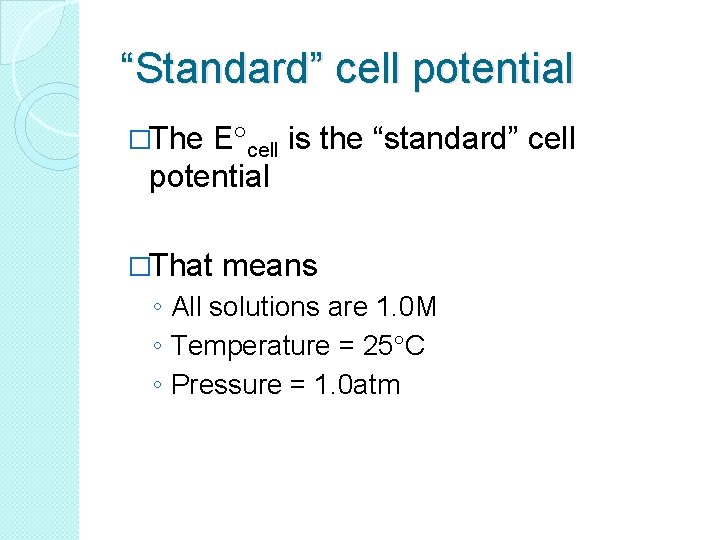
“Standard” cell potential �The E cell is the “standard” cell potential �That means ◦ All solutions are 1. 0 M ◦ Temperature = 25 C ◦ Pressure = 1. 0 atm
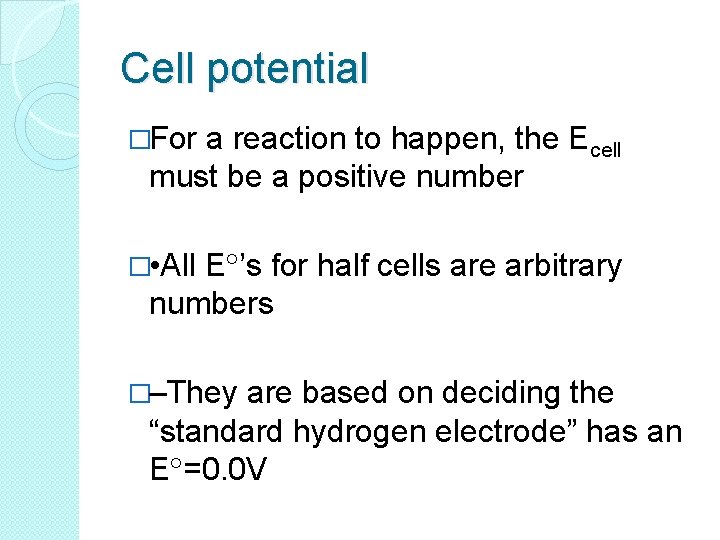
Cell potential �For a reaction to happen, the Ecell must be a positive number � • All E ’s for half cells are arbitrary numbers �–They are based on deciding the “standard hydrogen electrode” has an E =0. 0 V
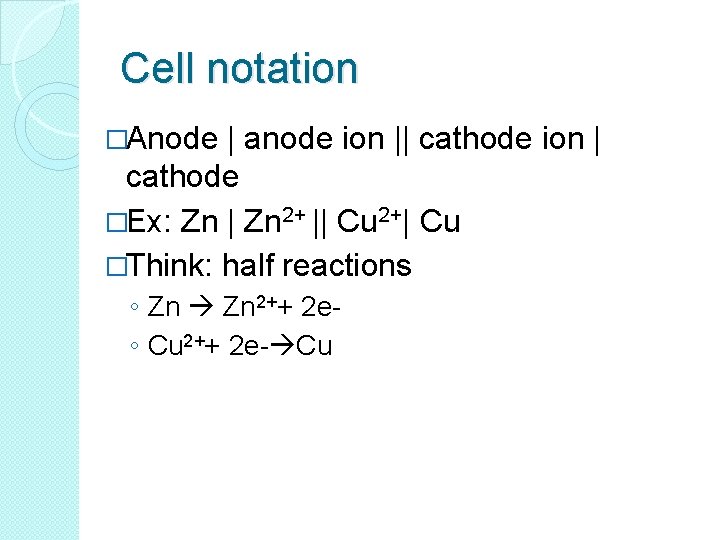
Cell notation �Anode | anode ion || cathode ion | cathode �Ex: Zn | Zn 2+ || Cu 2+| Cu �Think: half reactions ◦ Zn 2++ 2 e◦ Cu 2++ 2 e- Cu
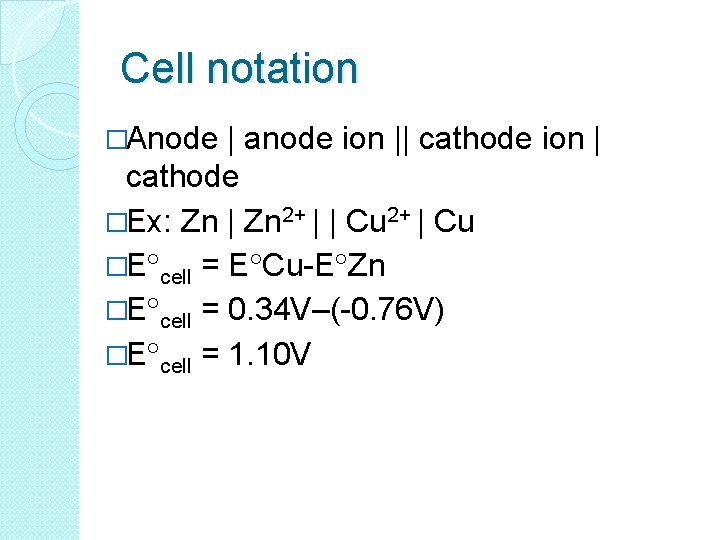
Cell notation �Anode | anode ion || cathode ion | cathode �Ex: Zn | Zn 2+ | | Cu 2+ | Cu �E cell = E Cu-E Zn �E cell = 0. 34 V–(-0. 76 V) �E cell = 1. 10 V
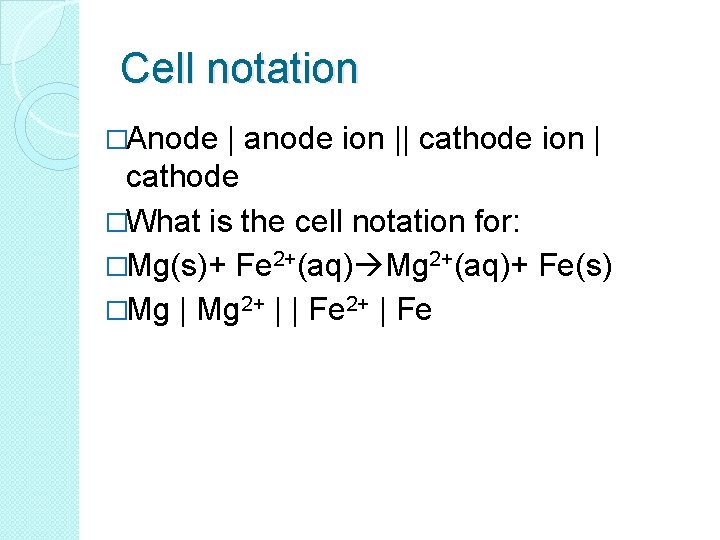
Cell notation �Anode | anode ion || cathode ion | cathode �What is the cell notation for: �Mg(s)+ Fe 2+(aq) Mg 2+(aq)+ Fe(s) �Mg | Mg 2+ | | Fe 2+ | Fe
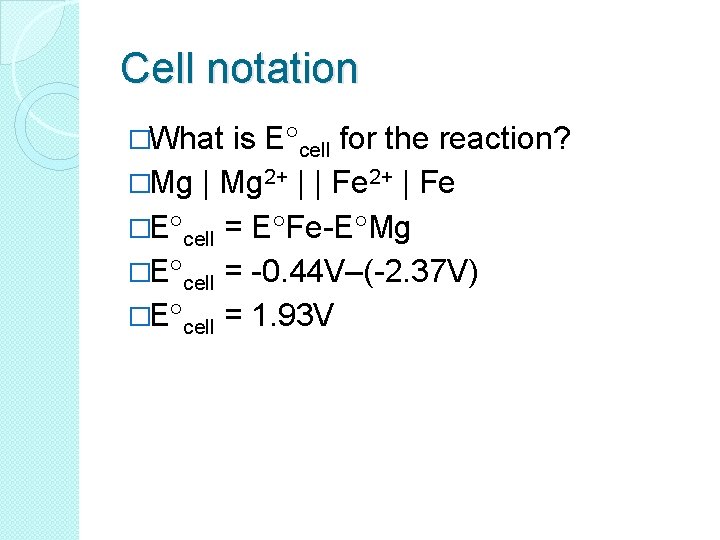
Cell notation �What is E cell for the reaction? �Mg | Mg 2+ | | Fe 2+ | Fe �E cell = E Fe-E Mg �E cell = -0. 44 V–(-2. 37 V) �E cell = 1. 93 V
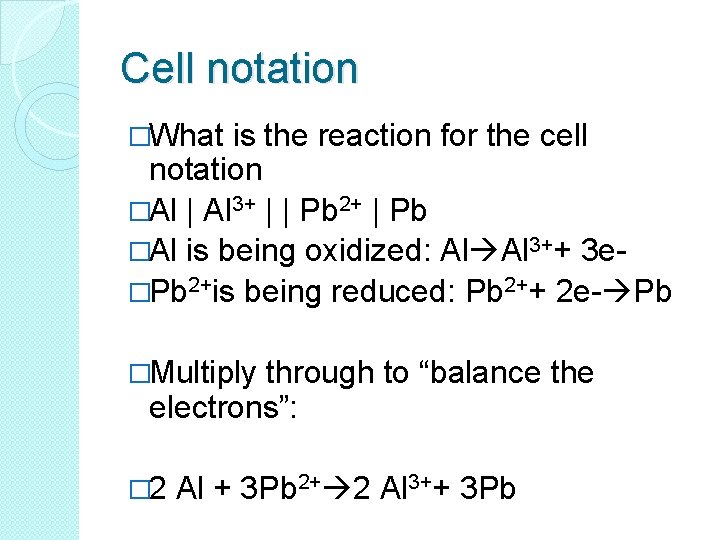
Cell notation �What is the reaction for the cell notation �Al | Al 3+ | | Pb 2+ | Pb �Al is being oxidized: Al Al 3++ 3 e�Pb 2+is being reduced: Pb 2++ 2 e- Pb �Multiply through to “balance the electrons”: � 2 Al + 3 Pb 2+ 2 Al 3++ 3 Pb
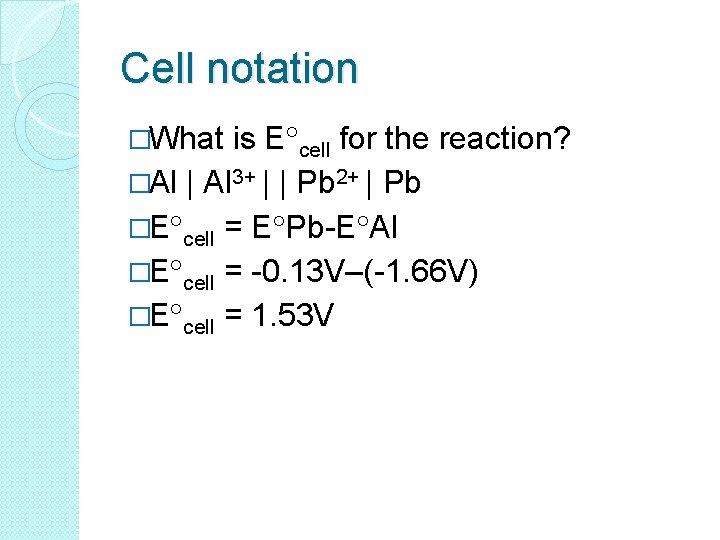
Cell notation �What is E cell for the reaction? �Al | Al 3+ | | Pb 2+ | Pb �E cell = E Pb-E Al �E cell = -0. 13 V–(-1. 66 V) �E cell = 1. 53 V
- Slides: 17