
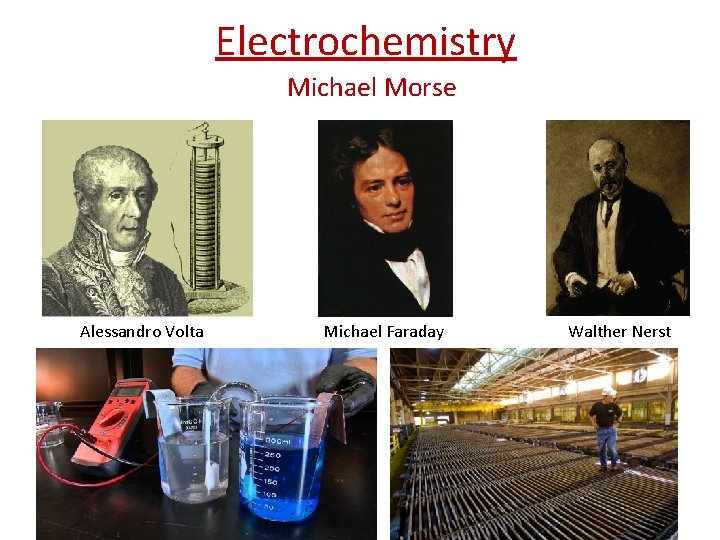
Electrochemistry Michael Morse Alessandro Volta Michael Faraday Walther

- Slides: 27
Electrochemistry Michael Morse Alessandro Volta Michael Faraday Walther Nerst
Electrochemistry Using electrical potentials and currents as a way to affect chemistry Using chemistry to generate electrical potentials and currents Using electrical potentials and currents as a way to study chemical phenomena In all of these uses, the key is to control or use oxidation-reduction chemistry by either supplying the electrons through wires, or getting the chemistry to deliver the electrons through wires.
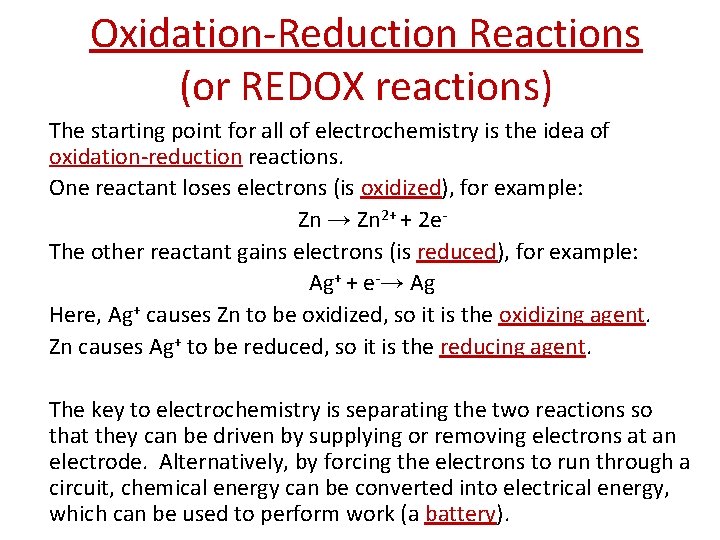
Oxidation-Reduction Reactions (or REDOX reactions) The starting point for all of electrochemistry is the idea of oxidation-reduction reactions. One reactant loses electrons (is oxidized), for example: Zn → Zn 2+ + 2 e. The other reactant gains electrons (is reduced), for example: Ag+ + e-→ Ag Here, Ag+ causes Zn to be oxidized, so it is the oxidizing agent. Zn causes Ag+ to be reduced, so it is the reducing agent. The key to electrochemistry is separating the two reactions so that they can be driven by supplying or removing electrons at an electrode. Alternatively, by forcing the electrons to run through a circuit, chemical energy can be converted into electrical energy, which can be used to perform work (a battery).
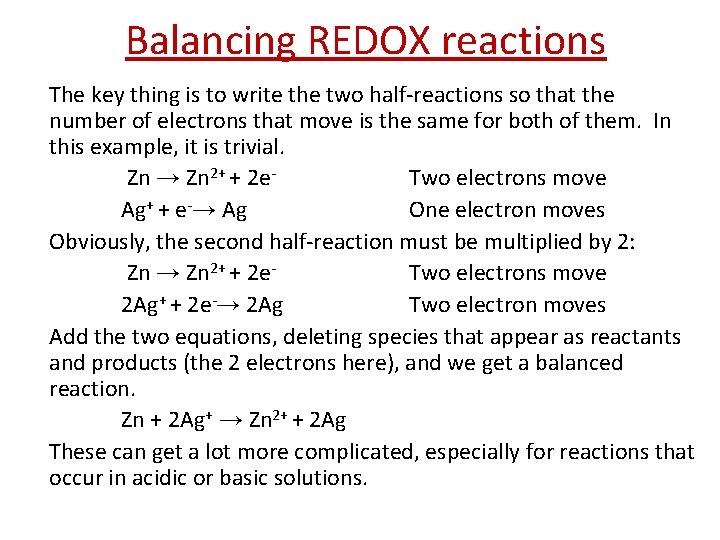
Balancing REDOX reactions The key thing is to write the two half-reactions so that the number of electrons that move is the same for both of them. In this example, it is trivial. Zn → Zn 2+ + 2 e. Two electrons move Ag+ + e-→ Ag One electron moves Obviously, the second half-reaction must be multiplied by 2: Zn → Zn 2+ + 2 e. Two electrons move 2 Ag+ + 2 e-→ 2 Ag Two electron moves Add the two equations, deleting species that appear as reactants and products (the 2 electrons here), and we get a balanced reaction. Zn + 2 Ag+ → Zn 2+ + 2 Ag These can get a lot more complicated, especially for reactions that occur in acidic or basic solutions.
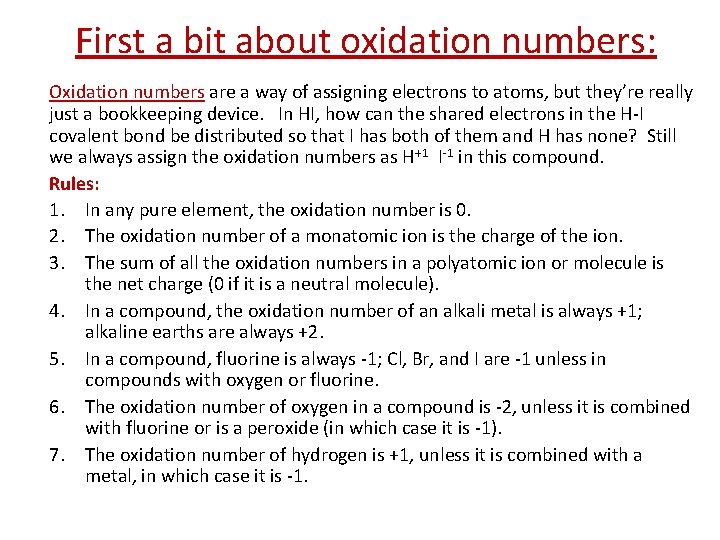
First a bit about oxidation numbers: Oxidation numbers are a way of assigning electrons to atoms, but they’re really just a bookkeeping device. In HI, how can the shared electrons in the H-I covalent bond be distributed so that I has both of them and H has none? Still we always assign the oxidation numbers as H+1 I-1 in this compound. Rules: 1. In any pure element, the oxidation number is 0. 2. The oxidation number of a monatomic ion is the charge of the ion. 3. The sum of all the oxidation numbers in a polyatomic ion or molecule is the net charge (0 if it is a neutral molecule). 4. In a compound, the oxidation number of an alkali metal is always +1; alkaline earths are always +2. 5. In a compound, fluorine is always -1; Cl, Br, and I are -1 unless in compounds with oxygen or fluorine. 6. The oxidation number of oxygen in a compound is -2, unless it is combined with fluorine or is a peroxide (in which case it is -1). 7. The oxidation number of hydrogen is +1, unless it is combined with a metal, in which case it is -1.
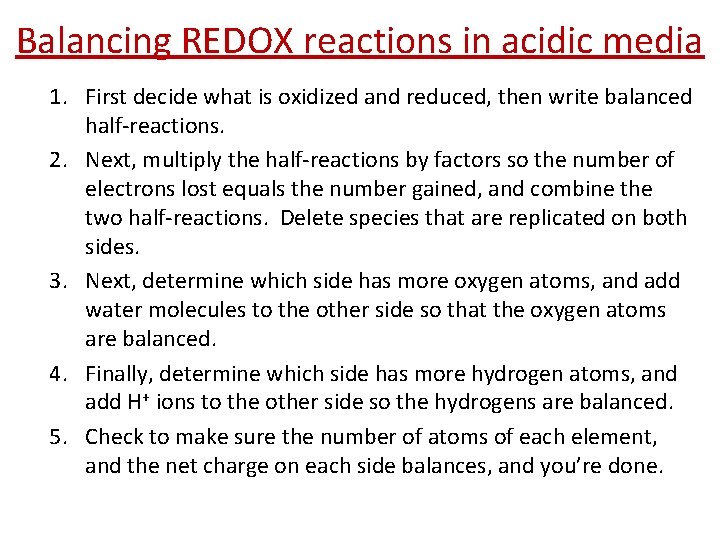
Balancing REDOX reactions in acidic media 1. First decide what is oxidized and reduced, then write balanced half-reactions. 2. Next, multiply the half-reactions by factors so the number of electrons lost equals the number gained, and combine the two half-reactions. Delete species that are replicated on both sides. 3. Next, determine which side has more oxygen atoms, and add water molecules to the other side so that the oxygen atoms are balanced. 4. Finally, determine which side has more hydrogen atoms, and add H+ ions to the other side so the hydrogens are balanced. 5. Check to make sure the number of atoms of each element, and the net charge on each side balances, and you’re done.
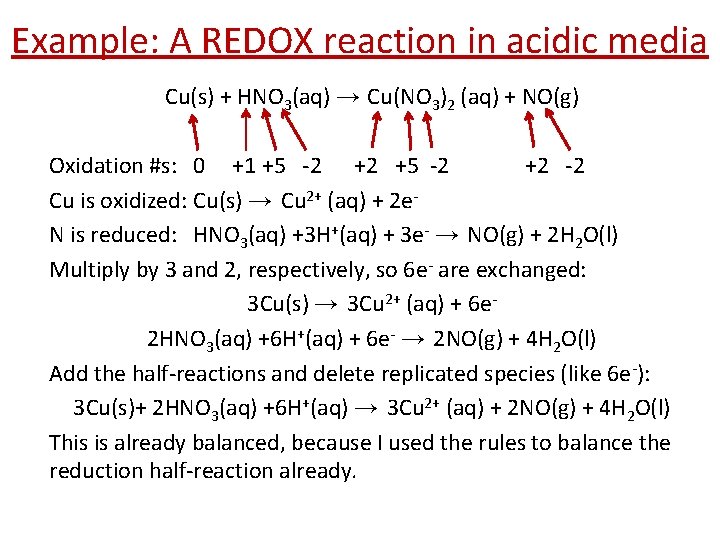
Example: A REDOX reaction in acidic media Cu(s) + HNO 3(aq) → Cu(NO 3)2 (aq) + NO(g) Oxidation #s: 0 +1 +5 -2 +2 +5 -2 +2 -2 Cu is oxidized: Cu(s) → Cu 2+ (aq) + 2 e. N is reduced: HNO 3(aq) +3 H+(aq) + 3 e- → NO(g) + 2 H 2 O(l) Multiply by 3 and 2, respectively, so 6 e- are exchanged: 3 Cu(s) → 3 Cu 2+ (aq) + 6 e 2 HNO 3(aq) +6 H+(aq) + 6 e- → 2 NO(g) + 4 H 2 O(l) Add the half-reactions and delete replicated species (like 6 e-): 3 Cu(s)+ 2 HNO 3(aq) +6 H+(aq) → 3 Cu 2+ (aq) + 2 NO(g) + 4 H 2 O(l) This is already balanced, because I used the rules to balance the reduction half-reaction already.
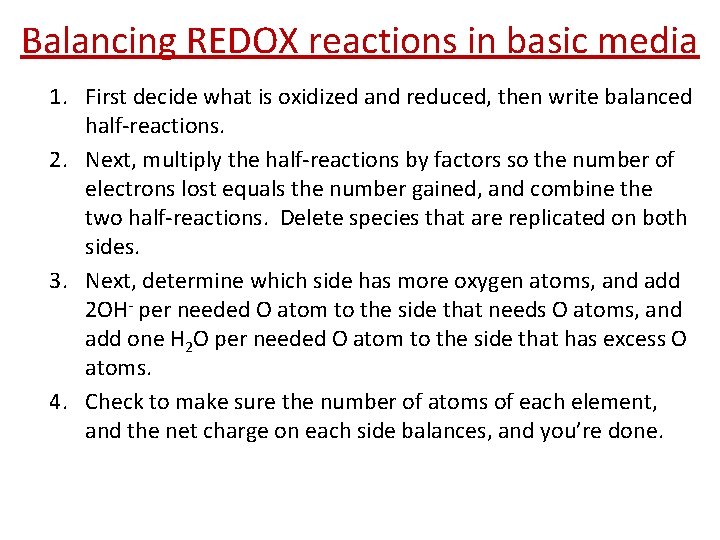
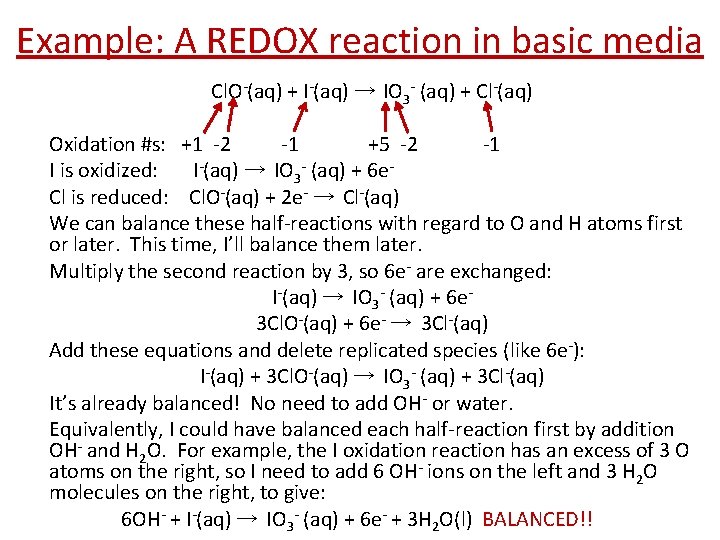
Balancing REDOX reactions in basic media 1. First decide what is oxidized and reduced, then write balanced half-reactions. 2. Next, multiply the half-reactions by factors so the number of electrons lost equals the number gained, and combine the two half-reactions. Delete species that are replicated on both sides. 3. Next, determine which side has more oxygen atoms, and add 2 OH- per needed O atom to the side that needs O atoms, and add one H 2 O per needed O atom to the side that has excess O atoms. 4. Check to make sure the number of atoms of each element, and the net charge on each side balances, and you’re done.
Example: A REDOX reaction in basic media Cl. O-(aq) + I-(aq) → IO 3 - (aq) + Cl-(aq) Oxidation #s: +1 -2 -1 +5 -2 -1 I is oxidized: I-(aq) → IO 3 - (aq) + 6 e. Cl is reduced: Cl. O-(aq) + 2 e- → Cl-(aq) We can balance these half-reactions with regard to O and H atoms first or later. This time, I’ll balance them later. Multiply the second reaction by 3, so 6 e- are exchanged: I-(aq) → IO 3 - (aq) + 6 e 3 Cl. O-(aq) + 6 e- → 3 Cl-(aq) Add these equations and delete replicated species (like 6 e-): I-(aq) + 3 Cl. O-(aq) → IO 3 - (aq) + 3 Cl-(aq) It’s already balanced! No need to add OH- or water. Equivalently, I could have balanced each half-reaction first by addition OH- and H 2 O. For example, the I oxidation reaction has an excess of 3 O atoms on the right, so I need to add 6 OH- ions on the left and 3 H 2 O molecules on the right, to give: 6 OH- + I-(aq) → IO 3 - (aq) + 6 e- + 3 H 2 O(l) BALANCED!!
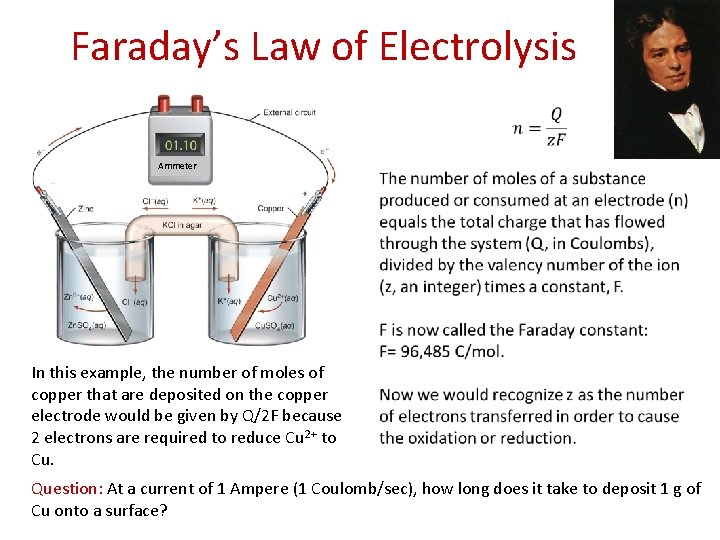
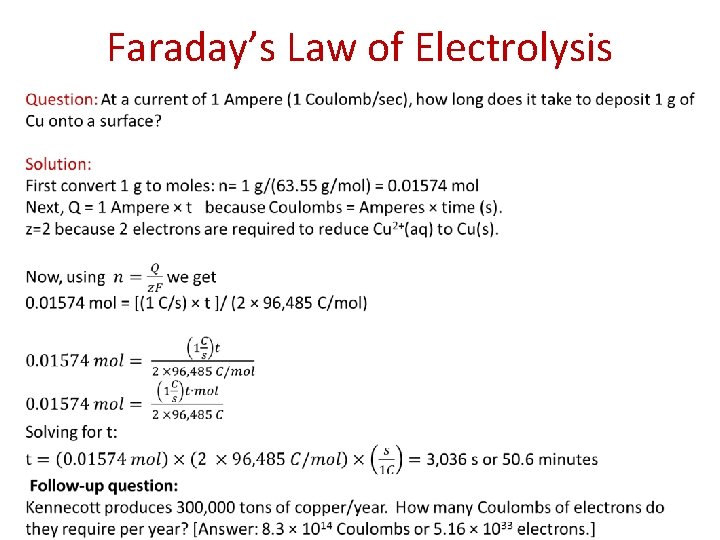
Faraday’s Law of Electrolysis Ammeter In this example, the number of moles of copper that are deposited on the copper electrode would be given by Q/2 F because 2 electrons are required to reduce Cu 2+ to Cu. Question: At a current of 1 Ampere (1 Coulomb/sec), how long does it take to deposit 1 g of Cu onto a surface?
Faraday’s Law of Electrolysis
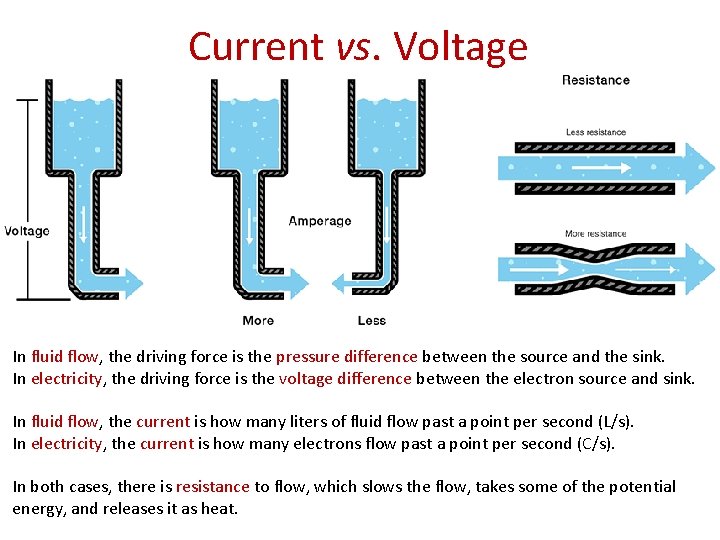
Current vs. Voltage Faraday’s Law – the total charge (or current integrated over time) governs how much material is oxidized or reduced. For galvanic or voltaic cells, we’re concerned with voltage. How can you understand the difference between current and voltage? Current is easy – how many electrons pass a given point per second. Voltage is related to the driving force that pushes the electrons to their destination. In electrochemistry, it is sometimes called the electromotive force (emf), measured in volts.
Current vs. Voltage In fluid flow, the driving force is the pressure difference between the source and the sink. In electricity, the driving force is the voltage difference between the electron source and sink. In fluid flow, the current is how many liters of fluid flow past a point per second (L/s). In electricity, the current is how many electrons flow past a point per second (C/s). In both cases, there is resistance to flow, which slows the flow, takes some of the potential energy, and releases it as heat.
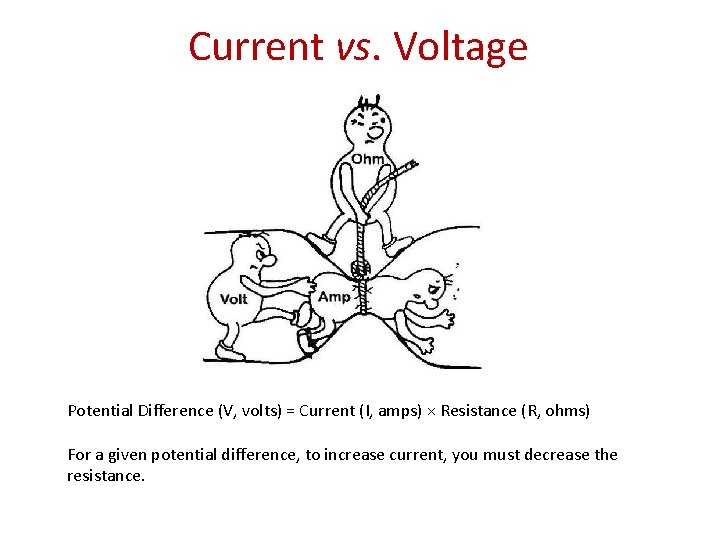
Current vs. Voltage Potential Difference (V, volts) = Current (I, amps) × Resistance (R, ohms) For a given potential difference, to increase current, you must decrease the resistance.
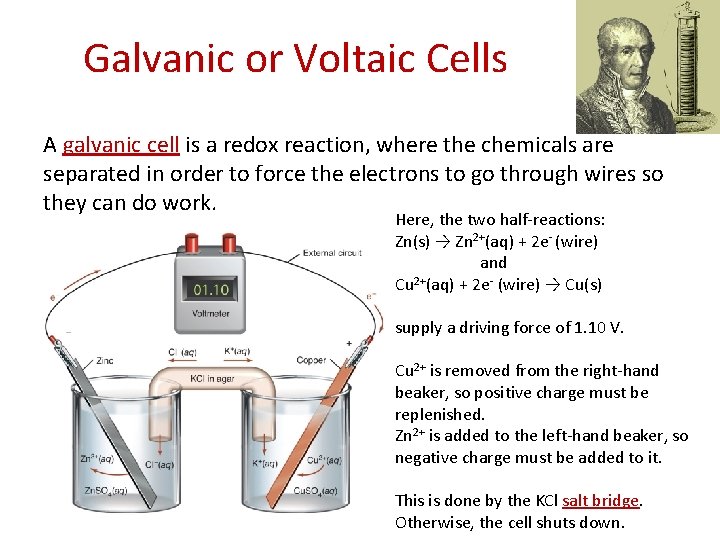
Galvanic or Voltaic Cells A galvanic cell is a redox reaction, where the chemicals are separated in order to force the electrons to go through wires so they can do work. Here, the two half-reactions: Zn(s) → Zn 2+(aq) + 2 e- (wire) and Cu 2+(aq) + 2 e- (wire) → Cu(s) supply a driving force of 1. 10 V. Cu 2+ is removed from the right-hand beaker, so positive charge must be replenished. Zn 2+ is added to the left-hand beaker, so negative charge must be added to it. This is done by the KCl salt bridge. Otherwise, the cell shuts down.
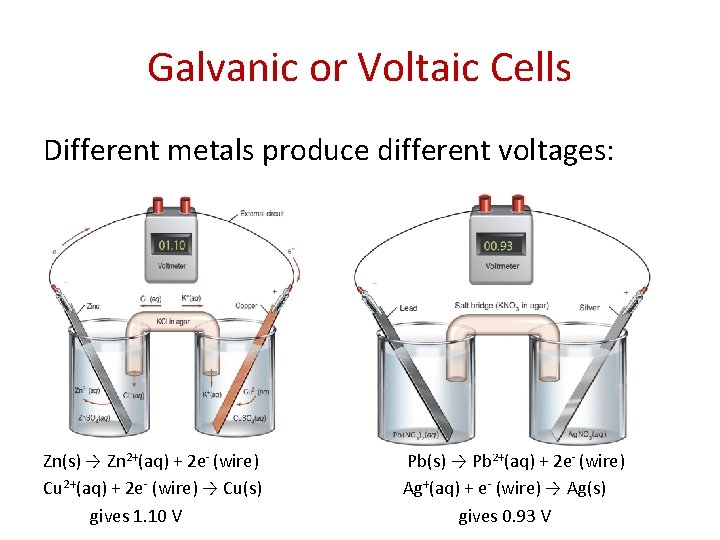
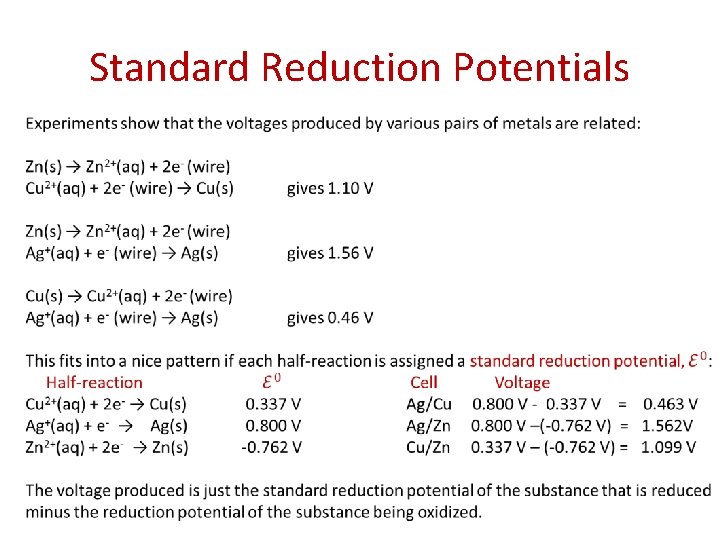
Galvanic or Voltaic Cells Different metals produce different voltages: Zn(s) → Zn 2+(aq) + 2 e- (wire) Cu 2+(aq) + 2 e- (wire) → Cu(s) gives 1. 10 V Pb(s) → Pb 2+(aq) + 2 e- (wire) Ag+(aq) + e- (wire) → Ag(s) gives 0. 93 V
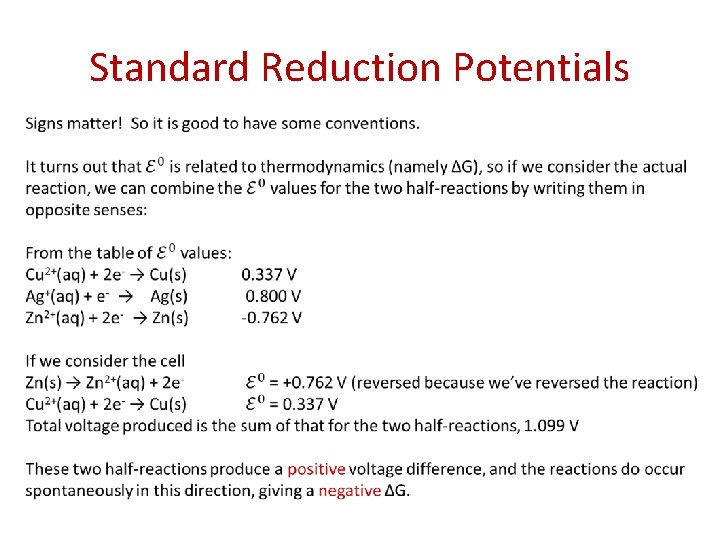
Standard Reduction Potentials
Standard Reduction Potentials
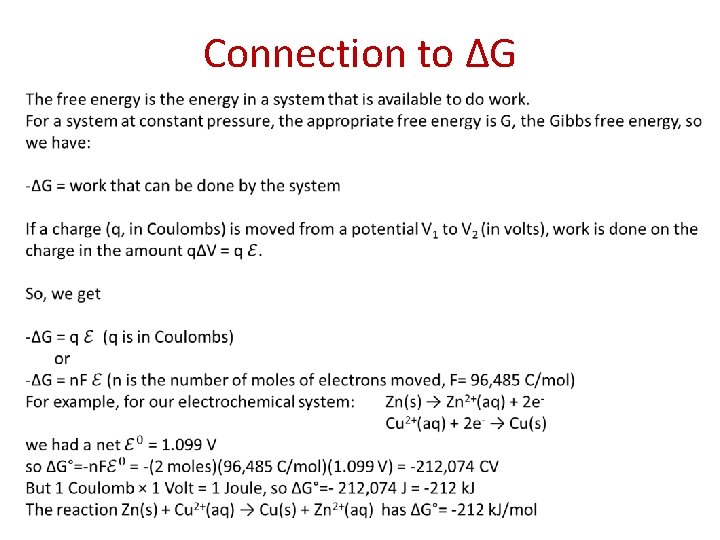
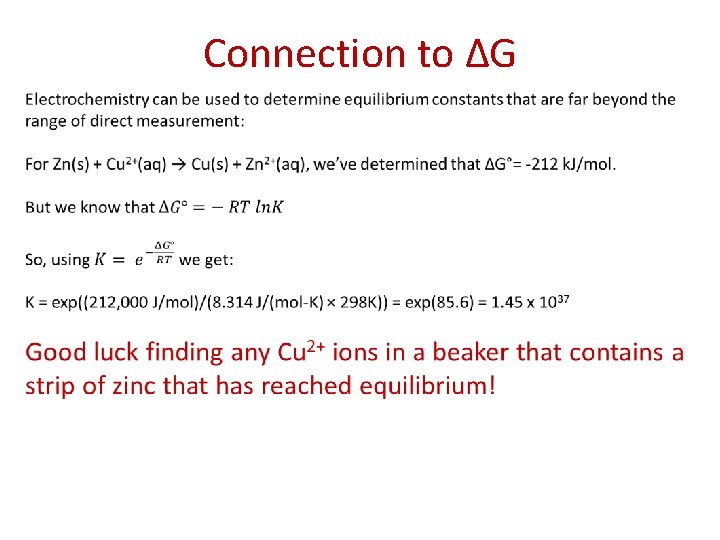
Connection to ∆G
Connection to ∆G
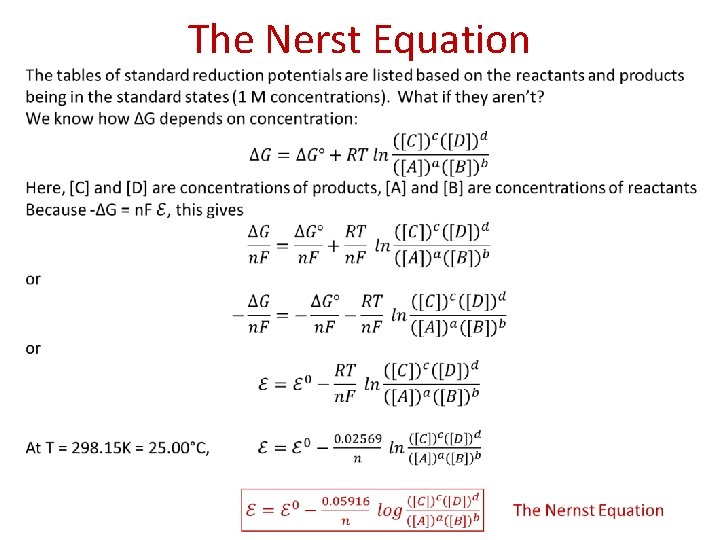
The Nerst Equation
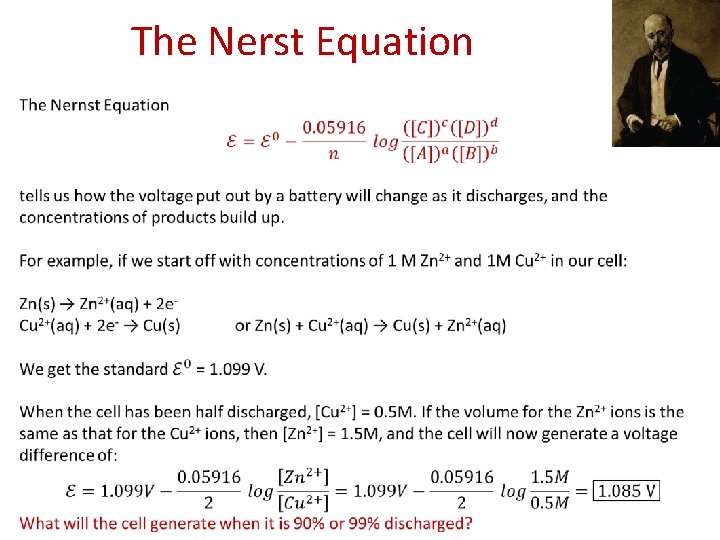
The Nerst Equation
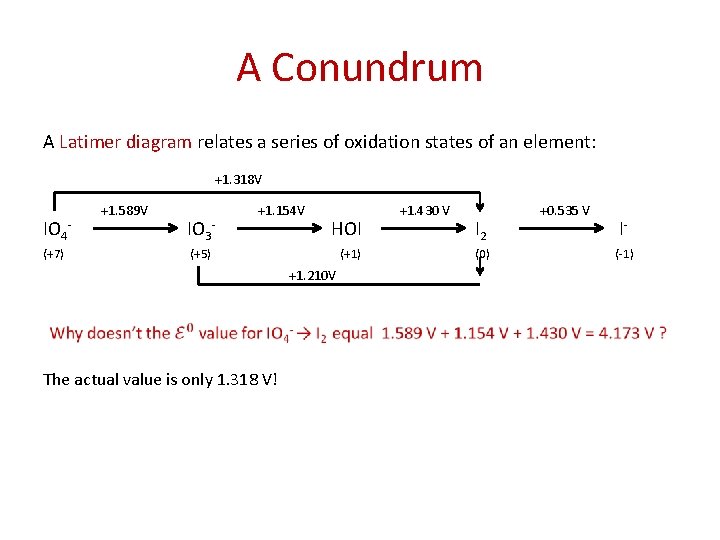
A Conundrum A Latimer diagram relates a series of oxidation states of an element: +1. 318 V IO 4(+7) +1. 589 V +1. 154 V +1. 430 V +0. 535 V IO 3 - HOI I 2 (+5) (+1) (0) +1. 210 V The actual value is only 1. 318 V! I- (-1)
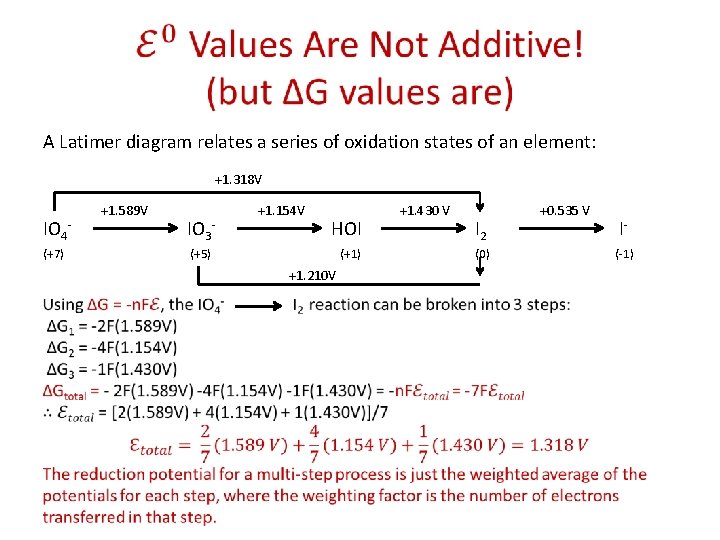
A Latimer diagram relates a series of oxidation states of an element: +1. 318 V IO 4(+7) +1. 589 V +1. 154 V +1. 430 V +0. 535 V IO 3 - HOI I 2 (+5) (+1) (0) +1. 210 V I- (-1)
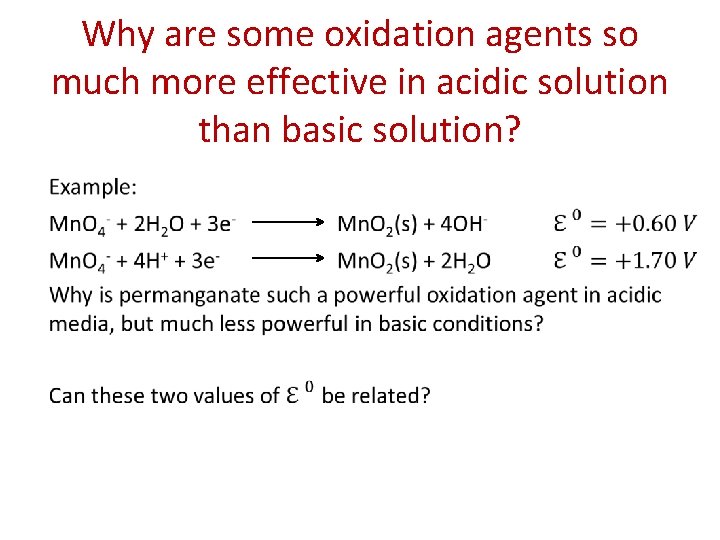
Why are some oxidation agents so much more effective in acidic solution than basic solution? •
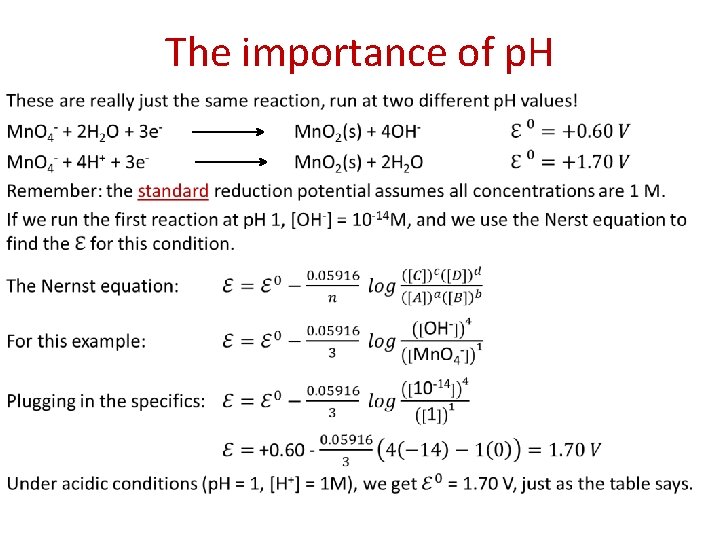
The importance of p. H •
Thanks for your attention!