
Electrochemistry 1 E 1 Fundamental concepts An electrolyte

- Slides: 101
Electrochemistry 1
E 1. Fundamental concepts An electrolyte is a substance which leads electric current in solution or in form of melt. Electrolytic dissociation: In solutions neutral molecules decompose to charged particles – ions: +: cation - : anion
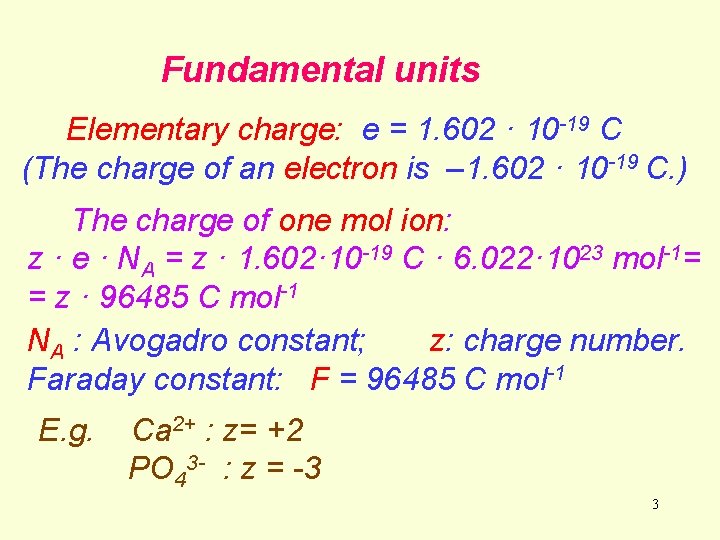
Fundamental units Elementary charge: e = 1. 602 · 10 -19 C (The charge of an electron is – 1. 602 · 10 -19 C. ) The charge of one mol ion: z · e · NA = z · 1. 602· 10 -19 C · 6. 022· 1023 mol-1= = z · 96485 C mol-1 NA : Avogadro constant; z: charge number. Faraday constant: F = 96485 C mol-1 E. g. Ca 2+ : z= +2 PO 43 - : z = -3 3
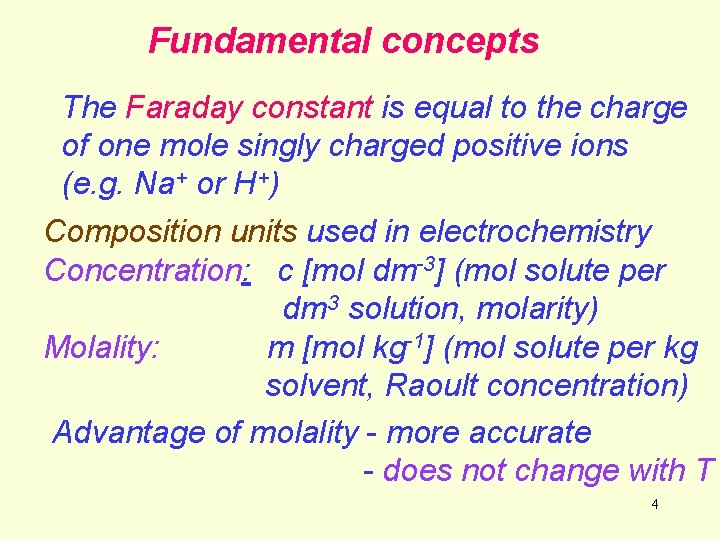
Fundamental concepts The Faraday constant is equal to the charge of one mole singly charged positive ions (e. g. Na+ or H+) Composition units used in electrochemistry Concentration: c [mol dm-3] (mol solute per dm 3 solution, molarity) Molality: m [mol kg-1] (mol solute per kg solvent, Raoult concentration) Advantage of molality - more accurate - does not change with T 4
E 2. Equilibrium in electrolytes Even very dilute solutions cannot be regarded ideal (because of the strong electrostatic interaction between ions). Still Kc can be frequently used as equilibrium constant (It is assumed here that the activity coefficients are independent of concentration, so K is taken constant). 5
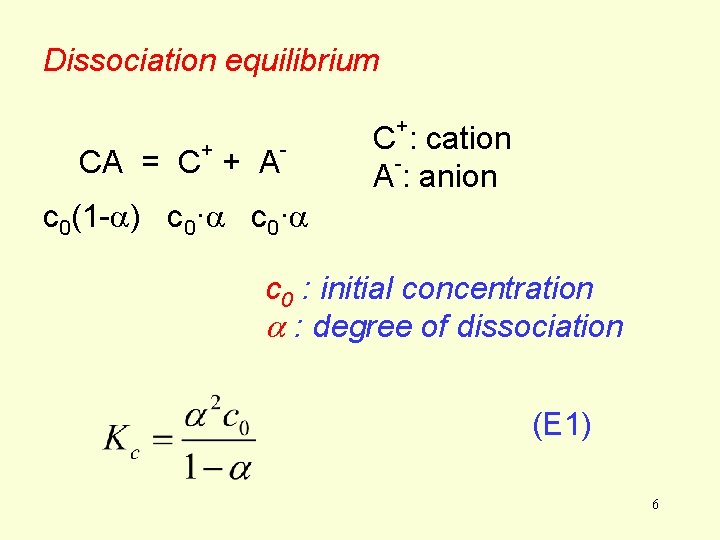
Dissociation equilibrium + + CA = C + A - C : cation A : anion c 0(1 - ) c 0· c 0 : initial concentration a : degree of dissociation (E 1) 6
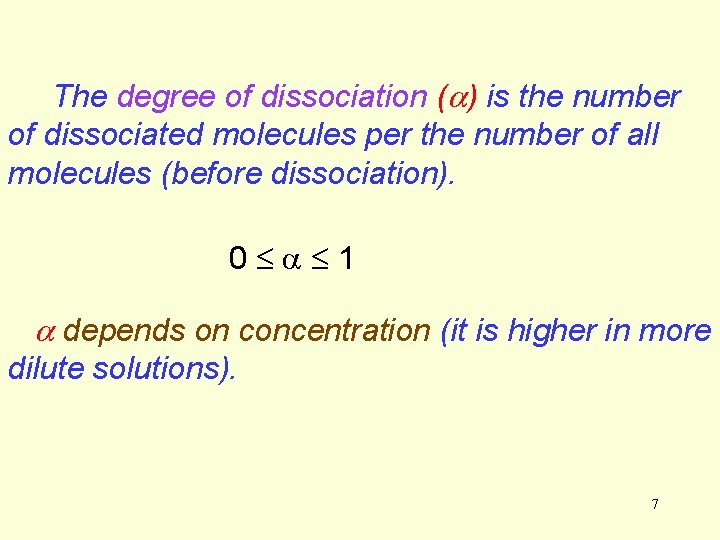
The degree of dissociation (a) is the number of dissociated molecules per the number of all molecules (before dissociation). 0 1 a depends on concentration (it is higher in more dilute solutions). 7
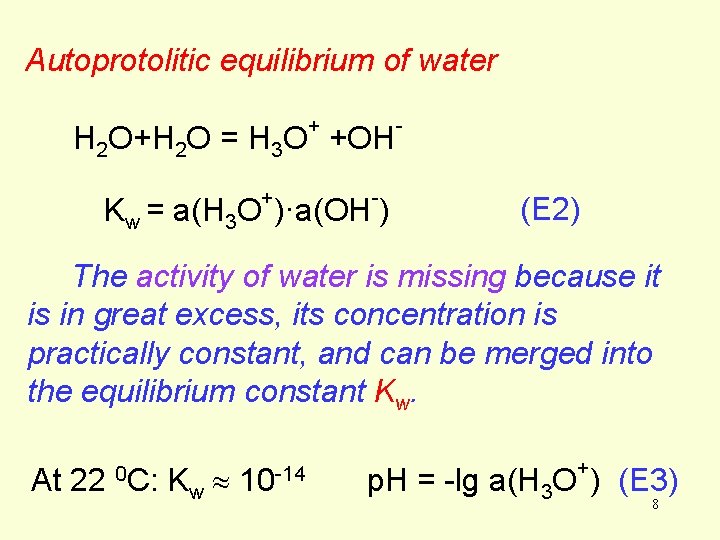
Autoprotolitic equilibrium of water + H 2 O+H 2 O = H 3 O +OH + - Kw = a(H 3 O )·a(OH ) - (E 2) The activity of water is missing because it is in great excess, its concentration is practically constant, and can be merged into the equilibrium constant Kw. At 22 0 C: Kw 10 -14 + p. H = -lg a(H 3 O ) (E 3) 8
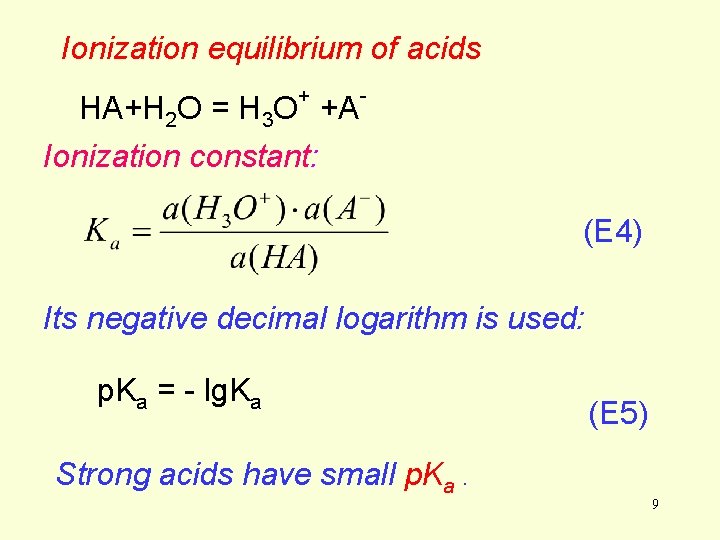
Ionization equilibrium of acids + HA+H 2 O = H 3 O +A - Ionization constant: (E 4) Its negative decimal logarithm is used: p. Ka = - lg. Ka Strong acids have small p. Ka. (E 5) 9
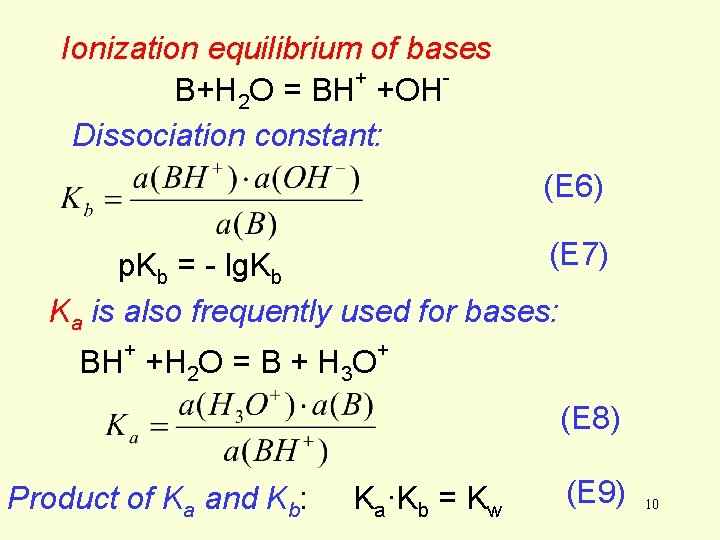
Ionization equilibrium of bases + B+H 2 O = BH +OH Dissociation constant: (E 6) (E 7) p. Kb = - lg. Kb Ka is also frequently used for bases: + BH +H 2 O = B + H 3 O + (E 8) Product of Ka and Kb: Ka·Kb = Kw (E 9) 10
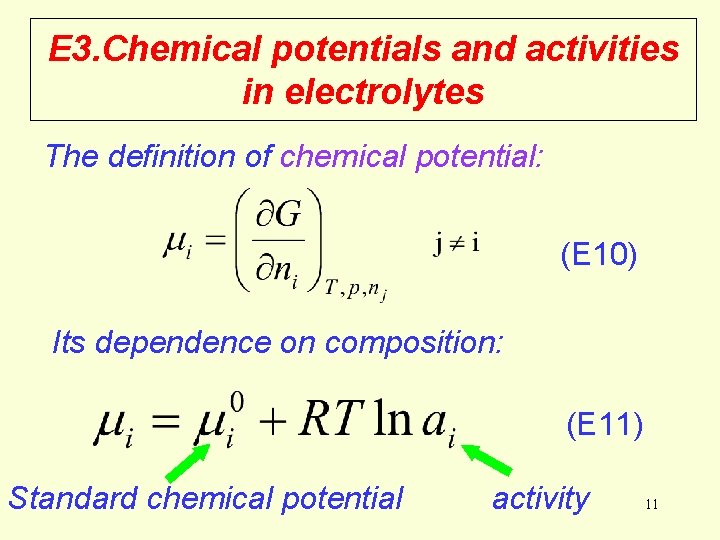
E 3. Chemical potentials and activities in electrolytes The definition of chemical potential: (E 10) Its dependence on composition: (E 11) Standard chemical potential activity 11
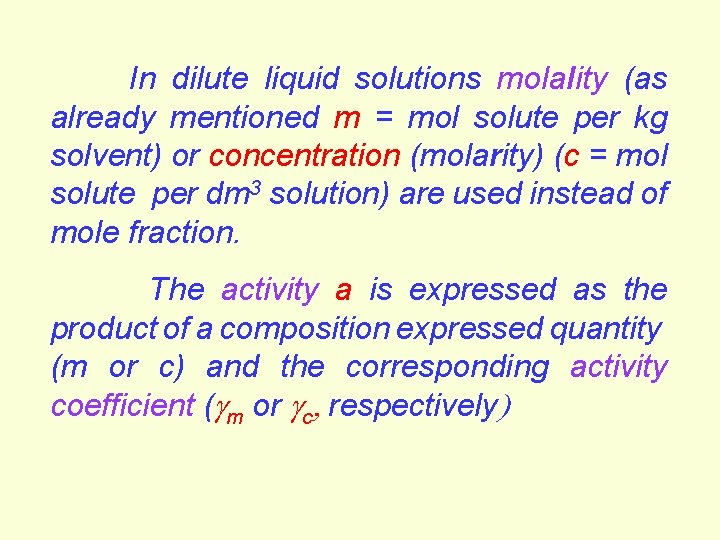
In dilute liquid solutions molality (as already mentioned m = mol solute per kg solvent) or concentration (molarity) (c = mol solute per dm 3 solution) are used instead of mole fraction. The activity a is expressed as the product of a composition expressed quantity (m or c) and the corresponding activity coefficient ( m or c, respectively)
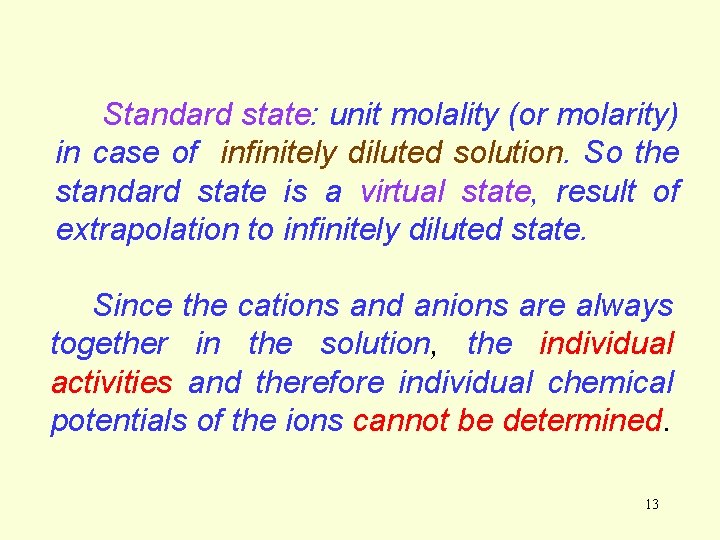
Standard state: unit molality (or molarity) in case of infinitely diluted solution. So the standard state is a virtual state, result of extrapolation to infinitely diluted state. Since the cations and anions are always together in the solution, the individual activities and therefore individual chemical potentials of the ions cannot be determined. 13
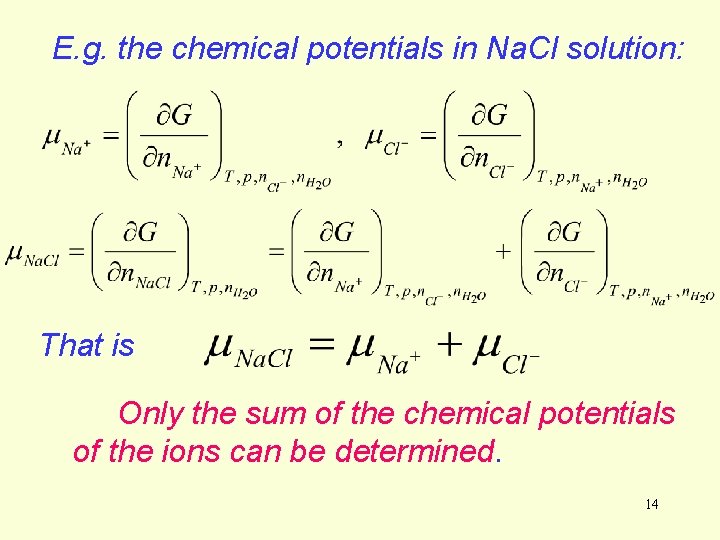
E. g. the chemical potentials in Na. Cl solution: That is Only the sum of the chemical potentials of the ions can be determined. 14
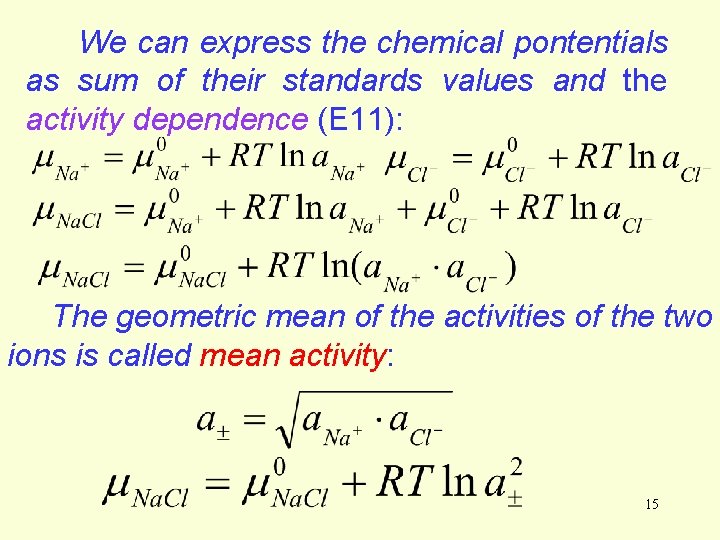
We can express the chemical pontentials as sum of their standards values and the activity dependence (E 11): The geometric mean of the activities of the two ions is called mean activity: 15
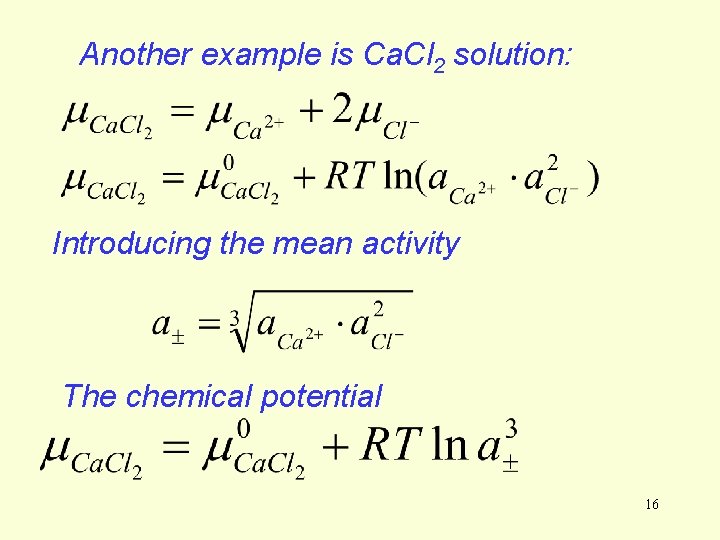
Another example is Ca. Cl 2 solution: Introducing the mean activity The chemical potential 16
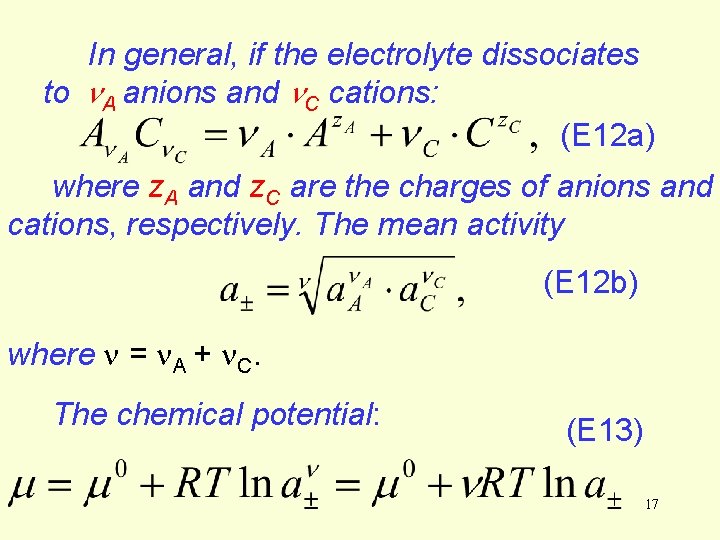
In general, if the electrolyte dissociates to A anions and C cations: (E 12 a) where z. A and z. C are the charges of anions and cations, respectively. The mean activity (E 12 b) where = A + C. The chemical potential: (E 13) 17
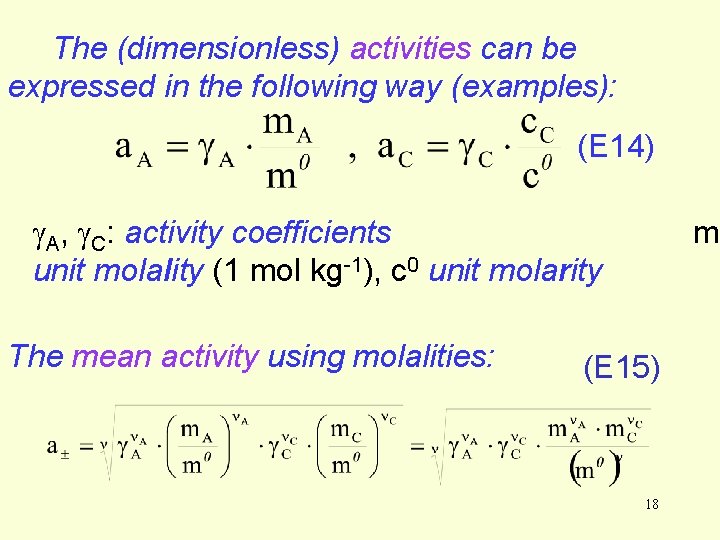
The (dimensionless) activities can be expressed in the following way (examples): (E 14) g. A, g. C: activity coefficients unit molality (1 mol kg-1), c 0 unit molarity The mean activity using molalities: mo (E 15) 18
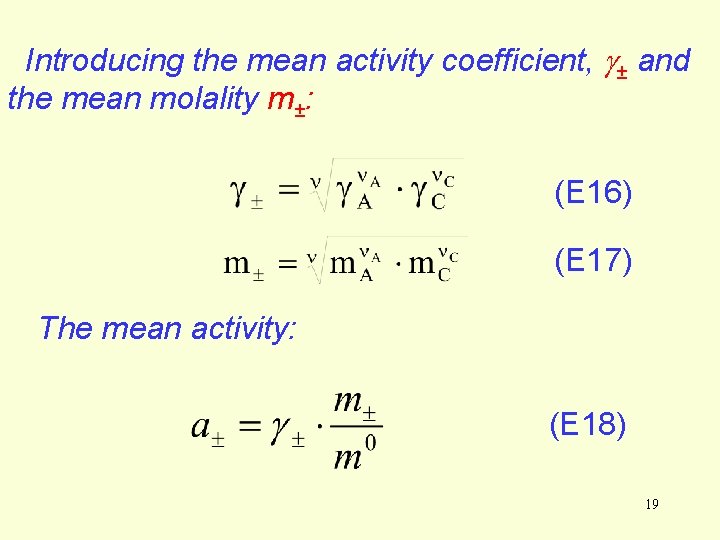
Introducing the mean activity coefficient, ± and the mean molality m±: (E 16) (E 17) The mean activity: (E 18) 19
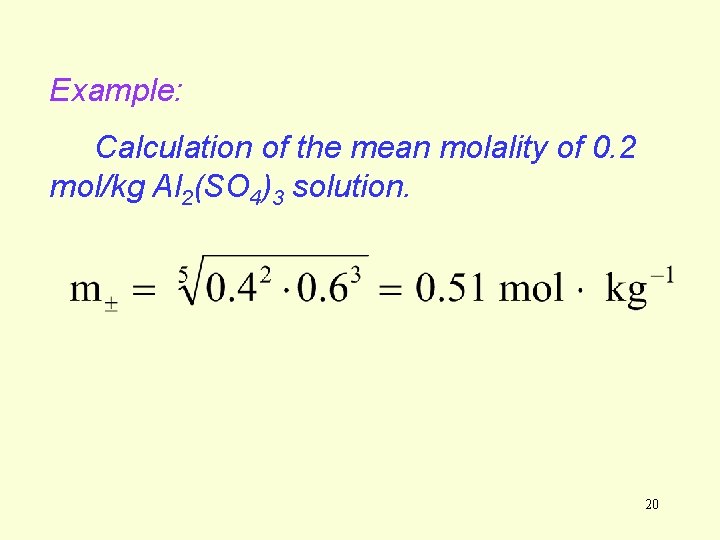
Example: Calculation of the mean molality of 0. 2 mol/kg Al 2(SO 4)3 solution. 20
E 4. Debye-Hückel theory The electrolytes do not behave ideally even if the solution is dilute. The reason is the electrostatic interaction between ions. Debye and Hückel developed a theory in 1923, which explains the behaviour of dilute electrolytes. We discuss only the main points of this theory. 21
Cations and anions are not distributed evenly in the solution. A selected anion is surrounded by more cations than anions and vica versa. Around a cation there is an excess of anions. Around an anion there is an excess of cations. The cloud of such ions has a spheric symmetry. It is called ionic atmosphere. 22
How does the cloud of ions of opposite charge influence the chemical potential? The interionic attractive forces reduces the energy of ions, the chemical potential is reduced, too. So the activity coefficient is less than 1. The result of a long derivation is a simple expression for the activity coefficient. 23
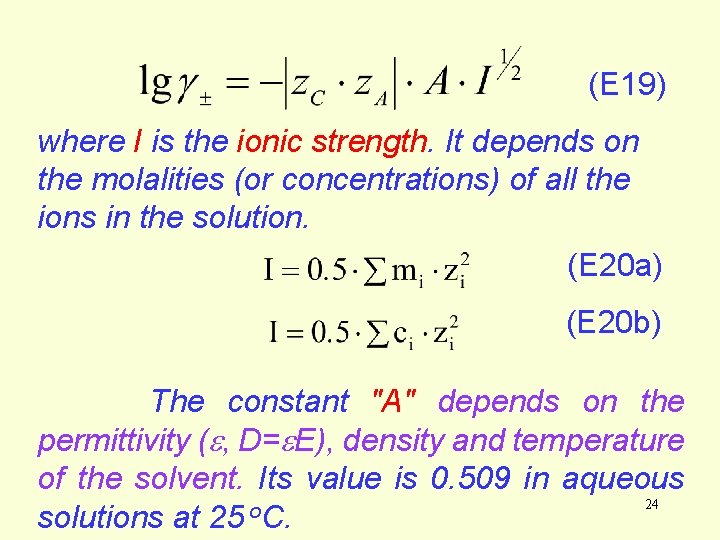
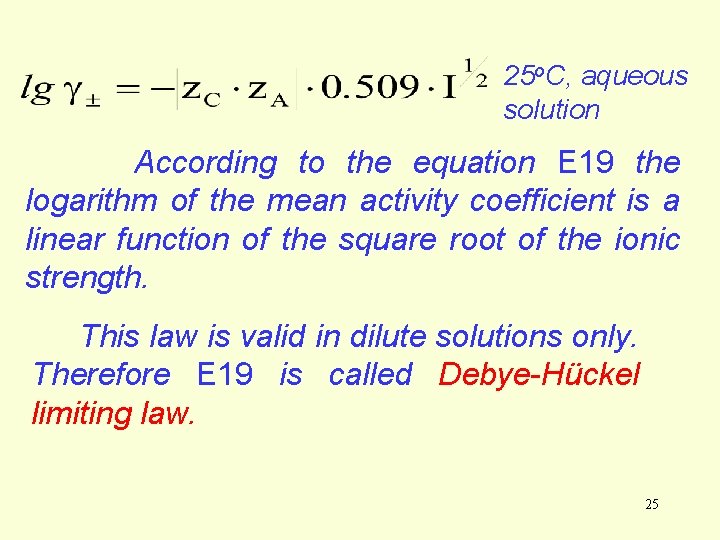
(E 19) where I is the ionic strength. It depends on the molalities (or concentrations) of all the ions in the solution. (E 20 a) (E 20 b) The constant "A" depends on the permittivity (e, D=e. E), density and temperature of the solvent. Its value is 0. 509 in aqueous 24 o solutions at 25 C.
25 o. C, aqueous solution According to the equation E 19 the logarithm of the mean activity coefficient is a linear function of the square root of the ionic strength. This law is valid in dilute solutions only. Therefore E 19 is called Debye-Hückel limiting law. 25
E 5. The electrochemical potential The total differential of Gibbs free energy in an open system (material and energy exchange with the surroundings are allowed) at constant T and p: (E 21) If dni mol neutral component is added to the solution, the change of Gibbs free energy is idni. 26
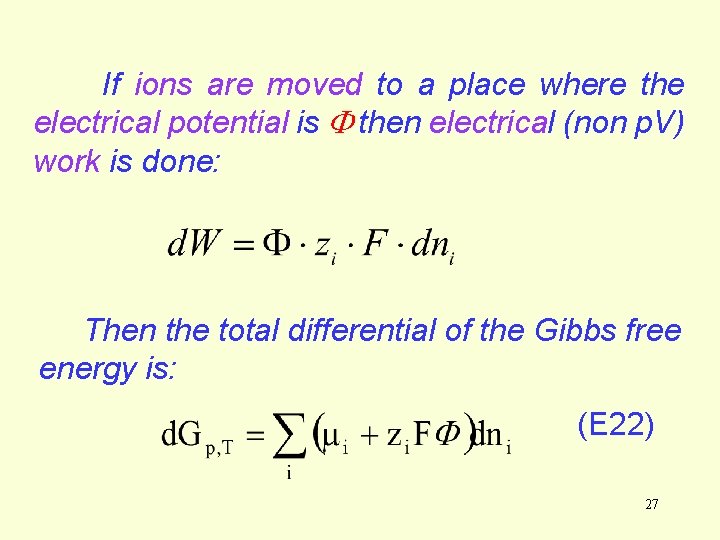
If ions are moved to a place where the electrical potential is then electrical (non p. V) work is done: Then the total differential of the Gibbs free energy is: (E 22) 27
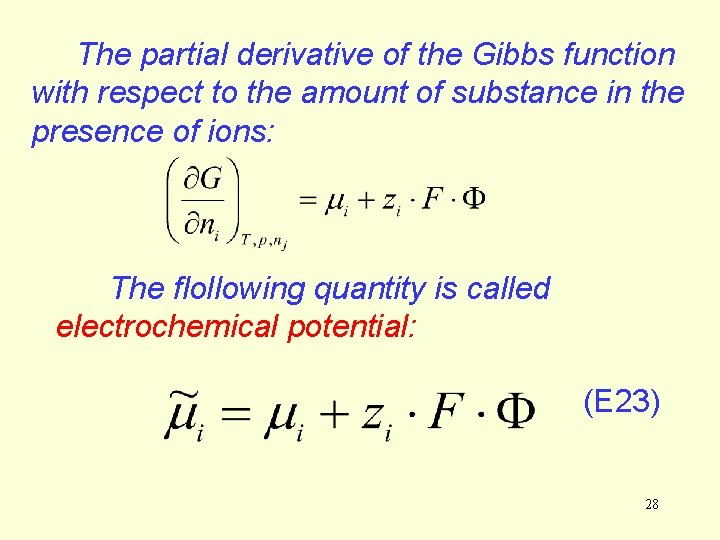
The partial derivative of the Gibbs function with respect to the amount of substance in the presence of ions: The flollowing quantity is called electrochemical potential: (E 23) 28
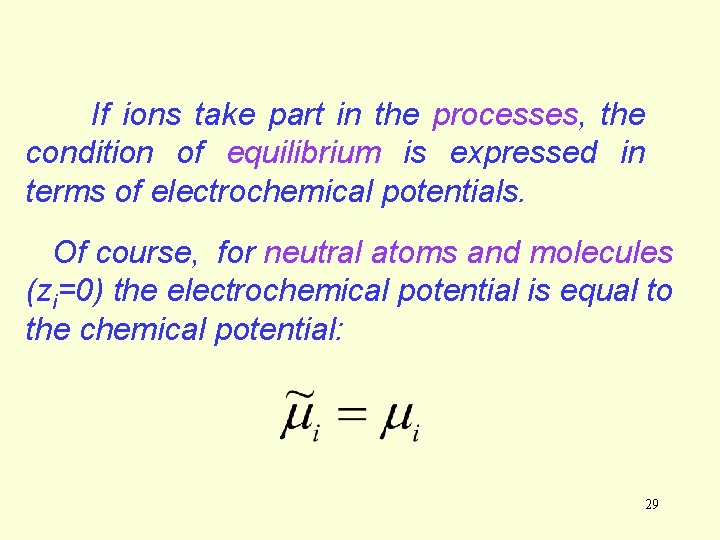
If ions take part in the processes, the condition of equilibrium is expressed in terms of electrochemical potentials. Of course, for neutral atoms and molecules (zi=0) the electrochemical potential is equal to the chemical potential: 29
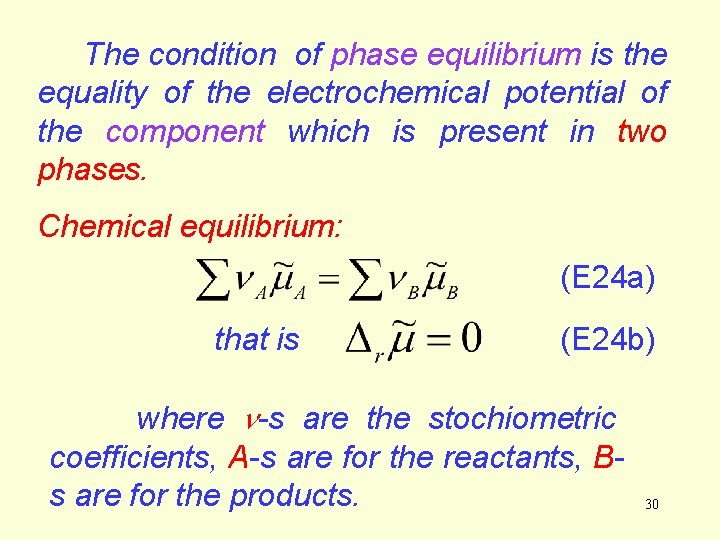
The condition of phase equilibrium is the equality of the electrochemical potential of the component which is present in two phases. Chemical equilibrium: (E 24 a) that is (E 24 b) where -s are the stochiometric coefficients, A-s are for the reactants, Bs are for the products. 30
Some practical applications of the electrochemical potential 1. Contact potential Behaviour of electrons in metals. Their energies are different in different metals. Therefore their electrochemical potentials are also different. If two metals are brought into contact (welding, soldering), electrons flow from the metal where their electrochemical potential is higher to the metal where their electrochemical 31 potential is lower.
As result the metal that gains net electrons, acquires negative charge, while. the metal that loses net electrons, aquires positive charge. Thus an electric potential difference occurs at the contact between the two metals. The condition of equilibrium is the equality of electrochemical potential for electrons in the two metals. 32
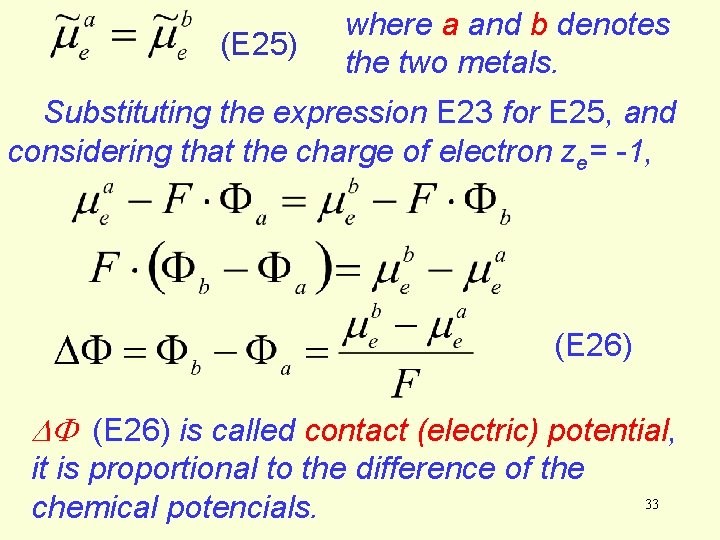
(E 25) where a and b denotes the two metals. Substituting the expression E 23 for E 25, and considering that the charge of electron ze= -1, (E 26) is called contact (electric) potential, it is proportional to the difference of the chemical potencials. 33
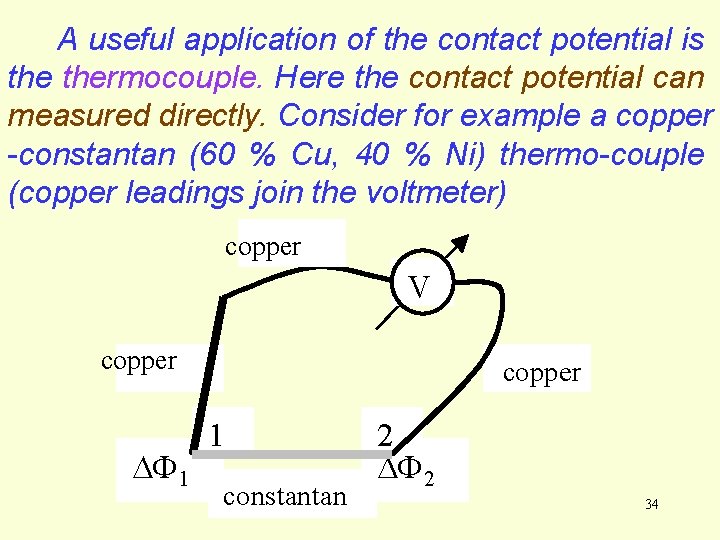
A useful application of the contact potential is thermocouple. Here the contact potential can measured directly. Consider for example a copper -constantan (60 % Cu, 40 % Ni) thermo-couple (copper leadings join the voltmeter) copper V copper F 1 copper 1 constantan 2 F 2 34
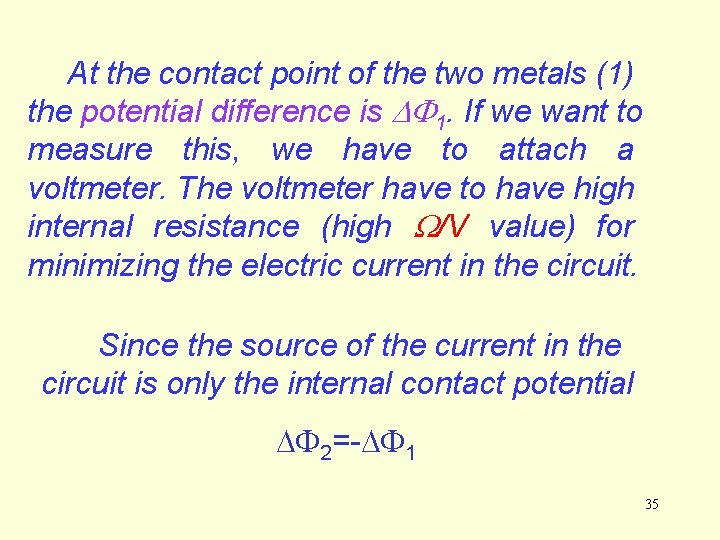
At the contact point of the two metals (1) the potential difference is 1. If we want to measure this, we have to attach a voltmeter. The voltmeter have to have high internal resistance (high /V value) for minimizing the electric current in the circuit. Since the source of the current in the circuit is only the internal contact potential F 2=- F 1 35
The contact potential depends on temperature (thermocouple!) If points 1 and 2 are of different temperature, the resultant voltage is not zero any more. It is the function of temperature difference: U = f( t). Themocouples are used for temperature measurement. They always measure temperature difference between two points. Practically one of the two points have fixed temperature (cold point). 36
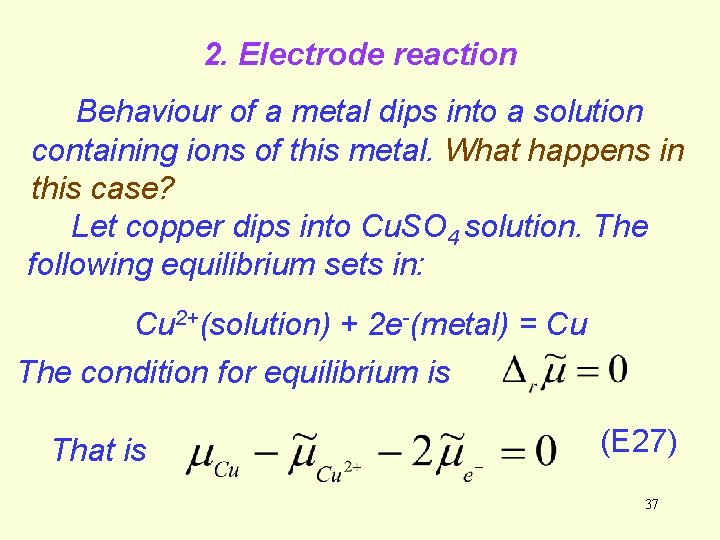
2. Electrode reaction Behaviour of a metal dips into a solution containing ions of this metal. What happens in this case? Let copper dips into Cu. SO 4 solution. The following equilibrium sets in: Cu 2+(solution) + 2 e-(metal) = Cu The condition for equilibrium is That is (E 27) 37
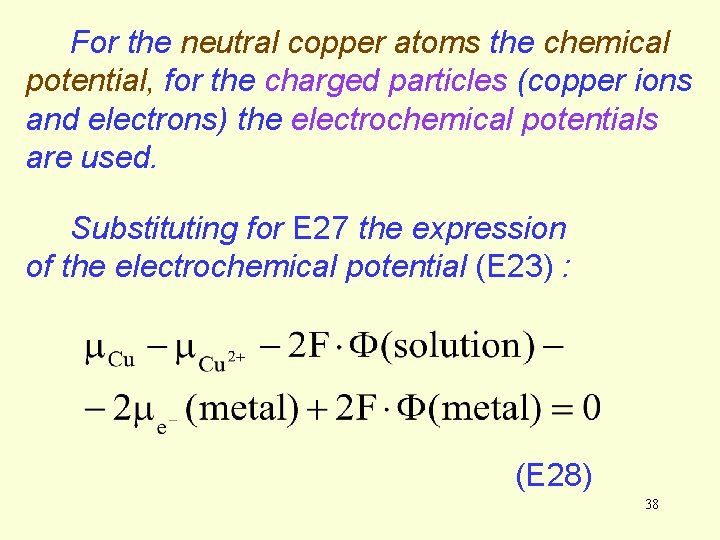
For the neutral copper atoms the chemical potential, for the charged particles (copper ions and electrons) the electrochemical potentials are used. Substituting for E 27 the expression of the electrochemical potential (E 23) : (E 28) 38
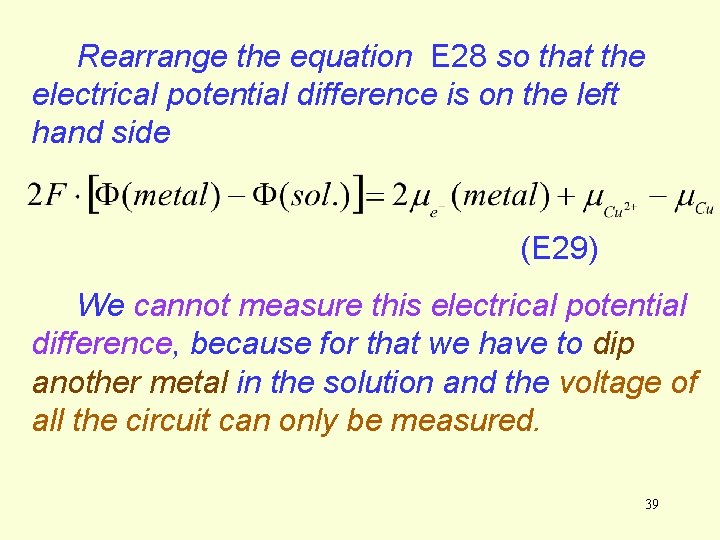
Rearrange the equation E 28 so that the electrical potential difference is on the left hand side (E 29) We cannot measure this electrical potential difference, because for that we have to dip another metal in the solution and the voltage of all the circuit can only be measured. 39
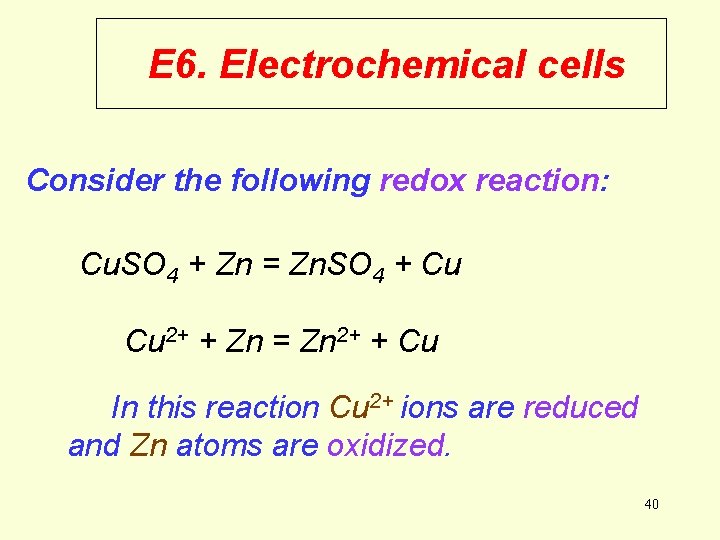
E 6. Electrochemical cells Consider the following redox reaction: Cu. SO 4 + Zn = Zn. SO 4 + Cu Cu 2+ + Zn = Zn 2+ + Cu In this reaction Cu 2+ ions are reduced and Zn atoms are oxidized. 40
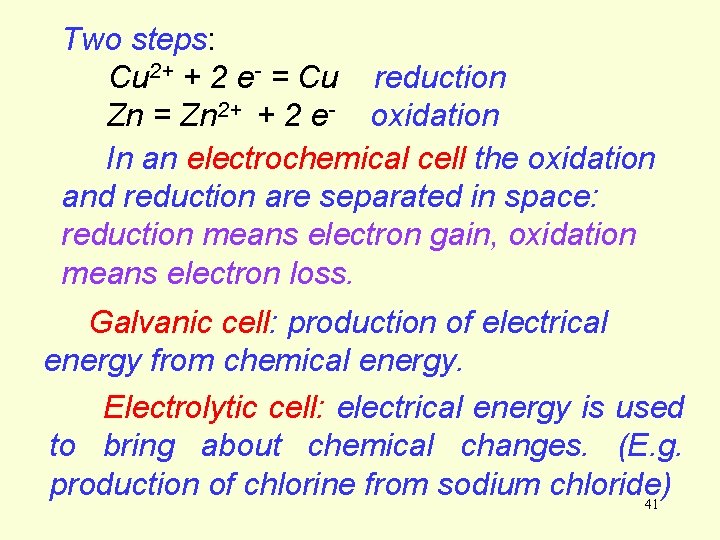
Two steps: Cu 2+ + 2 e- = Cu reduction Zn = Zn 2+ + 2 e- oxidation In an electrochemical cell the oxidation and reduction are separated in space: reduction means electron gain, oxidation means electron loss. Galvanic cell: production of electrical energy from chemical energy. Electrolytic cell: electrical energy is used to bring about chemical changes. (E. g. production of chlorine from sodium chloride) 41
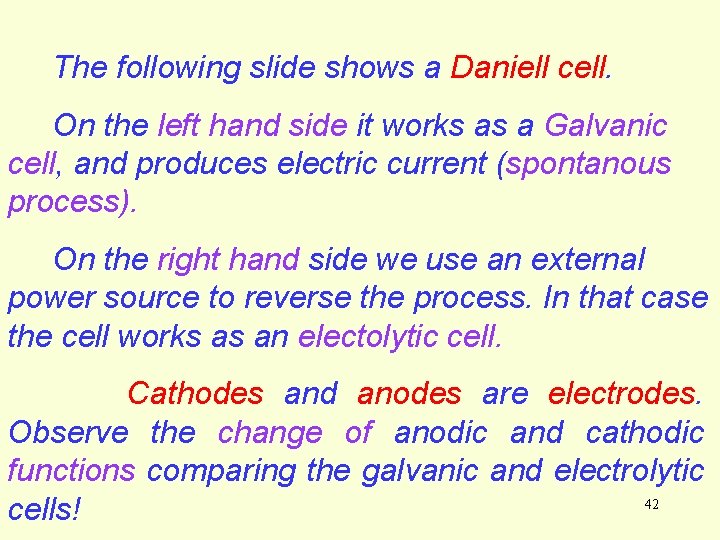
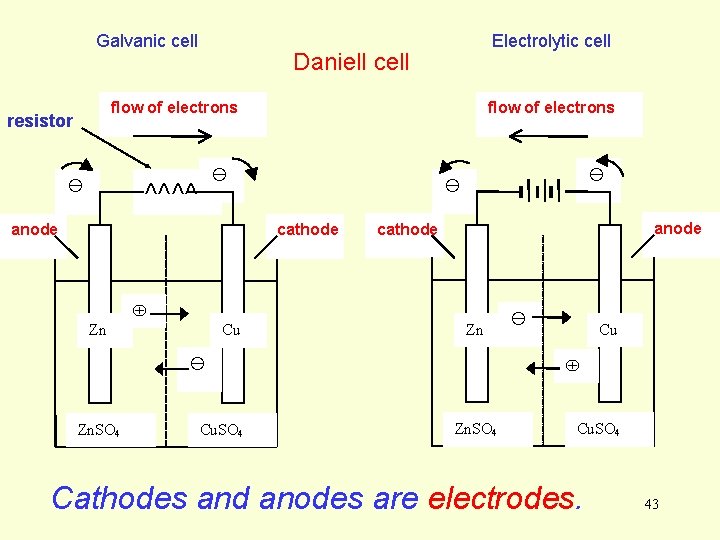
The following slide shows a Daniell cell. On the left hand side it works as a Galvanic cell, and produces electric current (spontanous process). On the right hand side we use an external power source to reverse the process. In that case the cell works as an electolytic cell. Cathodes and anodes are electrodes. Observe the change of anodic and cathodic functions comparing the galvanic and electrolytic 42 cells!
Galvanic cell Electrolytic cell Daniell cell flow of electrons resistor y flow of electrons y ^^^^ anode y y cathode anode cathode Zn Cu. SO 4 Cu y Zn. SO 4 Cu. SO 4 Cathodes and anodes are electrodes. 43
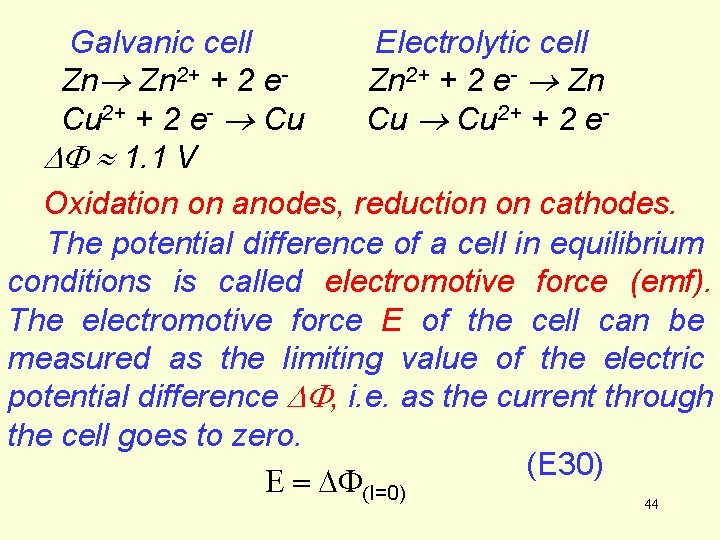
Galvanic cell Electrolytic cell Zn Zn 2+ + 2 e- Zn Cu 2+ + 2 e- Cu Cu 2+ + 2 e 1. 1 V Oxidation on anodes, reduction on cathodes. The potential difference of a cell in equilibrium conditions is called electromotive force (emf). The electromotive force E of the cell can be measured as the limiting value of the electric potential difference , i. e. as the current through the cell goes to zero. (E 30) E = F(I=0) 44
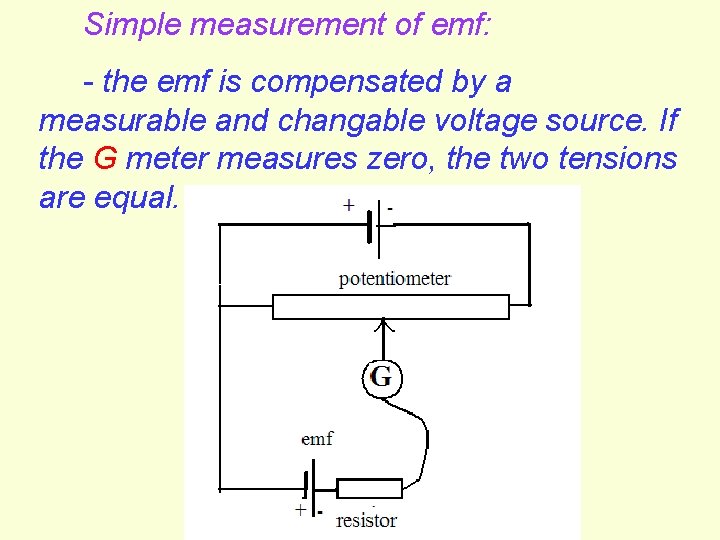
Simple measurement of emf: - the emf is compensated by a measurable and changable voltage source. If the G meter measures zero, the two tensions are equal.
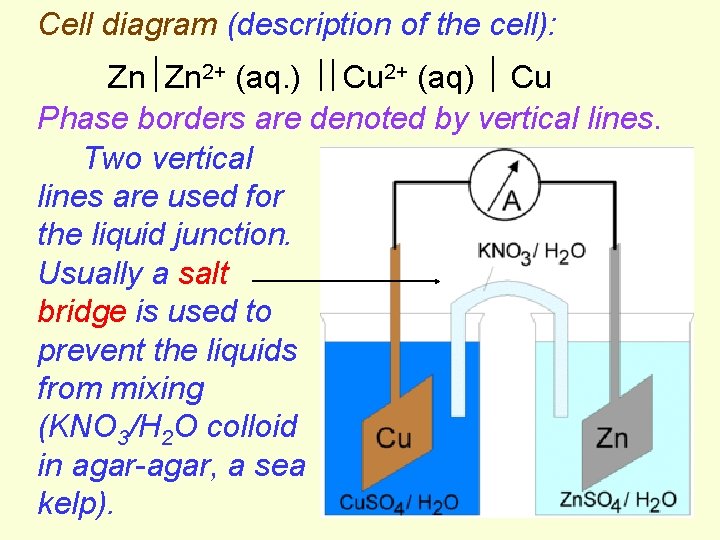
Cell diagram (description of the cell): Zn Zn 2+ (aq. ) Cu 2+ (aq) Cu Phase borders are denoted by vertical lines. Two vertical lines are used for the liquid junction. Usually a salt bridge is used to prevent the liquids from mixing (KNO 3/H 2 O colloid in agar-agar, a sea 46 kelp).
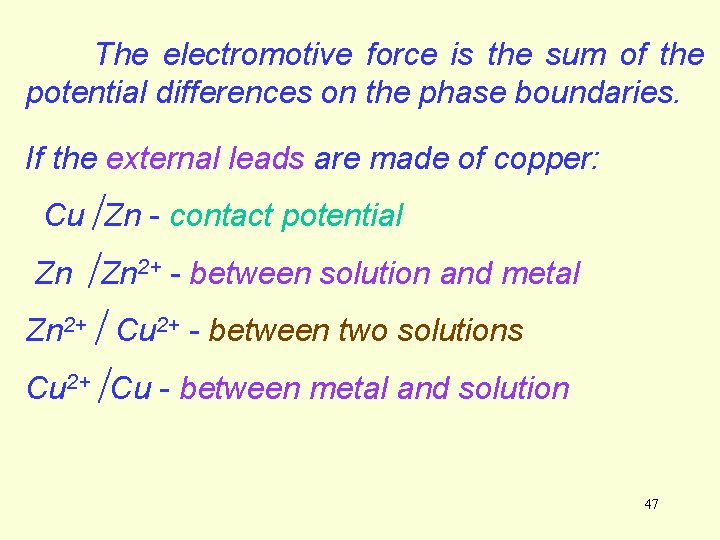
The electromotive force is the sum of the potential differences on the phase boundaries. If the external leads are made of copper: Cu Zn - contact potential Zn Zn 2+ - between solution and metal Zn 2+ Cu 2+ - between two solutions Cu 2+ Cu - between metal and solution 47
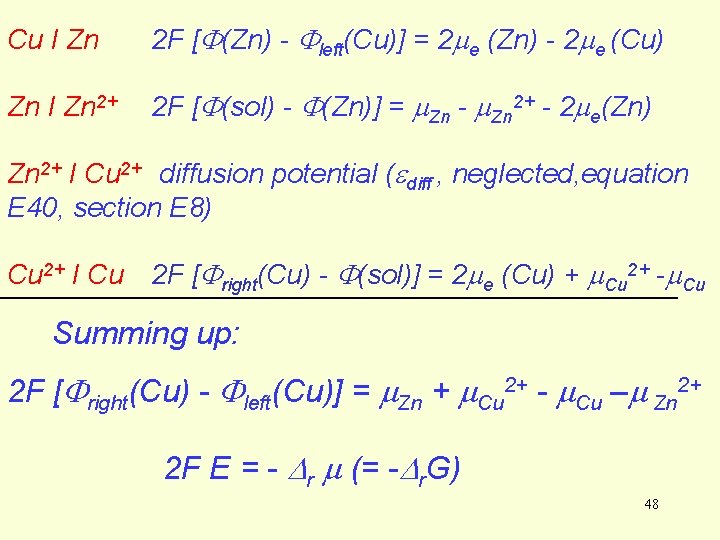
Cu I Zn 2 F [ (Zn) - left(Cu)] = 2 e (Zn) - 2 e (Cu) Zn I Zn 2+ 2 F [ (sol) - (Zn)] = Zn - Zn 2+ - 2 e(Zn) Zn 2+ I Cu 2+ diffusion potential (ediff , neglected, equation E 40, section E 8) Cu 2+ I Cu 2 F [ right(Cu) - (sol)] = 2 e (Cu) + Cu 2+ - Cu Summing up: 2 F [ right(Cu) - left(Cu)] = Zn + Cu 2+ - Cu – Zn 2+ 2 F E = - r (= - r. G) 48
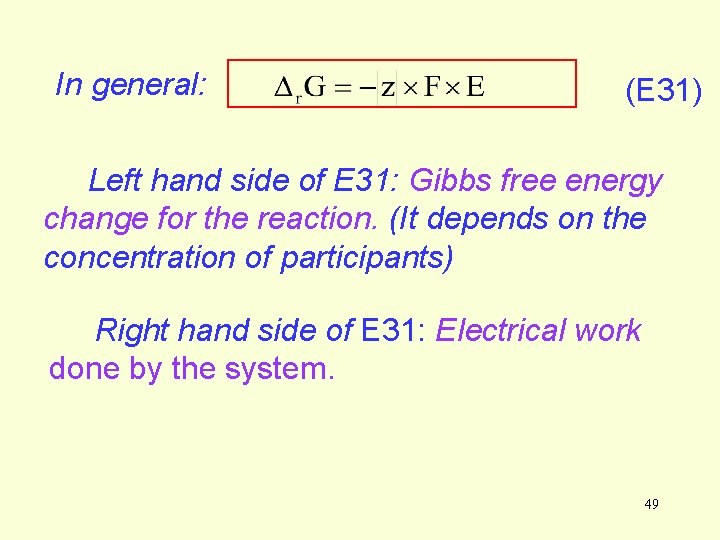
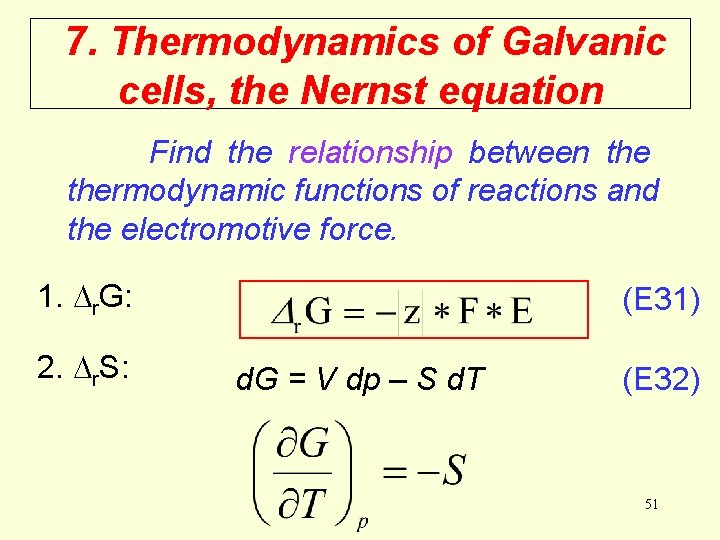
In general: (E 31) Left hand side of E 31: Gibbs free energy change for the reaction. (It depends on the concentration of participants) Right hand side of E 31: Electrical work done by the system. 49
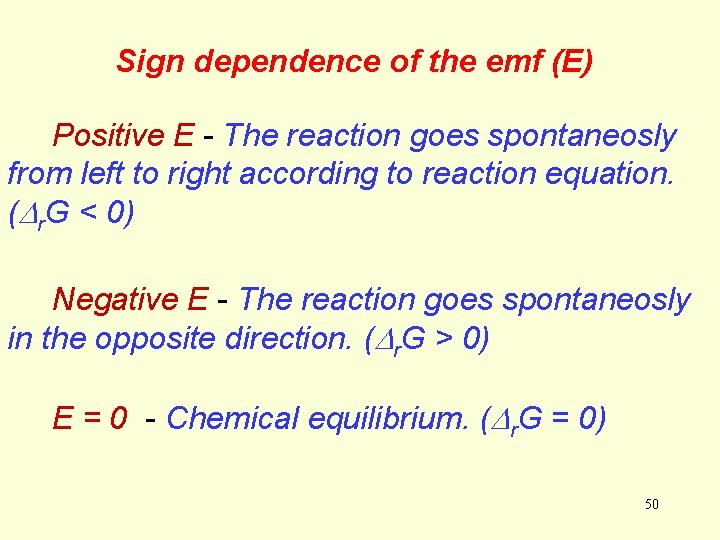
Sign dependence of the emf (E) Positive E - The reaction goes spontaneosly from left to right according to reaction equation. ( r. G < 0) Negative E - The reaction goes spontaneosly in the opposite direction. ( r. G > 0) E = 0 - Chemical equilibrium. ( r. G = 0) 50
7. Thermodynamics of Galvanic cells, the Nernst equation Find the relationship between thermodynamic functions of reactions and the electromotive force. 1. r. G: 2. r. S: (E 31) d. G = V dp – S d. T (E 32) 51
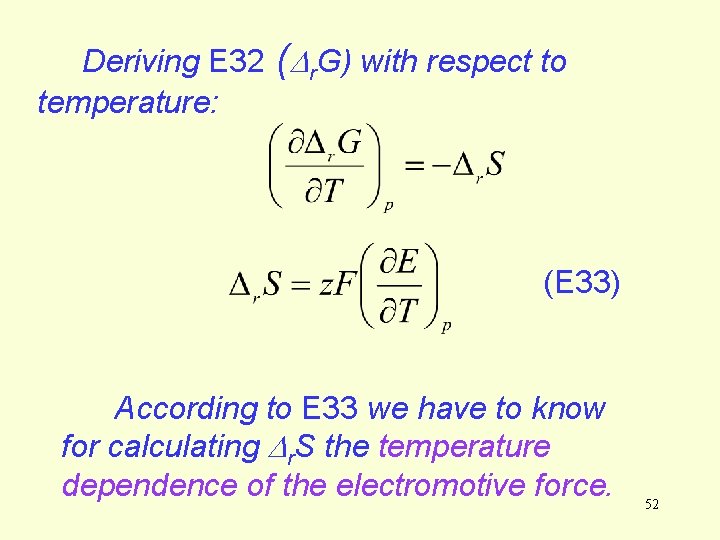
Deriving E 32 ( r. G) with respect to temperature: (E 33) According to E 33 we have to know for calculating r. S the temperature dependence of the electromotive force. 52
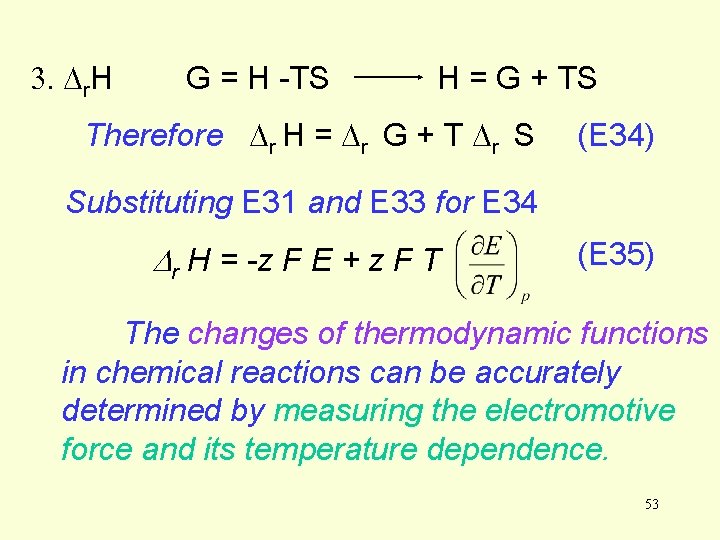
3. r. H G = H -TS H = G + TS Therefore r H = r G + T r S (E 34) Substituting E 31 and E 33 for E 34 r H = -z F E + z F T (E 35) The changes of thermodynamic functions in chemical reactions can be accurately determined by measuring the electromotive force and its temperature dependence. 53
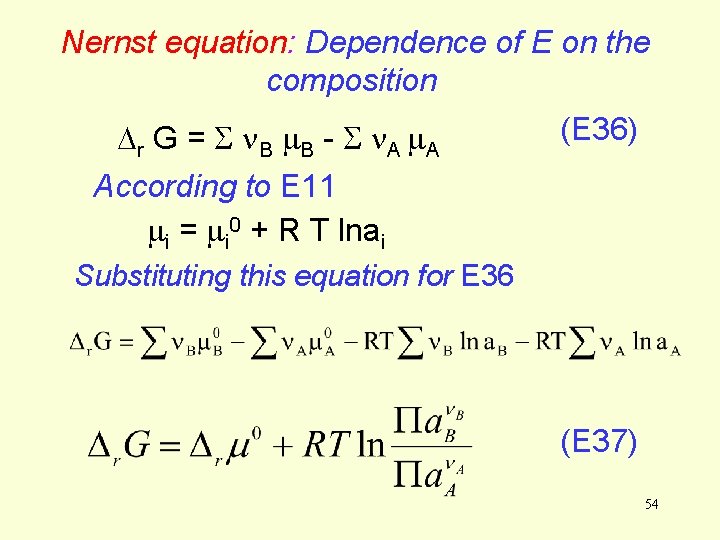
Nernst equation: Dependence of E on the composition r G = B B - A A (E 36) According to E 11 i = i 0 + R T lnai Substituting this equation for E 36 (E 37) 54
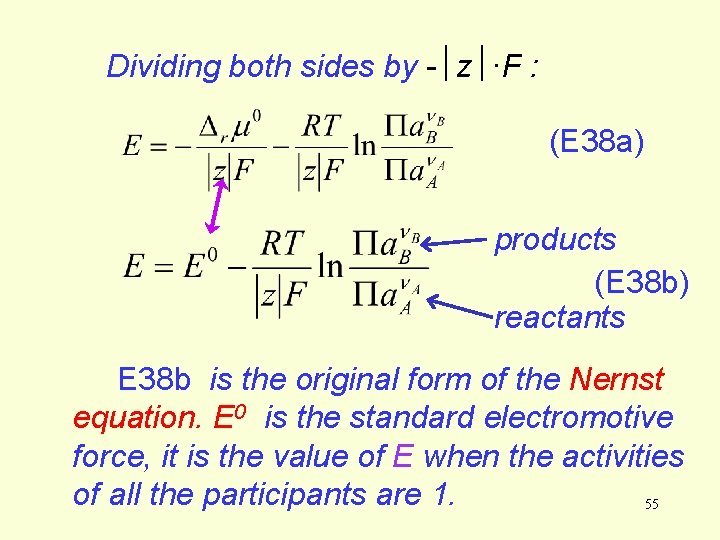
Dividing both sides by - z ·F : (E 38 a) products (E 38 b) reactants E 38 b is the original form of the Nernst equation. E 0 is the standard electromotive force, it is the value of E when the activities of all the participants are 1. 55
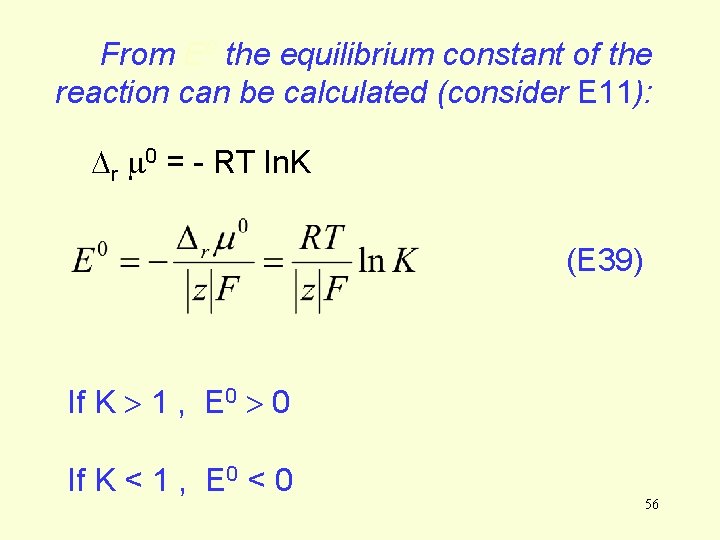
From E 0 the equilibrium constant of the reaction can be calculated (consider E 11): r 0 = - RT ln. K (E 39) If K 1 , E 0 0 If K < 1 , E 0 < 0 56
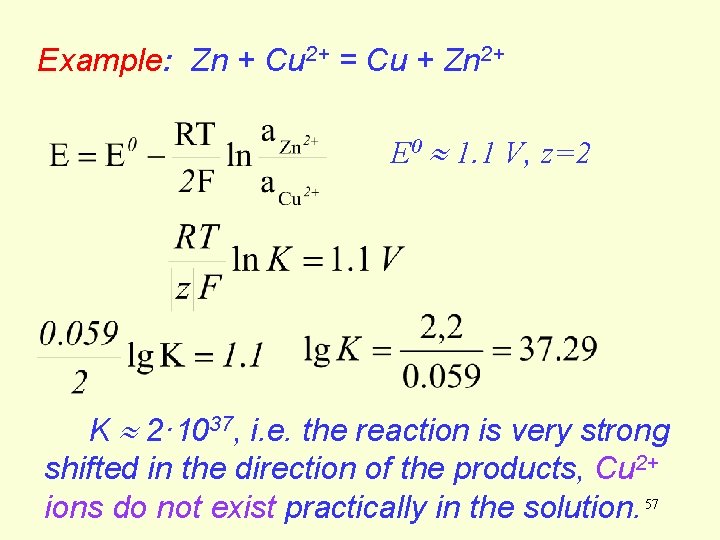
Example: Zn + Cu 2+ = Cu + Zn 2+ E 0 1. 1 V, z=2 K 2· 1037, i. e. the reaction is very strong shifted in the direction of the products, Cu 2+ ions do not exist practically in the solution. 57
E 8. Electrode potentials In a galvanic cell oxidation and reduction are separated in space (figure in section E). Anode - oxidation Cathode - reduction Many different electrodes can be constructed. Electrodes can be combined to form galvanic cells. 58
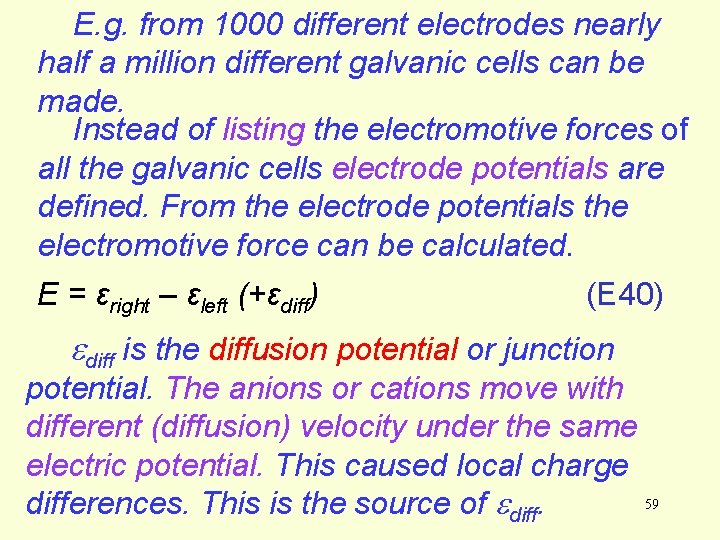
E. g. from 1000 different electrodes nearly half a million different galvanic cells can be made. Instead of listing the electromotive forces of all the galvanic cells electrode potentials are defined. From the electrode potentials the electromotive force can be calculated. E = εright – εleft (+εdiff) (E 40) ediff is the diffusion potential or junction potential. The anions or cations move with different (diffusion) velocity under the same electric potential. This caused local charge 59 differences. This is the source of ediff.
We have seen that the absolute values of electrode potentials cannot be determined. Therefore a relative electrode potential scale was defined. One electrode was selected as a standard, and the electrode potentials of all the electrodes are related to this standard. The selected electrode is the standard hydrogen electrode
In a standard hydrogen electrode a platinum wire dips in a solution where the activity of hydrogen ions (H 3 O+ ions) is 1, and hydrogen gas of 105 Pa standard pressure bubbles around the platinum. The adsorbed hydrogen molecules and the hydrogen (H 3 O+) ions in the solution take part in the electrode reaction. 61
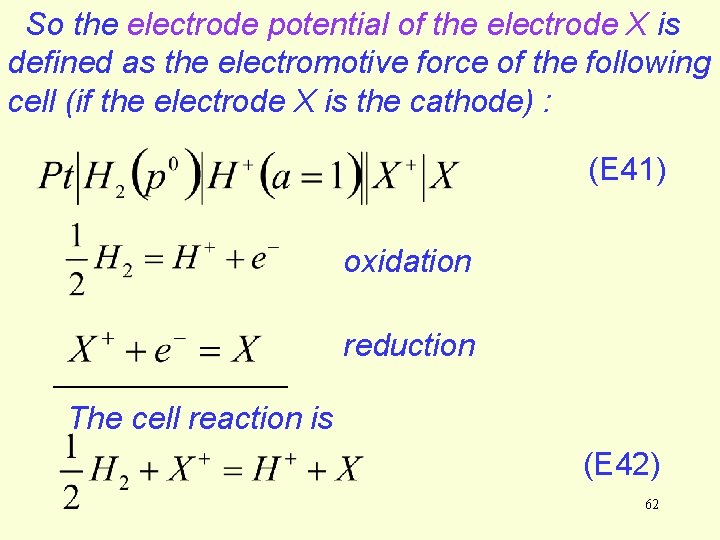
So the electrode potential of the electrode X is defined as the electromotive force of the following cell (if the electrode X is the cathode) : (E 41) oxidation reduction The cell reaction is (E 42) 62
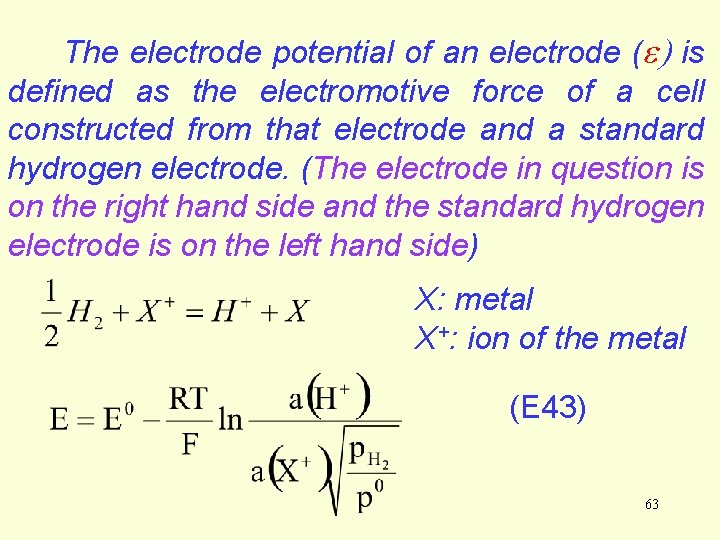
The electrode potential of an electrode (e) is defined as the electromotive force of a cell constructed from that electrode and a standard hydrogen electrode. (The electrode in question is on the right hand side and the standard hydrogen electrode is on the left hand side) X: metal X+: ion of the metal (E 43) 63
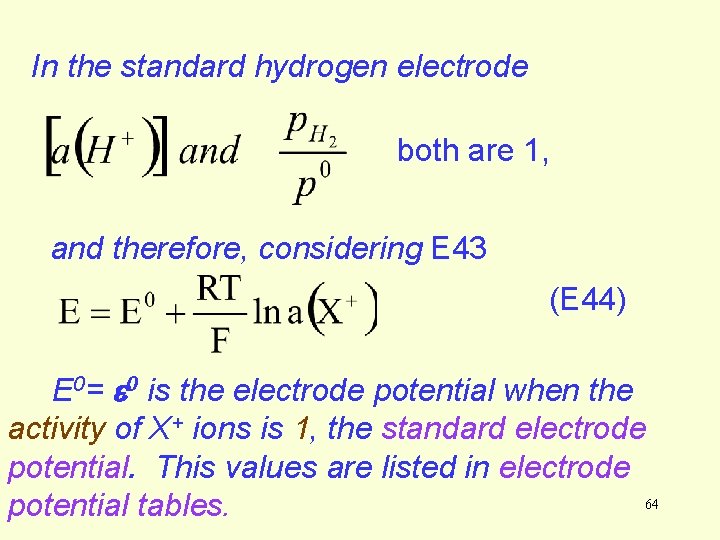
In the standard hydrogen electrode both are 1, and therefore, considering E 43 (E 44) E 0= 0 is the electrode potential when the activity of X+ ions is 1, the standard electrode potential. This values are listed in electrode 64 potential tables.
If the electrode potential is positive, the electrode oxidizes H 2. If the electrode potential is negative, the electrode reduces H+. In general, the value of the electrode potential shows the oxidizing-reducing ability of the system. A system having more positive electrode potential oxidizes the system having more negative electrode potential. 65
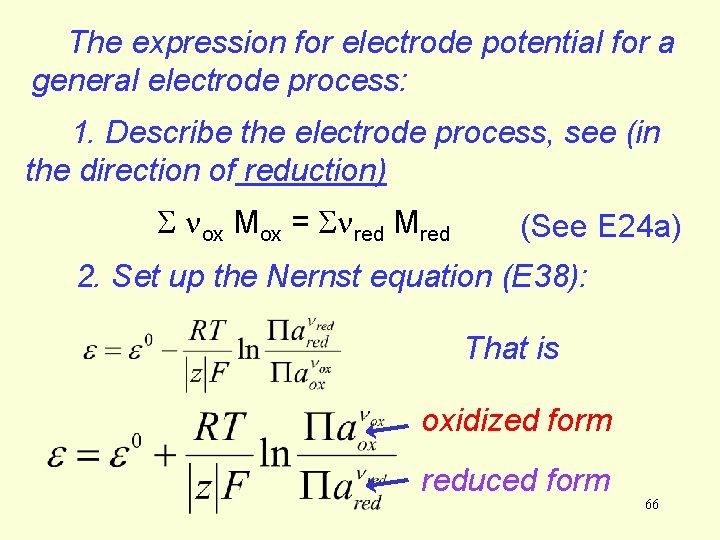
The expression for electrode potential for a general electrode process: 1. Describe the electrode process, see (in the direction of reduction) ox Mox = red Mred (See E 24 a) 2. Set up the Nernst equation (E 38): That is oxidized form reduced form 66
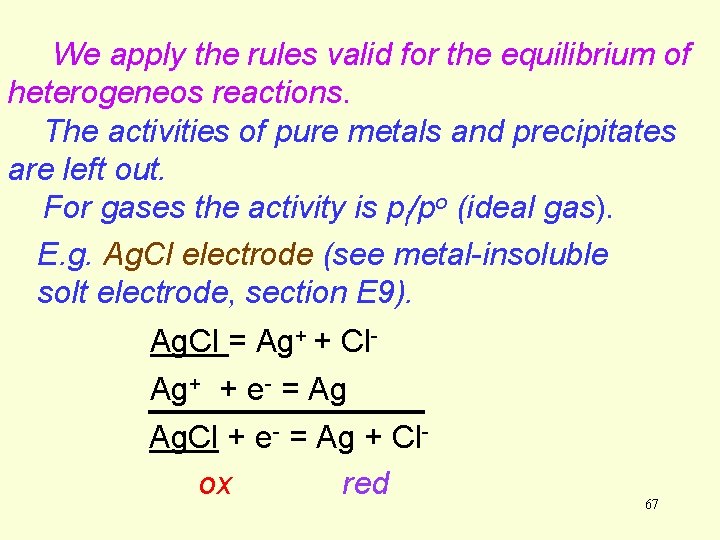
We apply the rules valid for the equilibrium of heterogeneos reactions. The activities of pure metals and precipitates are left out. For gases the activity is pi/po (ideal gas). E. g. Ag. Cl electrode (see metal-insoluble solt electrode, section E 9). Ag. Cl = Ag+ + Cl. Ag+ + e- = Ag Ag. Cl + e- = Ag + Clox red 67
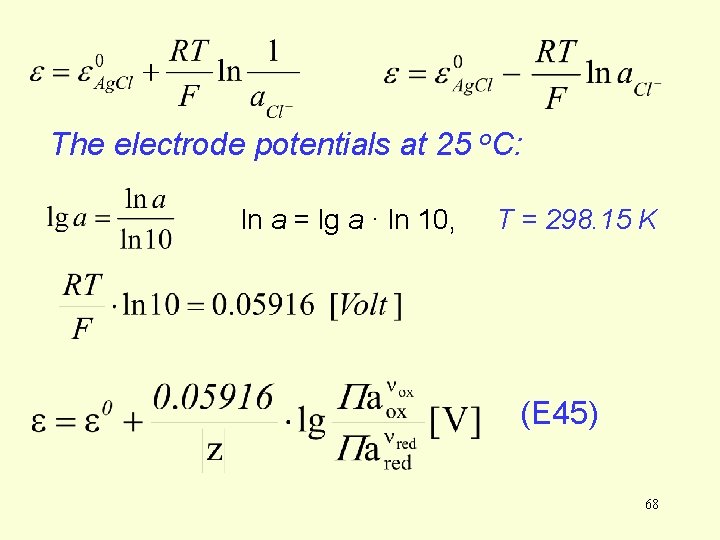
The electrode potentials at 25 o. C: ln a = lg a · ln 10, T = 298. 15 K (E 45) 68
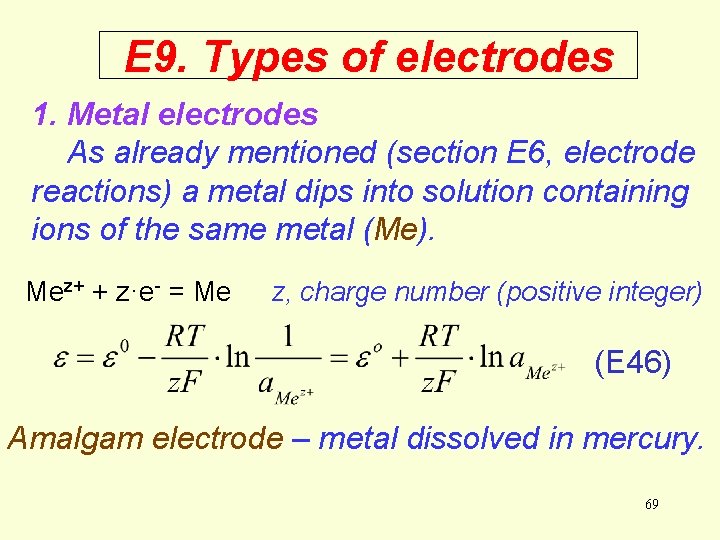
E 9. Types of electrodes 1. Metal electrodes As already mentioned (section E 6, electrode reactions) a metal dips into solution containing ions of the same metal (Me). Mez+ + z·e- = Me z, charge number (positive integer) (E 46) Amalgam electrode – metal dissolved in mercury. 69
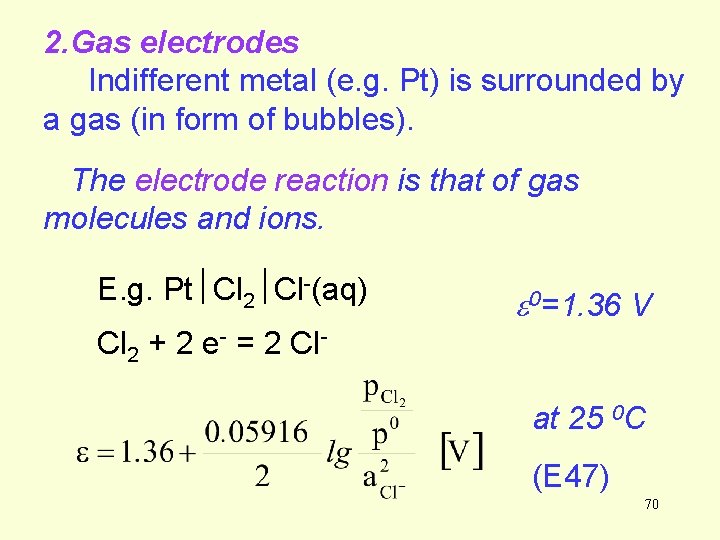
2. Gas electrodes Indifferent metal (e. g. Pt) is surrounded by a gas (in form of bubbles). The electrode reaction is that of gas molecules and ions. E. g. Pt Cl 2 Cl-(aq) e 0=1. 36 V Cl 2 + 2 e- = 2 Clat 25 0 C (E 47) 70
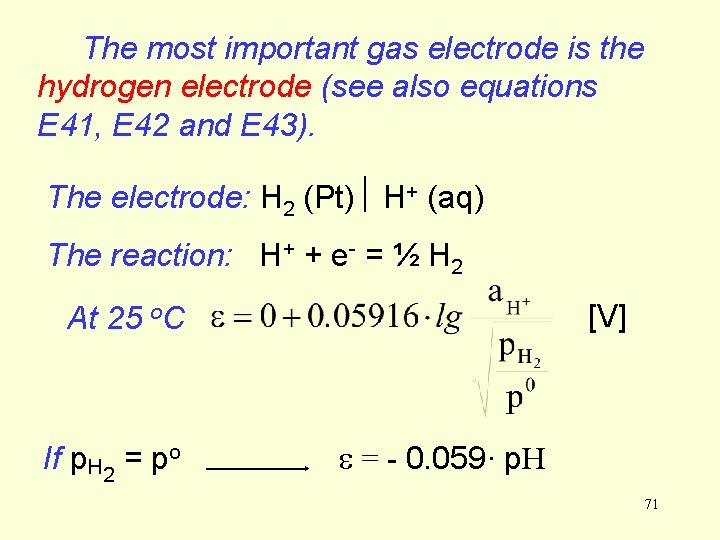
The most important gas electrode is the hydrogen electrode (see also equations E 41, E 42 and E 43). The electrode: H 2 (Pt) H+ (aq) The reaction: H+ + e- = ½ H 2 [V] At 25 o. C If p. H 2 = po = - 0. 059· p. H 71
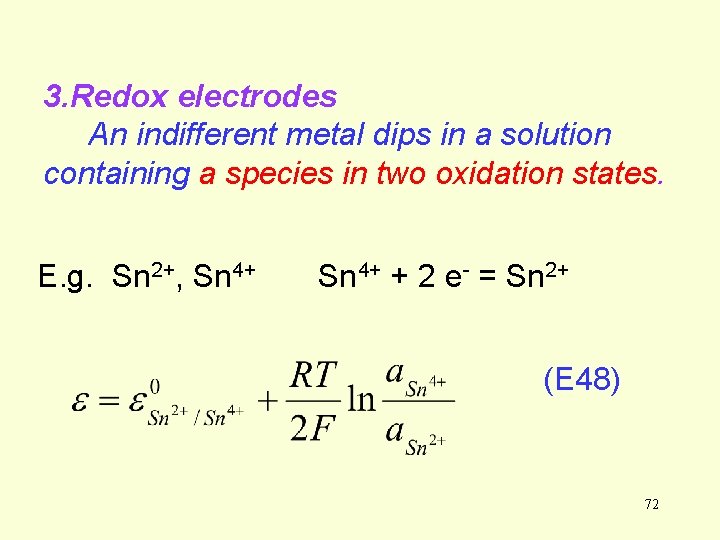
3. Redox electrodes An indifferent metal dips in a solution containing a species in two oxidation states. E. g. Sn 2+, Sn 4+ + 2 e- = Sn 2+ (E 48) 72
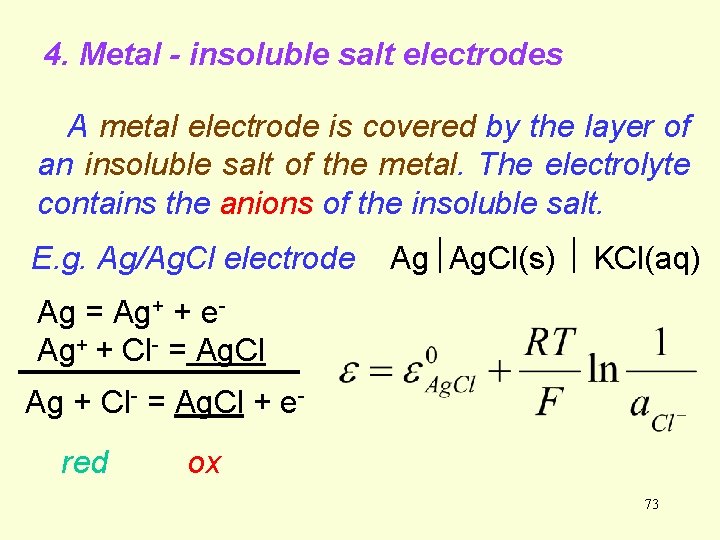
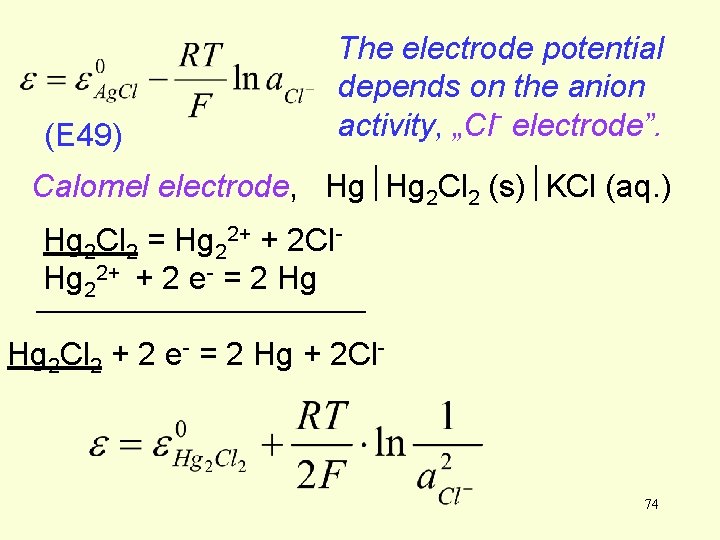
4. Metal - insoluble salt electrodes A metal electrode is covered by the layer of an insoluble salt of the metal. The electrolyte contains the anions of the insoluble salt. E. g. Ag/Ag. Cl electrode Ag Ag. Cl(s) KCl(aq) Ag = Ag+ + e. Ag+ + Cl- = Ag. Cl Ag + Cl- = Ag. Cl + ered ox 73
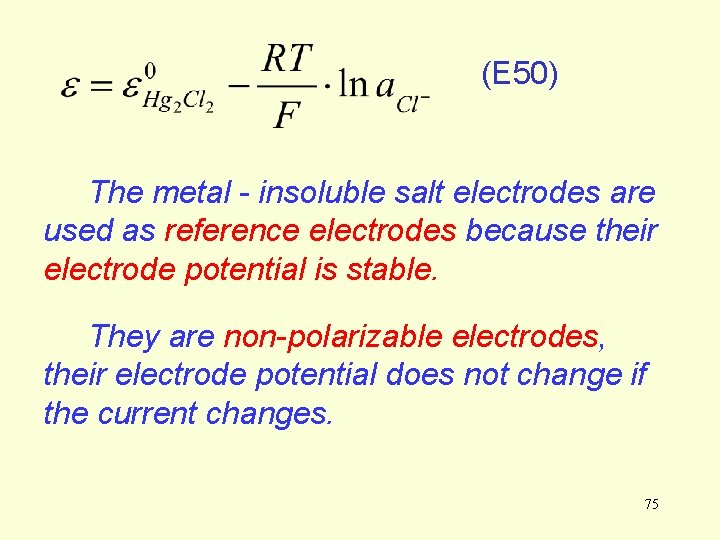
(E 49) The electrode potential depends on the anion activity, „Cl- electrode”. Calomel electrode, Hg Hg 2 Cl 2 (s) KCl (aq. ) Hg 2 Cl 2 = Hg 22+ + 2 Cl. Hg 22+ + 2 e- = 2 Hg Hg 2 Cl 2 + 2 e- = 2 Hg + 2 Cl- 74
(E 50) The metal - insoluble salt electrodes are used as reference electrodes because their electrode potential is stable. They are non-polarizable electrodes, their electrode potential does not change if the current changes. 75
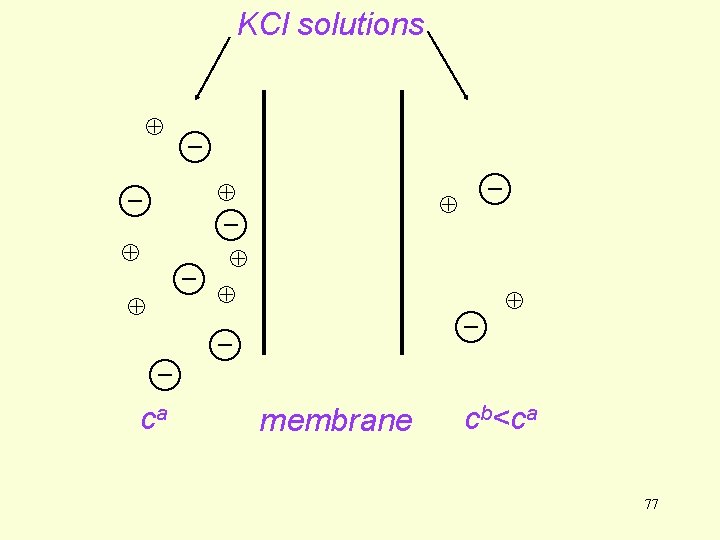
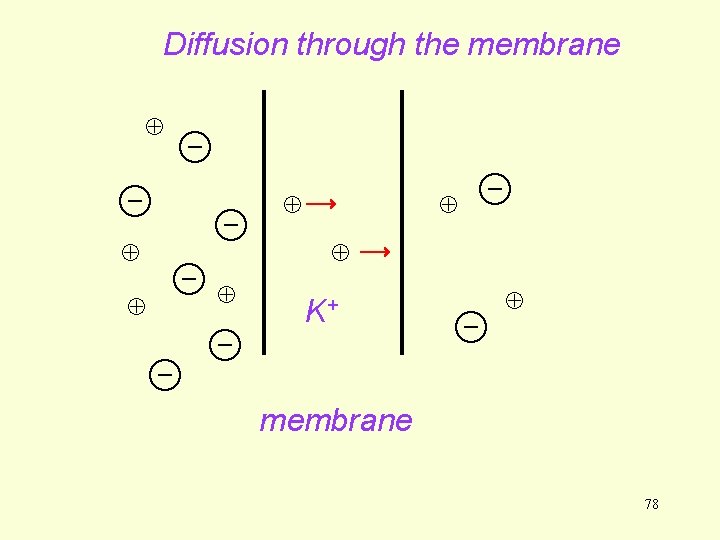
E 10. Membrane potentials, glass electrodes Membranes are significant in biology. The walls of living cells behave as membranes. Consider e. g. two solutions of different concentrations of KCl, and let the membrane dividing them be permeable only to K+. The K+ ions tend to diffuse into the more dilute solution but the Cl- ions cannot follow. 76
KCl solutions ca membrane cb<ca 77
Diffusion through the membrane K+ membrane 78
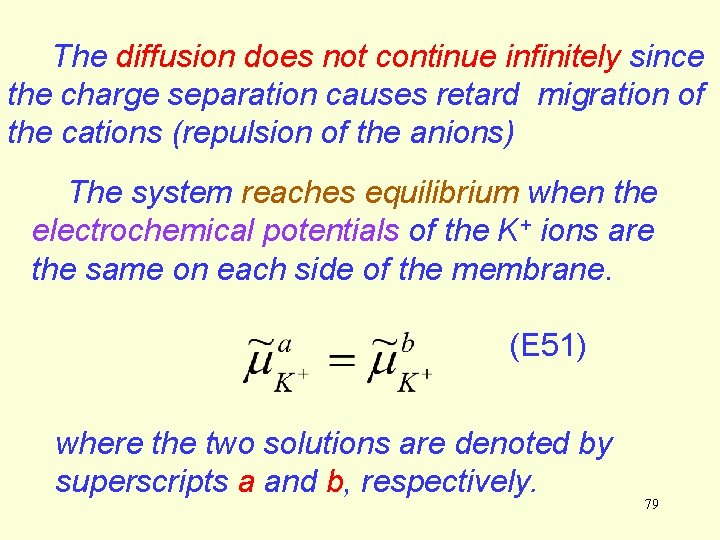
The diffusion does not continue infinitely since the charge separation causes retard migration of the cations (repulsion of the anions) The system reaches equilibrium when the electrochemical potentials of the K+ ions are the same on each side of the membrane. (E 51) where the two solutions are denoted by superscripts a and b, respectively. 79
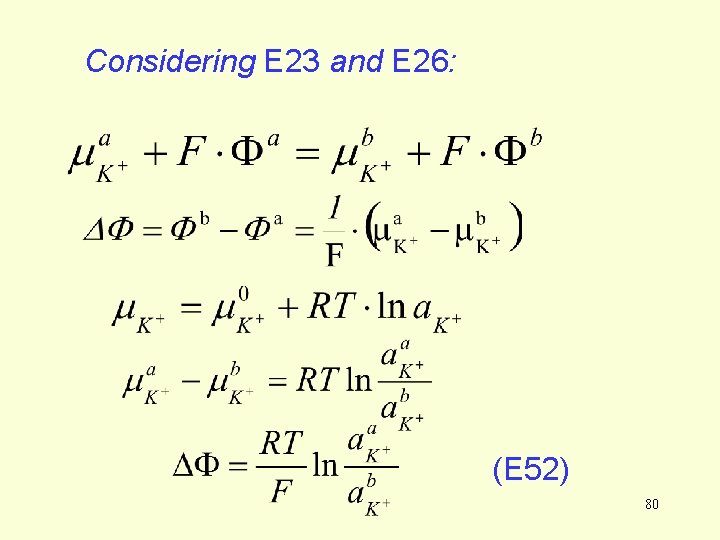
Considering E 23 and E 26: (E 52) 80
Glass electrodes are used for measuring p. H. The main part of the glass electrode is a glass membrane of special composition. It consists of Si-O frame with negative charge compensated by positive ions (Li+, Na+, Ca 2+). The positive ions are mobile so the membrane slightly conducts electricity. Thickness ~0. 05 mm. Resistance 107 - 109 ohm. 81
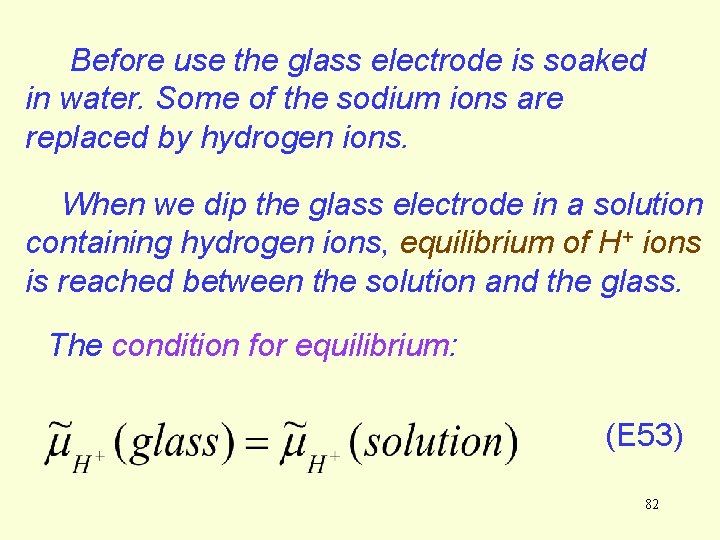
Before use the glass electrode is soaked in water. Some of the sodium ions are replaced by hydrogen ions. When we dip the glass electrode in a solution containing hydrogen ions, equilibrium of H+ ions is reached between the solution and the glass. The condition for equilibrium: (E 53) 82
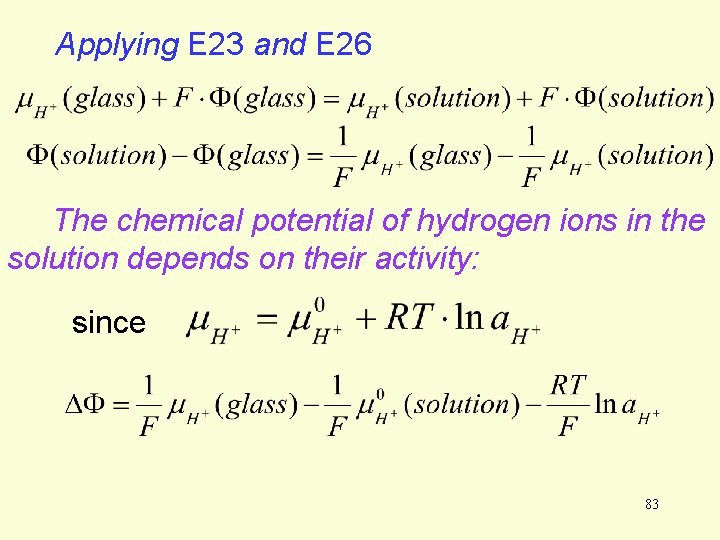
Applying E 23 and E 26 The chemical potential of hydrogen ions in the solution depends on their activity: since 83
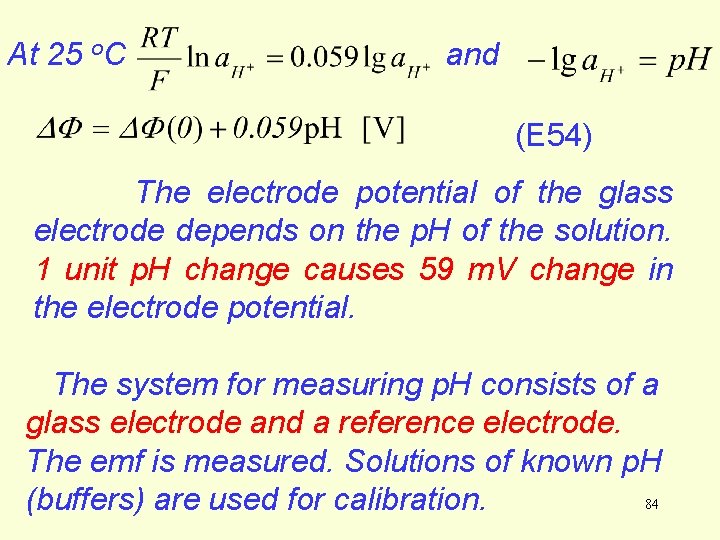
At 25 o. C and (E 54) The electrode potential of the glass electrode depends on the p. H of the solution. 1 unit p. H change causes 59 m. V change in the electrode potential. The system for measuring p. H consists of a glass electrode and a reference electrode. The emf is measured. Solutions of known p. H 84 (buffers) are used for calibration.
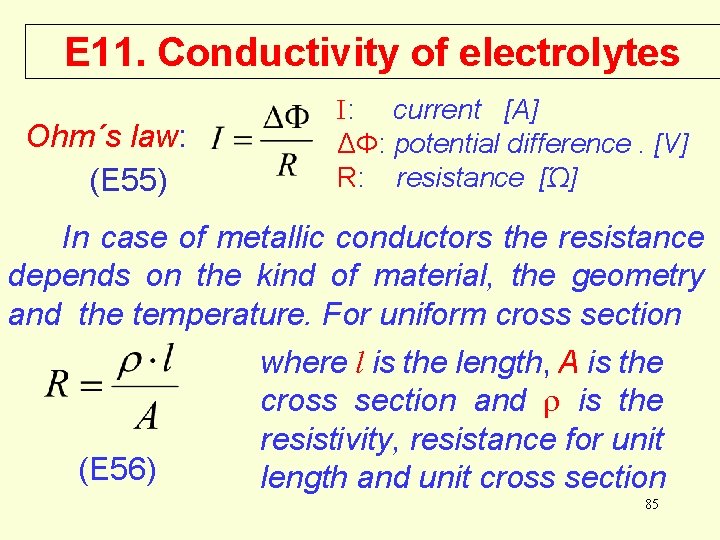
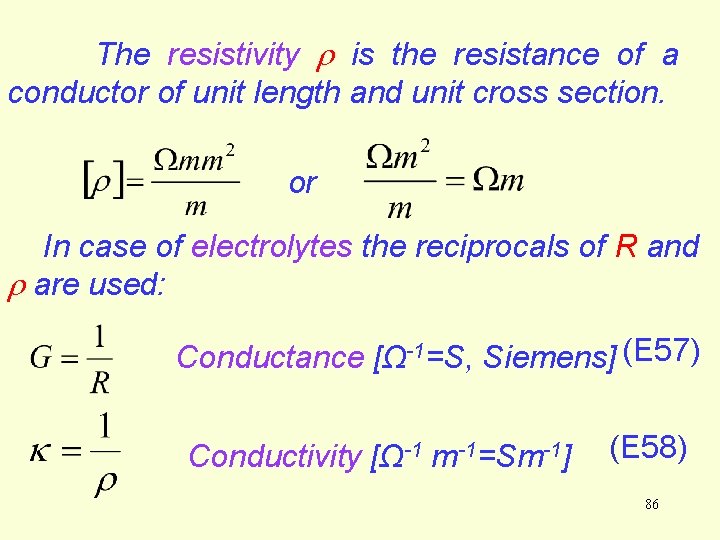
E 11. Conductivity of electrolytes Ohm´s law: (E 55) I: current [A] ΔΦ: potential difference. [V] R: resistance [Ώ] In case of metallic conductors the resistance depends on the kind of material, the geometry and the temperature. For uniform cross section (E 56) where l is the length, A is the cross section and r is the resistivity, resistance for unit length and unit cross section 85
The resistivity r is the resistance of a conductor of unit length and unit cross section. or In case of electrolytes the reciprocals of R and r are used: Conductance [Ω-1=S, Siemens] (E 57) Conductivity [Ω-1 m-1=Sm-1] (E 58) 86
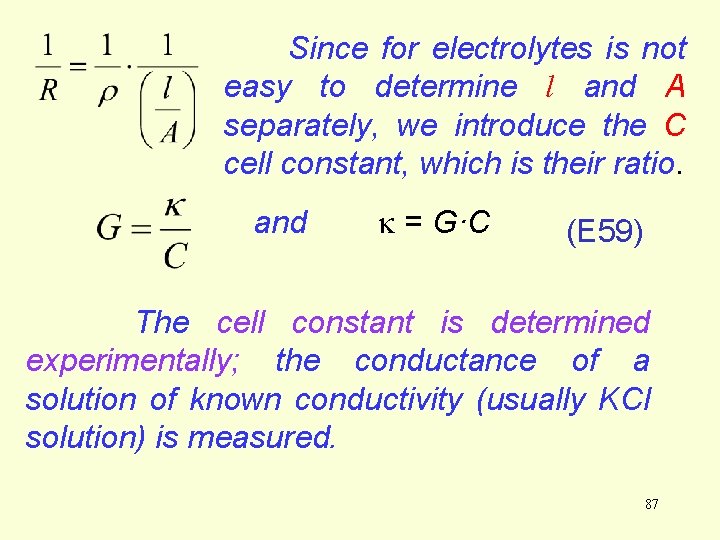
Since for electrolytes is not easy to determine l and A separately, we introduce the C cell constant, which is their ratio. and k = G·C (E 59) The cell constant is determined experimentally; the conductance of a solution of known conductivity (usually KCl solution) is measured. 87
Several parameters determine the values of G and k: Conductance depends on a) the type of electrolyte b) concentration c) temperature d) the geometry of the cell. Conductivity depends only on a) the type of electrolyte b) concentration c) temperature 88
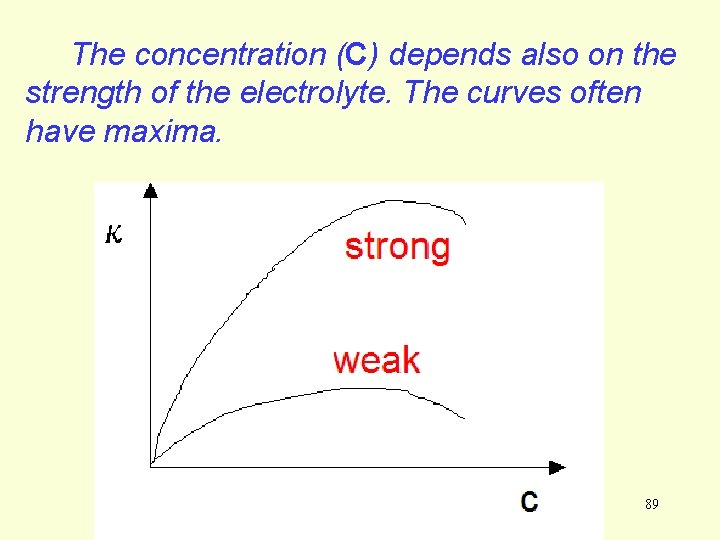
The concentration (C) depends also on the strength of the electrolyte. The curves often have maxima. 89
What is the explanation of the decreasing conductivity at higher concentrations? Weak electrolytes: the degree of dissociation decreases. Less ions take part in carrying electric charges. Strong electrolytes: (the degree of dissociation is 100 %) The ions are too close and disturb one another in migration. 90
Temperature dependence of conductivity. In contrast to metals, the conductivity of electrolytes increases with increasing temperature (resistivity decreases). Explanation: The ions migrate with the solvent (water) molecules attached to them. It is the viscosity of water ( ) that hinders the migration of ions (for viscosity see equation T 12 and subsection „T 4. Viscosity”) T increases decreases k increases 91
Around room temperature the viscosity of water decreases by 2 -2. 5 per cent per degree. For the majority of electrolytes in aqueous solution the conductivity increases by 2 -2. 5 per cent per degree. So one can assume for the first approximation that the temperature dependence of conductivity is independent of the type of ion. The conductivity of a solution is the sum of conductivities of ions: k = kion (E 60) 92
E 12. Molar conductivity ( ) is defined as the ratio of conductivity and concentration: (E 61) where V (m 3/mol) is the reciprocal of concentration, the molar volume. The unit of the molar conductivity is [ ] = -1 m 3 mol-1 = -1 m 2 mol-1 = =Sm 2 mol-1. Siemens (S) in the unit of the electric conductivity ( ). Here the concentration has to be expressed in mol m-3 units. 93
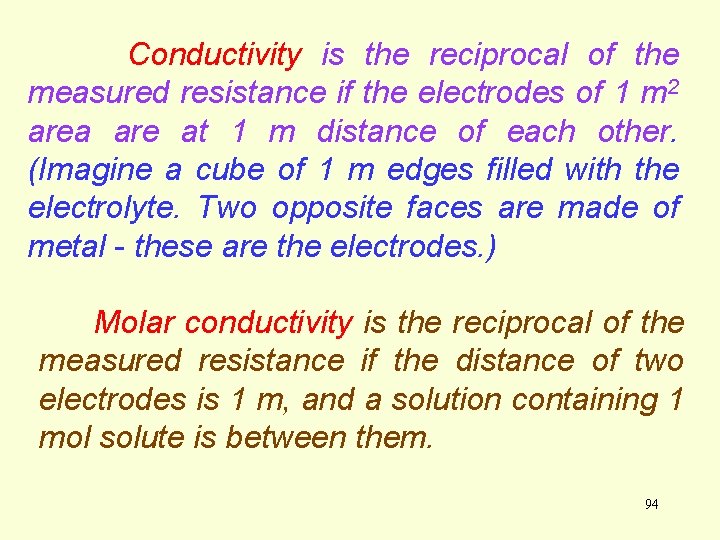
Conductivity is the reciprocal of the measured resistance if the electrodes of 1 m 2 area are at 1 m distance of each other. (Imagine a cube of 1 m edges filled with the electrolyte. Two opposite faces are made of metal - these are the electrodes. ) Molar conductivity is the reciprocal of the measured resistance if the distance of two electrodes is 1 m, and a solution containing 1 mol solute is between them. 94
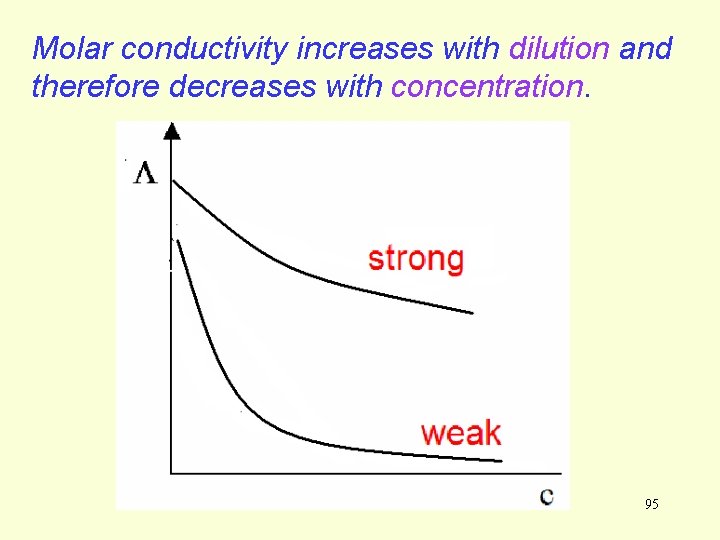
Molar conductivity increases with dilution and therefore decreases with concentration. 95
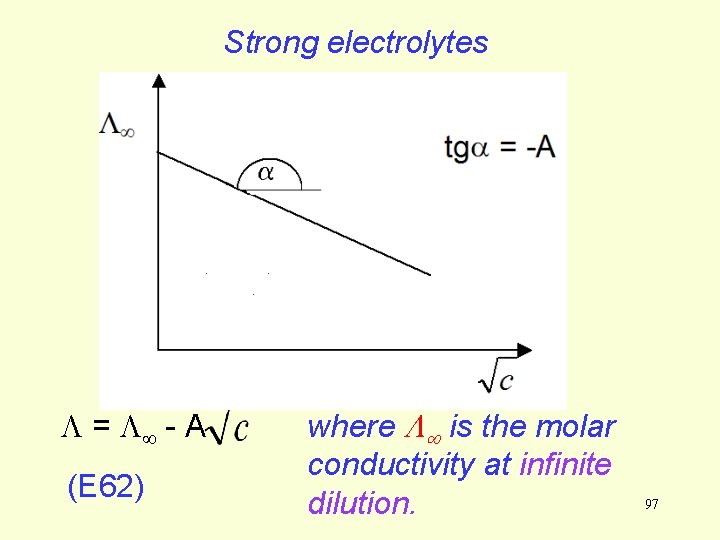
Weak electrolytes: The degree of dissociation increases with dilution, so the number of ions increases, too. Strong electrolytes: The degree of dissociation is nearly 100 percent both in dilute and in concentrated solution. At higher concentrations the ions disturb one another in migration. Kohlrausch´s law says that in case of strong electrolytes is proportional to the square root of concentration (next slide). 96
Strong electrolytes = - A (E 62) where is the molar conductivity at infinite dilution. 97
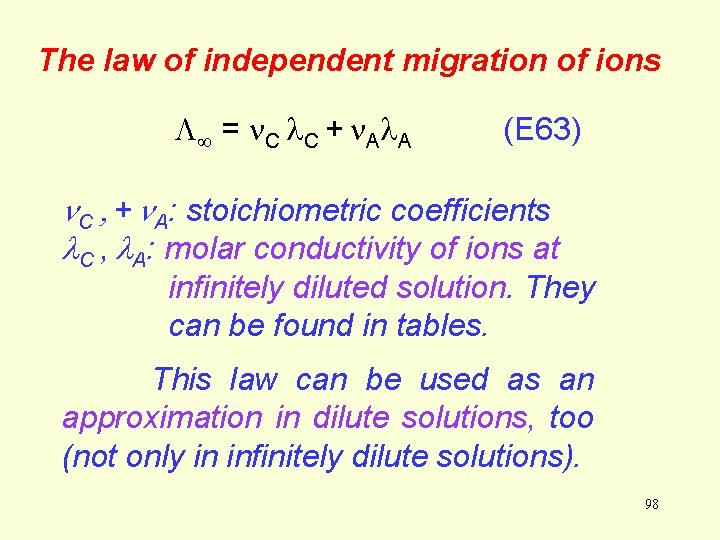
The law of independent migration of ions = C C + A A (E 63) C , + A: stoichiometric coefficients C , A: molar conductivity of ions at infinitely diluted solution. They can be found in tables. This law can be used as an approximation in dilute solutions, too (not only in infinitely dilute solutions). 98
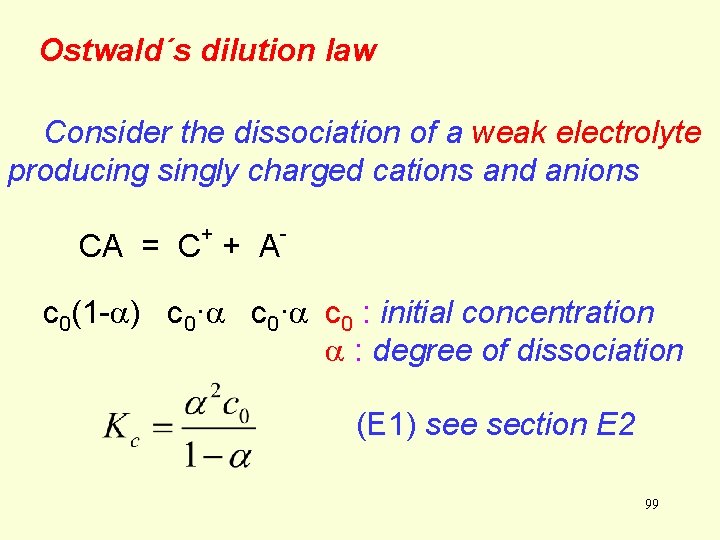
Ostwald´s dilution law Consider the dissociation of a weak electrolyte producing singly charged cations and anions + CA = C + A - c 0(1 - ) c 0· c 0 : initial concentration : degree of dissociation (E 1) see section E 2 99
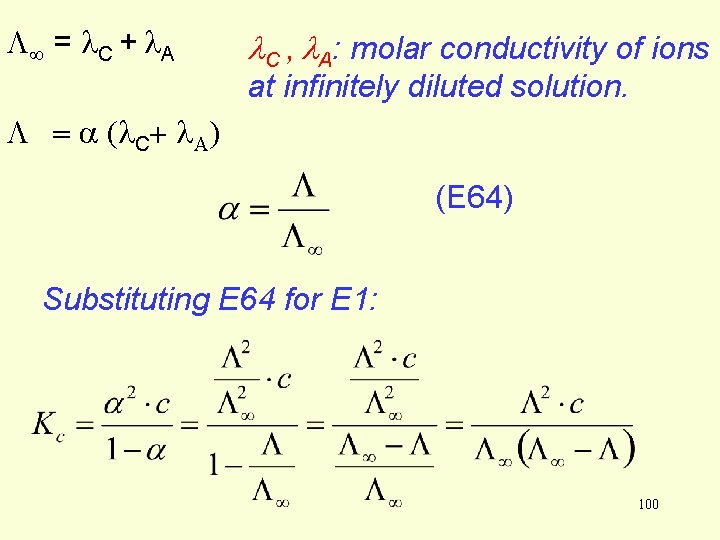
= C + A C , A: molar conductivity of ions at infinitely diluted solution. = ( C+ A) (E 64) Substituting E 64 for E 1: 100
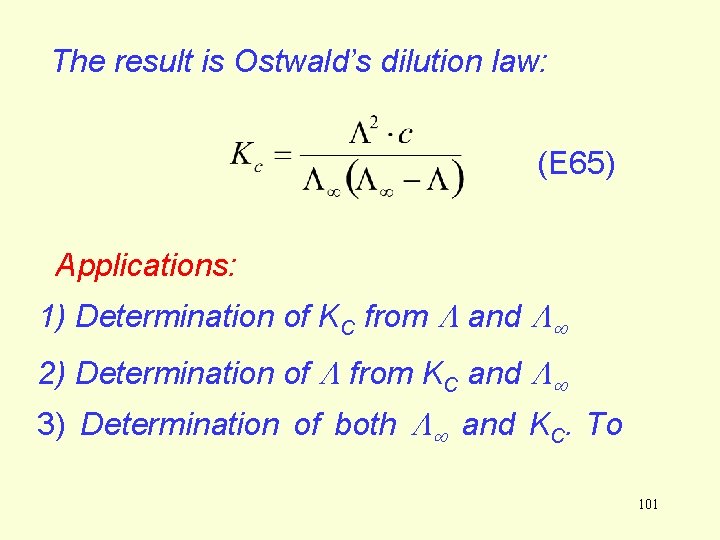
The result is Ostwald’s dilution law: (E 65) Applications: 1) Determination of KC from and 2) Determination of from KC and 3) Determination of both and KC. To 101