
Electroanalytical Chemsitry and Its Biological Applications 2014 Masstransfercontrolled
生物电分析化学 Electroanalytical Chemsitry and Its Biological Applications 主讲人:刘宏 教授 2014年秋
Mass-transfer-controlled electrochemical process (传质控制的电化学过程) 1. Mass transfer (���程 ) 2. Limiting Current (极限�流 ) 3. Chronoamperometry (���位法 )
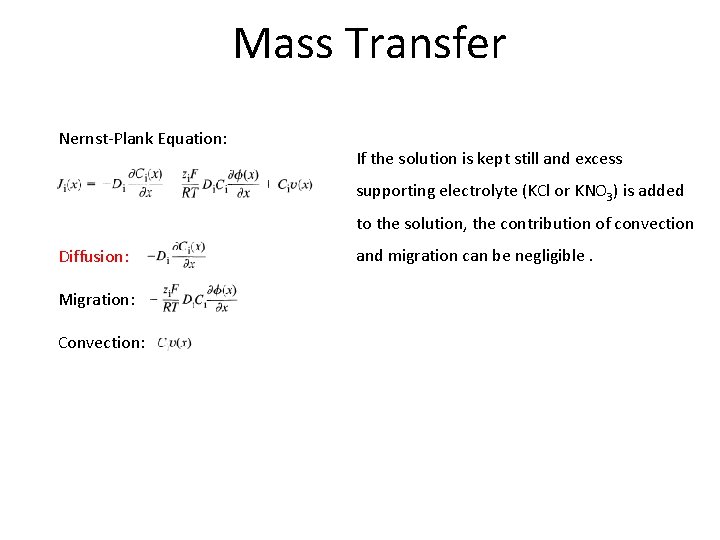
Mass Transfer Nernst-Plank Equation: If the solution is kept still and excess supporting electrolyte (KCl or KNO 3) is added to the solution, the contribution of convection Diffusion: Migration: Convection: and migration can be negligible.

Linear Diffusion Fick's Laws of Diffusion Jo(x, t) - the flux of a substance О at a given location x at a time t unit: mol/s/cm 2 Fick's second law pertains to the change in concentration of О with time
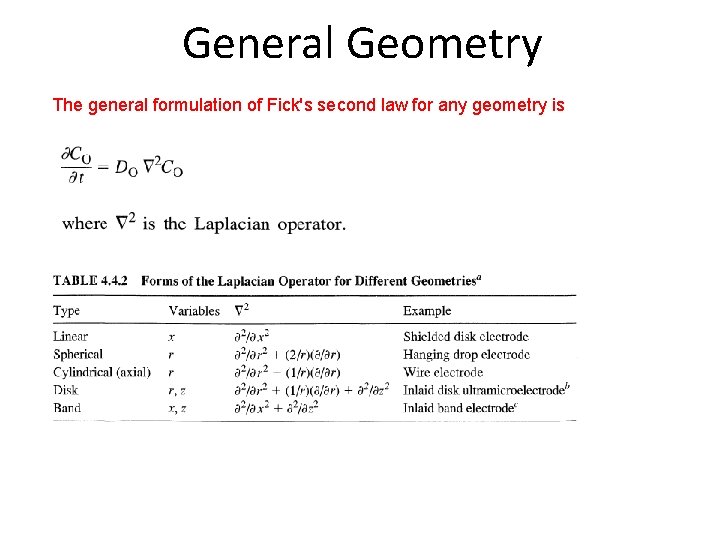
General Geometry The general formulation of Fick's second law for any geometry is

Planar electrode/linear diffusion Boundary conditions: Current-time response (Cottrell equation): Concentration profile 2(Dot)1/2 – thickness of diffusion layer

Experimental Limitation p Limitations in the recording device. p Charging current p Convection

Spherical electrode/diffusion Concentration profile: Boundary conditions: Diffusion current: Which means:
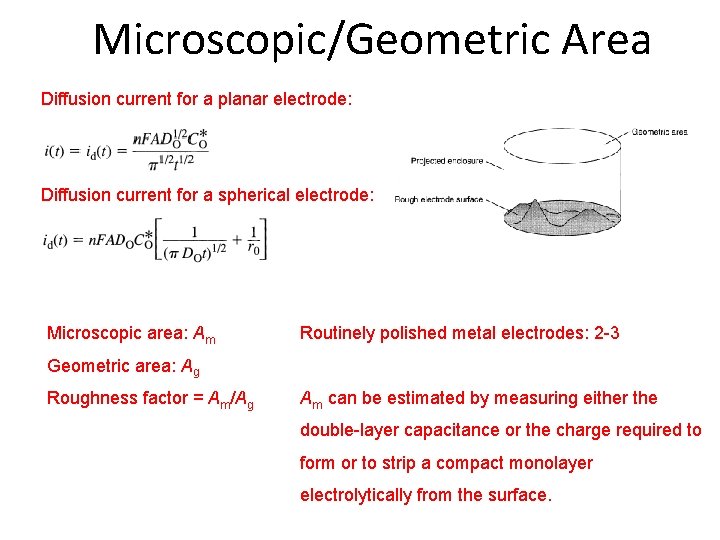
Microscopic/Geometric Area Diffusion current for a planar electrode: Diffusion current for a spherical electrode: Microscopic area: Am Routinely polished metal electrodes: 2 -3 Geometric area: Ag Roughness factor = Am/Ag Am can be estimated by measuring either the double-layer capacitance or the charge required to form or to strip a compact monolayer electrolytically from the surface.
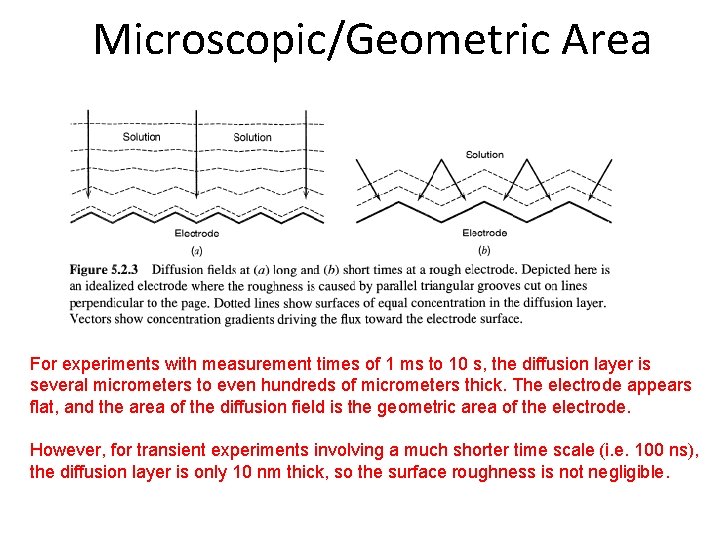
Microscopic/Geometric Area For experiments with measurement times of 1 ms to 10 s, the diffusion layer is several micrometers to even hundreds of micrometers thick. The electrode appears flat, and the area of the diffusion field is the geometric area of the electrode. However, for transient experiments involving a much shorter time scale (i. e. 100 ns), the diffusion layer is only 10 nm thick, so the surface roughness is not negligible.
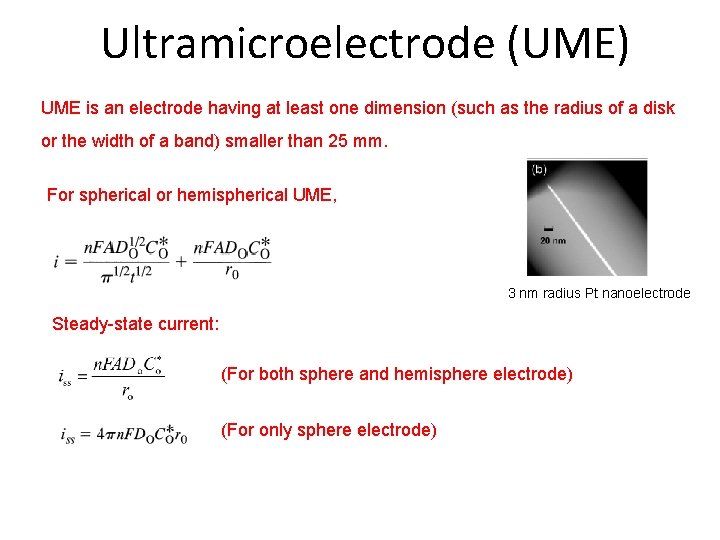
Ultramicroelectrode (UME) UME is an electrode having at least one dimension (such as the radius of a disk or the width of a band) smaller than 25 mm. For spherical or hemispherical UME, 3 nm radius Pt nanoelectrode Steady-state current: (For both sphere and hemisphere electrode) (For only sphere electrode)
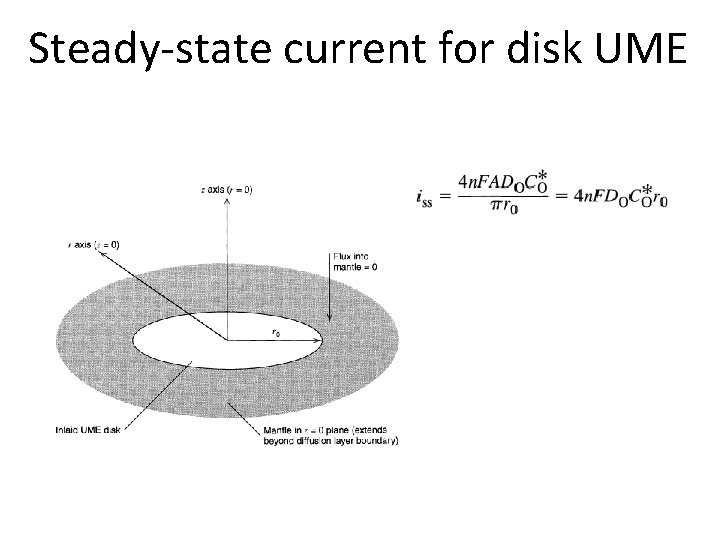
Steady-state current for disk UME
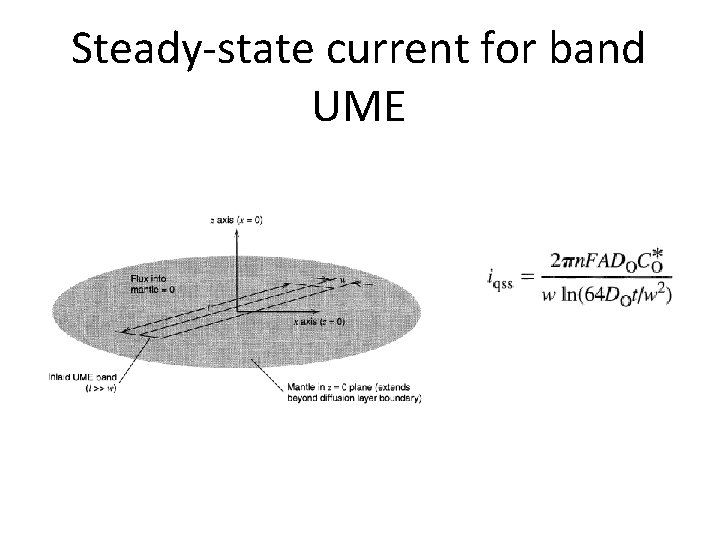
Steady-state current for band UME
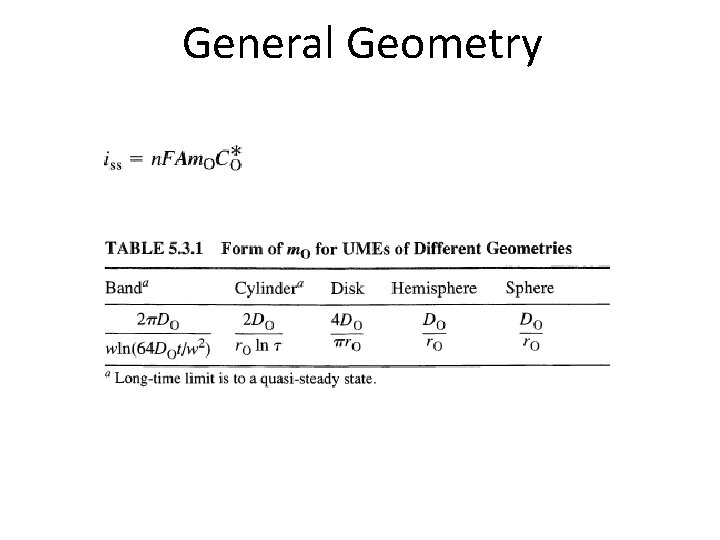
General Geometry
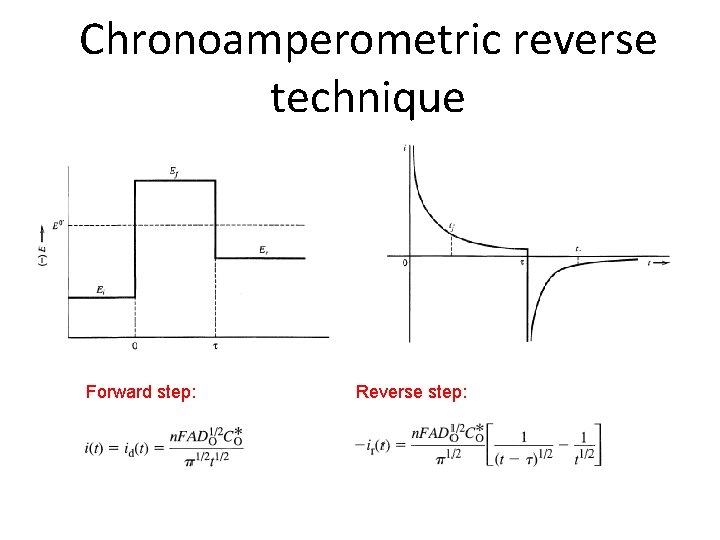
Chronoamperometric reverse technique Forward step: Reverse step:
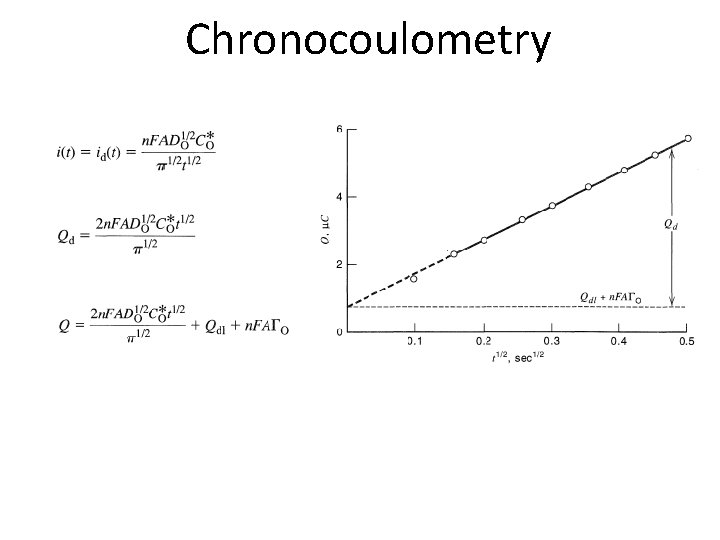
Chronocoulometry
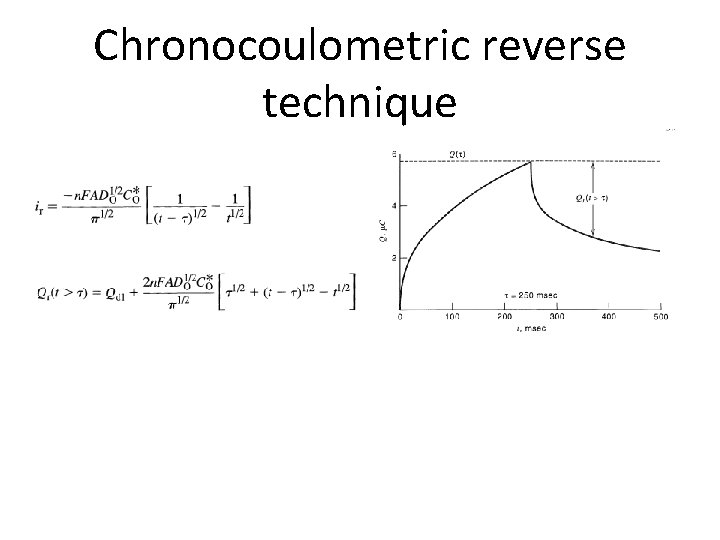
Chronocoulometric reverse technique
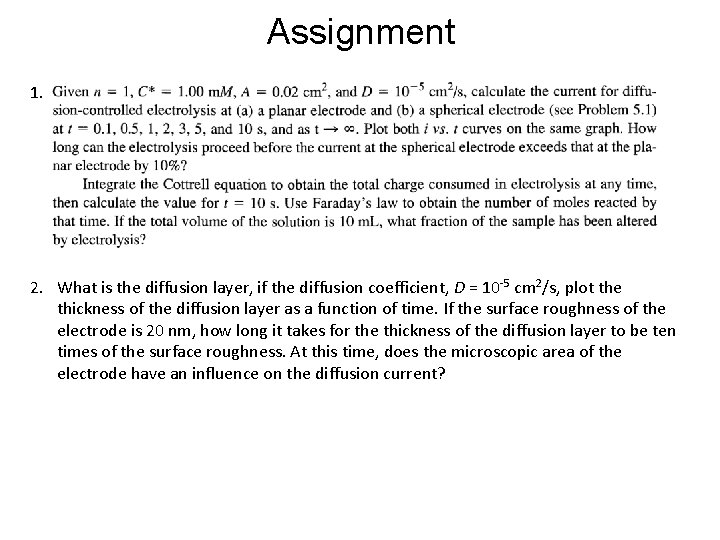
Assignment 1. 2. What is the diffusion layer, if the diffusion coefficient, D = 10 -5 cm 2/s, plot the thickness of the diffusion layer as a function of time. If the surface roughness of the electrode is 20 nm, how long it takes for the thickness of the diffusion layer to be ten times of the surface roughness. At this time, does the microscopic area of the electrode have an influence on the diffusion current?
- Slides: 18