
ELECTRICITY Part 1 Electrostatics One of the three
- Slides: 17
ELECTRICITY Part 1: Electrostatics.
►One of the three basic energy use sectors.
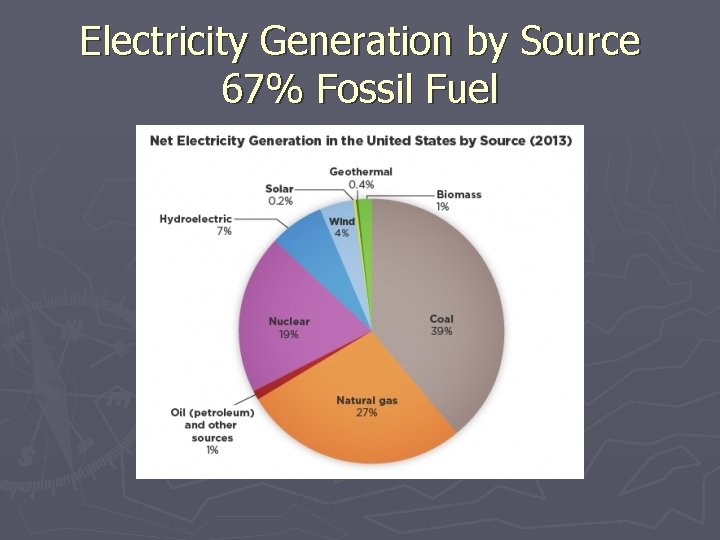
Electricity Generation by Source 67% Fossil Fuel
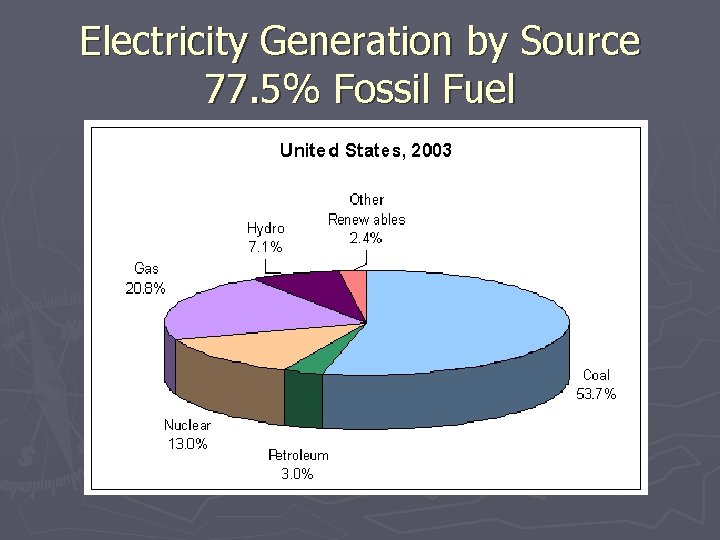
Electricity Generation by Source 77. 5% Fossil Fuel
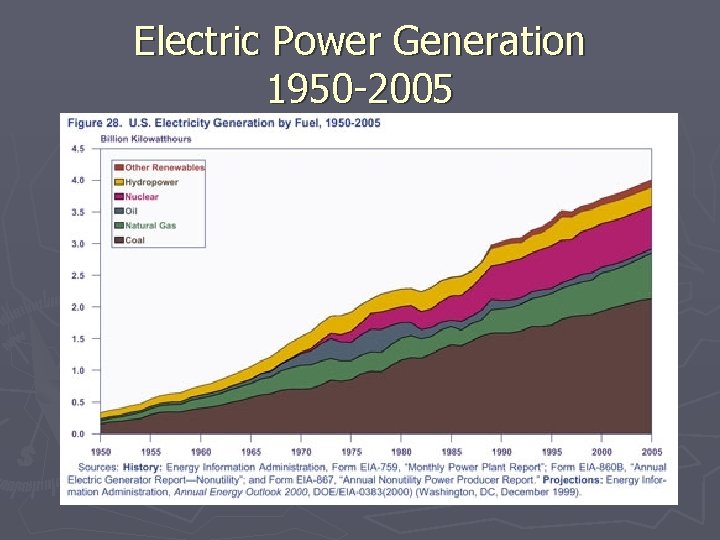
Electric Power Generation 1950 -2005
Electrostatics ► Study of charges that are NOT moving. ► What is Charge? ► A new property of matter. Similar to mass. ► Mass creates and responds to gravitational fields ► Charges create and respond to electric fields.
► There are two types of charges (Ben Franklin): § positive (+) § negative (-) ► Symbols for charge are q or Q ► Units of charge: Coulomb (C) ► A Coulomb is a lot of charge. Usually deal in micro coulombs and less in electrostatics. ► Fundamental charge: Magnitude of the charge on an electron or proton. ►e=1. 602 x 10 -19 C ► Like charges repel, Unlike charges attract.
Definitions ► Conductor: Material that charges are free to move around in. Examples: metal (silver is best but copper is almost as good) ► Insulator (Dielectric): Material that charges are NOT free to move around in. Examples: glass, quartz, wood. ► Semiconductor: Can behave as either depending on conditions: Silicon, Germanium, Gallium. Arsenide.
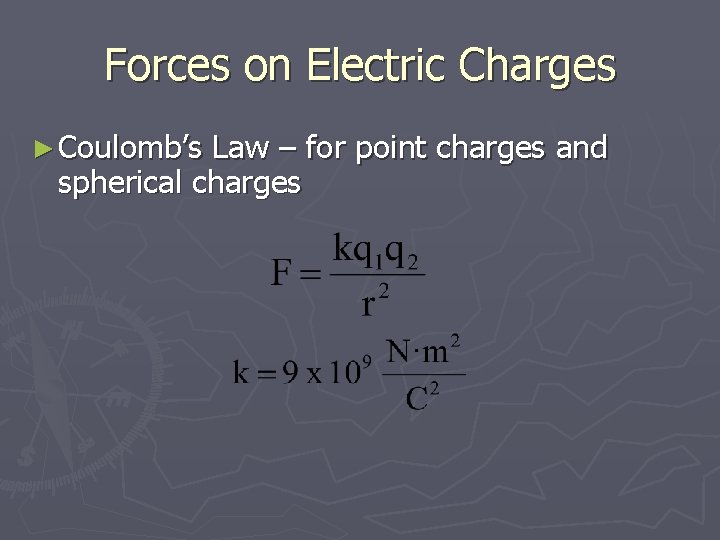
Forces on Electric Charges ► Coulomb’s Law – for point charges and spherical charges
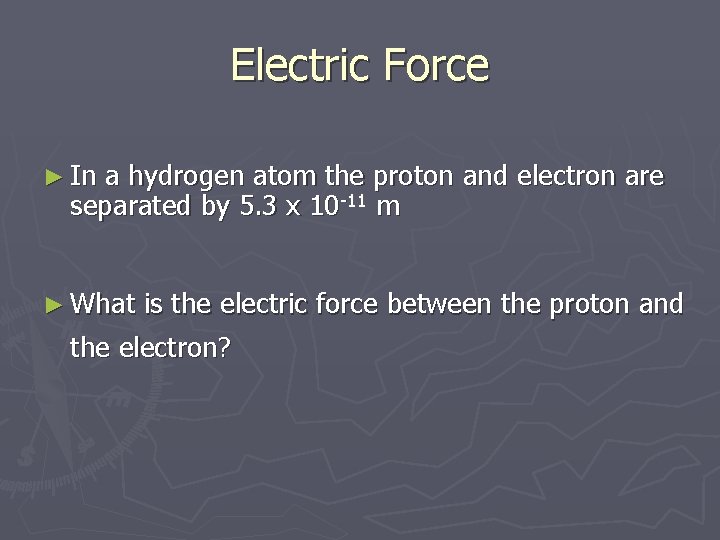
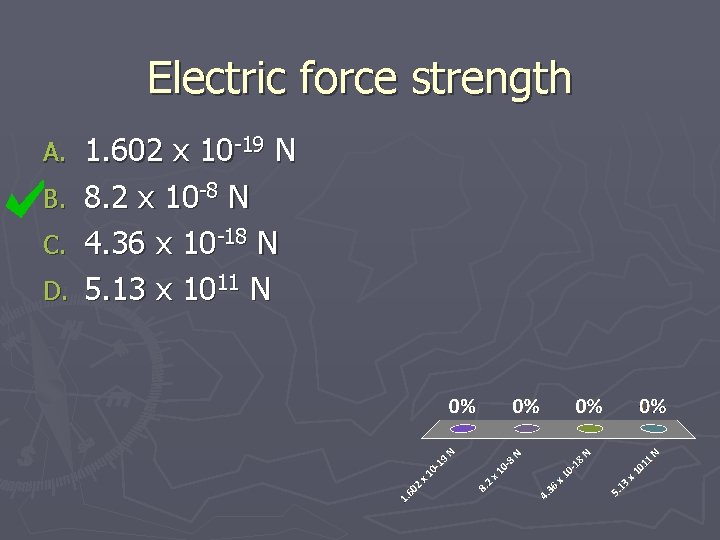
Electric Force ► In a hydrogen atom the proton and electron are separated by 5. 3 x 10 -11 m ► What is the electric force between the proton and the electron?
Electric force strength A. B. C. D. 1. 602 x 10 -19 N 8. 2 x 10 -8 N 4. 36 x 10 -18 N 5. 13 x 1011 N
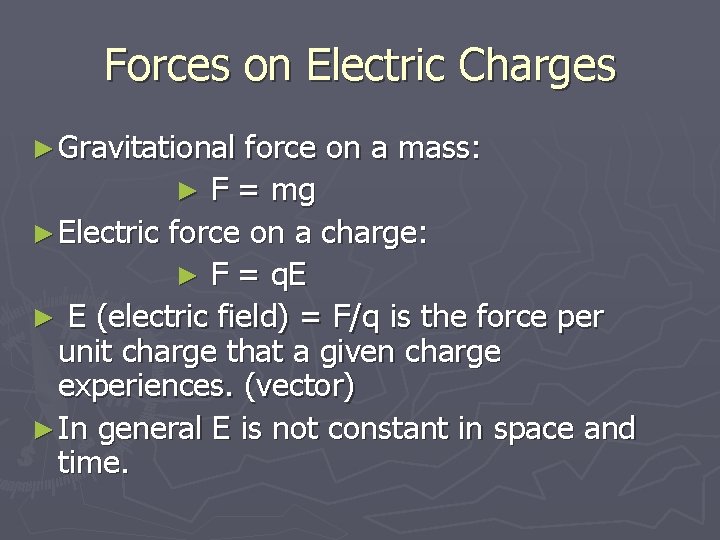
Forces on Electric Charges ► Gravitational force on a mass: ► F = mg ► Electric force on a charge: ► F = q. E ► E (electric field) = F/q is the force per unit charge that a given charge experiences. (vector) ► In general E is not constant in space and time.
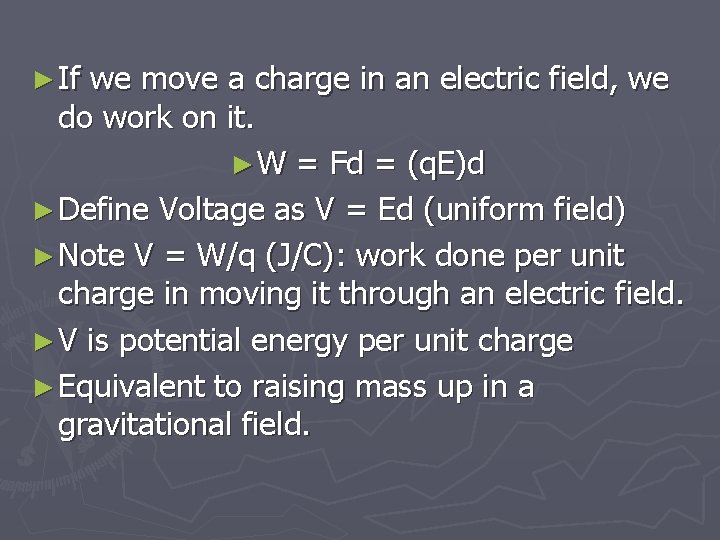
► If we move a charge in an electric field, we do work on it. ► W = Fd = (q. E)d ► Define Voltage as V = Ed (uniform field) ► Note V = W/q (J/C): work done per unit charge in moving it through an electric field. ► V is potential energy per unit charge ► Equivalent to raising mass up in a gravitational field.
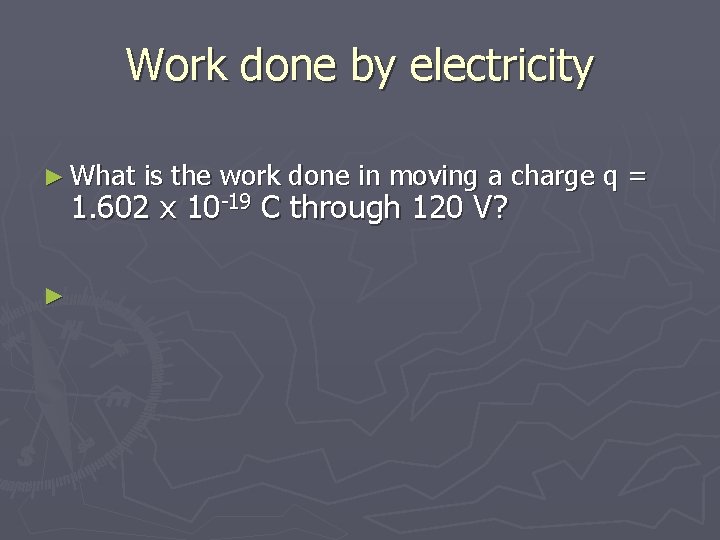
Work done by electricity ► What is the work done in moving a charge q = 1. 602 x 10 -19 C through 120 V? ►
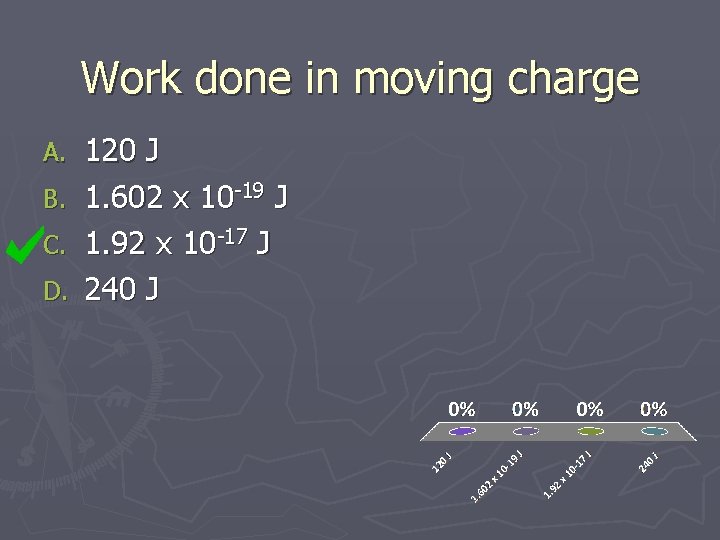
Work done in moving charge A. B. C. D. 120 J 1. 602 x 10 -19 J 1. 92 x 10 -17 J 240 J
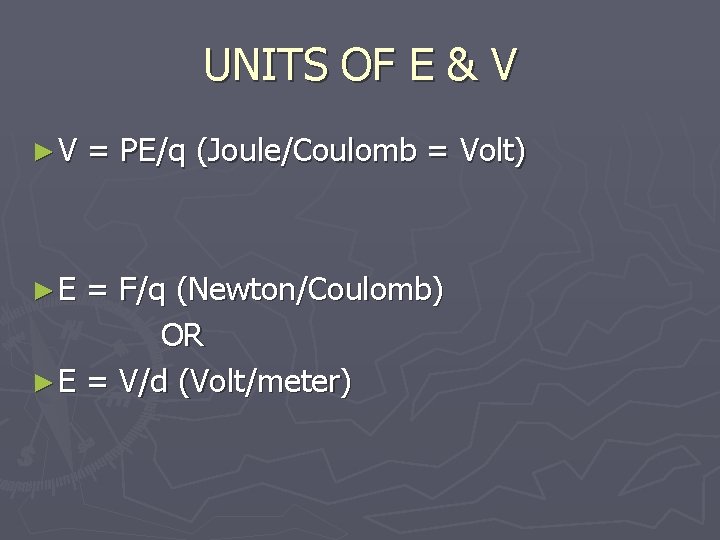
UNITS OF E & V ►V ►E = PE/q (Joule/Coulomb = Volt) = F/q (Newton/Coulomb) OR ► E = V/d (Volt/meter)
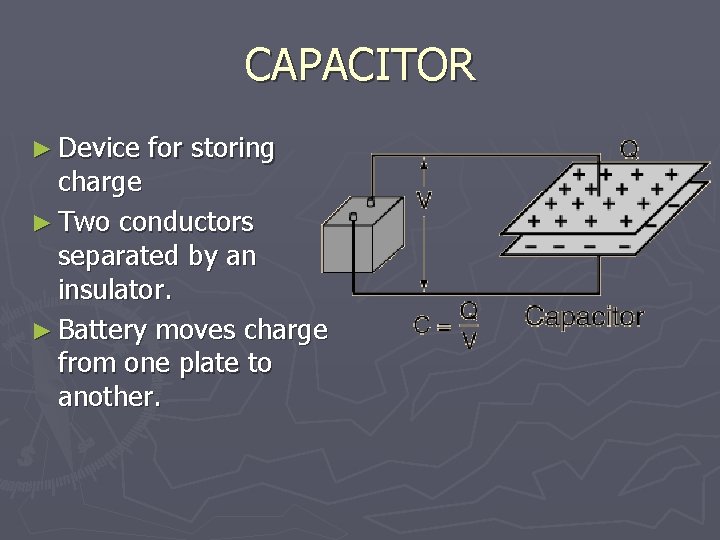
CAPACITOR ► Device for storing charge ► Two conductors separated by an insulator. ► Battery moves charge from one plate to another.