
Electricity Chapter 21 21 1 Electric Charge Learning

- Slides: 49
Electricity Chapter 21
21: 1 Electric Charge Learning Target: -To understand electric charge. Success Criteria: I can… -describe the effects of static electricity. -distinguish between conductors and insulators. -recognize the presence of charge in an electroscope.
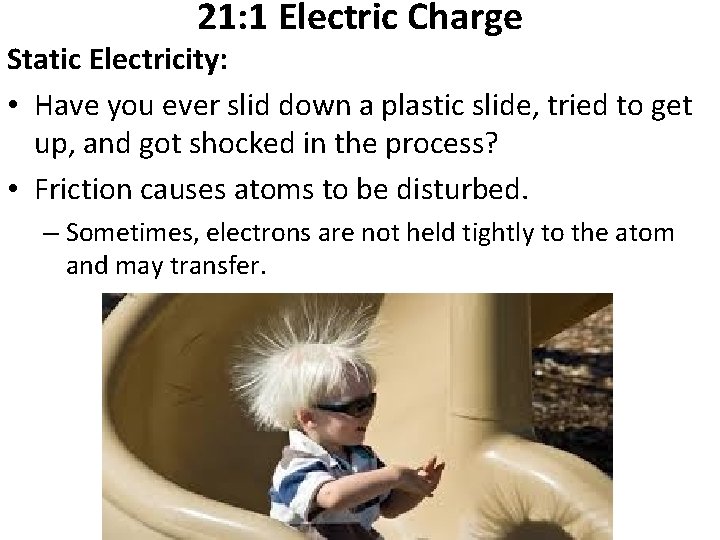
21: 1 Electric Charge Static Electricity: • Have you ever slid down a plastic slide, tried to get up, and got shocked in the process? • Friction causes atoms to be disturbed. – Sometimes, electrons are not held tightly to the atom and may transfer.
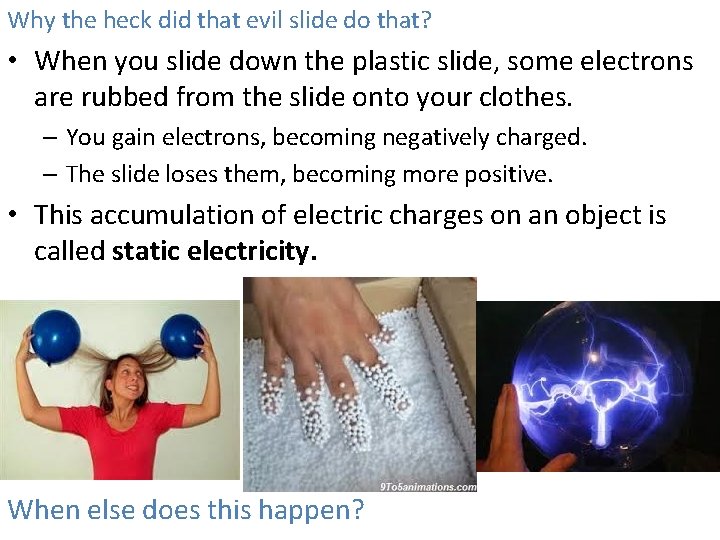
Why the heck did that evil slide do that? • When you slide down the plastic slide, some electrons are rubbed from the slide onto your clothes. – You gain electrons, becoming negatively charged. – The slide loses them, becoming more positive. • This accumulation of electric charges on an object is called static electricity. When else does this happen?
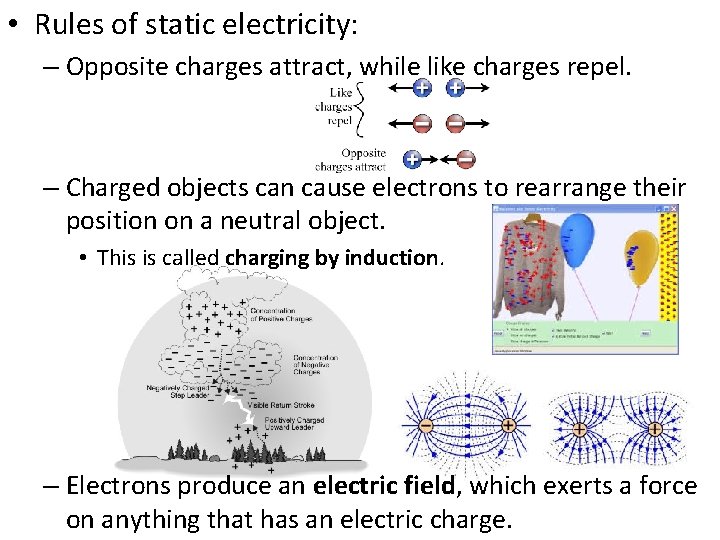
• Rules of static electricity: – Opposite charges attract, while like charges repel. – Charged objects can cause electrons to rearrange their position on a neutral object. • This is called charging by induction. – Electrons produce an electric field, which exerts a force on anything that has an electric charge.
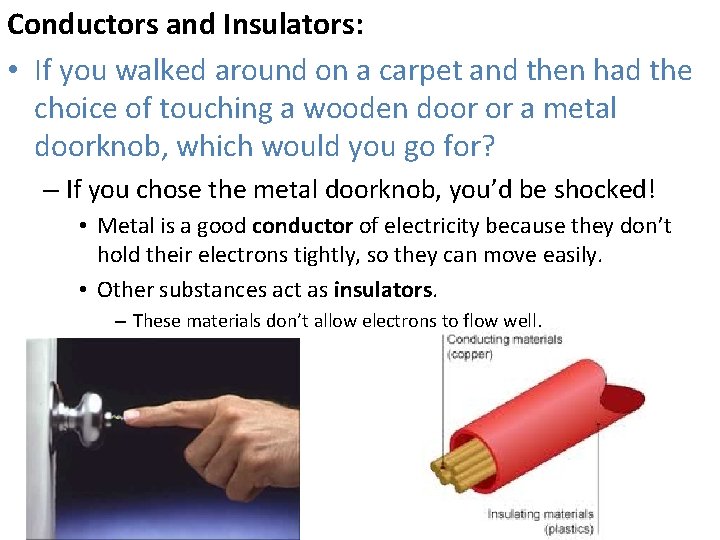
Conductors and Insulators: • If you walked around on a carpet and then had the choice of touching a wooden door or a metal doorknob, which would you go for? – If you chose the metal doorknob, you’d be shocked! • Metal is a good conductor of electricity because they don’t hold their electrons tightly, so they can move easily. • Other substances act as insulators. – These materials don’t allow electrons to flow well.
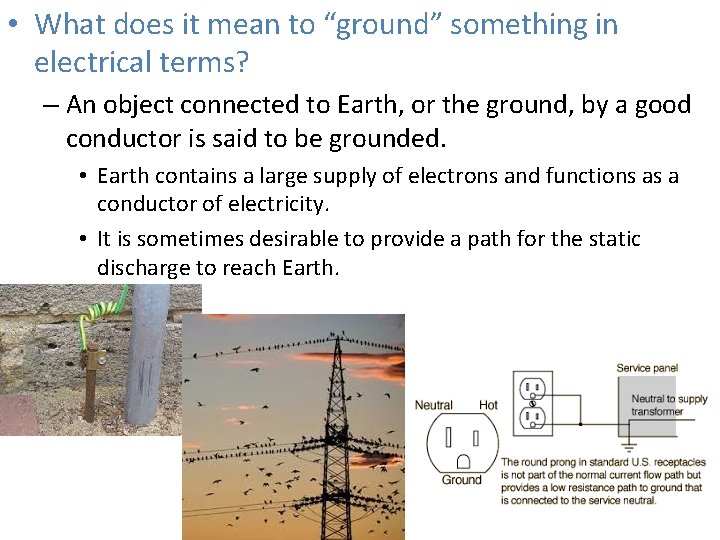
• What does it mean to “ground” something in electrical terms? – An object connected to Earth, or the ground, by a good conductor is said to be grounded. • Earth contains a large supply of electrons and functions as a conductor of electricity. • It is sometimes desirable to provide a path for the static discharge to reach Earth.
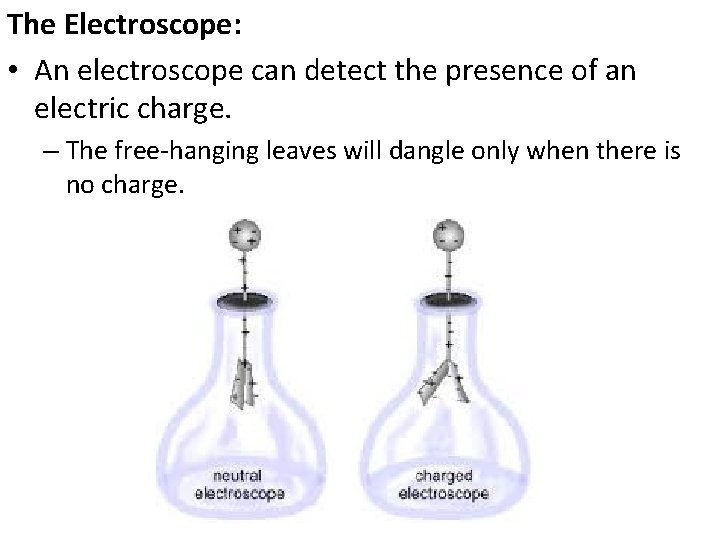
The Electroscope: • An electroscope can detect the presence of an electric charge. – The free-hanging leaves will dangle only when there is no charge.
Learning Checkpoint • What is static electricity? • Distinguish between electrical conductors and insulators and give an example of each. • Assume you have already charged an electroscope with a positively charged glass rod. Hypothesize what would happen if you touched the knob again with another positively charged object. • Explain why metals are typically much better conductors than nonmetals.
21: 3 Electric Current Learning Target: • To understand movement and behavior of electric current. Success Criteria: I can… • describe how the potential energy of an electron changes as it moves through a simple circuit. • explain how a dry cell is a source of electricity. • conceptually and mathematically relate potential difference, resistance, and current.
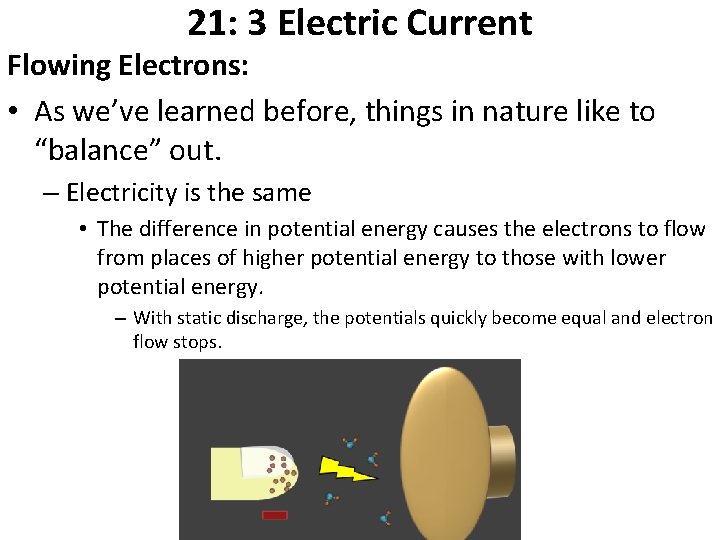
21: 3 Electric Current Flowing Electrons: • As we’ve learned before, things in nature like to “balance” out. – Electricity is the same • The difference in potential energy causes the electrons to flow from places of higher potential energy to those with lower potential energy. – With static discharge, the potentials quickly become equal and electron flow stops.
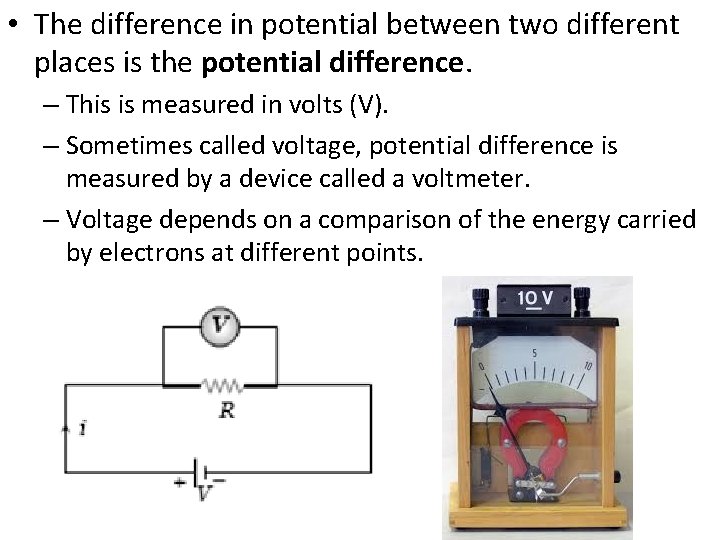
• The difference in potential between two different places is the potential difference. – This is measured in volts (V). – Sometimes called voltage, potential difference is measured by a device called a voltmeter. – Voltage depends on a comparison of the energy carried by electrons at different points.
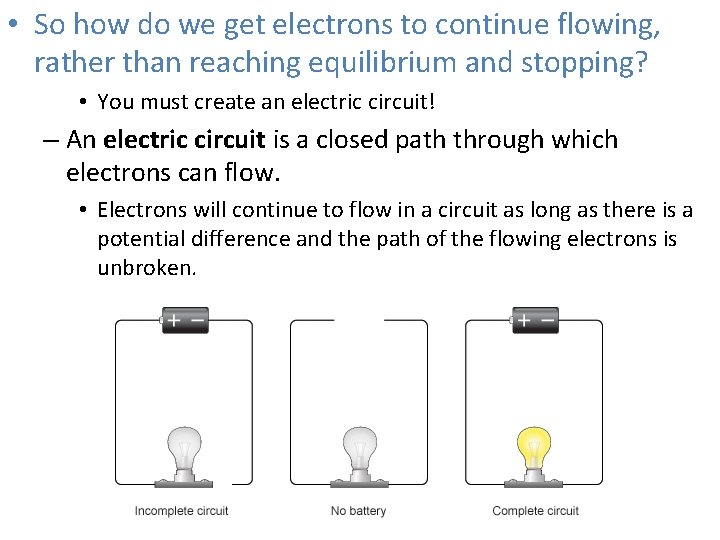
• So how do we get electrons to continue flowing, rather than reaching equilibrium and stopping? • You must create an electric circuit! – An electric circuit is a closed path through which electrons can flow. • Electrons will continue to flow in a circuit as long as there is a potential difference and the path of the flowing electrons is unbroken.
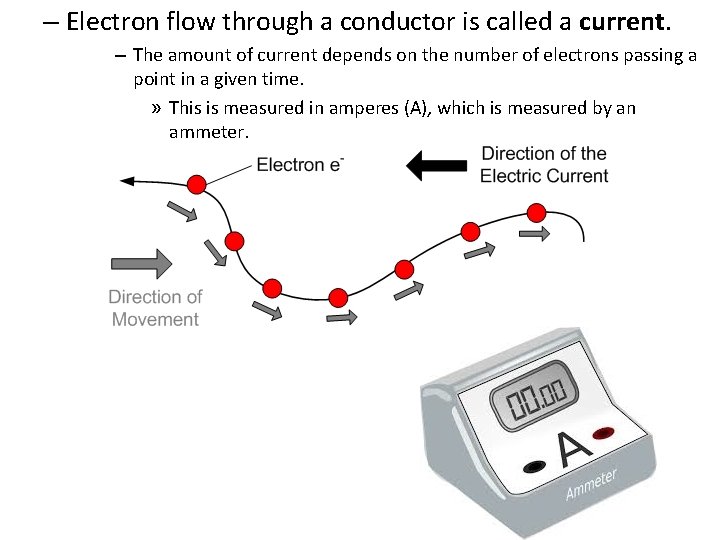
– Electron flow through a conductor is called a current. – The amount of current depends on the number of electrons passing a point in a given time. » This is measured in amperes (A), which is measured by an ammeter.
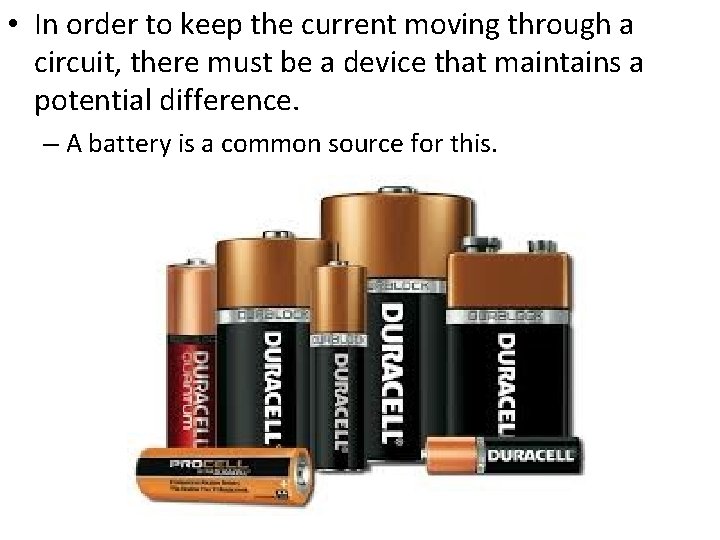
• In order to keep the current moving through a circuit, there must be a device that maintains a potential difference. – A battery is a common source for this.
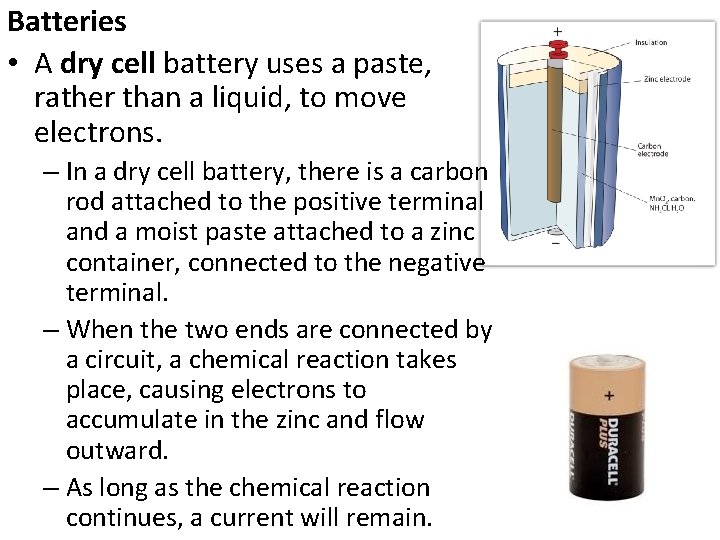
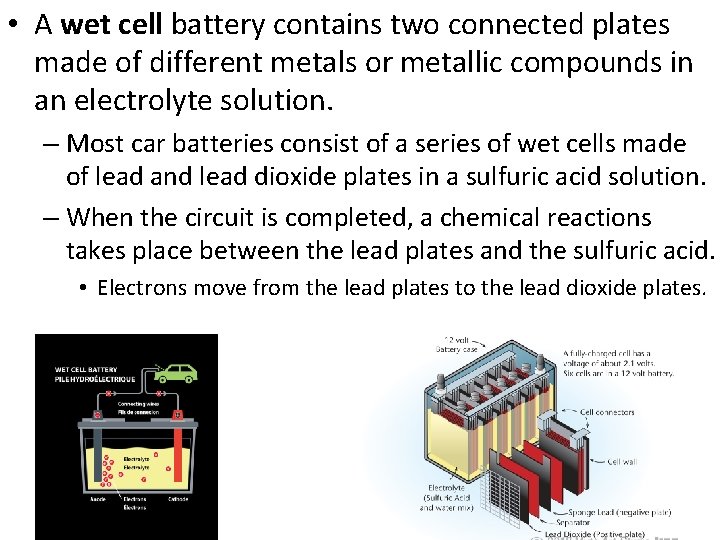
Batteries • A dry cell battery uses a paste, rather than a liquid, to move electrons. – In a dry cell battery, there is a carbon rod attached to the positive terminal and a moist paste attached to a zinc container, connected to the negative terminal. – When the two ends are connected by a circuit, a chemical reaction takes place, causing electrons to accumulate in the zinc and flow outward. – As long as the chemical reaction continues, a current will remain.
• A wet cell battery contains two connected plates made of different metals or metallic compounds in an electrolyte solution. – Most car batteries consist of a series of wet cells made of lead and lead dioxide plates in a sulfuric acid solution. – When the circuit is completed, a chemical reactions takes place between the lead plates and the sulfuric acid. • Electrons move from the lead plates to the lead dioxide plates.
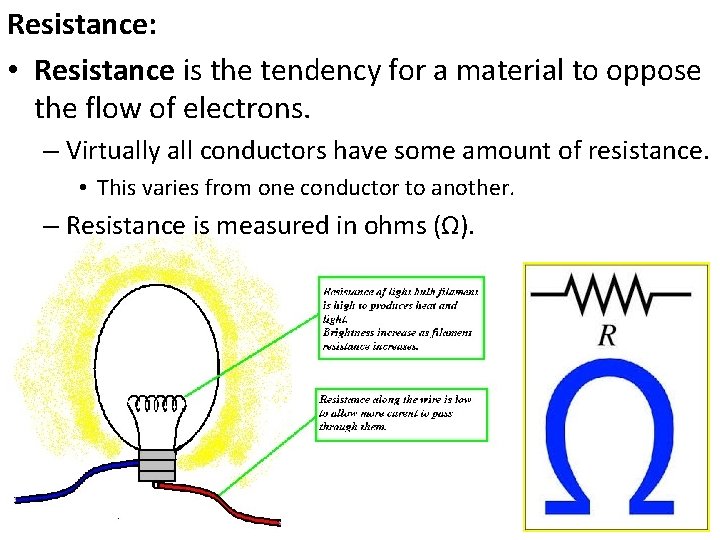
Resistance: • Resistance is the tendency for a material to oppose the flow of electrons. – Virtually all conductors have some amount of resistance. • This varies from one conductor to another. – Resistance is measured in ohms (Ω).
• Wire type influences resistance. – Copper doesn’t resist much, which is why it’s used in electrical wiring. – Tungsten is very resistant, which is why it glows and produces heat. • Wire size also affects resistance. – Thinner wires have greater resistance to electron flow. – Longer wires also offer greater resistance. • Resistance also increases as temperature increases.
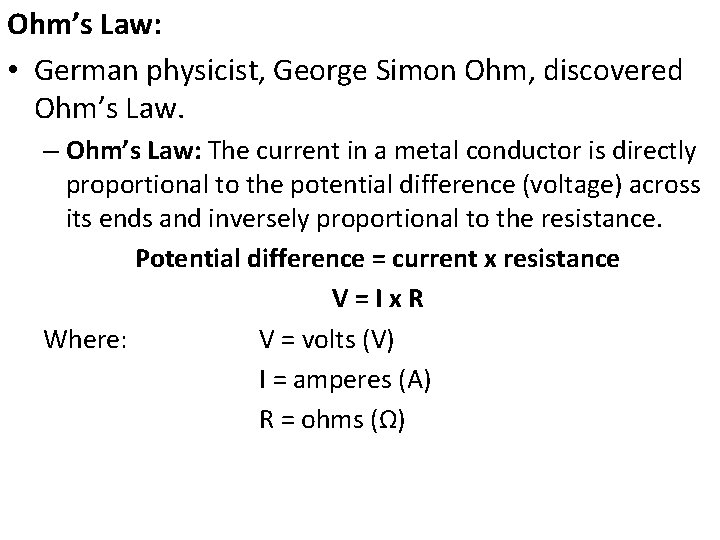
Ohm’s Law: • German physicist, George Simon Ohm, discovered Ohm’s Law. – Ohm’s Law: The current in a metal conductor is directly proportional to the potential difference (voltage) across its ends and inversely proportional to the resistance. Potential difference = current x resistance V=Ix. R Where: V = volts (V) I = amperes (A) R = ohms (Ω)
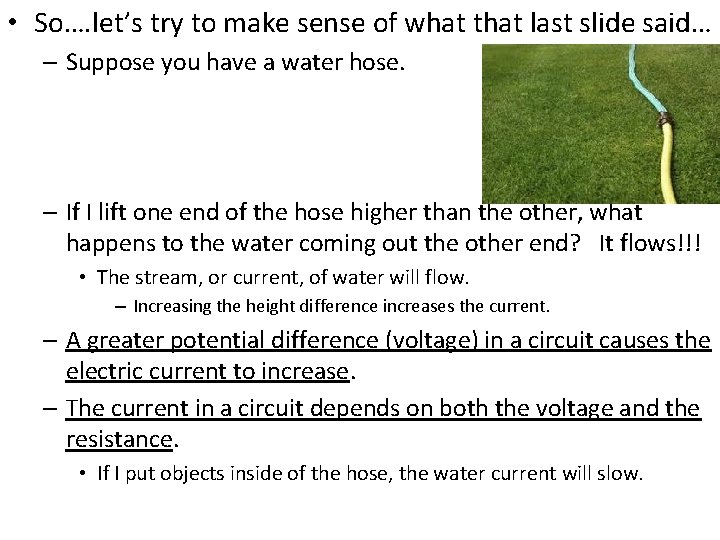
• So…. let’s try to make sense of what that last slide said… – Suppose you have a water hose. – If I lift one end of the hose higher than the other, what happens to the water coming out the other end? It flows!!! • The stream, or current, of water will flow. – Increasing the height difference increases the current. – A greater potential difference (voltage) in a circuit causes the electric current to increase. – The current in a circuit depends on both the voltage and the resistance. • If I put objects inside of the hose, the water current will slow.
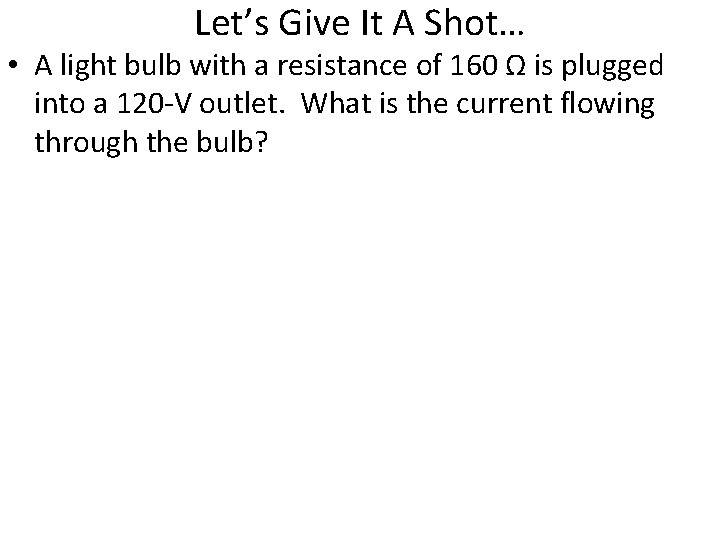
Let’s Give It A Shot… • A light bulb with a resistance of 160 Ω is plugged into a 120 -V outlet. What is the current flowing through the bulb?
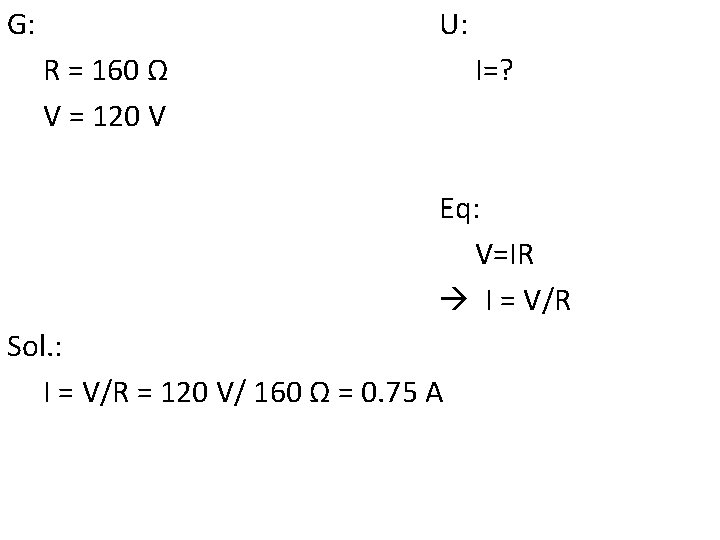
G: U: R = 160 Ω V = 120 V I=? Eq: V=IR I = V/R Sol. : I = V/R = 120 V/ 160 Ω = 0. 75 A
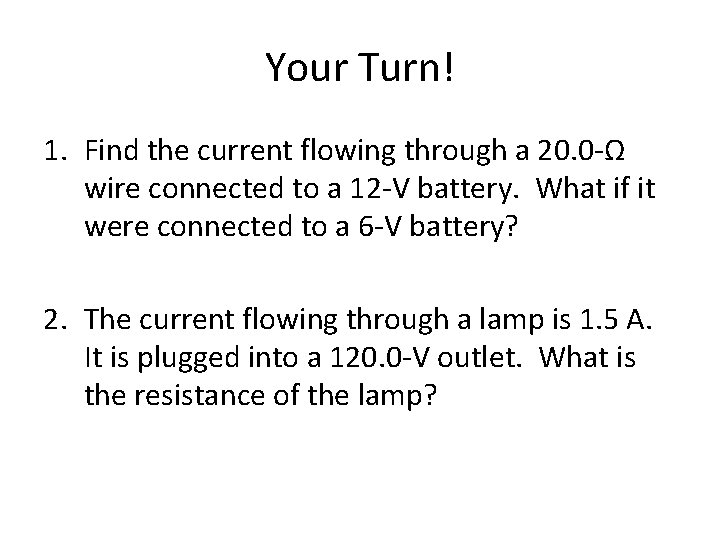
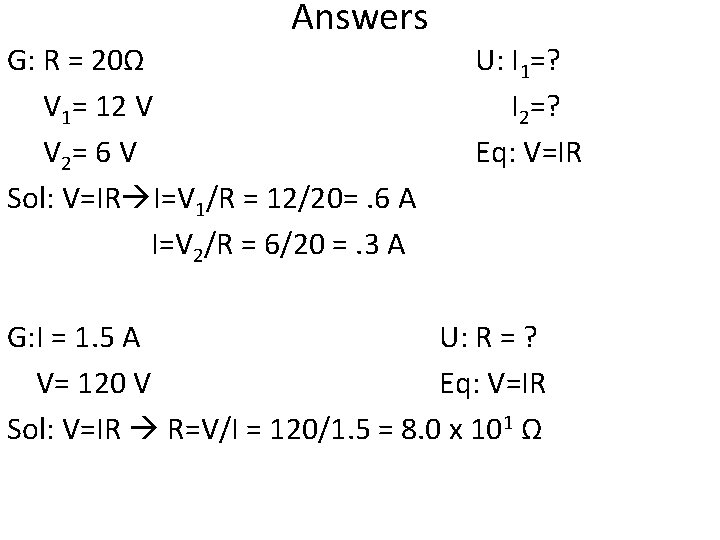
Your Turn! 1. Find the current flowing through a 20. 0 -Ω wire connected to a 12 -V battery. What if it were connected to a 6 -V battery? 2. The current flowing through a lamp is 1. 5 A. It is plugged into a 120. 0 -V outlet. What is the resistance of the lamp?
Answers G: R = 20Ω V 1= 12 V V 2 = 6 V Sol: V=IR I=V 1/R = 12/20=. 6 A I=V 2/R = 6/20 =. 3 A U: I 1=? I 2=? Eq: V=IR G: I = 1. 5 A U: R = ? V= 120 V Eq: V=IR Sol: V=IR R=V/I = 120/1. 5 = 8. 0 x 101 Ω
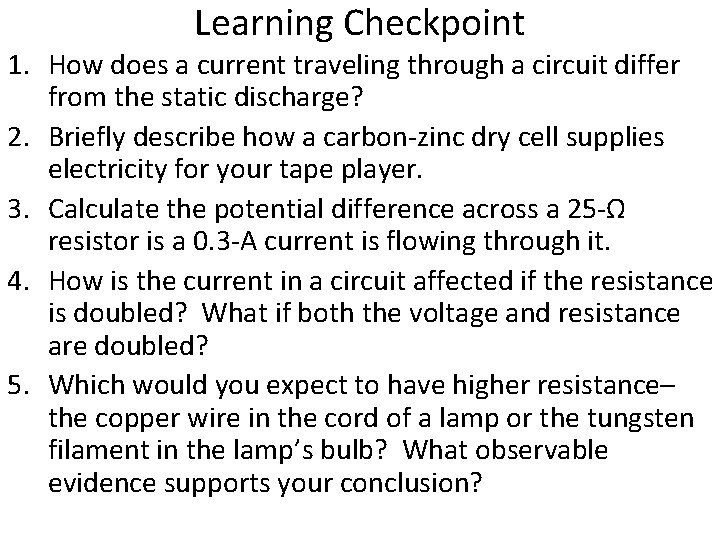
Learning Checkpoint 1. How does a current traveling through a circuit differ from the static discharge? 2. Briefly describe how a carbon-zinc dry cell supplies electricity for your tape player. 3. Calculate the potential difference across a 25 -Ω resistor is a 0. 3 -A current is flowing through it. 4. How is the current in a circuit affected if the resistance is doubled? What if both the voltage and resistance are doubled? 5. Which would you expect to have higher resistance– the copper wire in the cord of a lamp or the tungsten filament in the lamp’s bulb? What observable evidence supports your conclusion?
21: 4 Electrical Circuits Learning Target: • To understand electrical circuits. Success Criteria: I can… • sketch a series and a parallel circuit, and list applications of each type of circuit. • recognize the function of circuit breakers and fuses.
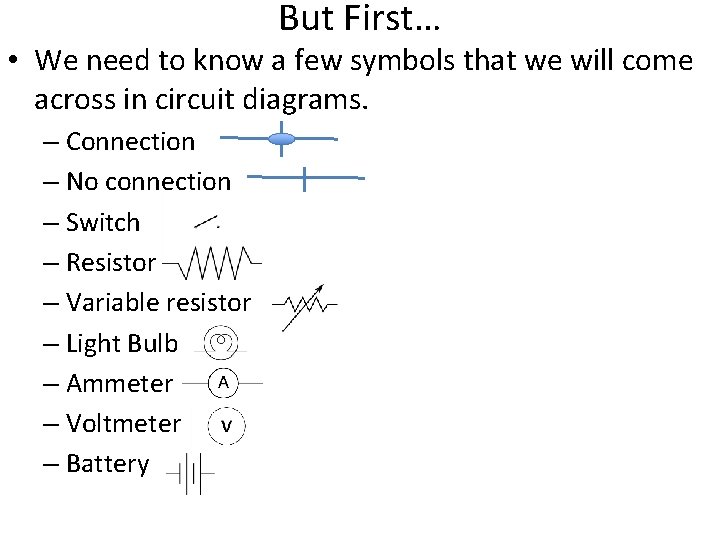
But First… • We need to know a few symbols that we will come across in circuit diagrams. – Connection – No connection – Switch – Resistor – Variable resistor – Light Bulb – Ammeter – Voltmeter – Battery
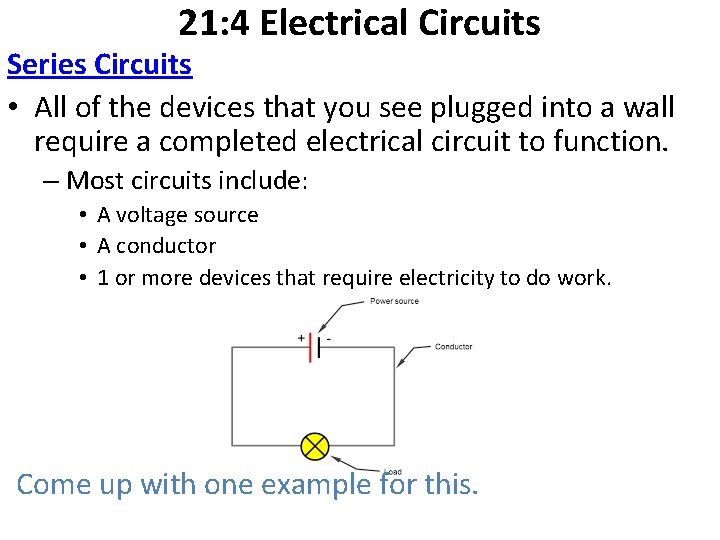
21: 4 Electrical Circuits Series Circuits • All of the devices that you see plugged into a wall require a completed electrical circuit to function. – Most circuits include: • A voltage source • A conductor • 1 or more devices that require electricity to do work. Come up with one example for this.
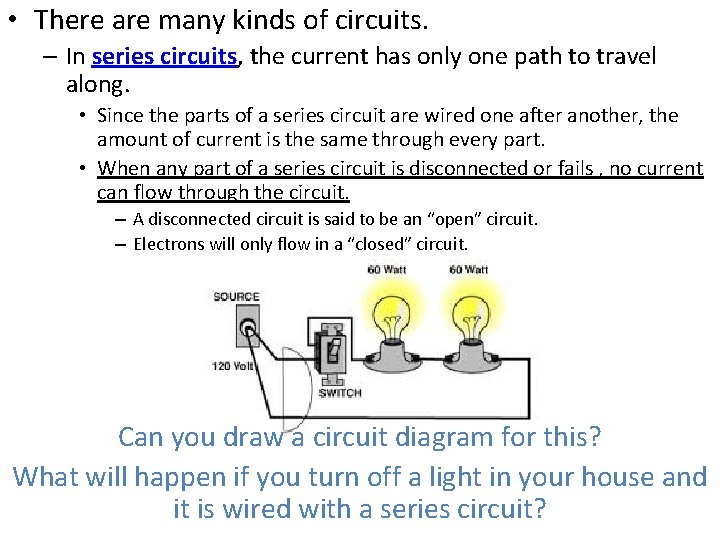
• There are many kinds of circuits. – In series circuits, the current has only one path to travel along. • Since the parts of a series circuit are wired one after another, the amount of current is the same through every part. • When any part of a series circuit is disconnected or fails , no current can flow through the circuit. – A disconnected circuit is said to be an “open” circuit. – Electrons will only flow in a “closed” circuit. Can you draw a circuit diagram for this? What will happen if you turn off a light in your house and it is wired with a series circuit?
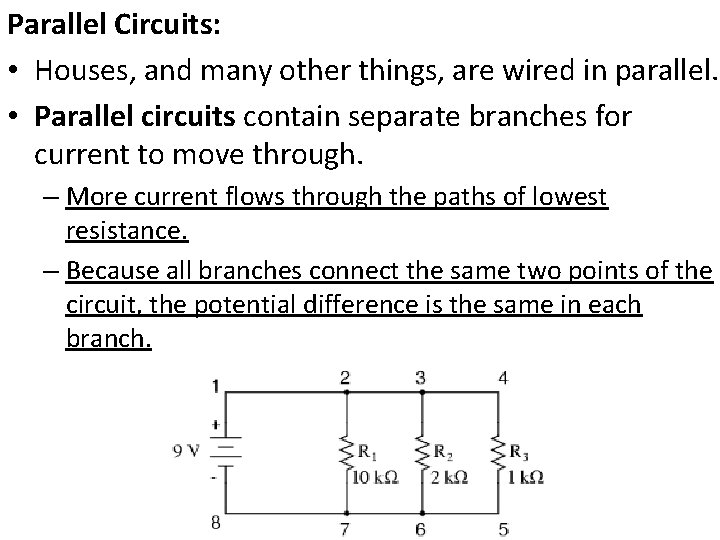
Parallel Circuits: • Houses, and many other things, are wired in parallel. • Parallel circuits contain separate branches for current to move through. – More current flows through the paths of lowest resistance. – Because all branches connect the same two points of the circuit, the potential difference is the same in each branch.
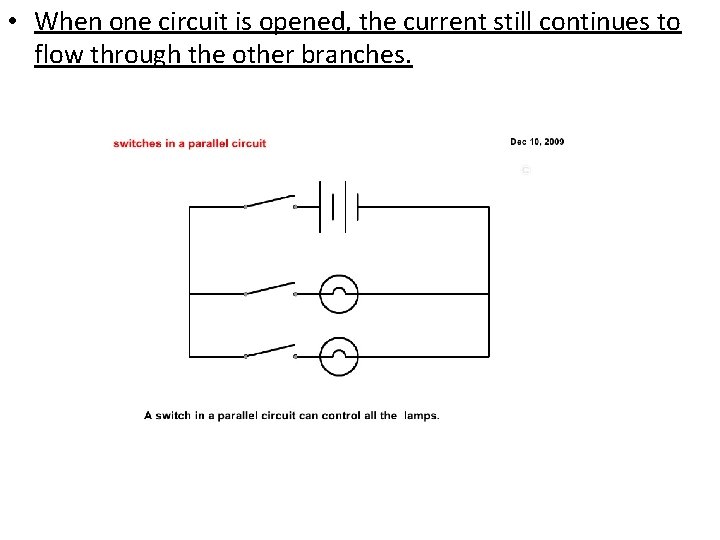
• When one circuit is opened, the current still continues to flow through the other branches.
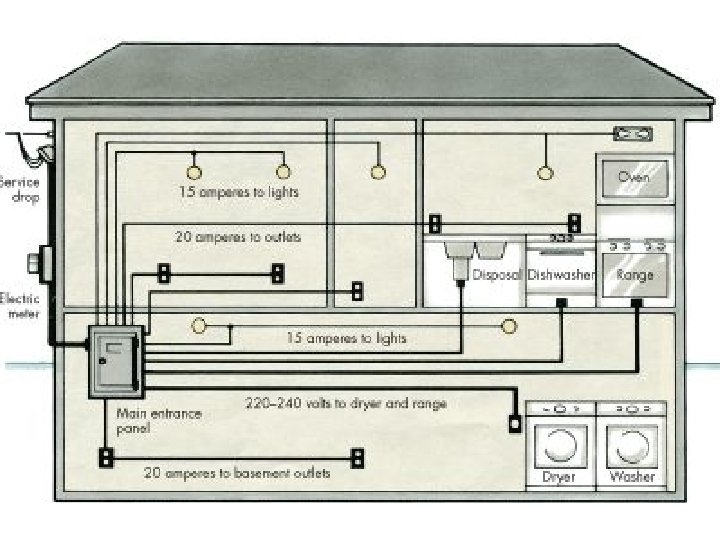
Household Circuits: • Although you can’t see it, the wiring in a house is composed mostly of a combination or very organized parallel circuits. – Electrical currents enter conventional homes through overhead or underground wires. • They first pass through a meter to monitor your energy use. • From the meter, wires are connected to your breaker box. • The wires then branch out to the rest of your house.
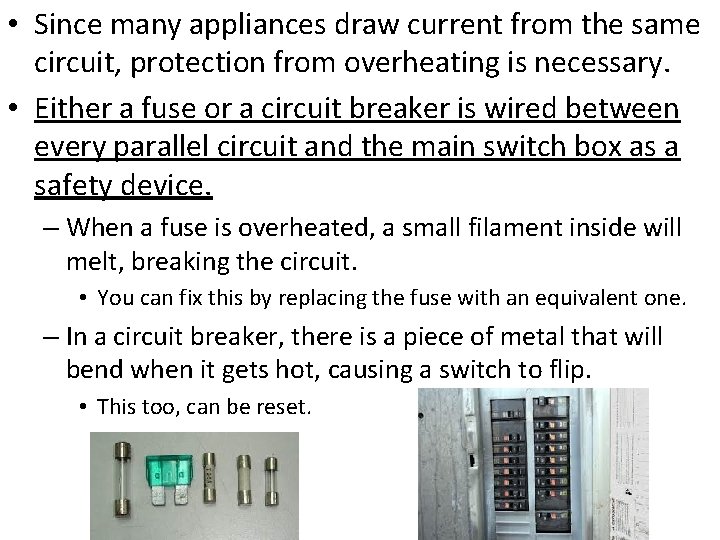
• Since many appliances draw current from the same circuit, protection from overheating is necessary. • Either a fuse or a circuit breaker is wired between every parallel circuit and the main switch box as a safety device. – When a fuse is overheated, a small filament inside will melt, breaking the circuit. • You can fix this by replacing the fuse with an equivalent one. – In a circuit breaker, there is a piece of metal that will bend when it gets hot, causing a switch to flip. • This too, can be reset.
Learning Checkpoint: 1. Use a circuit diagram to draw a series circuit containing a battery, an open switch, a resistor, and a light bulb. 2. Use symbols to draw a parallel circuit with a battery and two resistors wired into parallel. 3. Compare and contrast fuses and circuit breakers. Which is easier to use? 4. Explain why buildings are wired in parallel instead of series circuits. 5. Pennies are made of copper and are excellent conductors of heat and electricity. Explain why you should never replace a blown fuse with a penny.
21: 5 Electrical Power & Energy Learning Target: • To understand electrical power. Success Criteria: I can… • explain and calculate electric power. • calculate the amount of electrical energy in kilowatt -hours.
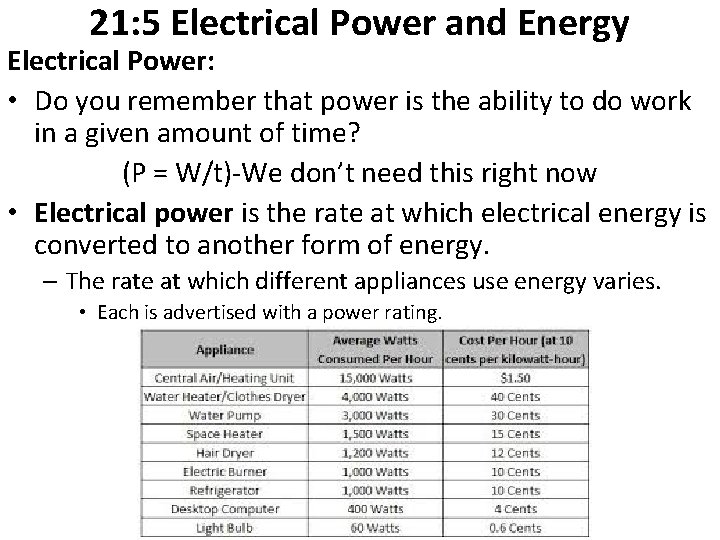
21: 5 Electrical Power and Energy Electrical Power: • Do you remember that power is the ability to do work in a given amount of time? (P = W/t)-We don’t need this right now • Electrical power is the rate at which electrical energy is converted to another form of energy. – The rate at which different appliances use energy varies. • Each is advertised with a power rating.
• Electrical power is expressed in watts (W), but we sometimes measure this in kilowatts (k. W). • Electrical power is the amount of power used and can be calculated by multiplying the potential difference by the current. P=Ix. V where P=Power (W) I = Current (A) V = Potential Difference (V)
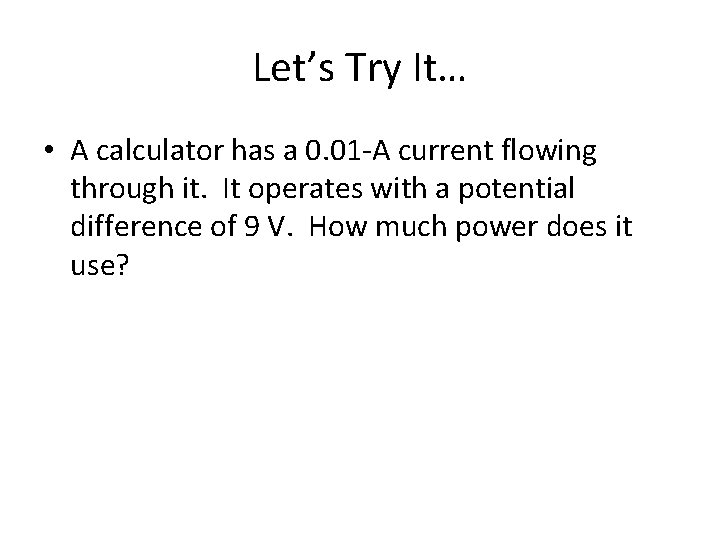
Let’s Try It… • A calculator has a 0. 01 -A current flowing through it. It operates with a potential difference of 9 V. How much power does it use?
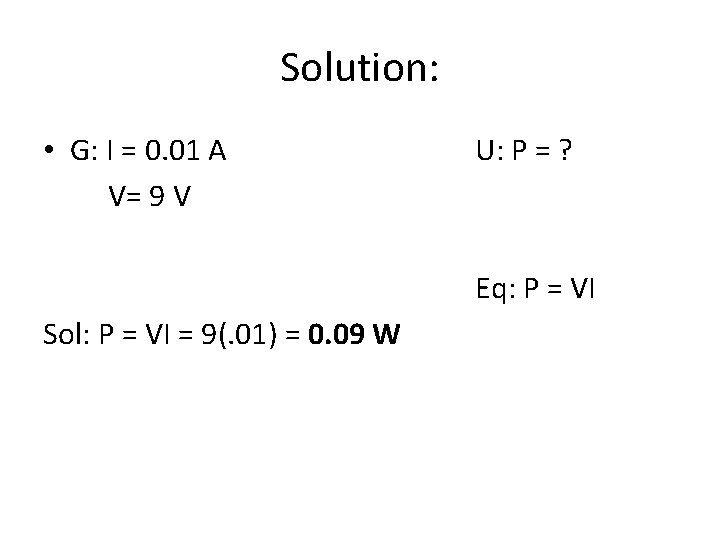
Solution: • G: I = 0. 01 A V= 9 V U: P = ? Eq: P = VI Sol: P = VI = 9(. 01) = 0. 09 W
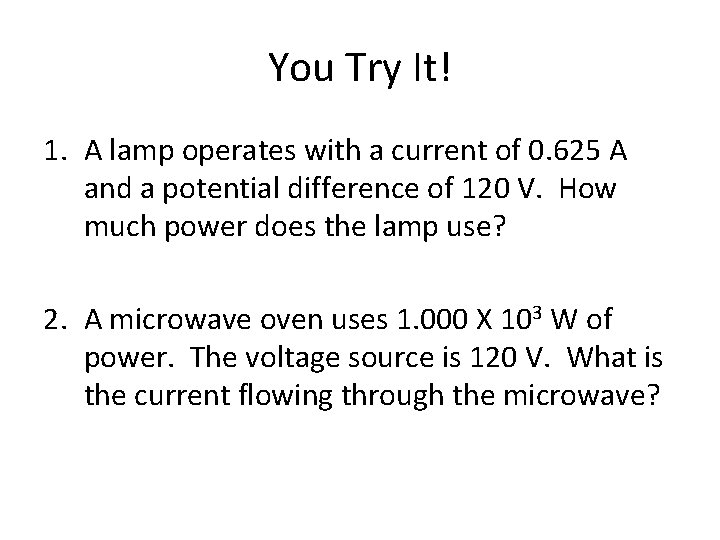
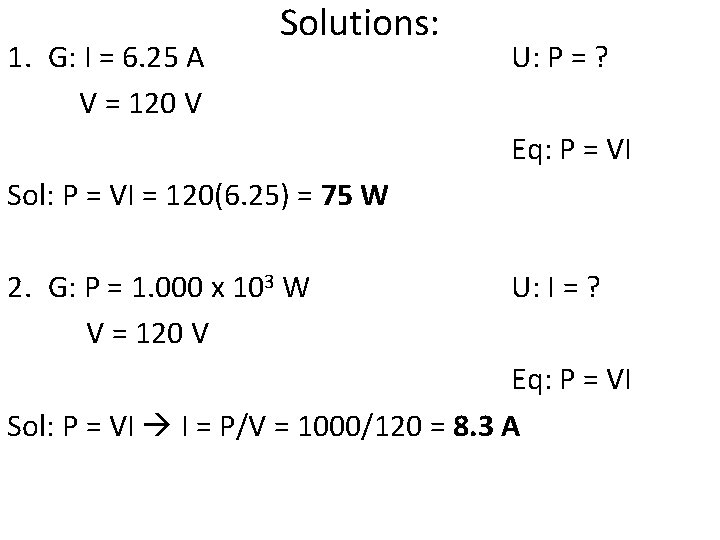
You Try It! 1. A lamp operates with a current of 0. 625 A and a potential difference of 120 V. How much power does the lamp use? 2. A microwave oven uses 1. 000 X 103 W of power. The voltage source is 120 V. What is the current flowing through the microwave?
1. G: I = 6. 25 A V = 120 V Solutions: U: P = ? Eq: P = VI Sol: P = VI = 120(6. 25) = 75 W 2. G: P = 1. 000 x 103 W V = 120 V U: I = ? Eq: P = VI Sol: P = VI I = P/V = 1000/120 = 8. 3 A
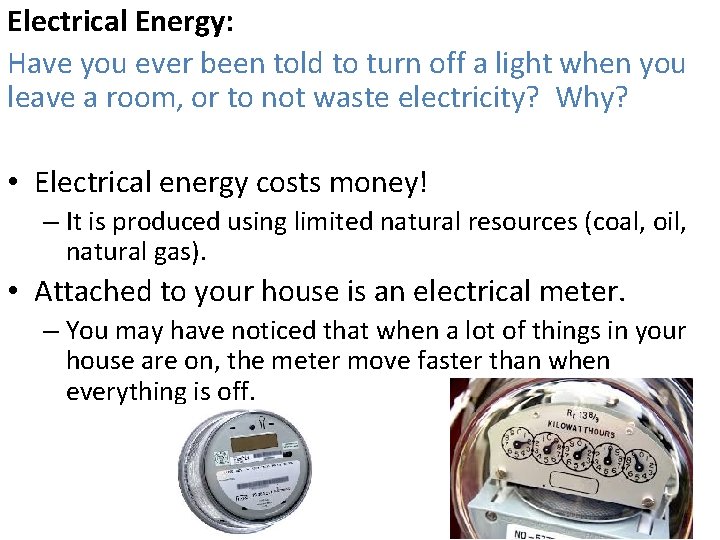
Electrical Energy: Have you ever been told to turn off a light when you leave a room, or to not waste electricity? Why? • Electrical energy costs money! – It is produced using limited natural resources (coal, oil, natural gas). • Attached to your house is an electrical meter. – You may have noticed that when a lot of things in your house are on, the meter move faster than when everything is off.
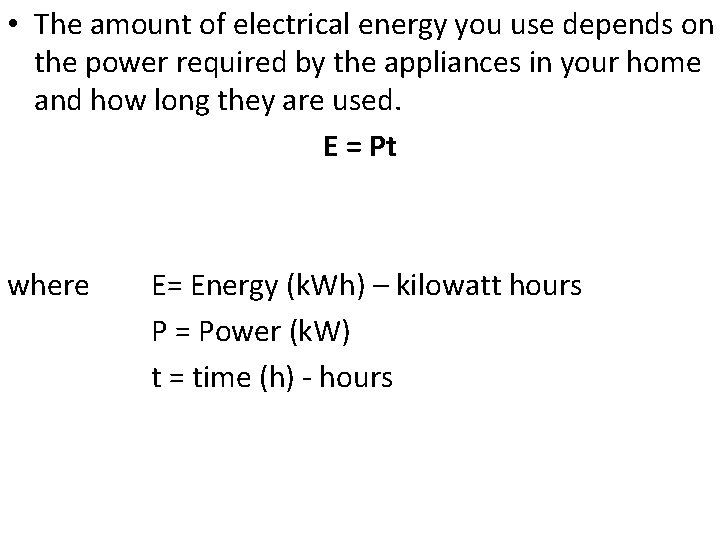
• The amount of electrical energy you use depends on the power required by the appliances in your home and how long they are used. E = Pt where E= Energy (k. Wh) – kilowatt hours P = Power (k. W) t = time (h) - hours
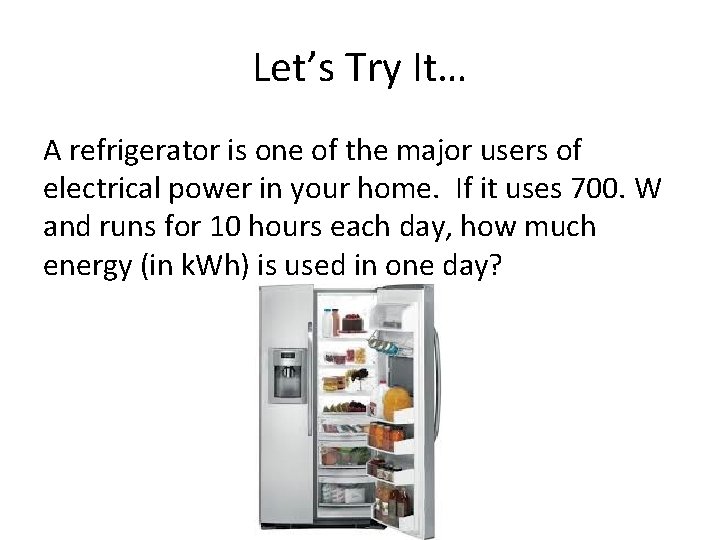
Let’s Try It… A refrigerator is one of the major users of electrical power in your home. If it uses 700. W and runs for 10 hours each day, how much energy (in k. Wh) is used in one day?
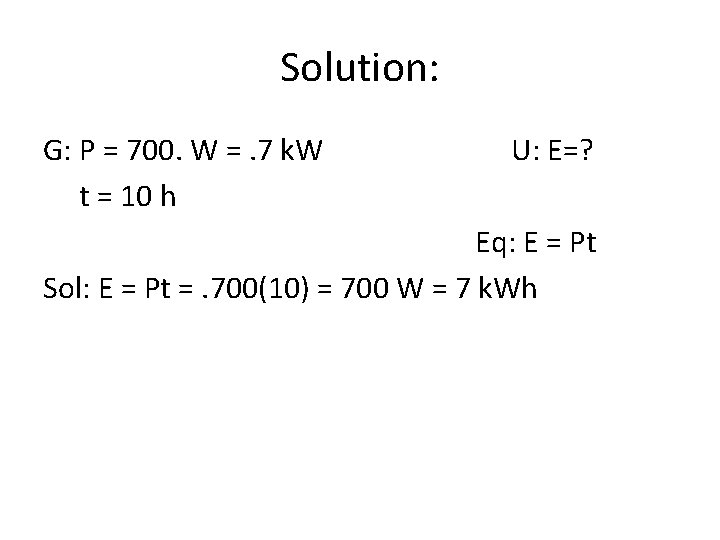
Solution: G: P = 700. W =. 7 k. W t = 10 h U: E=? Eq: E = Pt Sol: E = Pt =. 700(10) = 700 W = 7 k. Wh
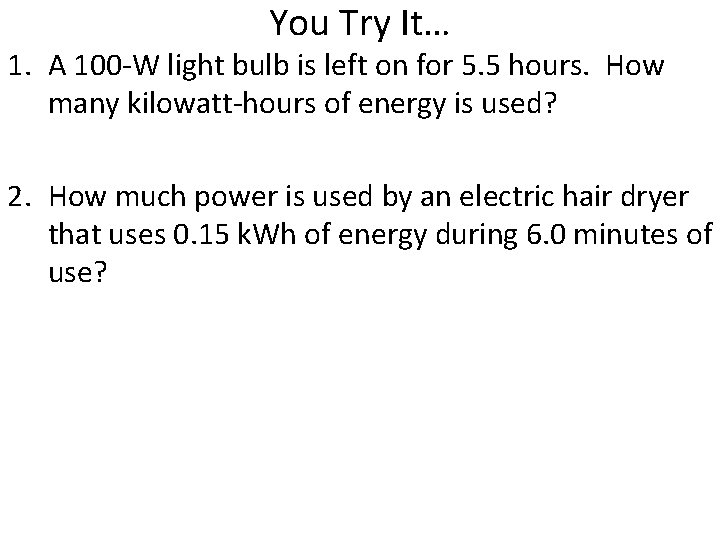
You Try It… 1. A 100 -W light bulb is left on for 5. 5 hours. How many kilowatt-hours of energy is used? 2. How much power is used by an electric hair dryer that uses 0. 15 k. Wh of energy during 6. 0 minutes of use?
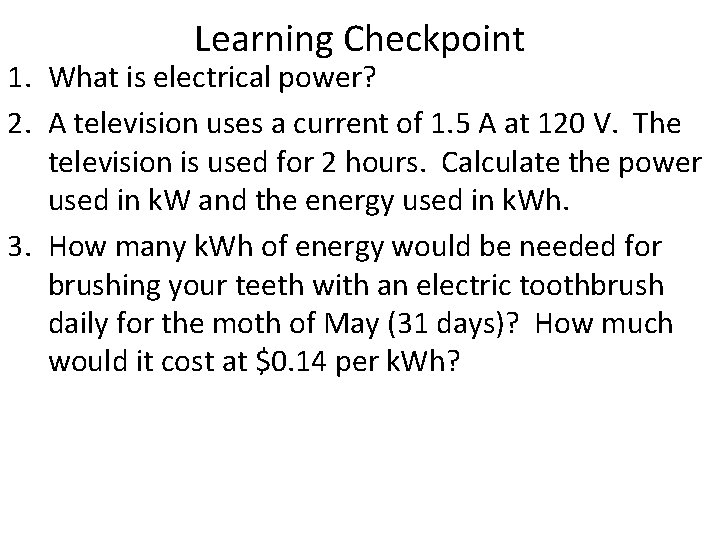
Learning Checkpoint 1. What is electrical power? 2. A television uses a current of 1. 5 A at 120 V. The television is used for 2 hours. Calculate the power used in k. W and the energy used in k. Wh. 3. How many k. Wh of energy would be needed for brushing your teeth with an electric toothbrush daily for the moth of May (31 days)? How much would it cost at $0. 14 per k. Wh?