
Electricity 1 Demonstrate that you know how to


- Slides: 34
Electricity
1. Demonstrate that you know how to respond to electrical emergencies by doing the following: a. Show to rescue a person touching a live wire in the home. Being in contact with a live electric wire First, do not touch a person who comes into contact with a live electric wire. If you do, the electricity will also flow through your body, and there will be two victims instead of one. Instead, if you can quickly turn off the power source, do so immediately. If it cannot be turned off quickly, try to knock the wire off with something that does not conduct electricity, such as a shoe (take it off first), a wooden broom handle, or a wooden chair. Once the victim has been separated from the electric power source, check for breathing. If the victim is not breathing, begin artificial respiration (mouth-to-mouth). 1 of 5
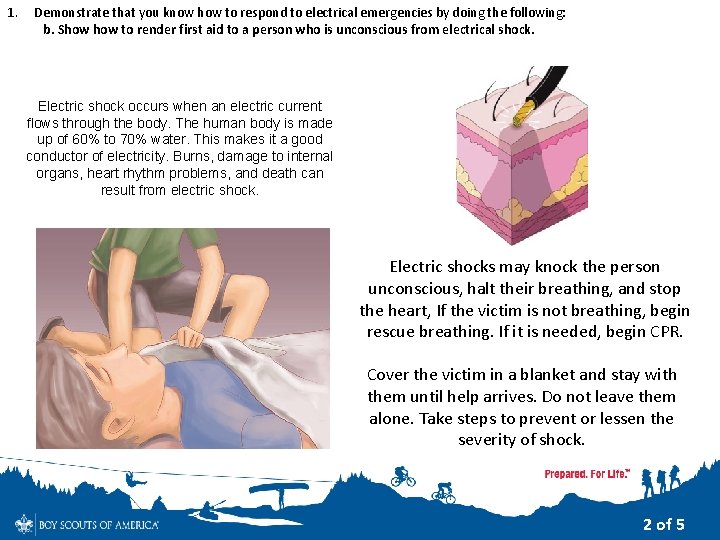
1. Demonstrate that you know how to respond to electrical emergencies by doing the following: b. Show to render first aid to a person who is unconscious from electrical shock. Electric shock occurs when an electric current flows through the body. The human body is made up of 60% to 70% water. This makes it a good conductor of electricity. Burns, damage to internal organs, heart rhythm problems, and death can result from electric shock. Electric shocks may knock the person unconscious, halt their breathing, and stop the heart, If the victim is not breathing, begin rescue breathing. If it is needed, begin CPR. Cover the victim in a blanket and stay with them until help arrives. Do not leave them alone. Take steps to prevent or lessen the severity of shock. 2 of 5
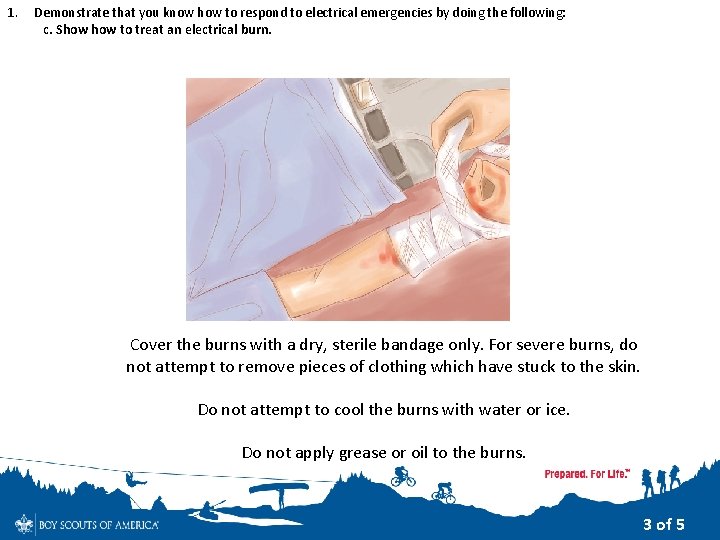
1. Demonstrate that you know how to respond to electrical emergencies by doing the following: c. Show to treat an electrical burn. Cover the burns with a dry, sterile bandage only. For severe burns, do not attempt to remove pieces of clothing which have stuck to the skin. Do not attempt to cool the burns with water or ice. Do not apply grease or oil to the burns. 3 of 5
1. Demonstrate that you know how to respond to electrical emergencies by doing the following: d. Explain what to do in an electrical storm. Preparing for an electrical storm is not complicated. First ensure that large, dead trees or branches surrounding your residence are cleared. This will help to prevent limbs from falling on the building, vehicles, or people in the event of a powerful storm. Always have an emergency kit assembled and stored in a convenient location. An emergency kit should include batteries, flashlight, radio, first aid products and water. Watch for darkening skies or winds that signify that a storm is approaching. Take cover in your home and make sure that your pets and livestock are also securely sheltered. During the course of an electrical storm, you should not use electrical appliances such as television or phone and do not use water. If you are outside and away from a building, take shelter in a vehicle if possible. If you are not near shelter, avoid standing under trees or other tall objects which are vulnerable to being struck by lightning. It is best to squat down with your hands on your knees if you are outside in an isolated area to avoid being hit by lightning. Additionally, immediately get out of water if you are swimming as soon as you see that an electrical storm is approaching. 4 of 5
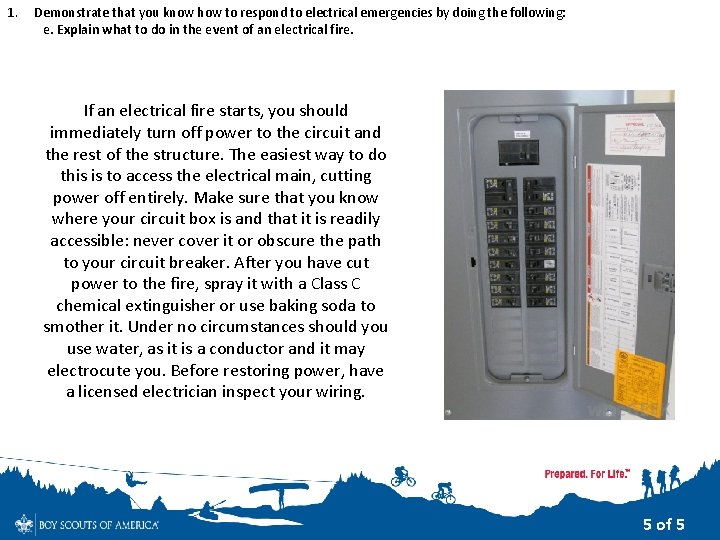
1. Demonstrate that you know how to respond to electrical emergencies by doing the following: e. Explain what to do in the event of an electrical fire. If an electrical fire starts, you should immediately turn off power to the circuit and the rest of the structure. The easiest way to do this is to access the electrical main, cutting power off entirely. Make sure that you know where your circuit box is and that it is readily accessible: never cover it or obscure the path to your circuit breaker. After you have cut power to the fire, spray it with a Class C chemical extinguisher or use baking soda to smother it. Under no circumstances should you use water, as it is a conductor and it may electrocute you. Before restoring power, have a licensed electrician inspect your wiring. 5 of 5
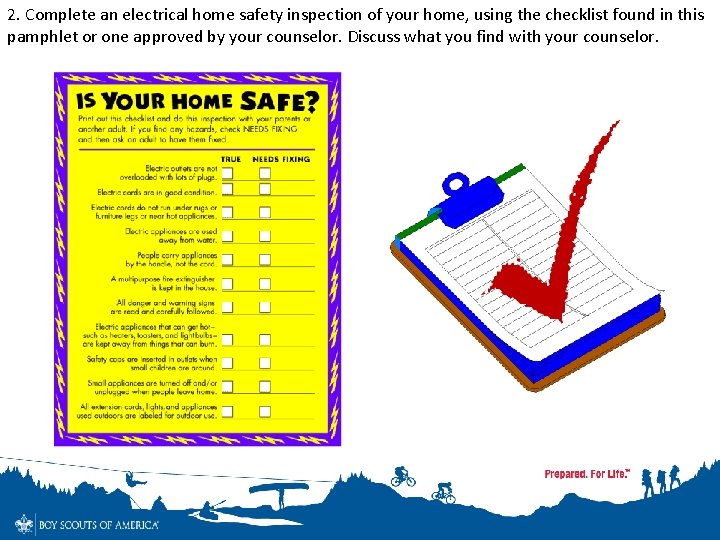
2. Complete an electrical home safety inspection of your home, using the checklist found in this pamphlet or one approved by your counselor. Discuss what you find with your counselor.
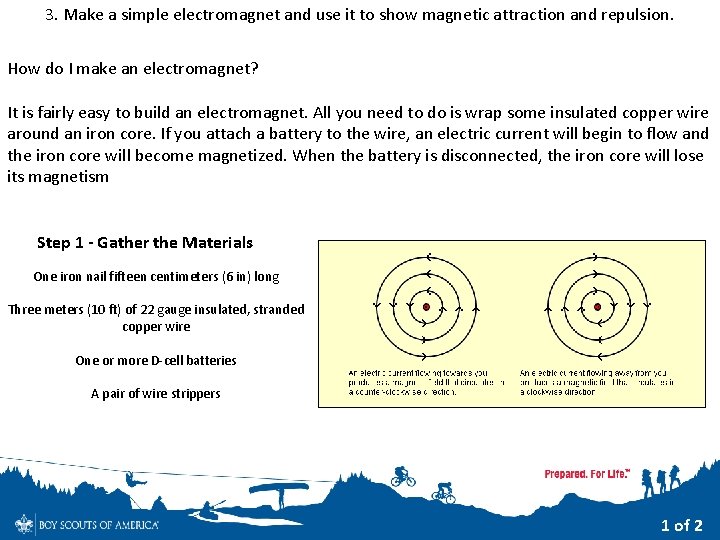
3. Make a simple electromagnet and use it to show magnetic attraction and repulsion. How do I make an electromagnet? It is fairly easy to build an electromagnet. All you need to do is wrap some insulated copper wire around an iron core. If you attach a battery to the wire, an electric current will begin to flow and the iron core will become magnetized. When the battery is disconnected, the iron core will lose its magnetism Step 1 - Gather the Materials One iron nail fifteen centimeters (6 in) long Three meters (10 ft) of 22 gauge insulated, stranded copper wire One or more D-cell batteries A pair of wire strippers 1 of 2
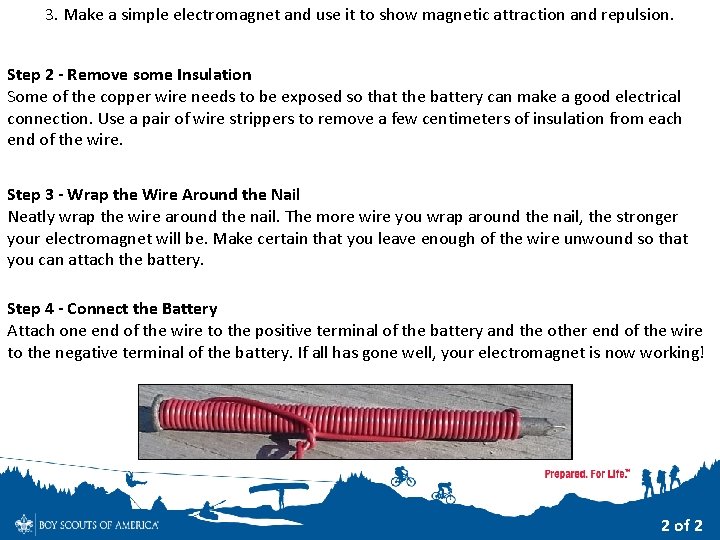
3. Make a simple electromagnet and use it to show magnetic attraction and repulsion. Step 2 - Remove some Insulation Some of the copper wire needs to be exposed so that the battery can make a good electrical connection. Use a pair of wire strippers to remove a few centimeters of insulation from each end of the wire. Step 3 - Wrap the Wire Around the Nail Neatly wrap the wire around the nail. The more wire you wrap around the nail, the stronger your electromagnet will be. Make certain that you leave enough of the wire unwound so that you can attach the battery. Step 4 - Connect the Battery Attach one end of the wire to the positive terminal of the battery and the other end of the wire to the negative terminal of the battery. If all has gone well, your electromagnet is now working! 2 of 2
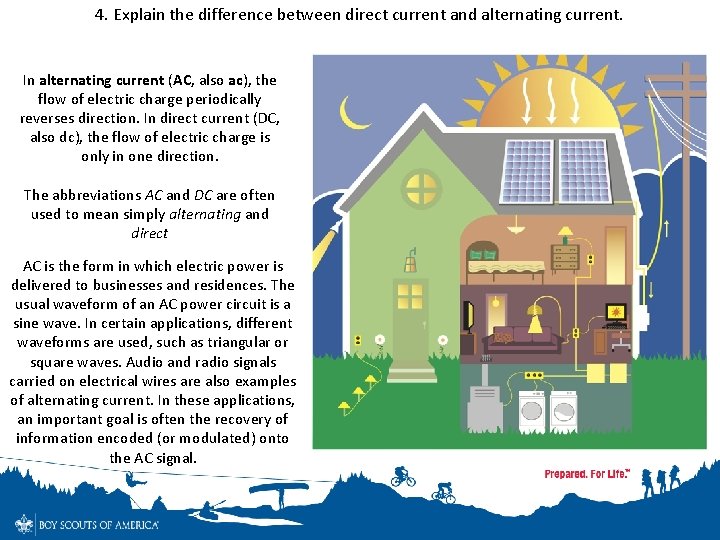
4. Explain the difference between direct current and alternating current. In alternating current (AC, also ac), the flow of electric charge periodically reverses direction. In direct current (DC, also dc), the flow of electric charge is only in one direction. The abbreviations AC and DC are often used to mean simply alternating and direct AC is the form in which electric power is delivered to businesses and residences. The usual waveform of an AC power circuit is a sine wave. In certain applications, different waveforms are used, such as triangular or square waves. Audio and radio signals carried on electrical wires are also examples of alternating current. In these applications, an important goal is often the recovery of information encoded (or modulated) onto the AC signal.
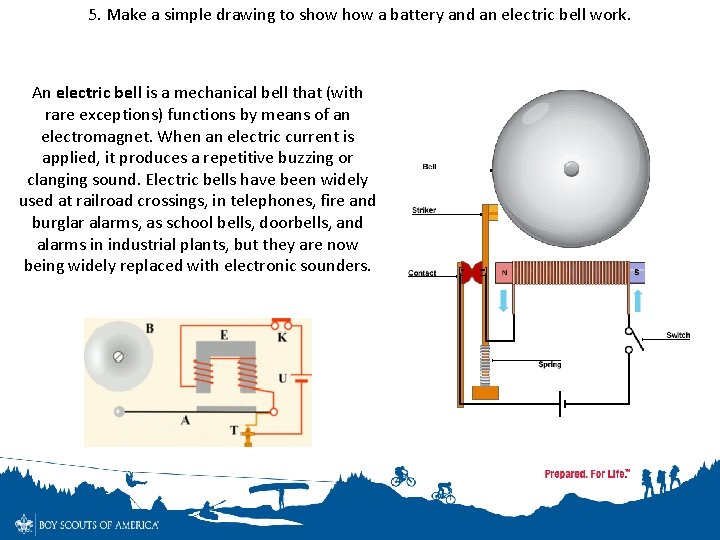
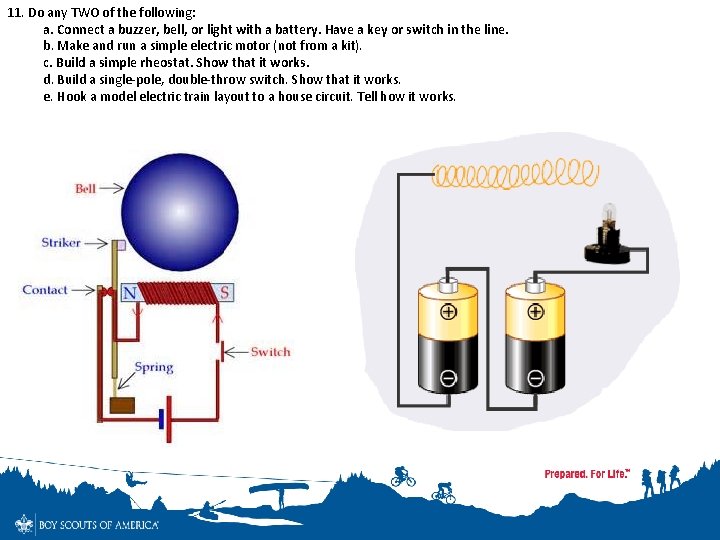
5. Make a simple drawing to show a battery and an electric bell work. An electric bell is a mechanical bell that (with rare exceptions) functions by means of an electromagnet. When an electric current is applied, it produces a repetitive buzzing or clanging sound. Electric bells have been widely used at railroad crossings, in telephones, fire and burglar alarms, as school bells, doorbells, and alarms in industrial plants, but they are now being widely replaced with electronic sounders.
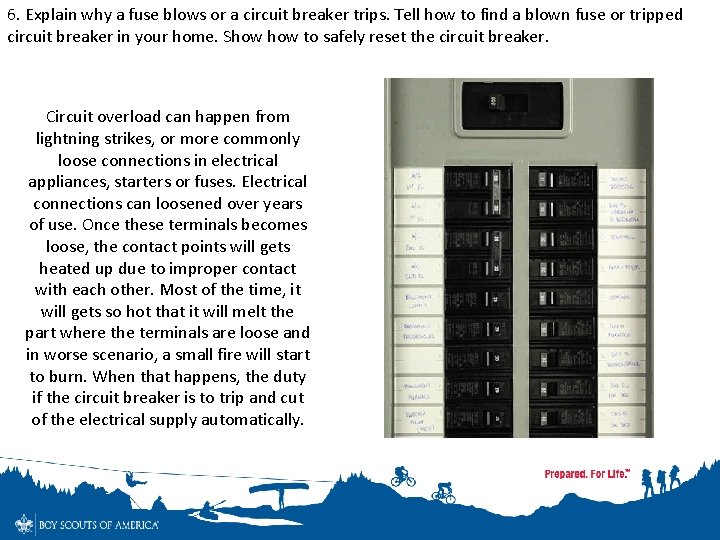
6. Explain why a fuse blows or a circuit breaker trips. Tell how to find a blown fuse or tripped circuit breaker in your home. Show to safely reset the circuit breaker. Circuit overload can happen from lightning strikes, or more commonly loose connections in electrical appliances, starters or fuses. Electrical connections can loosened over years of use. Once these terminals becomes loose, the contact points will gets heated up due to improper contact with each other. Most of the time, it will gets so hot that it will melt the part where the terminals are loose and in worse scenario, a small fire will start to burn. When that happens, the duty if the circuit breaker is to trip and cut of the electrical supply automatically.
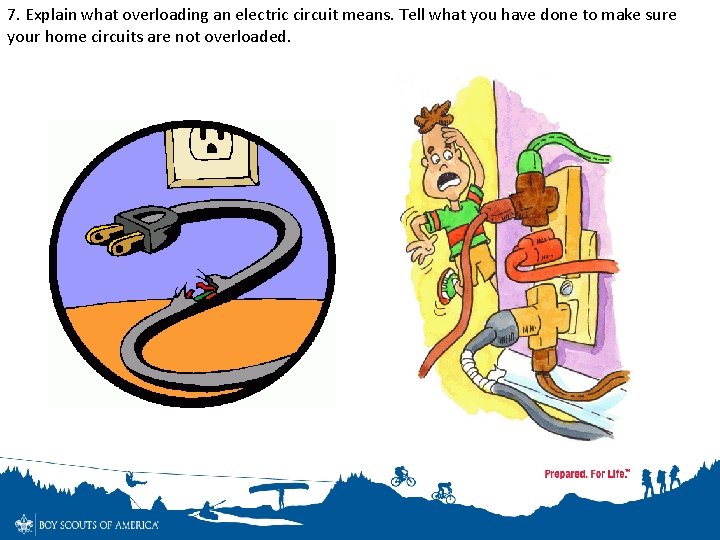
7. Explain what overloading an electric circuit means. Tell what you have done to make sure your home circuits are not overloaded.
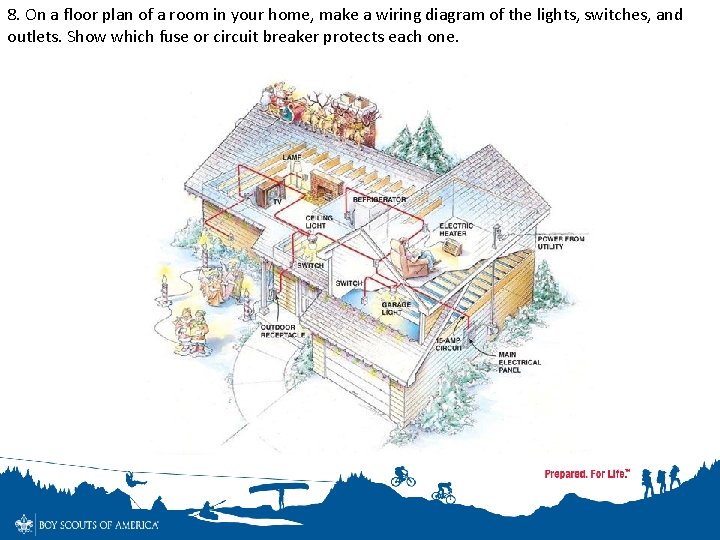
8. On a floor plan of a room in your home, make a wiring diagram of the lights, switches, and outlets. Show which fuse or circuit breaker protects each one.
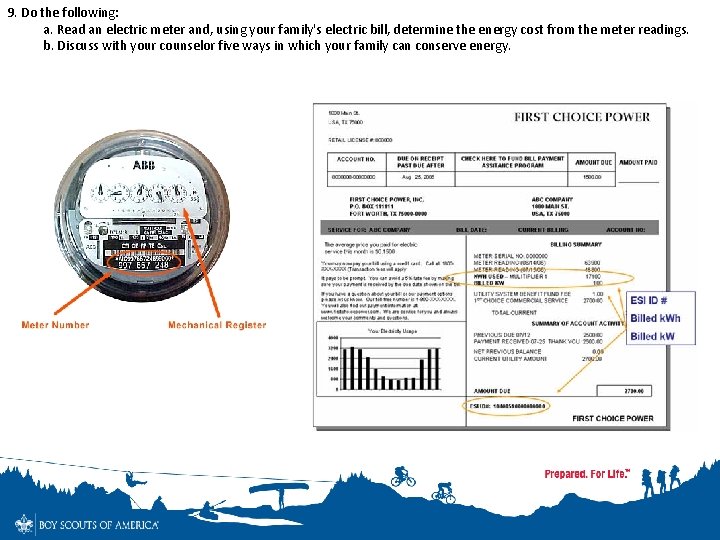
9. Do the following: a. Read an electric meter and, using your family's electric bill, determine the energy cost from the meter readings. b. Discuss with your counselor five ways in which your family can conserve energy.
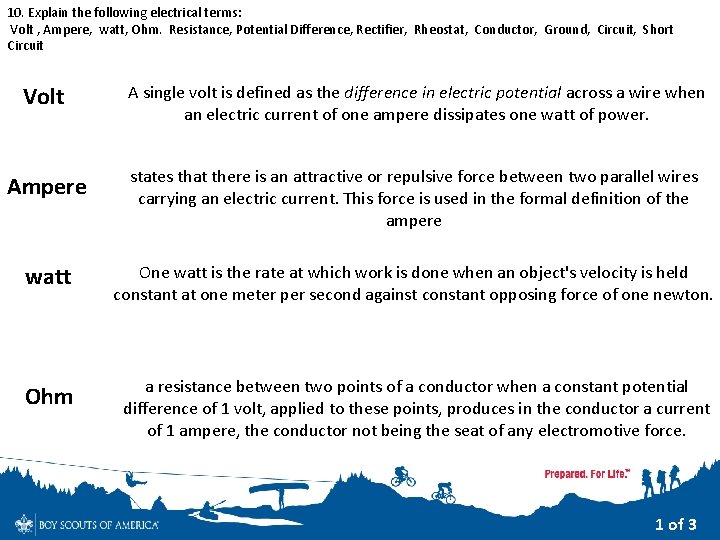
10. Explain the following electrical terms: Volt , Ampere, watt, Ohm. Resistance, Potential Difference, Rectifier, Rheostat, Conductor, Ground, Circuit, Short Circuit Volt A single volt is defined as the difference in electric potential across a wire when an electric current of one ampere dissipates one watt of power. Ampere states that there is an attractive or repulsive force between two parallel wires carrying an electric current. This force is used in the formal definition of the ampere watt One watt is the rate at which work is done when an object's velocity is held constant at one meter per second against constant opposing force of one newton. Ohm a resistance between two points of a conductor when a constant potential difference of 1 volt, applied to these points, produces in the conductor a current of 1 ampere, the conductor not being the seat of any electromotive force. 1 of 3
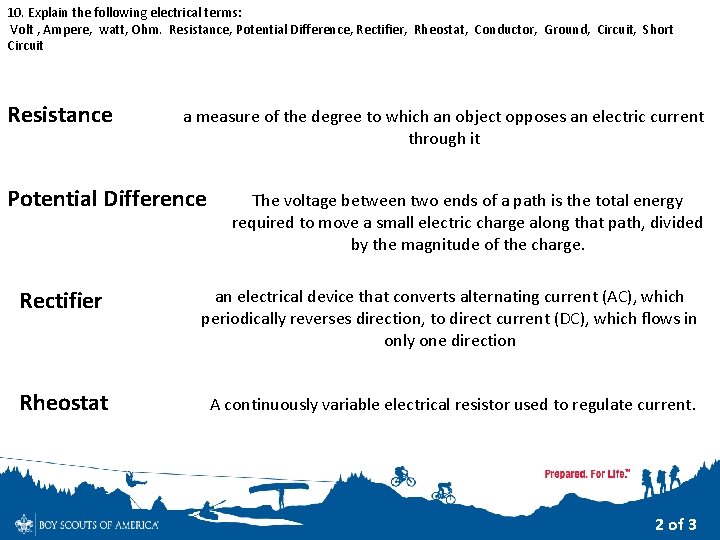
10. Explain the following electrical terms: Volt , Ampere, watt, Ohm. Resistance, Potential Difference, Rectifier, Rheostat, Conductor, Ground, Circuit, Short Circuit Resistance a measure of the degree to which an object opposes an electric current through it Potential Difference The voltage between two ends of a path is the total energy required to move a small electric charge along that path, divided by the magnitude of the charge. Rectifier an electrical device that converts alternating current (AC), which periodically reverses direction, to direct current (DC), which flows in only one direction Rheostat A continuously variable electrical resistor used to regulate current. 2 of 3
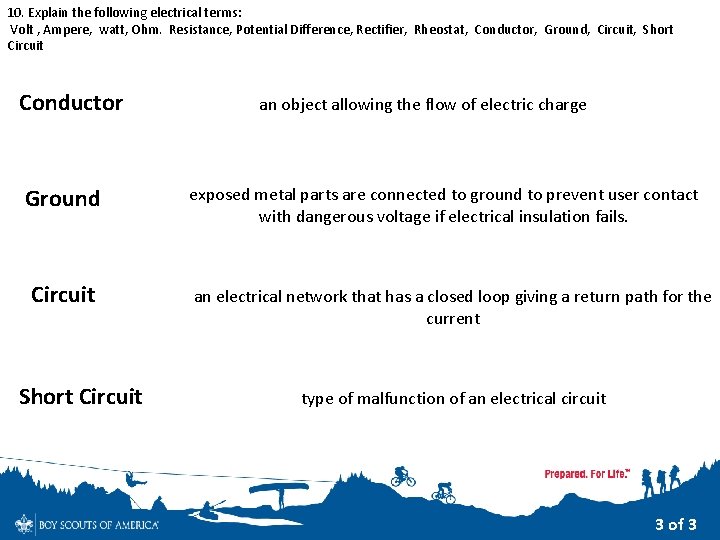
10. Explain the following electrical terms: Volt , Ampere, watt, Ohm. Resistance, Potential Difference, Rectifier, Rheostat, Conductor, Ground, Circuit, Short Circuit Conductor Ground Circuit Short Circuit an object allowing the flow of electric charge exposed metal parts are connected to ground to prevent user contact with dangerous voltage if electrical insulation fails. an electrical network that has a closed loop giving a return path for the current type of malfunction of an electrical circuit 3 of 3
11. Do any TWO of the following: a. Connect a buzzer, bell, or light with a battery. Have a key or switch in the line. b. Make and run a simple electric motor (not from a kit). c. Build a simple rheostat. Show that it works. d. Build a single-pole, double-throw switch. Show that it works. e. Hook a model electric train layout to a house circuit. Tell how it works.
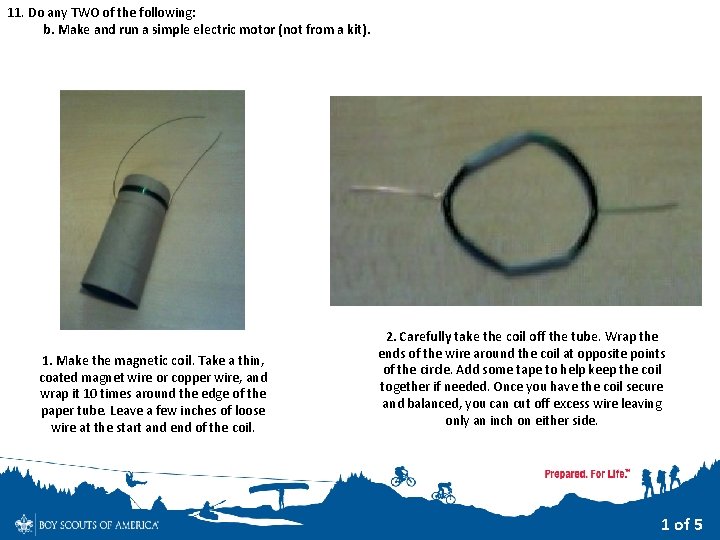
11. Do any TWO of the following: b. Make and run a simple electric motor (not from a kit). 1. Make the magnetic coil. Take a thin, coated magnet wire or copper wire, and wrap it 10 times around the edge of the paper tube. Leave a few inches of loose wire at the start and end of the coil. 2. Carefully take the coil off the tube. Wrap the ends of the wire around the coil at opposite points of the circle. Add some tape to help keep the coil together if needed. Once you have the coil secure and balanced, you can cut off excess wire leaving only an inch on either side. 1 of 5
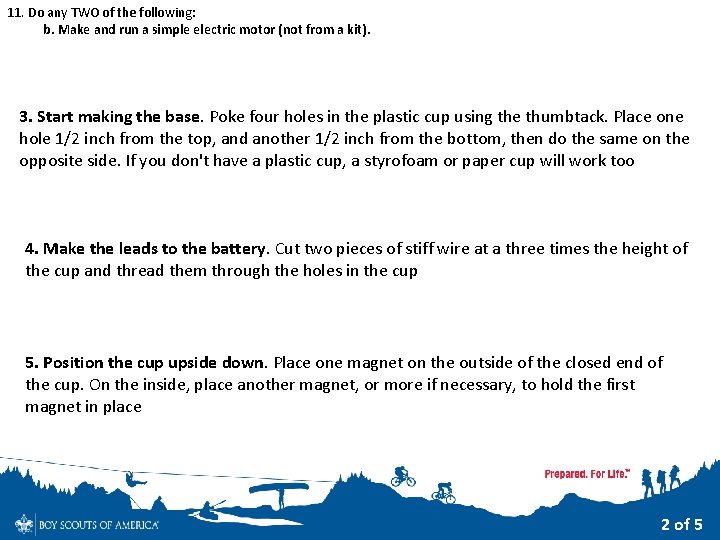
11. Do any TWO of the following: b. Make and run a simple electric motor (not from a kit). 3. Start making the base. Poke four holes in the plastic cup using the thumbtack. Place one hole 1/2 inch from the top, and another 1/2 inch from the bottom, then do the same on the opposite side. If you don't have a plastic cup, a styrofoam or paper cup will work too 4. Make the leads to the battery. Cut two pieces of stiff wire at a three times the height of the cup and thread them through the holes in the cup 5. Position the cup upside down. Place one magnet on the outside of the closed end of the cup. On the inside, place another magnet, or more if necessary, to hold the first magnet in place 2 of 5
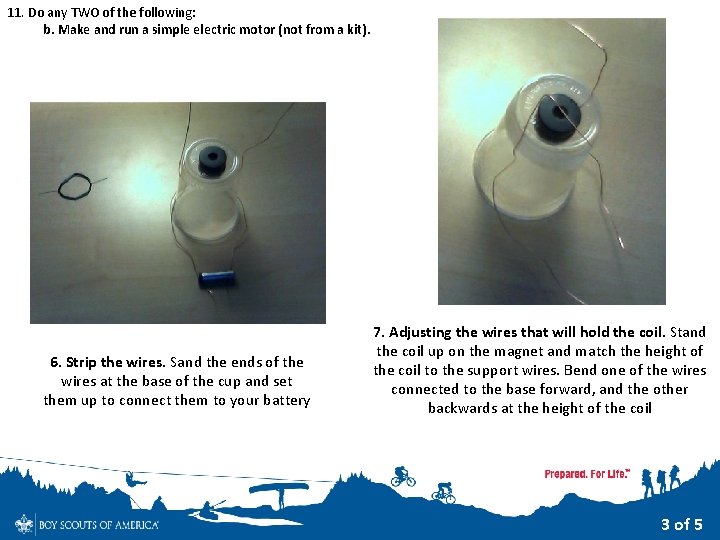
11. Do any TWO of the following: b. Make and run a simple electric motor (not from a kit). 6. Strip the wires. Sand the ends of the wires at the base of the cup and set them up to connect them to your battery 7. Adjusting the wires that will hold the coil. Stand the coil up on the magnet and match the height of the coil to the support wires. Bend one of the wires connected to the base forward, and the other backwards at the height of the coil 3 of 5
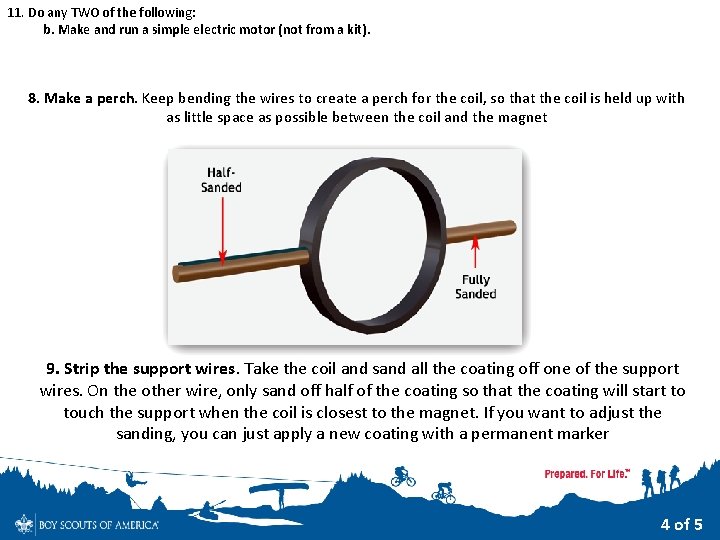
11. Do any TWO of the following: b. Make and run a simple electric motor (not from a kit). 8. Make a perch. Keep bending the wires to create a perch for the coil, so that the coil is held up with as little space as possible between the coil and the magnet 9. Strip the support wires. Take the coil and sand all the coating off one of the support wires. On the other wire, only sand off half of the coating so that the coating will start to touch the support when the coil is closest to the magnet. If you want to adjust the sanding, you can just apply a new coating with a permanent marker 4 of 5
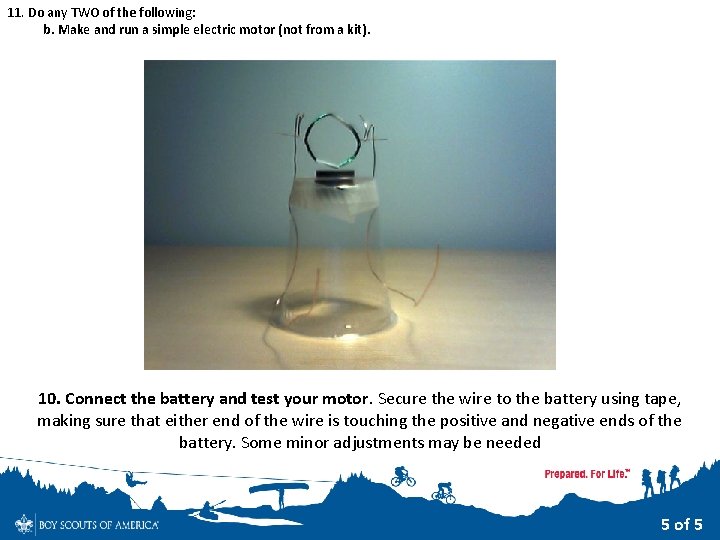
11. Do any TWO of the following: b. Make and run a simple electric motor (not from a kit). 10. Connect the battery and test your motor. Secure the wire to the battery using tape, making sure that either end of the wire is touching the positive and negative ends of the battery. Some minor adjustments may be needed 5 of 5