
Electrical Wire Identification Types of Cable Nonmetallic sheathed

Electrical Wire Identification
Types of Cable • Nonmetallic sheathed cable: copper or aluminum wire covered with paper, rubber, or vinyl for insulation • Armored cable: flexible metal sheath with individual wires inside. Wires are insulated • Conduit: tubing with individually insulated wires
Wire Type and Size • • copper No 14 (14 gauge) = 15 amp circuits No 12 = 20 amps No 10 = 30 amps aluminum use one size larger lower gauge number = larger wire No 8 and larger use bundles of wires current travels on outer surface of wire, so a bundle of smaller wires can carry more
Voltage Drop • loss of voltage as it travels along a wire • lights dim, motors overheat • larger wires have less voltage drop for a given amount of current • longer wire = greater problem • must increase wire size as distance increases
Wire Identification • Type of outer covering, individual wire covering, cable construction, number of wires • Wire type stamped on outer surface
Wire Types • • • Type T - dry locations Type TW - dry or wet THHN - dry, high temps THW and THWN - wet, high temps XHHW - high moisture & heat resistance • UF - direct burial in soil but not concrete
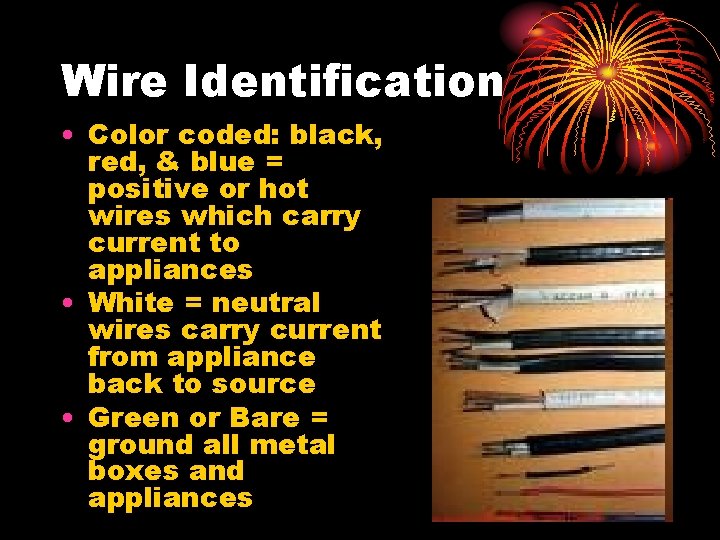
Wire Identification • Color coded: black, red, & blue = positive or hot wires which carry current to appliances • White = neutral wires carry current from appliance back to source • Green or Bare = ground all metal boxes and appliances

Wire Identification • Wire Size: 12 -2 has two strands of No. 12 wire (black & white) • 12 -2 w/g same, with one green or bare • 12 -3 has three strands of No. 12 (black, red, white) • 12 -3 w/g same, with green or bare
- Slides: 8