
Electrical Trade Theory N 1 Module 1 Safety
- Slides: 29
Electrical Trade Theory N 1
Module 1: Safety precautions HOUSEKEEPING Housekeeping is about ensuring that equipment and materials are kept in their proper places and are easily accessible to all. A neat and organised workplace is a safer workplace, and a safer working environment allows better profits and a happier workforce, and it saves time. In short, good housekeeping is about a place for everything and everything in its place. www. futuremanagers. com
Module 1: Safety precautions (continued) ACCIDENTS AND INCIDENTS An accident can simply be defined as an unplanned event that can result in an injury, the loss of life or damage to property or goods. On the other hand, an ‘incident’ can simply be defined as any unplanned event that did not result in injury or damage. www. futuremanagers. com
Module 1: Safety precautions (continued) SAFETY SWITCHES Safety switches are included in a circuit to ensure safety by causing a circuit to be opened in the event of an incorrect operation. These come in the forms of: • Electrical interlocks, • Lockout switches, and • Circuit-breakers, • Earth-leakage relays. • Overload relays, www. futuremanagers. com
Module 1: Safety precautions (continued) SIGNAGE Signage refers to codes and symbols used to universally show meaning and promote safety. Signage are generally used with specific colours and signs to represent meaning quickly. www. futuremanagers. com
Module 1: Safety precautions (continued) OCCUPATIONAL HEALTH AND SAFETY ACT (OHS ACT) In South Africa we have the Occupational Health and Safety Act (OHS Act) No. 85 of 1993 that regulates the safety in general of workers in our country. According to the Act, an accident is an unplanned, uncontrolled event caused by unsafe acts and conditions. It is the aim of the act to eliminate or reduce work- related accidents. It tries to ensure that workers have a safe environment to work in. www. futuremanagers. com
Module 1: Safety precautions (continued) PERSONAL PROTECTIVE EQUIPMENT Workshops and construction sites can be very dangerous places. It is therefore important to wear protective gear in order to prevent unnecessary accidents. Different protective equipment is required for different jobs. PPE will protect the user against health and safety risks at the workplace. PPE can be anything from hard hats and safety goggles to leather gloves and aprons. www. futuremanagers. com
Module 2: Fire and firefighting FIRE Because of the type of work being done in electrical workshops, there is always a risk of a fire. Many fires are caused by faulty electrical conditions or connections. It is therefore important that everyone working in an electrical workshop or laboratory knows what to do in the event of a fire. www. futuremanagers. com
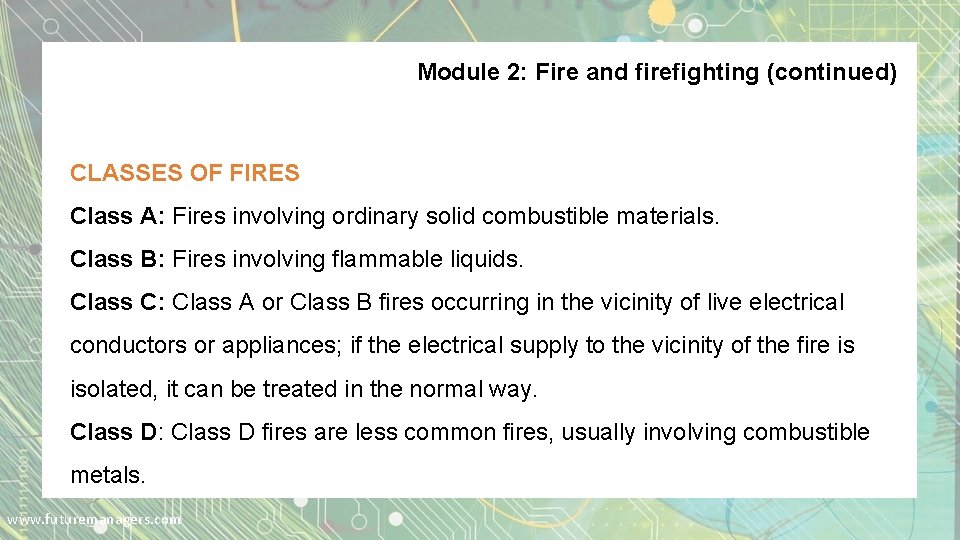
Module 2: Fire and firefighting (continued) CLASSES OF FIRES Class A: Fires involving ordinary solid combustible materials. Class B: Fires involving flammable liquids. Class C: Class A or Class B fires occurring in the vicinity of live electrical conductors or appliances; if the electrical supply to the vicinity of the fire is isolated, it can be treated in the normal way. Class D: Class D fires are less common fires, usually involving combustible metals. www. futuremanagers. com
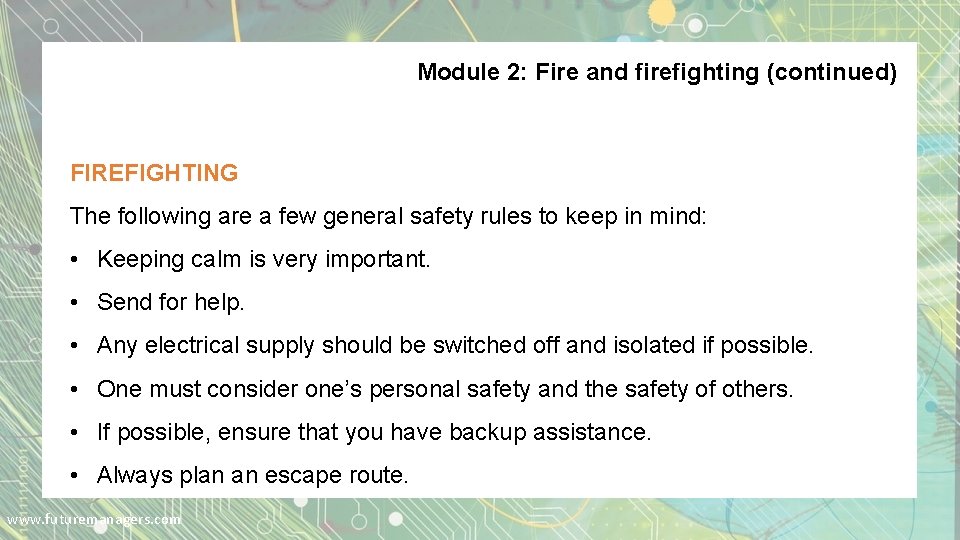
Module 2: Fire and firefighting (continued) FIREFIGHTING The following are a few general safety rules to keep in mind: • Keeping calm is very important. • Send for help. • Any electrical supply should be switched off and isolated if possible. • One must consider one’s personal safety and the safety of others. • If possible, ensure that you have backup assistance. • Always plan an escape route. www. futuremanagers. com
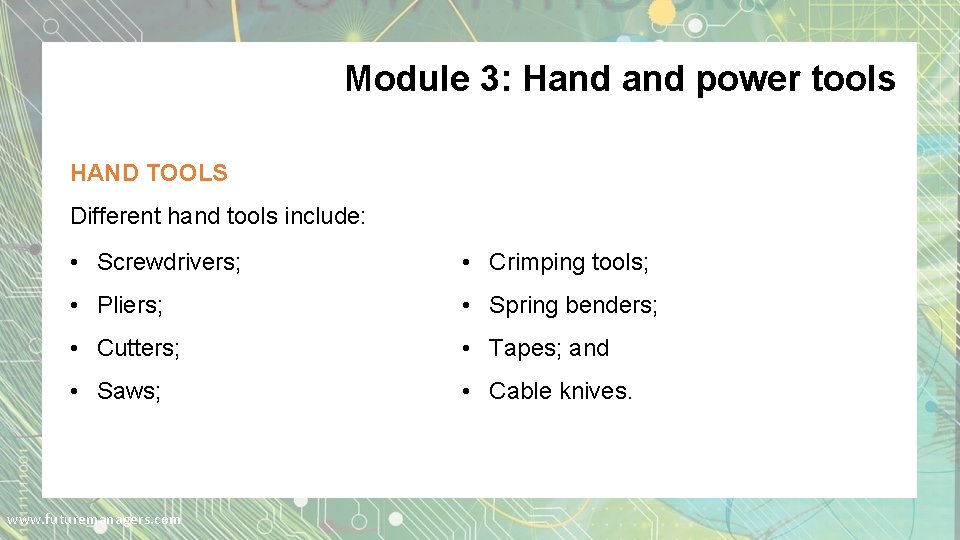
Module 3: Hand power tools HAND TOOLS Different hand tools include: • Screwdrivers; • Crimping tools; • Pliers; • Spring benders; • Cutters; • Tapes; and • Saws; • Cable knives. www. futuremanagers. com
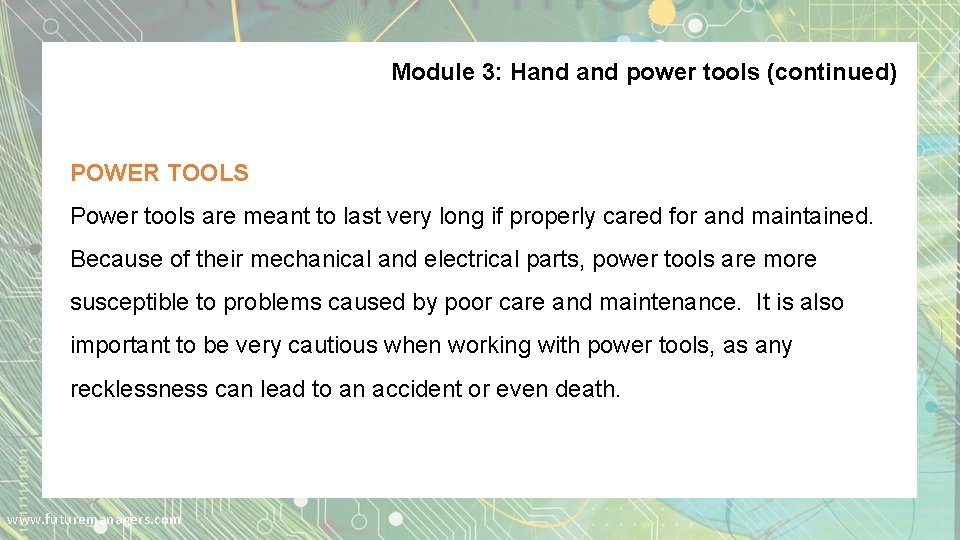
Module 3: Hand power tools (continued) POWER TOOLS Power tools are meant to last very long if properly cared for and maintained. Because of their mechanical and electrical parts, power tools are more susceptible to problems caused by poor care and maintenance. It is also important to be very cautious when working with power tools, as any recklessness can lead to an accident or even death. www. futuremanagers. com
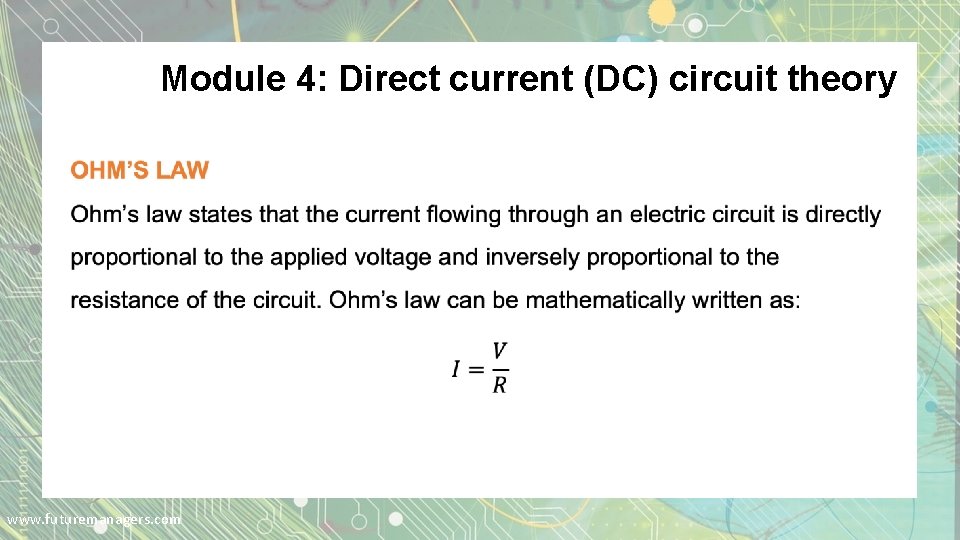
Module 4: Direct current (DC) circuit theory www. futuremanagers. com
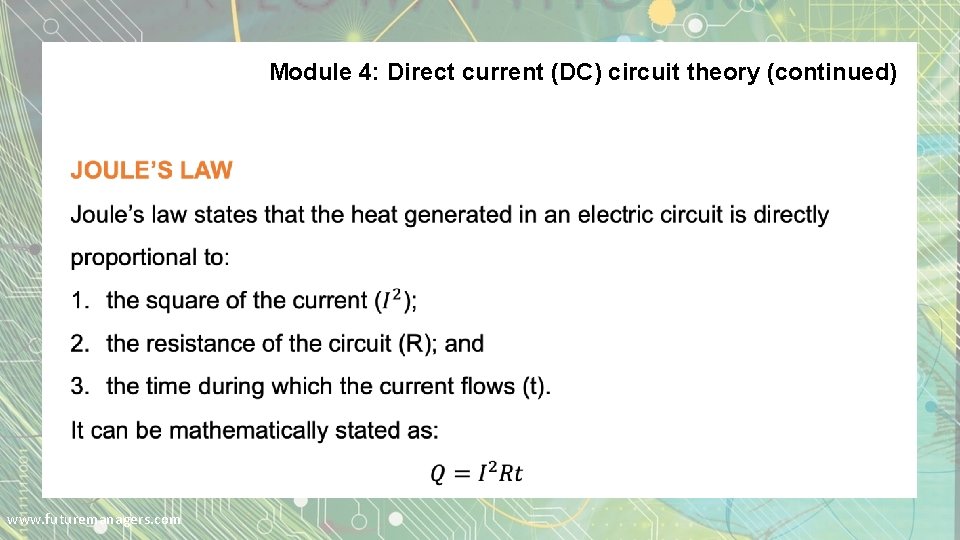
Module 4: Direct current (DC) circuit theory (continued) www. futuremanagers. com
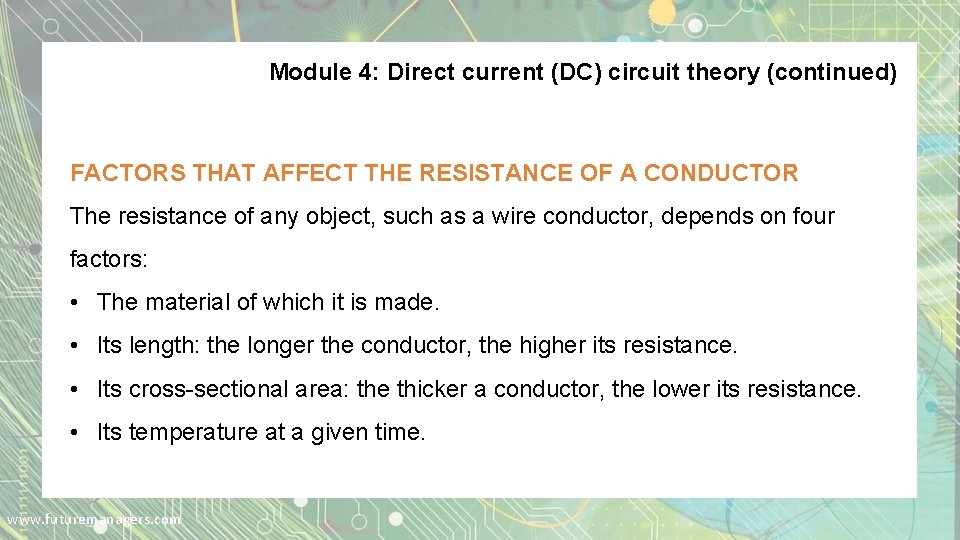
Module 4: Direct current (DC) circuit theory (continued) FACTORS THAT AFFECT THE RESISTANCE OF A CONDUCTOR The resistance of any object, such as a wire conductor, depends on four factors: • The material of which it is made. • Its length: the longer the conductor, the higher its resistance. • Its cross-sectional area: the thicker a conductor, the lower its resistance. • Its temperature at a given time. www. futuremanagers. com
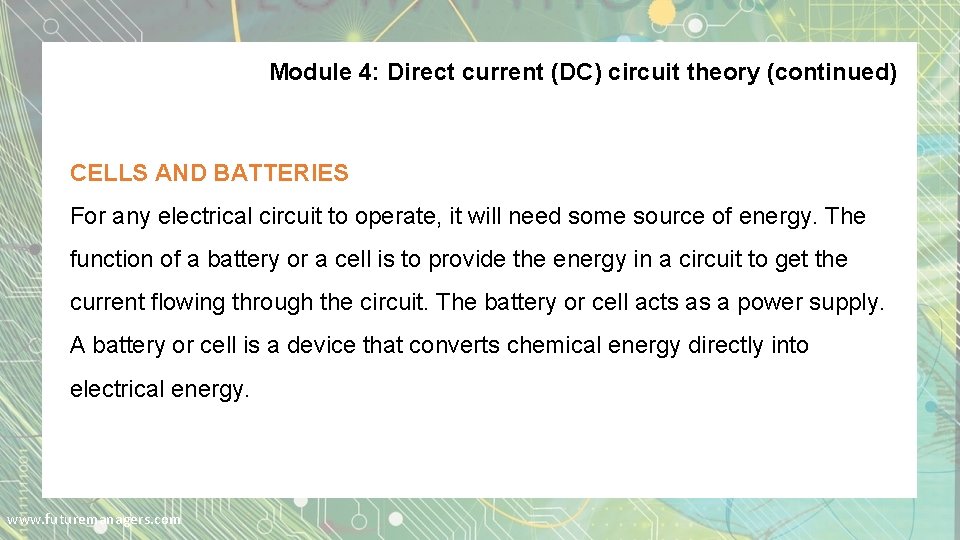
Module 4: Direct current (DC) circuit theory (continued) CELLS AND BATTERIES For any electrical circuit to operate, it will need some source of energy. The function of a battery or a cell is to provide the energy in a circuit to get the current flowing through the circuit. The battery or cell acts as a power supply. A battery or cell is a device that converts chemical energy directly into electrical energy. www. futuremanagers. com
Module 4: Direct current (DC) circuit theory (continued) TEMPERATURE COEFFICIENT OF RESISTANCE Temperature coefficient of resistance can be defined as the change in resistance of a material per degree centigrade. The symbol used to represent temperature coefficient is the Greek letter alfa (α). www. futuremanagers. com
Module 5: Conductor and insulating materials CONDUCTORS A conductor can be defined as a substance that will allow current to flow through it freely. Some materials are better conductors than others. When referring to conductive materials, metals are generally thought of first. However, non-metals (such as carbon) and liquids (such as water) can also act as conductors. www. futuremanagers. com
Module 5: Conductor and insulating materials (continued) INSULATORS An insulator can be defined as a substance that prevents the flow of electric current through it. The main function of insulating materials is to support and/or electrically separate conductors in order to prevent the flow of an electric current where a potential difference exists between two or more points. www. futuremanagers. com
Module 5: Conductor and insulating materials (continued) SEMICONDUCTORS A semiconductor can be seen as a material that is neither a good conductor nor an insulator. A semiconductor material has an electrical conductivity value between that of a conductor, such as metallic copper, and an insulator, such as glass. Its resistance decreases as its temperature increases, which is behaviour opposite to that of a metal. This makes it a good medium for the control of electric current. www. futuremanagers. com
Module 6: Wiring of premises SYMBOLS In the electrical field, all electrical components are represented by a graphical picture or a symbol. These symbols are largely standardised internationally today, with the IEC (International Electrotechnical Commission) as the standard and conformity assessment body. www. futuremanagers. com
Module 6: Wiring of premises (continued) PROTECTIVE DEVICES A circuit-breaker is a mechanical switching device which can operate as a manual switch and its purpose is to automatically disconnect an appliance or circuit from the supply in the event of an abnormal condition such as an overcurrent. The purpose of an earth-leakage unit is to detect an earth fault current and to automatically disconnect an installation or circuit from the supply, within a specified time, when it exceeds a specified or predetermined value. www. futuremanagers. com
Module 6: Wiring of premises (continued) PROTECTIVE DEVICES (CONT) A lightning arrestor is a device designed to protect an installation from transient (momentary) voltage surges caused by lightning. Fuses are overcurrent protective devices that come in many shapes and sizes, depending on the type of application. www. futuremanagers. com
Module 7: Testing of a single-phase installation INSULATION-RESISTANCE TESTER When carrying out insulation-resistance tests: • Use an AC (RMS value) or DC voltage of at least twice the normal voltage, with a minimum of 500 V. • Ensure that all fuses are in place and switches and circuit-breakers (MCBs) are in the on positions. The loads such as stoves and other appliances may be disconnected. www. futuremanagers. com
Module 8: Magnetism and electromagnetism MAGNETISM Magnets only attract what is known as ferromagnetic material (such as iron, nickel and cobalt). All magnets have two poles: a north and a south pole. These magnetic poles behave rather like electric charges. There are three types of magnets: • Natural magnets; • Permanent magnets; and • Electromagnets. www. futuremanagers. com
Module 8: Magnetism and electromagnetism (continued) ELECTROMAGNETISM Electromagnetic induction, according to Faraday’s law, may be stated: • An emf can be induced in a conductor whenever there is a change in the magnetic flux linking with the conductor. • The magnitude of the induced emf is directly proportional to the rate of change of the magnetic flux linking with the conductor. www. futuremanagers. com
Module 9: Renewable energies TYPES OF RENEWABLE ENERGY Renewable energy can be defined as energy that is generated from sources that cannot be depleted or can continuously be regenerated. The most common types of renewable energy are solar, wind, hydro, geothermal, tidal and biomass. www. futuremanagers. com
Module 9: Renewable energies (continued) ADVANTAGES OF RENEWABLE ENERGY Renewable energy is preferred over fossil fuels because of its benefits to humans as well as the environment. Some of the benefits of renewable energy are the following: • Renewable energy has the advantage that it will never run out. • It has health and environmental benefits. Renewable energy emits fewer harmful gases or does not pollute our water resources. • Less maintenance is required. www. futuremanagers. com
Module 9: Renewable energies (continued) ADVANTAGES OF RENEWABLE ENERGY (CONT) • Multiple forms of renewable energy exist compared to fossil fuel resources. • It leads to greater energy independence. Fossil fuels come from only a few countries; therefore, pricing and availability are controlled by them. By developing renewable energy resources, countries can work towards energy independence with a diverse number of energy sources to access. With renewable energy technologies, energy can be produced locally. www. futuremanagers. com