
Electrical Trade Theory N 1 Chapter 1 Safety
- Slides: 62
Electrical Trade Theory N 1
Chapter 1: Safety and basic hand tools SAFETY Safety is everyone’s responsibility, but accidents are mainly caused by: • carelessness; • ignorance; and • inexperience. www. futuremanagers. com
Chapter 1: Safety and basic hand tools (continued) ENVIRONMENTAL Employers must provide and maintain a safe and health and safety risk-free working environment and employees must obey all health and safety rules. Includes housekeeping, colour-coding, safety signs, machine guarding, and grinders and ladders. www. futuremanagers. com
Chapter 1: Safety and basic hand tools (continued) FIRES Many fires are electrically related. Open flames, faulty electrical apparatus, carelessness and burning cigarette butts carelessly discarded, are major causes of fires. www. futuremanagers. com
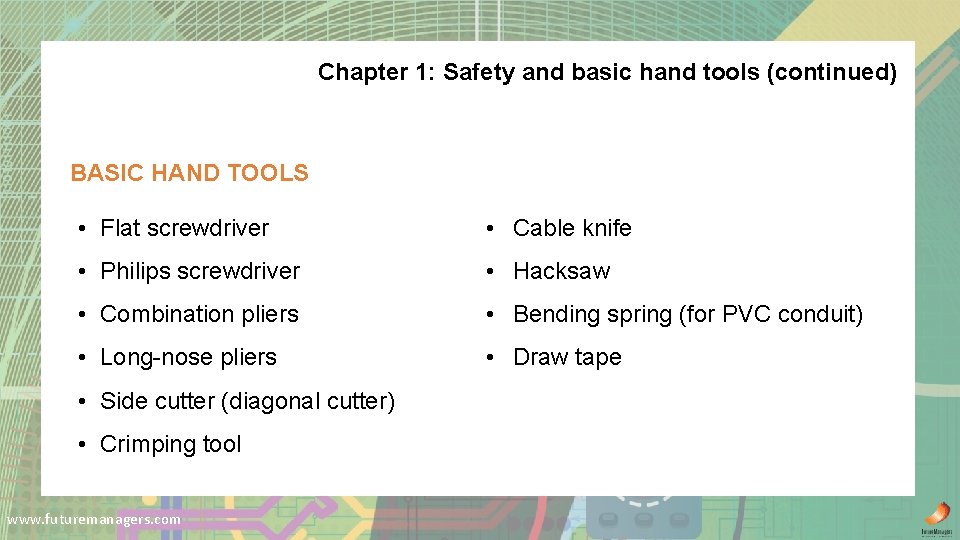
Chapter 1: Safety and basic hand tools (continued) BASIC HAND TOOLS • Flat screwdriver • Cable knife • Philips screwdriver • Hacksaw • Combination pliers • Bending spring (for PVC conduit) • Long-nose pliers • Draw tape • Side cutter (diagonal cutter) • Crimping tool www. futuremanagers. com
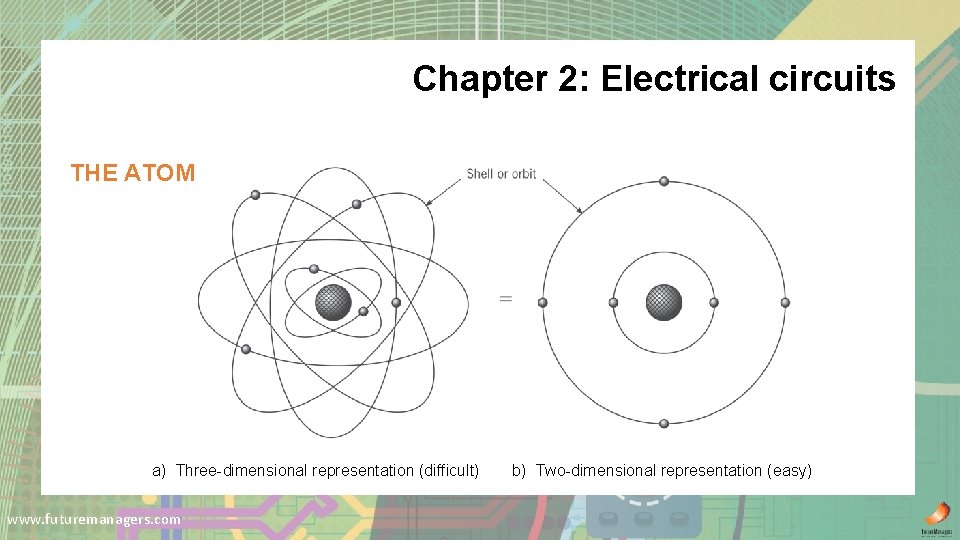
Chapter 2: Electrical circuits THE ATOM a) Three-dimensional representation (difficult) www. futuremanagers. com b) Two-dimensional representation (easy)
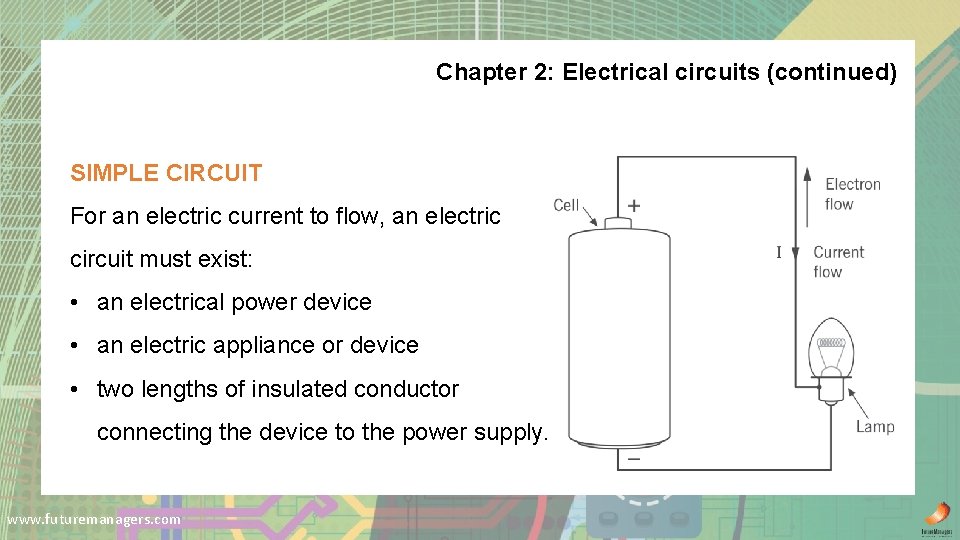
Chapter 2: Electrical circuits (continued) SIMPLE CIRCUIT For an electric current to flow, an electric circuit must exist: • an electrical power device • an electric appliance or device • two lengths of insulated conductor connecting the device to the power supply. www. futuremanagers. com
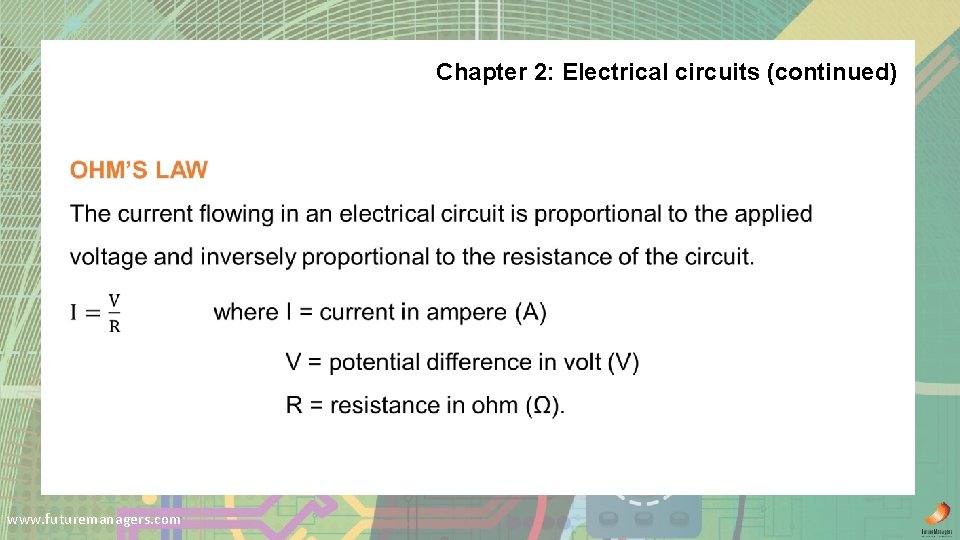
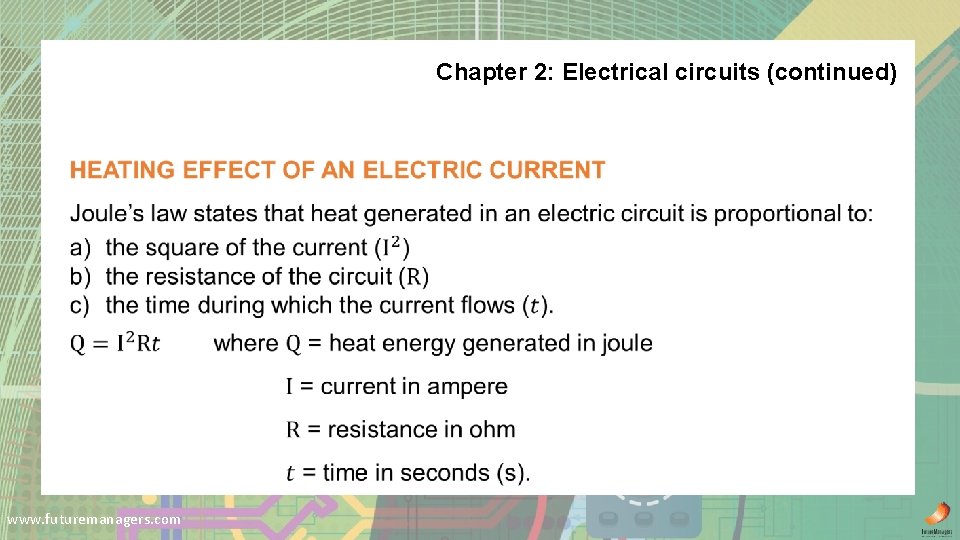
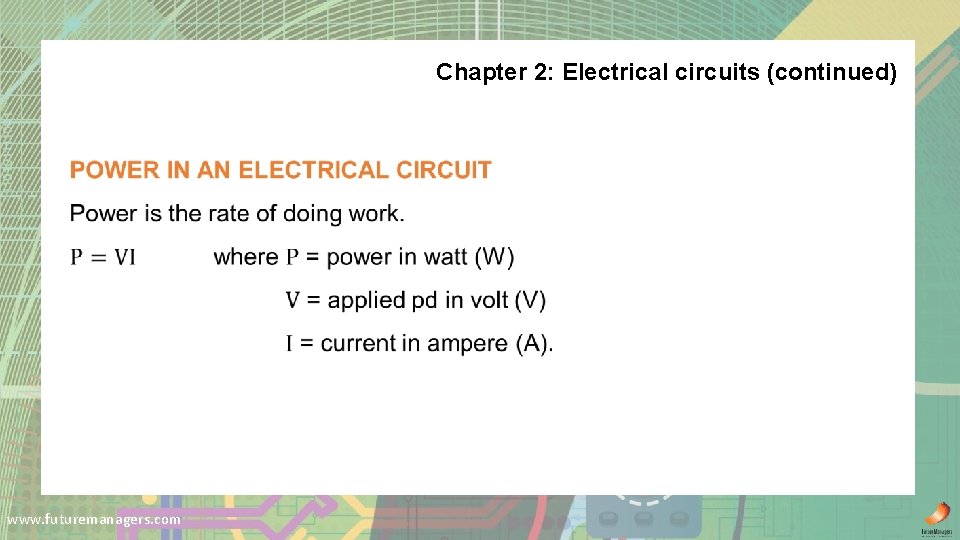
Chapter 2: Electrical circuits (continued) www. futuremanagers. com
Chapter 2: Electrical circuits (continued) www. futuremanagers. com
Chapter 2: Electrical circuits (continued) www. futuremanagers. com
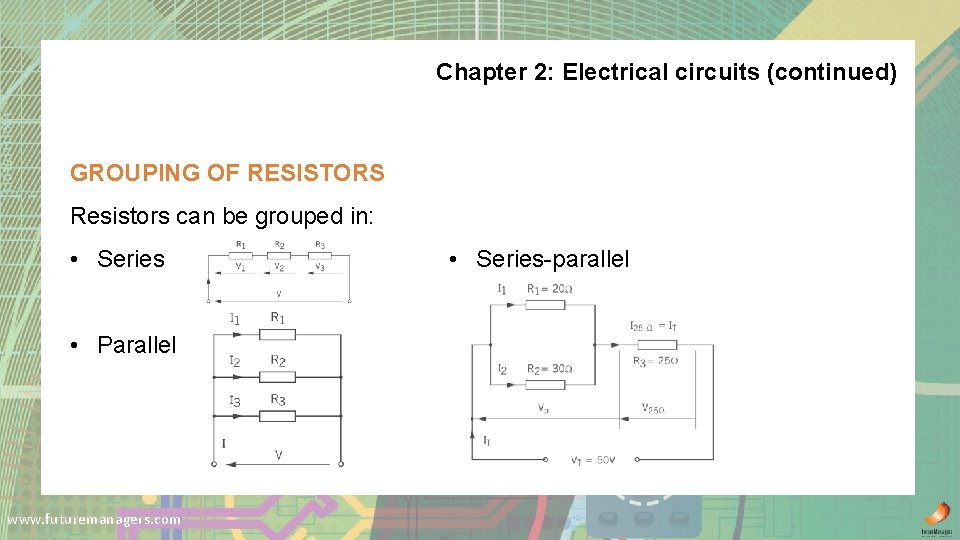
Chapter 2: Electrical circuits (continued) GROUPING OF RESISTORS Resistors can be grouped in: • Series • Parallel www. futuremanagers. com • Series-parallel
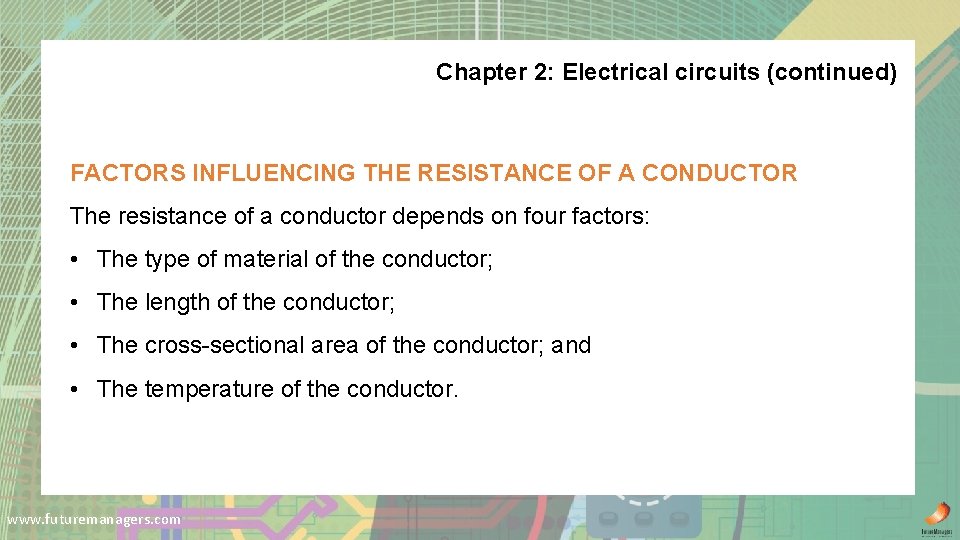
Chapter 2: Electrical circuits (continued) FACTORS INFLUENCING THE RESISTANCE OF A CONDUCTOR The resistance of a conductor depends on four factors: • The type of material of the conductor; • The length of the conductor; • The cross-sectional area of the conductor; and • The temperature of the conductor. www. futuremanagers. com
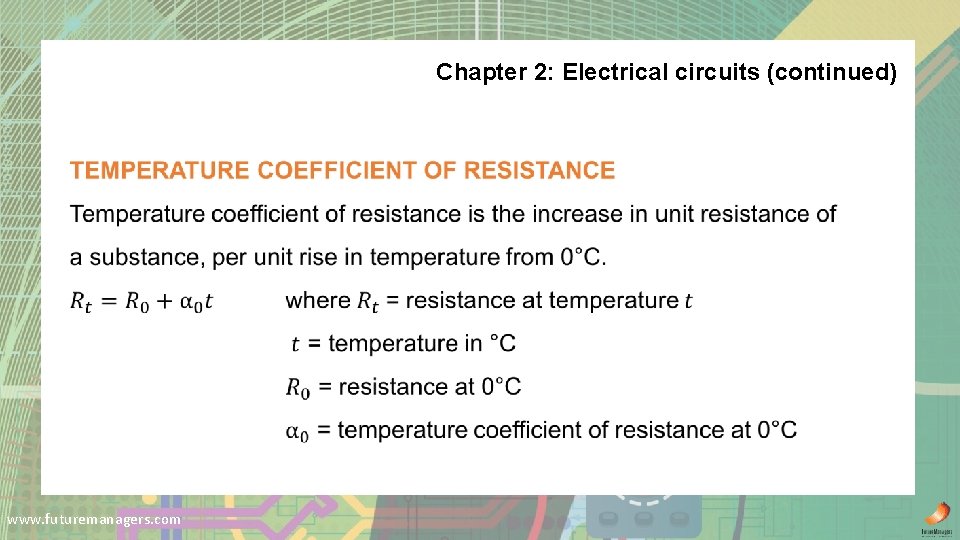
Chapter 2: Electrical circuits (continued) www. futuremanagers. com
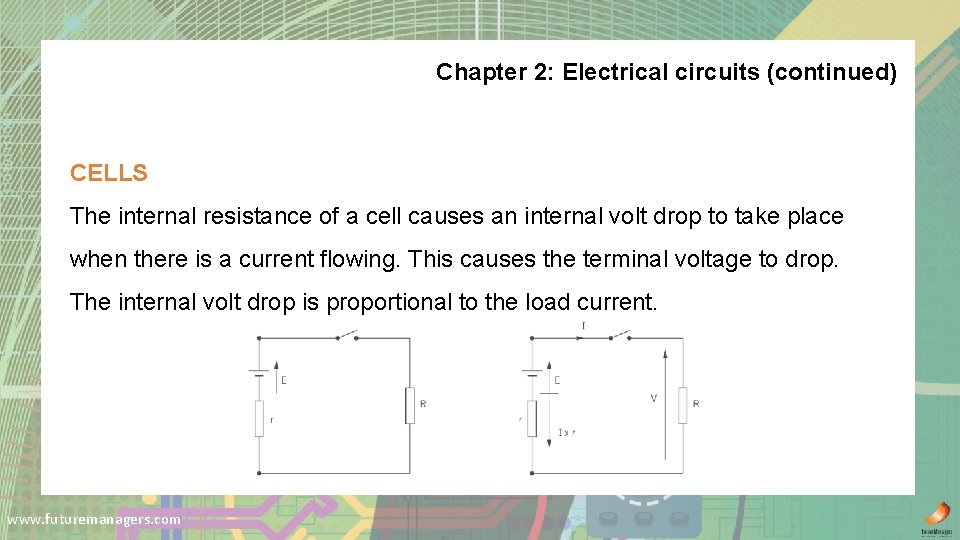
Chapter 2: Electrical circuits (continued) CELLS The internal resistance of a cell causes an internal volt drop to take place when there is a current flowing. This causes the terminal voltage to drop. The internal volt drop is proportional to the load current. www. futuremanagers. com
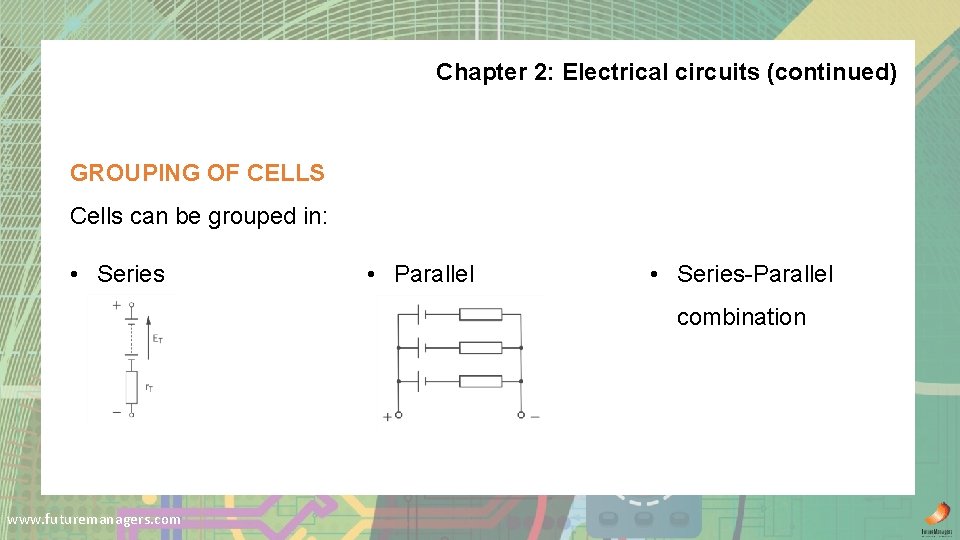
Chapter 2: Electrical circuits (continued) GROUPING OF CELLS Cells can be grouped in: • Series • Parallel • Series-Parallel combination www. futuremanagers. com
Chapter 3: Magnetism and transformers MAGNETISM There are three types of magnets: • Natural magnets; • Permanent magnets; and • Electromagnets. www. futuremanagers. com
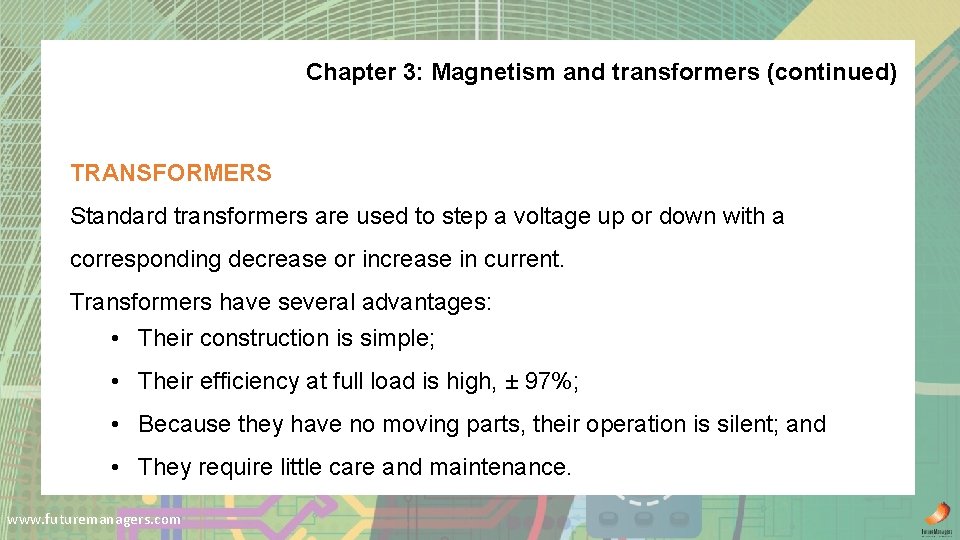
Chapter 3: Magnetism and transformers (continued) TRANSFORMERS Standard transformers are used to step a voltage up or down with a corresponding decrease or increase in current. Transformers have several advantages: • Their construction is simple; • Their efficiency at full load is high, ± 97%; • Because they have no moving parts, their operation is silent; and • They require little care and maintenance. www. futuremanagers. com
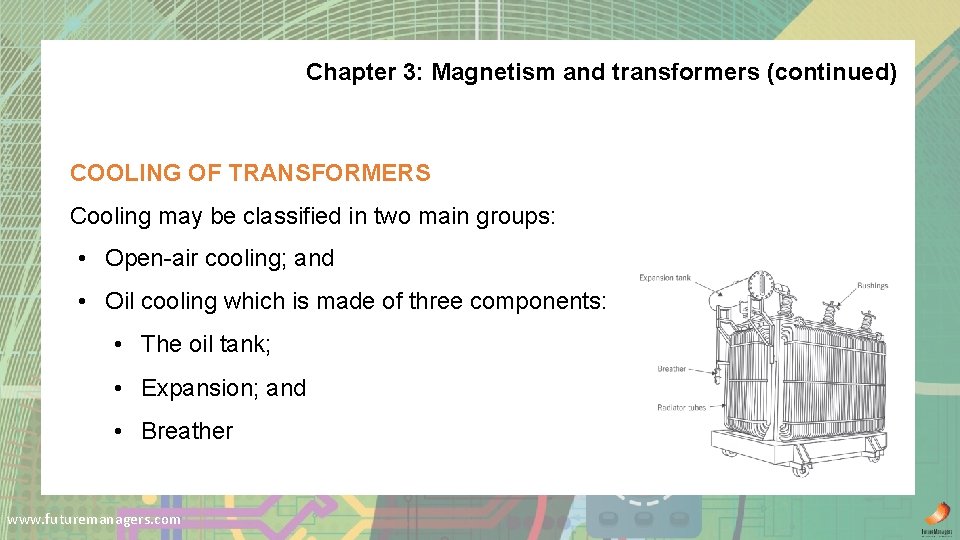
Chapter 3: Magnetism and transformers (continued) COOLING OF TRANSFORMERS Cooling may be classified in two main groups: • Open-air cooling; and • Oil cooling which is made of three components: • The oil tank; • Expansion; and • Breather www. futuremanagers. com
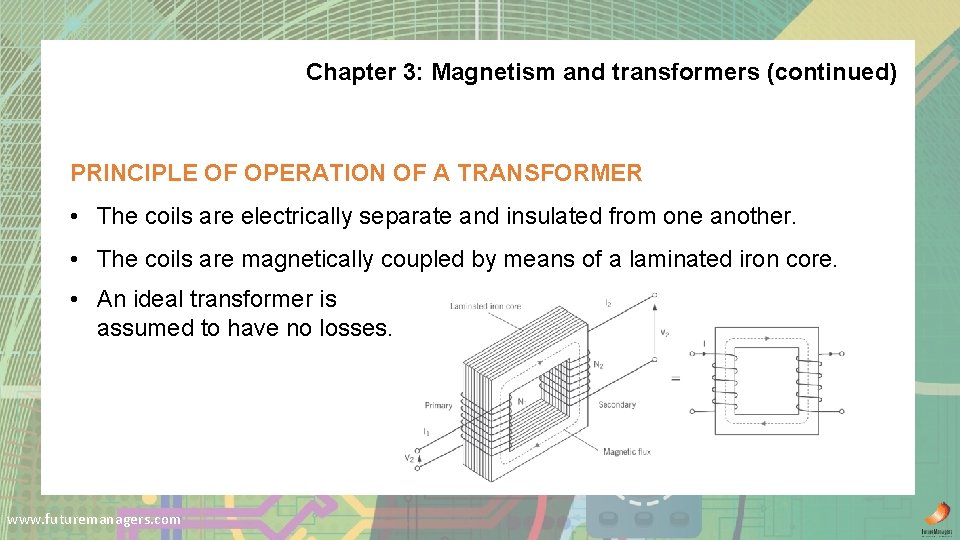
Chapter 3: Magnetism and transformers (continued) PRINCIPLE OF OPERATION OF A TRANSFORMER • The coils are electrically separate and insulated from one another. • The coils are magnetically coupled by means of a laminated iron core. • An ideal transformer is assumed to have no losses. www. futuremanagers. com
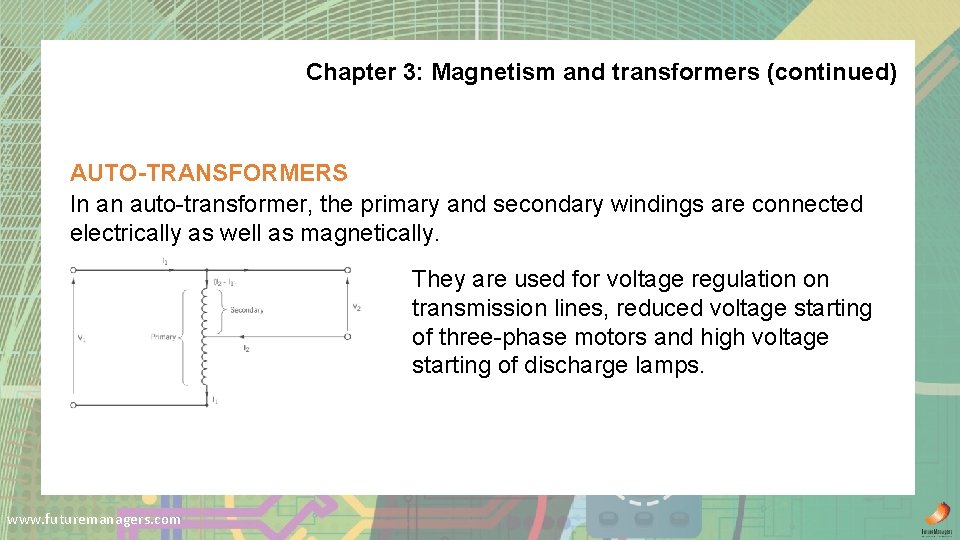
Chapter 3: Magnetism and transformers (continued) AUTO-TRANSFORMERS In an auto-transformer, the primary and secondary windings are connected electrically as well as magnetically. They are used for voltage regulation on transmission lines, reduced voltage starting of three-phase motors and high voltage starting of discharge lamps. www. futuremanagers. com
Chapter 4: Alternating current ELECTROMAGNETIC INDUCTION An electro-magnetic field (emf) is induced when a conductor goes through a magnetic field. Faraday’s first law of electromagnetic induction states: An emf is induced in an electric circuit whenever there is a change in the magnetic flux linking with the circuit. Faraday’s second law of electromagnetic induction: The magnitude of the induced emf is proportional to the rate of change of flux linking with the circuit. www. futuremanagers. com
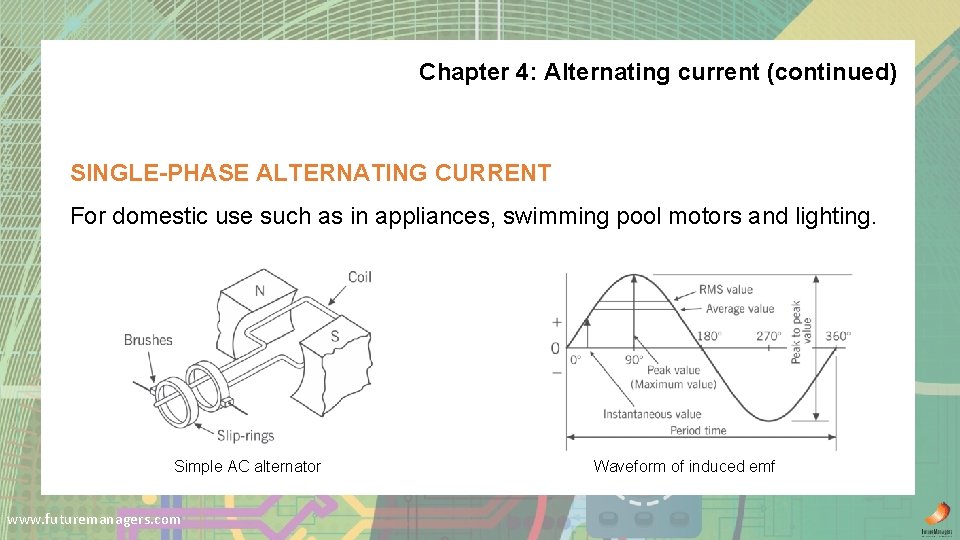
Chapter 4: Alternating current (continued) SINGLE-PHASE ALTERNATING CURRENT For domestic use such as in appliances, swimming pool motors and lighting. Simple AC alternator www. futuremanagers. com Waveform of induced emf
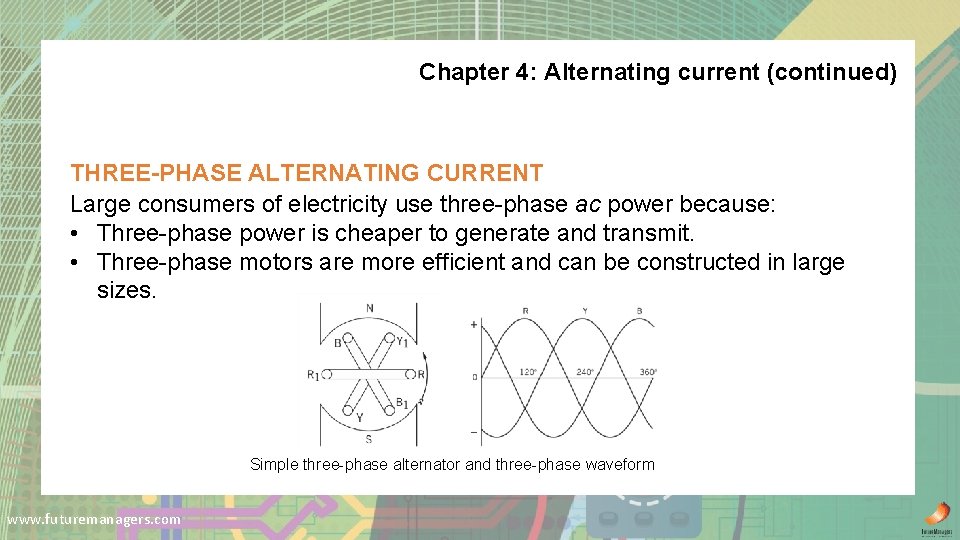
Chapter 4: Alternating current (continued) THREE-PHASE ALTERNATING CURRENT Large consumers of electricity use three-phase ac power because: • Three-phase power is cheaper to generate and transmit. • Three-phase motors are more efficient and can be constructed in large sizes. Simple three-phase alternator and three-phase waveform www. futuremanagers. com
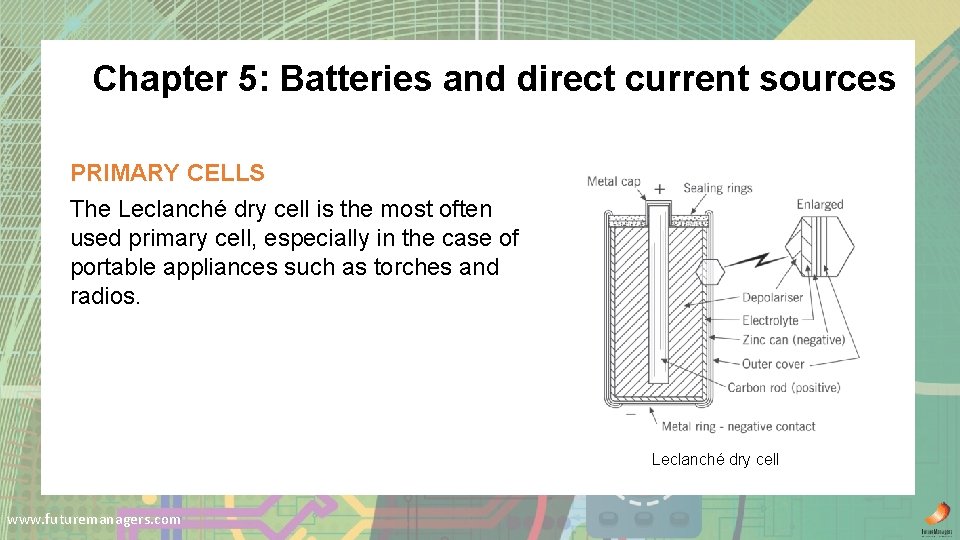
Chapter 5: Batteries and direct current sources PRIMARY CELLS The Leclanché dry cell is the most often used primary cell, especially in the case of portable appliances such as torches and radios. Leclanché dry cell www. futuremanagers. com
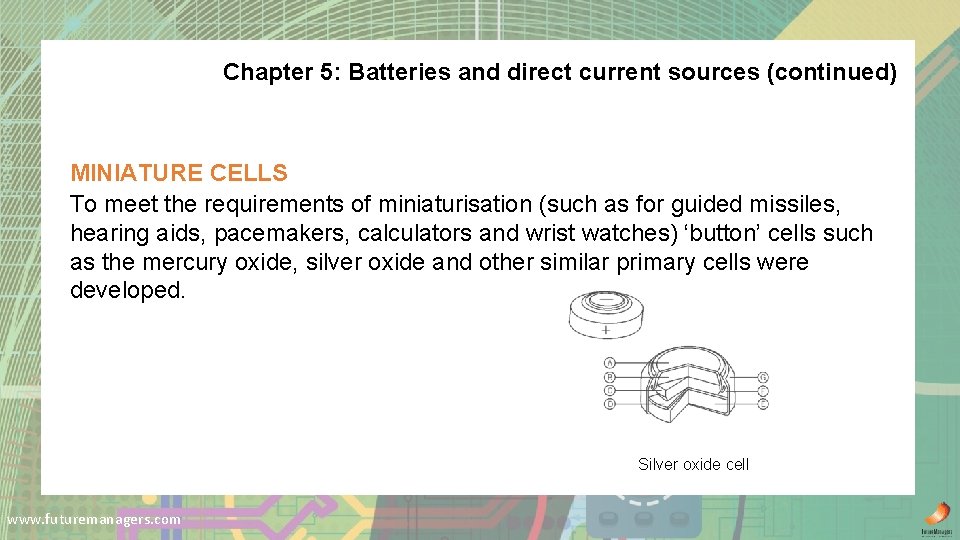
Chapter 5: Batteries and direct current sources (continued) MINIATURE CELLS To meet the requirements of miniaturisation (such as for guided missiles, hearing aids, pacemakers, calculators and wrist watches) ‘button’ cells such as the mercury oxide, silver oxide and other similar primary cells were developed. Silver oxide cell www. futuremanagers. com
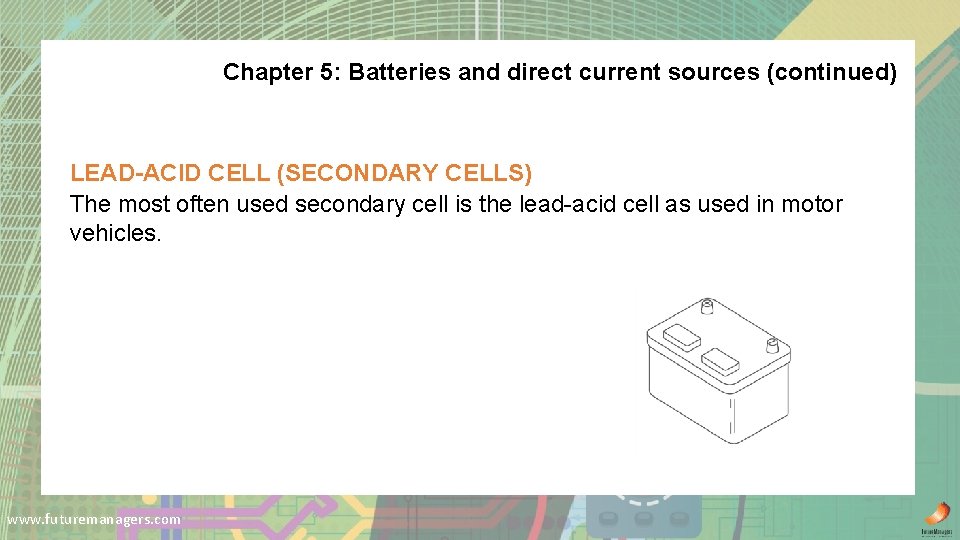
Chapter 5: Batteries and direct current sources (continued) LEAD-ACID CELL (SECONDARY CELLS) The most often used secondary cell is the lead-acid cell as used in motor vehicles. www. futuremanagers. com
Chapter 5: Batteries and direct current sources (continued) CHOICE OF CELLS Certain factors may have to be considered when selecting cells, such as: • • • The voltage required by the load; The current delivering capacity (the load current) that is required; The duration of current flow; The life expectancy of the cell; Whether or not a rechargeable cell is required; and The shelf (storage) life of the cell. www. futuremanagers. com
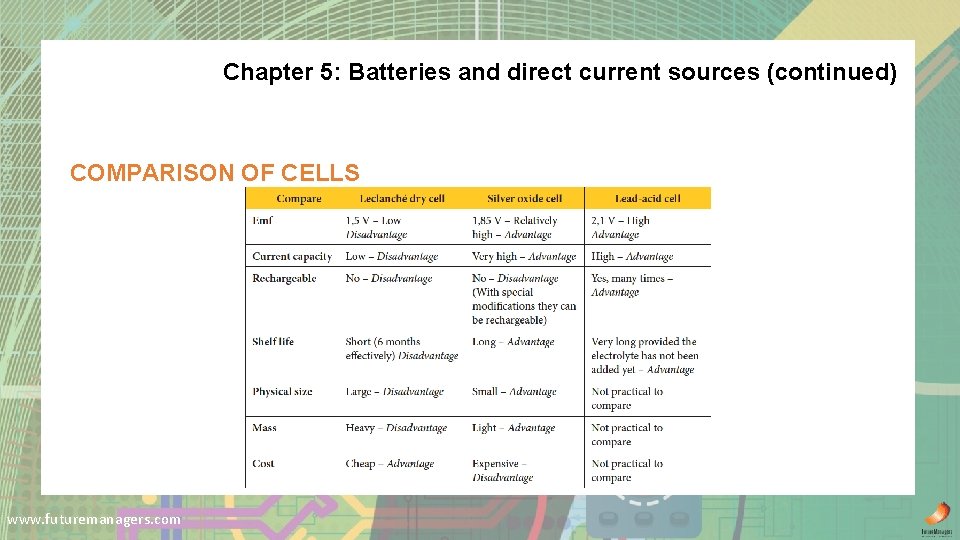
Chapter 5: Batteries and direct current sources (continued) COMPARISON OF CELLS www. futuremanagers. com
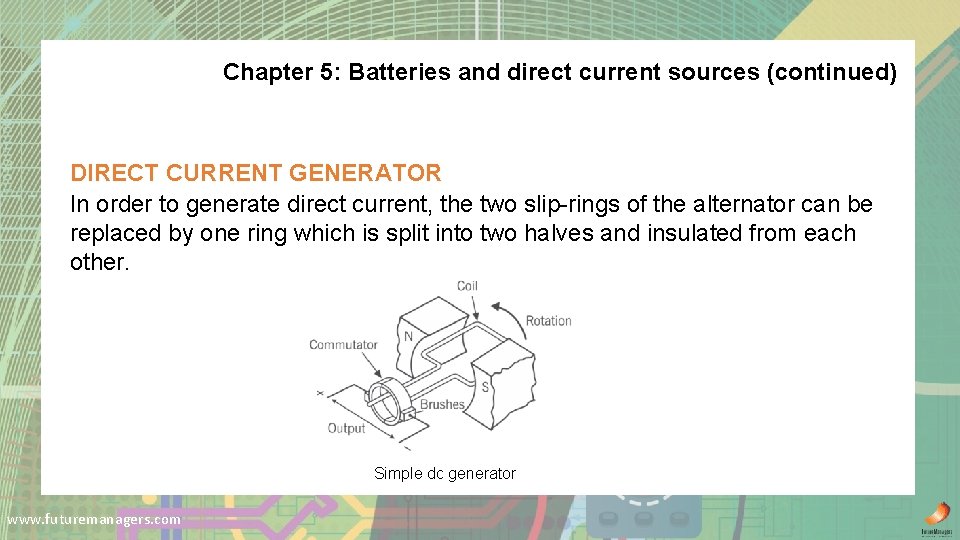
Chapter 5: Batteries and direct current sources (continued) DIRECT CURRENT GENERATOR In order to generate direct current, the two slip-rings of the alternator can be replaced by one ring which is split into two halves and insulated from each other. Simple dc generator www. futuremanagers. com
Chapter 5: Batteries and direct current sources (continued) METHODS OF PRODUCING ELECTRICITY Including primary and secondary cells and generators, electricity can be produced in the following ways: • Chemical reaction; • Electro-magnetic induction; • Solar energy conversion; • Heat; and • Friction. www. futuremanagers. com
Chapter 6: Measuring instruments VOLTMETERS AND AMMETERS An ammeter measures the current (or a known fraction of it), and a voltmeter measures the current proportional to the voltage. Fundamentally, both instruments are the same. www. futuremanagers. com
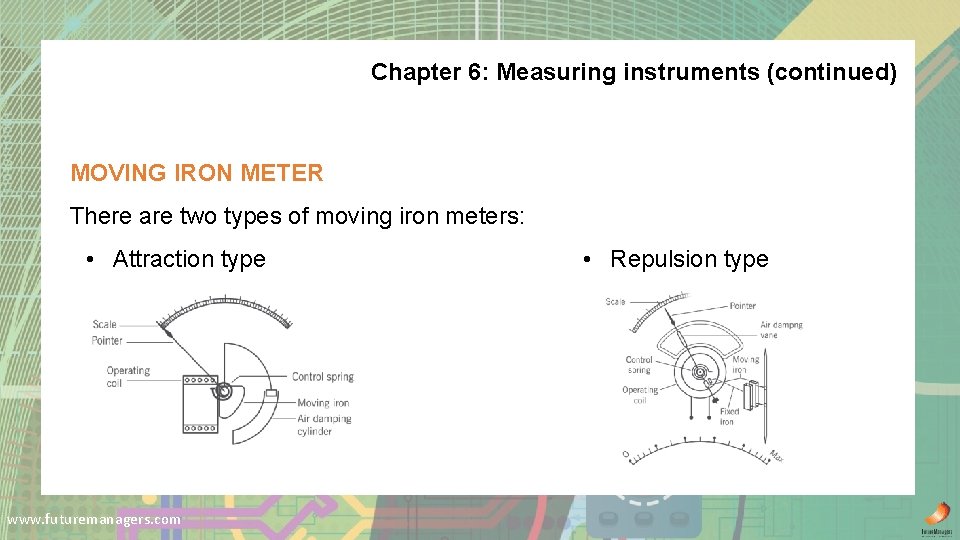
Chapter 6: Measuring instruments (continued) MOVING IRON METER There are two types of moving iron meters: • Attraction type www. futuremanagers. com • Repulsion type
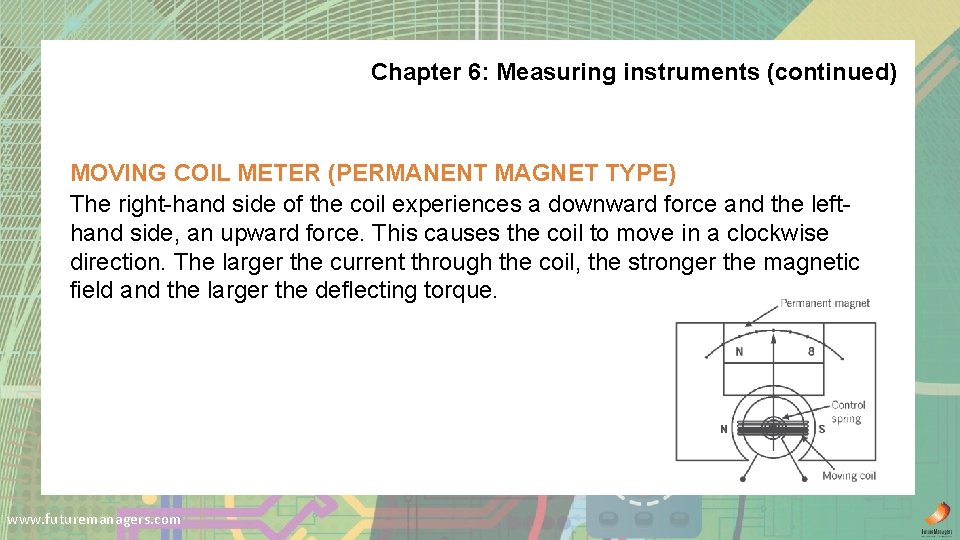
Chapter 6: Measuring instruments (continued) MOVING COIL METER (PERMANENT MAGNET TYPE) The right-hand side of the coil experiences a downward force and the lefthand side, an upward force. This causes the coil to move in a clockwise direction. The larger the current through the coil, the stronger the magnetic field and the larger the deflecting torque. www. futuremanagers. com
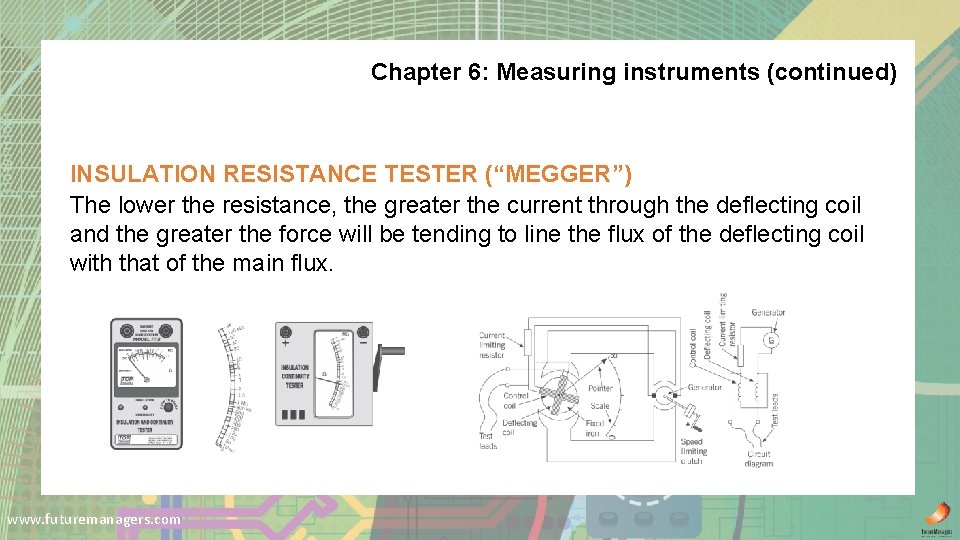
Chapter 6: Measuring instruments (continued) INSULATION RESISTANCE TESTER (“MEGGER”) The lower the resistance, the greater the current through the deflecting coil and the greater the force will be tending to line the flux of the deflecting coil with that of the main flux. www. futuremanagers. com
Chapter 6: Measuring instruments (continued) CONNECTION OF INSTRUMENTS For low voltage and low current circuits, instruments such as voltmeters and ammeters are connected directly. In order to extend the range of instruments and to enable them to measure higher voltages and currents, series and shunt resistors (for both ac and dc circuits) and instrument transformers for higher ac voltages and currents can be used. www. futuremanagers. com
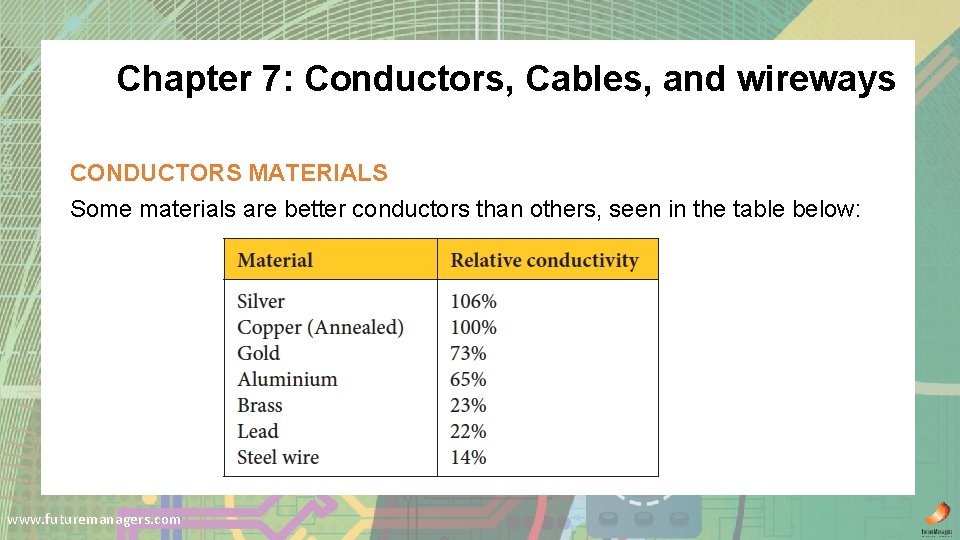
Chapter 7: Conductors, Cables, and wireways CONDUCTORS MATERIALS Some materials are better conductors than others, seen in the table below: www. futuremanagers. com
Chapter 7: Conductors, Cables, and wireways (continued) INSULATORS The main function of insulating materials is to support and/or electrically separate conductors in order to prevent the flow of an electric current where a potential difference exists between two or more points. www. futuremanagers. com
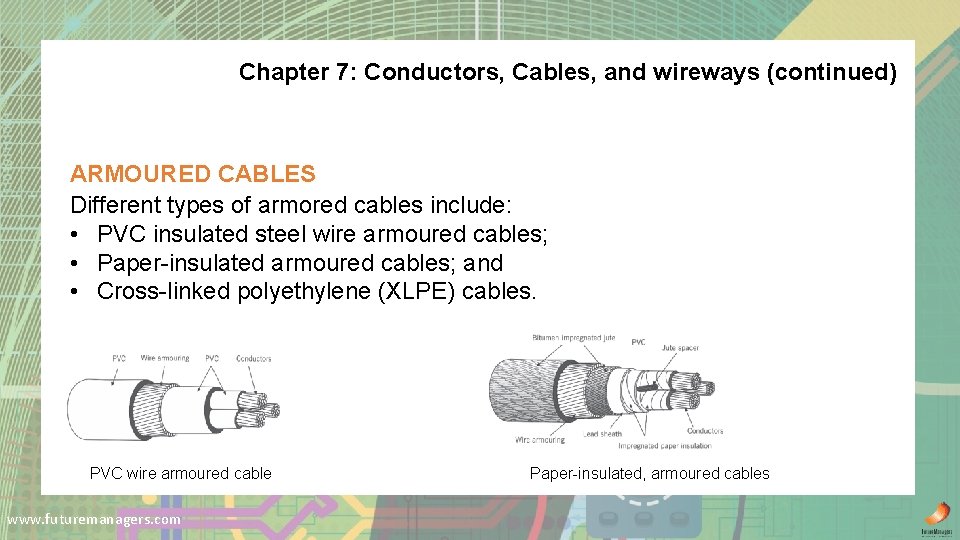
Chapter 7: Conductors, Cables, and wireways (continued) ARMOURED CABLES Different types of armored cables include: • PVC insulated steel wire armoured cables; • Paper-insulated armoured cables; and • Cross-linked polyethylene (XLPE) cables. PVC wire armoured cable www. futuremanagers. com Paper-insulated, armoured cables
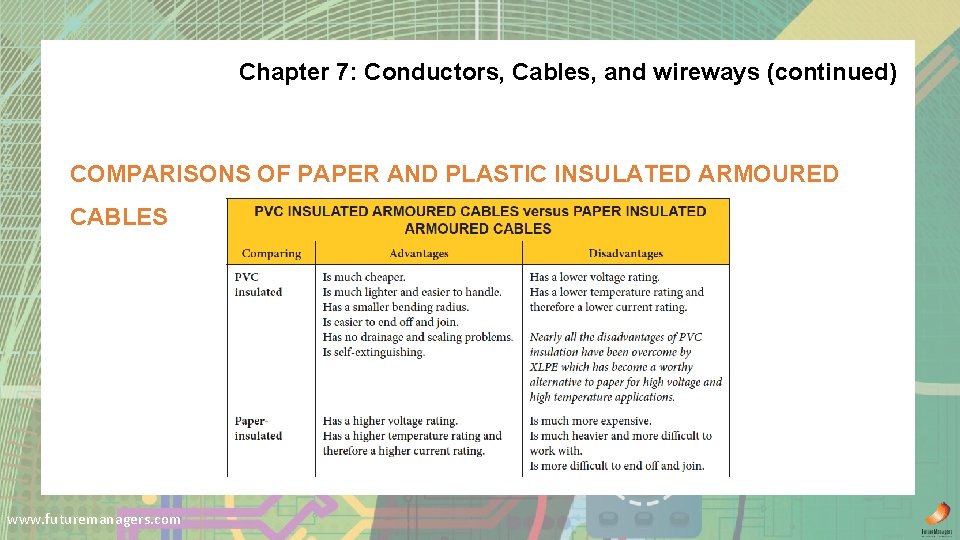
Chapter 7: Conductors, Cables, and wireways (continued) COMPARISONS OF PAPER AND PLASTIC INSULATED ARMOURED CABLES www. futuremanagers. com
Chapter 7: Conductors, Cables, and wireways (continued) WIREWAYS A wireway is used to house conductors, cables and busbars. It can be defined as a tray, any enclosed casing such as conduit, sleeving, ducting, trunking system and the like that is used to contain conductors or cables. www. futuremanagers. com
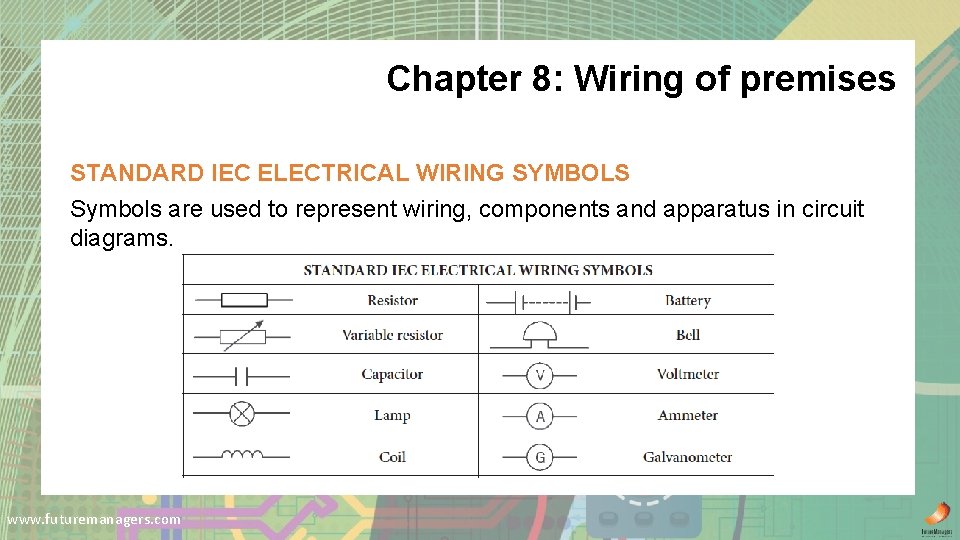
Chapter 8: Wiring of premises STANDARD IEC ELECTRICAL WIRING SYMBOLS Symbols are used to represent wiring, components and apparatus in circuit diagrams. www. futuremanagers. com
Chapter 8: Wiring of premises (continued) APPLIANCES Appliances can be divided into three groups: • Fixed appliances; • Portable appliances; and • Stationary appliances. www. futuremanagers. com
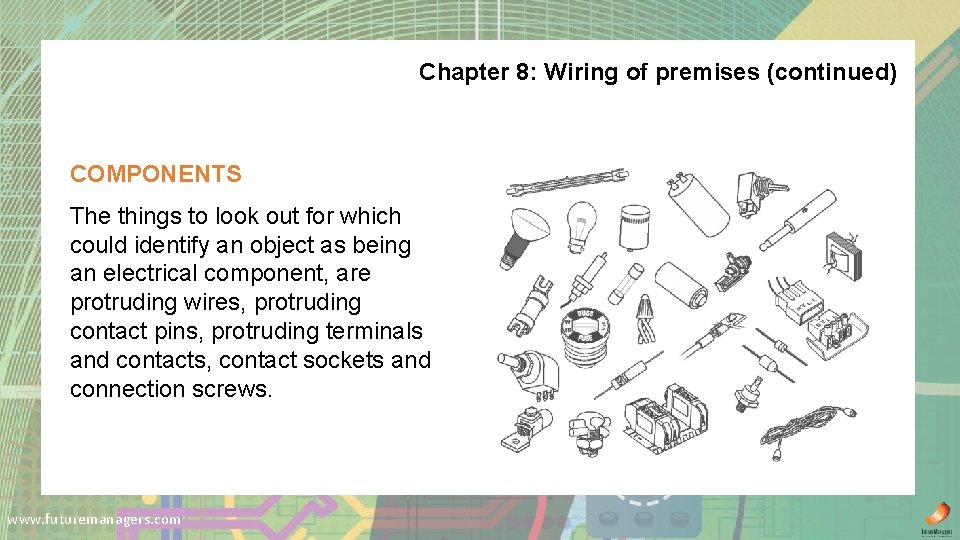
Chapter 8: Wiring of premises (continued) COMPONENTS The things to look out for which could identify an object as being an electrical component, are protruding wires, protruding contact pins, protruding terminals and contacts, contact sockets and connection screws. www. futuremanagers. com
Chapter 8: Wiring of premises (continued) DISTRIBUTION BOARDS A distribution board is an enclosure that contains electrical equipment for the distribution or control of electrical power from one or more incoming circuits to one or more outgoing circuits. www. futuremanagers. com
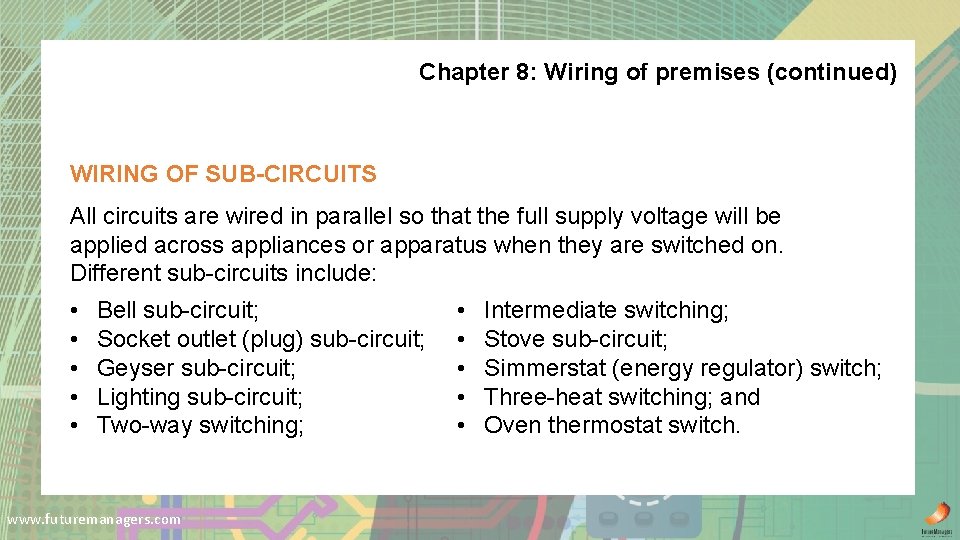
Chapter 8: Wiring of premises (continued) WIRING OF SUB-CIRCUITS All circuits are wired in parallel so that the full supply voltage will be applied across appliances or apparatus when they are switched on. Different sub-circuits include: • • • Bell sub-circuit; Socket outlet (plug) sub-circuit; Geyser sub-circuit; Lighting sub-circuit; Two-way switching; www. futuremanagers. com • • • Intermediate switching; Stove sub-circuit; Simmerstat (energy regulator) switch; Three-heat switching; and Oven thermostat switch.
Chapter 8: Wiring of premises (continued) PROTECTION The fundamental principles that form the basis of the South African National Standard (SANS) 10142 are primarily to ensure the safety of persons, livestock and property against electrical hazards. www. futuremanagers. com
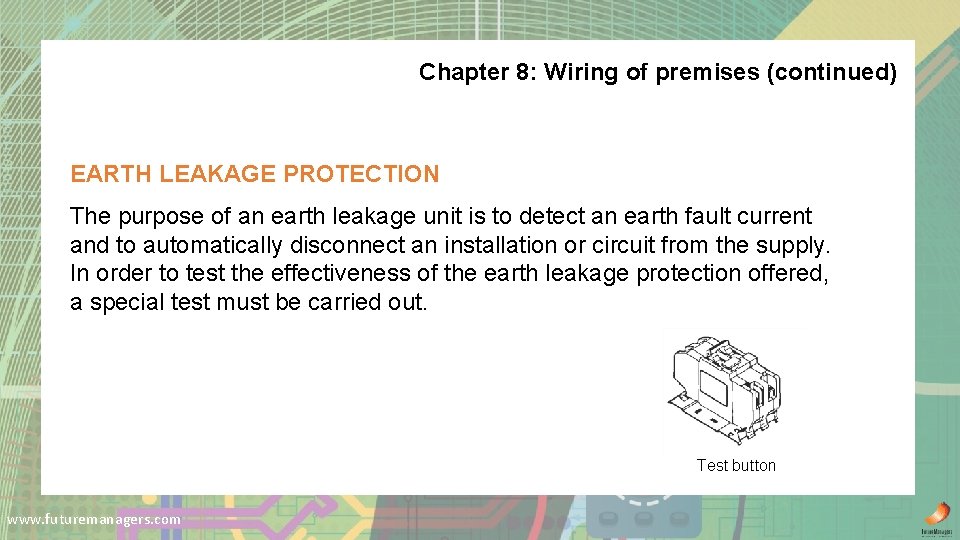
Chapter 8: Wiring of premises (continued) EARTH LEAKAGE PROTECTION The purpose of an earth leakage unit is to detect an earth fault current and to automatically disconnect an installation or circuit from the supply. In order to test the effectiveness of the earth leakage protection offered, a special test must be carried out. Test button www. futuremanagers. com
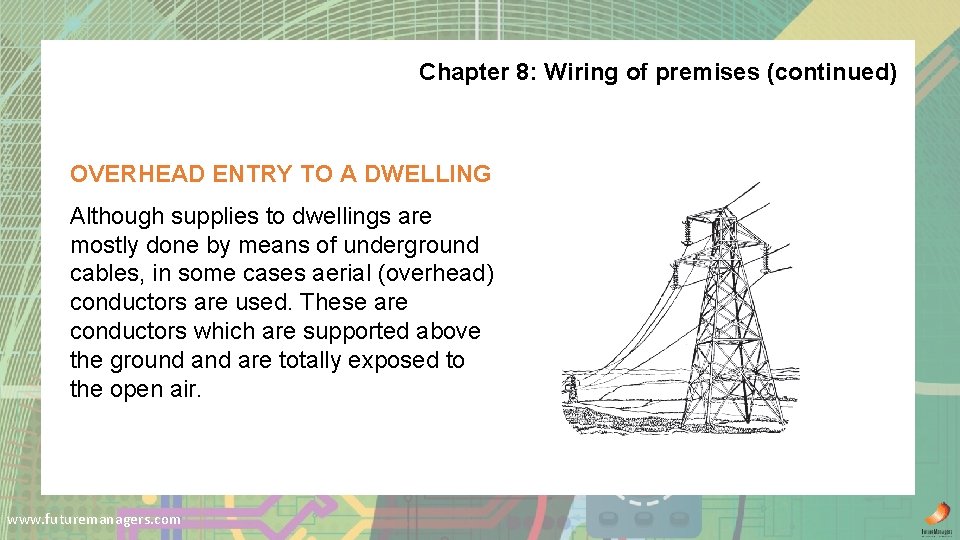
Chapter 8: Wiring of premises (continued) OVERHEAD ENTRY TO A DWELLING Although supplies to dwellings are mostly done by means of underground cables, in some cases aerial (overhead) conductors are used. These are conductors which are supported above the ground are totally exposed to the open air. www. futuremanagers. com
Chapter 8: Wiring of premises (continued) LOAD BALANCING It is important to attempt to balance the load across the three phases when a three-phase transformer supplies single-phase load. This will ensure that the efficiency of the three-phase supply transformer is at its best. www. futuremanagers. com
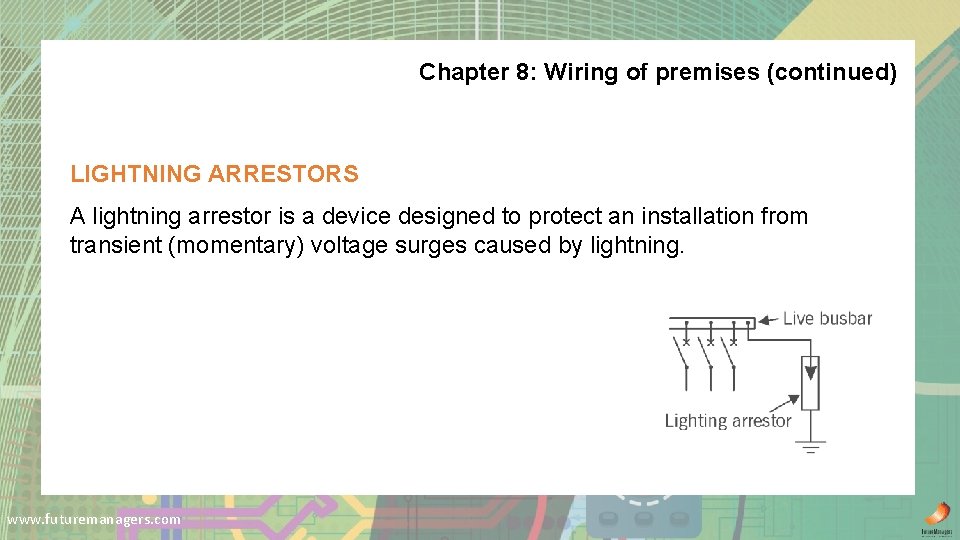
Chapter 8: Wiring of premises (continued) LIGHTNING ARRESTORS A lightning arrestor is a device designed to protect an installation from transient (momentary) voltage surges caused by lightning. www. futuremanagers. com
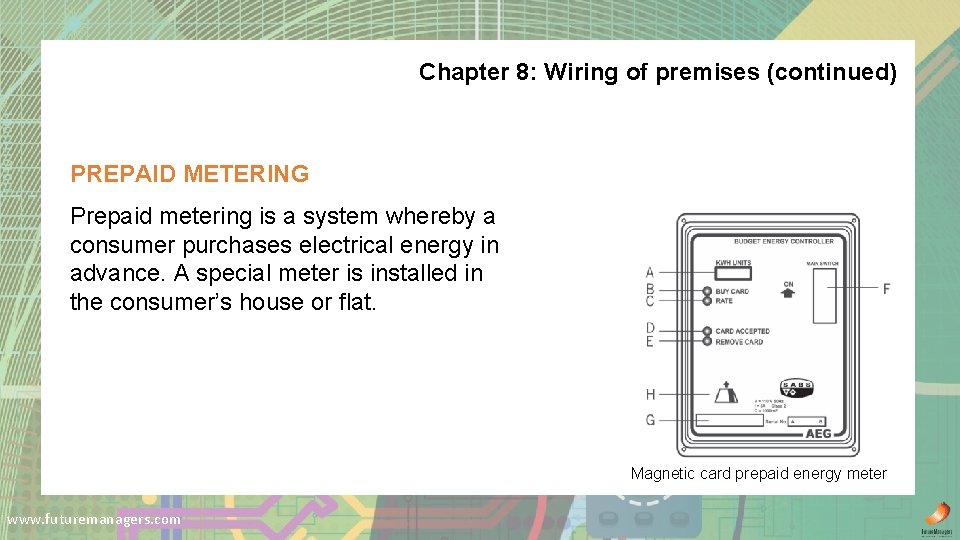
Chapter 8: Wiring of premises (continued) PREPAID METERING Prepaid metering is a system whereby a consumer purchases electrical energy in advance. A special meter is installed in the consumer’s house or flat. Magnetic card prepaid energy meter www. futuremanagers. com
Chapter 8: Wiring of premises (continued) ENERGY CONTROL UNITS An energy control unit is used to shed a non-essential load such as a geyser or underfloor heating during high demand periods. www. futuremanagers. com
Chapter 9: Testing TESTING AND INSPECTION Before a Certificate of Compliance (Co. C) may be issued, inspection and testing must be carried by an authorised person. A test report must also be issued. It is important to pay attention to the protection offered by the earth leakage device, earthing and bonding, especially of roofs, gutters and downpipes. www. futuremanagers. com
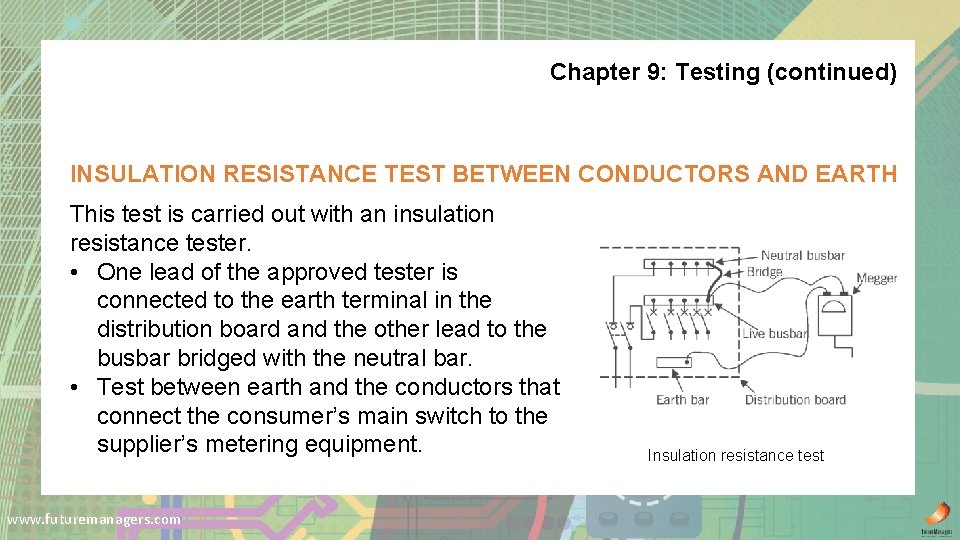
Chapter 9: Testing (continued) INSULATION RESISTANCE TEST BETWEEN CONDUCTORS AND EARTH This test is carried out with an insulation resistance tester. • One lead of the approved tester is connected to the earth terminal in the distribution board and the other lead to the busbar bridged with the neutral bar. • Test between earth and the conductors that connect the consumer’s main switch to the supplier’s metering equipment. www. futuremanagers. com Insulation resistance test
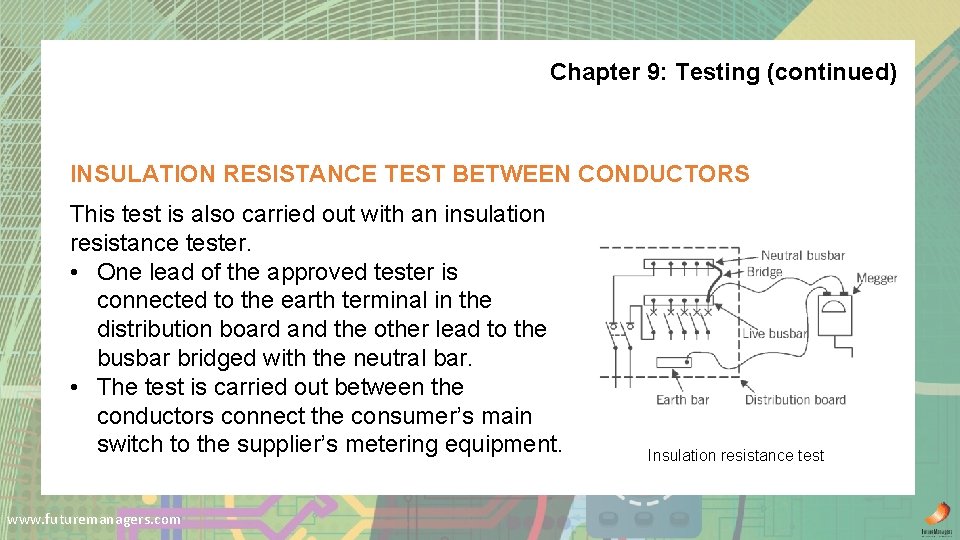
Chapter 9: Testing (continued) INSULATION RESISTANCE TEST BETWEEN CONDUCTORS This test is also carried out with an insulation resistance tester. • One lead of the approved tester is connected to the earth terminal in the distribution board and the other lead to the busbar bridged with the neutral bar. • The test is carried out between the conductors connect the consumer’s main switch to the supplier’s metering equipment. www. futuremanagers. com Insulation resistance test
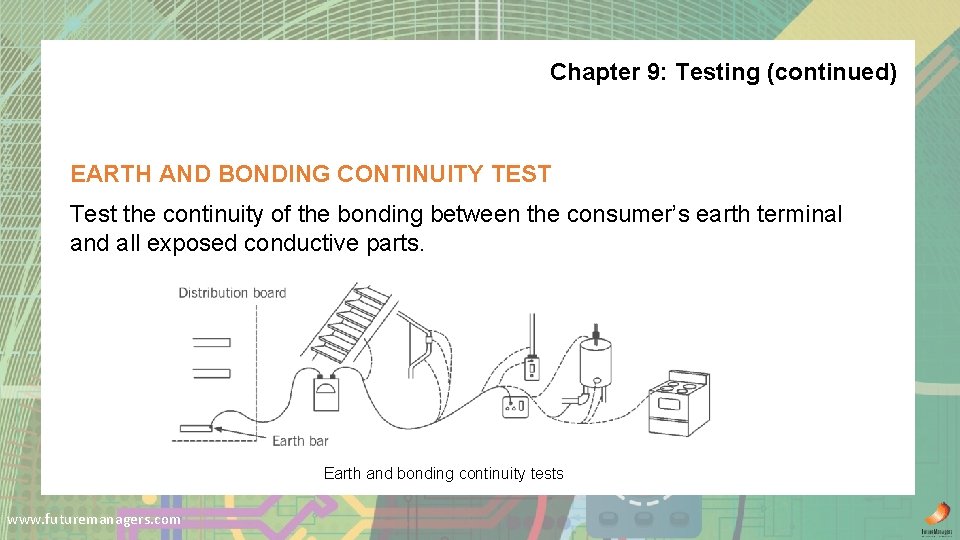
Chapter 9: Testing (continued) EARTH AND BONDING CONTINUITY TEST Test the continuity of the bonding between the consumer’s earth terminal and all exposed conductive parts. Earth and bonding continuity tests www. futuremanagers. com
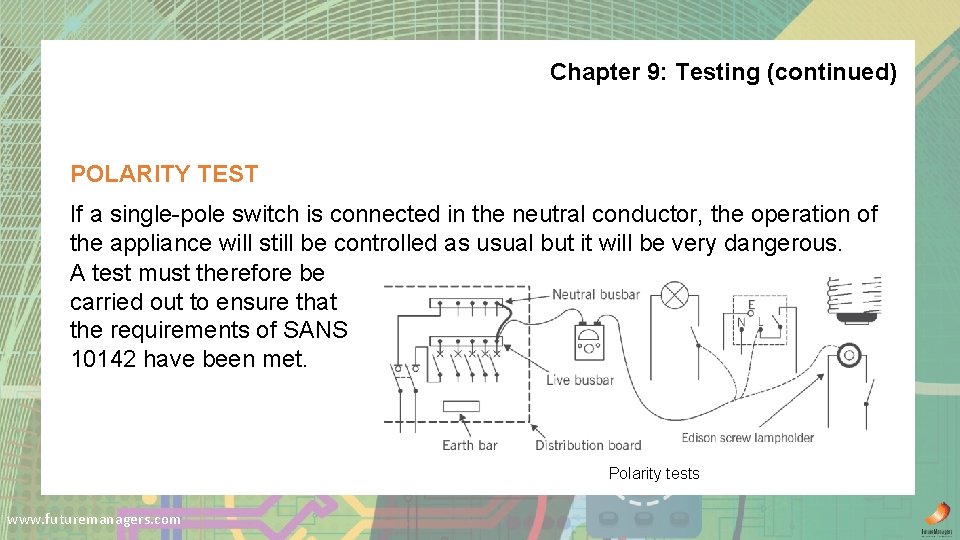
Chapter 9: Testing (continued) POLARITY TEST If a single-pole switch is connected in the neutral conductor, the operation of the appliance will still be controlled as usual but it will be very dangerous. A test must therefore be carried out to ensure that the requirements of SANS 10142 have been met. Polarity tests www. futuremanagers. com
Chapter 9: Testing (continued) TESTING THE CONTINUITY OF CONDUCTORS A continuity test of with an ohmmeter can be carried out as follows: • The main disconnector must be open (off). • Disconnect all appliances and fluorescent lamp fittings. • Remove all incandescent lamps (globes). • Close the sub-circuit breakers. • Bridge the busbar and neutral bar • Close all light switches. • Test between live and neutral contacts at lighting points and socket outlets. www. futuremanagers. com
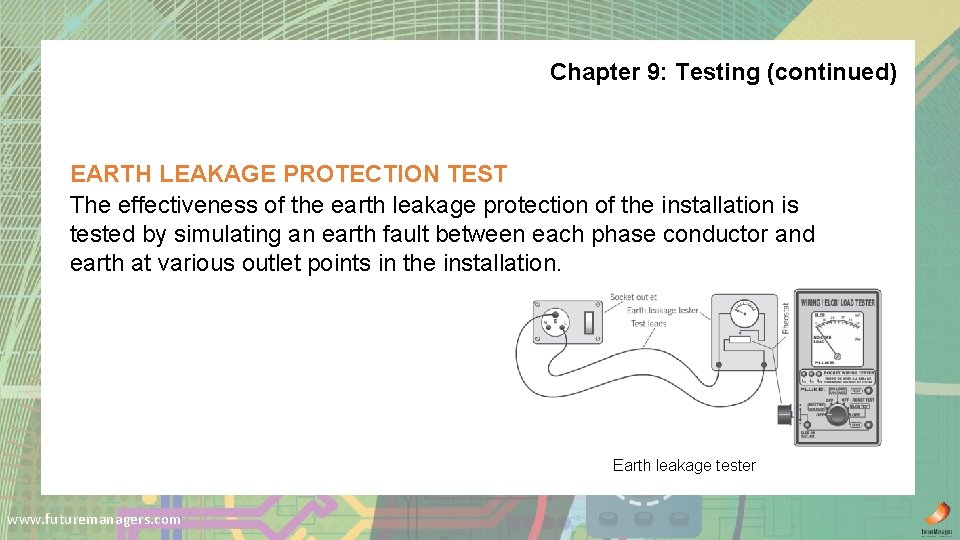
Chapter 9: Testing (continued) EARTH LEAKAGE PROTECTION TEST The effectiveness of the earth leakage protection of the installation is tested by simulating an earth fault between each phase conductor and earth at various outlet points in the installation. Earth leakage tester www. futuremanagers. com
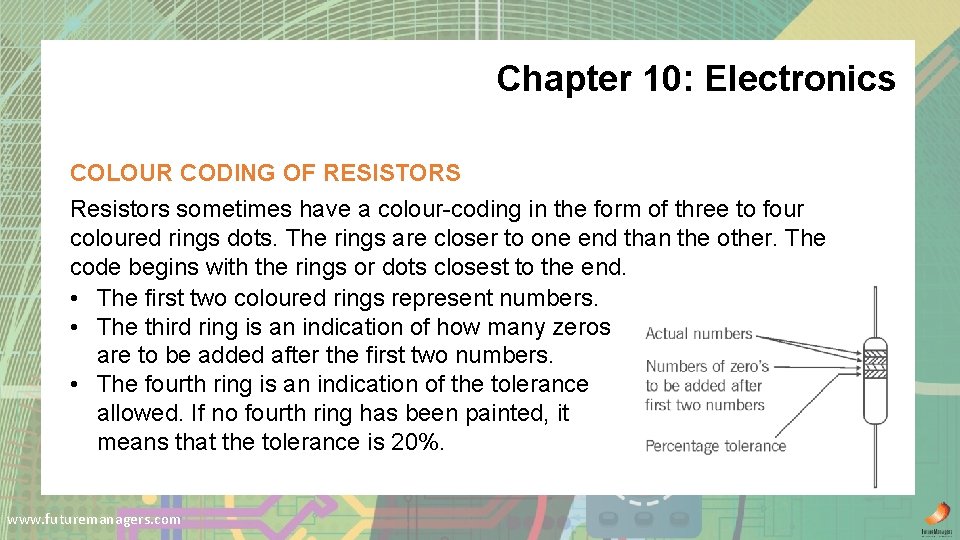
Chapter 10: Electronics COLOUR CODING OF RESISTORS Resistors sometimes have a colour-coding in the form of three to four coloured rings dots. The rings are closer to one end than the other. The code begins with the rings or dots closest to the end. • The first two coloured rings represent numbers. • The third ring is an indication of how many zeros are to be added after the first two numbers. • The fourth ring is an indication of the tolerance allowed. If no fourth ring has been painted, it means that the tolerance is 20%. www. futuremanagers. com
Chapter 10: Electronics (continued) SEMICONDUCTORS Semiconductors are materials which are neither good conductors nor good insulators. A semiconductor may act either as a conductor or as an insulator depending on various physical influences. Common semiconductor materials are germanium and silicon. www. futuremanagers. com
Chapter 10: Electronics (continued) CAPACITORS A capacitor is a device comprising two conductors, known as plates, separated by an insulating material known as a dielectric. Common dielectric materials are mica, air, waxed paper and plastic films. Variable air capacitor www. futuremanagers. com Rolled foil capacitor