
Electrical Tools Equipment Lesson Plan PSTS C 6
- Slides: 60
Electrical Tools & Equipment Lesson Plan PSTS: C 6 -5 1
Anticipated Problems 1. How can a person identify and use outlet and device boxes? 2. What types of cable are needed to install electrical circuits? 3. How can a person identify lampholders, switches, and controls? How are they used? 2
Anticipated Problems 4. How can a person identify receptacles, wall plates, and box covers? How are they used? 5. How can a person identify miscellaneous equipment and how it is used? 6. How can a person identify various electrical tools and how they are used? 3
Terms 4 240 -volt receptacles blank covers box hangers cable connectors cable ripper combination switches and receptacles conduit duplex receptacles equipment grounding conductor extension rings fish tape and reel flush-mounted device boxes four-way switches (DPDT)
Terms 5 fused receptacles ground rods & clamps grounded conductor grounding screws, clips, & pigtails humidistats keyless lampholders knockout seals lineman’s pliers long-nose pliers metallic octagon boxes metallic square boxes multipurpose tool National Electrical Code (NEC) nonmetallic boxes nonmetallic sheathed cable
Terms pull-chain lampholders screwdrivers single-pole switches (SPST) solderless connectors split-bolt connectors straps or staples surface-mounted device boxes 6 test light thermostats three-way switches (SPDT) underground feeder cable ungrounded conductor wall plates
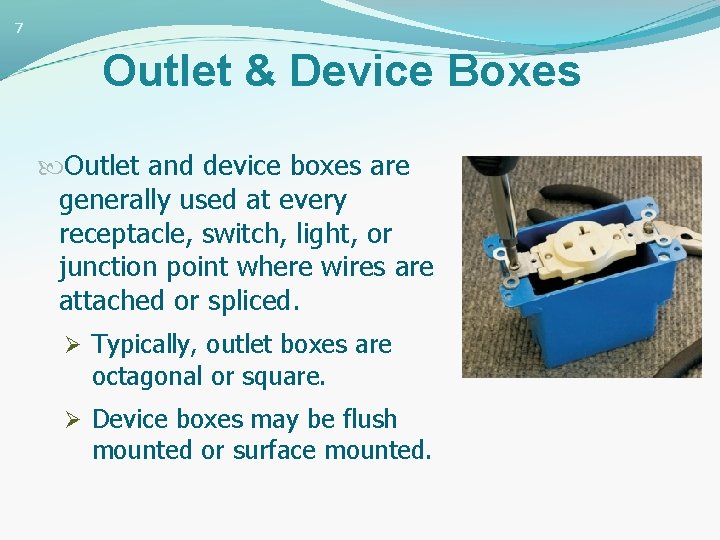
7 Outlet & Device Boxes Outlet and device boxes are generally used at every receptacle, switch, light, or junction point where wires are attached or spliced. Ø Typically, outlet boxes are octagonal or square. Ø Device boxes may be flush mounted or surface mounted.
8 Outlet Boxes Nonmetallic boxes are items used in damp or dusty agricultural buildings for all receptacles, switches, or junction boxes. Ø Gasket covers are necessary on nonmetallic electrical boxes to seal out dust, moisture, and corrosive gases.
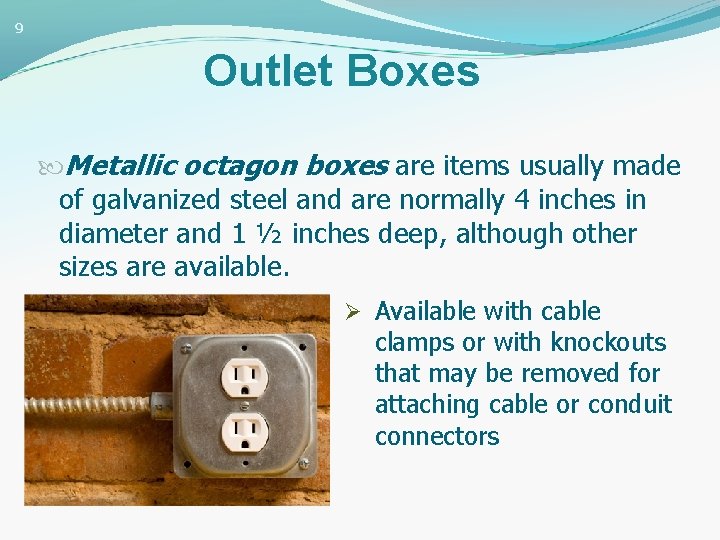
9 Outlet Boxes Metallic octagon boxes are items usually made of galvanized steel and are normally 4 inches in diameter and 1 ½ inches deep, although other sizes are available. Ø Available with cable clamps or with knockouts that may be removed for attaching cable or conduit connectors
10 Outlet Boxes Metallic square boxes are items generally 4 inches across and 1 ½ inches deep. Ø Often are used in place of octagon boxes when more wires are needed than would be permitted in octagon boxes. Ø Available with or without cable clamps.
11 Outlet Boxes Extension rings are items available for octagon and square boxes that provide additional room when more wires are needed than are permitted in single boxes.
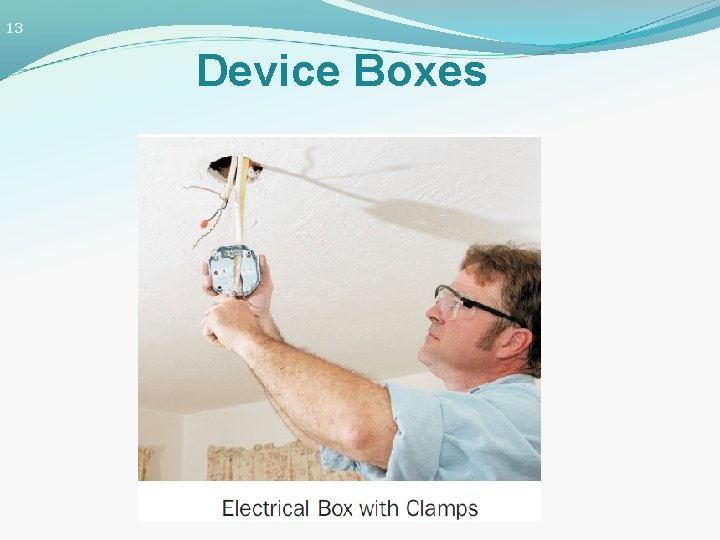
12 Device Boxes Flush-mounted device boxes are items used in homes and finished buildings where owners want wiring to be concealed in the walls. Ø Most common are the beveled corner device boxes
13 Device Boxes
14 Device Boxes Surface-mounted device boxes are items made for fastening to exposed surfaces. Ø Also known as handy boxes Ø Have rounded corners and are generally not equipped with cable clamps. Ø May be used for conduit or cable wiring
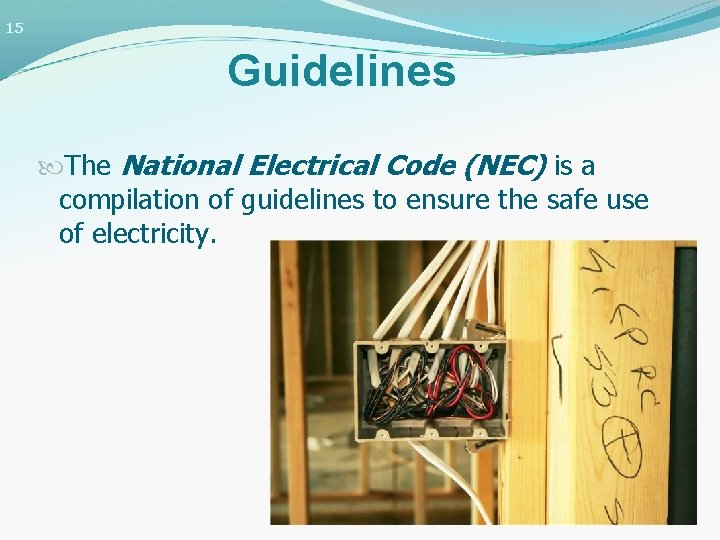
15 Guidelines The National Electrical Code (NEC) is a compilation of guidelines to ensure the safe use of electricity.
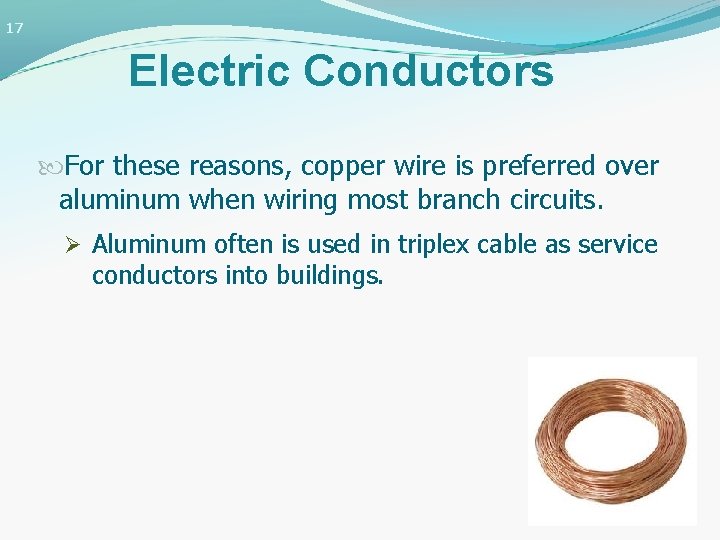
16 Electric Conductors Electric conductors and wires are made of aluminum or copper. Ø Aluminum is less expensive and weighs less than copper. Ø Copper offers less resistance to the flow of electricity, does not have as high of a rate of thermal expansion, and has less of a problem with oxidation than aluminum.
17 Electric Conductors For these reasons, copper wire is preferred over aluminum when wiring most branch circuits. Ø Aluminum often is used in triplex cable as service conductors into buildings.
18 Electric Conductors Three basic conductors are used in electric wiring. Ø Grounded conductor Ø Equipment grounding conductor Ø Ungrounded conductor
19 Grounded Conductor A grounded conductor is a conductor intentionally connected to ground. Ø Connected to the neutral bar in the service entrance panel (SEP) - referred to as a neutral conductor. Ø In a 120 -volt circuit, it is a normal current-carrying conductor. Ø According to the NEC, ungrounded conductors AWG #6 or smaller must have white or natural gray-colored insulation.
20 Equipment Grounding Conductor An equipment grounding conductor is a conductor that bonds conductive materials that enclose electrical conductors or equipment back to the system grounding electrode to protect people and property from damage or injuries in case of a ground-fault.
21 Equipment Grounding Conductor An equipment grounding conductor Ø During normal operation, it carries no current. Ø Usually is not insulated - if it is insulated, it must be green or green with one or more yellow stripes.
22 Ungrounded Conductor An ungrounded conductor is a conductor that originates at the circuit breaker or fuse and is usually black or red.
23 Choosing the Conductor Choosing the right type and size of conductor is important. Considerations are Ø The load in amps required Ø The type of wire being used Ø The length of travel from the SEP to the load
24 Cable The NEC requires that single wires be protected from physical damage. When wiring branch circuits, people generally do this by using cable or conduit.
25 Cable A cable is two or more wires in a protective outer sheath or jacket. Ø Each wire must be individually insulated, except for the equipment grounding wire, which may be bare.
26 Cable The cable may be described based on Ø The cable type Ø The size of individual conductors Ø The number of current-carrying conductors within the cable Ø Whether or not there is an equipment grounding conductor present
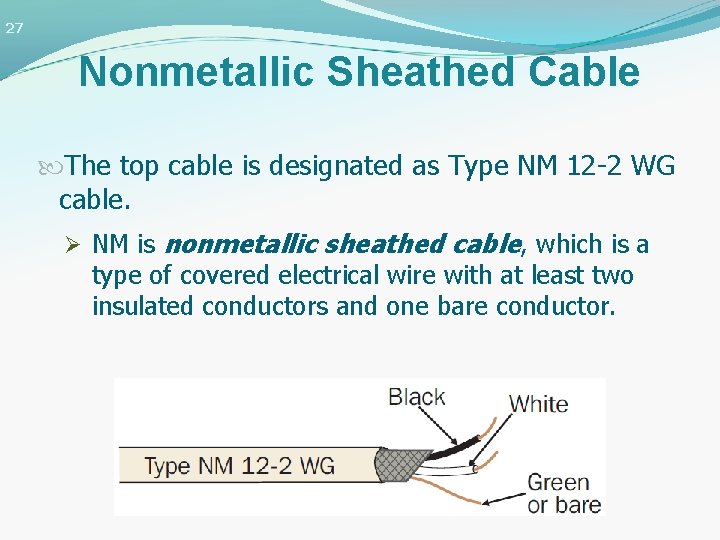
27 Nonmetallic Sheathed Cable The top cable is designated as Type NM 12 -2 WG cable. Ø NM is nonmetallic sheathed cable, which is a type of covered electrical wire with at least two insulated conductors and one bare conductor.
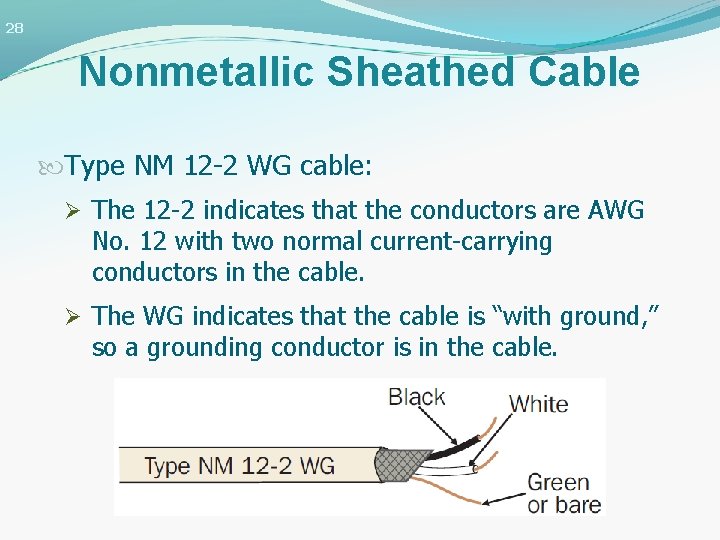
28 Nonmetallic Sheathed Cable Type NM 12 -2 WG cable: Ø The 12 -2 indicates that the conductors are AWG No. 12 with two normal current-carrying conductors in the cable. Ø The WG indicates that the cable is “with ground, ” so a grounding conductor is in the cable.
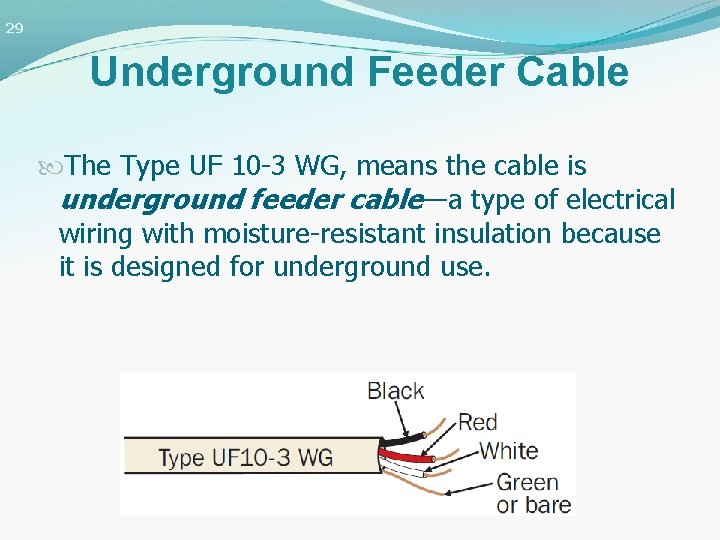
29 Underground Feeder Cable The Type UF 10 -3 WG, means the cable is underground feeder cable—a type of electrical wiring with moisture-resistant insulation because it is designed for underground use.
30 Underground Feeder Cable Three current carrying conductors are present in size AWG No. 10; the cable contains a grounding conductor. Ø Cable should be secured at least every 4 ½ feet and within 12 inches of each cabinet, box, or fitting using approved staples, cable ties, straps, or similar fittings. Ø Sharp bends in the cable should be avoided.
31 Conduit is a metallic or nonmetallic channel or tube through which conductors are run to provide mechanical protection. Ø The conduit is installed first, and conductors are “fished” through to make circuit connections.
32 Lampholders are used as light fixtures in many agricultural applications. Ø Wired the same as most light types used in homes Ø Switches are used to turn the lights off and on. Ø The type of switch used will depend on how many switches will control the same light(s).
33 Lampholders Keyless lampholders are devices controlled by a separate switch or switches in the line. Ø Common porcelain lampholders are made to fit on 4 -inch octagon boxes.
34 Lampholders Pull-chain lampholders are devices with a built -in switch turned off and on at the lampholder with a string or chain.
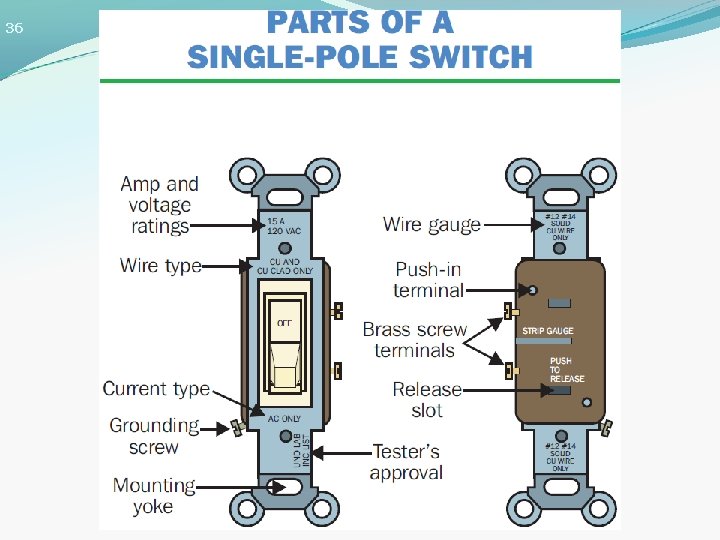
35 Single-Pole Switches Single-pole switches (SPST) are devices used to break the connection in a single hot wire. Ø They have two terminal screws and are used to control lights or receptacles from one location. Ø SPST have the words “on” and “off” on the toggle.
36
37 Three-Way Switches Three-way switches (SPDT) are devices used in pairs to control lights or receptacles from two locations. Ø They have three terminal screws and no words written on the toggle as they may be on or off in the up or down position, depending on the position of the other switch.
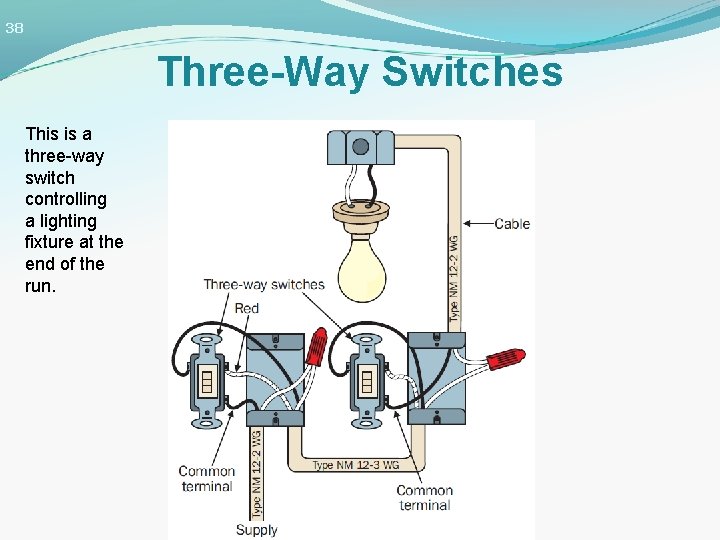
38 Three-Way Switches This is a three-way switch controlling a lighting fixture at the end of the run.
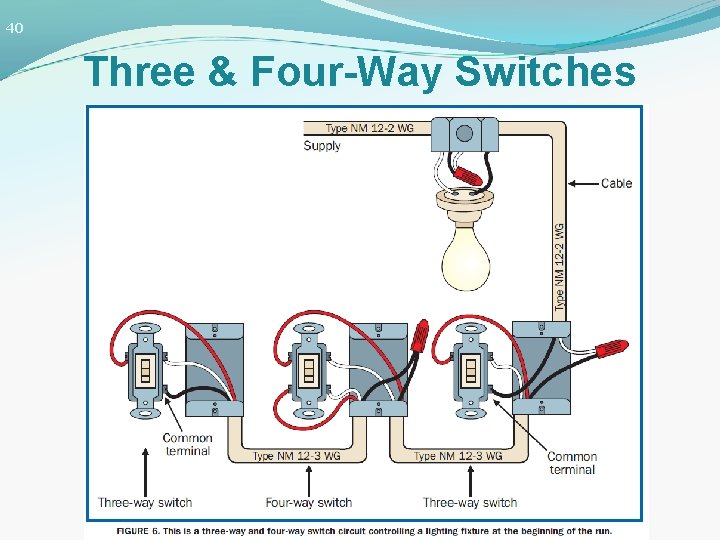
39 Four-Way Switches Four-way switches (DPDT) are devices used in conjunction with a pair of three-way switches. Ø They are useful if a person wants to control lights or receptacles from three or more locations. Ø Four-way switches have four terminal screws and do not have “on” or “off” written on the toggle.
40 Three & Four-Way Switches
41 Controls Thermostats are controls used to regulate heating and cooling systems. Humidistats are controls used to regulate humidity levels.
42 Receptacles are used to access electricity by any device that has a plug-in and cord on it. Ø They come in many types. Ø Wall plates and box covers are used to enclose the fronts of receptacles, switches, or boxes.
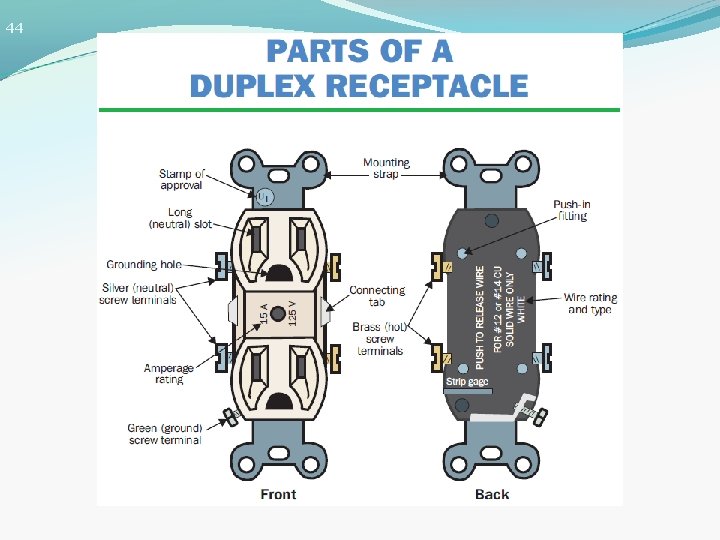
43 Duplex Receptacles Duplex receptacles are double plug-in outlets with two pairs of terminal screws that may be installed in a variety of box types. Ø Most receptacles have a “pry out” connection on the “hot” side that can be removed to control each individual receptacle separately. Ø Grounding-type receptacles have a green-colored terminal for attaching grounding wires. Ø They also have the additional third slot for three- pronged plugs.
44
45 240 -Volt Receptacles 240 -volt receptacles are devices installed for appliances requiring 240 volts. Ø Different slot arrangements are used, depending on the amperage rating of each.
46 Combination Switches & Receptacles Combination switches and receptacles are devices used when a convenience outlet is in the same device box with a switch. Ø They may be connected so the outlet is always “hot” and the switch controls one or more lights in the room or building. Ø They may also be connected so the switch controls the outlet.
47 Fused Receptacles Fused receptacles are devices that offer protection to the appliances plugged into them. Ø The appliances are protected by a fuse contained in the receptacle.
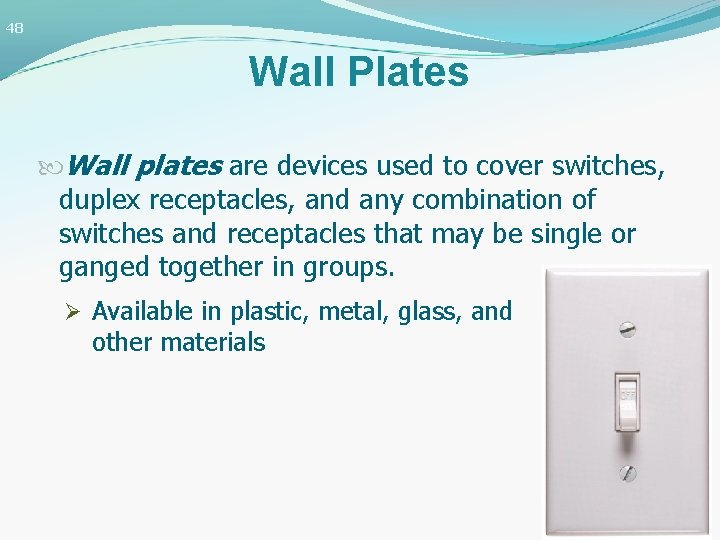
48 Wall Plates Wall plates are devices used to cover switches, duplex receptacles, and any combination of switches and receptacles that may be single or ganged together in groups. Ø Available in plastic, metal, glass, and other materials
49 Blank Covers Blank covers are devices used on octagon, square, or handy boxes that are simply junction points. Ø Used when there is just wire and no device is mounted in a box
50 Miscellaneous Equipment Cable connectors are devices used to fasten cables to boxes that do not have built-in cable clamps. Ø They are connected by inserting them into a knockout opening and are secured with a nut.
51 Miscellaneous Equipment Split-bolt connectors are devices often used when splicing larger size conductors Ø Example: outdoor wires to entrance wires
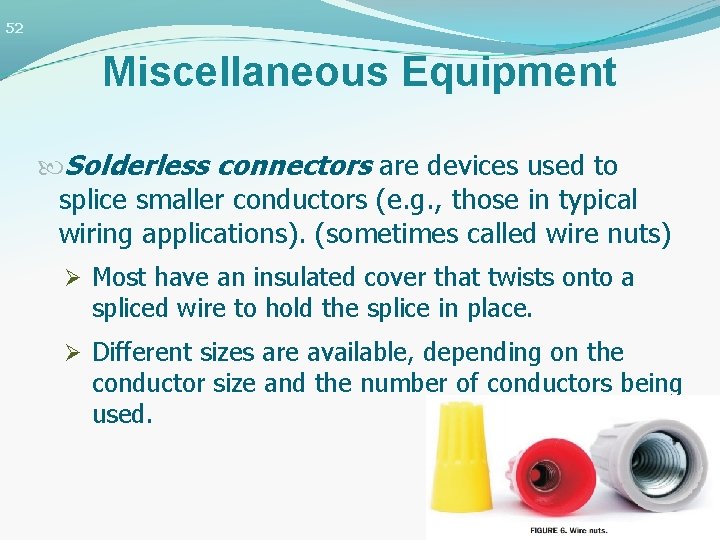
52 Miscellaneous Equipment Solderless connectors are devices used to splice smaller conductors (e. g. , those in typical wiring applications). (sometimes called wire nuts) Ø Most have an insulated cover that twists onto a spliced wire to hold the splice in place. Ø Different sizes are available, depending on the conductor size and the number of conductors being used.
53 Miscellaneous Equipment Straps or staples are devices used to fasten conduit and cable to the surfaces over which they run. Box hangers are devices useful in mounting outlet boxes, particularly in new work.
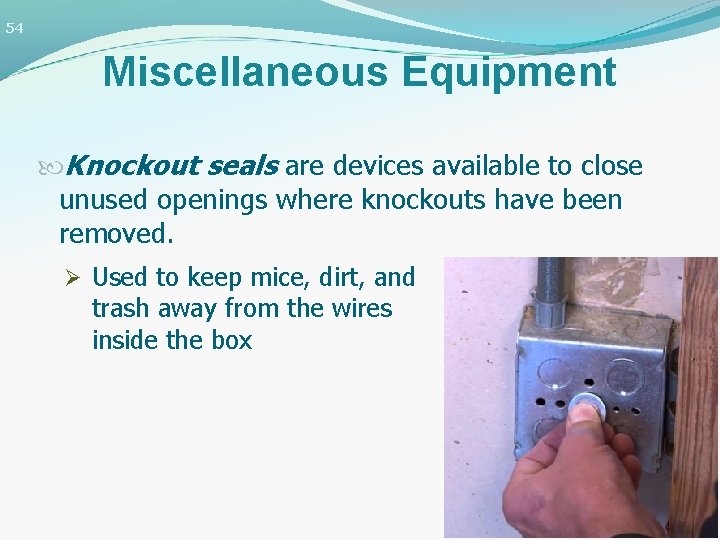
54 Miscellaneous Equipment Knockout seals are devices available to close unused openings where knockouts have been removed. Ø Used to keep mice, dirt, and trash away from the wires inside the box
55 Miscellaneous Equipment Grounding screws, clips, and pigtails are devices used to connect grounding conductors to boxes.
56 Miscellaneous Equipment Ground rods and clamps are important devices in agricultural wiring made of copper or coppercovered steel and driven deep into the ground (to provide for grounding). Ø Ground clamps are used to attach a ground wire to the ground rod.
57 Electrical Tools A test light is a device used to trace circuits and to test fuses and lines. A multipurpose tool is a device used for cutting wire, stripping conductors, and attaching terminals to conductors.
58 Electrical Tools Lineman’s pliers are tools used for cutting wires and gripping locknuts. A cable ripper is a tool used for stripping insulation off of cable. A fish tape and reel is a tool used to fish wire through walls or conduit.
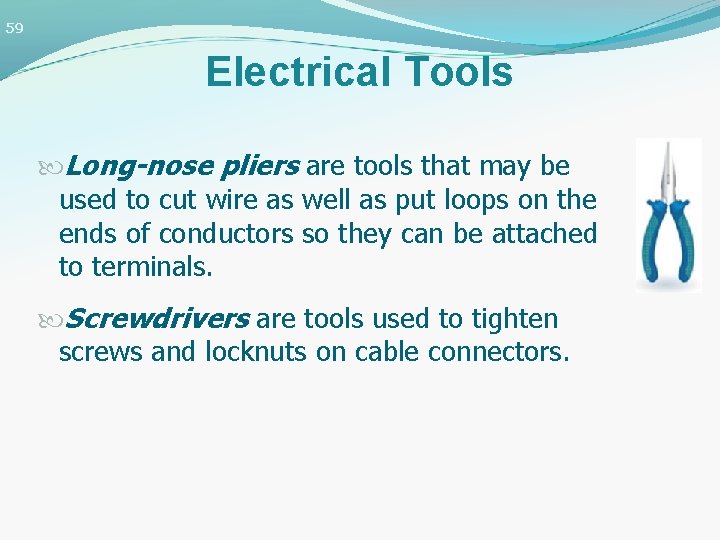
59 Electrical Tools Long-nose pliers are tools that may be used to cut wire as well as put loops on the ends of conductors so they can be attached to terminals. Screwdrivers are tools used to tighten screws and locknuts on cable connectors.
60 Review 1. Name three types of outlet boxes and where each might be used. 2. What should be considered when choosing a type of conductor? 3. What is the purpose of a wall plate? 4. What might be used to keep mice, dirt, and trash away from the wires inside a box? 5. Which pliers would be used for cutting wires and gripping locknuts?