
Electrical Theory Quantity Symbol Unit Equation Charge CV
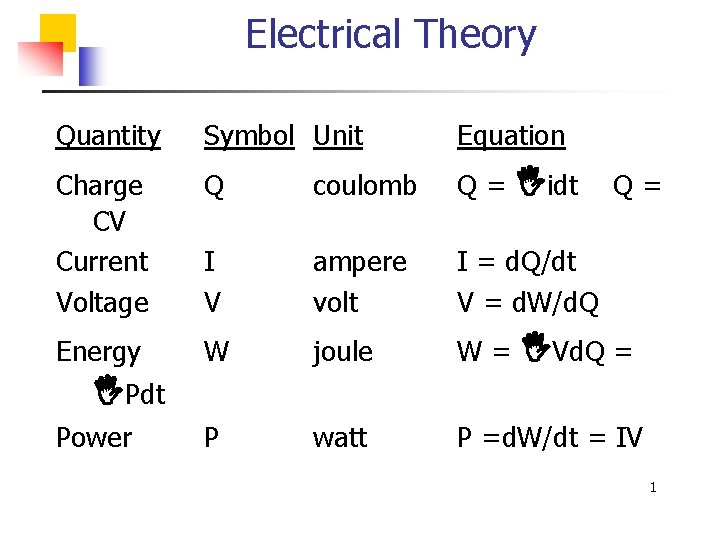
Electrical Theory Quantity Symbol Unit Equation Charge CV Current Voltage Q coulomb Q= I V ampere volt I = d. Q/dt V = d. W/d. Q Energy W joule W= P watt P =d. W/dt = IV Iidt Q= IVd. Q = IPdt Power 1
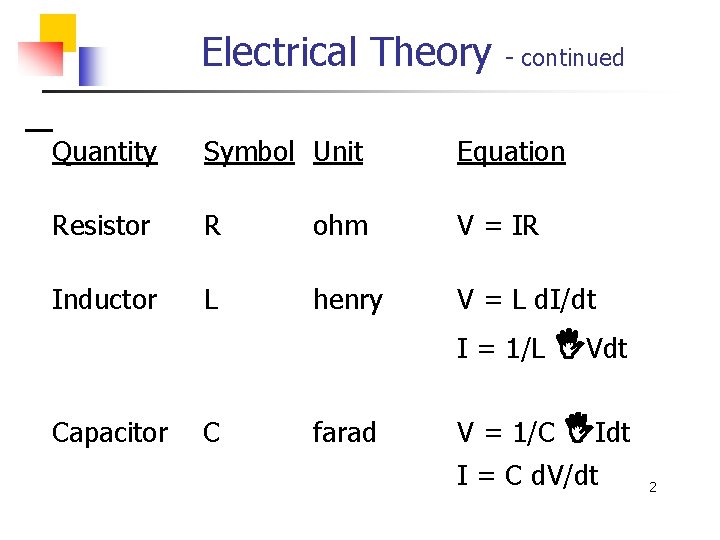
Electrical Theory - continued Quantity Symbol Unit Equation Resistor R ohm V = IR Inductor L henry V = L d. I/dt I = 1/L Capacitor C farad IVdt V = 1/C IIdt I = C d. V/dt 2
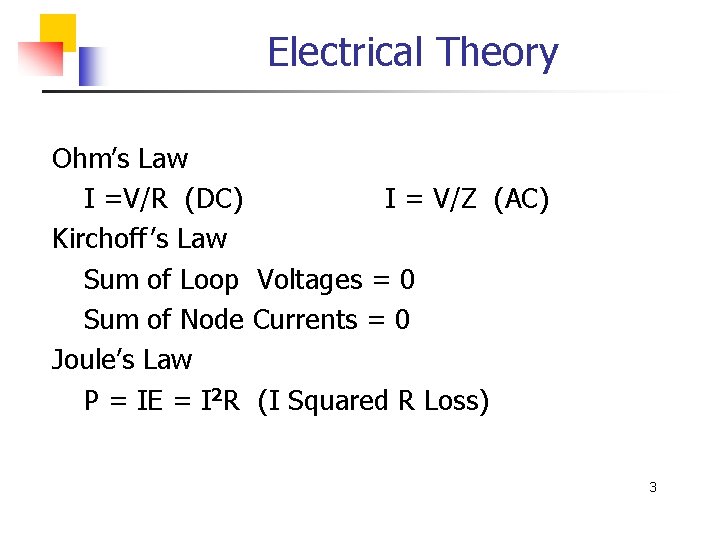
Electrical Theory Ohm’s Law I =V/R (DC) I = V/Z (AC) Kirchoff ’s Law Sum of Loop Voltages = 0 Sum of Node Currents = 0 Joule’s Law P = IE = I 2 R (I Squared R Loss) 3
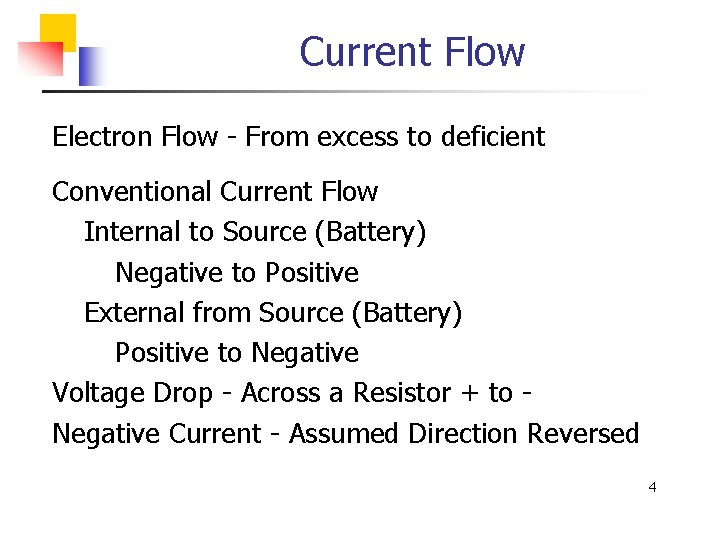
Current Flow Electron Flow - From excess to deficient Conventional Current Flow Internal to Source (Battery) Negative to Positive External from Source (Battery) Positive to Negative Voltage Drop - Across a Resistor + to Negative Current - Assumed Direction Reversed 4
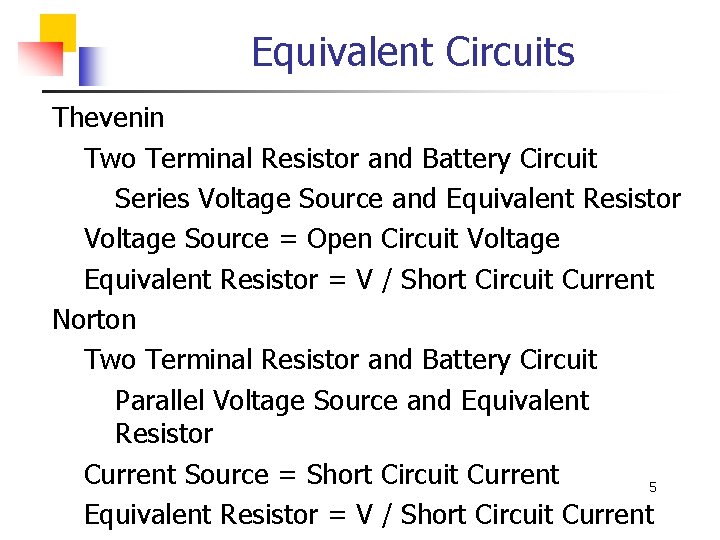
Equivalent Circuits Thevenin Two Terminal Resistor and Battery Circuit Series Voltage Source and Equivalent Resistor Voltage Source = Open Circuit Voltage Equivalent Resistor = V / Short Circuit Current Norton Two Terminal Resistor and Battery Circuit Parallel Voltage Source and Equivalent Resistor Current Source = Short Circuit Current 5 Equivalent Resistor = V / Short Circuit Current
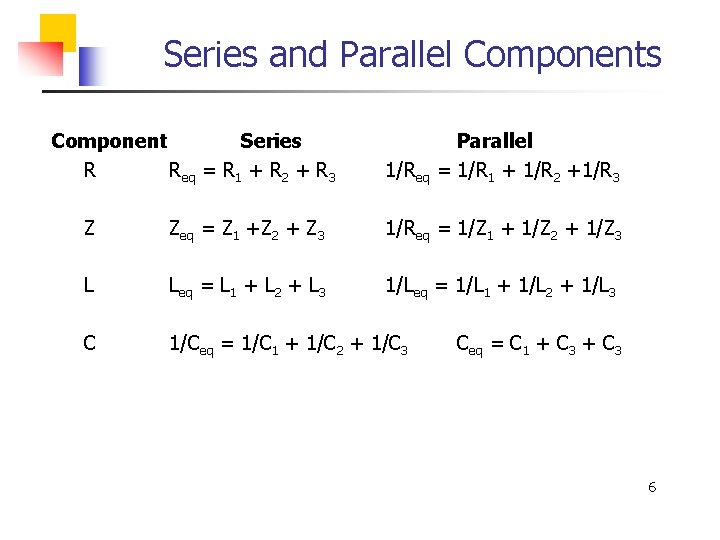
Series and Parallel Components Component Series R Req = R 1 + R 2 + R 3 1/Req Parallel = 1/R 1 + 1/R 2 +1/R 3 Z Zeq = Z 1 +Z 2 + Z 3 1/Req = 1/Z 1 + 1/Z 2 + 1/Z 3 L Leq = L 1 + L 2 + L 3 1/Leq = 1/L 1 + 1/L 2 + 1/L 3 C 1/Ceq = 1/C 1 + 1/C 2 + 1/C 3 Ceq = C 1 + C 3 6
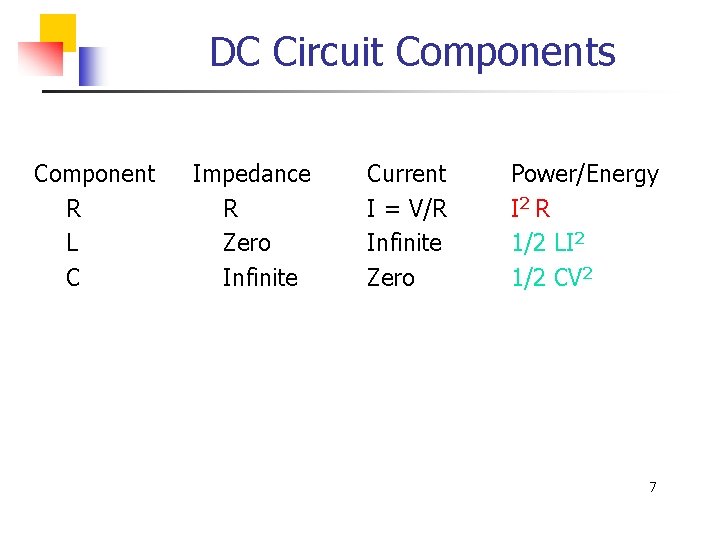
DC Circuit Components Component R L C Impedance R Zero Infinite Current I = V/R Infinite Zero Power/Energy I 2 R 1/2 LI 2 1/2 CV 2 7
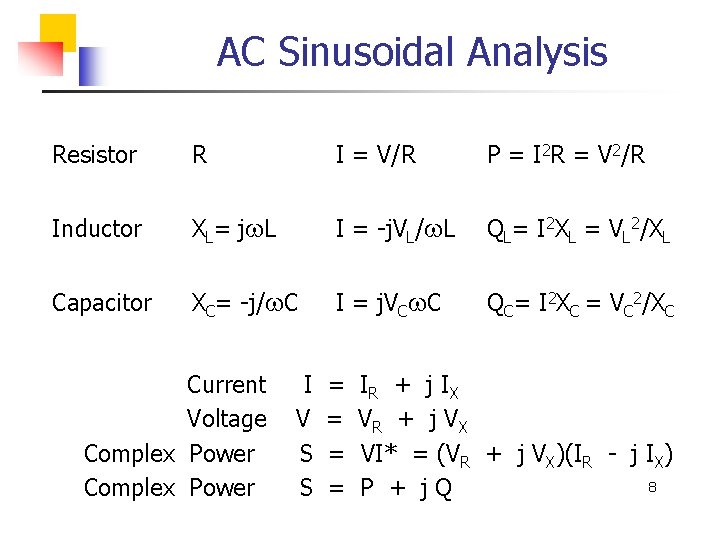
AC Sinusoidal Analysis Resistor R I = V/R P = I 2 R = V 2/R Inductor X L = j w. L I = -j. VL/w. L QL= I 2 XL = VL 2/XL Capacitor XC= -j/w. C I = j. VCw. C QC= I 2 XC = VC 2/XC Current Voltage Complex Power I V S S = = IR + j IX V R + j VX VI* = (VR + j VX)(IR - j IX) 8 P + j. Q
- Slides: 8