
Electrical Test Baseline Tiago Catalao da Rosa Fernando
Electrical Test Baseline Tiago Catalao da Rosa, Fernando Menendez Camara, Felix Rodriguez Mateos logo area 11 th January 2019, Review on the Quench Protection Heaters and Electrical Tests of the 11 T Dipole
Content 1. 2. 3. 4. 5. 6. Introduction Electrical Test Strategy 11 T Dipole Failure Scenarios & Worst-case Voltages Electrical Test Values El. QA Tests Sequence Proposed Intermediate Temperature Test logo area Tiago Catalao da Rosa 2
Introduction § Maximum expected voltages during operation are calculated through simulation of worst conditions during a quench, including failure of protection elements. § Calculations are conducted at nominal current. Conditions at ultimate current should be covered by the margin in the components design without applying safety factors. Some exceptional conservative cases must follow the same rule, as they are realistic but with very low likelihood of happening (HL-LHC Project policy). § Electrical test levels are obtained by applying factors regarding the different environments and temperature-pressure conditions under which the magnet will be tested. logo area Tiago Catalao da Rosa 3
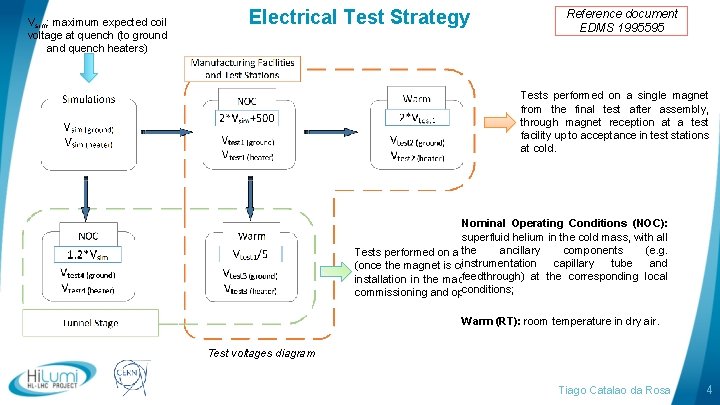
Vsim: maximum expected coil voltage at quench (to ground and quench heaters) Electrical Test Strategy Reference document EDMS 1995595 Tests performed on a single magnet from the final test after assembly, through magnet reception at a test facility up to acceptance in test stations at cold. Nominal Operating Conditions (NOC): superfluid helium in the cold mass, with all the ancillary components (e. g. Tests performed on a magnet or circuit instrumentation capillary tube and (once the magnet is connected) during feedthrough) at the corresponding local installation in the machine and further conditions; commissioning and operation. Warm (RT): room temperature in dry air. Test voltages diagram logo area Tiago Catalao da Rosa 4
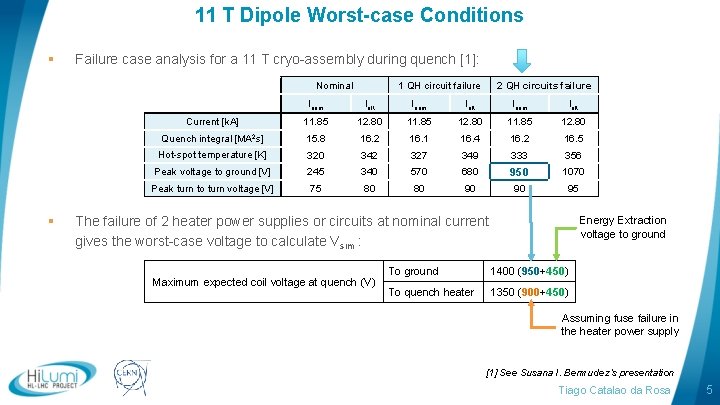
11 T Dipole Worst-case Conditions § Failure case analysis for a 11 T cryo-assembly during quench [1]: Nominal 2 QH circuits failure Inom Iult 11. 85 12. 80 15. 8 16. 2 16. 1 16. 4 16. 2 16. 5 Hot-spot temperature [K] 320 342 327 349 333 356 Peak voltage to ground [V] 245 340 570 680 950 1070 Peak turn to turn voltage [V] 75 80 80 90 90 95 Current [k. A] Quench integral § 1 QH circuit failure [MA 2 s] The failure of 2 heater power supplies or circuits at nominal current gives the worst-case voltage to calculate Vsim : Maximum expected coil voltage at quench (V) Energy Extraction voltage to ground To ground 1400 (950+450) To quench heater 1350 (900+450) Assuming fuse failure in the heater power supply logo area [1] See Susana I. Bermudez’s presentation Tiago Catalao da Rosa 5
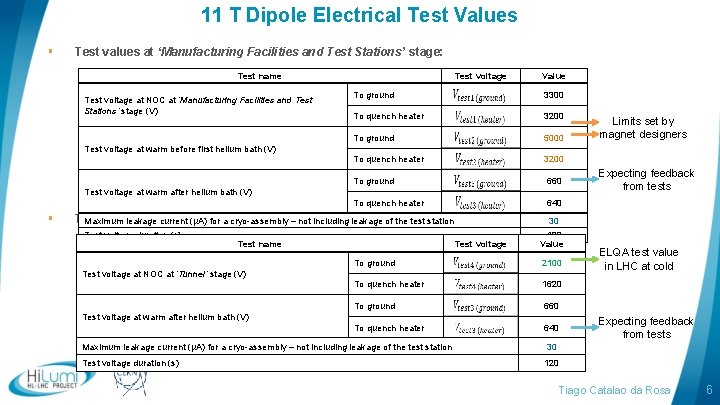
11 T Dipole Electrical Test Values § Test values at ‘Manufacturing Facilities and Test Stations’ stage: Test name Test voltage at NOC at ‘Manufacturing Facilities and Test Stations’ stage (V) Test voltage Value To ground 3300 To quench heater 3200 To ground 5000 To quench heater 3200 To ground 660 To quench heater 640 Limits set by magnet designers Test voltage at warm before first helium bath (V) Test voltage at warm after helium bath (V) § Test values at ‘Tunnel’ Maximum leakage current (µA)stage: for a cryo-assembly – not including leakage of the test station Test voltage duration (s) Test name Expecting feedback from tests 30 Test voltage 120 Value To ground 2100 To quench heater 1620 To ground 660 To quench heater 640 Test voltage at NOC at ‘Tunnel’ stage (V) Test voltage at warm after helium bath (V) Maximum leakage current (µA) for a cryo-assembly – not including leakage of the test station 30 Test voltage duration (s) logo area 120 ELQA test value in LHC at cold Expecting feedback from tests Tiago Catalao da Rosa 6
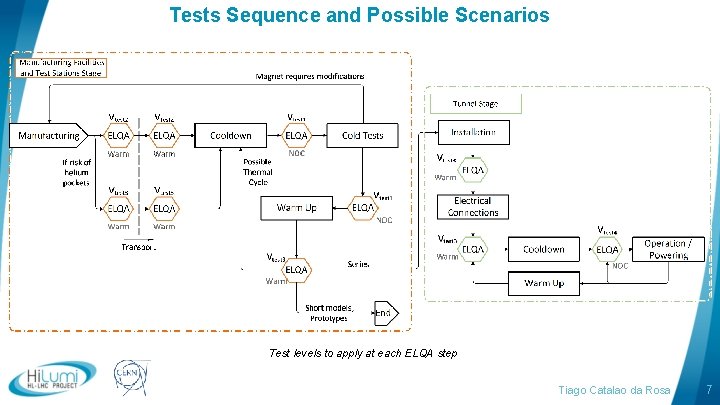
Tests Sequence and Possible Scenarios Test levels to apply at each ELQA step logo area Tiago Catalao da Rosa 7
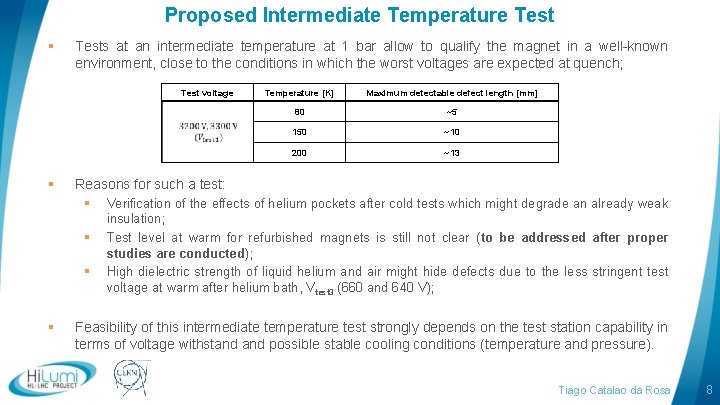
Proposed Intermediate Temperature Test § Tests at an intermediate temperature at 1 bar allow to qualify the magnet in a well-known environment, close to the conditions in which the worst voltages are expected at quench; Test voltage § Maximum detectable defect length [mm] 80 ~5 150 ~10 200 ~13 Reasons for such a test: § Verification of the effects of helium pockets after cold tests which might degrade an already weak § § § Temperature [K] insulation; Test level at warm for refurbished magnets is still not clear (to be addressed after proper studies are conducted); High dielectric strength of liquid helium and air might hide defects due to the less stringent test voltage at warm after helium bath, V test 3 (660 and 640 V); Feasibility of this intermediate temperature test strongly depends on the test station capability in terms of voltage withstand possible stable cooling conditions (temperature and pressure). logo area Tiago Catalao da Rosa 8

Thank you for your attention logo area Tiago Catalao da Rosa 9
![Backup Slide – Paschen Curves Test voltage logo area Temperature [K] Maximum detectable defect](http://slidetodoc.com/presentation_image_h2/a0627be5bde42915def51a33963852a2/image-10.jpg "Backup Slide – Paschen Curves Test voltage logo area Temperature [K] Maximum detectable defect")
Backup Slide – Paschen Curves Test voltage logo area Temperature [K] Maximum detectable defect length [mm] 80 ~5 150 ~10 200 ~13 Tiago Catalao da Rosa 10
- Slides: 10