
Electrical Safety The following contains disturbing images and
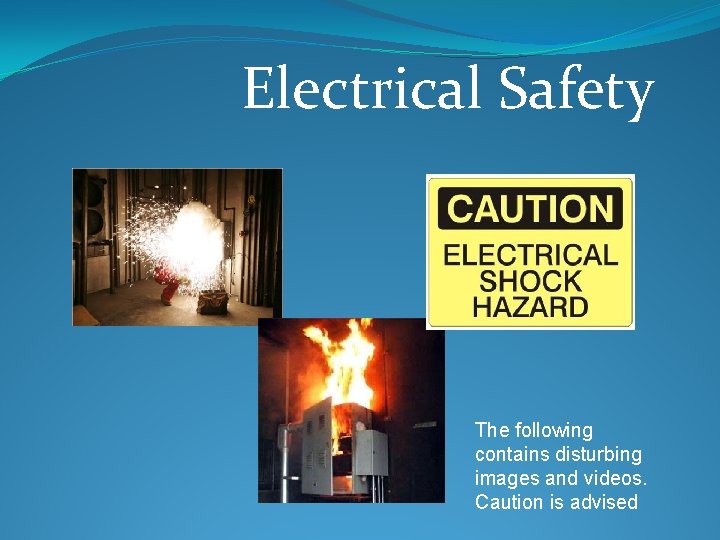
Electrical Safety The following contains disturbing images and videos. Caution is advised
Applicable Safety Standards �OSHA 29 CFR 1910 Subpart S �OSHA 29 CFR 1910. 147 of Subpart J �OSHA 29 CFR 1910. 269 of Subpart R �OSHA 29 CFR 1926 Subpart K �NFPA 70 – NEC �NFPA 70 B – Recommended Practice for Electrical Equipment Maintenance �NFPA 70 E – Electrical Safety in the Workplace �NFPA 77 – Recommended Practice for Static Electricity �NFPA 79 - Electrical Standard for Industrial Machinery

Where Am I Going and Why?
Well Planned Safety Culture �Improves Employee Productivity �Lowers Insurance Costs �Meets Government Requirements �Saves Organizations Money
Safety Standard Goals �Provide an electrically safe work place! �Minimize arc flash and blast hazards �Minimize shock hazards �Define “acceptable” tasks �Evaluate our Electrically Qualified Personnel �Work only on Electrically Safe Equipment.
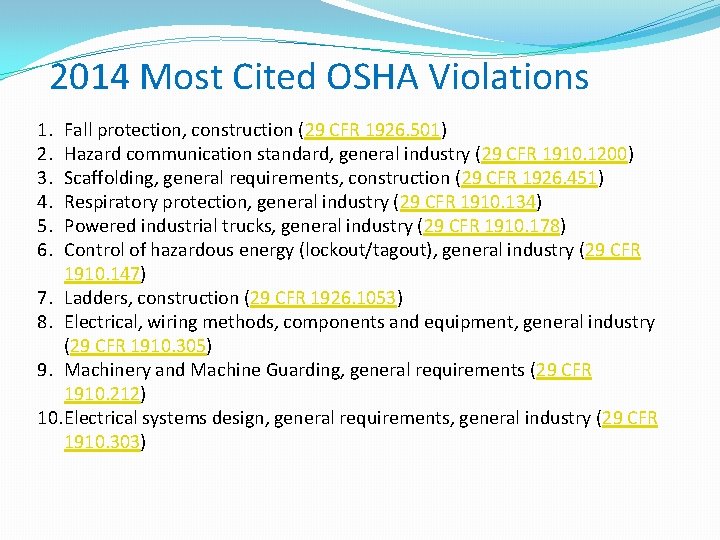
2014 Most Cited OSHA Violations 1. 2. 3. 4. 5. 6. Fall protection, construction (29 CFR 1926. 501) Hazard communication standard, general industry (29 CFR 1910. 1200) Scaffolding, general requirements, construction (29 CFR 1926. 451) Respiratory protection, general industry (29 CFR 1910. 134) Powered industrial trucks, general industry (29 CFR 1910. 178) Control of hazardous energy (lockout/tagout), general industry (29 CFR 1910. 147) 7. Ladders, construction (29 CFR 1926. 1053) 8. Electrical, wiring methods, components and equipment, general industry (29 CFR 1910. 305) 9. Machinery and Machine Guarding, general requirements (29 CFR 1910. 212) 10. Electrical systems design, general requirements, general industry (29 CFR 1910. 303)
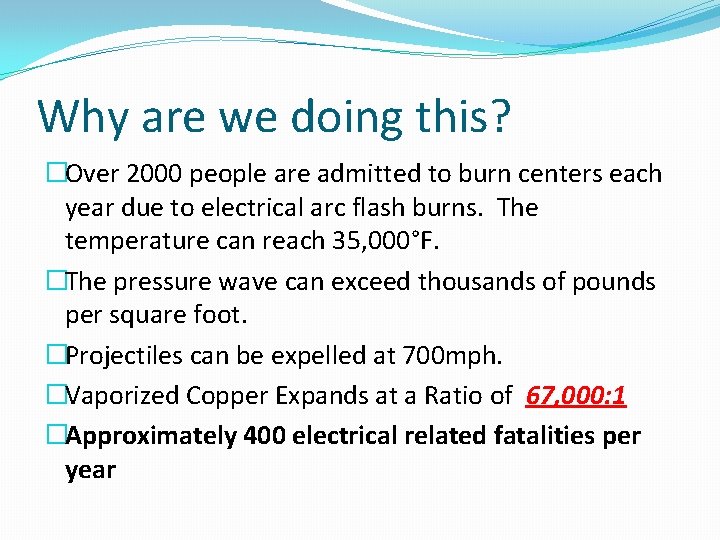
Why are we doing this? �Over 2000 people are admitted to burn centers each year due to electrical arc flash burns. The temperature can reach 35, 000°F. �The pressure wave can exceed thousands of pounds per square foot. �Projectiles can be expelled at 700 mph. �Vaporized Copper Expands at a Ratio of 67, 000: 1 �Approximately 400 electrical related fatalities per year
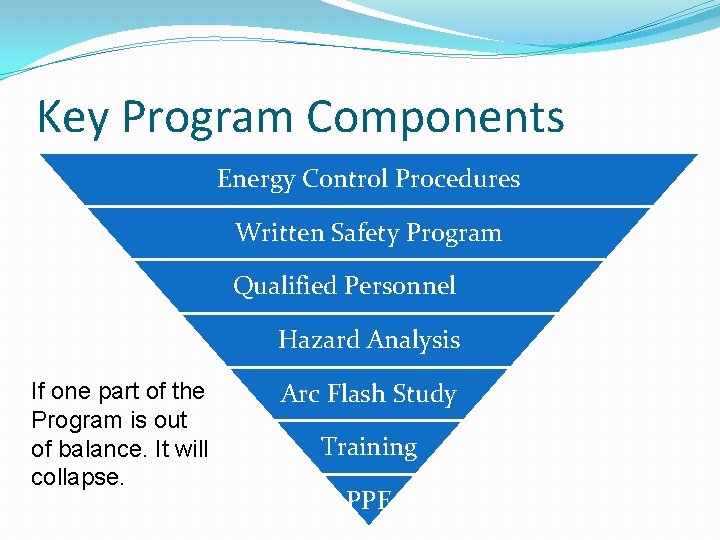
Key Program Components Energy Control Procedures Written Safety Program Qualified Personnel Hazard Analysis If one part of the Program is out of balance. It will collapse. Arc Flash Study Training PPE
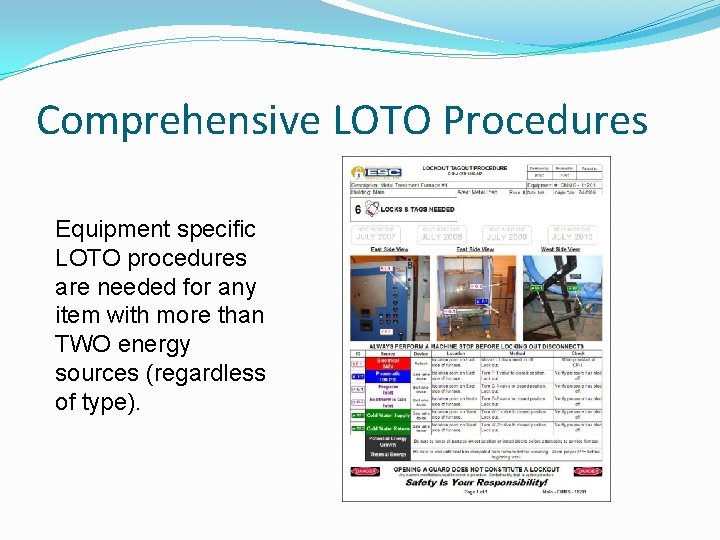
Comprehensive LOTO Procedures Equipment specific LOTO procedures are needed for any item with more than TWO energy sources (regardless of type).
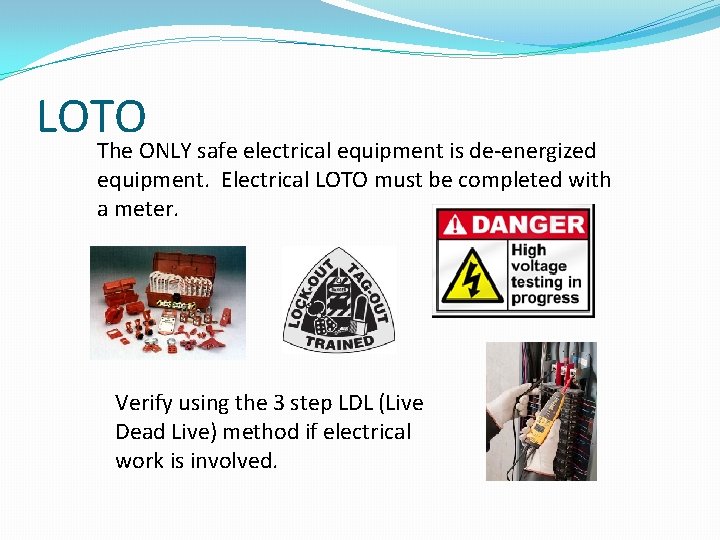
LOTO The ONLY safe electrical equipment is de-energized equipment. Electrical LOTO must be completed with a meter. Verify using the 3 step LDL (Live Dead Live) method if electrical work is involved.
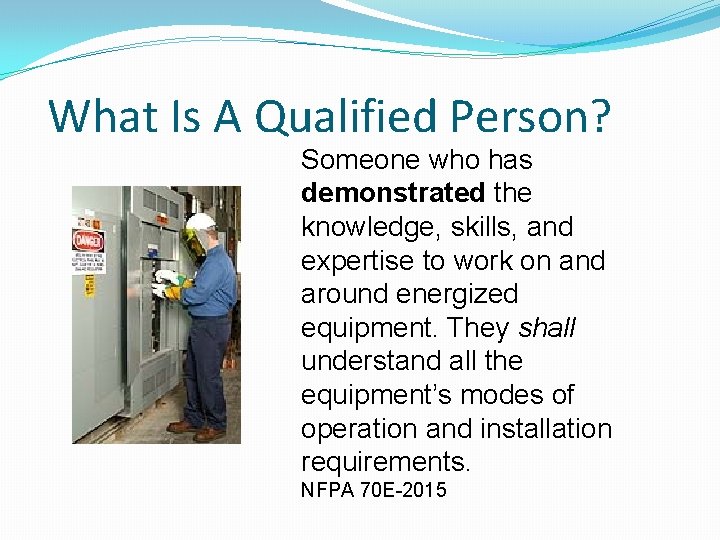
What Is A Qualified Person? Someone who has demonstrated the knowledge, skills, and expertise to work on and around energized equipment. They shall understand all the equipment’s modes of operation and installation requirements. NFPA 70 E-2015
Written Safety Program �Key Components �Define Qualified Personnel Requirements �Reference LOTO procedures and schedule for reviewing procedures �Appendix for Equipment Specific LOTO procedures �Define acceptable tasks � Plant Production Personnel � Electrically Qualified Personnel �Describe training guidelines and intervals �Care of PPE and tools
Hazard Analysis �What type of facility are we? �Manufacturing, Health Care, Hospitality, Mining, Petrochemical �What tasks do our qualified personnel complete? �Troubleshooting, programming, inspections �Frequency of those tasks. �Contributing factors. �Confined space, flammable surroundings, etc �Outside Contractors? �Arc Flash, Arc Blast, Shock or Fire
Arc Flash Study �Collect field data �Determine which evaluation method will be use �Update site electrical drawings �Create a model of the system to evaluate worst case arc flash situations �Professional Engineer evaluates the results �Generate equipment labels �Recommend mitigation options
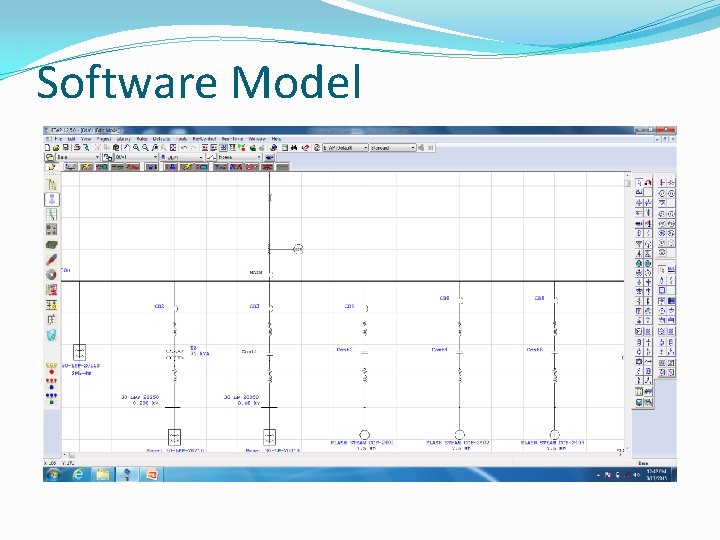
Software Model
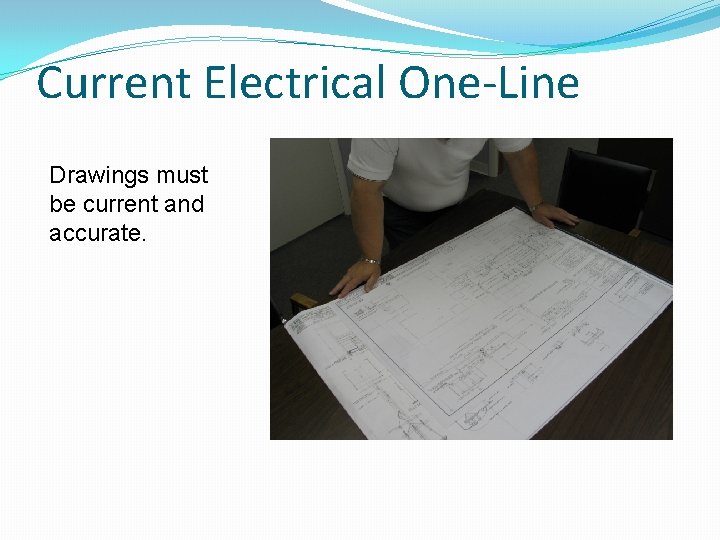
Current Electrical One-Line Drawings must be current and accurate.
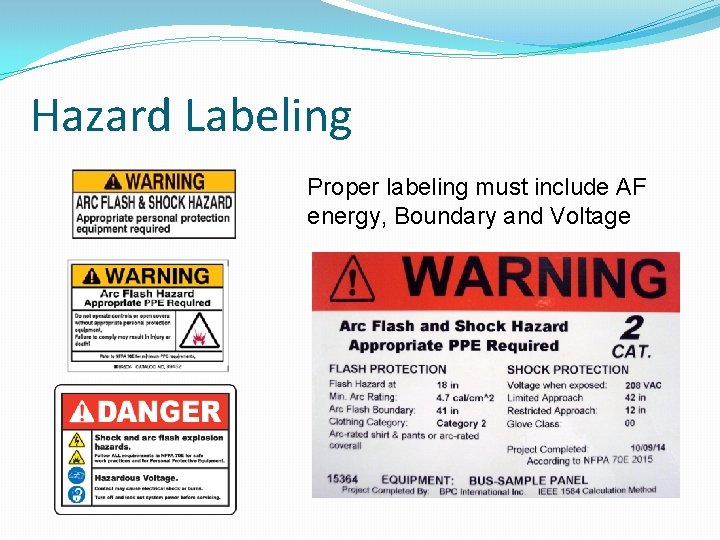
Hazard Labeling Proper labeling must include AF energy, Boundary and Voltage
Training �Factors impacting arc flash intensity �Proper Use of PPE �Arc Rated vs Flame Retardant �Impact of Electricity on the Human Body �Explain information on Arc Flash Labels �Boundaries �Calories /cm 2
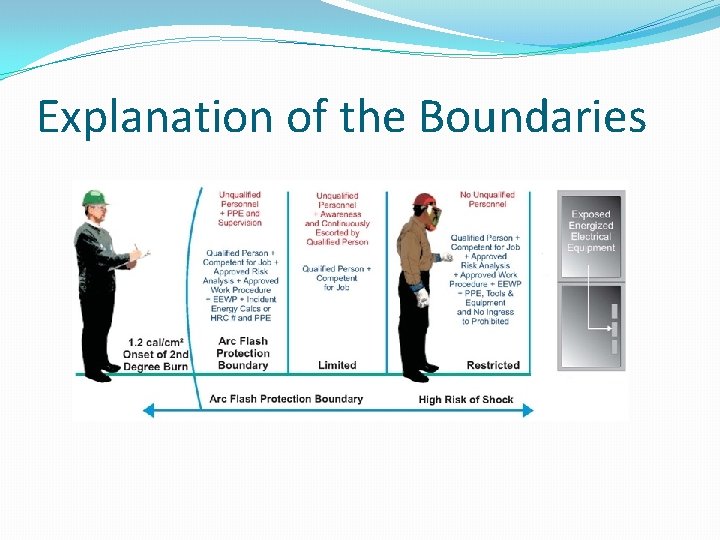
Explanation of the Boundaries
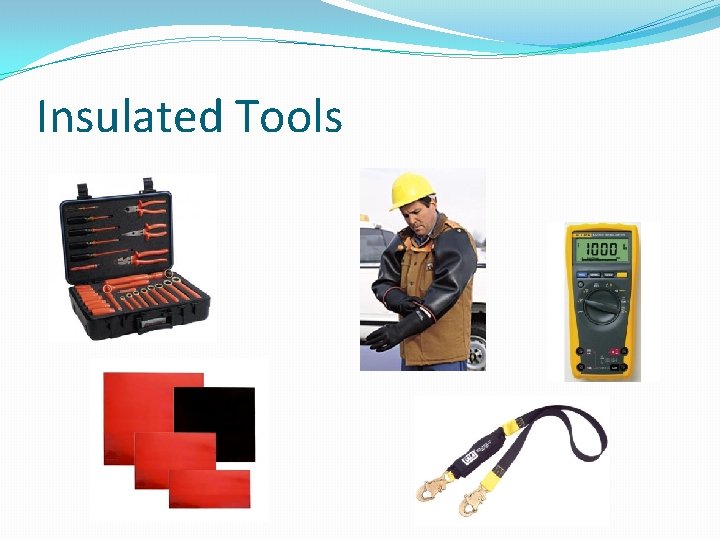
Insulated Tools
Selecting Appropriate PPE �Fabric Choice �Environmental Factors �Production Related Considerations �Select Testing Lab �Buy or Lease Clothing �If you lease want will the provider do for repairs, contamination, etc.
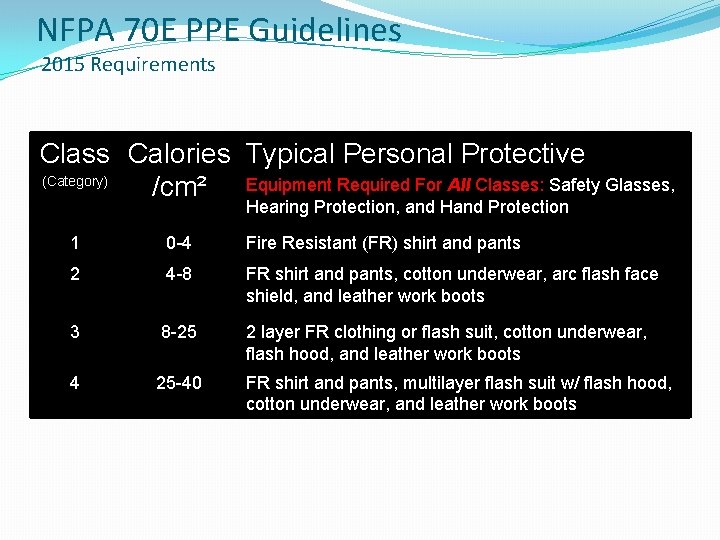
NFPA 70 E PPE Guidelines 2015 Requirements Class Calories Typical Personal Protective (Category) /cm² Equipment Required For All Classes: Safety Glasses, Hearing Protection, and Hand Protection 1 0 -4 Fire Resistant (FR) shirt and pants 2 4 -8 FR shirt and pants, cotton underwear, arc flash face shield, and leather work boots 3 8 -25 2 layer FR clothing or flash suit, cotton underwear, flash hood, and leather work boots 4 25 -40 FR shirt and pants, multilayer flash suit w/ flash hood, cotton underwear, and leather work boots
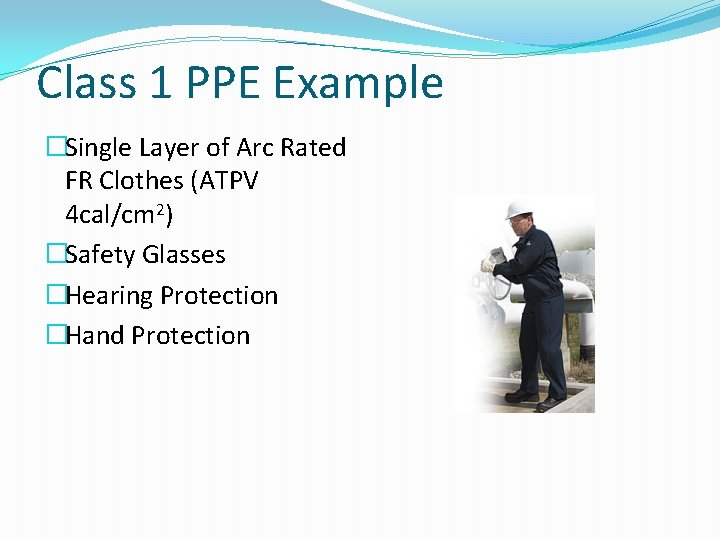
Class 1 PPE Example �Single Layer of Arc Rated FR Clothes (ATPV 4 cal/cm 2) �Safety Glasses �Hearing Protection �Hand Protection
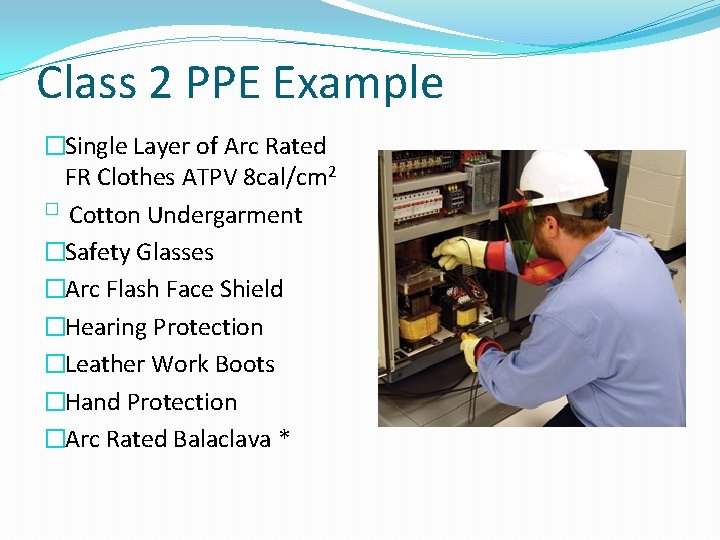
Class 2 PPE Example �Single Layer of Arc Rated FR Clothes ATPV 8 cal/cm 2 � Cotton Undergarment �Safety Glasses �Arc Flash Face Shield �Hearing Protection �Leather Work Boots �Hand Protection �Arc Rated Balaclava *
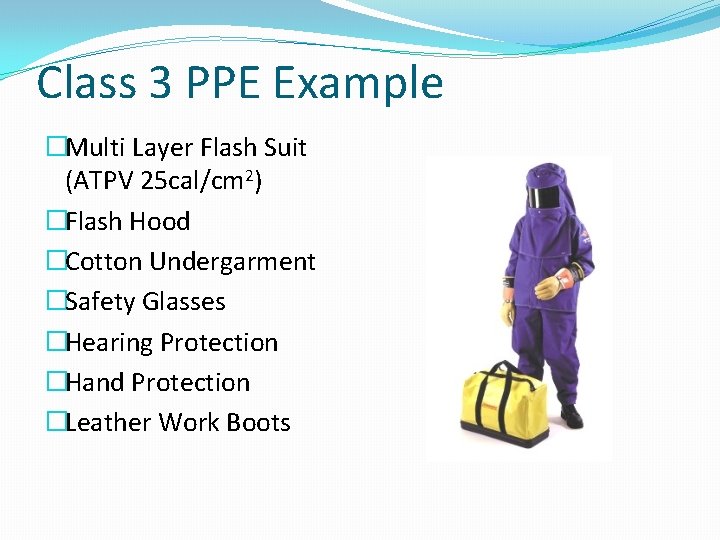
Class 3 PPE Example �Multi Layer Flash Suit (ATPV 25 cal/cm 2) �Flash Hood �Cotton Undergarment �Safety Glasses �Hearing Protection �Hand Protection �Leather Work Boots
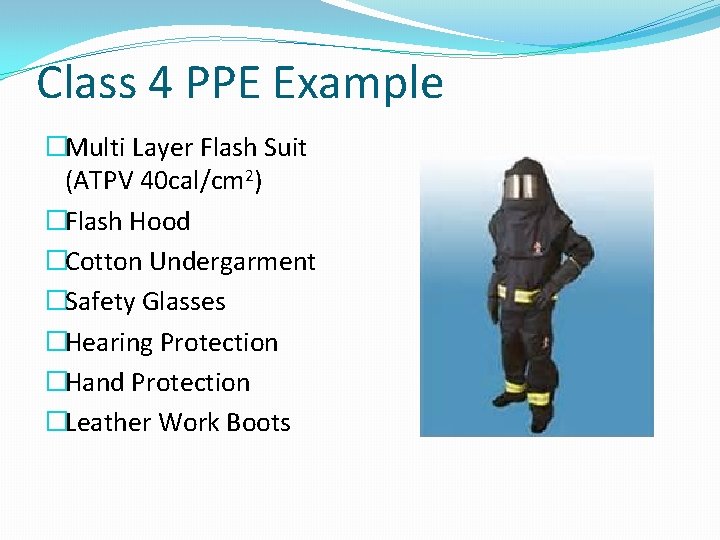
Class 4 PPE Example �Multi Layer Flash Suit (ATPV 40 cal/cm 2) �Flash Hood �Cotton Undergarment �Safety Glasses �Hearing Protection �Hand Protection �Leather Work Boots
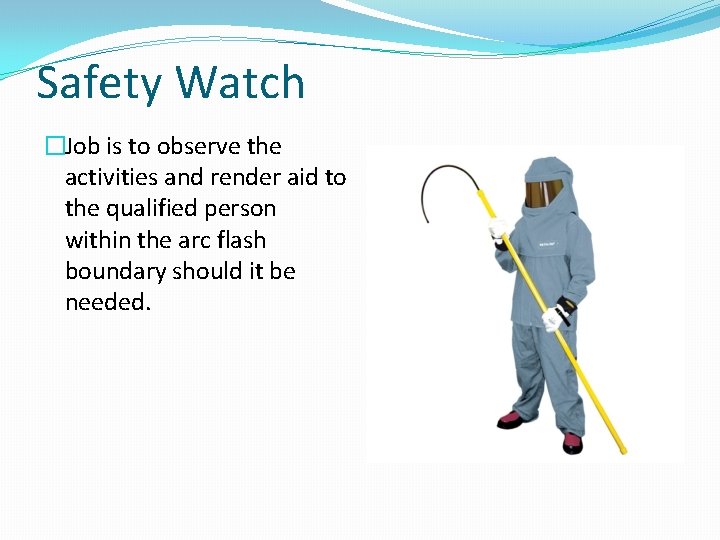
Safety Watch �Job is to observe the activities and render aid to the qualified person within the arc flash boundary should it be needed.
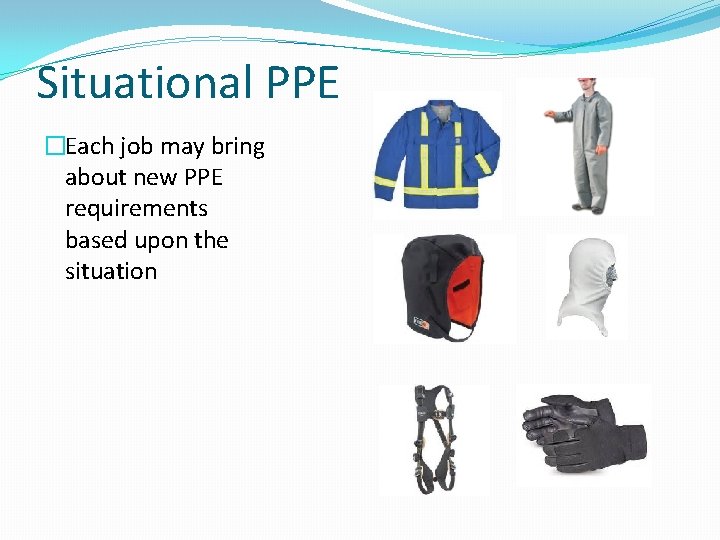
Situational PPE �Each job may bring about new PPE requirements based upon the situation
What does NFPA 70 E mean to you? �PPE requirements for you to follow for your jobs. �Safe Work Practices to follow. �Additional Training �Work restricted to “qualified” personnel. �Schedule repairs when equipment may be deenergized �Contractors MUST meet or exceed your Safety Programs
Sample Arc Flash
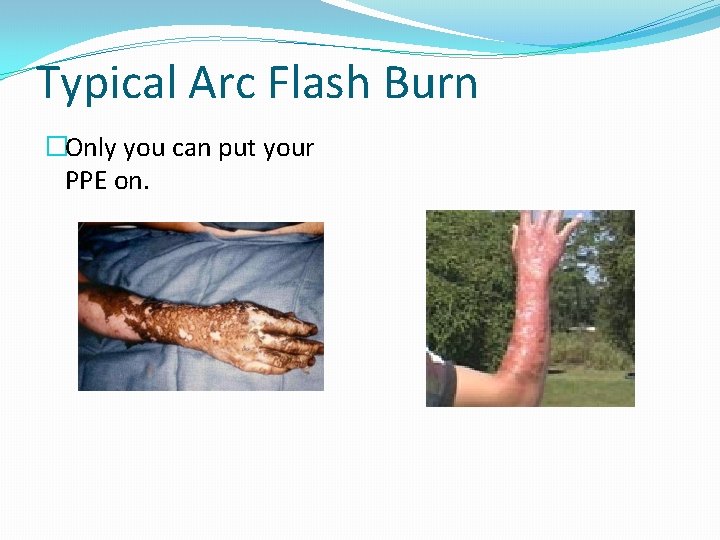
Typical Arc Flash Burn �Only you can put your PPE on.
Potential Fatal Current �The threshold for perception is about 100 microamps (0. 0001 Amps). �National Electrical Code (NEC) considers 5 milliamps (0. 005 Amps) to be a safe upper limit � 30 milliamps (0. 03 Amps) is considered a potentially fatal current for humans *Assumes AC power at 60 Hz. DC requires about 10 x as much.
Shock Hazards �NFPA and OSHA both require us to control shock hazards as well as arc flash hazards. Working in and around energized electrical equipment is no joking matter
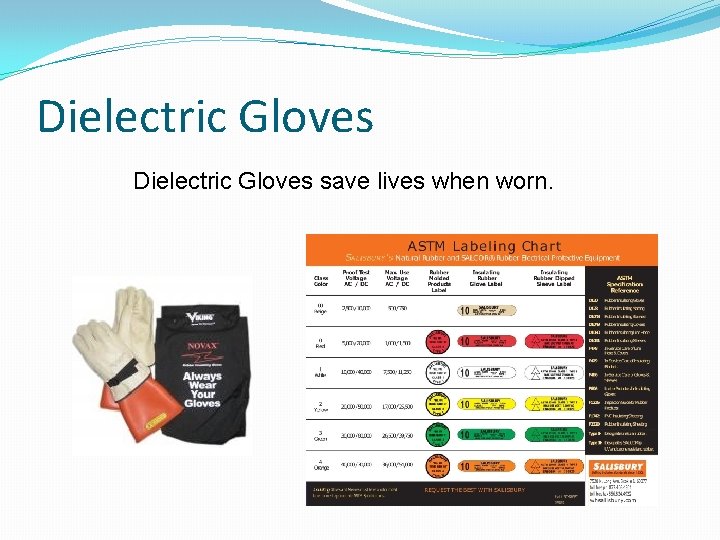
Dielectric Gloves save lives when worn.
So How Do I Do My Job? ? �Prior to work; determine arc flash & shock hazard. �Notify appropriate personnel – check in at all control rooms �Complete site safe work permit �Secure PPE �Add locks after site personnel have begun LOTO. �Secure workspace barriers. �Ensure proper illumination. �Complete task in accordance with safety guidelines.
For assistance with your electrical safety needs contact: BPC International Inc. Jeff Platter 888 -962 -4327 or 918 -663 -7833 jplatter@bpcintl. com www. bpcintl. com Our Professional Engineers are registered in over 30 states to meet your needs.
- Slides: 36