
Electrical Safety n n n Basic Principles of
Electrical Safety n n n Basic Principles of Electricity Alternating Current Basic Electric Circuits Safe Working Practices Maintenance
What is electricity ? n n n A source of Energy Essential to modern life Extremely Dangerous n n Cannot be seen or smelt About 10– 12 Fatalities at Work per Year
Electric Current n n A flow of electrons ! Certain materials ‘conduct’ better than others
Electric current n Conductors n n n Metals such as copper, silver, gold and aluminium. Loose electrons in abundance so charge can be transferred easily Copper very common on cost basis
Electric current n Summary n n Movement of electrons Best in soft metals Measured in Amperes or Amps Symbolised by ‘A’ n i. e. a 13 A fuse
Potential Difference n n Charge on an object Measured with respect to earth Also known as Pressure Water Analogy n n n Horizontal pipe – water does not flow Raise one end – water flows out A pressure difference exists
Potential Difference n n n Raising pipe created a pressure difference Raising electric charge has same effect only electric current will flow Amount of current that flows dependant on conductor (…more water could flow in a bigger pipe…)
Potential Difference n Summary n n Difference of charge between two objects Causes a current to flow n n n (water analogy) Measured in Volts Symbol ‘V’ n i. e. 230 V
Conductors and Insulators n n Conductors conduct electricity Insulators don’t Metals conduct Wood, plastic, air, oil and rigid glass do not conduct electricity (most of the time)
Resistance n Back to the water pipe again! n n n A larger diameter pipe allows more water to flow than a smaller one If a small diameter section of pipe is inserted into the large pipe the flow of water is restricted Some materials conduct electricity better than others (atomic structure different)
Resistance n n Small diameter wires (conductors) allow less electricity to flow than in similar bigger diameter wires The ease by which a material conducts electricity is known as resistance
Relationships n Electric Current - Amperes Potential Difference – Voltage Electrical Resistance n All above are related to each other n n
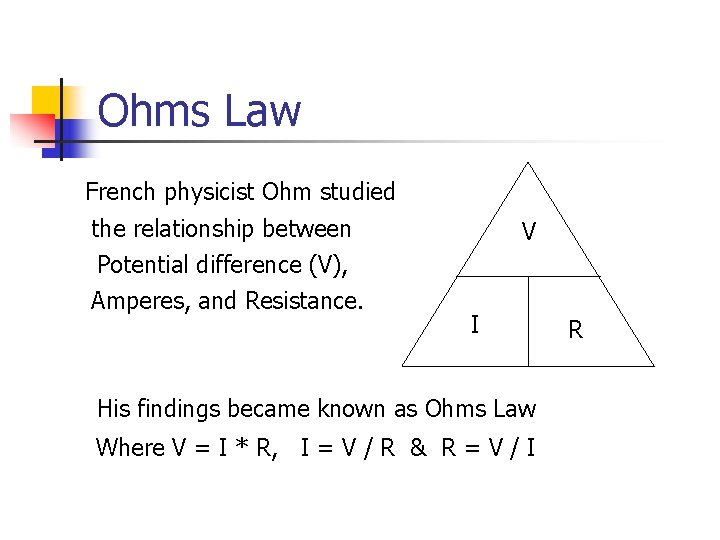
Ohms Law French physicist Ohm studied the relationship between Potential difference (V), Amperes, and Resistance. V I His findings became known as Ohms Law Where V = I * R, I = V / R & R = V / I R
§Sources of power § § Battery DC Mains Supply Portable Generators Solar panels
UK Electricity Supply System n n Electricity supplied to factories, offices and homes at 230 volts Large factories at 11000 volts or above Supply has alternating current (a. c. ) Alternates at (frequency) of 50 cycles per second (50 Hertz or Hz)
Power n n When current flows energy is transmitted and usually consumed by a load Examples – heaters, lights, motion n Such devices must consume electricity because we have to pay for it!
Power n Power = Volts X Amps (work done) n Measured in Watts (W) n Example – 2300 Watt electric kettle n Also referred to as 2. 3 kilowatt (k. W)
Summary n Amps, Volts, Ohms n Power
Effect of electricity on human body n Burns n n n Surface Deep tissue Electric Shock n n Muscular Contraction Asphyxia Respiratory Arrest Ventricular Fibrillation
Ventricular Fibrillation n n n Factors are Current / Time & Physiological Structure of body Can occur at 30 m. A (0. 03 A) Causes heart to ‘flutter’ Muscle cannot open / close properly Does not pump Lack of oxygen to brain - DEATH
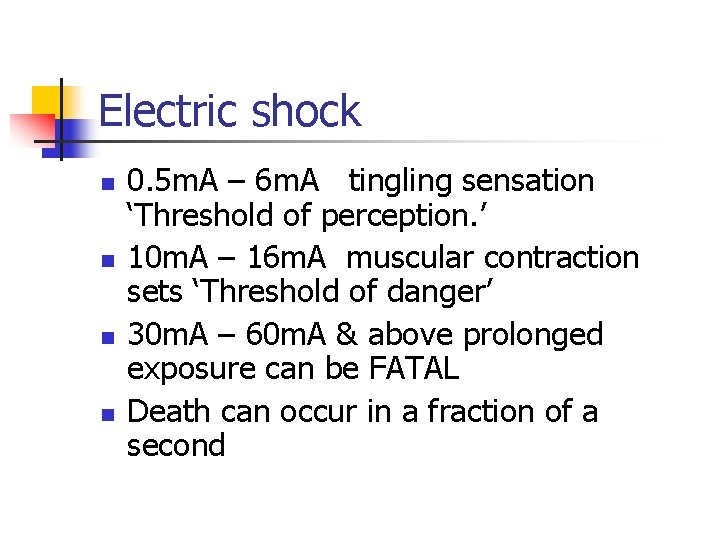
Electric shock n n 0. 5 m. A – 6 m. A tingling sensation ‘Threshold of perception. ’ 10 m. A – 16 m. A muscular contraction sets ‘Threshold of danger’ 30 m. A – 60 m. A & above prolonged exposure can be FATAL Death can occur in a fraction of a second
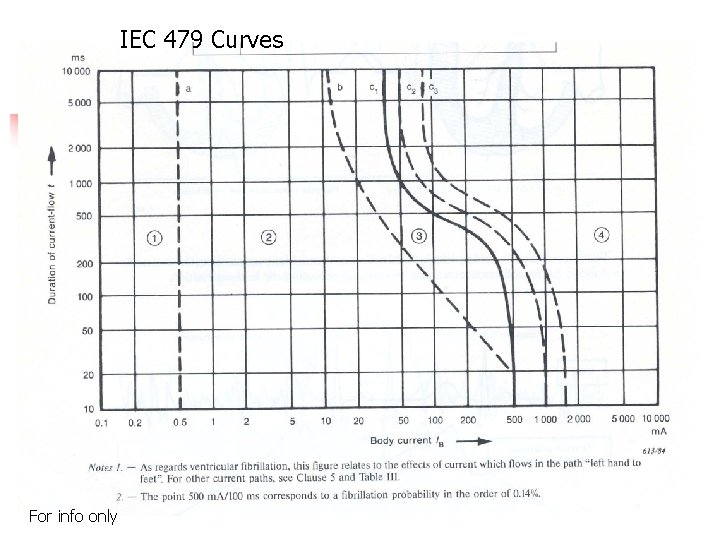
IEC 479 Curves IEC 479 curves For info only
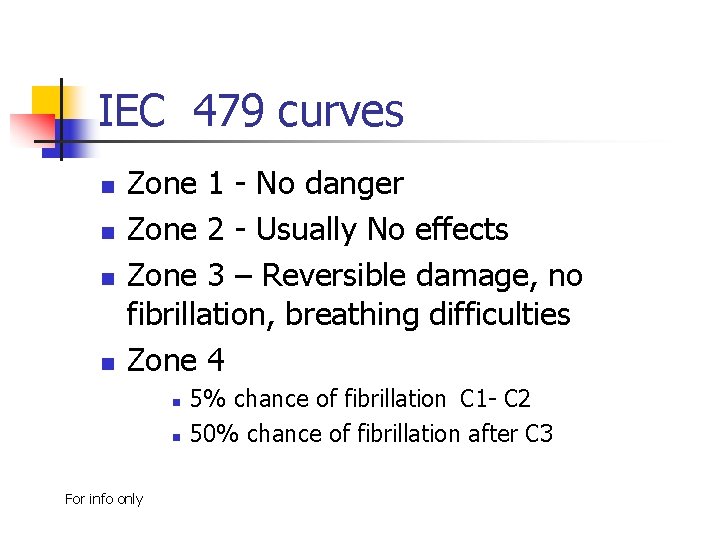
IEC 479 curves n n Zone 1 - No danger Zone 2 - Usually No effects Zone 3 – Reversible damage, no fibrillation, breathing difficulties Zone 4 n n For info only 5% chance of fibrillation C 1 - C 2 50% chance of fibrillation after C 3
Electric Shock - Treatment n n Isolate supply immediately – Dial 999 If you cannot isolate DO NOT attempt to touch casualty Physically remove victim using nonconducting implements Check for pulse / breathing, give artificial respiration if necessary
Electrical circuits n Consist of n n n Power Source Connecting cables Electrical equipment (energy converter)
Electrical circuits - Earthing n n Very important for safety ! Prevents conducting parts of equipment (ie. metal frames or lids), which do not normally conduct electricity from becoming live during faults.
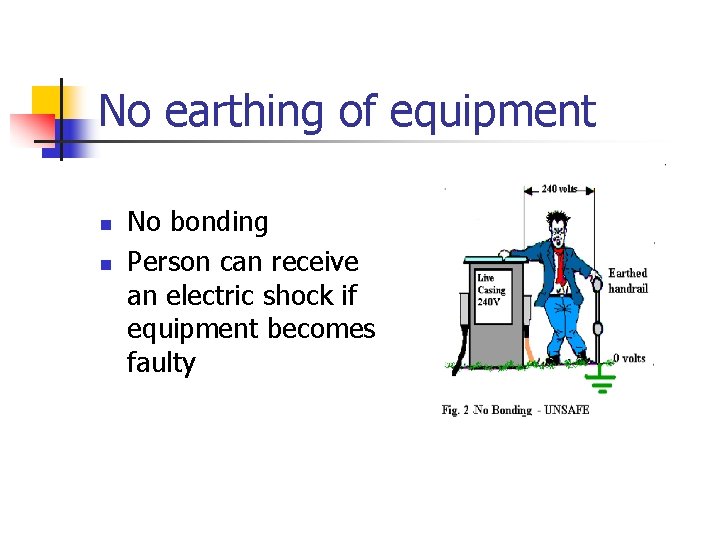
No earthing of equipment n n No bonding Person can receive an electric shock if equipment becomes faulty
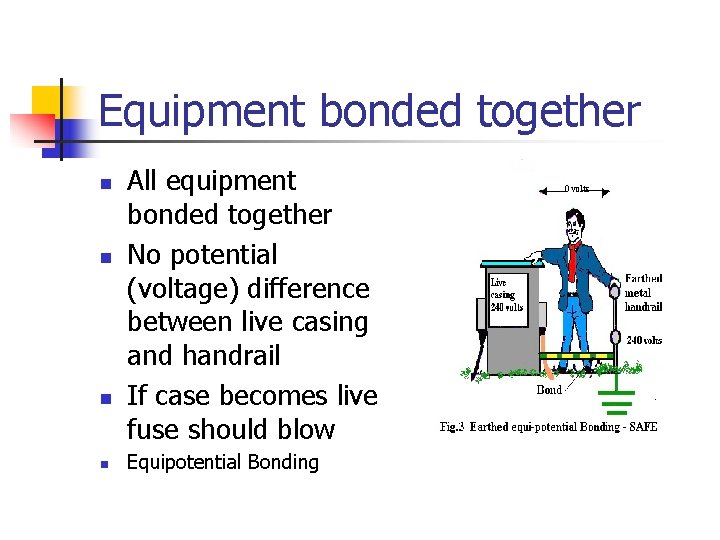
Equipment bonded together n n All equipment bonded together No potential (voltage) difference between live casing and handrail If case becomes live fuse should blow Equipotential Bonding
Fuses and RCD’s n Fuses n n essential for safety, will cut off supply at a certain current level i. e. 13 A, 5 A, 3 A mains supply fuse Fuse has a ‘fuseable’ wire element which heats up when current flows Excessive current = excessive heat & wire melts preventing current flow RCD’s n n Residual current device Compares current in Live & Neutral if different and above a certain value supply switched off
Work on Electrical Equipment n Always ISOLATE supply n n Switch off using a device that will create an air gap that should not fail Lock off where possible to prevent inadvertent switching ON whilst work taking place Always test conductors in a reliable way before touching (ie. test the test device before and after use!) Permit to work may be required for higher voltage or complex installations
Safe values of Voltage n n n 55 VAC systems have not caused anybody to be electrocuted Often referred to as a 110 VAC centre tapped earth supply (CTE) yellow coloured equipment Less than 120 VDC considered to be safe
Double Insulation n Lots of portable equipment is Double Insulated Extra layer of insulating material over live conductors to prevent exposure of conductors Can mean that an earth conductor is not required – risk reduced by additional insulation.
Electrical Fires / Arcs / Explosions n Fires n n Arcs n n n Overheating, arcing & sparking Generated during faults / flashover (Lightning) Very high temperatures / causing burns Explosions n n Flammable substances give off vapours Electrical sparks can ignite (ie. domestic light switch)
Electrical equipment selection n Must be suitable for environment n n n Wet, dusty, flammable gases, mechanical strength, corrosive atmospheres (maggot farms) Must be maintained in good condition Failure to select suitable equipment and maintain it often results in incidents at a later date
Maintenance of Portable Electrical Equipment n n n Many accidents result from 230 volt portable equipment Pressure Washers / Vacuum Cleaners Resulting from n n n Incorrect selection Inadequate maintenance / poor repairs Most important checks are easy to do !
Maintenance of Portable Electrical Equipment n Visual Inspection n n Check flexible mains cable for damage to insulation If insulation is damaged – REPLACE DO NOT wrap conductors together and tape up So called ‘Electrical Insulation Tape’ will not provide a sufficient barrier between you and a potentially fatal electric shock – as has been proven on many occasions
Maintenance of Portable Electrical Equipment n Plug n n n Check that only the outer insulation has been clamped / gripped. Clamping inner conductor insulation will potentially lead to exposure of live terminals. Is fuse correct rating (Instructions should advise correct current value – DO NOT use a nail) Check that all 3 pins are present and in good condition
Maintenance of Portable Electrical Equipment n Testing n n n Only by a competent person Earth bond test Insulation test On-load test Guidance – HSE HS(G) 107 (£ 5) ‘Maintaining portable and transportable electrical equipment’
The Law n n Health & Safety at Work etc Act 1974 Electricity at Work Regulations 1989 n Require n n n Safe construction, maintenance & work systems Capability, Environments, Insulation, Earthing, Connections, Fusing, Isolation, Making dead, Live working, Working Space, Competence. Covers ALL aspects at ALL voltages.
- Slides: 39