
Electrical Principles Topic 1 Basic Atomic Theory Unit
Electrical Principles Topic 1: Basic Atomic Theory Unit 1: Composition of matter
Assumed Prior Learning For this Unit there no assumptions about prior learning
Outcomes By the of this topic, you will be able to: 1. Describe matter, elements, compounds and molecules 2. Describe the construction of an atom in respect of orbits, nucleus, electrons, valence electrons and free electrons 3. Explain the forces in an atom
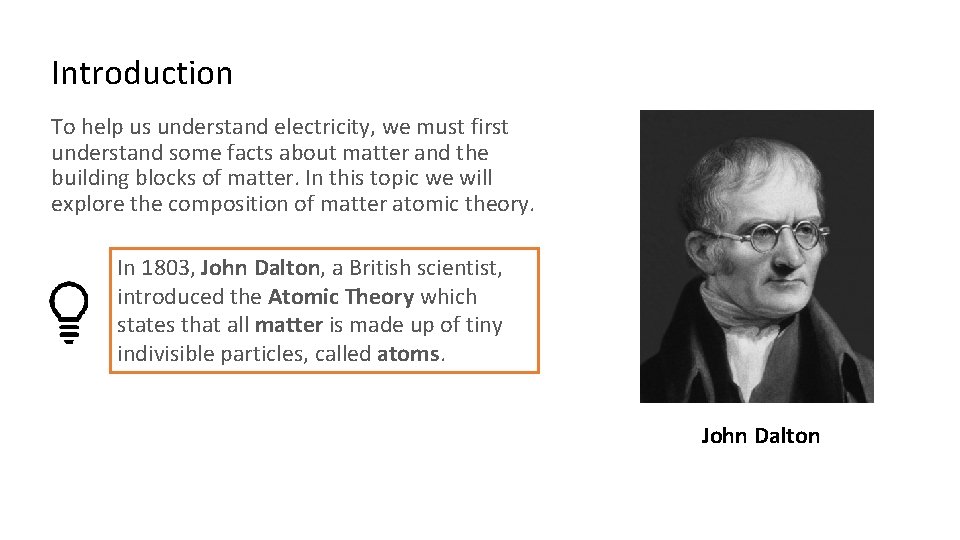
Introduction To help us understand electricity, we must first understand some facts about matter and the building blocks of matter. In this topic we will explore the composition of matter atomic theory. In 1803, John Dalton, a British scientist, introduced the Atomic Theory which states that all matter is made up of tiny indivisible particles, called atoms. John Dalton
What is matter? Matter is another word for the things that ‘stuff’ is made of. Matter is anything that has weight (mass) and takes up space (has volume). Think about it. Matter is all around you. The chair you sit in… the food you eat…anything you can see and touch. And even some things you cannot see or touch are also forms of matter. Watch the video to find out more about matter. Placeholder for Video- see notes
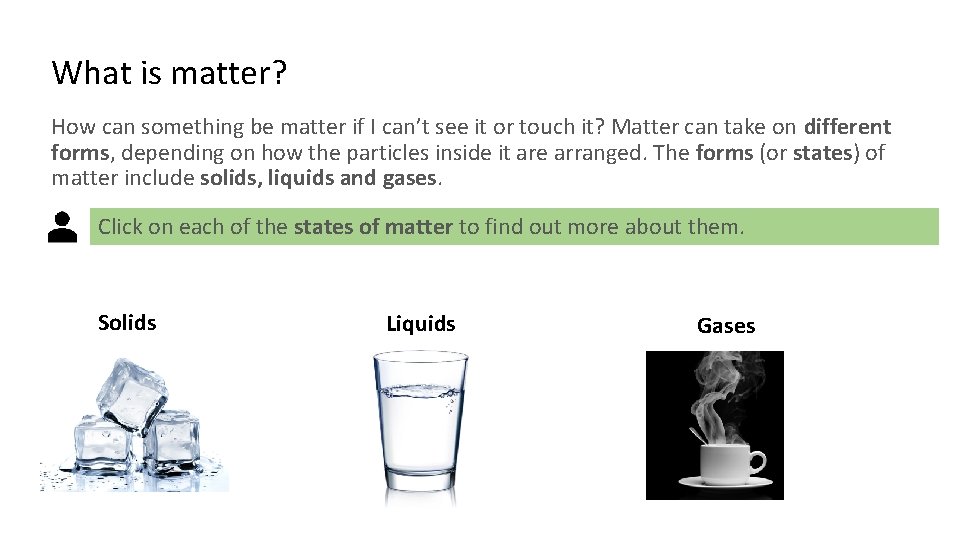
What is matter? How can something be matter if I can’t see it or touch it? Matter can take on different forms, depending on how the particles inside it are arranged. The forms (or states) of matter include solids, liquids and gases. Click on each of the states of matter to find out more about them. Solids Liquids Gases
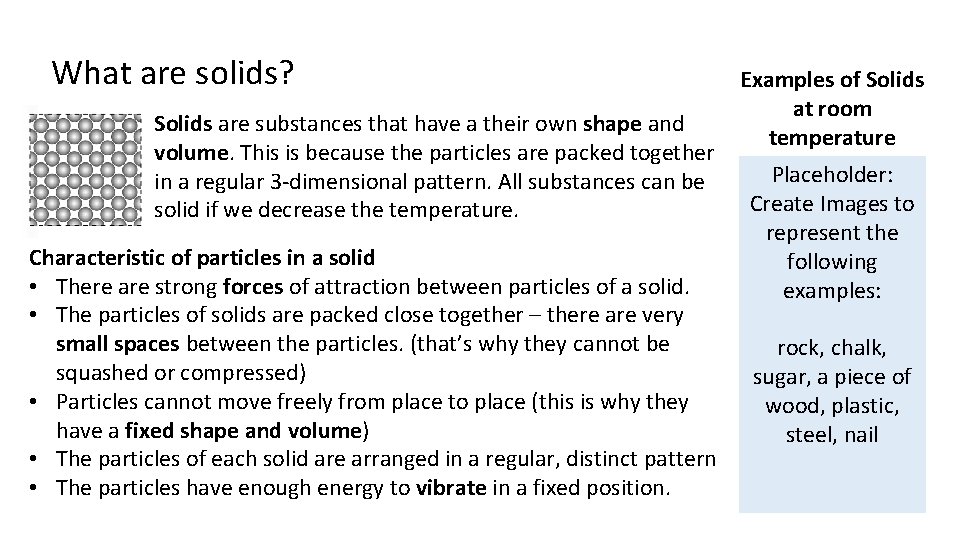
What are solids? Solids are substances that have a their own shape and volume. This is because the particles are packed together in a regular 3 -dimensional pattern. All substances can be solid if we decrease the temperature. Characteristic of particles in a solid • There are strong forces of attraction between particles of a solid. • The particles of solids are packed close together – there are very small spaces between the particles. (that’s why they cannot be squashed or compressed) • Particles cannot move freely from place to place (this is why they have a fixed shape and volume) • The particles of each solid are arranged in a regular, distinct pattern • The particles have enough energy to vibrate in a fixed position. Examples of Solids at room temperature Placeholder: Create Images to represent the following examples: rock, chalk, sugar, a piece of wood, plastic, steel, nail
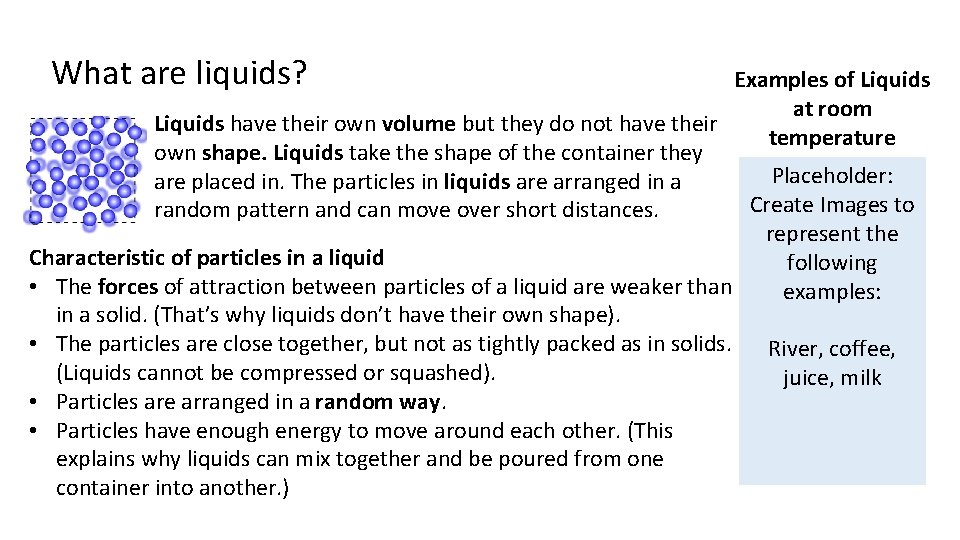
What are liquids? Examples of Liquids at room Liquids have their own volume but they do not have their temperature own shape. Liquids take the shape of the container they Placeholder: are placed in. The particles in liquids are arranged in a Create Images to random pattern and can move over short distances. represent the Characteristic of particles in a liquid following • The forces of attraction between particles of a liquid are weaker than examples: in a solid. (That’s why liquids don’t have their own shape). • The particles are close together, but not as tightly packed as in solids. River, coffee, (Liquids cannot be compressed or squashed). juice, milk • Particles are arranged in a random way. • Particles have enough energy to move around each other. (This explains why liquids can mix together and be poured from one container into another. )
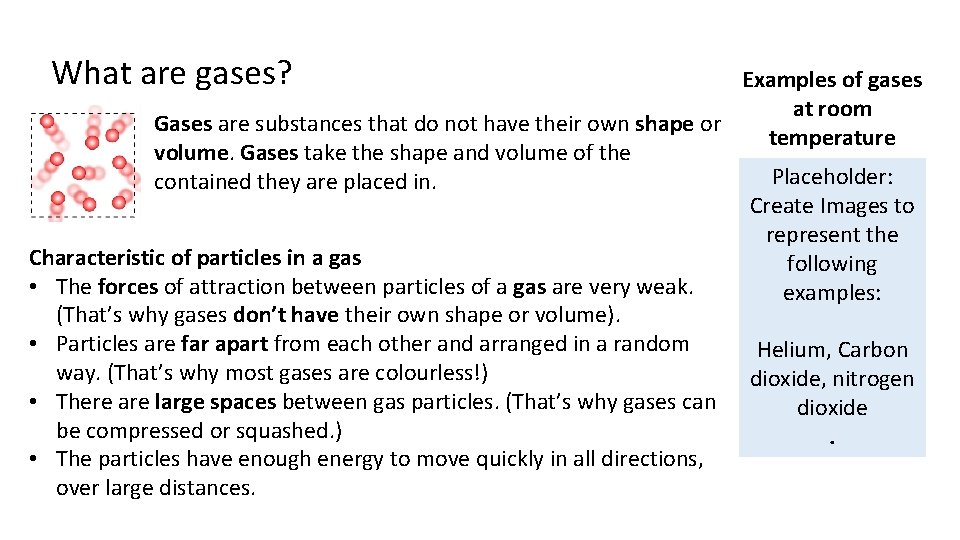
What are gases? Examples of gases at room Gases are substances that do not have their own shape or temperature volume. Gases take the shape and volume of the Placeholder: contained they are placed in. Create Images to represent the Characteristic of particles in a gas following • The forces of attraction between particles of a gas are very weak. examples: (That’s why gases don’t have their own shape or volume). • Particles are far apart from each other and arranged in a random Helium, Carbon way. (That’s why most gases are colourless!) dioxide, nitrogen • There are large spaces between gas particles. (That’s why gases can dioxide be compressed or squashed. ). • The particles have enough energy to move quickly in all directions, over large distances.
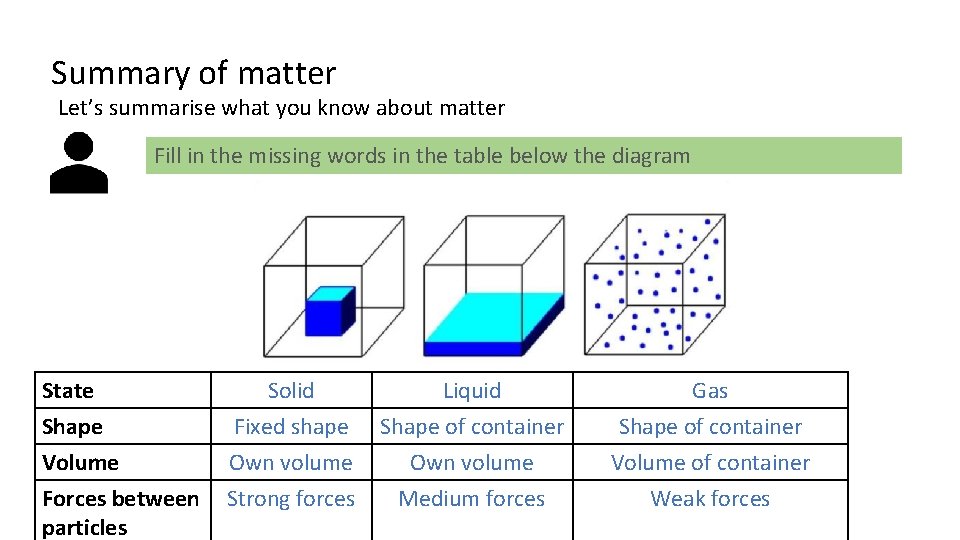
Summary of matter Let’s summarise what you know about matter Fill in the missing words in the table below the diagram State Shape Volume Forces between particles Solid Fixed shape Own volume Strong forces Liquid Shape of container Own volume Medium forces Gas Shape of container Volume of container Weak forces
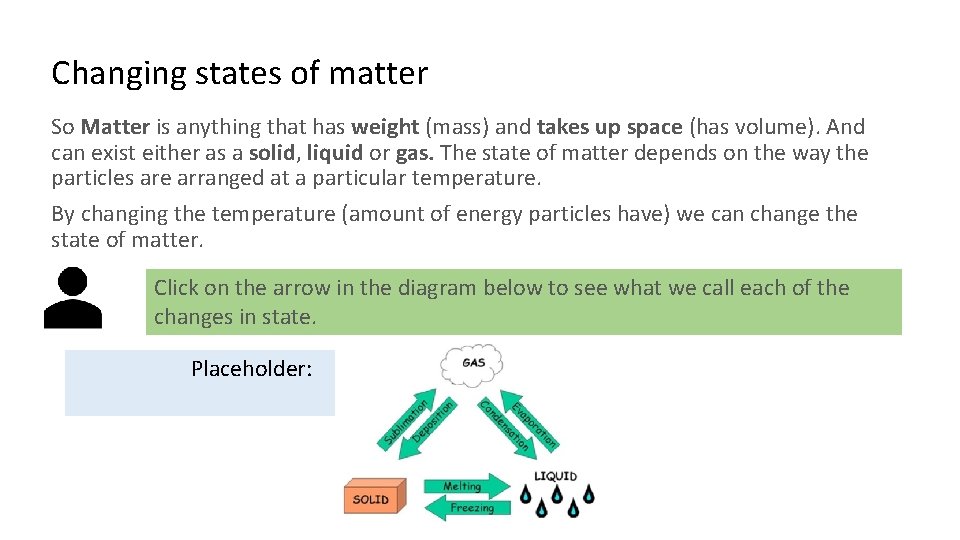
Changing states of matter So Matter is anything that has weight (mass) and takes up space (has volume). And can exist either as a solid, liquid or gas. The state of matter depends on the way the particles are arranged at a particular temperature. By changing the temperature (amount of energy particles have) we can change the state of matter. Click on the arrow in the diagram below to see what we call each of the changes in state. Placeholder:
Activity: Changing states You are going to use a simulation to see what happens to the particles of a substance when the temperature changes. Instructions: 1. Click here to open the simulation tool and select “States”. 2. The starting item on “Atoms & Molecules” menu is Neon. Above thermometer the temperature is given as 13 K (13 Kelvin) Click to change the temperature reading to degrees Celsius. 3. Now, click on: • Solid: Look at how the particles are arranged • Liquid: What do you notice about how the particles are arranged? What has happened to the temperature? • Gas: What do you notice about how the particles are arranged? What has happened to the temperature? 4. Select a different substance from the “Atoms & Molecules” menu and repeat step 3. You can change the temperature by using the heat or cool switch too.
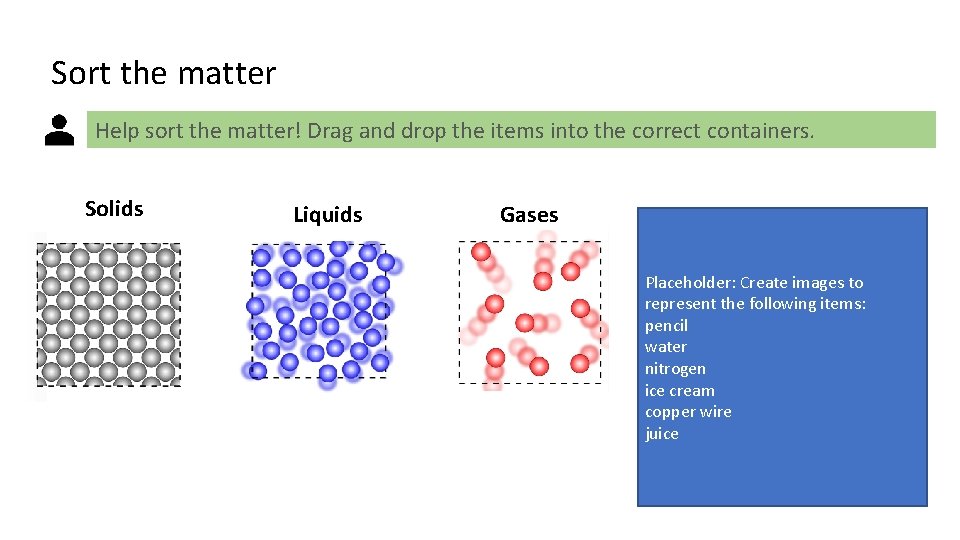
Sort the matter Help sort the matter! Drag and drop the items into the correct containers. Solids Liquids Gases Placeholder: Create images to represent the following items: pencil water nitrogen ice cream copper wire juice
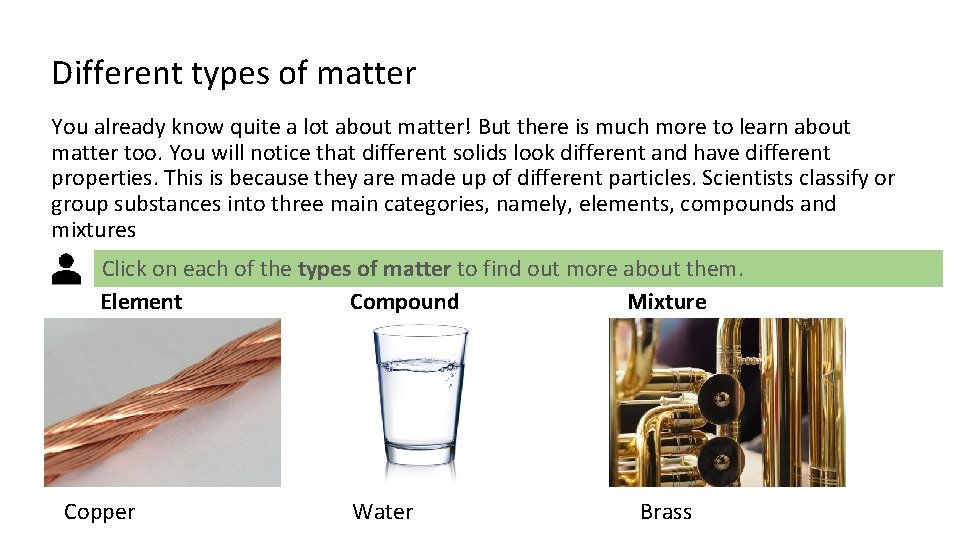
Different types of matter You already know quite a lot about matter! But there is much more to learn about matter too. You will notice that different solids look different and have different properties. This is because they are made up of different particles. Scientists classify or group substances into three main categories, namely, elements, compounds and mixtures Click on each of the types of matter to find out more about them. Element Compound Mixture Copper Water Brass
What are elements? Examples of elements Elements are pure substances that cannot be broken down into Placeholder: simpler substances. Each element has a unique symbol so that you Create Images to can identify it. represent the There are three types of elements - metals, metalloids and nonfollowing metals. The main difference in these types of elements is related to examples: how they conduct or do not conduct electricity. Copper Cu Particles in an element Iron Fe, • The smallest particles in all elements are atoms. Some non-metals Silicon Si atoms, like oxygen, hydrogen and nitrogen, join together to form Oxygen O 2, simple units called molecules of two atoms each. Mercury Hg • Different elements are made from atoms of different size and mass. • The atoms of a specific element have the same size and are similar in mass. Elements are arranged in the Periodic Table. Click here to see an interactive Periodic Table. Click on a symbol of element to find out more about it’s properties.
What are compounds? Compounds are pure substances that are formed when elements combine with each other during a chemical reaction. The chemical formula of a compound shows the ratio of how the elements combine e. g. H 2 O is the chemical formula of water. The ratio between the amount of hydrogen to oxygen is 2: 1 Particles in a compound • The particles in all compounds are a collection of atoms joined together. • In many compounds the atoms join together in the simple ratio as given in the chemical. The particles are called molecules. • Molecules can vary in size from small (a few atoms per molecule) to giant sized molecules (thousands of atoms per molecule). • When a metal atom joins to a non-metal atom an ordered arrangement of positively charged and negatively charge particles (ions) is formed. This structure is called an ionic lattice. Examples of compounds Placeholder: Create Images to represent the following examples: Water (H 2 O), Carbon dioxide (Dry ice) (CO 2) Polyethene (Plastic) ([-(CH 2)-]n Sodium chloride (salt)(Na. Cl)
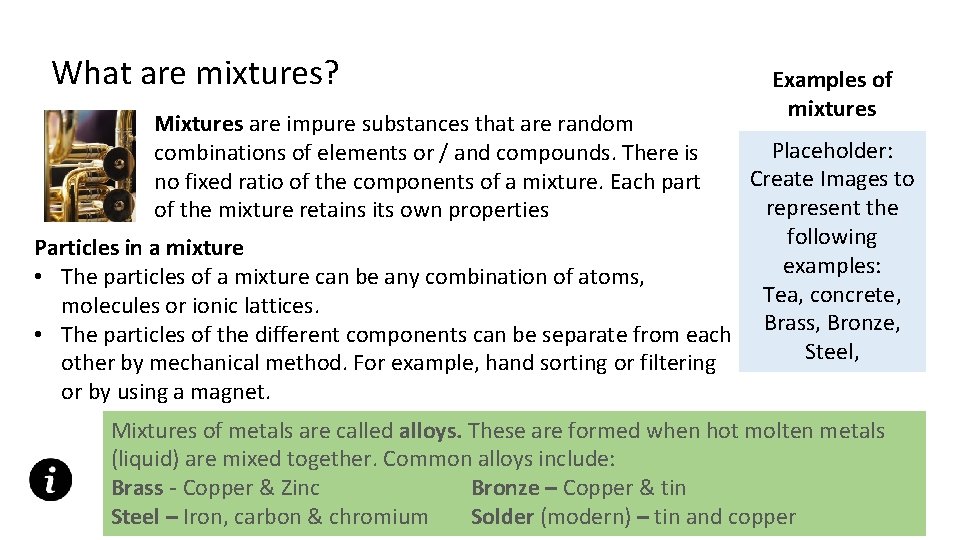
What are mixtures? Mixtures are impure substances that are random combinations of elements or / and compounds. There is no fixed ratio of the components of a mixture. Each part of the mixture retains its own properties Examples of mixtures Placeholder: Create Images to represent the following Particles in a mixture examples: • The particles of a mixture can be any combination of atoms, Tea, concrete, molecules or ionic lattices. • The particles of the different components can be separate from each Brass, Bronze, Steel, other by mechanical method. For example, hand sorting or filtering or by using a magnet. Mixtures of metals are called alloys. These are formed when hot molten metals (liquid) are mixed together. Common alloys include: Brass - Copper & Zinc Bronze – Copper & tin Steel – Iron, carbon & chromium Solder (modern) – tin and copper
What are atoms made of? As you have seen the basic building block of all matter is the atom. You cannot see an atom but by doing experiments scientists have developed different models of what an atom is. Do you know or remember the parts of an atom? Make a drawing and write down a few notes to see what you know. Check your ideas by watching the video below: Placeholder for Video- See appendix
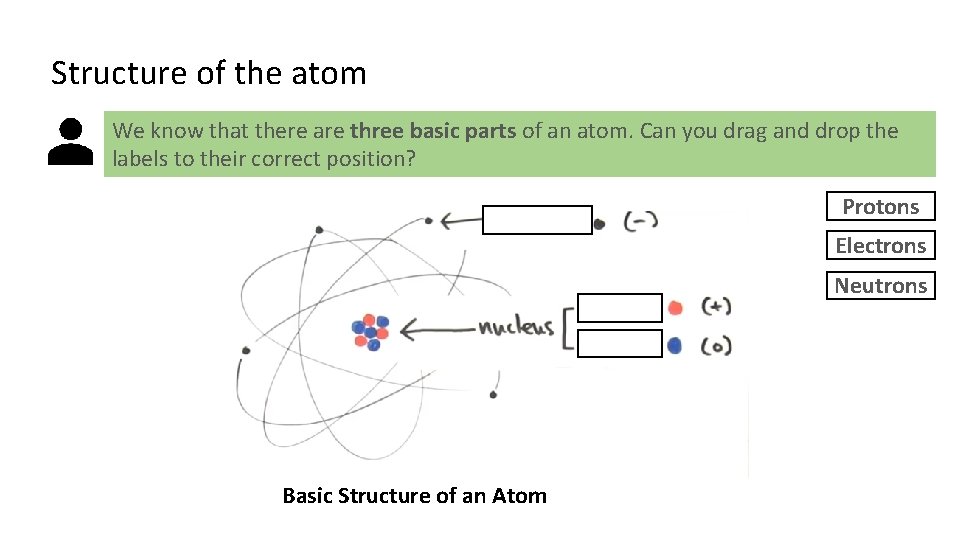
Structure of the atom We know that there are three basic parts of an atom. Can you drag and drop the labels to their correct position? Protons Electrons Neutrons Basic Structure of an Atom
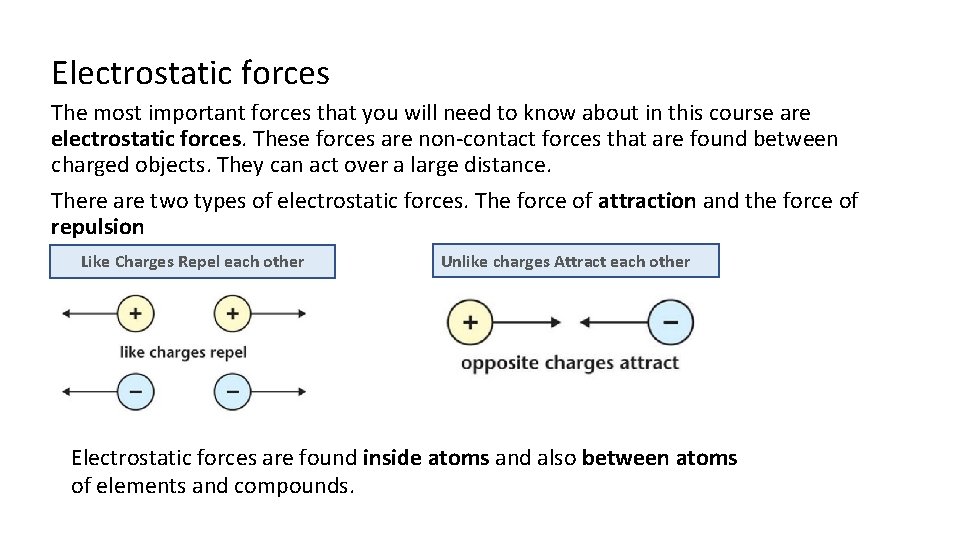
Electrostatic forces The most important forces that you will need to know about in this course are electrostatic forces. These forces are non-contact forces that are found between charged objects. They can act over a large distance. There are two types of electrostatic forces. The force of attraction and the force of repulsion Like Charges Repel each other Unlike charges Attract each other Electrostatic forces are found inside atoms and also between atoms of elements and compounds.
Forces inside an atom There are different forces inside an atom. Forces between the nucleus and the electrons: The force between the positively charged protons and negatively charged nucleus is called an electrostatic force. This is a force of attraction. The force between the electrons moving in a circular motion around the nucleus. This force is called the centrifugal force and pushes the electrons away from the nucleus. Forces inside the nucleus: Positively charged protons and neutral neutrons are held together in the nucleus by very strong nuclear forces. These forces are not the same as electrostatic forces.
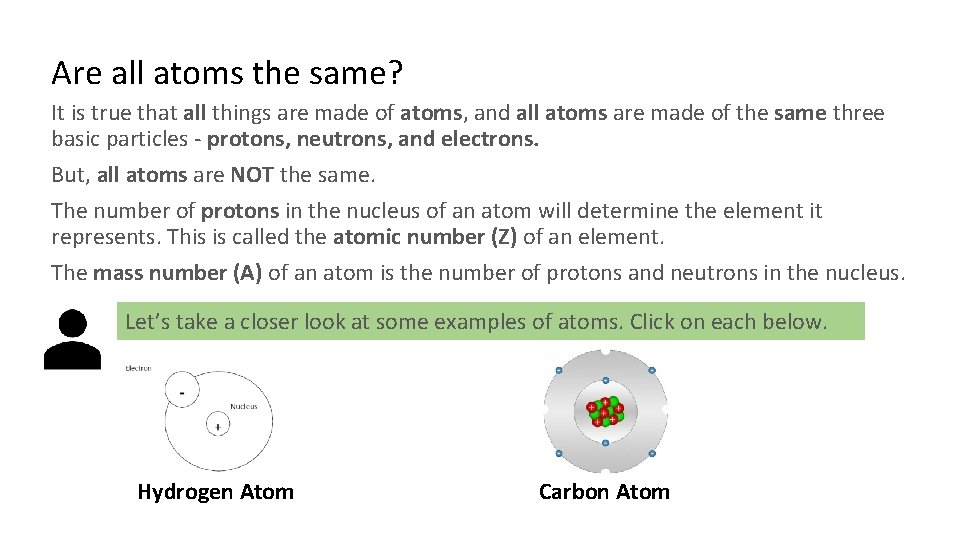
Are all atoms the same? It is true that all things are made of atoms, and all atoms are made of the same three basic particles - protons, neutrons, and electrons. But, all atoms are NOT the same. The number of protons in the nucleus of an atom will determine the element it represents. This is called the atomic number (Z) of an element. The mass number (A) of an atom is the number of protons and neutrons in the nucleus. Let’s take a closer look at some examples of atoms. Click on each below. Hydrogen Atom Carbon Atom
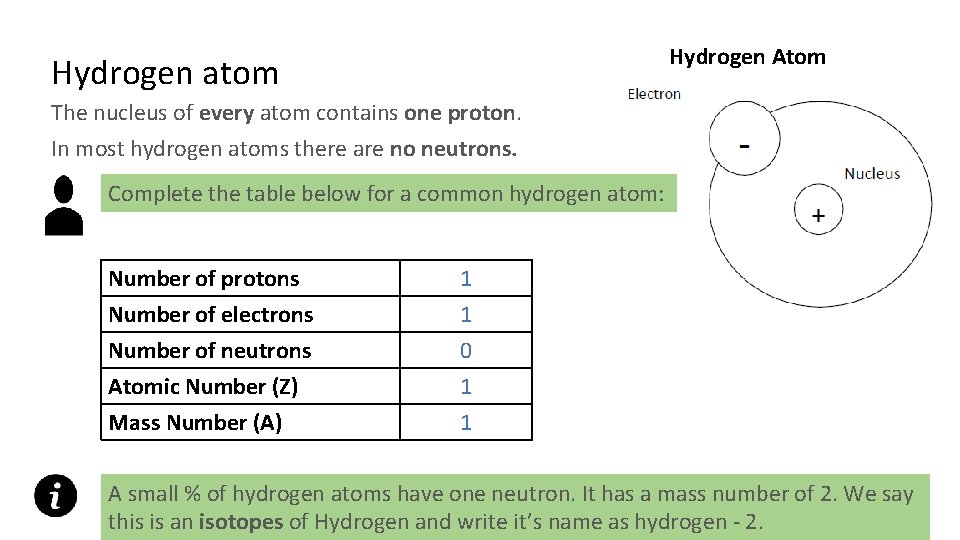
Hydrogen Atom Hydrogen atom The nucleus of every atom contains one proton. In most hydrogen atoms there are no neutrons. Complete the table below for a common hydrogen atom: Number of protons Number of electrons Number of neutrons Atomic Number (Z) 1 1 0 1 Mass Number (A) 1 A small % of hydrogen atoms have one neutron. It has a mass number of 2. We say this is an isotopes of Hydrogen and write it’s name as hydrogen - 2.
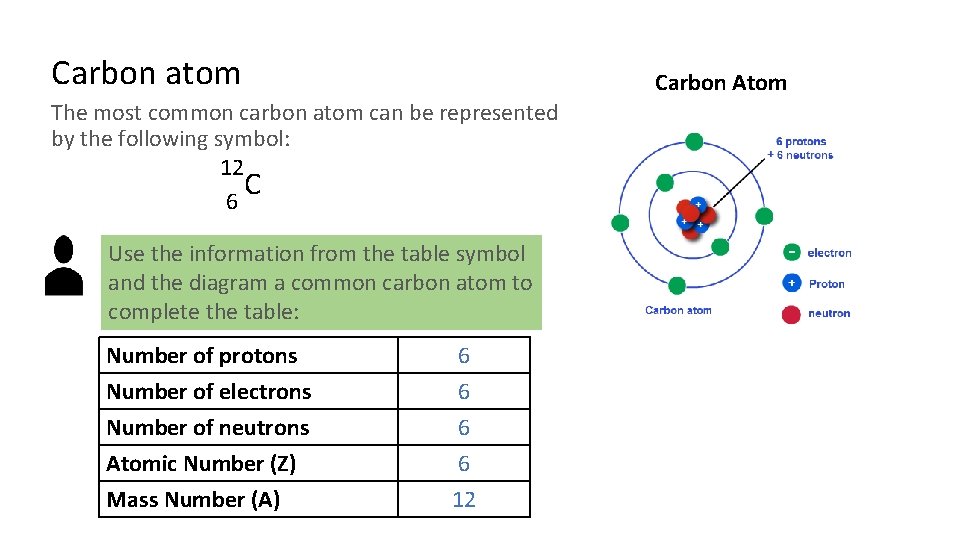
Carbon atom Carbon Atom The most common carbon atom can be represented by the following symbol: 12 C 6 Use the information from the table symbol and the diagram a common carbon atom to complete the table: Number of protons Number of electrons Number of neutrons Atomic Number (Z) 6 6 Mass Number (A) 12
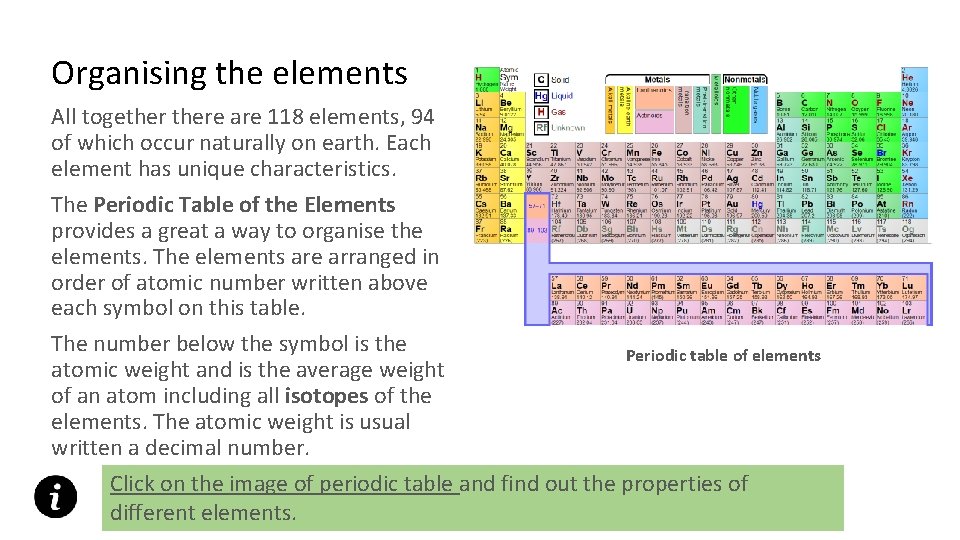
Organising the elements All togethere are 118 elements, 94 of which occur naturally on earth. Each element has unique characteristics. The Periodic Table of the Elements provides a great a way to organise the elements. The elements are arranged in order of atomic number written above each symbol on this table. The number below the symbol is the atomic weight and is the average weight of an atom including all isotopes of the elements. The atomic weight is usual written a decimal number. Periodic table of elements Click on the image of periodic table and find out the properties of different elements.
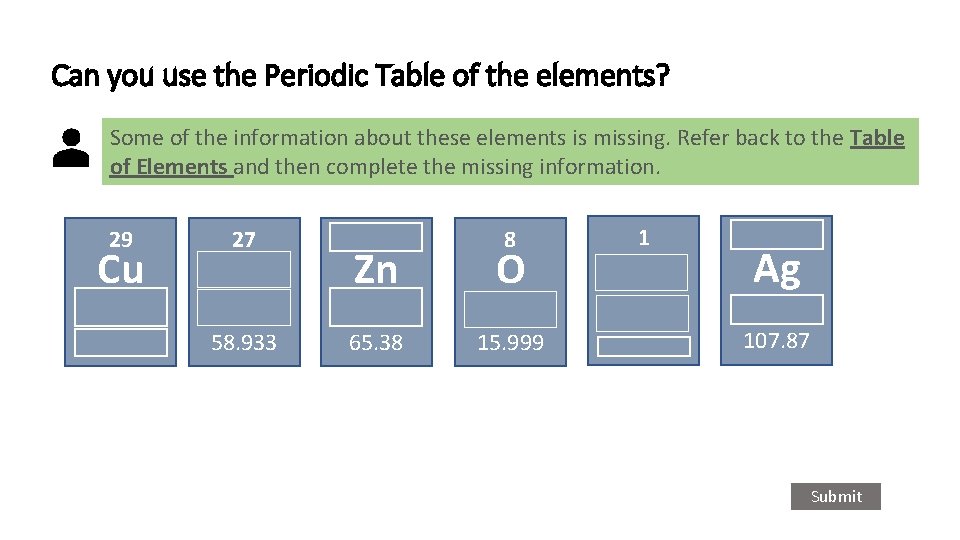
Can you use the Periodic Table of the elements? Some of the information about these elements is missing. Refer back to the Table of Elements and then complete the missing information. 29 Cu 27 58. 933 8 Zn O 65. 38 15. 999 1 Ag 107. 87 Submit
Activity: Building Atoms You are going to have some fun building several different types of atoms. Instructions: 1. Click here to open the simulation tool. 2. Choose the ‘Symbol’ option. You will work the Atomic Number and Mass Number of different isotopes of the elements. 3. Now, try to build the following: • Hydrogen atom: Place one proton and one neutron in the nucleus. Place one electron in the first orbit (energy level). • Carbon atom: Place six protons and six neutrons in the nucleus. Place six electrons on the atom. Start by filling the orbit (energy level) closest to the nucleus. • Neon atom: Place ten protons and ten neutrons in the nucleus. Place ten electrons on the atom. 4. When you feel ready select the ‘Game’ option and complete all four games.
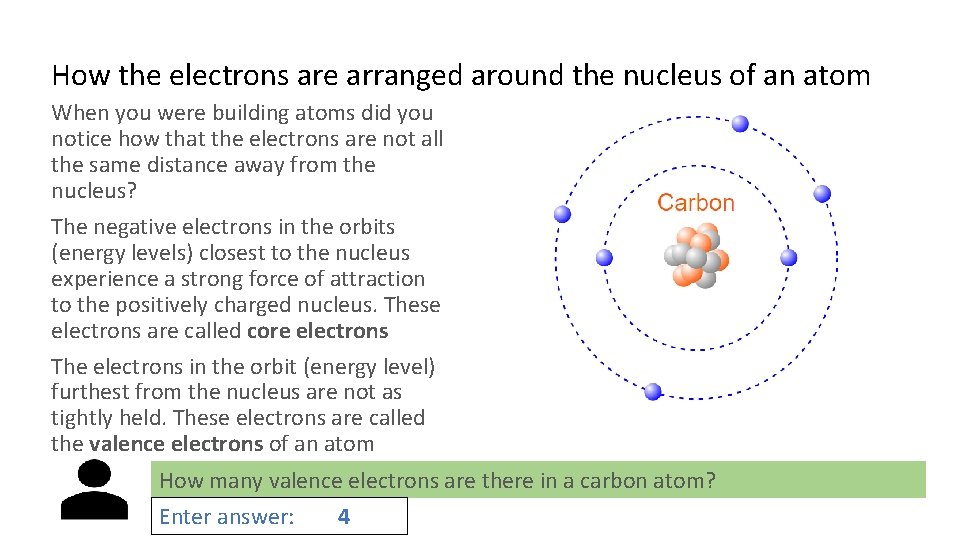
How the electrons are arranged around the nucleus of an atom When you were building atoms did you notice how that the electrons are not all the same distance away from the nucleus? The negative electrons in the orbits (energy levels) closest to the nucleus experience a strong force of attraction to the positively charged nucleus. These electrons are called core electrons The electrons in the orbit (energy level) furthest from the nucleus are not as tightly held. These electrons are called the valence electrons of an atom How many valence electrons are there in a carbon atom? Enter answer: 4
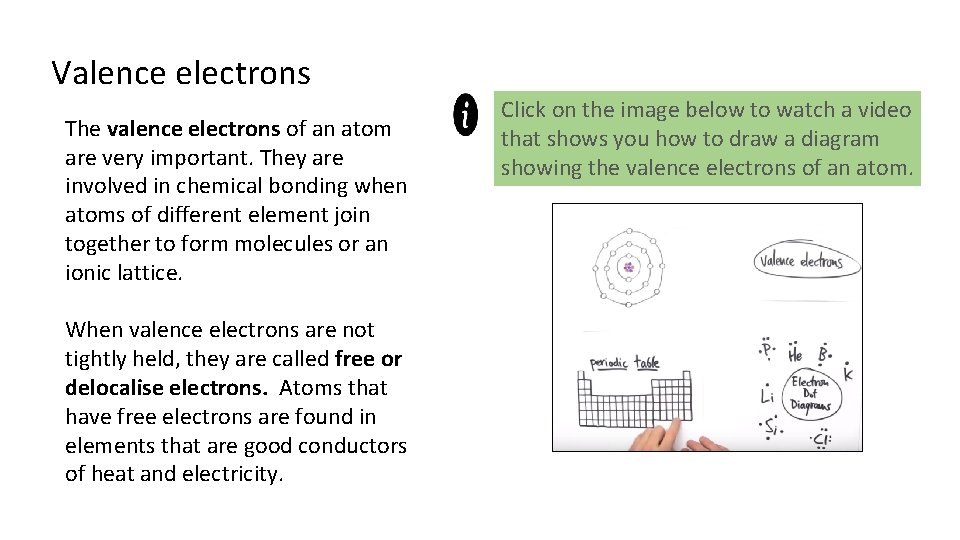
Valence electrons The valence electrons of an atom are very important. They are involved in chemical bonding when atoms of different element join together to form molecules or an ionic lattice. When valence electrons are not tightly held, they are called free or delocalise electrons. Atoms that have free electrons are found in elements that are good conductors of heat and electricity. Click on the image below to watch a video that shows you how to draw a diagram showing the valence electrons of an atom.
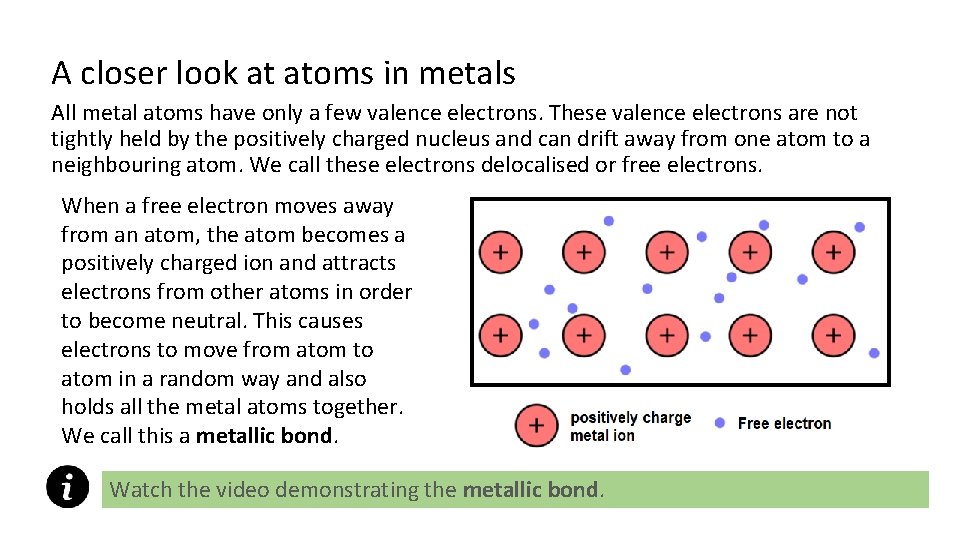
A closer look at atoms in metals All metal atoms have only a few valence electrons. These valence electrons are not tightly held by the positively charged nucleus and can drift away from one atom to a neighbouring atom. We call these electrons delocalised or free electrons. When a free electron moves away from an atom, the atom becomes a positively charged ion and attracts electrons from other atoms in order to become neutral. This causes electrons to move from atom to atom in a random way and also holds all the metal atoms together. We call this a metallic bond. Watch the video demonstrating the metallic bond.
The movement of free electrons Free electrons from the outer orbit move in a random way through the arrangement of positively charge metal ions. If we attach the positive terminal of a battery to one end of the metal wire and the negative end to the other end of the wire, the free electrons all move in the same direction. We call this flow of electrons an electric current. Watch the short video showing the movement of electrons in a metal.
A quick quiz Before we end off, take some time to check your understanding of what we have covered in this unit by answering the following questions. Q 1: What is the simplest unit of an element called? Q 2: What is the mass number for an atom? Q 3: Provide one word for a substance containing atoms of more than one element. Q 4: Provide the atomic number for: Hydrogen, Neon, Carbon, Oxygen, Silver, Aluminium Q 5: Name three sub-atomic particles that make up an atom.
Stop and Reflect 1 Atoms 2 Elements 3 Molecules 4 Compounds

APPENDIX
ICONS REQUIRED Appendix ICON REQUIRED ICON PURPOSE Outcomes Icon to represent Learning Outcomes Extra Information Icon to represent Additional Information Instruction Icon/ Or actual person to represent an Instruction (something learner needs to do) Tip Icon to represent a hint or tip Glossary Icon to represent Glossary Page Reflection Icon to represent Reflection/ Stop and Think Example:
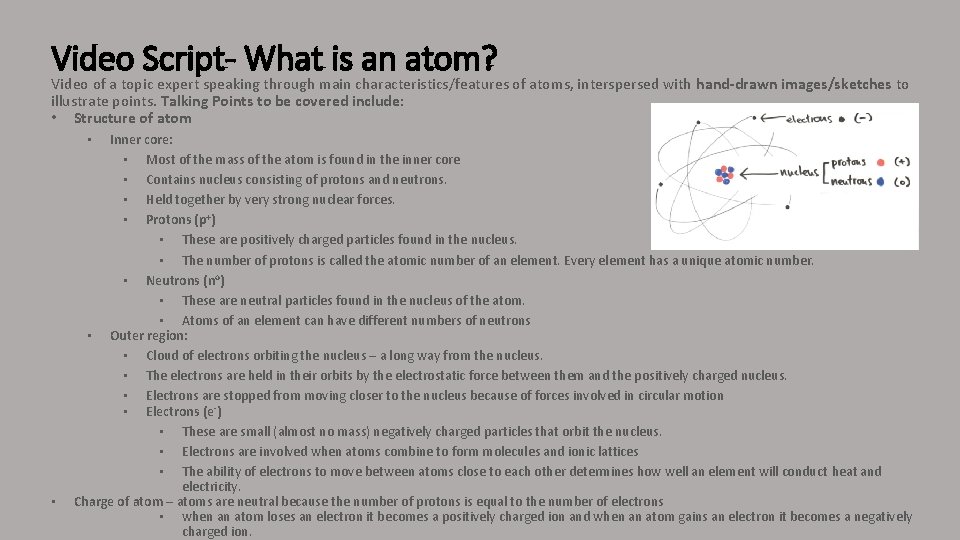
Video Script- What is an atom? Video of a topic expert speaking through main characteristics/features of atoms, interspersed with hand-drawn images/sketches to illustrate points. Talking Points to be covered include: • Structure of atom Inner core: • Most of the mass of the atom is found in the inner core • Contains nucleus consisting of protons and neutrons. • Held together by very strong nuclear forces. • Protons (p+) • These are positively charged particles found in the nucleus. • The number of protons is called the atomic number of an element. Every element has a unique atomic number. • Neutrons (no) • These are neutral particles found in the nucleus of the atom. • Atoms of an element can have different numbers of neutrons • Outer region: • Cloud of electrons orbiting the nucleus – a long way from the nucleus. • The electrons are held in their orbits by the electrostatic force between them and the positively charged nucleus. • Electrons are stopped from moving closer to the nucleus because of forces involved in circular motion • Electrons (e-) • These are small (almost no mass) negatively charged particles that orbit the nucleus. • Electrons are involved when atoms combine to form molecules and ionic lattices • The ability of electrons to move between atoms close to each other determines how well an element will conduct heat and electricity. Charge of atom – atoms are neutral because the number of protons is equal to the number of electrons • when an atom loses an electron it becomes a positively charged ion and when an atom gains an electron it becomes a negatively charged ion. • •
- Slides: 36