
Electrical Principles Topic 1 Basic Atomic Theory Unit
Electrical Principles Topic 1: Basic Atomic Theory Unit 3: Ionisation All copyright and intellectual property rights in respect of materials developed by the service provider during this project will vest in the Department of Higher Education and Training, which will have the right to allow any individual, company, agency or organisation to use or modify the materials for any purpose approved by this Department, including selling the materials or releasing them as Open Educational Resources (OER) under an appropriate copyright license.
Outcomes By the of this unit, you will be able to: 1. Explain the transfer of electrons and the formation of negative and positive ions 2. Explain why a solution containing ions conducts electricity 3. Explain why distilled water cannot conduct electricity 4. Explain what is meant by electrolyte All copyright and intellectual property rights in respect of materials developed by the service provider during this project will vest in the Department of Higher Education and Training, which will have the right to allow any individual, company, agency or organisation to use or modify the materials for any purpose approved by this Department, including selling the materials or releasing them as Open Educational Resources (OER) under an appropriate copyright license.
Introduction In the previous units, we looked at the composition of matter and classified materials as conductors, insulators or semi-conductors. In this unit we will be discussing ions and the process of ionisation. 1 What is an Ion? 2 What is Ionisation? Watch this video for a great introduction to Ions. Placeholder – Embedded Video All copyright and intellectual property rights in respect of materials developed by the service provider during this project will vest in the Department of Higher Education and Training, which will have the right to allow any individual, company, agency or organisation to use or modify the materials for any purpose approved by this Department, including selling the materials or releasing them as Open Educational Resources (OER) under an appropriate copyright license.
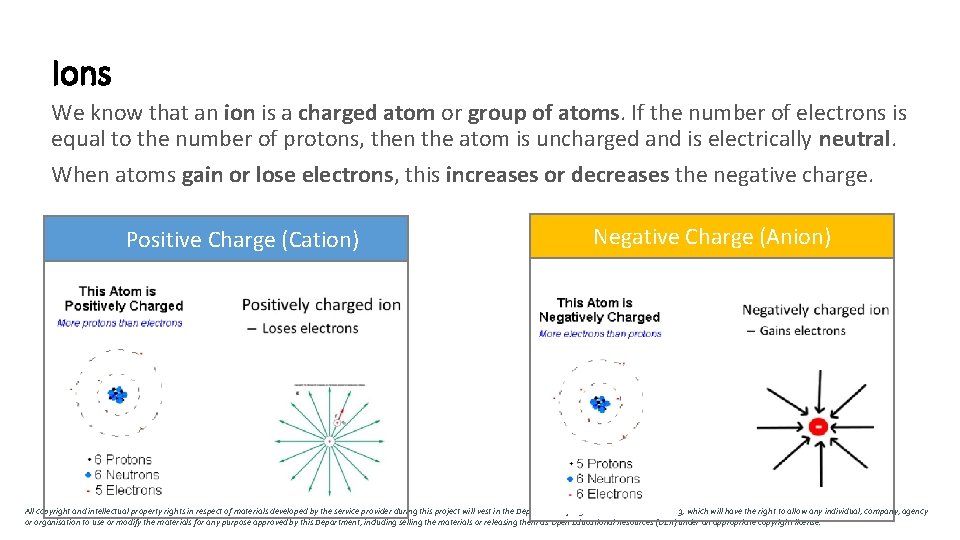
Ions We know that an ion is a charged atom or group of atoms. If the number of electrons is equal to the number of protons, then the atom is uncharged and is electrically neutral. When atoms gain or lose electrons, this increases or decreases the negative charge. Positive Charge (Cation) Negative Charge (Anion) All copyright and intellectual property rights in respect of materials developed by the service provider during this project will vest in the Department of Higher Education and Training, which will have the right to allow any individual, company, agency or organisation to use or modify the materials for any purpose approved by this Department, including selling the materials or releasing them as Open Educational Resources (OER) under an appropriate copyright license.
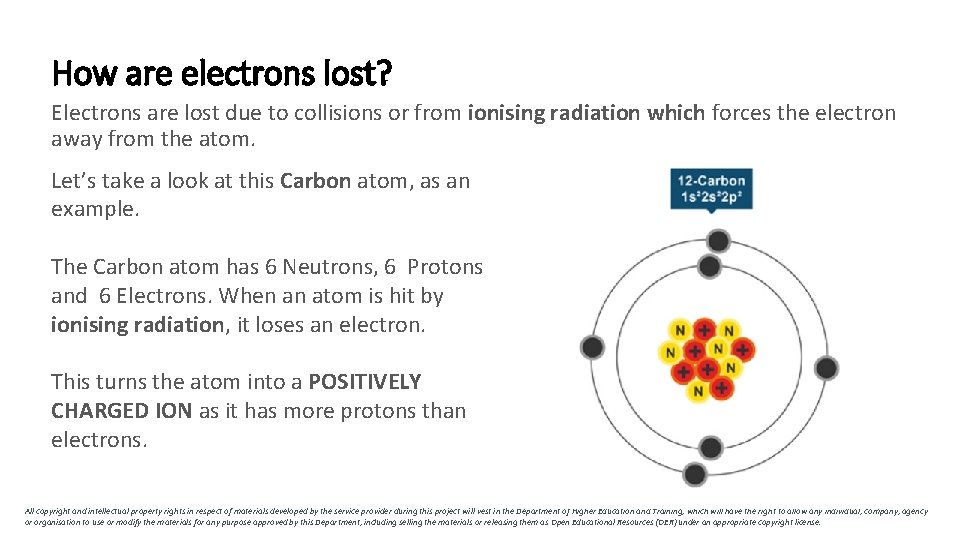
How are electrons lost? Electrons are lost due to collisions or from ionising radiation which forces the electron away from the atom. Let’s take a look at this Carbon atom, as an example. The Carbon atom has 6 Neutrons, 6 Protons and 6 Electrons. When an atom is hit by ionising radiation, it loses an electron. This turns the atom into a POSITIVELY CHARGED ION as it has more protons than electrons. All copyright and intellectual property rights in respect of materials developed by the service provider during this project will vest in the Department of Higher Education and Training, which will have the right to allow any individual, company, agency or organisation to use or modify the materials for any purpose approved by this Department, including selling the materials or releasing them as Open Educational Resources (OER) under an appropriate copyright license.
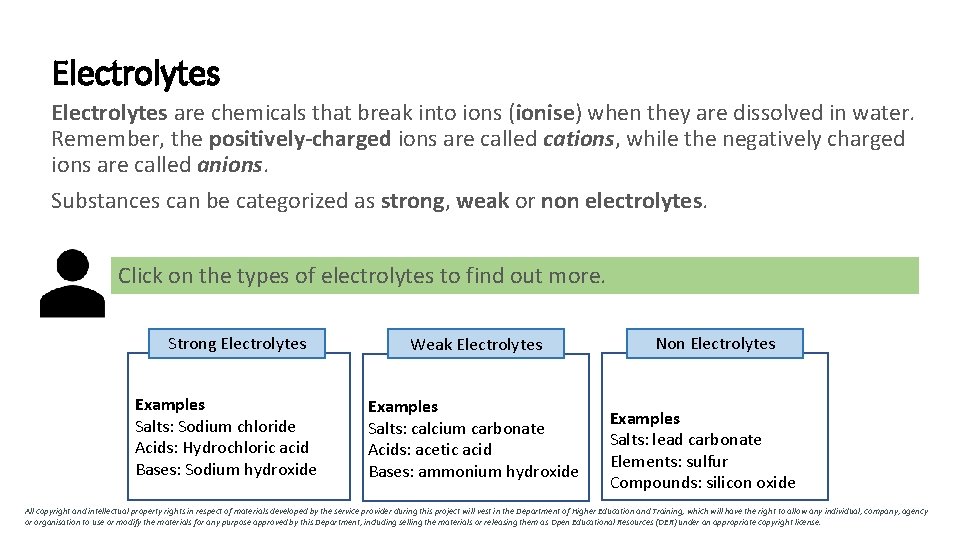
Electrolytes are chemicals that break into ions (ionise) when they are dissolved in water. Remember, the positively-charged ions are called cations, while the negatively charged ions are called anions. Substances can be categorized as strong, weak or non electrolytes. Click on the types of electrolytes to find out more. Strong Electrolytes Examples Salts: Sodium chloride Acids: Hydrochloric acid Bases: Sodium hydroxide Weak Electrolytes Examples Salts: calcium carbonate Acids: acetic acid Bases: ammonium hydroxide Non Electrolytes Examples Salts: lead carbonate Elements: sulfur Compounds: silicon oxide All copyright and intellectual property rights in respect of materials developed by the service provider during this project will vest in the Department of Higher Education and Training, which will have the right to allow any individual, company, agency or organisation to use or modify the materials for any purpose approved by this Department, including selling the materials or releasing them as Open Educational Resources (OER) under an appropriate copyright license.
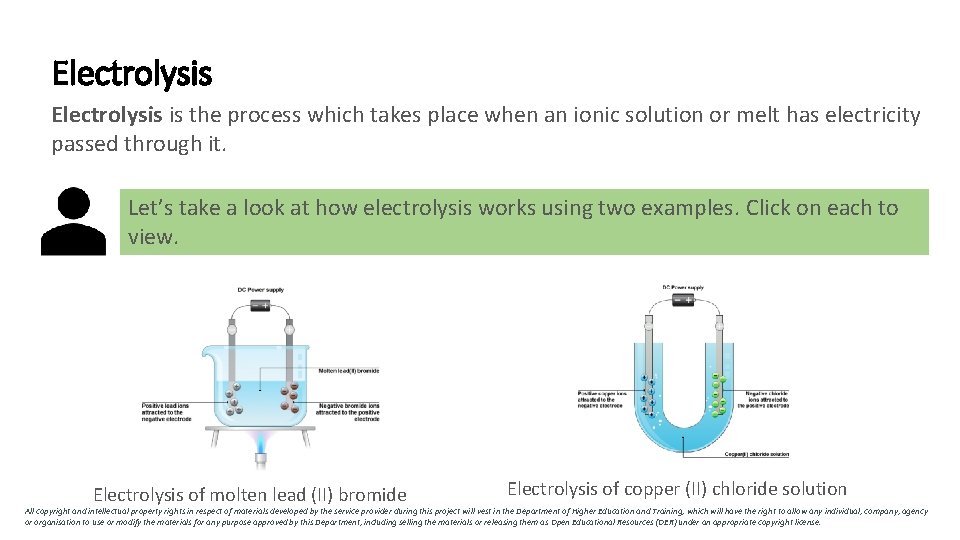
Electrolysis is the process which takes place when an ionic solution or melt has electricity passed through it. Let’s take a look at how electrolysis works using two examples. Click on each to view. Electrolysis of molten lead (II) bromide Electrolysis of copper (II) chloride solution All copyright and intellectual property rights in respect of materials developed by the service provider during this project will vest in the Department of Higher Education and Training, which will have the right to allow any individual, company, agency or organisation to use or modify the materials for any purpose approved by this Department, including selling the materials or releasing them as Open Educational Resources (OER) under an appropriate copyright license.
What do we know about electrolysis? There are certain processes which take place during electrolysis. Here’s what we know: 1 2 3 4 5 All copyright and intellectual property rights in respect of materials developed by the service provider during this project will vest in the Department of Higher Education and Training, which will have the right to allow any individual, company, agency or organisation to use or modify the materials for any purpose approved by this Department, including selling the materials or releasing them as Open Educational Resources (OER) under an appropriate copyright license.
How do solutions containing ions conduct electricity? Ionic substances are made of charged particles called ions. When the ionic solid is dissolved in water, the ionic lattice breaks up and the ions become free to move around in the water. When you pass electricity through the ionic solution, the ions are able to carry the electric current because of their ability to move freely. Placeholder – Need image or animation explaining process All copyright and intellectual property rights in respect of materials developed by the service provider during this project will vest in the Department of Higher Education and Training, which will have the right to allow any individual, company, agency or organisation to use or modify the materials for any purpose approved by this Department, including selling the materials or releasing them as Open Educational Resources (OER) under an appropriate copyright license.
Why can’t pure water conduct electricity? Pure water contains very few ions, so it does not conduct electricity very well. When table salt is dissolved in the water, the solution conducts very well, because the solution contains ions. All copyright and intellectual property rights in respect of materials developed by the service provider during this project will vest in the Department of Higher Education and Training, which will have the right to allow any individual, company, agency or organisation to use or modify the materials for any purpose approved by this Department, including selling the materials or releasing them as Open Educational Resources (OER) under an appropriate copyright license.
A quick quiz Before we end off, take some time to check your understanding of what we have covered in this unit by answering the following questions. Q 1: Identify the cation present in a sodium chloride crystal Q 2: An atom has 16 protons and gains 2 electrons. What type of ion is formed? What is the charge on the ion? Q 3: Which of the following is a strong electrolyte: sodium nitrate (salt), diamond, limewater, ammonia Q 4: In the electrolysis of copper chloride on which electrode will copper form and where will bubbles of chlorine form? All copyright and intellectual property rights in respect of materials developed by the service provider during this project will vest in the Department of Higher Education and Training, which will have the right to allow any individual, company, agency or organisation to use or modify the materials for any purpose approved by this Department, including selling the materials or releasing them as Open Educational Resources (OER) under an appropriate copyright license.
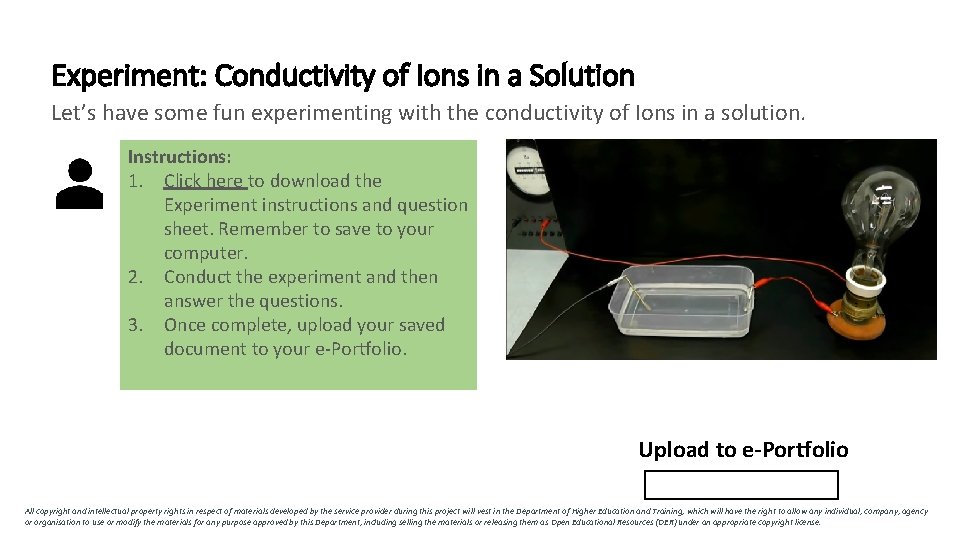
Experiment: Conductivity of Ions in a Solution Let’s have some fun experimenting with the conductivity of Ions in a solution. Instructions: 1. Click here to download the Experiment instructions and question sheet. Remember to save to your computer. 2. Conduct the experiment and then answer the questions. 3. Once complete, upload your saved document to your e-Portfolio. Upload to e-Portfolio All copyright and intellectual property rights in respect of materials developed by the service provider during this project will vest in the Department of Higher Education and Training, which will have the right to allow any individual, company, agency or organisation to use or modify the materials for any purpose approved by this Department, including selling the materials or releasing them as Open Educational Resources (OER) under an appropriate copyright license.
Activity: Conductivity of Ions in a Solution How did you find the experiment? In case you were unsure, here is a summary of the results Click here to download. All copyright and intellectual property rights in respect of materials developed by the service provider during this project will vest in the Department of Higher Education and Training, which will have the right to allow any individual, company, agency or organisation to use or modify the materials for any purpose approved by this Department, including selling the materials or releasing them as Open Educational Resources (OER) under an appropriate copyright license.
Activity: Covalent and Ionic Substances Instructions: Click here to open the simulation. 1. On the top select the ‘micro’ tab. Shake some sodium chloride into the solution. What do you observe? 2. Remove the solute, select the sucrose and shake some sugar into the water. What do you observe. 3. On the top select the ‘water’ tab. By looking at the water, what kind of intramolecular bonds exist between water? Give a reason for your answer. 4. Now, add the salt crystal lattice to the water. What happens? 5. What type of intramolecular force exists in salt lattices? 6. What is the smallest particle of a salt lattice? 7. Now add the sugar crystal to the water. What do you observe? 8. What kind of intramolecular forces exist between sugar particles? 9. What is the smallest particle of sugar? 10. Will the salt water or sugar water or both conduct electricity? Explain your answer. 11. Will the plain water conduct electricity? Explain your answer. All copyright and intellectual property rights in respect of materials developed by the service provider during this project will vest in the Department of Higher Education and Training, which will have the right to allow any individual, company, agency or organisation to use or modify the materials for any purpose approved by this Department, including selling the materials or releasing them as Open Educational Resources (OER) under an appropriate copyright license.
- Slides: 14