
Electrical Power Goal of the class Differentiate between
Electrical Power

Goal of the class • Differentiate between direct current and alternating current. • Relate electric power to the rate at which electrical energy is converted to other forms of energy. • Question of the Day: What factors affect the resistance of a piece of wire? • Previous answer: No previous question
Question • Hair dryers, microwaves, stereos, and other appliances use electric power when plugged into your outlets. • What is electric power? • Is electric power the same as the power discussed in the chapter “Work and Energy? ” • Do the utility companies bill your household for power, current, potential difference, energy, or something else? • What do you think is meant by the terms alternating current (AC) and direct current (DC)? • Which do you have in your home?

Direct Current • Batteries use chemical energy to give electrons potential energy. – Chemical energy is eventually depleted. • Electrons always flow in one direction. - + – Called direct current (DC)
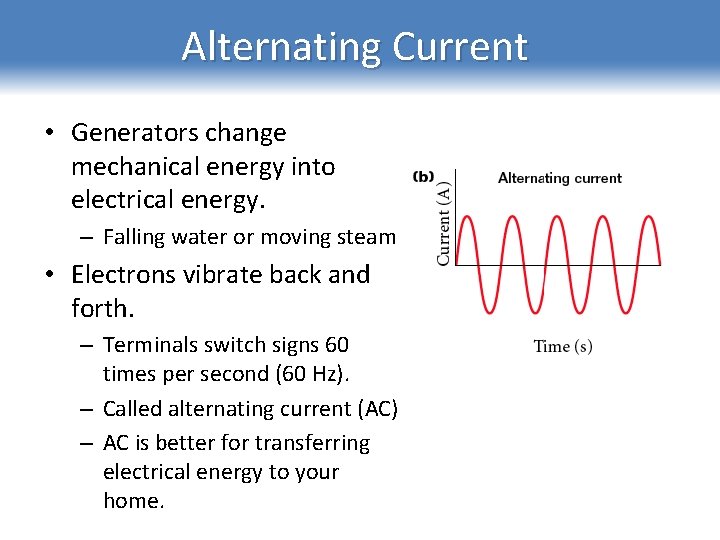
Alternating Current • Generators change mechanical energy into electrical energy. – Falling water or moving steam • Electrons vibrate back and forth. – Terminals switch signs 60 times per second (60 Hz). – Called alternating current (AC) – AC is better for transferring electrical energy to your home.
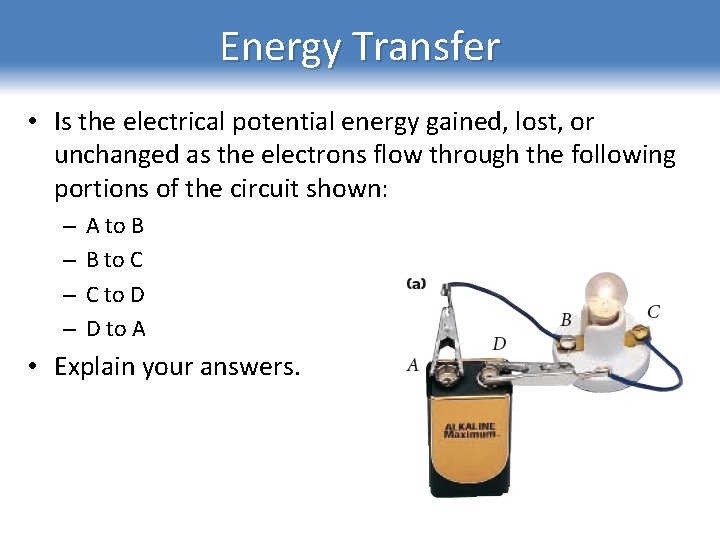
Energy Transfer • Is the electrical potential energy gained, lost, or unchanged as the electrons flow through the following portions of the circuit shown: – – A to B B to C C to D D to A • Explain your answers.
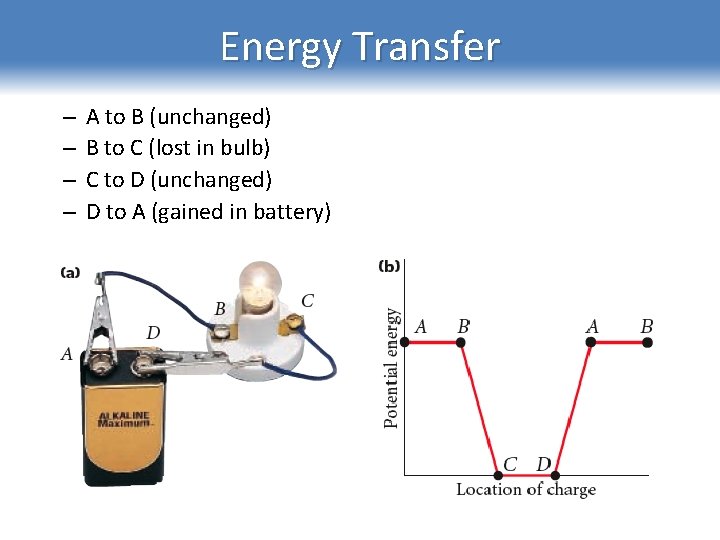
Energy Transfer – – A to B (unchanged) B to C (lost in bulb) C to D (unchanged) D to A (gained in battery)
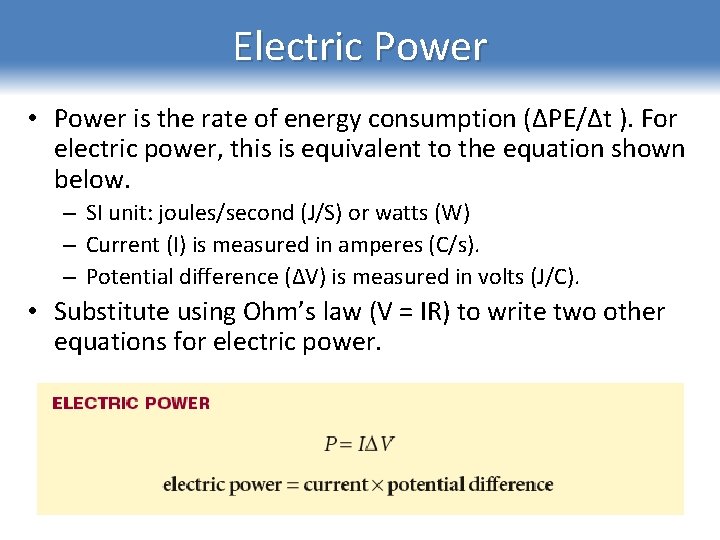
Electric Power • Power is the rate of energy consumption (ΔPE/Δt ). For electric power, this is equivalent to the equation shown below. – SI unit: joules/second (J/S) or watts (W) – Current (I) is measured in amperes (C/s). – Potential difference (ΔV) is measured in volts (J/C). • Substitute using Ohm’s law (V = IR) to write two other equations for electric power.
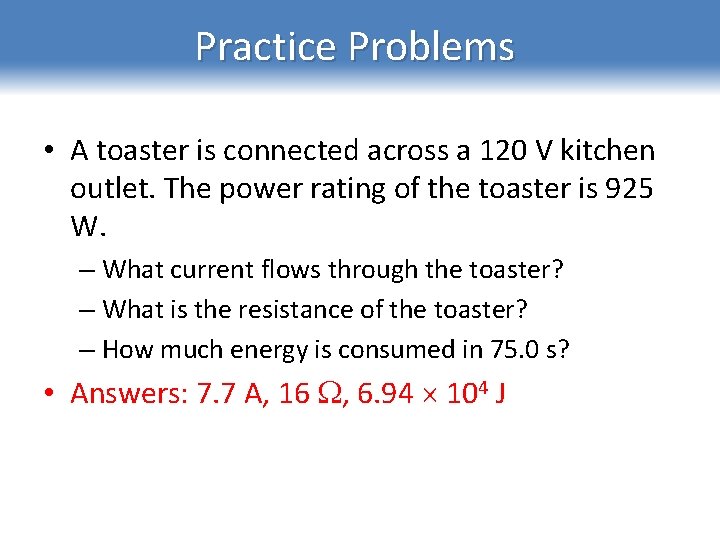
Practice Problems • A toaster is connected across a 120 V kitchen outlet. The power rating of the toaster is 925 W. – What current flows through the toaster? – What is the resistance of the toaster? – How much energy is consumed in 75. 0 s? • Answers: 7. 7 A, 16 , 6. 94 104 J
Household Energy Consumption • Power companies charge for energy, not power. – Energy consumption is measured in kilowatt·hours ( kw·h). • The joule is too small. – A kw·h is one kilowatt of power for one hour. • Examples of 1 kw·h: – 10 light bulbs of 100 W each on for 1 h – 1 light bulb of 100 W on for 10 h • 1 kw·hr = 3 600 000 J or 3. 6 x 10⁶ J
Electrical Energy Transfer • Transfer of energy from power plants to your neighborhood must be done at high voltage and low current. – Power lost in electrical lines is significant. • P = I 2 R • Power lines are good conductors but they are very long. • Since power companies can’t control the resistance (R), they control the current (I) by transferring at high voltage.
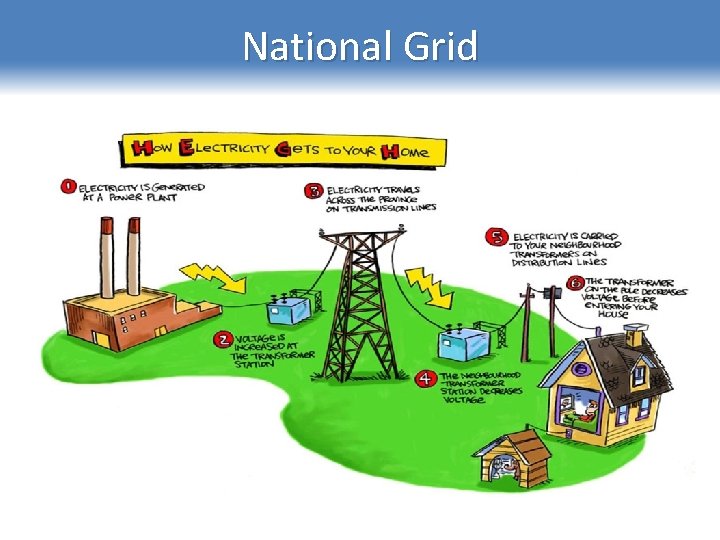
National Grid
Question • Hair dryers, microwaves, stereos, and other appliances use electric power when plugged into your outlets. • What is electric power? • Is electric power the same as the power discussed in the chapter “Work and Energy? ” • Do the utility companies bill your household for power, current, potential difference, energy, or something else? • What do you think is meant by the terms alternating current (AC) and direct current (DC)? • Which do you have in your home?
Homework • Please complete questions on page 616 • Q 47, 66, 70, 73, 78
- Slides: 14