
Electrical Methods Resistivity Surveying Chapter 12 Geologic Resistivity
- Slides: 49
Electrical Methods Resistivity Surveying Chapter 12
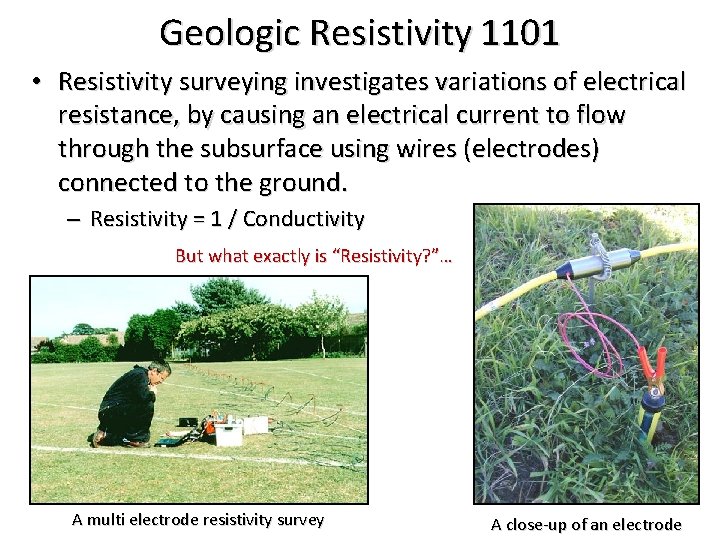
Geologic Resistivity 1101 • Resistivity surveying investigates variations of electrical resistance, by causing an electrical current to flow through the subsurface using wires (electrodes) connected to the ground. – Resistivity = 1 / Conductivity But what exactly is “Resistivity? ”… A multi electrode resistivity survey A close-up of an electrode
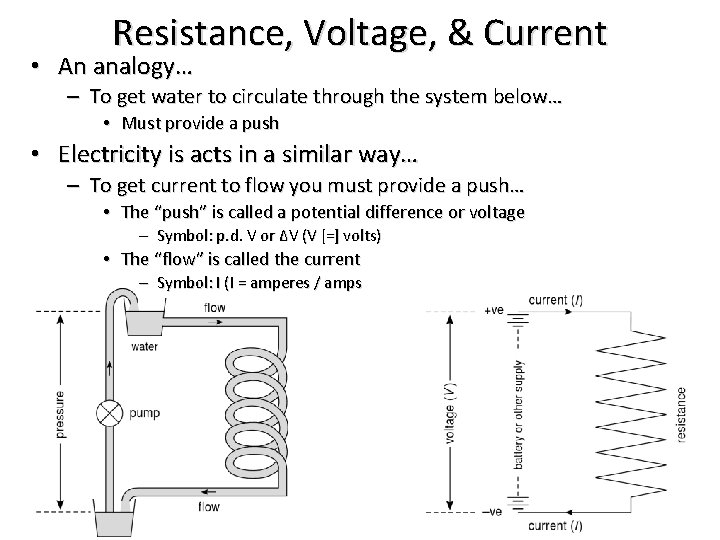
Resistance, Voltage, & Current • An analogy… – To get water to circulate through the system below… • Must provide a push • Electricity is acts in a similar way… – To get current to flow you must provide a push… • The “push” is called a potential difference or voltage – Symbol: p. d. V or ΔV (V [=] volts) • The “flow” is called the current – Symbol: I (I = amperes / amps
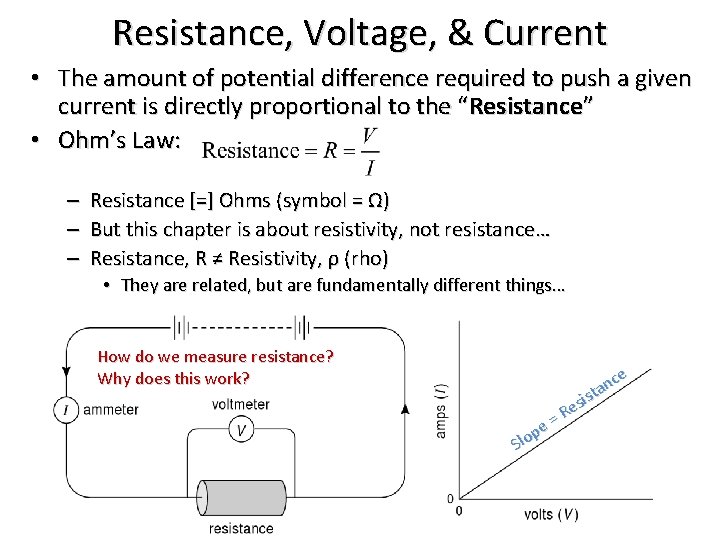
Resistance, Voltage, & Current • The amount of potential difference required to push a given current is directly proportional to the “Resistance” • Ohm’s Law: – – – Resistance [=] Ohms (symbol = Ω) But this chapter is about resistivity, not resistance… Resistance, R ≠ Resistivity, ρ (rho) • They are related, but are fundamentally different things… How do we measure resistance? Why does this work? pe o l S ce n a st i s e =R
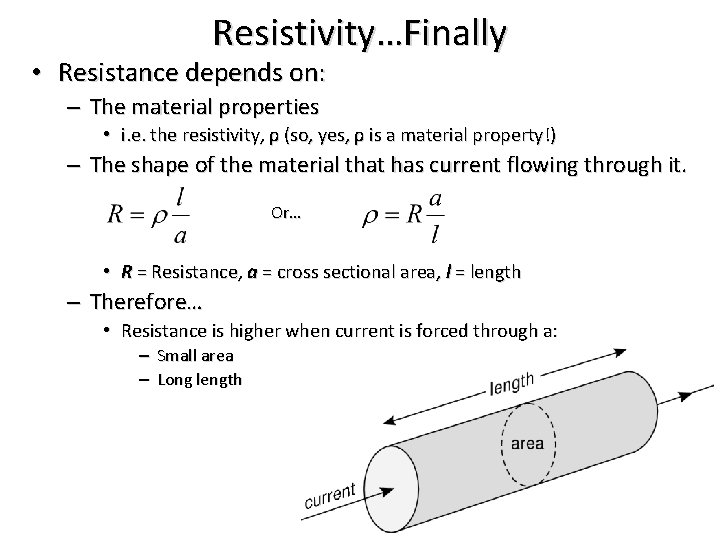
Resistivity…Finally • Resistance depends on: – The material properties • i. e. the resistivity, ρ (so, yes, ρ is a material property!) – The shape of the material that has current flowing through it. Or… • R = Resistance, a = cross sectional area, l = length – Therefore… • Resistance is higher when current is forced through a: – Small area – Long length
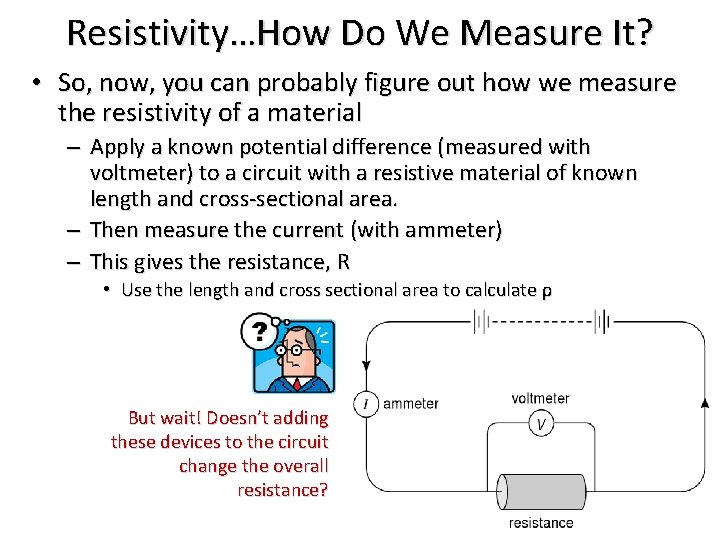
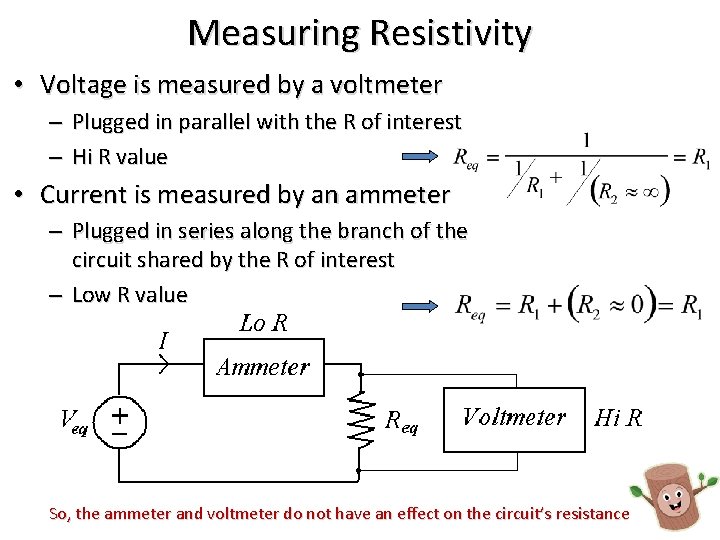
Resistivity…How Do We Measure It? • So, now, you can probably figure out how we measure the resistivity of a material – Apply a known potential difference (measured with voltmeter) to a circuit with a resistive material of known length and cross-sectional area. – Then measure the current (with ammeter) – This gives the resistance, R • Use the length and cross sectional area to calculate ρ But wait! Doesn’t adding these devices to the circuit change the overall resistance?
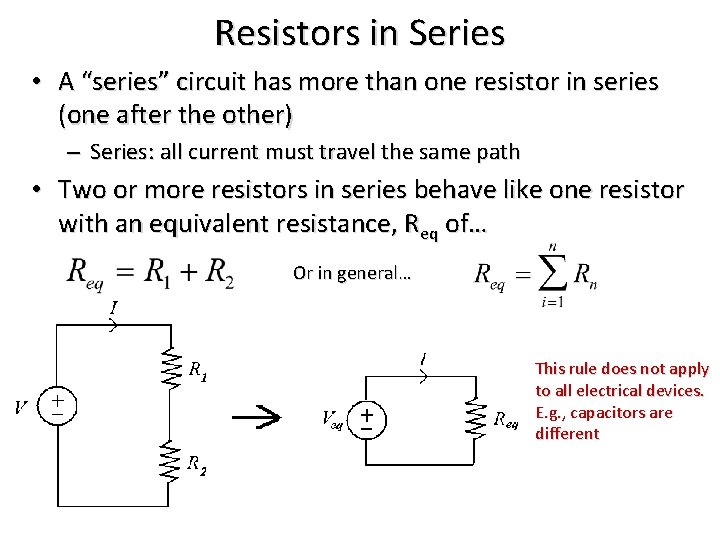
Resistors in Series • A “series” circuit has more than one resistor in series (one after the other) – Series: all current must travel the same path • Two or more resistors in series behave like one resistor with an equivalent resistance, Req of… Or in general… This rule does not apply to all electrical devices. E. g. , capacitors are different
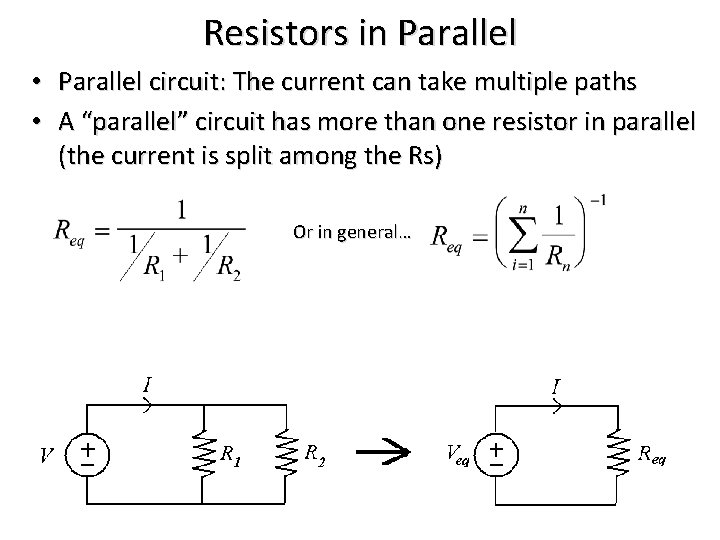
Resistors in Parallel • Parallel circuit: The current can take multiple paths • A “parallel” circuit has more than one resistor in parallel (the current is split among the Rs) Or in general…
Measuring Resistivity • Voltage is measured by a voltmeter – Plugged in parallel with the R of interest – Hi R value • Current is measured by an ammeter – Plugged in series along the branch of the circuit shared by the R of interest – Low R value So, the ammeter and voltmeter do not have an effect on the circuit’s resistance
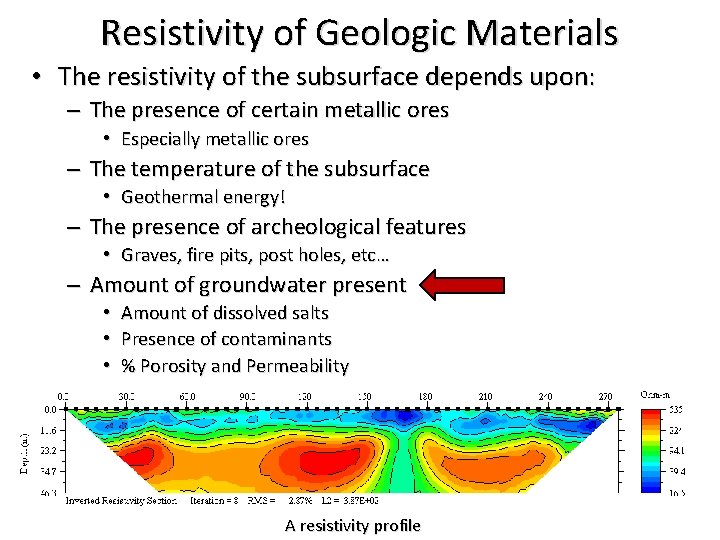
Resistivity of Geologic Materials • The resistivity of the subsurface depends upon: – The presence of certain metallic ores • Especially metallic ores – The temperature of the subsurface • Geothermal energy! – The presence of archeological features • Graves, fire pits, post holes, etc… – Amount of groundwater present • • • Amount of dissolved salts Presence of contaminants % Porosity and Permeability A resistivity profile
Atomic Charge? • Recall that matter is conceptualized as being made of atoms: – – – + charged nucleus (protons + neutrons) - charged electrons circle the nucleus in a cloud pattern Usually these charges are balanced • E. g. H 2 O, Na. Cl, KAl 2 Si 2 O 8, (Mg, Fe)2 Si. O 4 – An imbalance in charge (i. e. ions), gives a body a net charge. • SO 42 -, O 2 - – Resistivity is concerned with the FLOW of charge, not the net charge or any imbalance in charges
Types of Conduction • Conduction refers to the flow of electricity (or other types of energy) – For electric conduction: Three basic flavors • Electrolytic / Ionic – Slow movement of ions in fluid • Electronic – Metals allow electrons to flow freely • Di-electric – Electrons shift slightly during induction • We won’t cover this
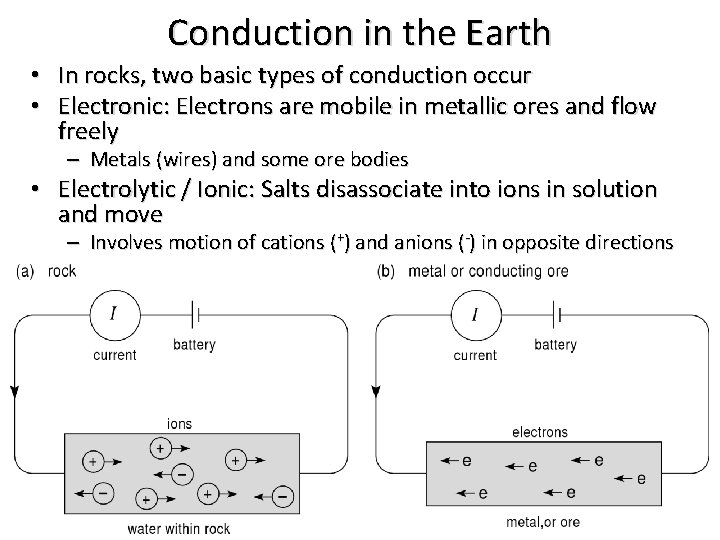
Conduction in the Earth • In rocks, two basic types of conduction occur • Electronic: Electrons are mobile in metallic ores and flow freely – Metals (wires) and some ore bodies • Electrolytic / Ionic: Salts disassociate into ions in solution and move – Involves motion of cations (+) and anions (-) in opposite directions
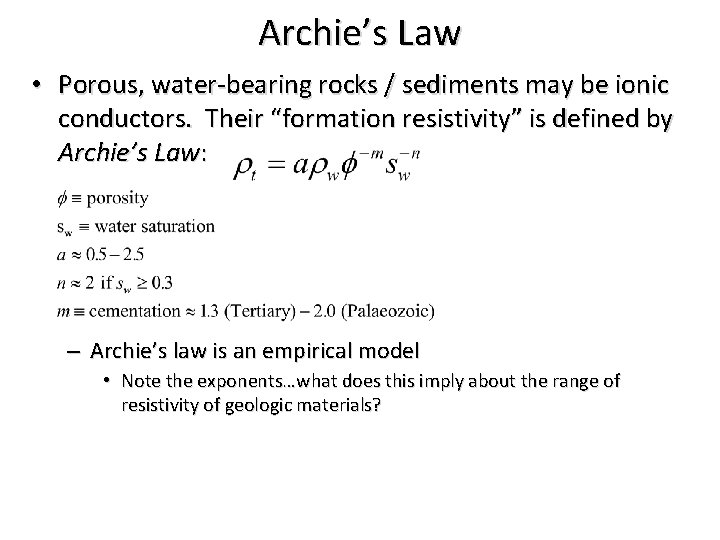
Archie’s Law • Porous, water-bearing rocks / sediments may be ionic conductors. Their “formation resistivity” is defined by Archie’s Law: – Archie’s law is an empirical model • Note the exponents…what does this imply about the range of resistivity of geologic materials?
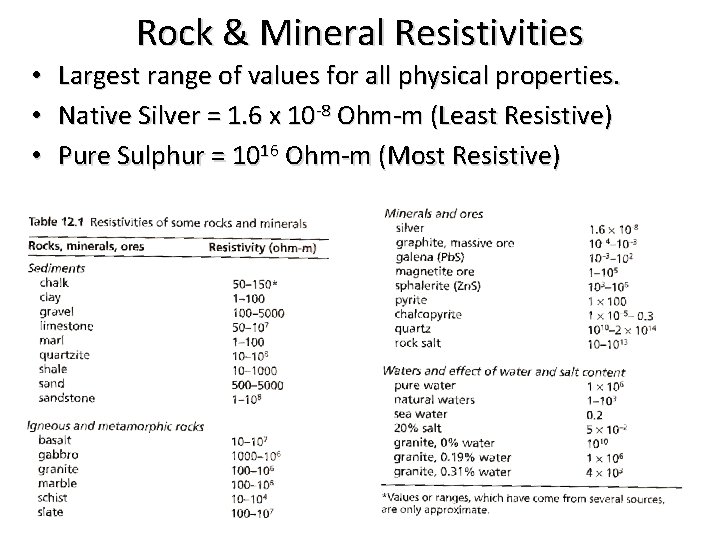
Rock & Mineral Resistivities • • • Largest range of values for all physical properties. Native Silver = 1. 6 x 10 -8 Ohm-m (Least Resistive) Pure Sulphur = 1016 Ohm-m (Most Resistive)
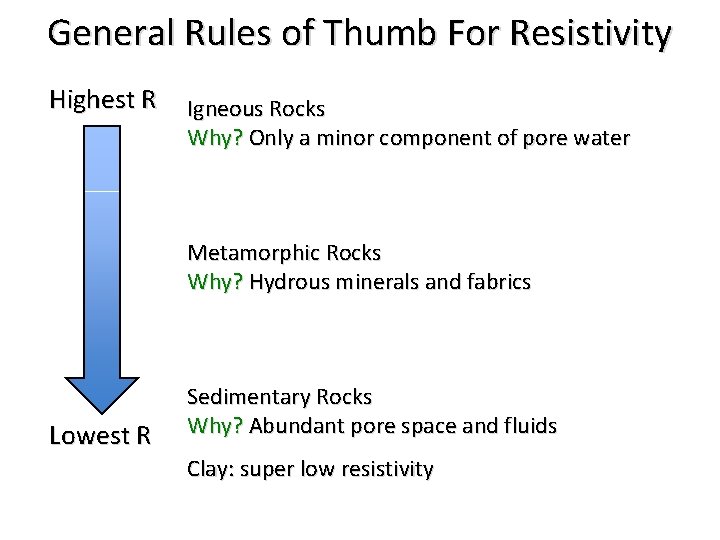
General Rules of Thumb For Resistivity Highest R Igneous Rocks Why? Only a minor component of pore water Metamorphic Rocks Why? Hydrous minerals and fabrics Lowest R Sedimentary Rocks Why? Abundant pore space and fluids Clay: super low resistivity
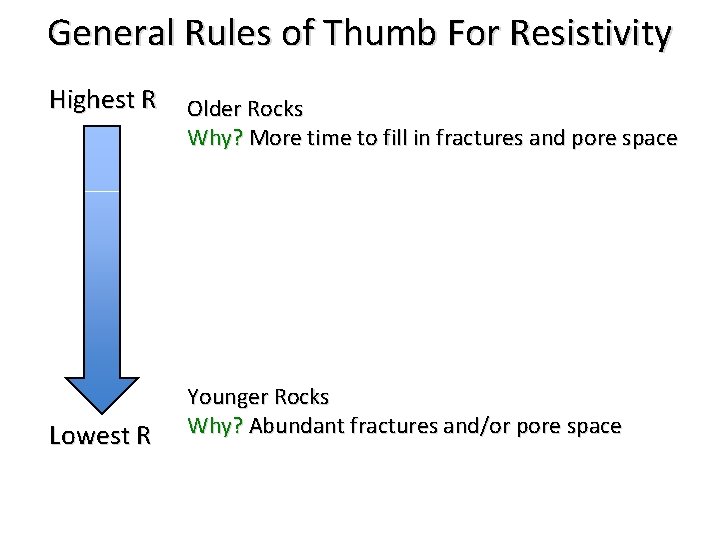
General Rules of Thumb For Resistivity Highest R Lowest R Older Rocks Why? More time to fill in fractures and pore space Younger Rocks Why? Abundant fractures and/or pore space
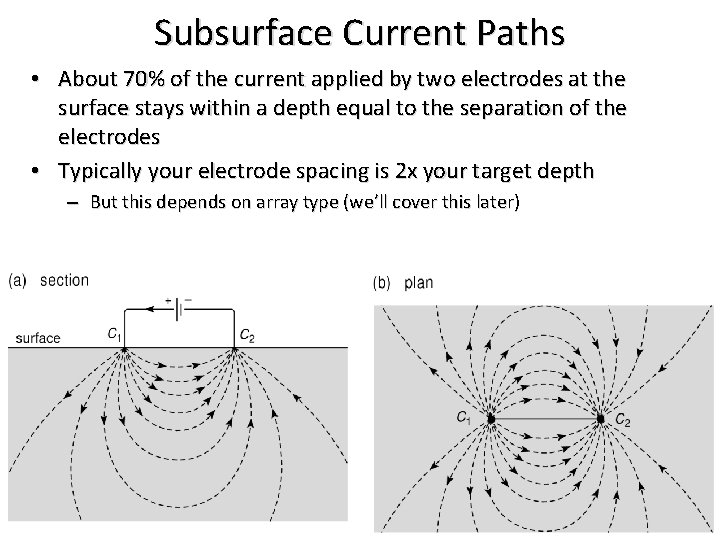
Subsurface Current Paths • About 70% of the current applied by two electrodes at the surface stays within a depth equal to the separation of the electrodes • Typically your electrode spacing is 2 x your target depth – But this depends on array type (we’ll cover this later)
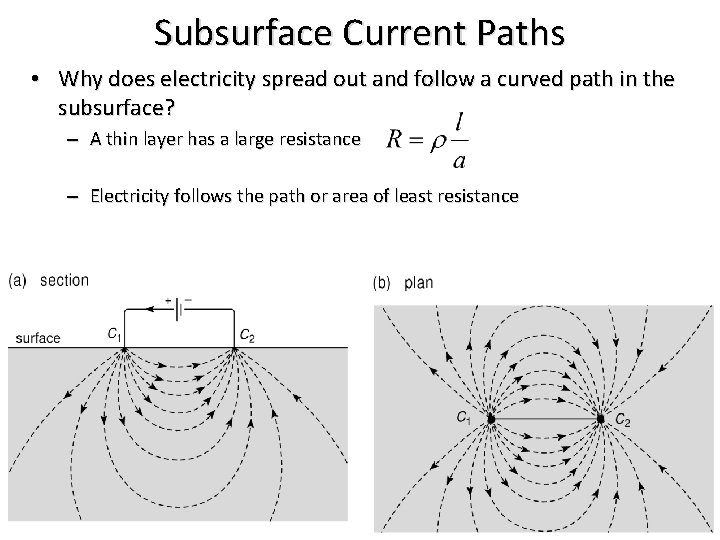
Subsurface Current Paths • Why does electricity spread out and follow a curved path in the subsurface? – A thin layer has a large resistance – Electricity follows the path or area of least resistance
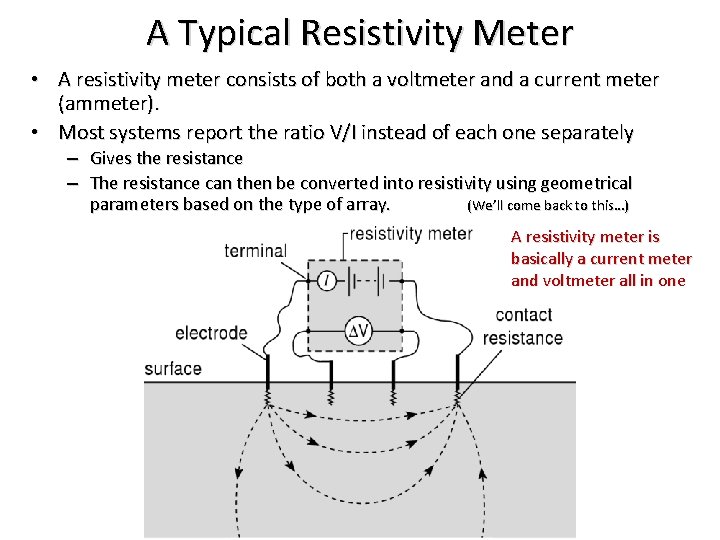
A Typical Resistivity Meter • A resistivity meter consists of both a voltmeter and a current meter (ammeter). • Most systems report the ratio V/I instead of each one separately – Gives the resistance – The resistance can then be converted into resistivity using geometrical parameters based on the type of array. (We’ll come back to this…) A resistivity meter is basically a current meter and voltmeter all in one
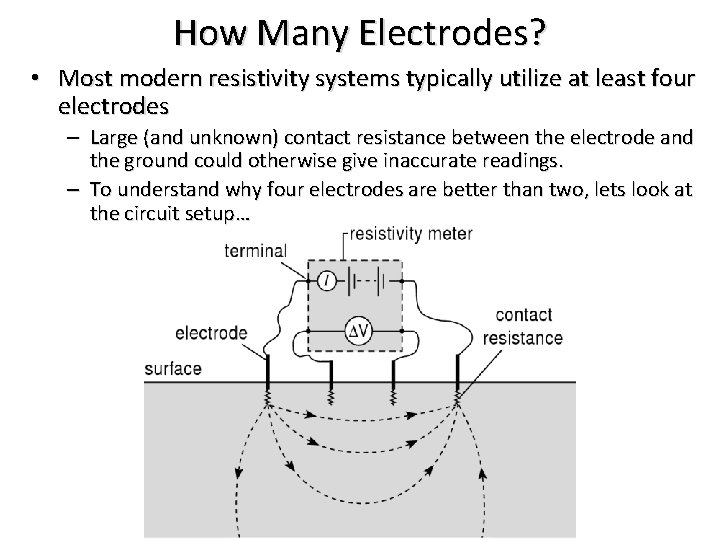
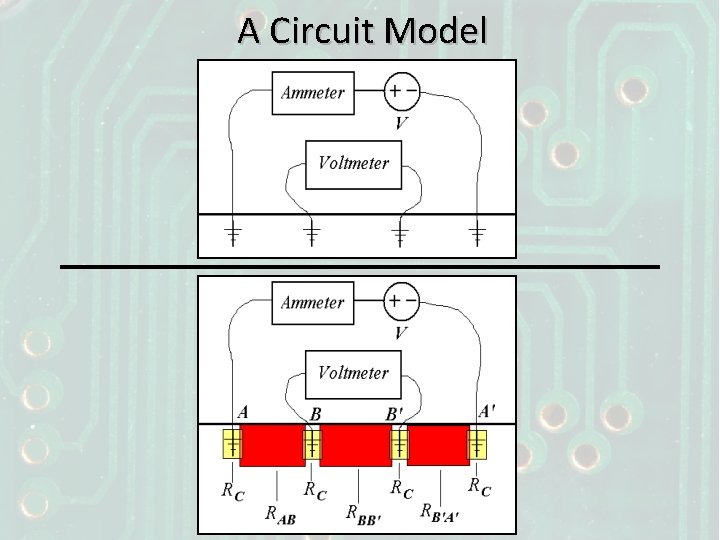
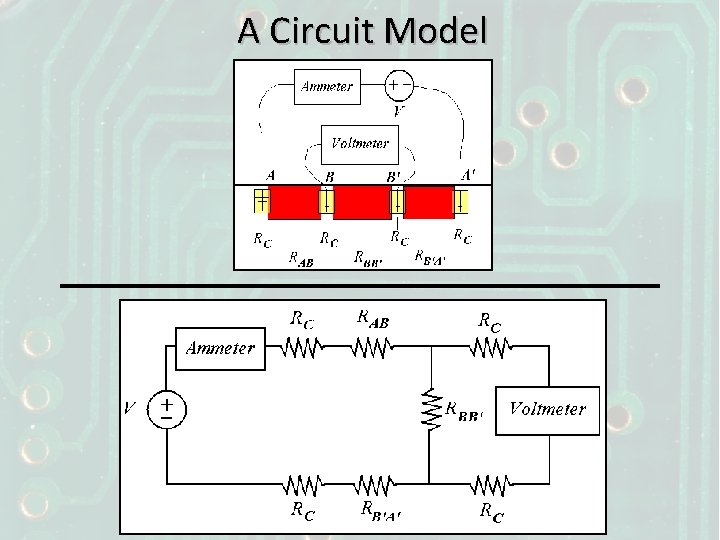
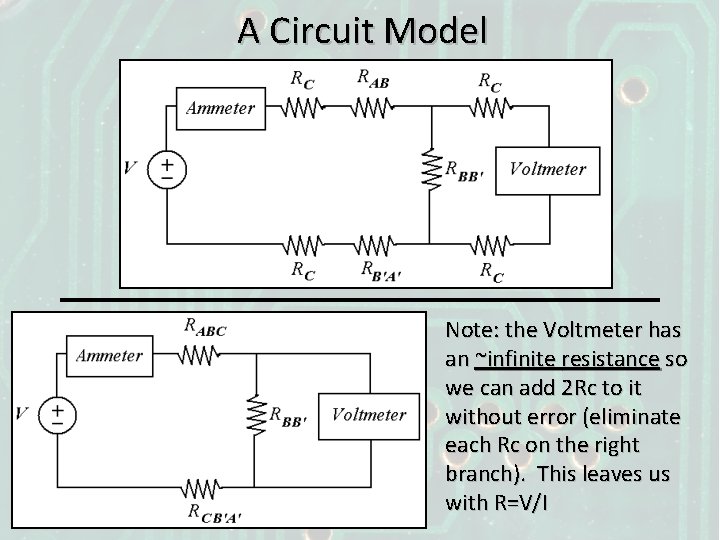
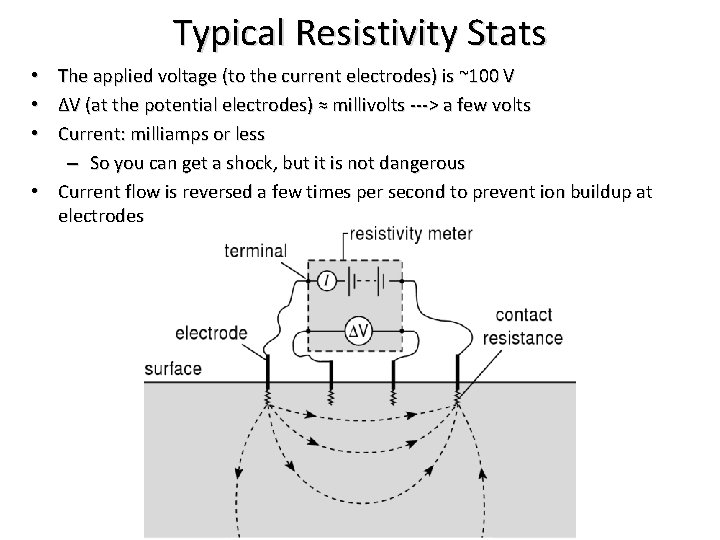
How Many Electrodes? • Most modern resistivity systems typically utilize at least four electrodes – Large (and unknown) contact resistance between the electrode and the ground could otherwise give inaccurate readings. – To understand why four electrodes are better than two, lets look at the circuit setup…
A Circuit Model
A Circuit Model
A Circuit Model Note: the Voltmeter has an ~infinite resistance so we can add 2 Rc to it without error (eliminate each Rc on the right branch). This leaves us with R=V/I
Typical Resistivity Stats The applied voltage (to the current electrodes) is ~100 V ΔV (at the potential electrodes) ≈ millivolts ---> a few volts Current: milliamps or less – So you can get a shock, but it is not dangerous • Current flow is reversed a few times per second to prevent ion buildup at electrodes • • •
Vertical Electrical Sounding • Resistivity surveys do not usually seek to determine the resistivity of some uniform rock – They seek to determine the “apparent resistivity” of several ~horizontal layers with different resistivities • Also called “VES”, depth sounding, or electrical drilling • The essence of VES is to expand electrodes from a fixed center – I. e. to increase at least some of the electrode spacings – Larger spacings cause electricity to penetrate deeper into the ground • To understand VES, lets look at some current paths…
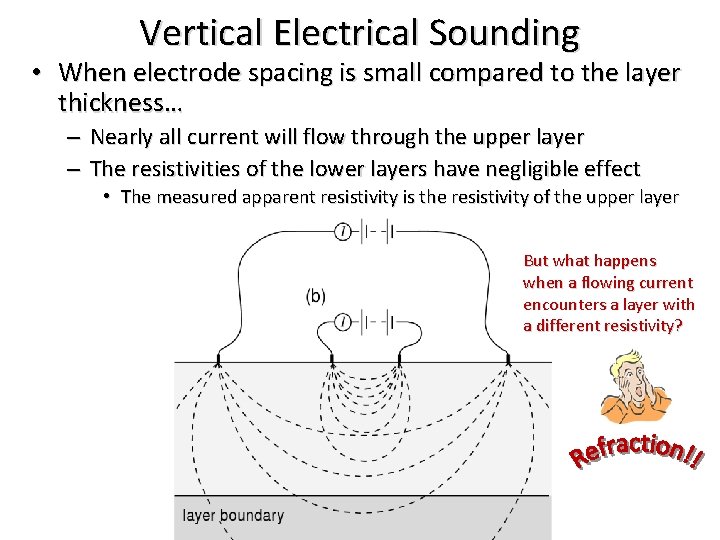
Vertical Electrical Sounding • When electrode spacing is small compared to the layer thickness… – Nearly all current will flow through the upper layer – The resistivities of the lower layers have negligible effect • The measured apparent resistivity is the resistivity of the upper layer But what happens when a flowing current encounters a layer with a different resistivity?
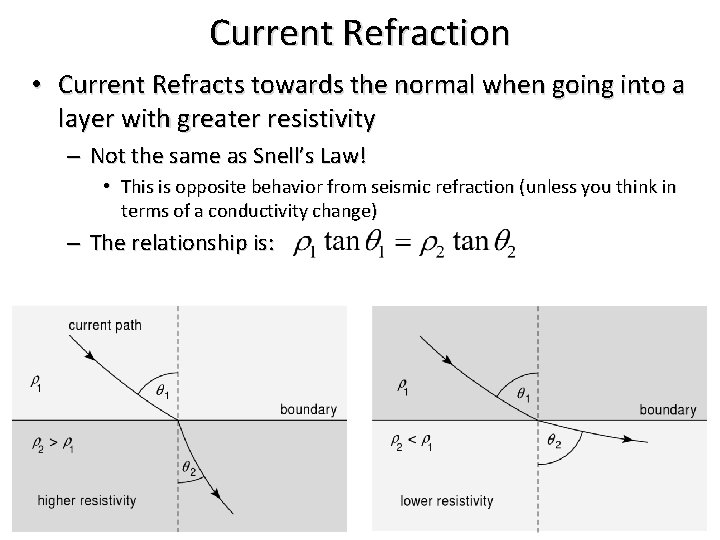
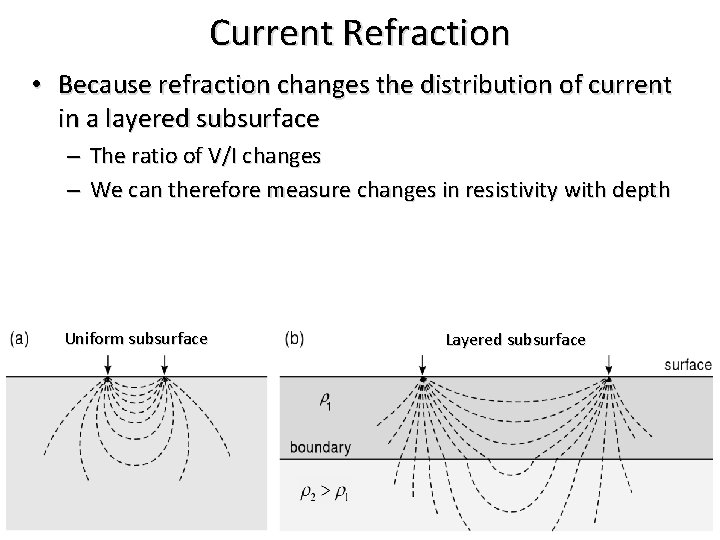
Current Refraction • Current Refracts towards the normal when going into a layer with greater resistivity – Not the same as Snell’s Law! • This is opposite behavior from seismic refraction (unless you think in terms of a conductivity change) – The relationship is:
Current Refraction • Because refraction changes the distribution of current in a layered subsurface – The ratio of V/I changes – We can therefore measure changes in resistivity with depth Uniform subsurface Layered subsurface
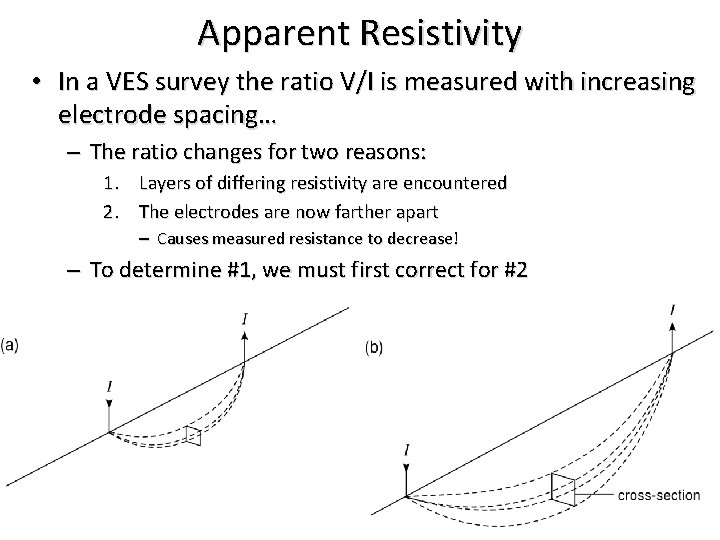
Apparent Resistivity • In a VES survey the ratio V/I is measured with increasing electrode spacing… – The ratio changes for two reasons: 1. Layers of differing resistivity are encountered 2. The electrodes are now farther apart – Causes measured resistance to decrease! – To determine #1, we must first correct for #2
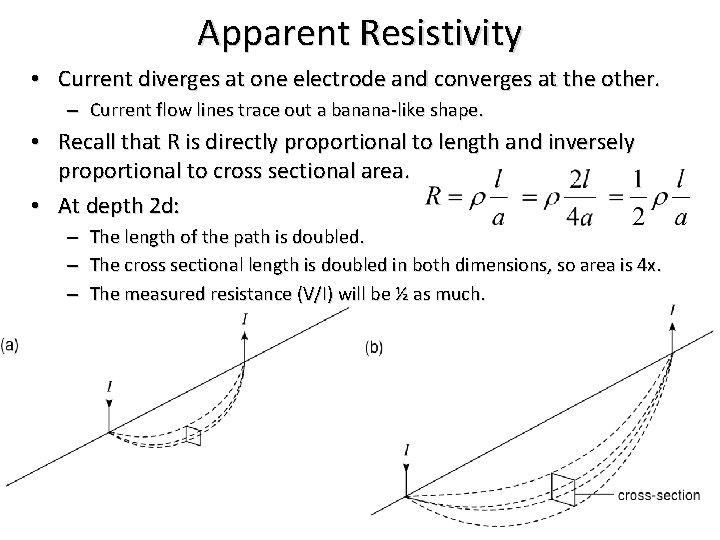
Apparent Resistivity • Current diverges at one electrode and converges at the other. – Current flow lines trace out a banana-like shape. • Recall that R is directly proportional to length and inversely proportional to cross sectional area. • At depth 2 d: – – – The length of the path is doubled. The cross sectional length is doubled in both dimensions, so area is 4 x. The measured resistance (V/I) will be ½ as much.
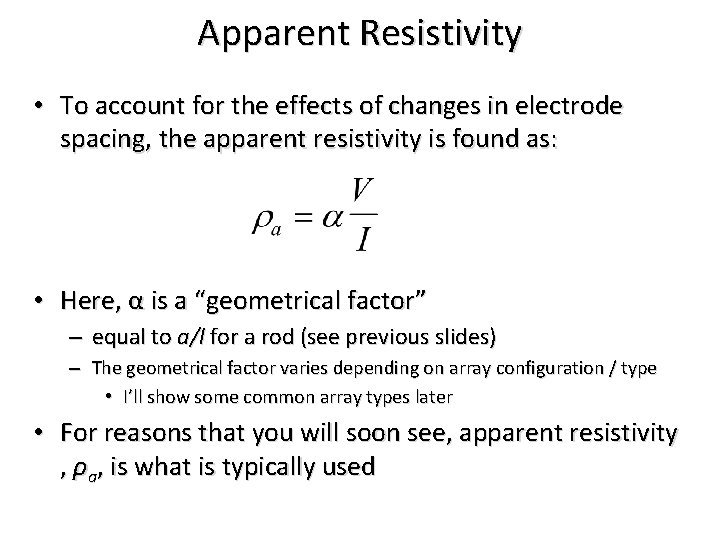
Apparent Resistivity • To account for the effects of changes in electrode spacing, the apparent resistivity is found as: • Here, α is a “geometrical factor” – equal to a/l for a rod (see previous slides) – The geometrical factor varies depending on array configuration / type • I’ll show some common array types later • For reasons that you will soon see, apparent resistivity , ρa, is what is typically used
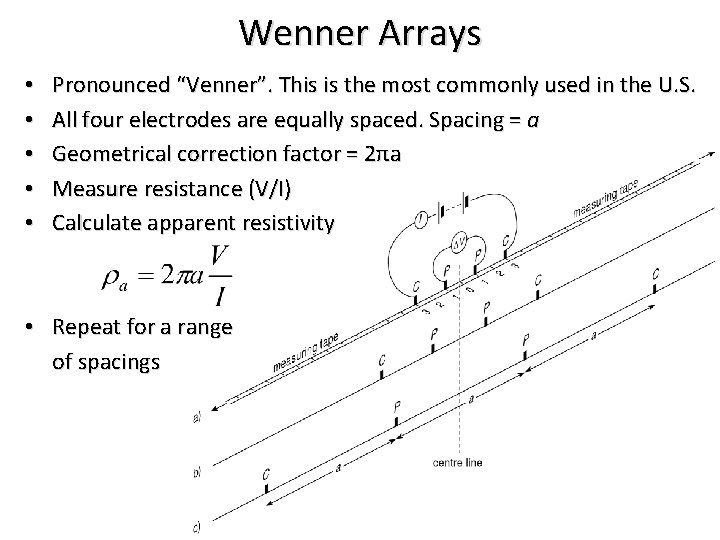
Wenner Arrays • • • Pronounced “Venner”. This is the most commonly used in the U. S. All four electrodes are equally spaced. Spacing = a Geometrical correction factor = 2πa Measure resistance (V/I) Calculate apparent resistivity • Repeat for a range of spacings
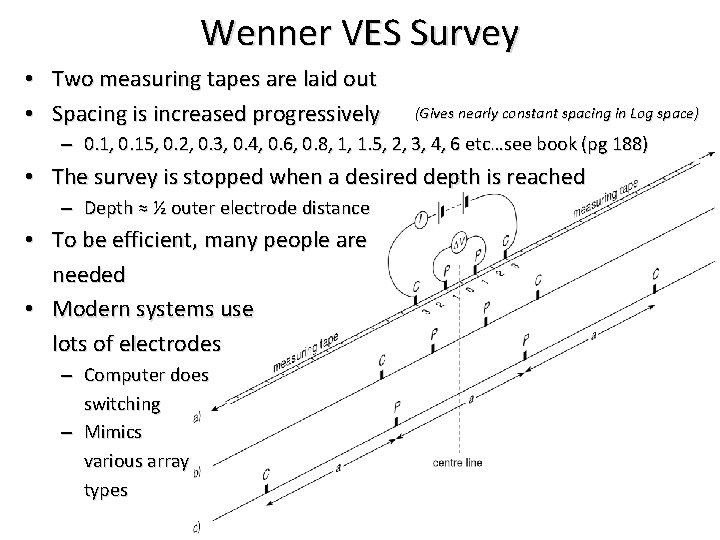
Wenner VES Survey • Two measuring tapes are laid out • Spacing is increased progressively (Gives nearly constant spacing in Log space) – 0. 1, 0. 15, 0. 2, 0. 3, 0. 4, 0. 6, 0. 8, 1, 1. 5, 2, 3, 4, 6 etc…see book (pg 188) • The survey is stopped when a desired depth is reached – Depth ≈ ½ outer electrode distance • To be efficient, many people are needed • Modern systems use lots of electrodes – Computer does switching – Mimics various array types
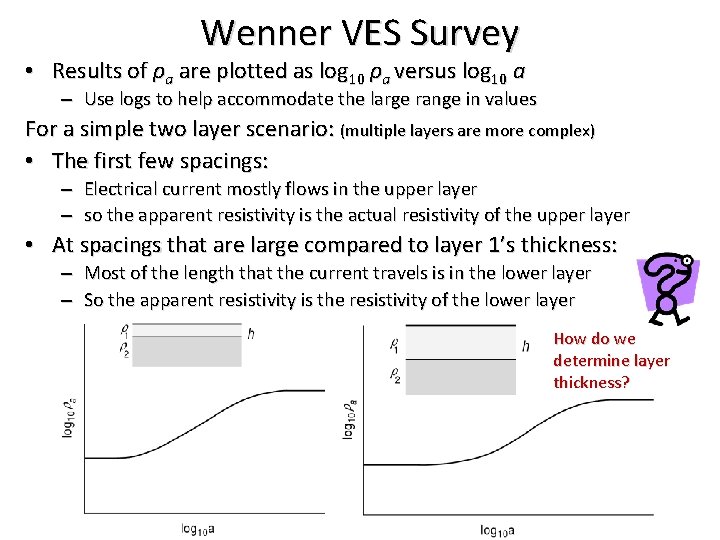
Wenner VES Survey • Results of ρa are plotted as log 10 ρa versus log 10 a – Use logs to help accommodate the large range in values For a simple two layer scenario: (multiple layers are more complex) • The first few spacings: – Electrical current mostly flows in the upper layer – so the apparent resistivity is the actual resistivity of the upper layer • At spacings that are large compared to layer 1’s thickness: – Most of the length that the current travels is in the lower layer – So the apparent resistivity is the resistivity of the lower layer How do we determine layer thickness?
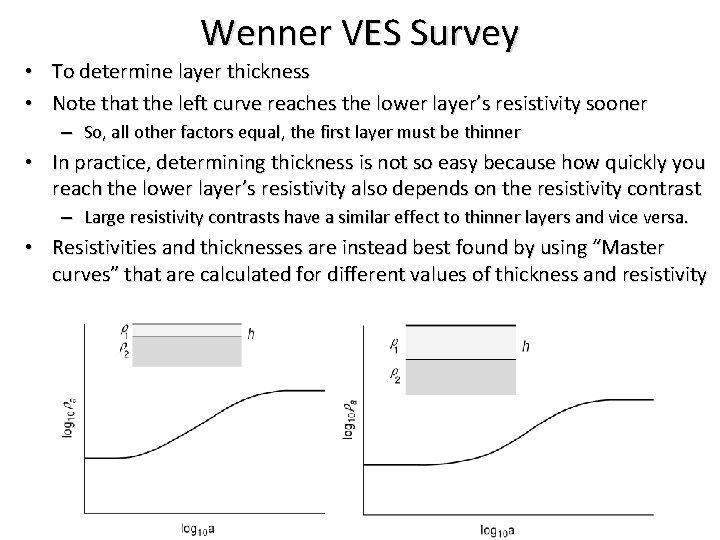
Wenner VES Survey • To determine layer thickness • Note that the left curve reaches the lower layer’s resistivity sooner – So, all other factors equal, the first layer must be thinner • In practice, determining thickness is not so easy because how quickly you reach the lower layer’s resistivity also depends on the resistivity contrast – Large resistivity contrasts have a similar effect to thinner layers and vice versa. • Resistivities and thicknesses are instead best found by using “Master curves” that are calculated for different values of thickness and resistivity
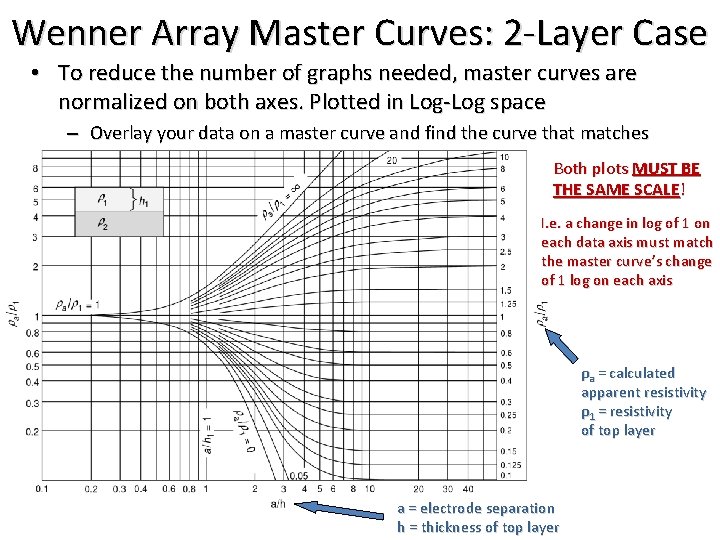
Wenner Array Master Curves: 2 -Layer Case • To reduce the number of graphs needed, master curves are normalized on both axes. Plotted in Log-Log space – Overlay your data on a master curve and find the curve that matches Both plots MUST BE THE SAME SCALE! I. e. a change in log of 1 on each data axis must match the master curve’s change of 1 log on each axis ρa = calculated apparent resistivity ρ1 = resistivity of top layer a = electrode separation h = thickness of top layer
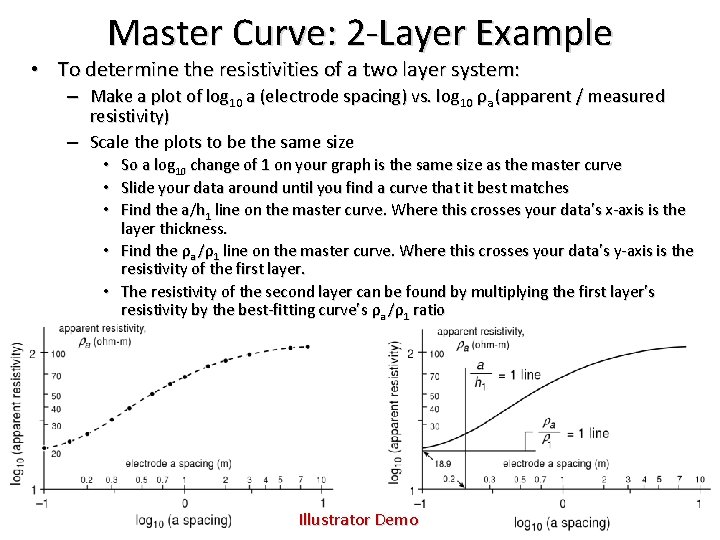
Master Curve: 2 -Layer Example • To determine the resistivities of a two layer system: – Make a plot of log 10 a (electrode spacing) vs. log 10 ρa (apparent / measured resistivity) – Scale the plots to be the same size So a log 10 change of 1 on your graph is the same size as the master curve Slide your data around until you find a curve that it best matches Find the a/h 1 line on the master curve. Where this crosses your data’s x-axis is the layer thickness. • Find the ρa /ρ1 line on the master curve. Where this crosses your data’s y-axis is the resistivity of the first layer. • The resistivity of the second layer can be found by multiplying the first layer’s resistivity by the best-fitting curve’s ρa /ρ1 ratio • • • Illustrator Demo
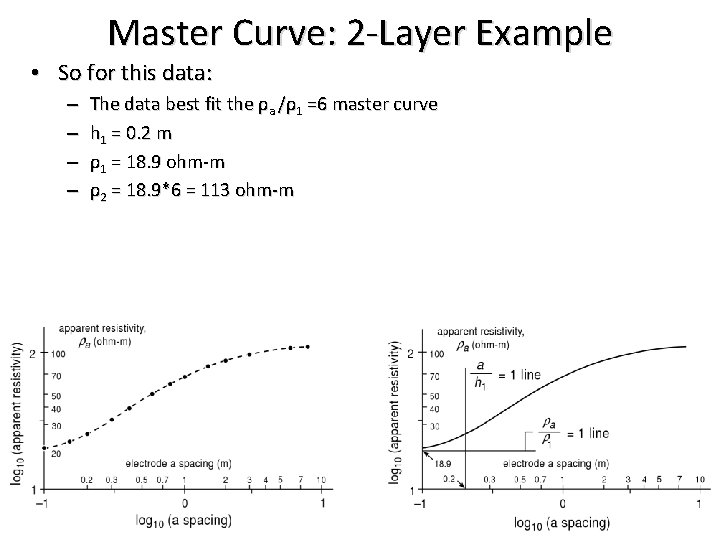
Master Curve: 2 -Layer Example • So for this data: – – The data best fit the ρa /ρ1 =6 master curve h 1 = 0. 2 m ρ1 = 18. 9 ohm-m ρ2 = 18. 9*6 = 113 ohm-m
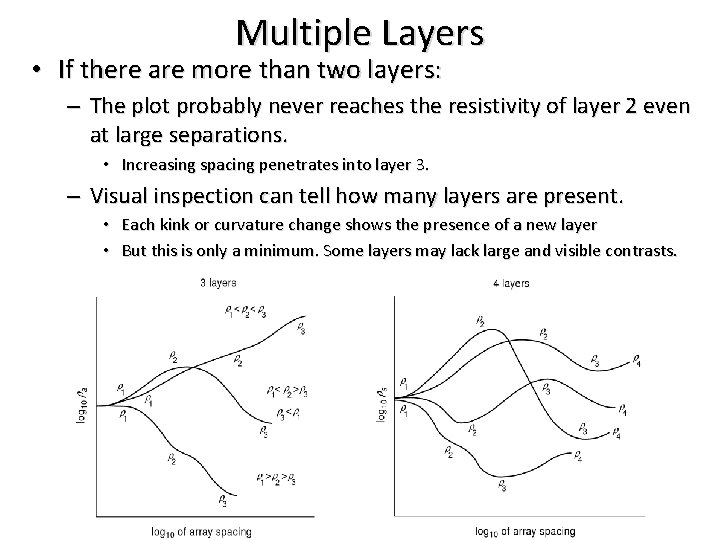
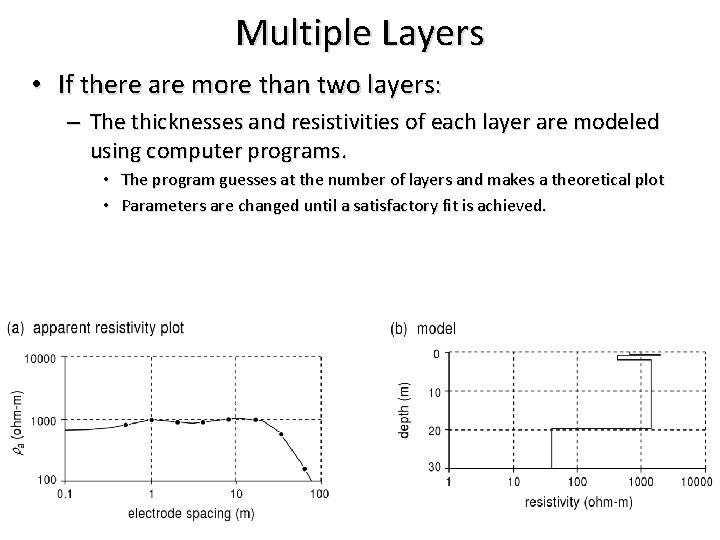
Multiple Layers • If there are more than two layers: – The plot probably never reaches the resistivity of layer 2 even at large separations. • Increasing spacing penetrates into layer 3. – Visual inspection can tell how many layers are present. • Each kink or curvature change shows the presence of a new layer • But this is only a minimum. Some layers may lack large and visible contrasts.
Multiple Layers • If there are more than two layers: – The thicknesses and resistivities of each layer are modeled using computer programs. • The program guesses at the number of layers and makes a theoretical plot • Parameters are changed until a satisfactory fit is achieved.
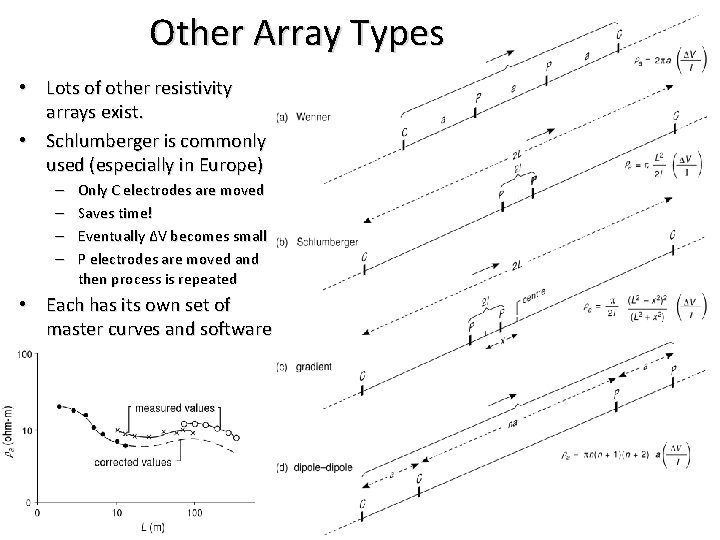
Other Array Types • Lots of other resistivity arrays exist. • Schlumberger is commonly used (especially in Europe) – – Only C electrodes are moved Saves time! Eventually ΔV becomes small P electrodes are moved and then process is repeated • Each has its own set of master curves and software
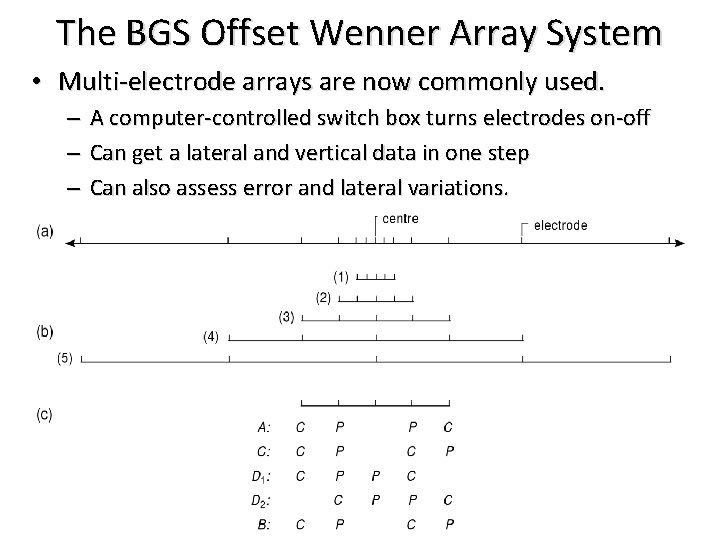
The BGS Offset Wenner Array System • Multi-electrode arrays are now commonly used. – – – A computer-controlled switch box turns electrodes on-off Can get a lateral and vertical data in one step Can also assess error and lateral variations.
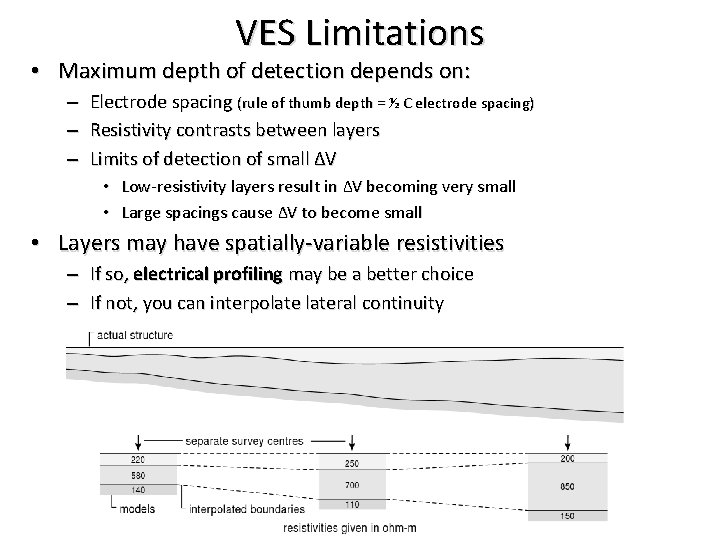
VES Limitations • Maximum depth of detection depends on: – – – Electrode spacing (rule of thumb depth = ½ C electrode spacing) Resistivity contrasts between layers Limits of detection of small ΔV • Low-resistivity layers result in ΔV becoming very small • Large spacings cause ΔV to become small • Layers may have spatially-variable resistivities – If so, electrical profiling may be a better choice – If not, you can interpolateral continuity
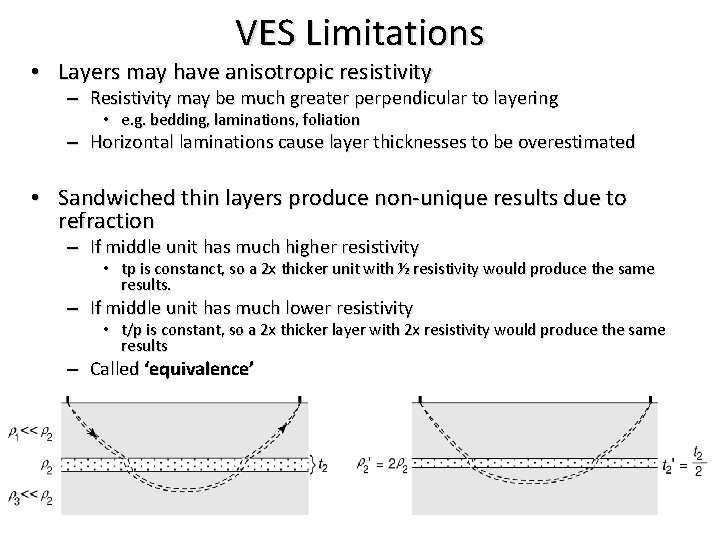
VES Limitations • Layers may have anisotropic resistivity – Resistivity may be much greater perpendicular to layering • e. g. bedding, laminations, foliation – Horizontal laminations cause layer thicknesses to be overestimated • Sandwiched thin layers produce non-unique results due to refraction – If middle unit has much higher resistivity • tp is constanct, so a 2 x thicker unit with ½ resistivity would produce the same results. – If middle unit has much lower resistivity • t/p is constant, so a 2 x thicker layer with 2 x resistivity would produce the same results – Called ‘equivalence’
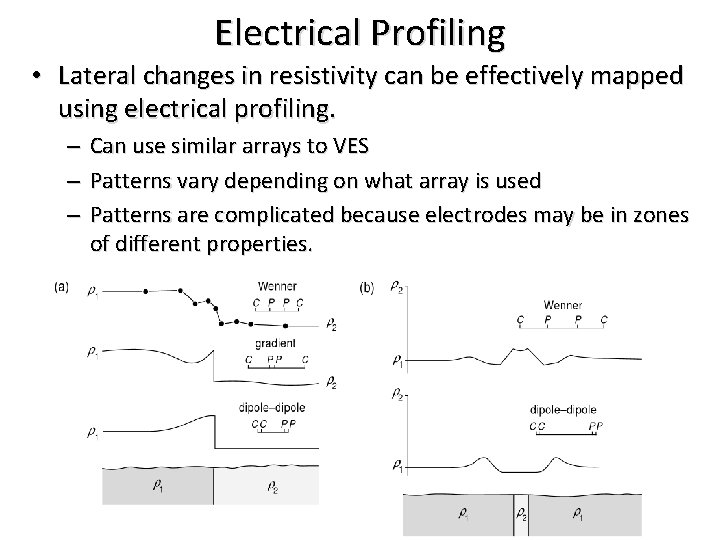
Electrical Profiling • Lateral changes in resistivity can be effectively mapped using electrical profiling. – – – Can use similar arrays to VES Patterns vary depending on what array is used Patterns are complicated because electrodes may be in zones of different properties.
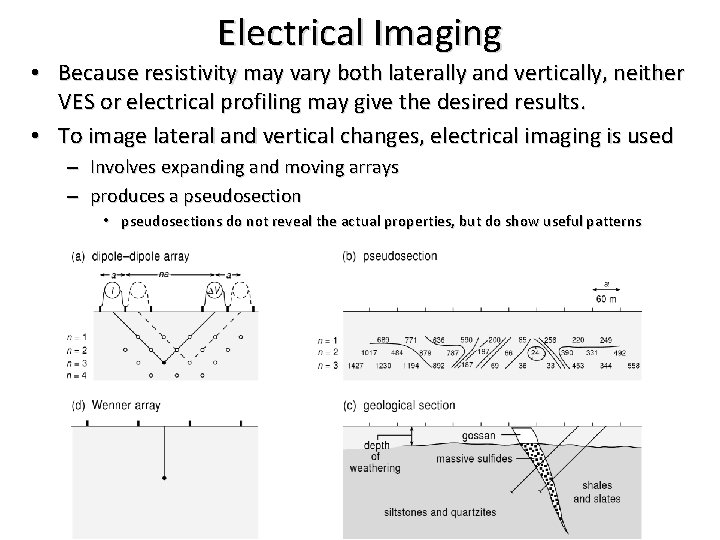
Electrical Imaging • Because resistivity may vary both laterally and vertically, neither VES or electrical profiling may give the desired results. • To image lateral and vertical changes, electrical imaging is used – Involves expanding and moving arrays – produces a pseudosection • pseudosections do not reveal the actual properties, but do show useful patterns
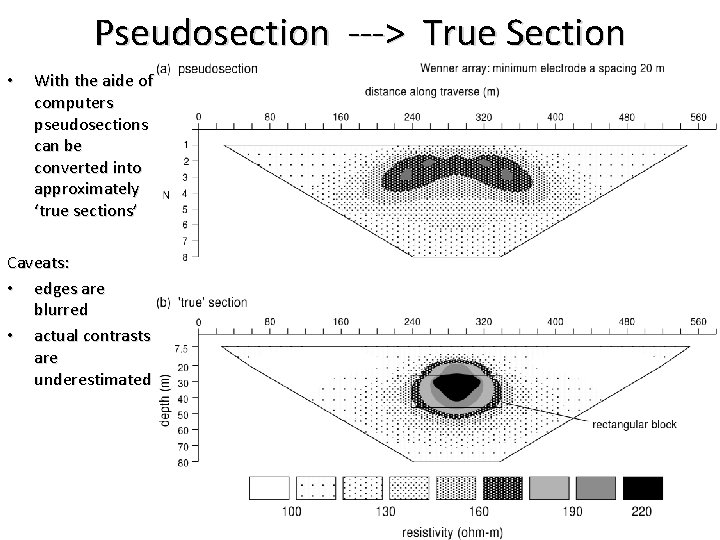
Pseudosection ---> True Section • With the aide of computers pseudosections can be converted into approximately ‘true sections’ Caveats: • edges are blurred • actual contrasts are underestimated
Final Remarks • Like all geophysical techniques resistivity: – Produces non-unique results • Data should be compared to known geological data (e. g. boreholes) • Similar rocks have a wide range in resistivities depending on water content • Lithology changes do not necessarily correspond to a resistivity change • Resistivity changes to not necessarily correspond to a lithology change – So, without sound geological knowledge, resistivity data may be misleading.