
ELECTRICAL MACHINES Types of Electrical Machines DC MACHINES
- Slides: 50
ELECTRICAL MACHINES
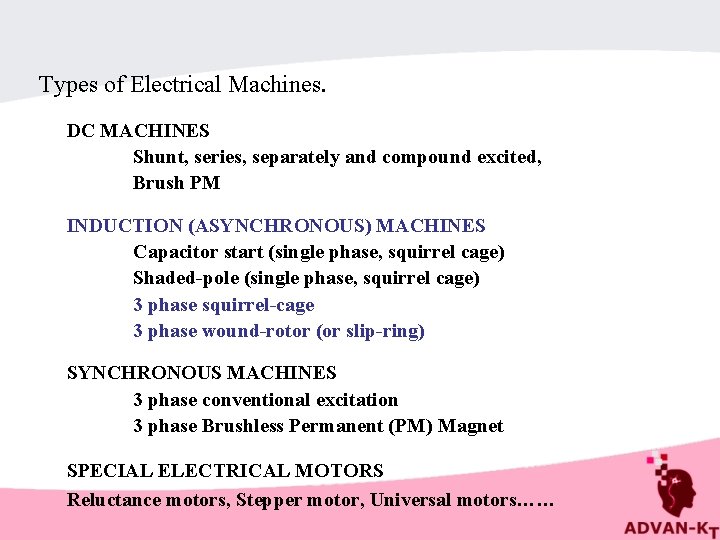
Types of Electrical Machines. DC MACHINES Shunt, series, separately and compound excited, Brush PM INDUCTION (ASYNCHRONOUS) MACHINES Capacitor start (single phase, squirrel cage) Shaded-pole (single phase, squirrel cage) 3 phase squirrel-cage 3 phase wound-rotor (or slip-ring) SYNCHRONOUS MACHINES 3 phase conventional excitation 3 phase Brushless Permanent (PM) Magnet SPECIAL ELECTRICAL MOTORS Reluctance motors, Stepper motor, Universal motors……
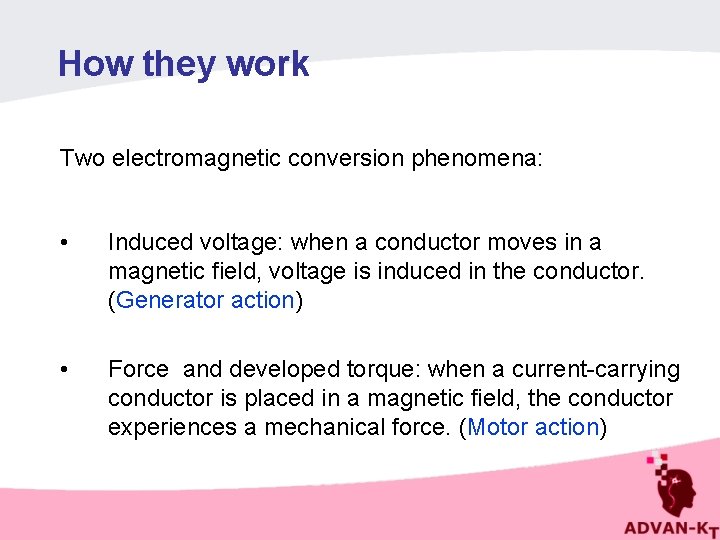
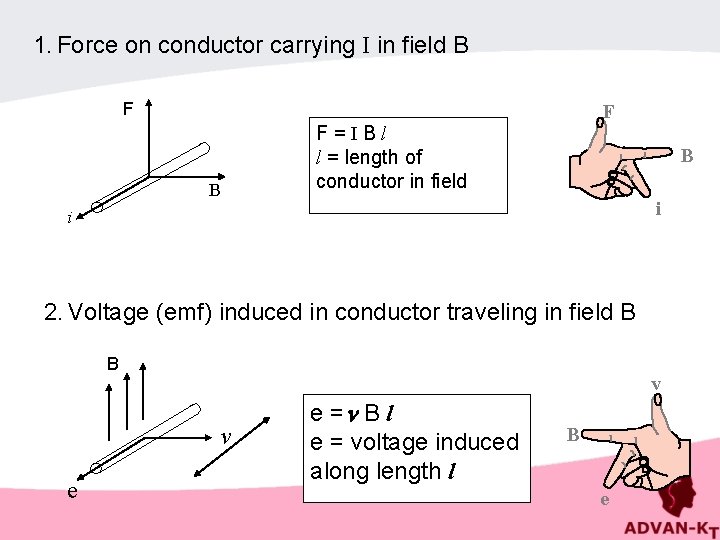
How they work Two electromagnetic conversion phenomena: • Induced voltage: when a conductor moves in a magnetic field, voltage is induced in the conductor. (Generator action) • Force and developed torque: when a current-carrying conductor is placed in a magnetic field, the conductor experiences a mechanical force. (Motor action)
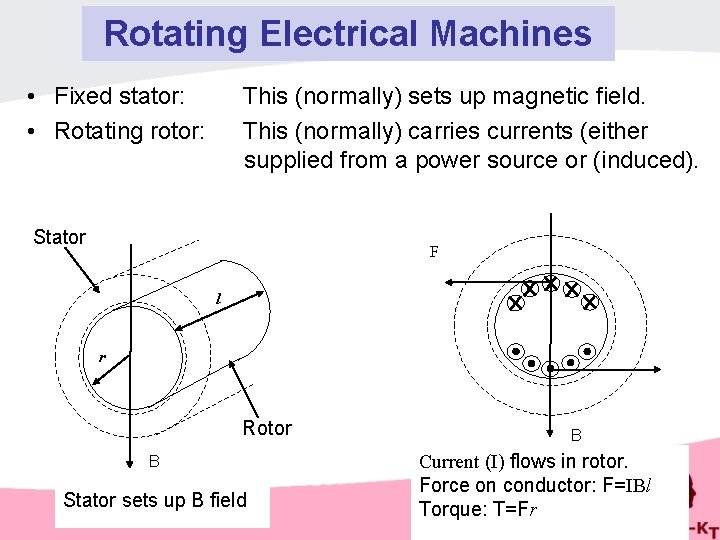
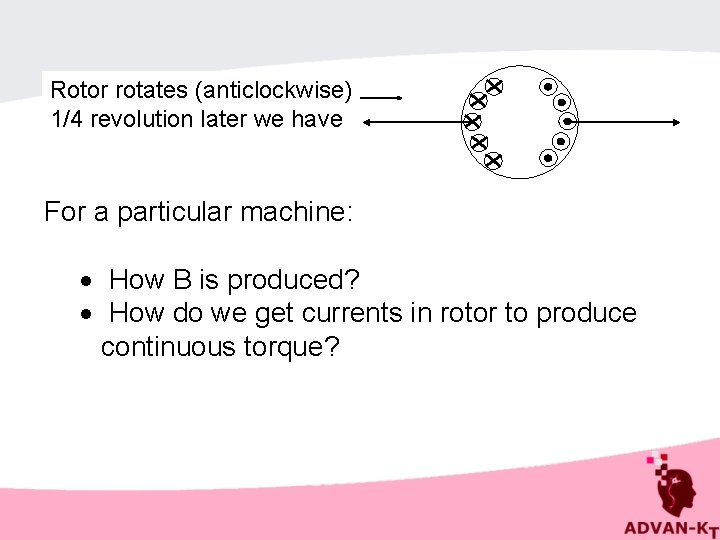
Rotating Electrical Machines • Fixed stator: • Rotating rotor: This (normally) sets up magnetic field. This (normally) carries currents (either supplied from a power source or (induced). Stator F l l r Rotor B Stator sets up B field B Current (I) flows in rotor. Force on conductor: F=IBl Torque: T=Fr
Rotor rotates (anticlockwise) 1/4 revolution later we have For a particular machine: · How B is produced? · How do we get currents in rotor to produce continuous torque?
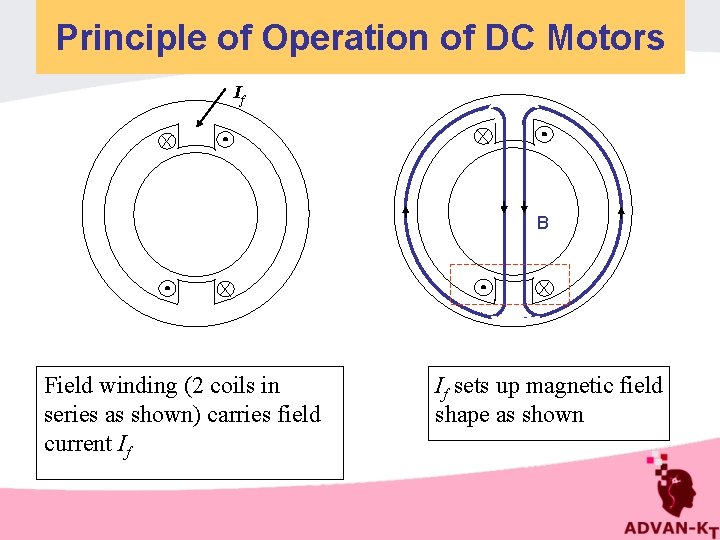
Principle of Operation of DC Motors If B Field winding (2 coils in series as shown) carries field current If If sets up magnetic field shape as shown
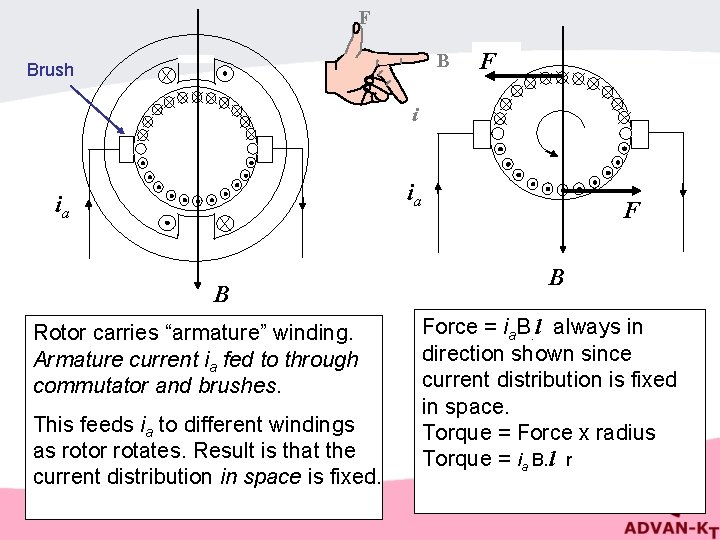
F B Brush F i ia ia B Rotor carries “armature” winding. Armature current ia fed to through commutator and brushes. This feeds ia to different windings as rotor rotates. Result is that the current distribution in space is fixed. F B Force = ia. B. l always in direction shown since current distribution is fixed in space. Torque = Force x radius Torque = ia B. l r
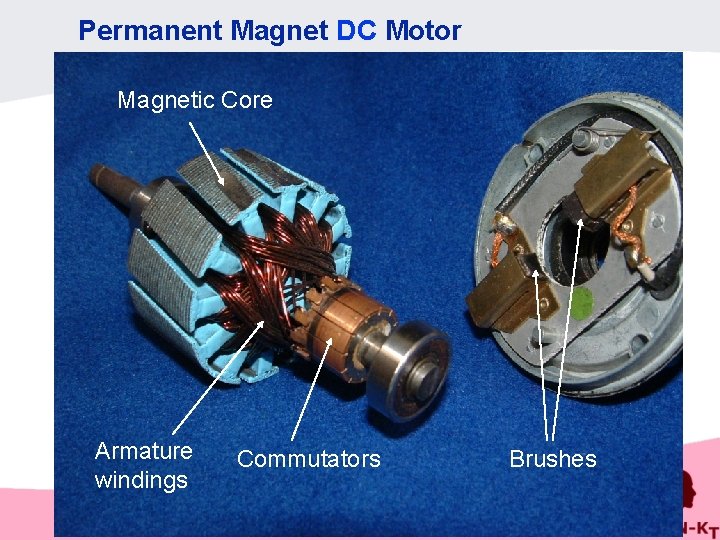
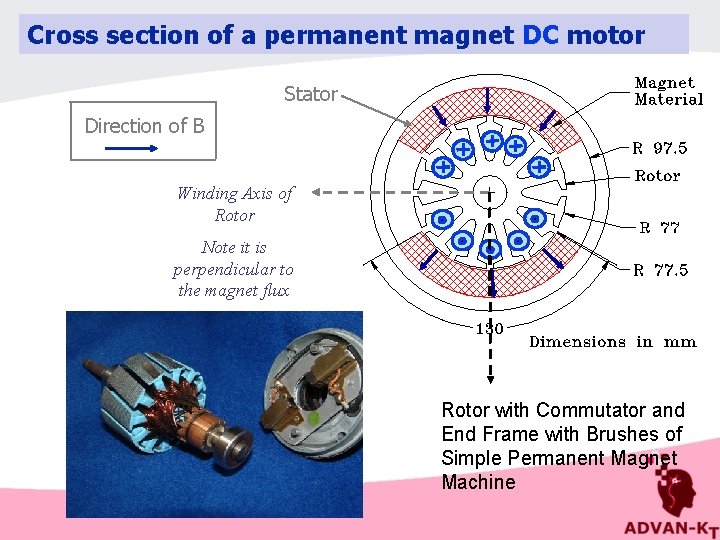
Permanent Magnet DC Motor Magnetic Core Armature windings Commutators Brushes
1. Force on conductor carrying I in field B F F=IBl l = length of conductor in field B i i 2. Voltage (emf) induced in conductor traveling in field B B v v e e = B l e = voltage induced along length l B e
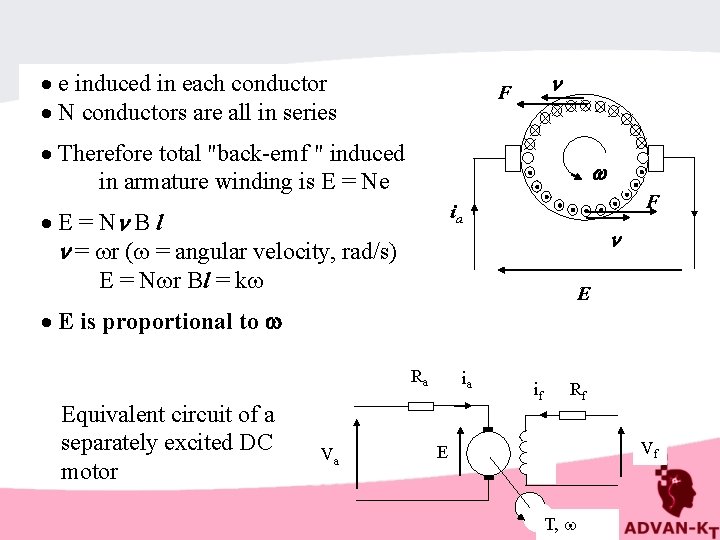
· e induced in each conductor · N conductors are all in series F · Therefore total "back-emf " induced in armature winding is E = Ne F ia · E = N B l = r ( = angular velocity, rad/s) E = N r Bl = k E · E is proportional to Ra Equivalent circuit of a separately excited DC motor Va ia if Rf Vf E T,
Cross section of a permanent magnet DC motor Stator Direction of B Winding Axis of Rotor Note it is perpendicular to the magnet flux Rotor with Commutator and End Frame with Brushes of Simple Permanent Magnet Machine
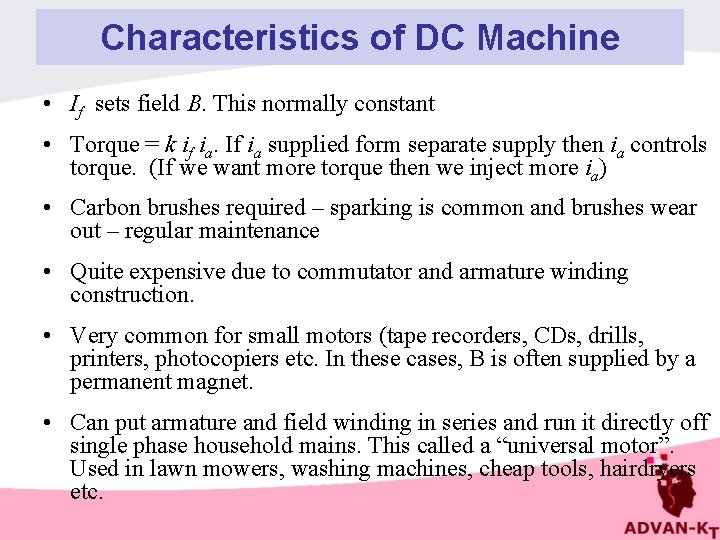
Characteristics of DC Machine • If sets field B. This normally constant • Torque = k if ia. If ia supplied form separate supply then ia controls torque. (If we want more torque then we inject more ia) • Carbon brushes required – sparking is common and brushes wear out – regular maintenance • Quite expensive due to commutator and armature winding construction. • Very common for small motors (tape recorders, CDs, drills, printers, photocopiers etc. In these cases, B is often supplied by a permanent magnet. • Can put armature and field winding in series and run it directly off single phase household mains. This called a “universal motor”. Used in lawn mowers, washing machines, cheap tools, hairdryers etc.
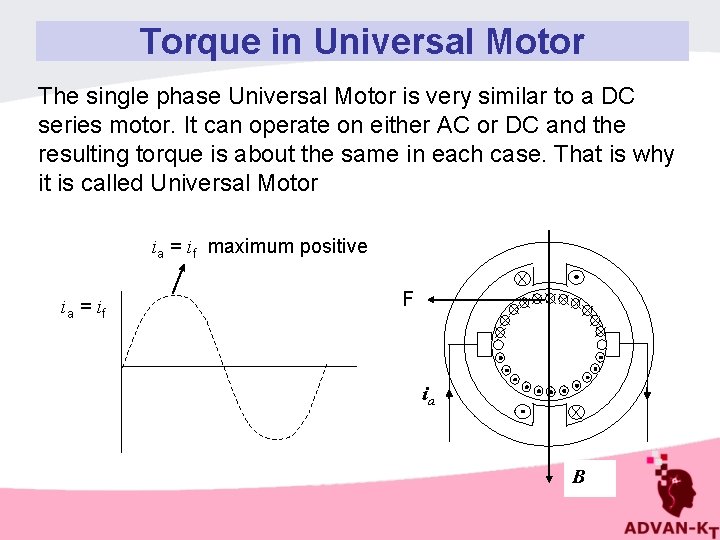
Torque in Universal Motor The single phase Universal Motor is very similar to a DC series motor. It can operate on either AC or DC and the resulting torque is about the same in each case. That is why it is called Universal Motor ia = if maximum positive ia = if F ia B
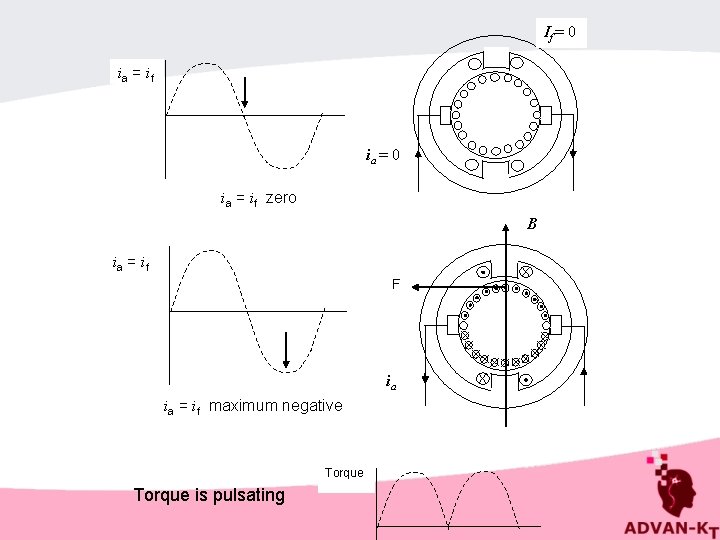
If = 0 ia = if ia = 0 ia = if zero B ia = if F ia ia = if maximum negative Torque is pulsating
Characteristics of Universal Motor • Normally Universal motors are rated at fractional horse power (less than 1 k. W) • The main advantage of Universal motors is their high speed ( 1500 to 15000 rpm) and high starting torque • Therefore, they are used to drive high speed centrifugal blowers in vacuum cleaners • The high speed and corresponding small size for a given power output is also an advantage in driving portable tools, such as electric saws and drilles H 61 IAL 15
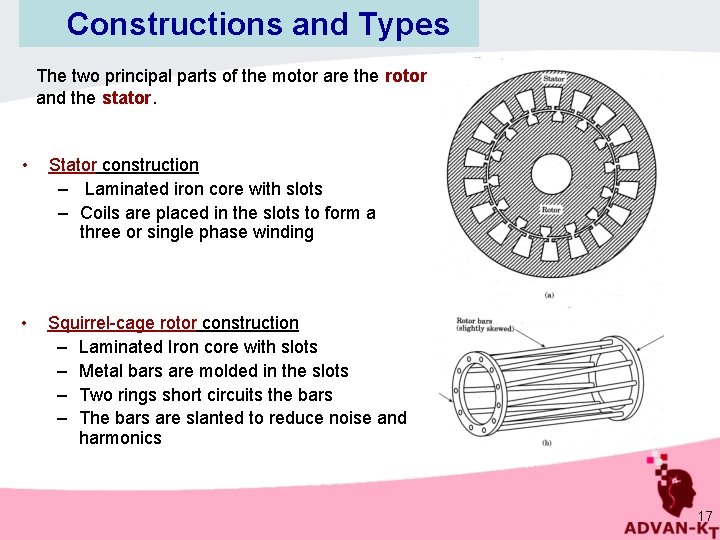
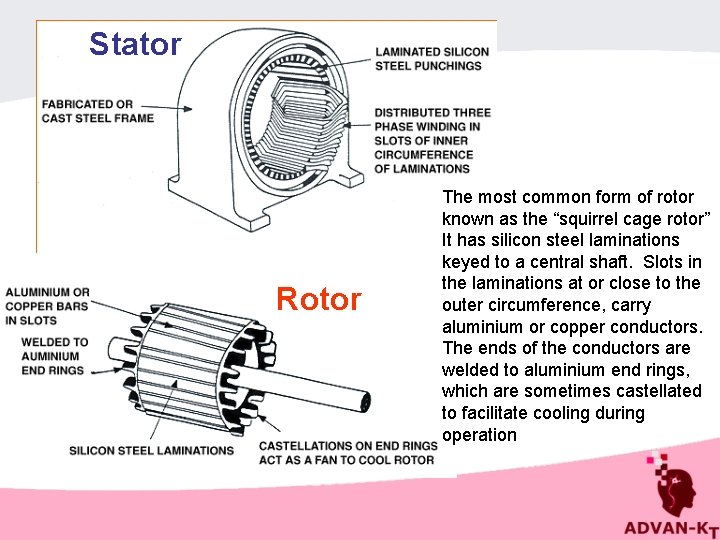
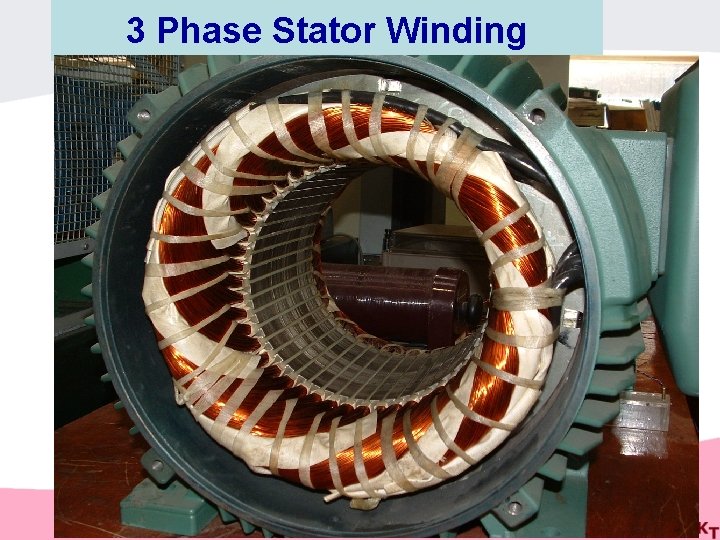
THE 3 -PHASE INDUCTION MACHINE • 65% of world's generated energy rotating machines • >90% of this induction machines Induction motor construction: The induction motor comprises two parts: • outer stationary frame called the “stator” • inner rotating section known as the “rotor” • The stator has a large number of circular silicon steel laminations with slots cut in their inner circumference mounted in a fabricated or cast steel frame. Three phase windings mutually displaced by 120 in space are wound in the slots.
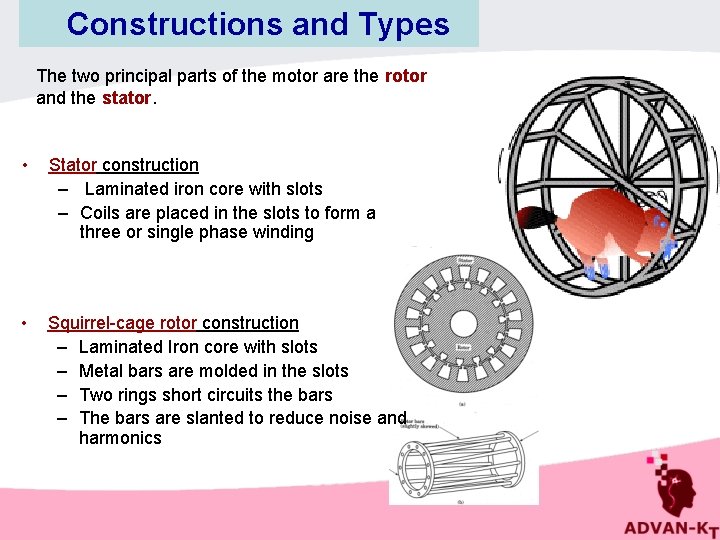
Constructions and Types The two principal parts of the motor are the rotor and the stator. • Stator construction – Laminated iron core with slots – Coils are placed in the slots to form a three or single phase winding • Squirrel-cage rotor construction – Laminated Iron core with slots – Metal bars are molded in the slots – Two rings short circuits the bars – The bars are slanted to reduce noise and harmonics 17
Constructions and Types The two principal parts of the motor are the rotor and the stator. • Stator construction – Laminated iron core with slots – Coils are placed in the slots to form a three or single phase winding • Squirrel-cage rotor construction – Laminated Iron core with slots – Metal bars are molded in the slots – Two rings short circuits the bars – The bars are slanted to reduce noise and harmonics
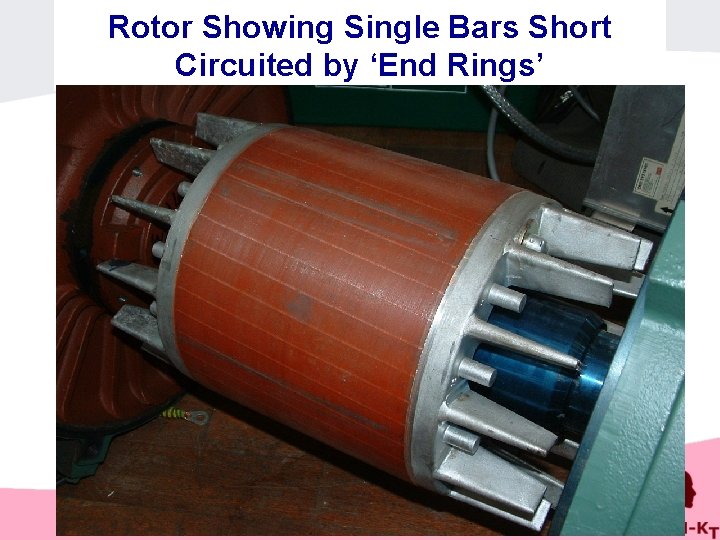
Stator Rotor The most common form of rotor known as the “squirrel cage rotor” It has silicon steel laminations keyed to a central shaft. Slots in the laminations at or close to the outer circumference, carry aluminium or copper conductors. The ends of the conductors are welded to aluminium end rings, which are sometimes castellated to facilitate cooling during operation
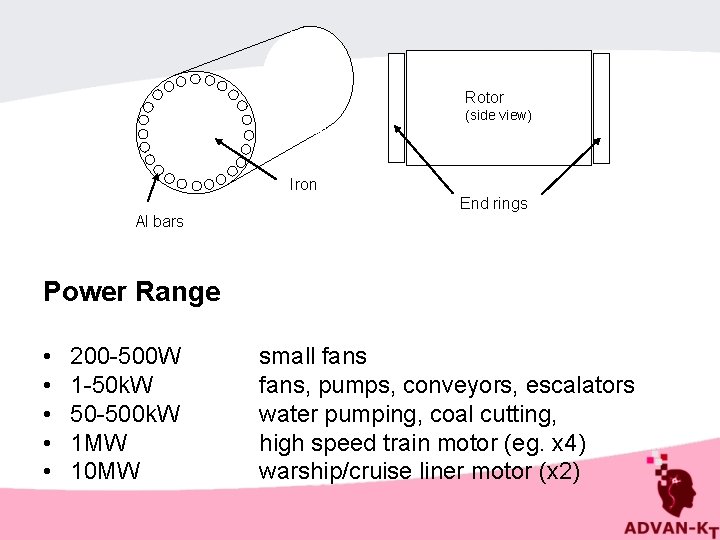
Rotor (side view) Iron End rings Al bars Power Range • • • 200 -500 W 1 -50 k. W 50 -500 k. W 1 MW 10 MW small fans, pumps, conveyors, escalators water pumping, coal cutting, high speed train motor (eg. x 4) warship/cruise liner motor (x 2)
3 Phase Stator Winding
Rotor Showing Single Bars Short Circuited by ‘End Rings’
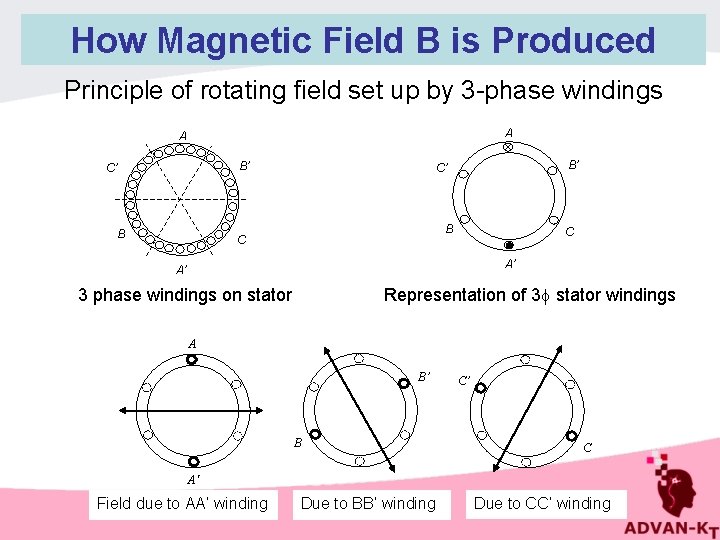
How Magnetic Field B is Produced Principle of rotating field set up by 3 -phase windings A A B’ C’ B C C A’ A’ 3 phase windings on stator Representation of 3 stator windings A B’ B C’ C A' Field due to AA’ winding Due to BB’ winding Due to CC’ winding
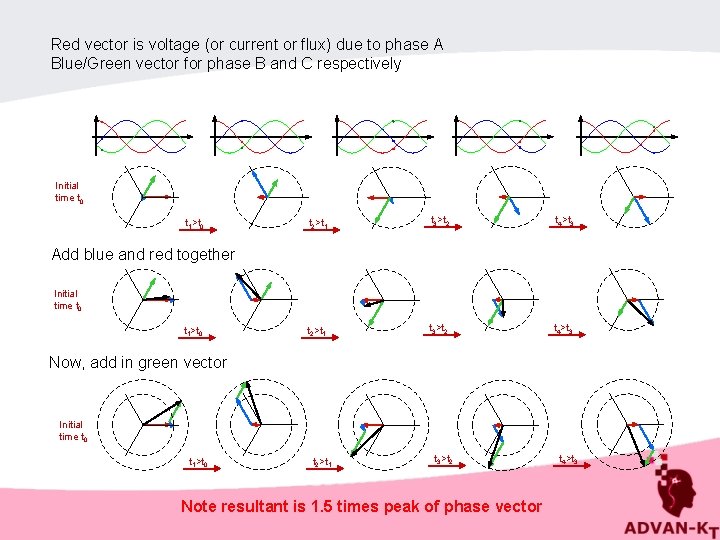
Red vector is voltage (or current or flux) due to phase A Blue/Green vector for phase B and C respectively Initial time t 0 t 1>t 0 t 2>t 1 t 3>t 2 t 4>t 3 Add blue and red together Initial time t 0 t 1>t 0 Now, add in green vector Initial time t 0 t 1>t 0 t 2>t 1 t 3>t 2 Note resultant is 1. 5 times peak of phase vector t 4>t 3
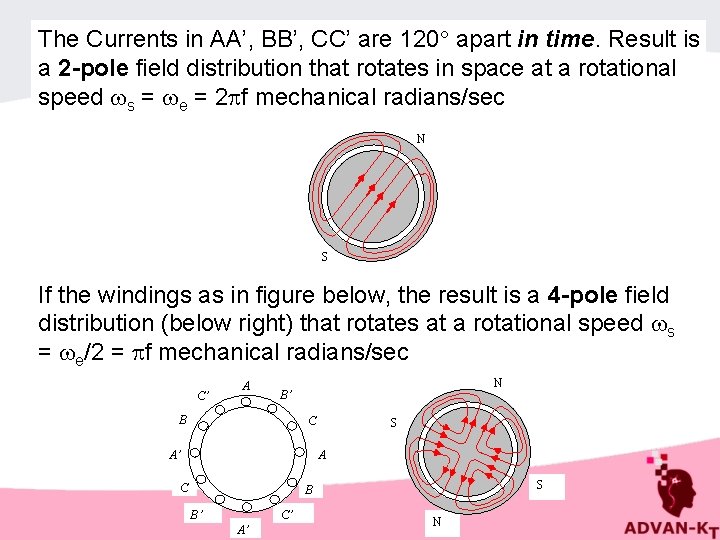
The Currents in AA’, BB’, CC’ are 120 apart in time. Result is a 2 -pole field distribution that rotates in space at a rotational speed s = e = 2 f mechanical radians/sec N S If the windings as in figure below, the result is a 4 -pole field distribution (below right) that rotates at a rotational speed s = e/2 = f mechanical radians/sec C’ A N B’ B C A’ S A C S B B’ C’ A’ N
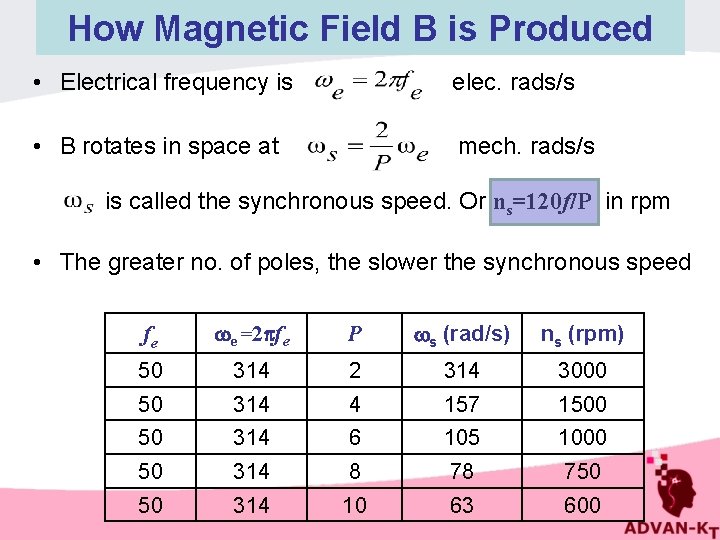
How Magnetic Field B is Produced • Electrical frequency is elec. rads/s • B rotates in space at mech. rads/s is called the synchronous speed. Or ns=120 f/P in rpm • The greater no. of poles, the slower the synchronous speed fe e =2 fe P s (rad/s) ns (rpm) 50 314 2 314 3000 50 314 4 157 1500 50 314 6 105 1000 50 314 8 78 750 50 314 10 63 600
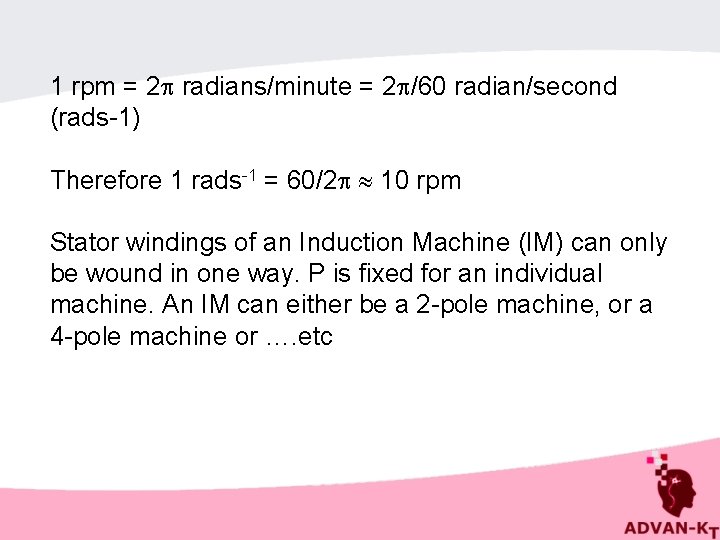
1 rpm = 2 radians/minute = 2 /60 radian/second (rads-1) Therefore 1 rads-1 = 60/2 10 rpm Stator windings of an Induction Machine (IM) can only be wound in one way. P is fixed for an individual machine. An IM can either be a 2 -pole machine, or a 4 -pole machine or …. etc
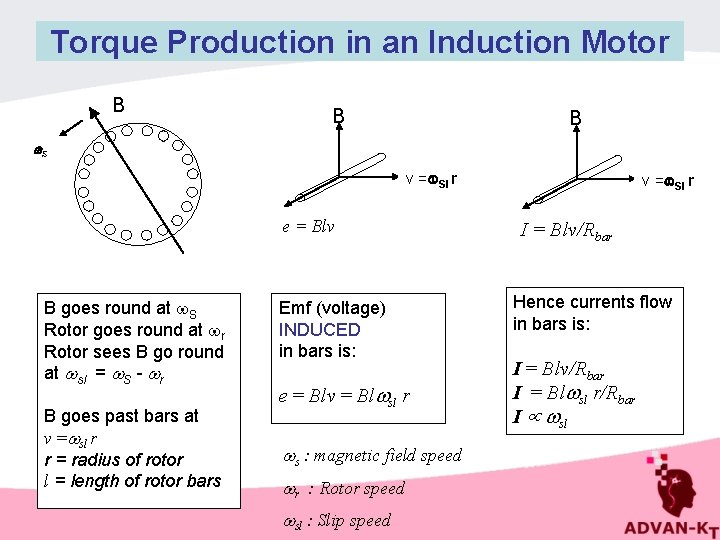
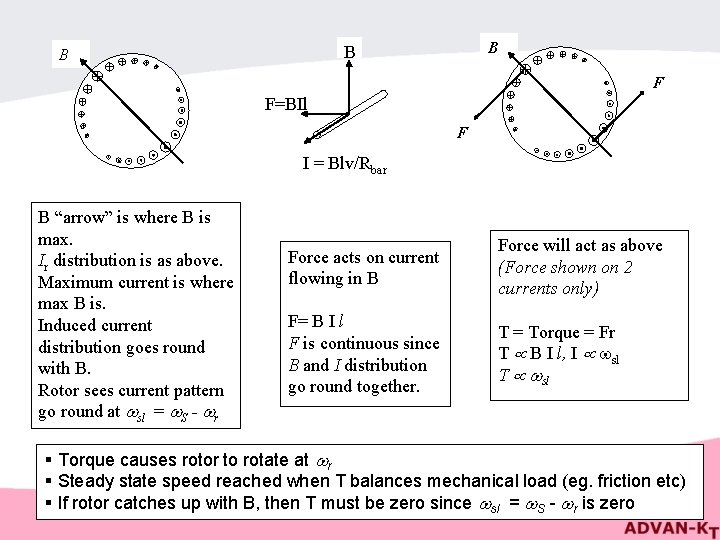
Torque Production in an Induction Motor B B B S v = Sl r e = Blv B goes round at S Rotor goes round at r Rotor sees B go round at sl = S - r B goes past bars at v = sl r r = radius of rotor l = length of rotor bars Emf (voltage) INDUCED in bars is: e = Blv = Bl sl r s : magnetic field speed r : Rotor speed sl : Slip speed v = Sl r I = Blv/Rbar Hence currents flow in bars is: I = Blv/Rbar I = Bl sl r/Rbar I sl
B B B F F=BIl F I = Blv/Rbar B “arrow” is where B is max. Ir distribution is as above. Maximum current is where max B is. Induced current distribution goes round with B. Rotor sees current pattern go round at sl = S - r Force acts on current flowing in B Force will act as above (Force shown on 2 currents only) F= B I l F is continuous since B and I distribution go round together. T = Torque = Fr T B I l, I sl T sl § Torque causes rotor to rotate at r § Steady state speed reached when T balances mechanical load (eg. friction etc) § If rotor catches up with B, then T must be zero since sl = S - r is zero
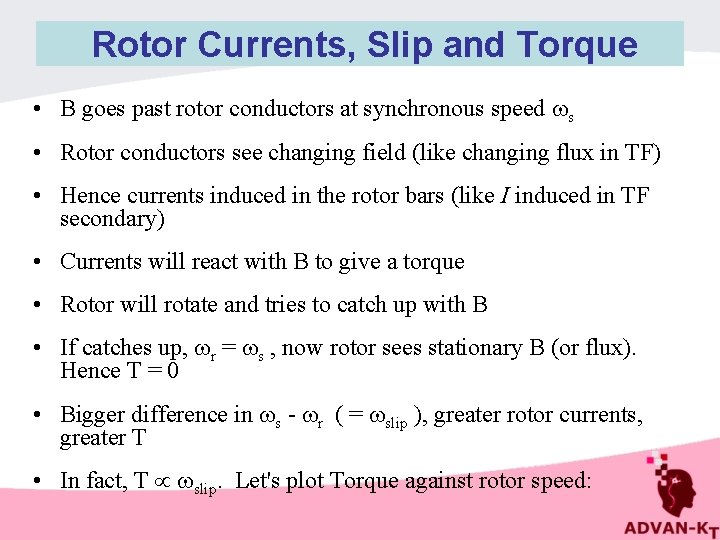
Rotor Currents, Slip and Torque • B goes past rotor conductors at synchronous speed s • Rotor conductors see changing field (like changing flux in TF) • Hence currents induced in the rotor bars (like I induced in TF secondary) • Currents will react with B to give a torque • Rotor will rotate and tries to catch up with B • If catches up, r = s , now rotor sees stationary B (or flux). Hence T = 0 • Bigger difference in s - r ( = slip ), greater rotor currents, greater T • In fact, T slip. Let's plot Torque against rotor speed:
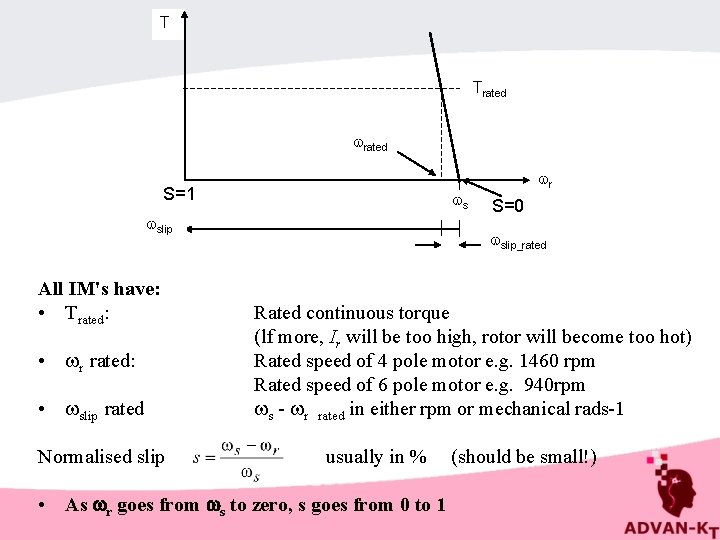
T Trated S=1 s slip All IM's have: • Trated: • r rated: • slip rated Normalised slip r S=0 slip_rated Rated continuous torque (lf more, Ir will be too high, rotor will become too hot) Rated speed of 4 pole motor e. g. 1460 rpm Rated speed of 6 pole motor e. g. 940 rpm s - r rated in either rpm or mechanical rads-1 usually in % • As r goes from s to zero, s goes from 0 to 1 (should be small!)
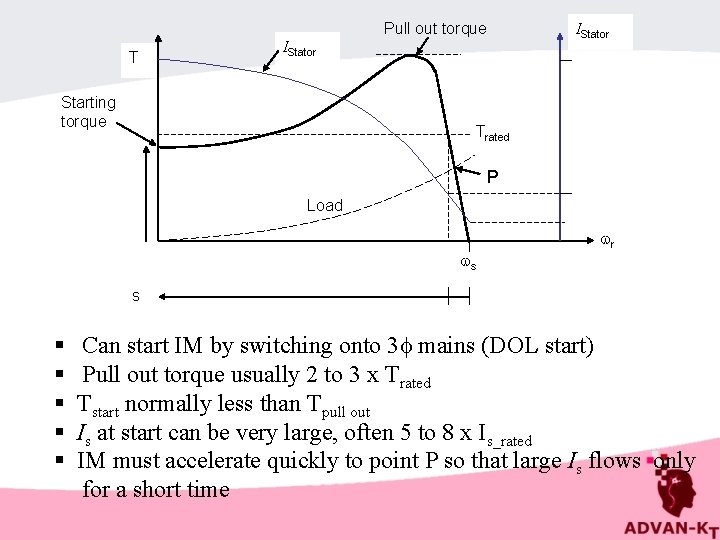
Maximum Torque and Starting Torque • Complete rest of T-speed curve (just accept this) • Also plot Istator (written Is) - as slip increase, Ir increases - Ir sets up (rotating) field of its own to try and reduce main B - Not allowed to do this! See TF operation! - Additional Is flows to nullify field of Ir
Pull out torque T IStator Starting torque IStator Trated P Load s r s § § § Can start IM by switching onto 3 mains (DOL start) Pull out torque usually 2 to 3 x Trated Tstart normally less than Tpull out Is at start can be very large, often 5 to 8 x Is_rated IM must accelerate quickly to point P so that large Is flows only for a short time
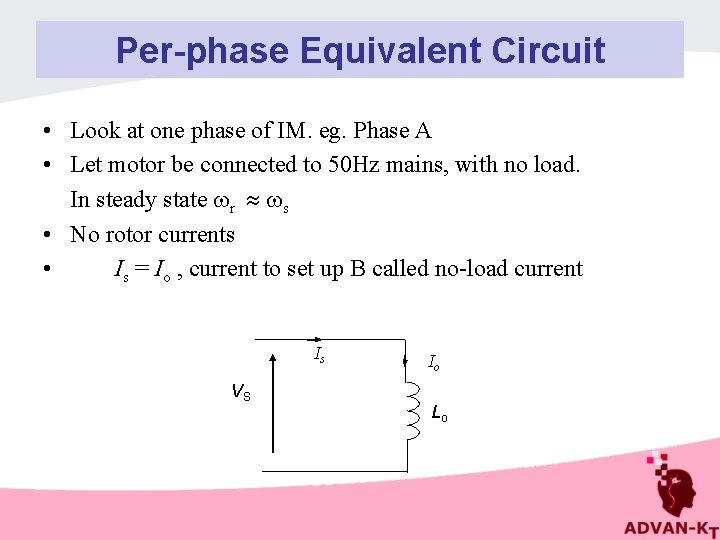
Per-phase Equivalent Circuit • Look at one phase of IM. eg. Phase A • Let motor be connected to 50 Hz mains, with no load. In steady state r s • No rotor currents • Is = Io , current to set up B called no-load current Is VS Io Lo
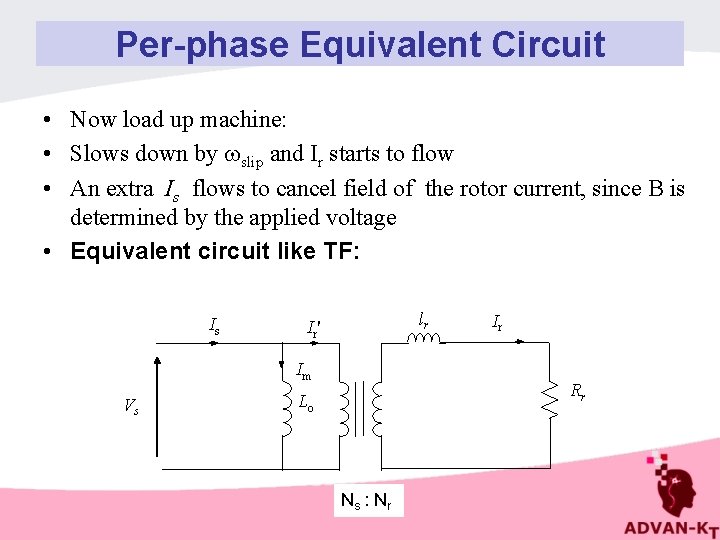
Per-phase Equivalent Circuit • Now load up machine: • Slows down by slip and Ir starts to flow • An extra Is flows to cancel field of the rotor current, since B is determined by the applied voltage • Equivalent circuit like TF: Is lr Ir ' Im Vs Ir Rr Lo Ns : N r
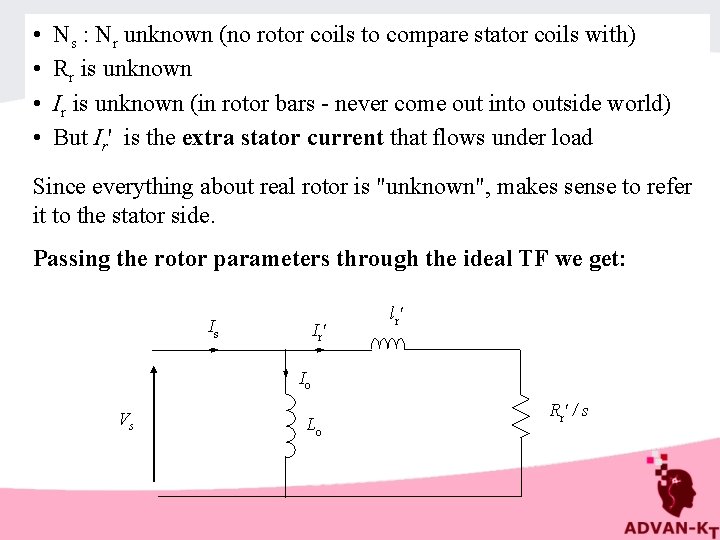
• • Ns : Nr unknown (no rotor coils to compare stator coils with) Rr is unknown Ir is unknown (in rotor bars - never come out into outside world) But Ir' is the extra stator current that flows under load Since everything about real rotor is "unknown", makes sense to refer it to the stator side. Passing the rotor parameters through the ideal TF we get: Is Ir ' lr ' Io Vs Lo Rr ' / s
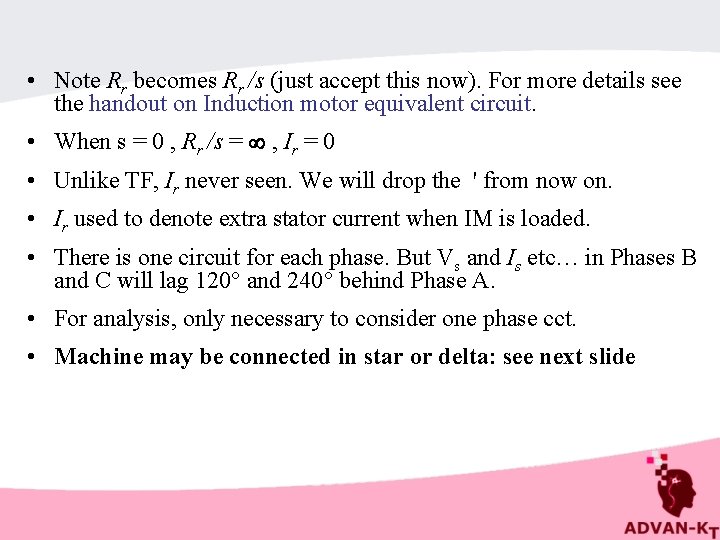
• Note Rr becomes Rr /s (just accept this now). For more details see the handout on Induction motor equivalent circuit. • When s = 0 , Rr /s = , Ir = 0 • Unlike TF, Ir never seen. We will drop the ' from now on. • Ir used to denote extra stator current when IM is loaded. • There is one circuit for each phase. But Vs and Is etc… in Phases B and C will lag 120 and 240 behind Phase A. • For analysis, only necessary to consider one phase cct. • Machine may be connected in star or delta: see next slide
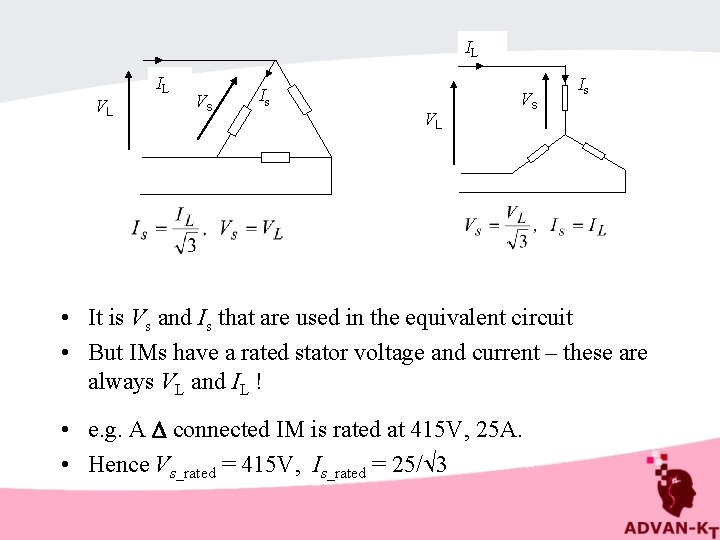
IL IL VL Vs Is • It is Vs and Is that are used in the equivalent circuit • But IMs have a rated stator voltage and current – these are always VL and IL ! • e. g. A connected IM is rated at 415 V, 25 A. • Hence Vs_rated = 415 V, Is_rated = 25/ 3
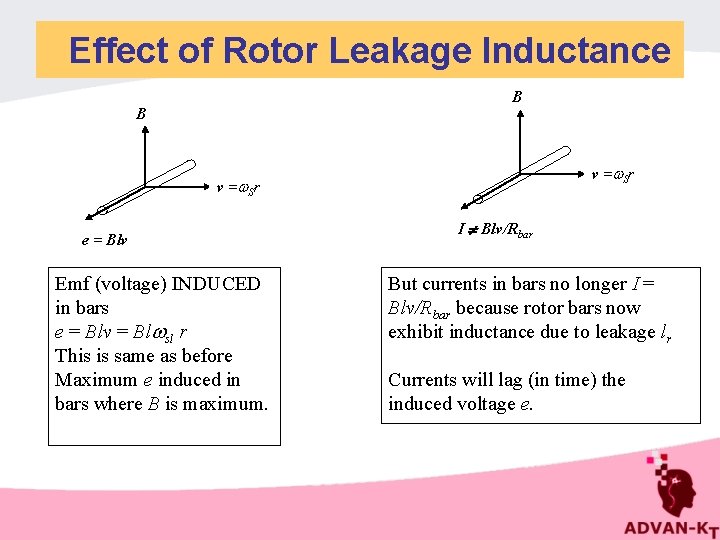
Effect of Rotor Leakage Inductance B B v = Sr e = Blv Emf (voltage) INDUCED in bars e = Blv = Bl sl r This is same as before Maximum e induced in bars where B is maximum. I Blv/Rbar But currents in bars no longer I = Blv/Rbar because rotor bars now exhibit inductance due to leakage lr Currents will lag (in time) the induced voltage e.
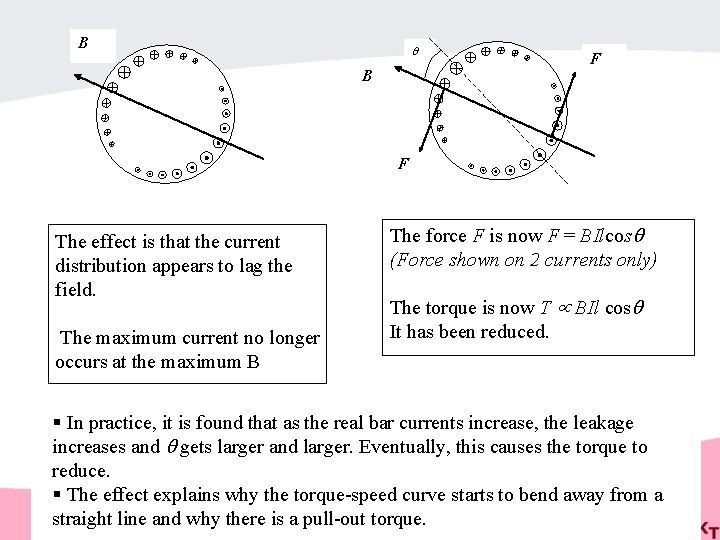
B B F F The effect is that the current distribution appears to lag the field. The maximum current no longer occurs at the maximum B The force F is now F = BIlcos (Force shown on 2 currents only) The torque is now T BIl cos It has been reduced. § In practice, it is found that as the real bar currents increase, the leakage increases and gets larger and larger. Eventually, this causes the torque to reduce. § The effect explains why the torque-speed curve starts to bend away from a straight line and why there is a pull-out torque.
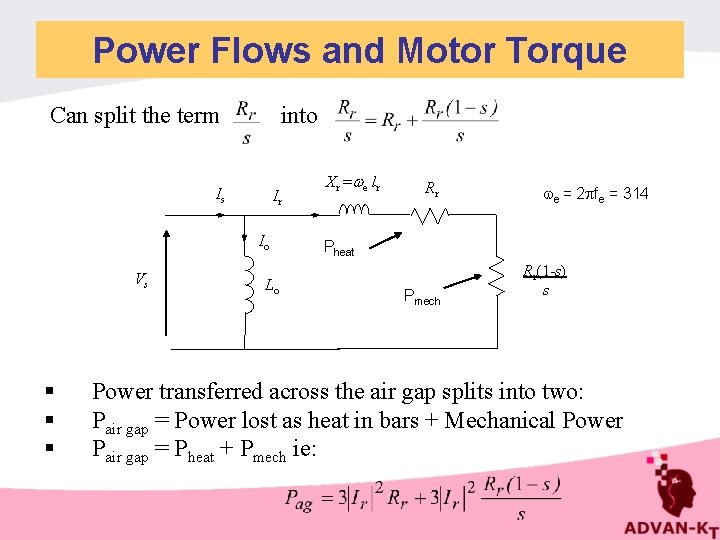
Power Flows and Motor Torque Can split the term into Is Ir Io Vs § § § Lo X r = e l r Rr e = 2 fe = 314 Pheat Pmech Rr(1 -s) s Power transferred across the air gap splits into two: Pair gap = Power lost as heat in bars + Mechanical Power Pair gap = Pheat + Pmech ie:
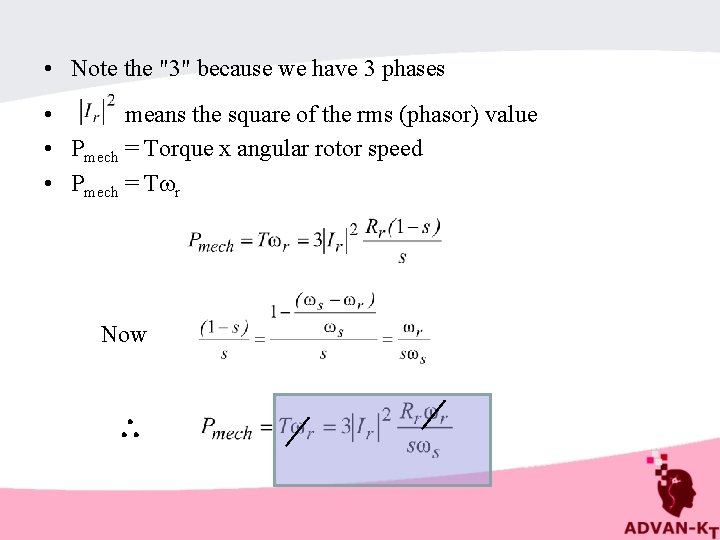
• Note the "3" because we have 3 phases • means the square of the rms (phasor) value • Pmech = Torque x angular rotor speed • Pmech = T r Now
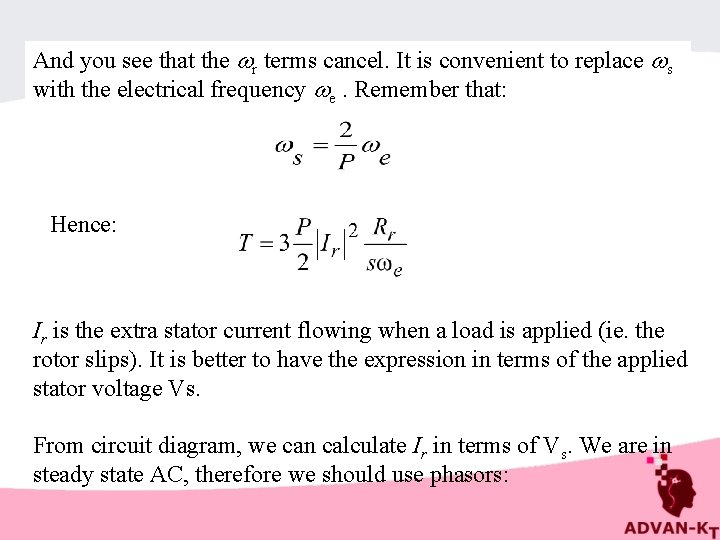
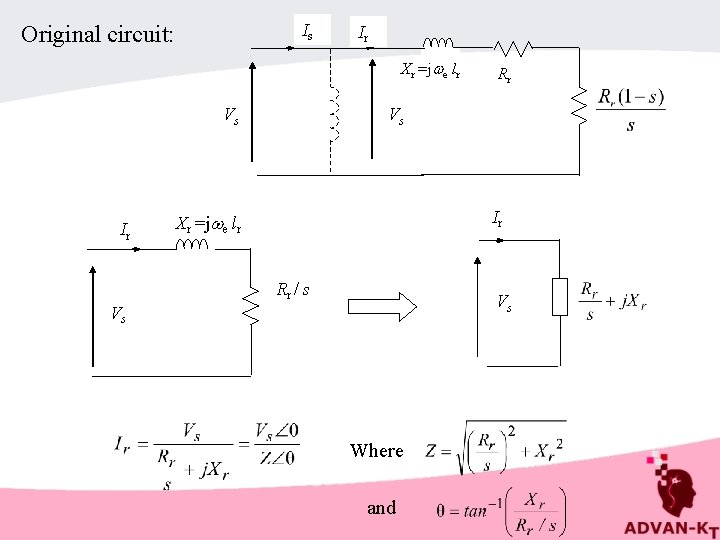
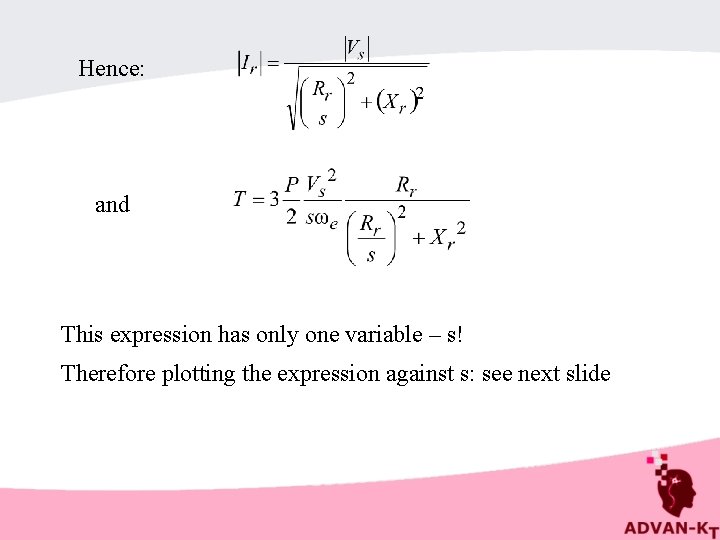
And you see that the r terms cancel. It is convenient to replace s with the electrical frequency e. Remember that: Hence: Ir is the extra stator current flowing when a load is applied (ie. the rotor slips). It is better to have the expression in terms of the applied stator voltage Vs. From circuit diagram, we can calculate Ir in terms of Vs. We are in steady state AC, therefore we should use phasors:
Is Original circuit: Ir Xr =j e lr Vs Ir Rr Vs Ir Xr =j e lr Rr / s Vs Vs Where and
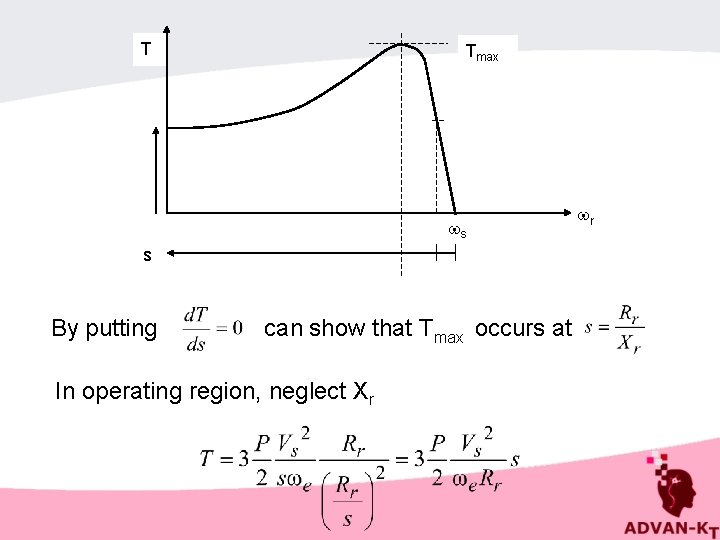
Hence: and This expression has only one variable – s! Therefore plotting the expression against s: see next slide
T Tmax s s By putting can show that Tmax occurs at In operating region, neglect Xr r
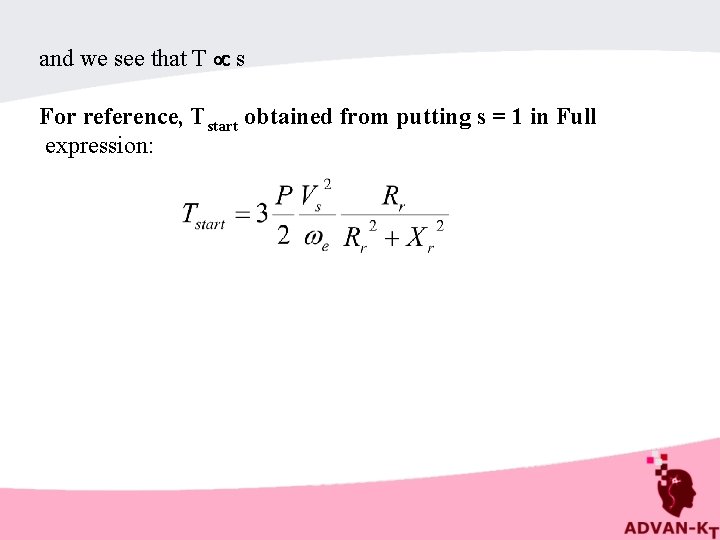
and we see that T s For reference, Tstart obtained from putting s = 1 in Full expression:
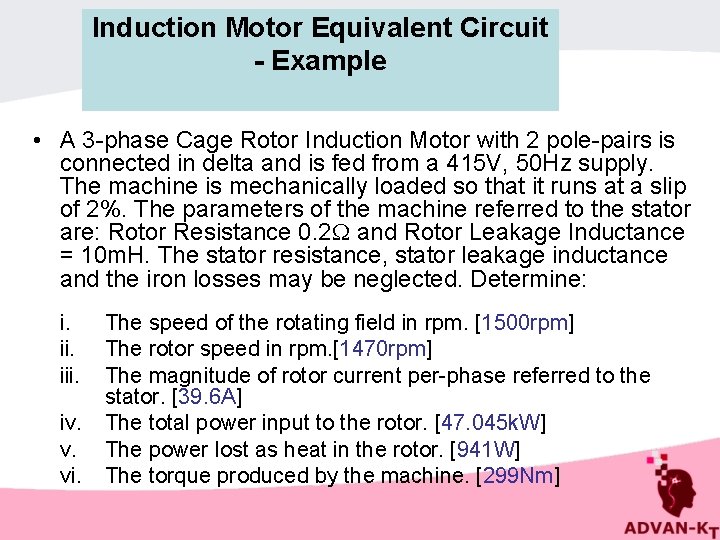
Induction Motor Equivalent Circuit - Example • A 3 -phase Cage Rotor Induction Motor with 2 pole-pairs is connected in delta and is fed from a 415 V, 50 Hz supply. The machine is mechanically loaded so that it runs at a slip of 2%. The parameters of the machine referred to the stator are: Rotor Resistance 0. 2 and Rotor Leakage Inductance = 10 m. H. The stator resistance, stator leakage inductance and the iron losses may be neglected. Determine: i. iii. iv. v. vi. The speed of the rotating field in rpm. [1500 rpm] The rotor speed in rpm. [1470 rpm] The magnitude of rotor current per-phase referred to the stator. [39. 6 A] The total power input to the rotor. [47. 045 k. W] The power lost as heat in the rotor. [941 W] The torque produced by the machine. [299 Nm]
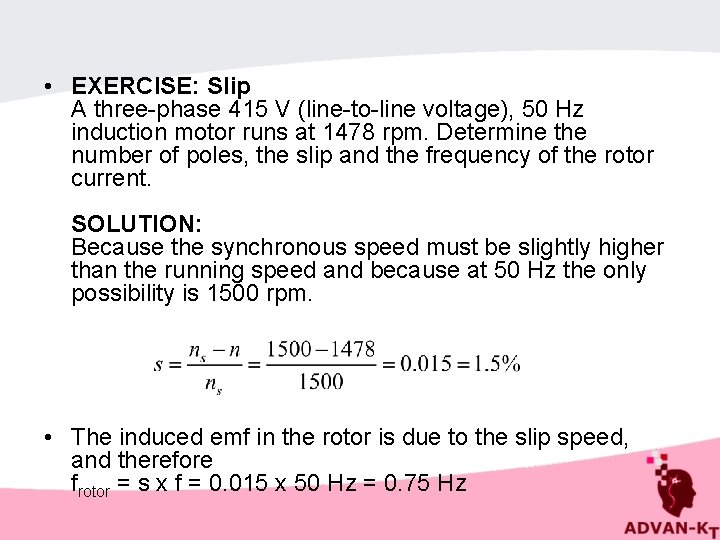
• EXERCISE: Slip A three-phase 415 V (line-to-line voltage), 50 Hz induction motor runs at 1478 rpm. Determine the number of poles, the slip and the frequency of the rotor current. SOLUTION: Because the synchronous speed must be slightly higher than the running speed and because at 50 Hz the only possibility is 1500 rpm. • The induced emf in the rotor is due to the slip speed, and therefore frotor = s x f = 0. 015 x 50 Hz = 0. 75 Hz
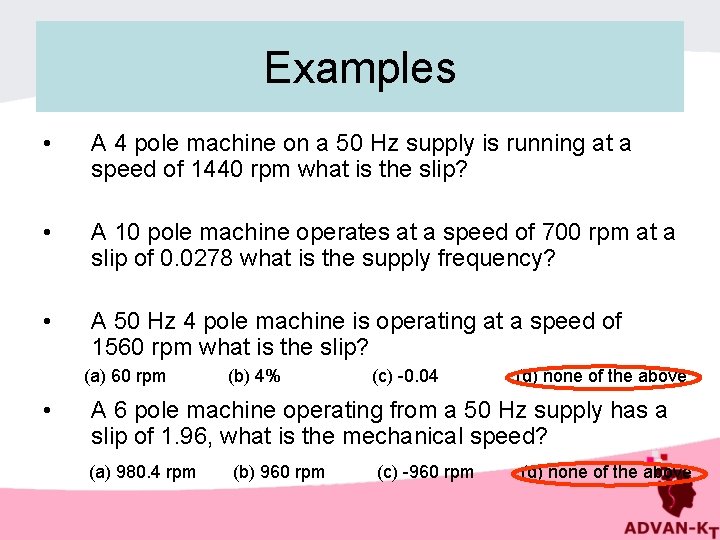
Examples • A 4 pole machine on a 50 Hz supply is running at a speed of 1440 rpm what is the slip? • A 10 pole machine operates at a speed of 700 rpm at a slip of 0. 0278 what is the supply frequency? • A 50 Hz 4 pole machine is operating at a speed of 1560 rpm what is the slip? (a) 60 rpm • (b) 4% (c) -0. 04 (d) none of the above A 6 pole machine operating from a 50 Hz supply has a slip of 1. 96, what is the mechanical speed? (a) 980. 4 rpm (b) 960 rpm (c) -960 rpm (d) none of the above