
Electrical Engineering Comparison of Single Carrier and Multicarrier
- Slides: 27
• Electrical Engineering Comparison of Single Carrier and Multi-carrier (OFDM) PSK transmission schemes in Multi-path Wireless channel Professor : Dr. Pao Lo Liu Teaching Assistant: Saurav Bandyopadhyay Group Members: Asghar Hasnain Anantakrishna Varanasi Pavan Venugopal
• Electrical Engineering Presentation Outline • Understanding Multipath Wireless channel and ISI • OFDM and OFDM Block Diagram • Our approach • MATLAB Implementation – Block by Block explanation • Simulation Results • Conclusion
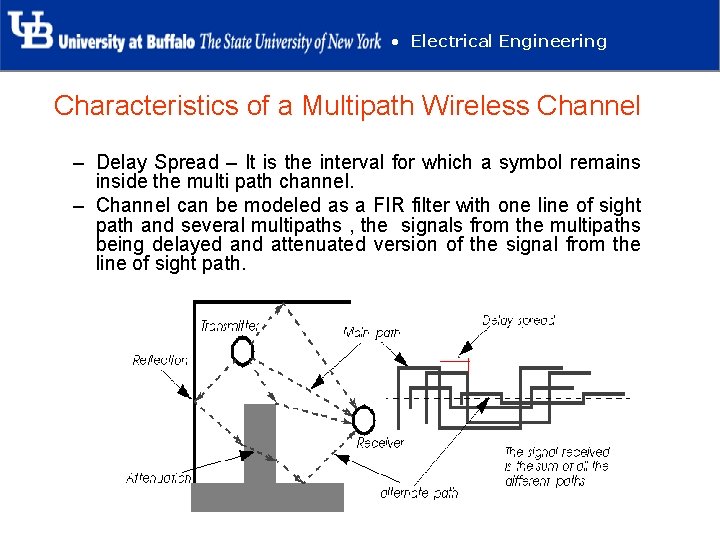
• Electrical Engineering Characteristics of a Multipath Wireless Channel – Delay Spread – It is the interval for which a symbol remains inside the multi path channel. – Channel can be modeled as a FIR filter with one line of sight path and several multipaths , the signals from the multipaths being delayed and attenuated version of the signal from the line of sight path.
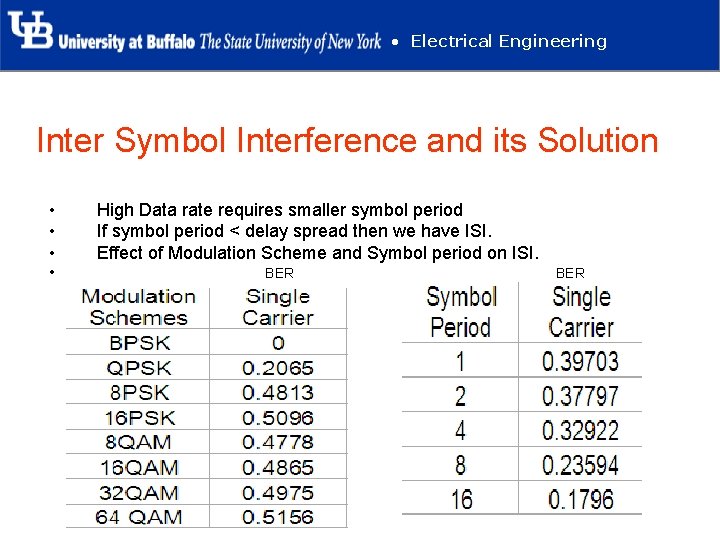
• Electrical Engineering Inter Symbol Interference and its Solution • • High Data rate requires smaller symbol period If symbol period < delay spread then we have ISI. Effect of Modulation Scheme and Symbol period on ISI. BER
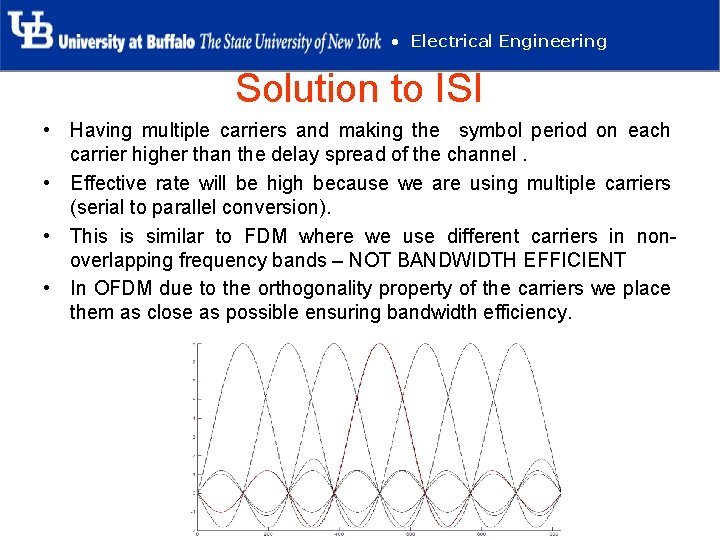
• Electrical Engineering Solution to ISI • Having multiple carriers and making the symbol period on each carrier higher than the delay spread of the channel. • Effective rate will be high because we are using multiple carriers (serial to parallel conversion). • This is similar to FDM where we use different carriers in nonoverlapping frequency bands – NOT BANDWIDTH EFFICIENT • In OFDM due to the orthogonality property of the carriers we place them as close as possible ensuring bandwidth efficiency.
• Electrical Engineering A Qualitative Description of OFDM stands for Orthogonal Frequency Division Multiplexing. • OFDM is based on a parallel data transmission scheme that reduces the effect of multipath fading and makes the use of complex equalizers unnecessary. • OFDM is derived from the fact that the digital data is sent using many carriers, each of a different frequency and these carriers are orthogonal to each other, hence Orthogonal Frequency Division Multiplexing. The frequency spacing of the carriers is chosen in such a way that the modulated carriers are orthogonal and do not interfere with one another.
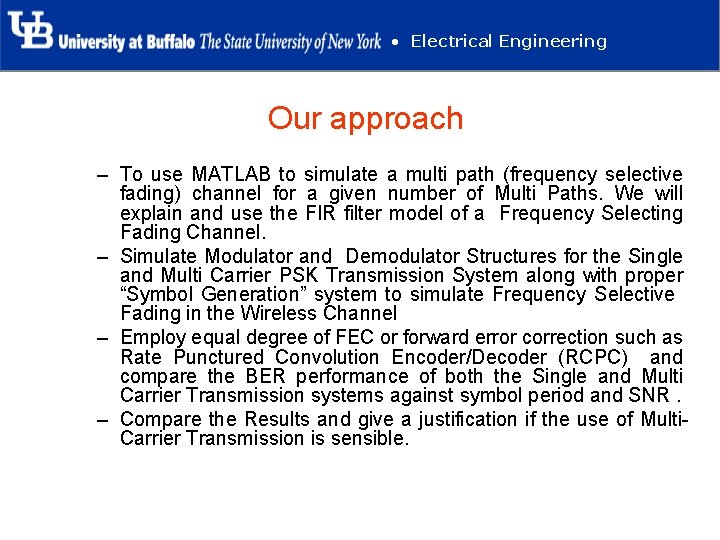
• Electrical Engineering Our approach – To use MATLAB to simulate a multi path (frequency selective fading) channel for a given number of Multi Paths. We will explain and use the FIR filter model of a Frequency Selecting Fading Channel. – Simulate Modulator and Demodulator Structures for the Single and Multi Carrier PSK Transmission System along with proper “Symbol Generation” system to simulate Frequency Selective Fading in the Wireless Channel – Employ equal degree of FEC or forward error correction such as Rate Punctured Convolution Encoder/Decoder (RCPC) and compare the BER performance of both the Single and Multi Carrier Transmission systems against symbol period and SNR. – Compare the Results and give a justification if the use of Multi. Carrier Transmission is sensible.
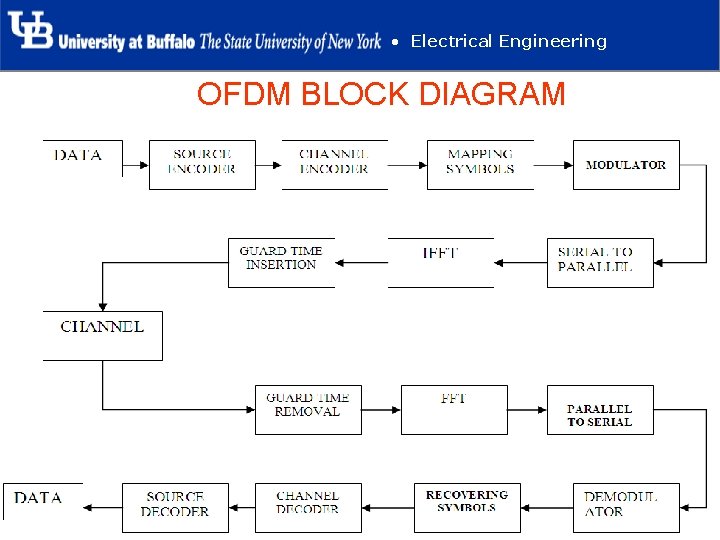
• Electrical Engineering OFDM BLOCK DIAGRAM
• Electrical Engineering Source Encoder / Decoder ENCODER n The data is usually image, wav or text which is converted into binary data bits. n These bits are then padded with zeros such as to form group of bits to create the symbols based on the modulation scheme. DECODER n At the decoder the recovered bits are put back to get back the original source data.
• Electrical Engineering Channel Encoder/Decoder ENCODER n The data is then encoded for the channel based on the channel rate. n We use RCPC ( Rate Compatible Punctured Convolution Codes). n RCPC is used to give different level of protection for the data bits. The channel rates used are (1/3 , 1/2 and 2/3).
• Electrical Engineering Channel Encoder/Decoder. . . contd. • • • DECODER The data recovered is in the form of + 1 and -1 (bipolar form). The bits recovered from demodulator inserted with zeros at the punctured places-- this is the UNQUANT MODE. These bits are then decoded using VITERBI Decoder. We use the standard vitdec ( ) function in MATLAB.
• Electrical Engineering Mapping /Recovering Symbols MAPPING of SYMBOLS n We group the bits based on the modulation method selected by the user to form symbols ready for modulation. n For Multicarrier transmission signal we pad the bits with zeros to make it a multiple of sub- carriers. RECOVERING of SYMBOLS n The bits are recovered from the symbols by unpacking the symbols.
• Electrical Engineering Modulation / Demodulation The symbols are then modulated and demodulated using the different modulation schemes 1. BPSK Modulation 2. QPSK Modulation 3. 8 PSK Modulation 4. 16 PSK Modulation 5. 8 QAM Modulation 6. 16 QAM Modulation 7. 32 QAM Modulation 8. 64 QAM Modulation
• Electrical Engineering Generation of FIR filter model to simulate a multipath fading channel • The function takes in the number of multipaths and the delay spread. • It returns a vector ( our channel ) whose length is equal to the delay spread and the number of non zero coeffcients is the given number of multipaths. • We try to implement a Rician Fading Channel which has a LOS path. • Technically, we should choose our Channel Coefficients from a Rician PDF, but we approximated it using a Raleigh PDF.
• Electrical Engineering Single carrier Transmission Scheme • After the Modulator, we employ the following for Single Carrier Transmission Scheme. • The Modulated Data is Delayed and Multiplied with the associated channel coefficient and added to get the channel output. • This signal is corrupted with noise based on the modulation scheme, with BPSK getting Real Noise and Complex Noise for Other Schemes.
• Electrical Engineering Simulation of a multi-carrier system Transmitter • Using the Spectrum of a Particular symbol we locate the carrier positions in the frequency domain. • We proceed to perform a serial to parallel conversion on the stream of symbols and placing them at the positions of the carriers along with pilot symbols next to them. • We take an IFFT to get the OFDM time signal per block of symbols. We concatenate all the blocks to get the total OFDM time signal • We insert guard time(cyclic prefix) to prevent inter-block interference. • We filter this time signal through an FIR filter and add noise to obtain our received signal
• Electrical Engineering Simulation of a multi-carrier system Receiver • We remove the Guard Band divide the time signal into the OFDM blocks. • For Each Block we take the FFT and locate the symbols on interest and also pilot symbols as per the carrier locations. • We try to Estimate the Channel Frequency Response using the Pilot Symbols and use the same to approximately correct the distortion in the desired symbol.
• Electrical Engineering Pilot Signal Transmission Technique ¢The channel is frequency selective and in order to reconstruct the symbols at the receiver we need the channel response at the position of the symbol. ¢We insert known pilot symbols very next to our symbols and send them through the same channel filter. ¢At the receiver we estimate the channel response by using the pilot symbols and take the frequency response of the channel to be the same at the position of the symbol ¢ We correct the distortion in the symbols of interest using the approximate channel response obtained using pilot symbols.
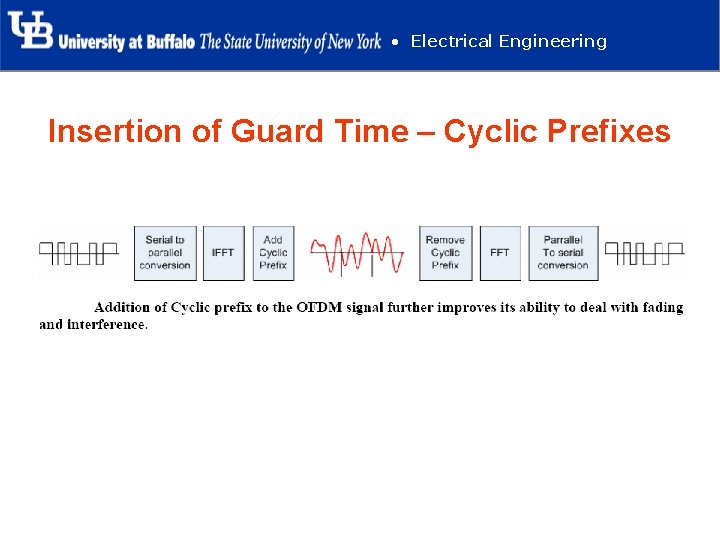
• Electrical Engineering Insertion of Guard Time – Cyclic Prefixes
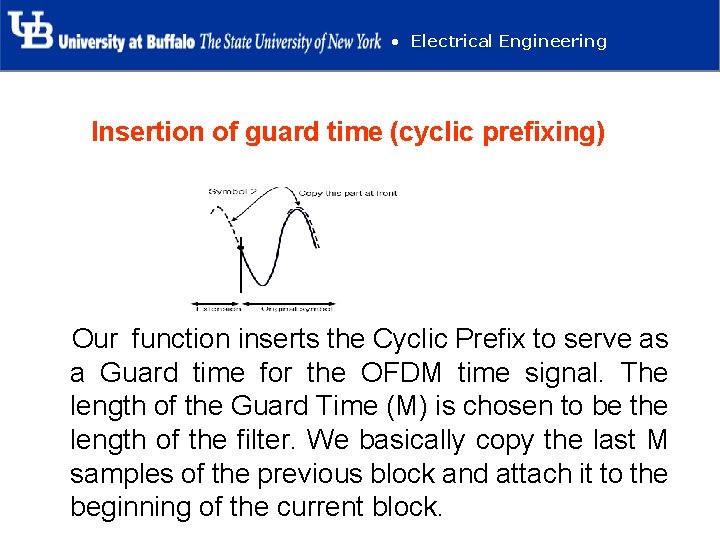
• Electrical Engineering Insertion of guard time (cyclic prefixing) Our function inserts the Cyclic Prefix to serve as a Guard time for the OFDM time signal. The length of the Guard Time (M) is chosen to be the length of the filter. We basically copy the last M samples of the previous block and attach it to the beginning of the current block.
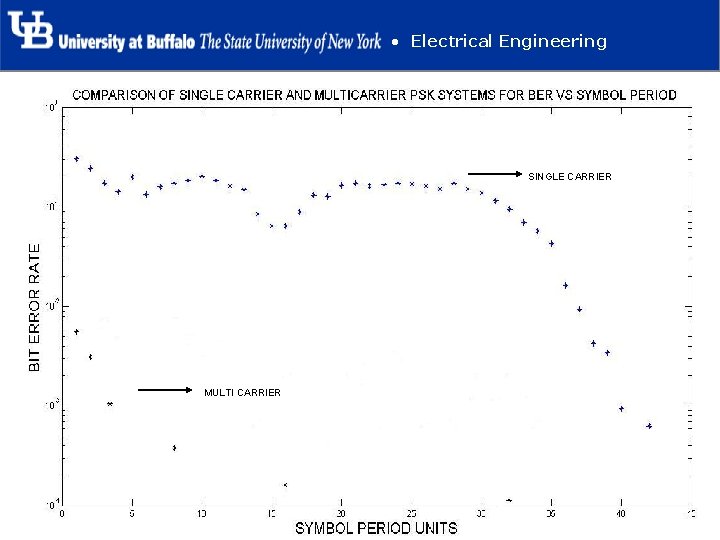
• Electrical Engineering SIMULATION RESULTS SINGLE CARRIER MULTI CARRIER
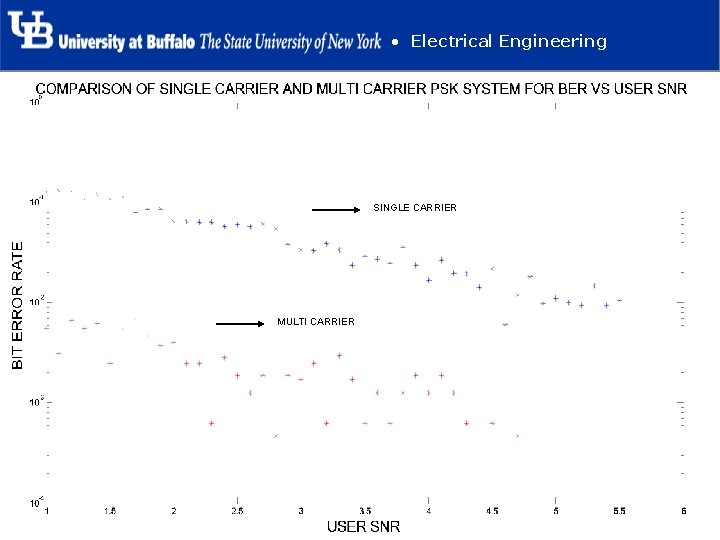
• Electrical Engineering SINGLE CARRIER MULTICARRIER
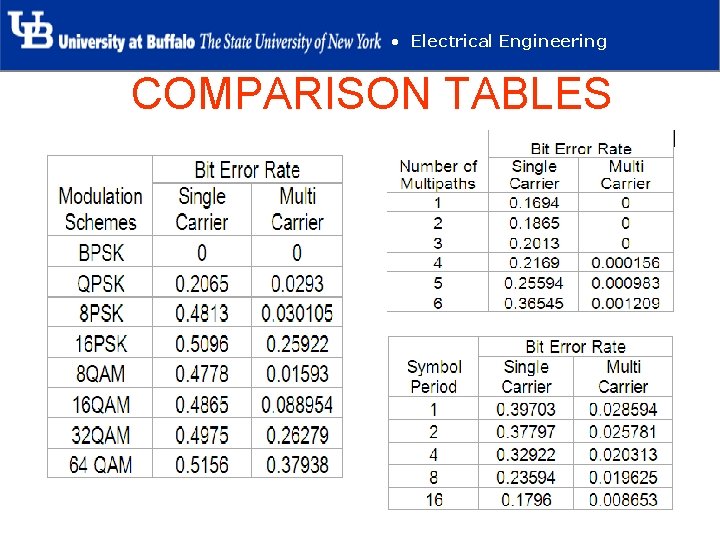
• Electrical Engineering COMPARISON TABLES
• Electrical Engineering
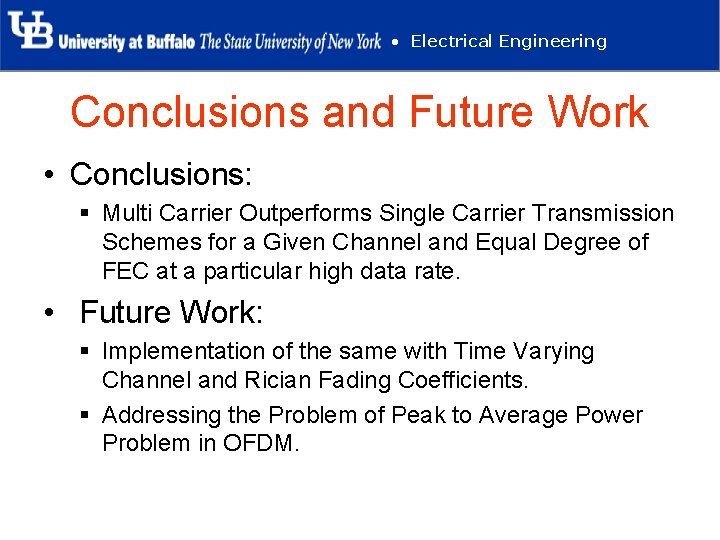
• Electrical Engineering Conclusions and Future Work • Conclusions: § Multi Carrier Outperforms Single Carrier Transmission Schemes for a Given Channel and Equal Degree of FEC at a particular high data rate. • Future Work: § Implementation of the same with Time Varying Channel and Rician Fading Coefficients. § Addressing the Problem of Peak to Average Power Problem in OFDM.
• Electrical Engineering Questions? ?
• Electrical Engineering THANK YOU