
Electrical energy Capacitance Electrical Energy Capacitance 1 work
- Slides: 29
Electrical energy & Capacitance Electrical Energy & Capacitance 1
work… Ø previously… A force is conservative if the work done on an object when moving from A to B does not depend on the path followed. Consequently, work was defined as: W=PEi-PEf=- PE Ø this was derived for a gravitational force, but as we saw in the previous chapter, gravitational and Coulomb forces are very similar: Fg=Gm 1 m 2/r 122 with G=6. 67 x 10 -11 Nm 2/kg 2 Fe=keq 1 q 2/r 122 with ke=8. 99 x 109 Nm 2/C 2 Hence: The Coulomb force is a conservative force Electrical Energy & Capacitance 2
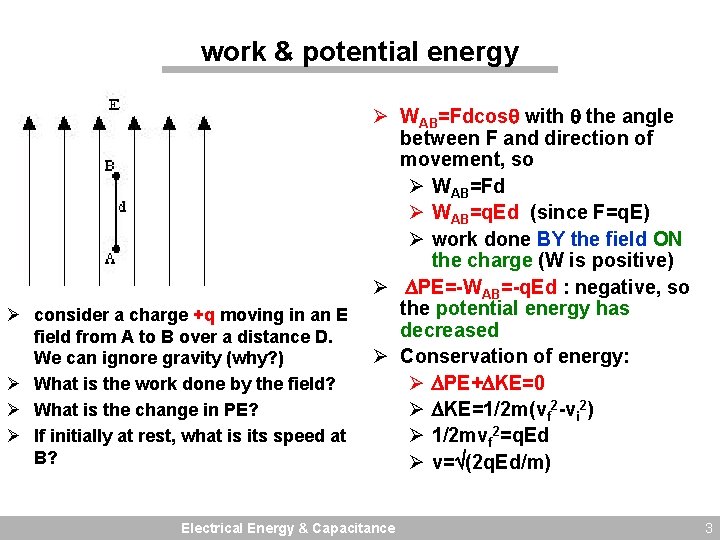
work & potential energy Ø consider a charge +q moving in an E field from A to B over a distance D. We can ignore gravity (why? ) Ø What is the work done by the field? Ø What is the change in PE? Ø If initially at rest, what is its speed at B? Ø WAB=Fdcos with the angle between F and direction of movement, so Ø WAB=Fd Ø WAB=q. Ed (since F=q. E) Ø work done BY the field ON the charge (W is positive) Ø PE=-WAB=-q. Ed : negative, so the potential energy has decreased Ø Conservation of energy: Ø PE+ KE=0 Ø KE=1/2 m(vf 2 -vi 2) Ø 1/2 mvf 2=q. Ed Ø v= (2 q. Ed/m) Electrical Energy & Capacitance 3
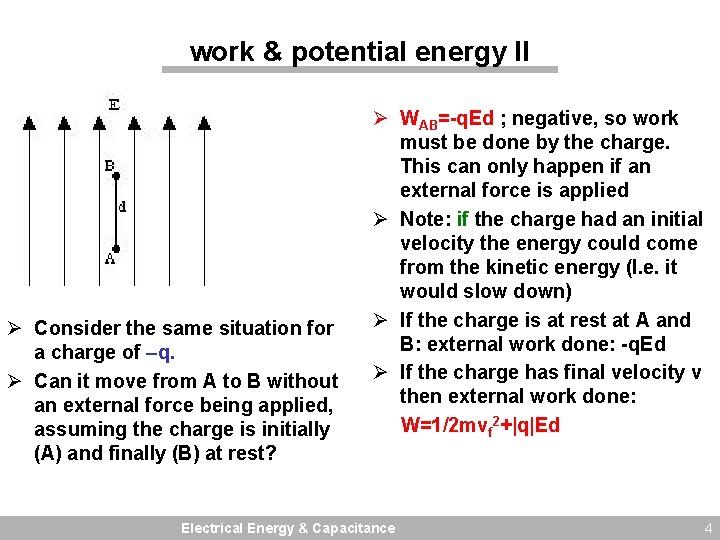
work & potential energy II Ø Consider the same situation for a charge of –q. Ø Can it move from A to B without an external force being applied, assuming the charge is initially (A) and finally (B) at rest? Ø WAB=-q. Ed ; negative, so work must be done by the charge. This can only happen if an external force is applied Ø Note: if the charge had an initial velocity the energy could come from the kinetic energy (I. e. it would slow down) Ø If the charge is at rest at A and B: external work done: -q. Ed Ø If the charge has final velocity v then external work done: W=1/2 mvf 2+|q|Ed Electrical Energy & Capacitance 4
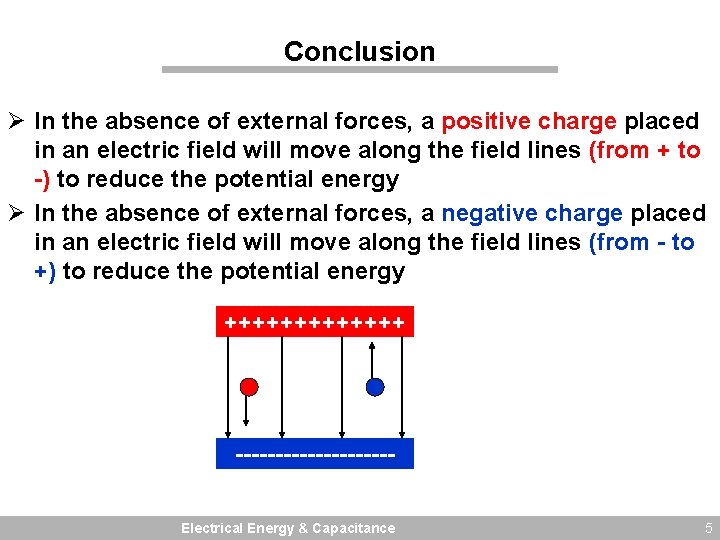
Conclusion Ø In the absence of external forces, a positive charge placed in an electric field will move along the field lines (from + to -) to reduce the potential energy Ø In the absence of external forces, a negative charge placed in an electric field will move along the field lines (from - to +) to reduce the potential energy +++++++ ----------Electrical Energy & Capacitance 5
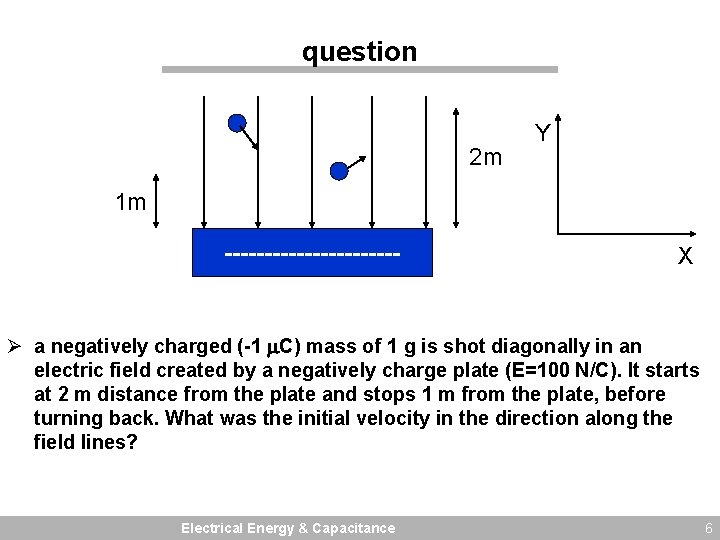
question 2 m Y 1 m ----------- X Ø a negatively charged (-1 C) mass of 1 g is shot diagonally in an electric field created by a negatively charge plate (E=100 N/C). It starts at 2 m distance from the plate and stops 1 m from the plate, before turning back. What was the initial velocity in the direction along the field lines? Electrical Energy & Capacitance 6
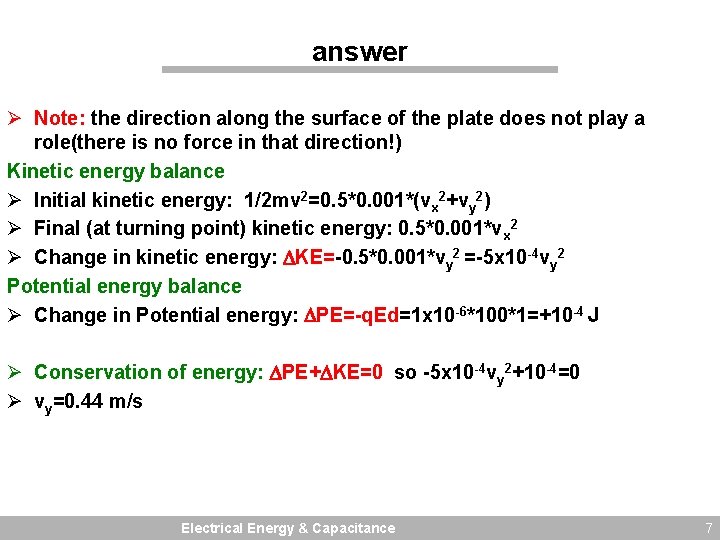
answer Ø Note: the direction along the surface of the plate does not play a role(there is no force in that direction!) Kinetic energy balance Ø Initial kinetic energy: 1/2 mv 2=0. 5*0. 001*(vx 2+vy 2) Ø Final (at turning point) kinetic energy: 0. 5*0. 001*vx 2 Ø Change in kinetic energy: KE=-0. 5*0. 001*vy 2 =-5 x 10 -4 vy 2 Potential energy balance Ø Change in Potential energy: PE=-q. Ed=1 x 10 -6*100*1=+10 -4 J Ø Conservation of energy: PE+ KE=0 so -5 x 10 -4 vy 2+10 -4=0 Ø vy=0. 44 m/s Electrical Energy & Capacitance 7
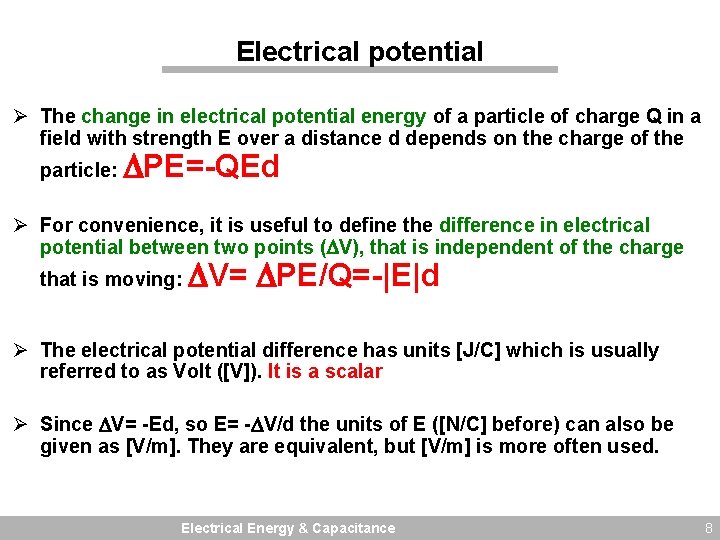
Electrical potential Ø The change in electrical potential energy of a particle of charge Q in a field with strength E over a distance d depends on the charge of the particle: PE=-QEd Ø For convenience, it is useful to define the difference in electrical potential between two points ( V), that is independent of the charge that is moving: V= PE/Q=-|E|d Ø The electrical potential difference has units [J/C] which is usually referred to as Volt ([V]). It is a scalar Ø Since V= -Ed, so E= - V/d the units of E ([N/C] before) can also be given as [V/m]. They are equivalent, but [V/m] is more often used. Electrical Energy & Capacitance 8
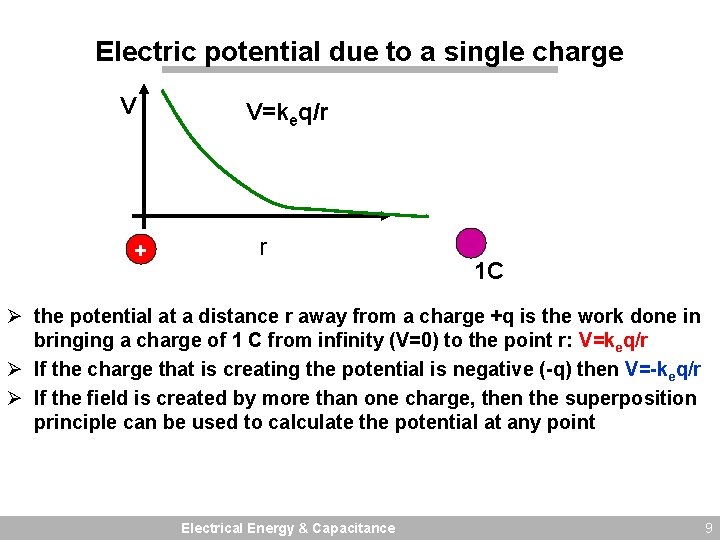
Electric potential due to a single charge V + V=keq/r r 1 C Ø the potential at a distance r away from a charge +q is the work done in bringing a charge of 1 C from infinity (V=0) to the point r: V=keq/r Ø If the charge that is creating the potential is negative (-q) then V=-keq/r Ø If the field is created by more than one charge, then the superposition principle can be used to calculate the potential at any point Electrical Energy & Capacitance 9
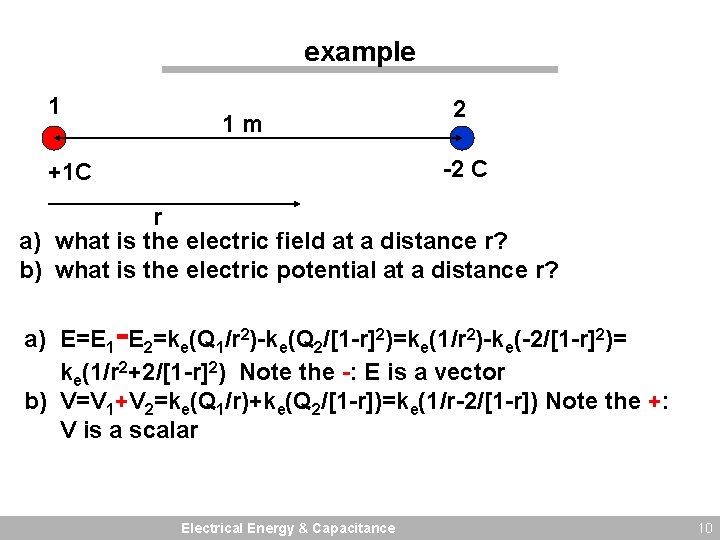
example 1 1 m 2 -2 C +1 C r a) what is the electric field at a distance r? b) what is the electric potential at a distance r? - a) E=E 1 E 2=ke(Q 1/r 2)-ke(Q 2/[1 -r]2)=ke(1/r 2)-ke(-2/[1 -r]2)= ke(1/r 2+2/[1 -r]2) Note the -: E is a vector b) V=V 1+V 2=ke(Q 1/r)+ke(Q 2/[1 -r])=ke(1/r-2/[1 -r]) Note the +: V is a scalar Electrical Energy & Capacitance 10
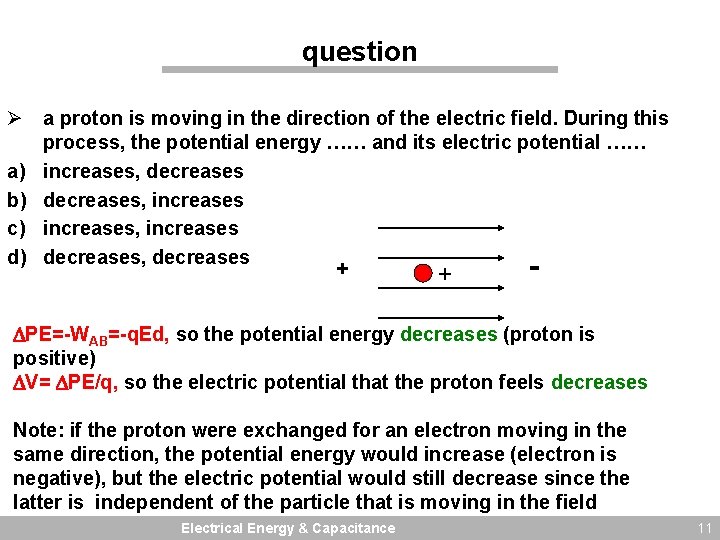
question Ø a proton is moving in the direction of the electric field. During this process, the potential energy …… and its electric potential …… a) increases, decreases b) decreases, increases c) increases, increases d) decreases, decreases + + - PE=-WAB=-q. Ed, so the potential energy decreases (proton is positive) V= PE/q, so the electric potential that the proton feels decreases Note: if the proton were exchanged for an electron moving in the same direction, the potential energy would increase (electron is negative), but the electric potential would still decrease since the latter is independent of the particle that is moving in the field Electrical Energy & Capacitance 11
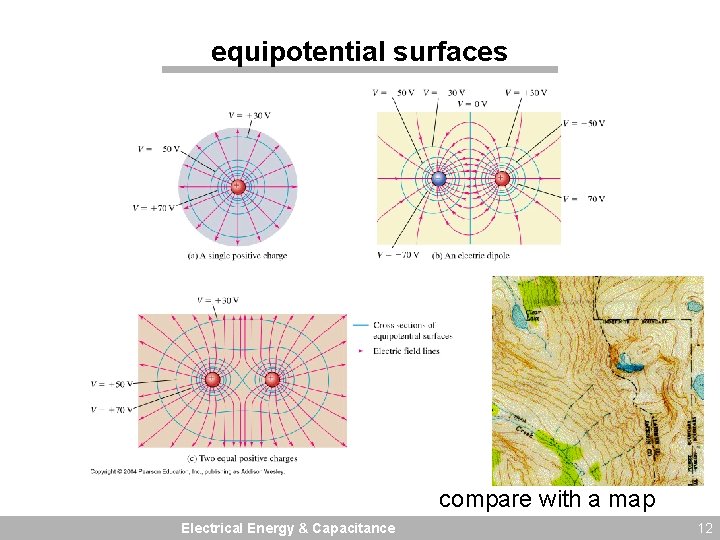
equipotential surfaces compare with a map Electrical Energy & Capacitance 12
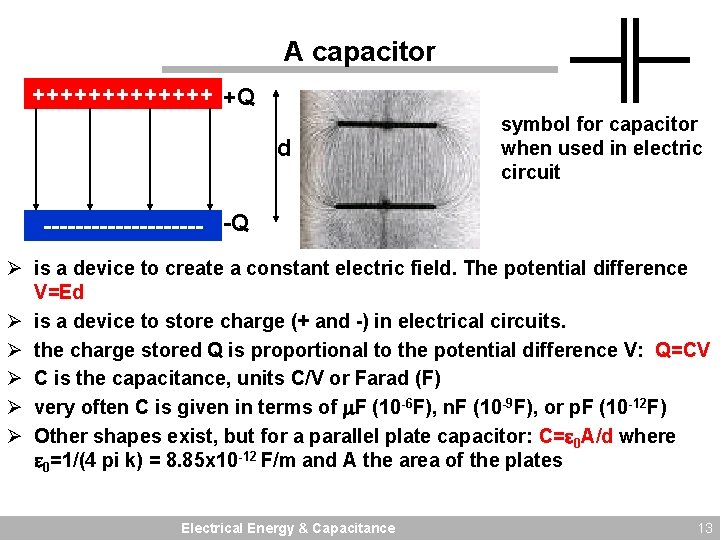
A capacitor +++++++ +Q d symbol for capacitor when used in electric circuit ---------- -Q Ø is a device to create a constant electric field. The potential difference V=Ed Ø is a device to store charge (+ and -) in electrical circuits. Ø the charge stored Q is proportional to the potential difference V: Q=CV Ø C is the capacitance, units C/V or Farad (F) Ø very often C is given in terms of F (10 -6 F), n. F (10 -9 F), or p. F (10 -12 F) Ø Other shapes exist, but for a parallel plate capacitor: C= 0 A/d where 0=1/(4 pi k) = 8. 85 x 10 -12 F/m and A the area of the plates Electrical Energy & Capacitance 13
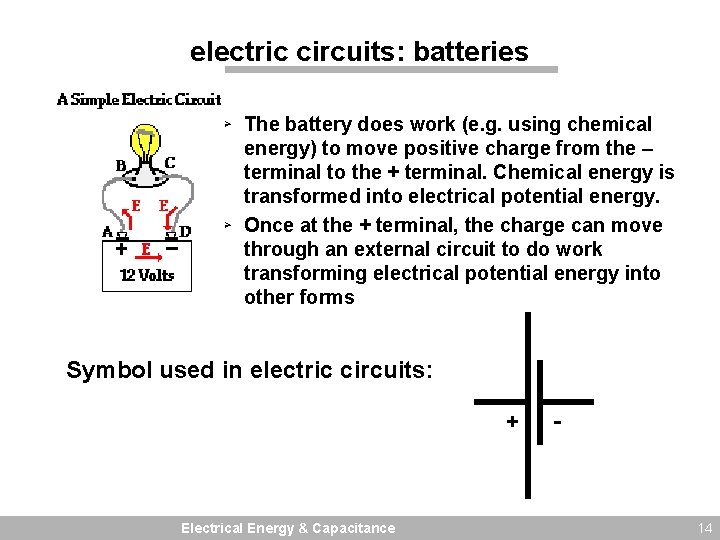
electric circuits: batteries Ø The battery does work (e. g. using chemical energy) to move positive charge from the – terminal to the + terminal. Chemical energy is transformed into electrical potential energy. Ø Once at the + terminal, the charge can move through an external circuit to do work transforming electrical potential energy into other forms Symbol used in electric circuits: + Electrical Energy & Capacitance - 14
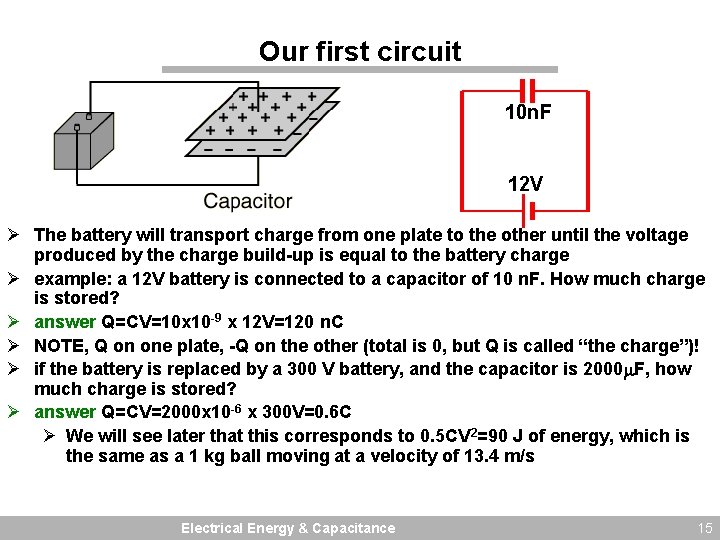
Our first circuit 10 n. F 12 V Ø The battery will transport charge from one plate to the other until the voltage produced by the charge build-up is equal to the battery charge Ø example: a 12 V battery is connected to a capacitor of 10 n. F. How much charge is stored? Ø answer Q=CV=10 x 10 -9 x 12 V=120 n. C Ø NOTE, Q on one plate, -Q on the other (total is 0, but Q is called “the charge”)! Ø if the battery is replaced by a 300 V battery, and the capacitor is 2000 F, how much charge is stored? Ø answer Q=CV=2000 x 10 -6 x 300 V=0. 6 C Ø We will see later that this corresponds to 0. 5 CV 2=90 J of energy, which is the same as a 1 kg ball moving at a velocity of 13. 4 m/s Electrical Energy & Capacitance 15
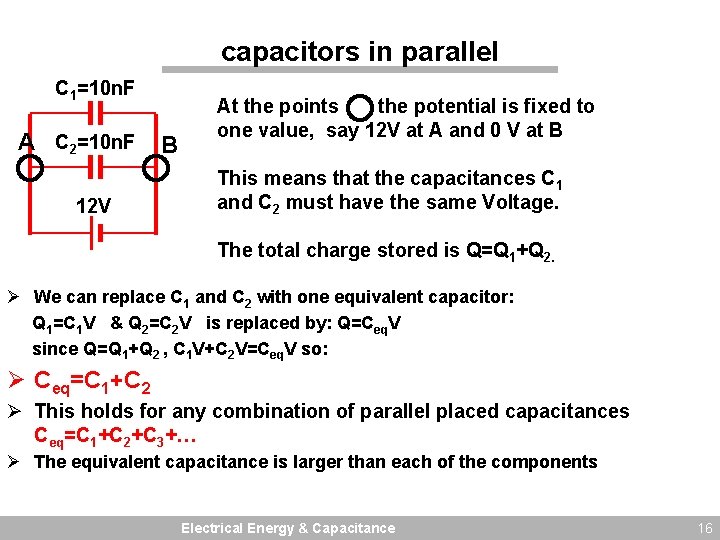
capacitors in parallel C 1=10 n. F A C 2=10 n. F 12 V B At the points the potential is fixed to one value, say 12 V at A and 0 V at B This means that the capacitances C 1 and C 2 must have the same Voltage. The total charge stored is Q=Q 1+Q 2. Ø We can replace C 1 and C 2 with one equivalent capacitor: Q 1=C 1 V & Q 2=C 2 V is replaced by: Q=Ceq. V since Q=Q 1+Q 2 , C 1 V+C 2 V=Ceq. V so: Ø Ceq=C 1+C 2 Ø This holds for any combination of parallel placed capacitances Ceq=C 1+C 2+C 3+… Ø The equivalent capacitance is larger than each of the components Electrical Energy & Capacitance 16
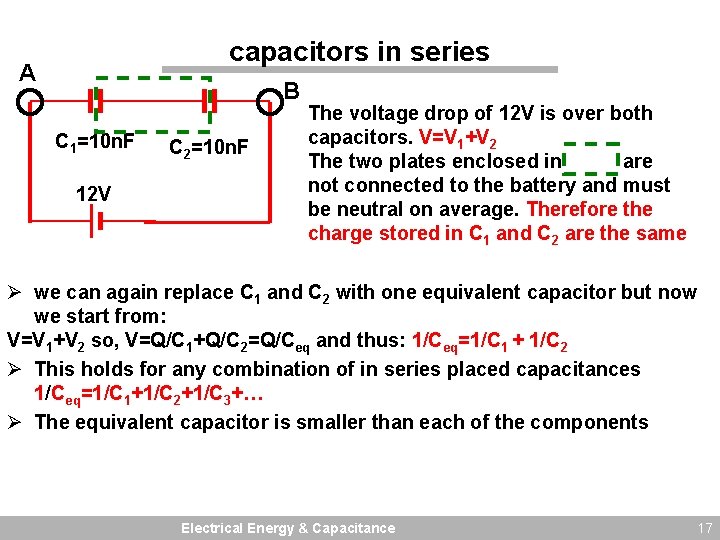
capacitors in series A B C 1=10 n. F 12 V C 2=10 n. F The voltage drop of 12 V is over both capacitors. V=V 1+V 2 The two plates enclosed in are not connected to the battery and must be neutral on average. Therefore the charge stored in C 1 and C 2 are the same Ø we can again replace C 1 and C 2 with one equivalent capacitor but now we start from: V=V 1+V 2 so, V=Q/C 1+Q/C 2=Q/Ceq and thus: 1/Ceq=1/C 1 + 1/C 2 Ø This holds for any combination of in series placed capacitances 1/Ceq=1/C 1+1/C 2+1/C 3+… Ø The equivalent capacitor is smaller than each of the components Electrical Energy & Capacitance 17
question Ø Given three capacitors of 1 n. F, an capacitor can be constructed that has minimally a capacitance of: a) b) c) d) 1/3 n. F 1. 5 n. F 3 n. F The smallest possible is by putting the three in series: 1/Ceq=1/C 1+1/C 2+1/C 3=1+1+1=3 so Ceq=1/3 n. F Electrical Energy & Capacitance 18
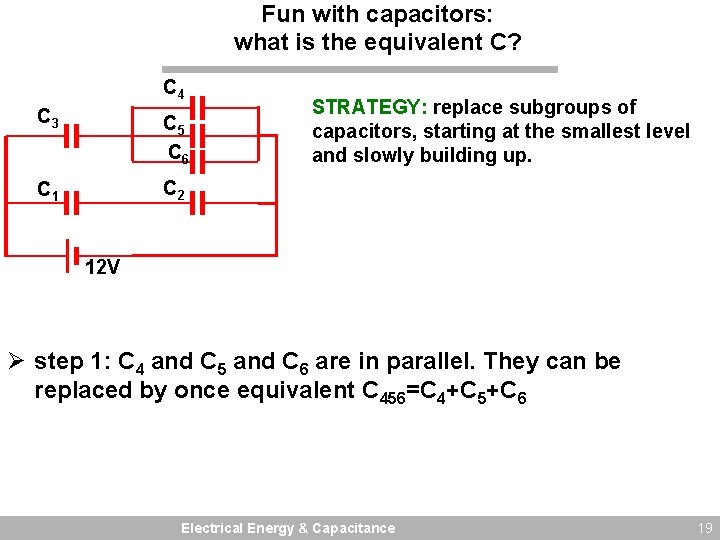
Fun with capacitors: what is the equivalent C? C 4 C 3 C 5 C 6 C 1 C 2 STRATEGY: replace subgroups of capacitors, starting at the smallest level and slowly building up. 12 V Ø step 1: C 4 and C 5 and C 6 are in parallel. They can be replaced by once equivalent C 456=C 4+C 5+C 6 Electrical Energy & Capacitance 19
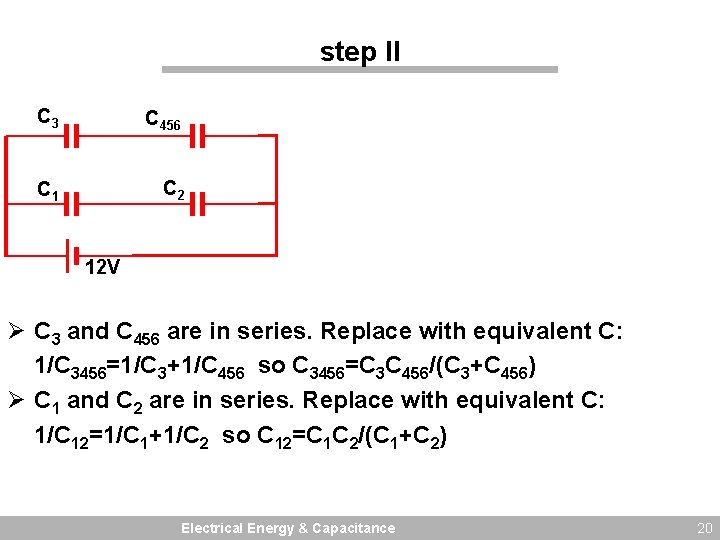
step II C 3 C 456 C 1 C 2 12 V Ø C 3 and C 456 are in series. Replace with equivalent C: 1/C 3456=1/C 3+1/C 456 so C 3456=C 3 C 456/(C 3+C 456) Ø C 1 and C 2 are in series. Replace with equivalent C: 1/C 12=1/C 1+1/C 2 so C 12=C 1 C 2/(C 1+C 2) Electrical Energy & Capacitance 20
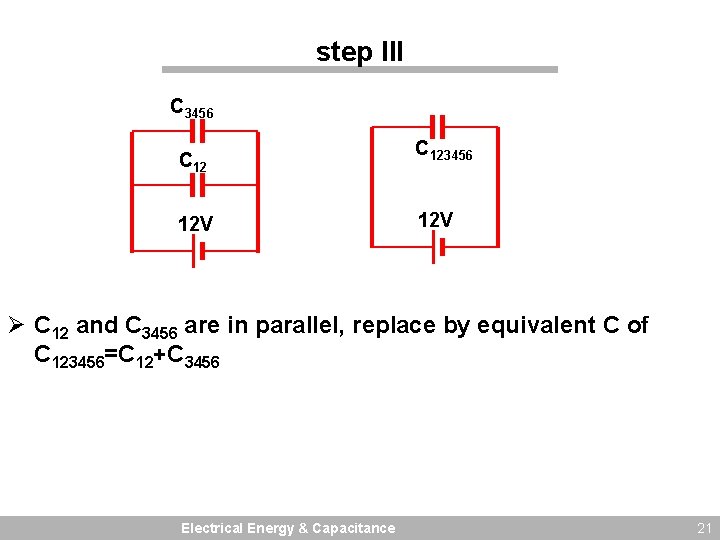
step III C 3456 C 12 12 V C 123456 12 V Ø C 12 and C 3456 are in parallel, replace by equivalent C of C 123456=C 12+C 3456 Electrical Energy & Capacitance 21
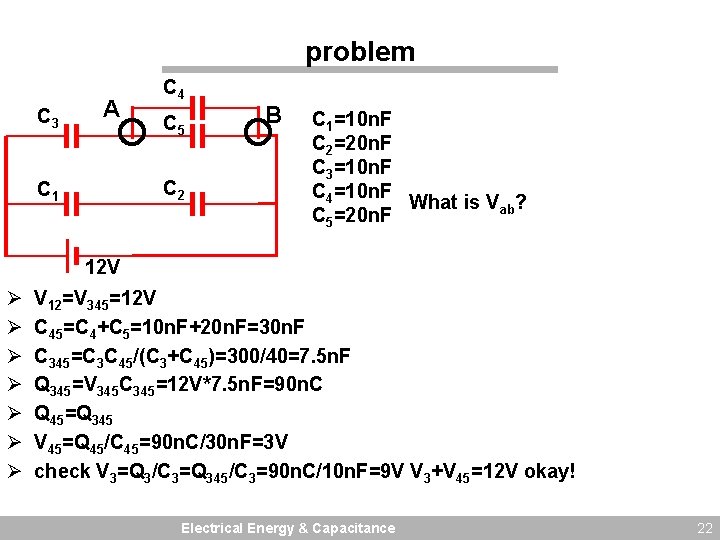
problem C 3 A C 4 C 5 C 2 C 1 B C 1=10 n. F C 2=20 n. F C 3=10 n. F C 4=10 n. F What is Vab? C 5=20 n. F 12 V Ø Ø Ø Ø V 12=V 345=12 V C 45=C 4+C 5=10 n. F+20 n. F=30 n. F C 345=C 3 C 45/(C 3+C 45)=300/40=7. 5 n. F Q 345=V 345 C 345=12 V*7. 5 n. F=90 n. C Q 45=Q 345 V 45=Q 45/C 45=90 n. C/30 n. F=3 V check V 3=Q 3/C 3=Q 345/C 3=90 n. C/10 n. F=9 V V 3+V 45=12 V okay! Electrical Energy & Capacitance 22
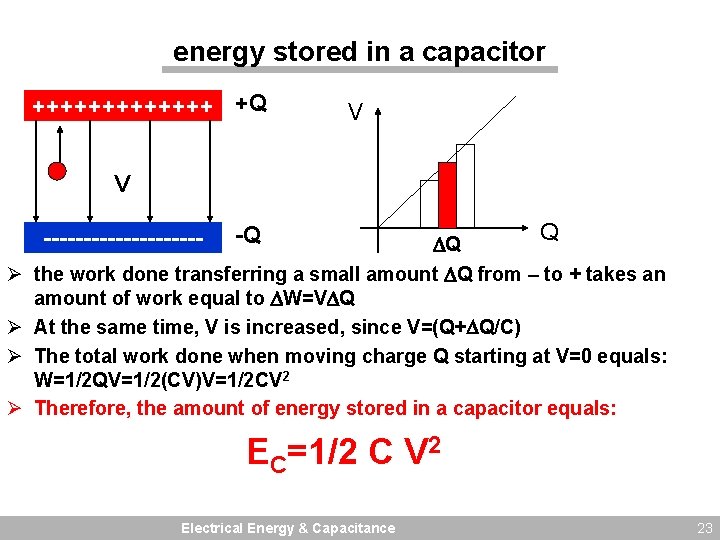
energy stored in a capacitor +++++++ +Q V V ---------- Ø Ø -Q Q Q the work done transferring a small amount Q from – to + takes an amount of work equal to W=V Q At the same time, V is increased, since V=(Q+ Q/C) The total work done when moving charge Q starting at V=0 equals: W=1/2 QV=1/2(CV)V=1/2 CV 2 Therefore, the amount of energy stored in a capacitor equals: EC=1/2 C V 2 Electrical Energy & Capacitance 23
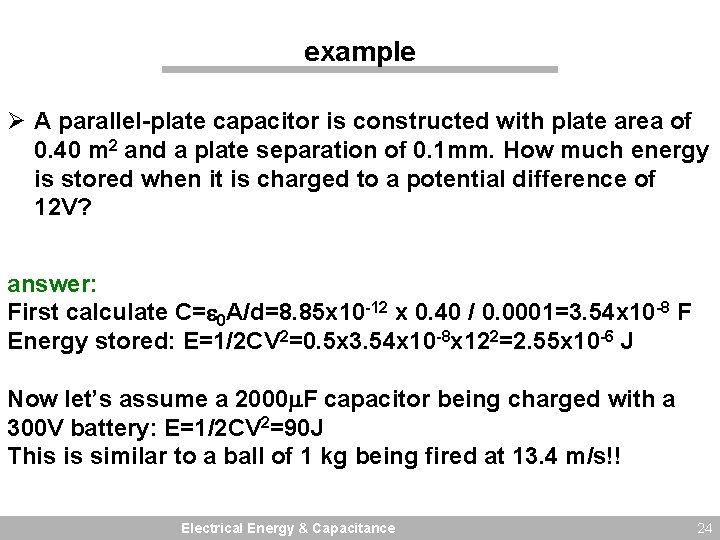
example Ø A parallel-plate capacitor is constructed with plate area of 0. 40 m 2 and a plate separation of 0. 1 mm. How much energy is stored when it is charged to a potential difference of 12 V? answer: First calculate C= 0 A/d=8. 85 x 10 -12 x 0. 40 / 0. 0001=3. 54 x 10 -8 F Energy stored: E=1/2 CV 2=0. 5 x 3. 54 x 10 -8 x 122=2. 55 x 10 -6 J Now let’s assume a 2000 F capacitor being charged with a 300 V battery: E=1/2 CV 2=90 J This is similar to a ball of 1 kg being fired at 13. 4 m/s!! Electrical Energy & Capacitance 24
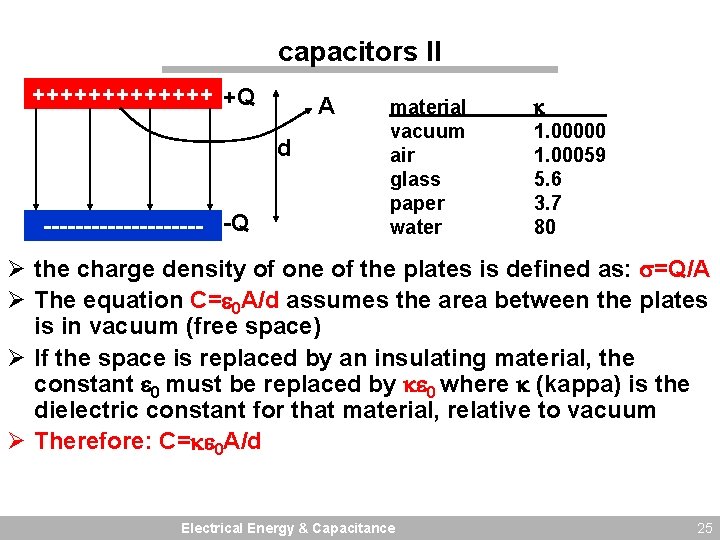
capacitors II +++++++ +Q A d ---------- -Q material vacuum air glass paper water 1. 00000 1. 00059 5. 6 3. 7 80 Ø the charge density of one of the plates is defined as: =Q/A Ø The equation C= 0 A/d assumes the area between the plates is in vacuum (free space) Ø If the space is replaced by an insulating material, the constant 0 must be replaced by 0 where (kappa) is the dielectric constant for that material, relative to vacuum Ø Therefore: C= 0 A/d Electrical Energy & Capacitance 25
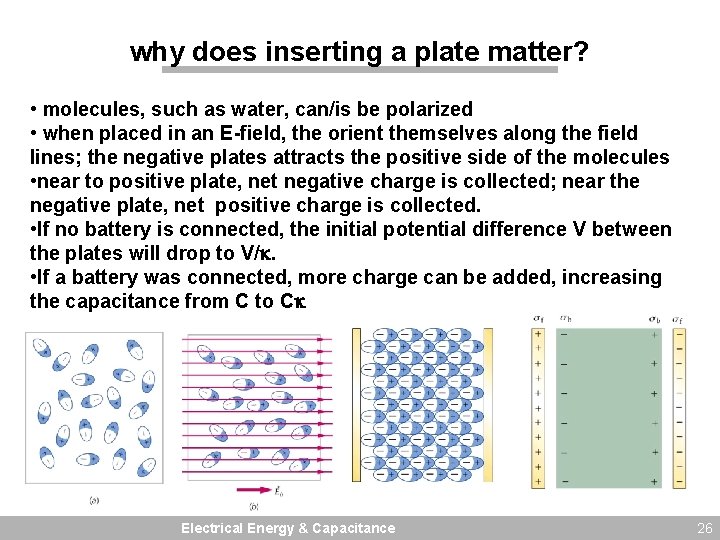
why does inserting a plate matter? • molecules, such as water, can/is be polarized • when placed in an E-field, the orient themselves along the field lines; the negative plates attracts the positive side of the molecules • near to positive plate, net negative charge is collected; near the negative plate, net positive charge is collected. • If no battery is connected, the initial potential difference V between the plates will drop to V/. • If a battery was connected, more charge can be added, increasing the capacitance from C to C Electrical Energy & Capacitance 26
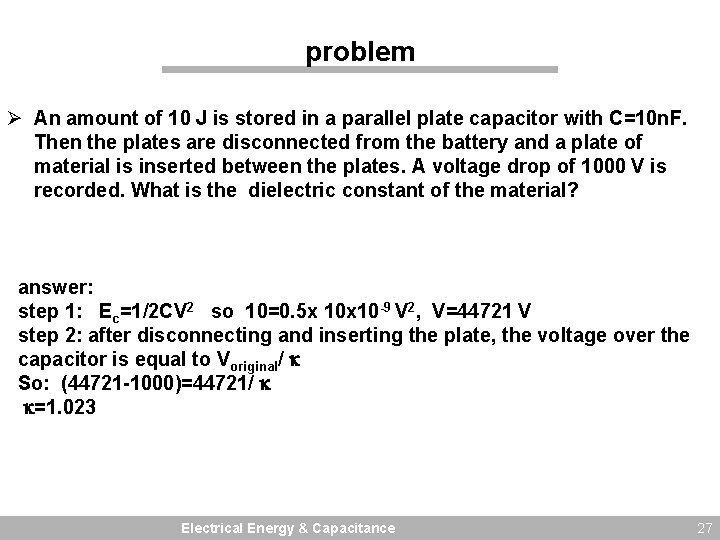
problem Ø An amount of 10 J is stored in a parallel plate capacitor with C=10 n. F. Then the plates are disconnected from the battery and a plate of material is inserted between the plates. A voltage drop of 1000 V is recorded. What is the dielectric constant of the material? answer: step 1: Ec=1/2 CV 2 so 10=0. 5 x 10 -9 V 2, V=44721 V step 2: after disconnecting and inserting the plate, the voltage over the capacitor is equal to Voriginal/ So: (44721 -1000)=44721/ =1. 023 Electrical Energy & Capacitance 27
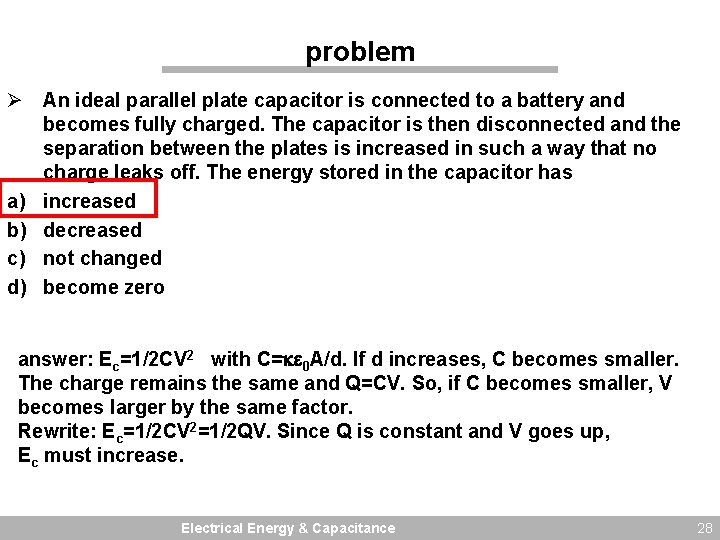
problem Ø An ideal parallel plate capacitor is connected to a battery and becomes fully charged. The capacitor is then disconnected and the separation between the plates is increased in such a way that no charge leaks off. The energy stored in the capacitor has a) increased b) decreased c) not changed d) become zero answer: Ec=1/2 CV 2 with C= 0 A/d. If d increases, C becomes smaller. The charge remains the same and Q=CV. So, if C becomes smaller, V becomes larger by the same factor. Rewrite: Ec=1/2 CV 2=1/2 QV. Since Q is constant and V goes up, Ec must increase. Electrical Energy & Capacitance 28
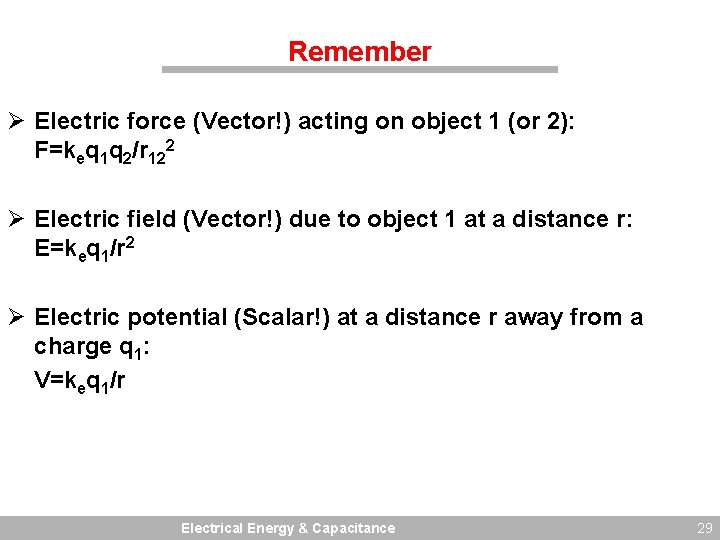
Remember Ø Electric force (Vector!) acting on object 1 (or 2): F=keq 1 q 2/r 122 Ø Electric field (Vector!) due to object 1 at a distance r: E=keq 1/r 2 Ø Electric potential (Scalar!) at a distance r away from a charge q 1: V=keq 1/r Electrical Energy & Capacitance 29