
Electrical current is measured in which of the

- Slides: 28
Electrical current is measured in which of the following units? A. Volts B. Watts C. Ohms D. Amperes T 5 A 01 HRLM (3 - 1)
Electrical current is measured in which of the following units? A. Volts B. Watts C. Ohms D. Amperes (D) T 5 A 01 HRLM (3 - 1)
Electrical power is measured in which of the following units? A. Volts B. Watts C. Ohms D. Amperes T 5 A 02 HRLM (3 - 7)
Electrical power is measured in which of the following units? A. Volts B. Watts C. Ohms D. Amperes (B) T 5 A 02 HRLM (3 - 7)
What is the name for the flow of electrons in an electric circuit? A. Voltage B. Resistance C. Capacitance D. Current T 5 A 03 HRLM (3 - 1)
What is the name for the flow of electrons in an electric circuit? A. Voltage B. Resistance C. Capacitance D. Current (D) T 5 A 03 HRLM (3 - 1)
What is the name for a current that flows only in one direction? A. Alternating current B. Direct current C. Normal current D. Smooth current T 5 A 04 HRLM (3 - 2)
What is the name for a current that flows only in one direction? A. Alternating current B. Direct current C. Normal current D. Smooth current (B) T 5 A 04 HRLM (3 - 2)
What is the electrical term for the electromotive force (EMF) that causes electron flow? A. Voltage B. Ampere-hours C. Capacitance D. Inductance T 5 A 05 HRLM (3 - 1)
What is the electrical term for the electromotive force (EMF) that causes electron flow? A. Voltage B. Ampere-hours C. Capacitance D. Inductance (A) T 5 A 05 HRLM (3 - 1)
How much voltage does a mobile transceiver typically require? A. About 12 volts B. About 30 volts C. About 120 volts D. About 240 volts T 5 A 06 HRLM (5 - 16)
How much voltage does a mobile transceiver typically require? A. About 12 volts B. About 30 volts C. About 120 volts D. About 240 volts (A) T 5 A 06 HRLM (5 - 16)
Which of the following is a good electrical conductor? A. Glass B. Wood C. Copper D. Rubber T 5 A 07 HRLM (3 - 5)
Which of the following is a good electrical conductor? A. Glass B. Wood C. Copper D. Rubber (C) T 5 A 07 HRLM (3 - 5)
Which of the following is a good electrical insulator? A. Copper B. Glass C. Aluminum D. Mercury T 5 A 08 HRLM (3 - 5)
Which of the following is a good electrical insulator? A. Copper B. Glass C. Aluminum D. Mercury (B) T 5 A 08 HRLM (3 - 5)
What is the name for a current that reverses direction on a regular basis? A. Alternating current B. Direct current C. Circular current D. Vertical current T 5 A 09 HRLM (3 - 2)
What is the name for a current that reverses direction on a regular basis? A. Alternating current B. Direct current C. Circular current D. Vertical current (A) T 5 A 09 HRLM (3 - 2)
Which term describes the rate at which electrical energy is used? A. Resistance B. Current C. Power D. Voltage T 5 A 10 HRLM (3 - 7)
Which term describes the rate at which electrical energy is used? A. Resistance B. Current C. Power D. Voltage (C) T 5 A 10 HRLM (3 - 7)
What is the unit of electromotive force? A. The volt B. The watt C. The ampere D. The ohm T 5 A 11 HRLM (3 - 2)
What is the unit of electromotive force? A. The volt B. The watt C. The ampere D. The ohm (A) T 5 A 11 HRLM (3 - 2)
What describes the number of times per second that an alternating current makes a complete cycle? A. Pulse rate B. Speed C. Wavelength D. Frequency T 5 A 12 HRLM (2 - 3)
What describes the number of times per second that an alternating current makes a complete cycle? A. Pulse rate B. Speed C. Wavelength D. Frequency (D) T 5 A 12 HRLM (2 - 3)
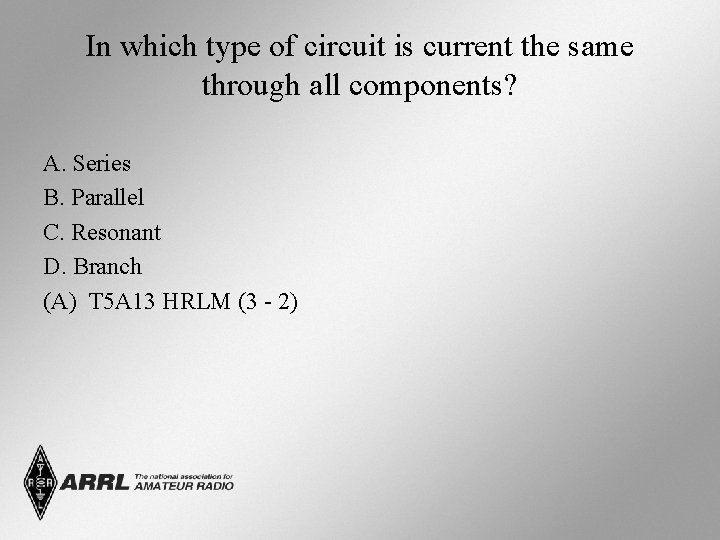
In which type of circuit is current the same through all components? A. Series B. Parallel C. Resonant D. Branch T 5 A 13 HRLM (3 - 2)
In which type of circuit is current the same through all components? A. Series B. Parallel C. Resonant D. Branch (A) T 5 A 13 HRLM (3 - 2)
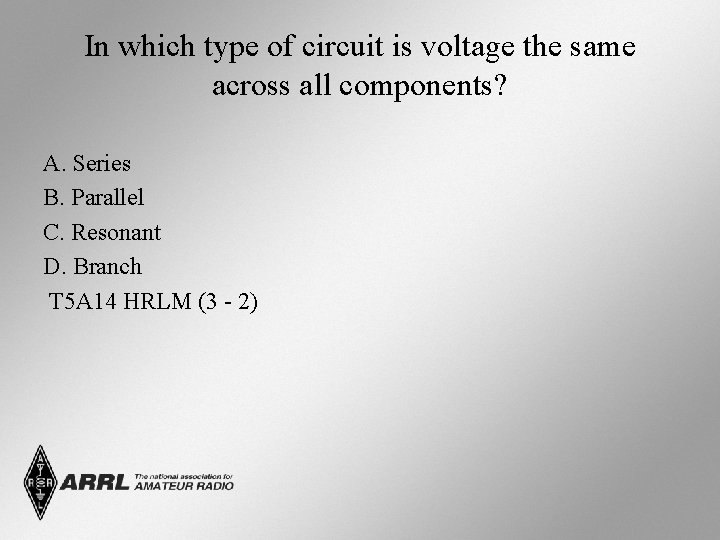
In which type of circuit is voltage the same across all components? A. Series B. Parallel C. Resonant D. Branch T 5 A 14 HRLM (3 - 2)
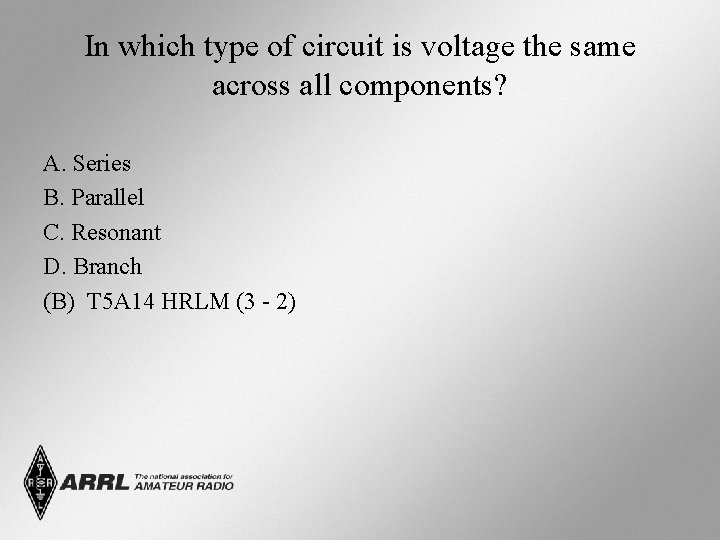
In which type of circuit is voltage the same across all components? A. Series B. Parallel C. Resonant D. Branch (B) T 5 A 14 HRLM (3 - 2)