
Electrical components and systems Topic 9 Lighting systems





- Slides: 40
Electrical components and systems Topic 9 – Lighting systems All copyright and intellectual property rights in respect of materials developed by the service provider during this project will vest in the Department of Higher Education and Training, which will have the right to allow any individual, company, agency or organisation to use or modify the materials for any purpose approved by this Department, including selling the materials or releasing them as Open Educational Resources (OER) under an appropriate copyright license.
Light switching and circuit testing Unit 9. 1
Assumed prior learning • Electrical components (circuit protection). • Wire a circuit. • Don’t feel confident yet about these topics? Click on each to review the content. • Feeling confident? Click next to proceed with this unit.
Outcomes • Explain the different types of light switching. • Understand interpret all symbols used in a circuit diagram. • Wire a two-way switch. • Wire an intermediate switch. • Test a circuit using a bell tester.
Introduction Lighting systems are essential in modern society. In this lesson we focus on the different ways lights can be wired and get to grips with circuit diagrams.
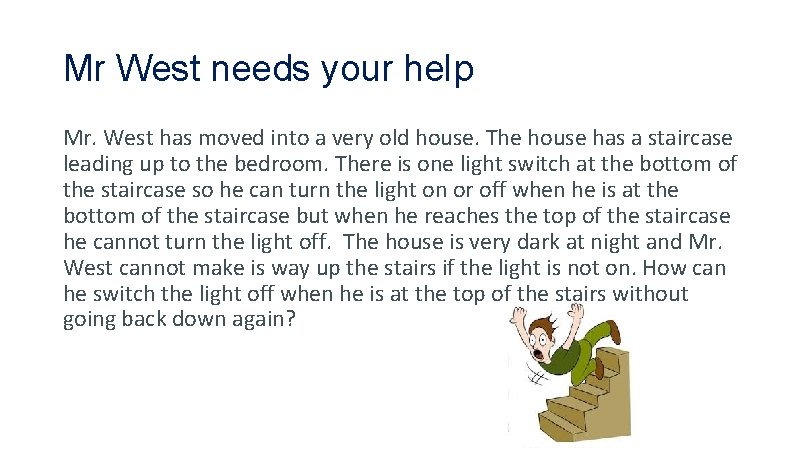
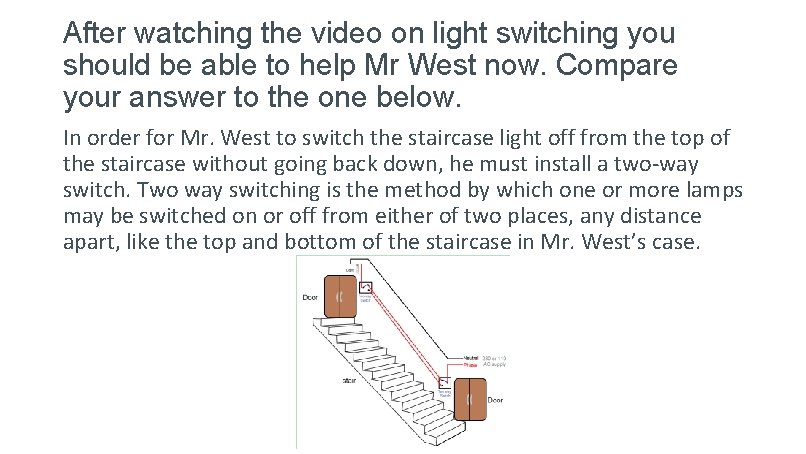
Mr West needs your help Mr. West has moved into a very old house. The house has a staircase leading up to the bedroom. There is one light switch at the bottom of the staircase so he can turn the light on or off when he is at the bottom of the staircase but when he reaches the top of the staircase he cannot turn the light off. The house is very dark at night and Mr. West cannot make is way up the stairs if the light is not on. How can he switch the light off when he is at the top of the stairs without going back down again?
To solve Mr. West’s problem you will need to know more about light switches and circuits. We go over that first and then help him a little later on when we have a much better understanding of light switching.
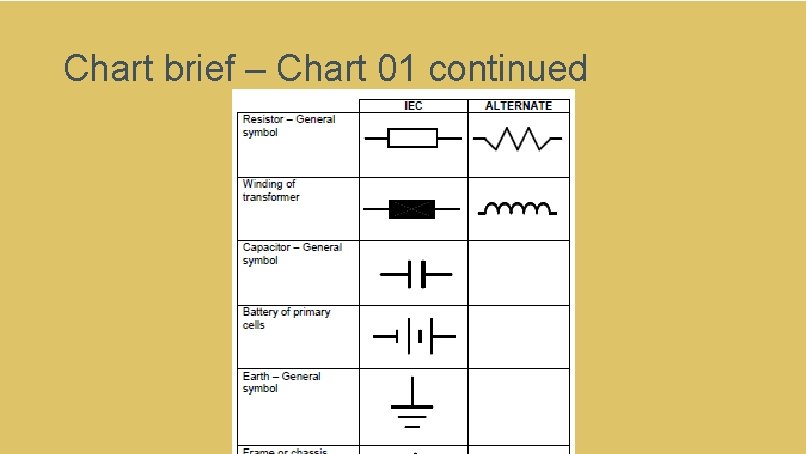
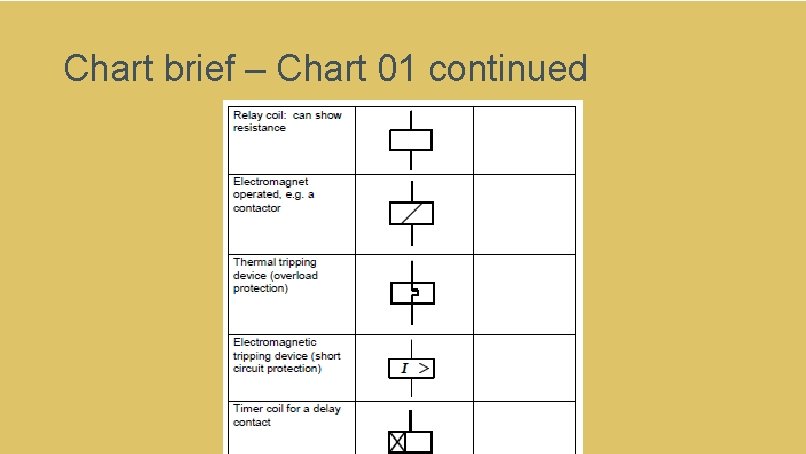
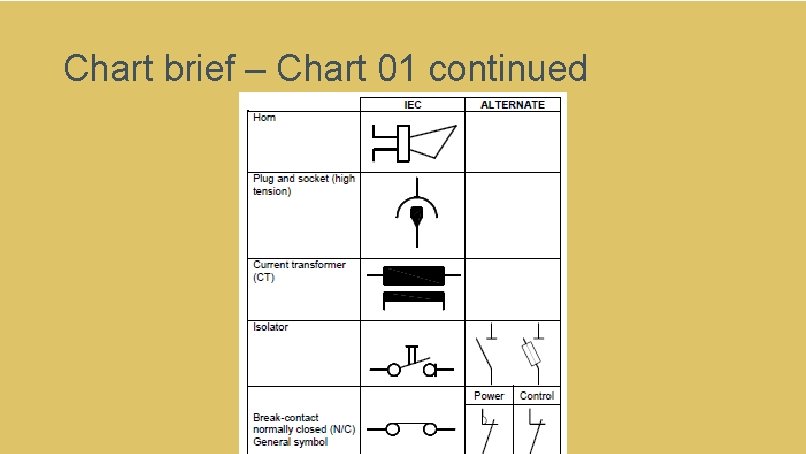
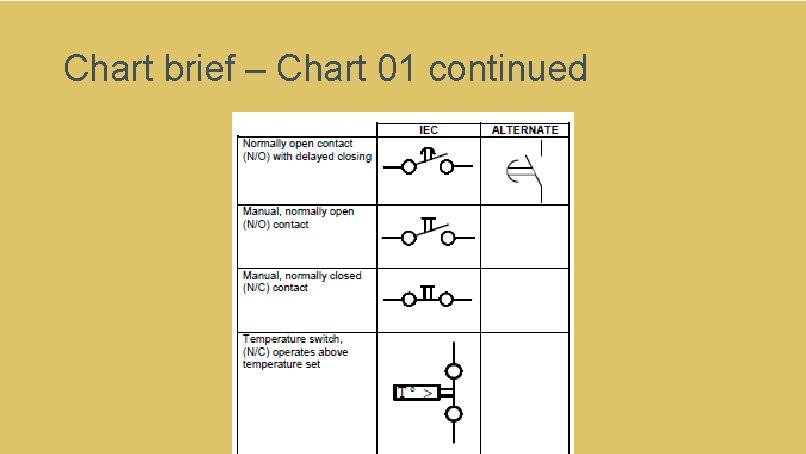
Standard symbols In order for you to read and understand a circuit diagram, you must be able to identify electrical equipment and components from the symbols that are used. There are many different symbols you need to recognise, rather than memorizing the symbols make sure you understand them and it will be easier to recall. View the chart by clicking below for DIN and IEC symbols commonly used. STANDARD SYMBOLS
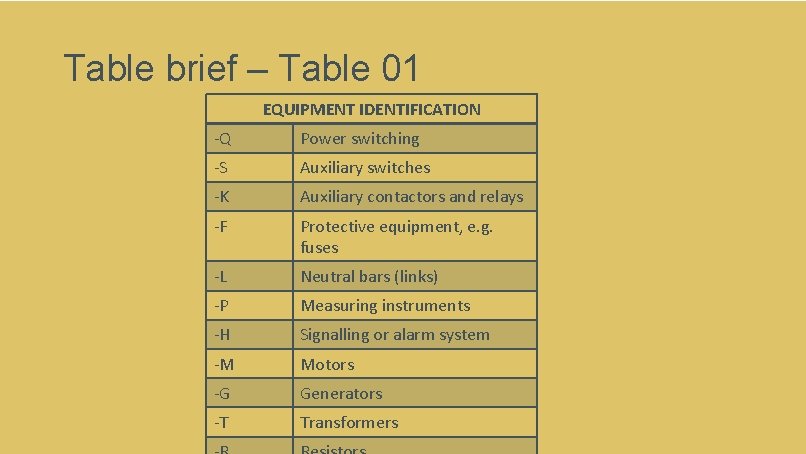
Equipment identification Equipment and components can also be identified by a minus sign and a capital letter, click the button below to view the standard identification. EQUIPMENT IDENTIFICATION
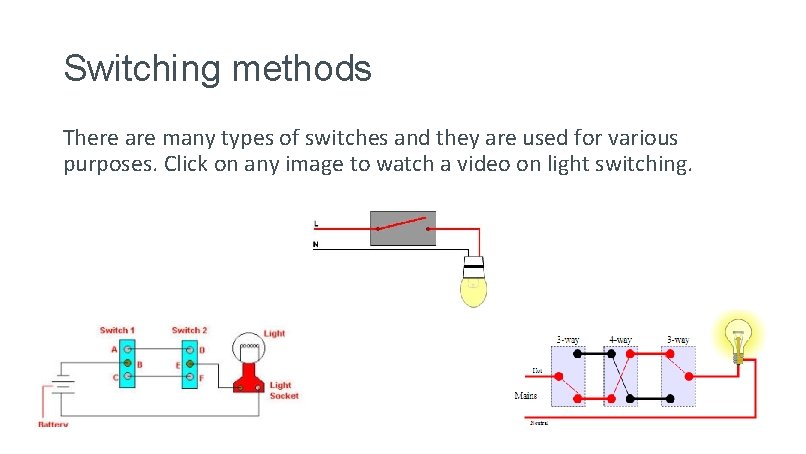
Switching methods There are many types of switches and they are used for various purposes. Click on any image to watch a video on light switching.
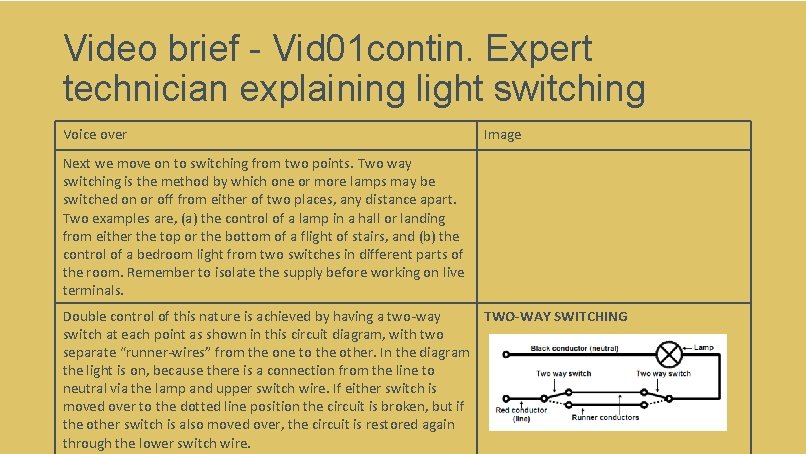
After watching the video on light switching you should be able to help Mr West now. Compare your answer to the one below. In order for Mr. West to switch the staircase light off from the top of the staircase without going back down, he must install a two-way switch. Two way switching is the method by which one or more lamps may be switched on or off from either of two places, any distance apart, like the top and bottom of the staircase in Mr. West’s case.
Quiz time Test your understanding of light switching and circuit diagrams by answering the following questions.
Question 1 What component or piece of equipment does -M identify? a) b) c) d) Power switching Motors Measuring instruments Mechanical equipment
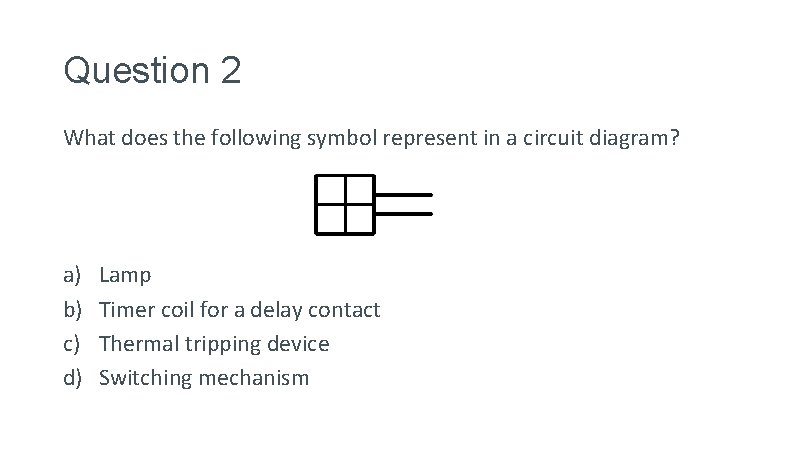
Question 2 What does the following symbol represent in a circuit diagram? a) b) c) d) Lamp Timer coil for a delay contact Thermal tripping device Switching mechanism
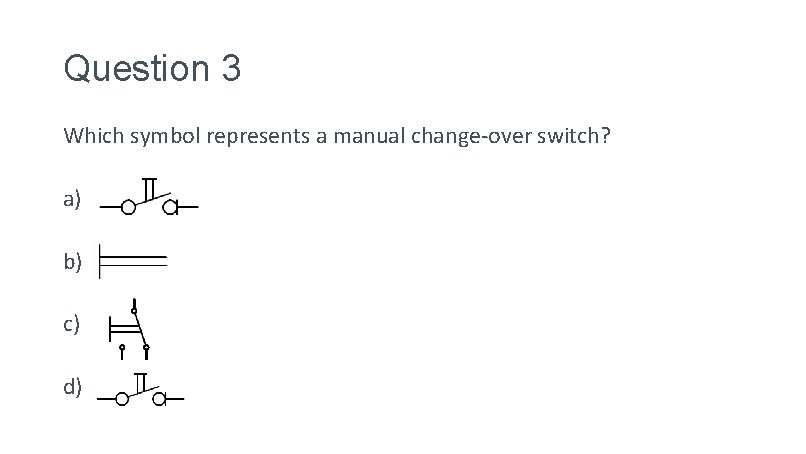
Question 3 Which symbol represents a manual change-over switch? a) Img b) Img c) Img d) Img
Question 4 What type of control system would you used to control a light point from two different points? a) b) c) d) One way Two way Intermediate switch Dimmer switch
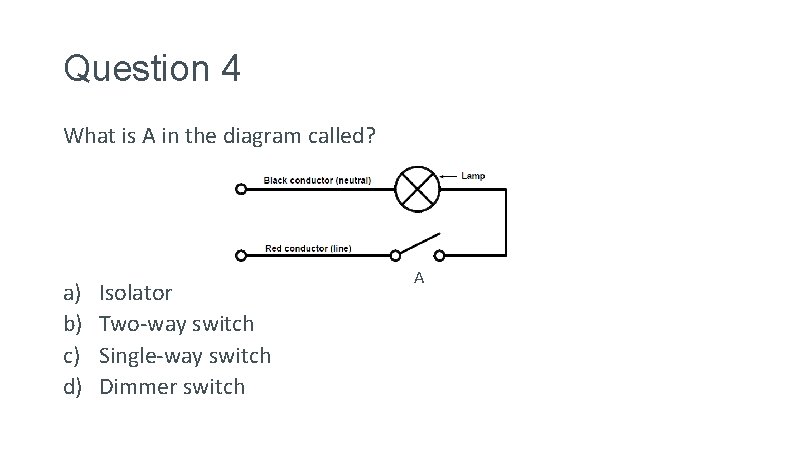
Question 4 What is A in the diagram called? a) b) c) d) Isolator Two-way switch Single-way switch Dimmer switch A
Electrical protection In all of the previous circuit diagrams it was assumed that a 220 V AC supply was used. Therefore, some form of protection must be incorporated to protect persons, equipment, cables and wires. Fuses and circuit breakers are used for this purpose.
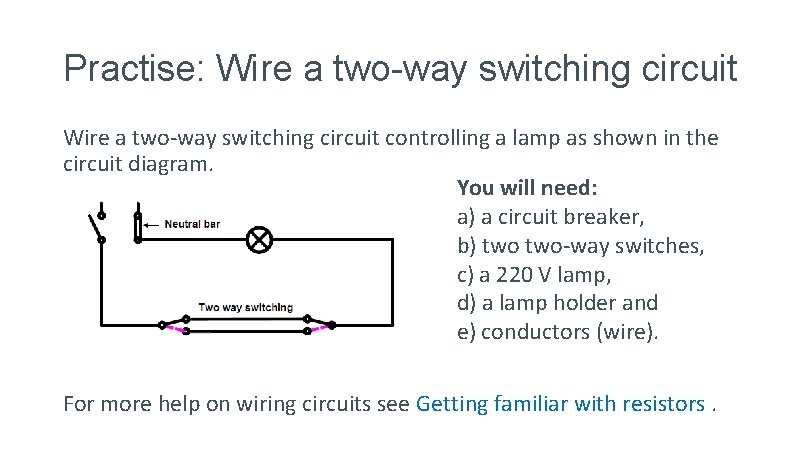
Practise: Wire a two-way switching circuit controlling a lamp as shown in the circuit diagram. You will need: a) a circuit breaker, b) two-way switches, c) a 220 V lamp, d) a lamp holder and e) conductors (wire). For more help on wiring circuits see Getting familiar with resistors.
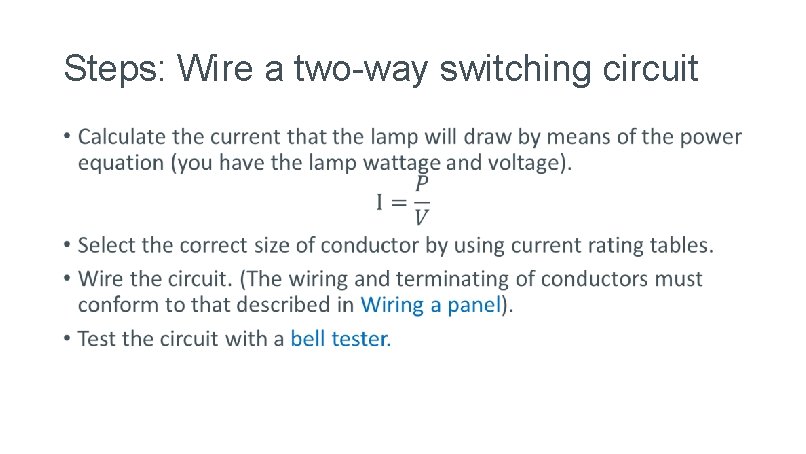
Steps: Wire a two-way switching circuit •
Testing a circuit Before any electrical installation is made or apparatus is connected to a supply, tests should be carried out to check that the operation of the circuit is correct. There are several methods of carrying out these tests, but only the commonly used bell tester will be described in this lesson.
The bell tester consists of a battery and an electrical bell or buzzer which is usually built into a portable box. SAFETY FIRST ! USING A BELL TESTER TO TEST A CIRCUIT
Quiz time We have come to the end of this unit. Answer the following questions to make sure you understand how to work with circuits.
Question 1 What is this diagram showing? A a) b) c) d) Single-way switching Two-way switching Intermediate switching Four-way switching
Question 2 What does A in the diagram show? A a) b) c) d) Lamp Bridging pieces Runner conductors Earth connection
Question 3 Before any electrical installation is made or apparatus is connected to a supply, tests should be carried out to check that the operation of the circuit is correct. TRUE Click on the correct answer. FALSE
Question 4 If the bell in the bell tester rings, it indicates that there is no continuity in the circuit. TRUE Click on the correct answer. FALSE
Let’s review: In this lesson we have covered: üLight switching methods. üVarious symbols used in circuits. üWiring of the various switches. üUsing a bell tester. Make sure you have a complete understanding of all the work covered here before you start the next unit.
Chart brief – Show following text before bringing the chart up Standard symbols are used by most countries. Listed below are some of the standards that you will encounter. • DIN - Federal Republic of Germany • BS 3939 - UK • ANC 32. 2 - SA • NEMA ICS - USA • CEMA ICS - Canada • IEC Publ 117 - International Electro-technical Commission For practical reasons the DIN and IEC symbols are primarily used in the mining industry. Some symbols and alternates are shown.
Chart brief – Chart 01 continued
Chart brief – Chart 01 continued
Chart brief – Chart 01 continued
Chart brief – Chart 01 continued
Chart brief – Chart 01 continued
Table brief – Table 01 EQUIPMENT IDENTIFICATION -Q Power switching -S Auxiliary switches -K Auxiliary contactors and relays -F Protective equipment, e. g. fuses -L Neutral bars (links) -P Measuring instruments -H Signalling or alarm system -M Motors -G Generators -T Transformers
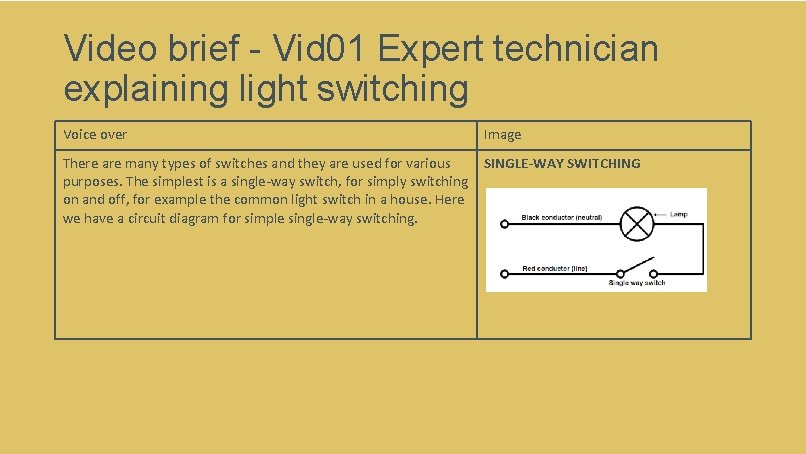
Video brief - Vid 01 Expert technician explaining light switching Voice over Image There are many types of switches and they are used for various SINGLE-WAY SWITCHING purposes. The simplest is a single-way switch, for simply switching on and off, for example the common light switch in a house. Here we have a circuit diagram for simple single-way switching.
Video brief - Vid 01 contin. Expert technician explaining light switching Voice over Image Next we move on to switching from two points. Two way switching is the method by which one or more lamps may be switched on or off from either of two places, any distance apart. Two examples are, (a) the control of a lamp in a hall or landing from either the top or the bottom of a flight of stairs, and (b) the control of a bedroom light from two switches in different parts of the room. Remember to isolate the supply before working on live terminals. Double control of this nature is achieved by having a two-way TWO-WAY SWITCHING switch at each point as shown in this circuit diagram, with two separate “runner-wires” from the one to the other. In the diagram the light is on, because there is a connection from the line to neutral via the lamp and upper switch wire. If either switch is moved over to the dotted line position the circuit is broken, but if the other switch is also moved over, the circuit is restored again through the lower switch wire.
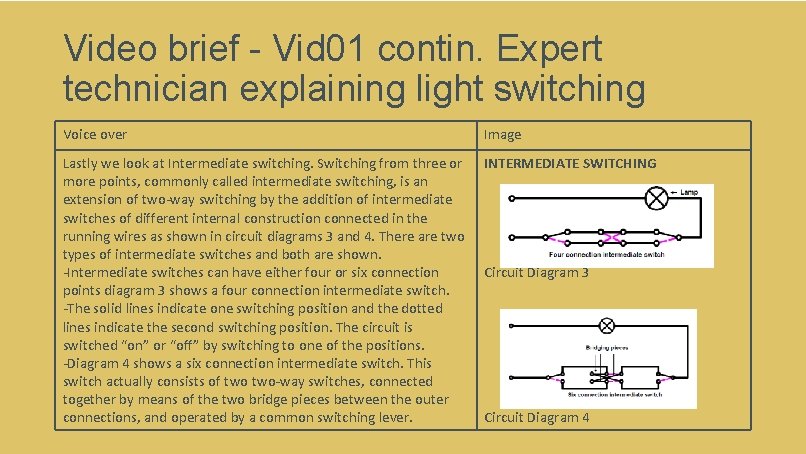
Video brief - Vid 01 contin. Expert technician explaining light switching Voice over Image Lastly we look at Intermediate switching. Switching from three or more points, commonly called intermediate switching, is an extension of two-way switching by the addition of intermediate switches of different internal construction connected in the running wires as shown in circuit diagrams 3 and 4. There are two types of intermediate switches and both are shown. -Intermediate switches can have either four or six connection points diagram 3 shows a four connection intermediate switch. -The solid lines indicate one switching position and the dotted lines indicate the second switching position. The circuit is switched “on” or “off” by switching to one of the positions. -Diagram 4 shows a six connection intermediate switch. This switch actually consists of two-way switches, connected together by means of the two bridge pieces between the outer connections, and operated by a common switching lever. INTERMEDIATE SWITCHING Circuit Diagram 3 Circuit Diagram 4
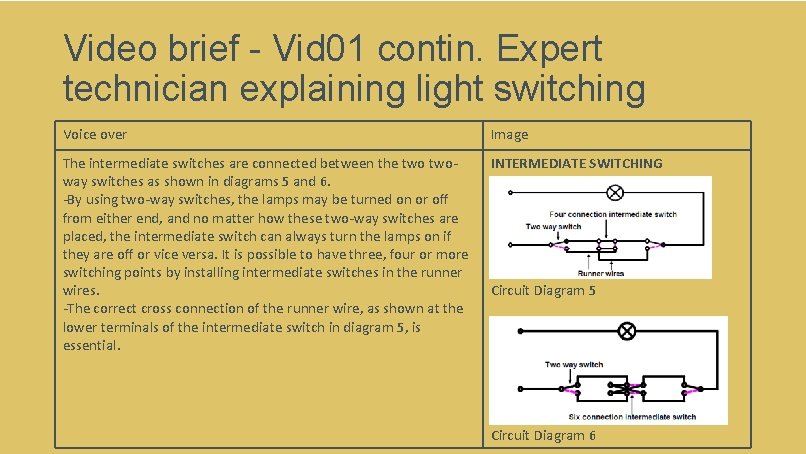
Video brief - Vid 01 contin. Expert technician explaining light switching Voice over Image The intermediate switches are connected between the twoway switches as shown in diagrams 5 and 6. -By using two-way switches, the lamps may be turned on or off from either end, and no matter how these two-way switches are placed, the intermediate switch can always turn the lamps on if they are off or vice versa. It is possible to have three, four or more switching points by installing intermediate switches in the runner wires. -The correct cross connection of the runner wire, as shown at the lower terminals of the intermediate switch in diagram 5, is essential. INTERMEDIATE SWITCHING Circuit Diagram 5 Circuit Diagram 6
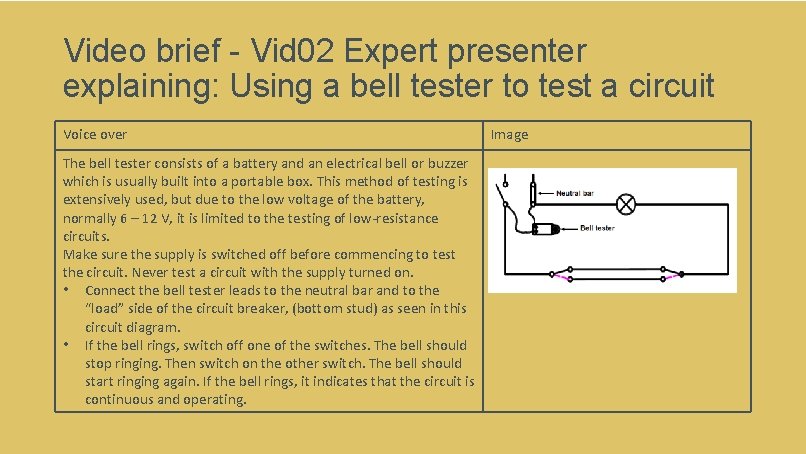
Video brief - Vid 02 Expert presenter explaining: Using a bell tester to test a circuit Voice over The bell tester consists of a battery and an electrical bell or buzzer which is usually built into a portable box. This method of testing is extensively used, but due to the low voltage of the battery, normally 6 – 12 V, it is limited to the testing of low-resistance circuits. Make sure the supply is switched off before commencing to test the circuit. Never test a circuit with the supply turned on. • Connect the bell tester leads to the neutral bar and to the “load” side of the circuit breaker, (bottom stud) as seen in this circuit diagram. • If the bell rings, switch off one of the switches. The bell should stop ringing. Then switch on the other switch. The bell should start ringing again. If the bell rings, it indicates that the circuit is continuous and operating. Image