
Electrical Circuits Gabriel Bascara 2 nd period Mr
Electrical Circuits Gabriel Bascara 2 nd period Mr. Tillay Put a Shock to Your System
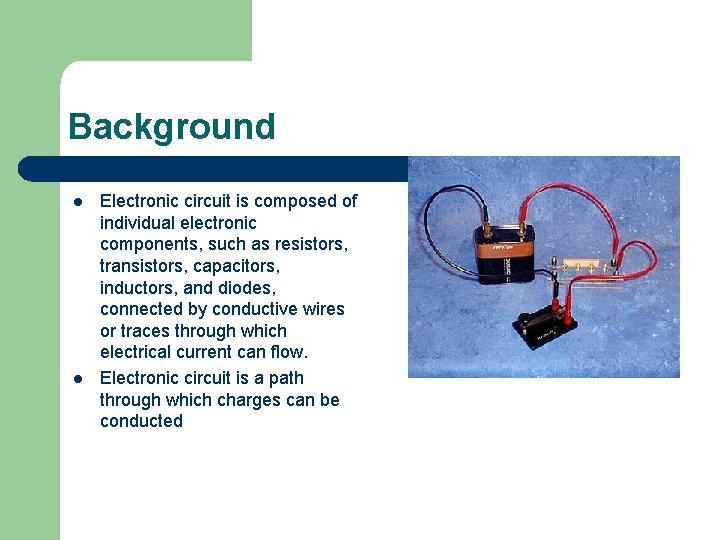
Background l l Electronic circuit is composed of individual electronic components, such as resistors, transistors, capacitors, inductors, and diodes, connected by conductive wires or traces through which electrical current can flow. Electronic circuit is a path through which charges can be conducted
Parts to a circuit These are usually found in most circuits: l Wires, conductor that connects elements of a circuit l Power source, usually a battery, provides current l Load, dissipates energy l Switch, used to resume or stop flow of current
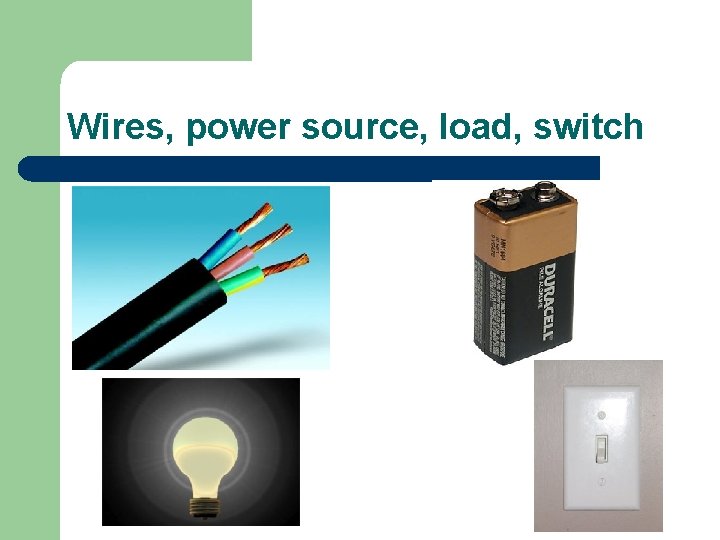
Wires, power source, load, switch
Ohm’s Law and Current l l Ohm’s law defines the relationship between current, voltage, and resistance. Ohm’s law: V=IR Electrical current proportional to the voltage; inversely proportional to the resistance. Conventional current flow (+ to-) opposite of electron flow (- to +)
Resistors l l l Resistor, two-terminal electronic component that produces a voltage across its terminals Limits current in a circuit. Resistance, ratio of potential difference across a conductor to the current it carries
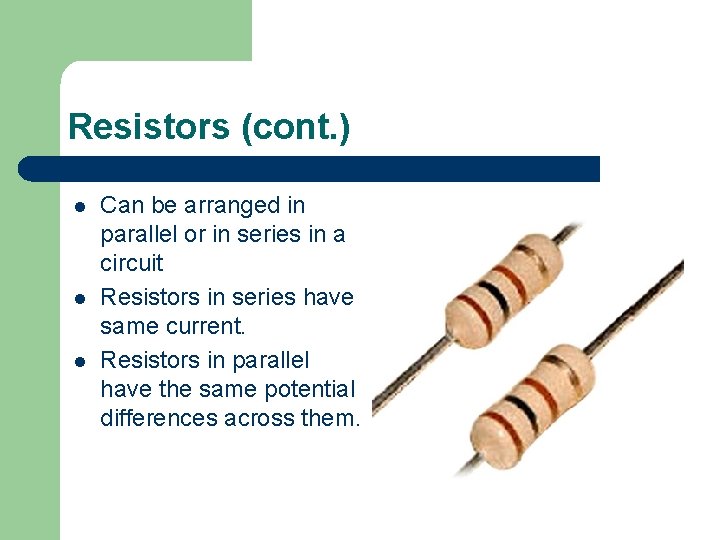
Resistors (cont. ) l l l Can be arranged in parallel or in series in a circuit Resistors in series have same current. Resistors in parallel have the same potential differences across them.
Capacitor l l Capacitors store energy. Amount of energy it can store is capacitance. Capacitance measured in farads. Capacitors are widely used in electronic circuits to block the flow of direct current while allowing alternating current to pass, to filter out interference, to smooth the output of power supplies.
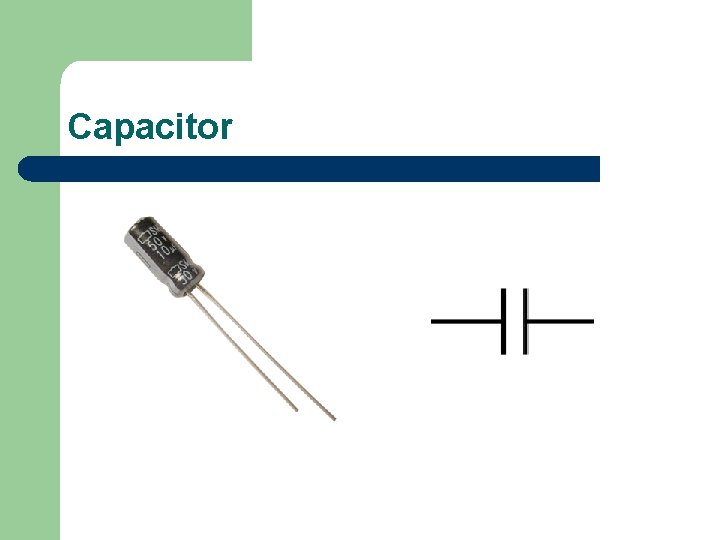
Capacitor
Schematic Diagrams l Schematic diagrams use standardized symbols to summarize the contents of electric circuits.
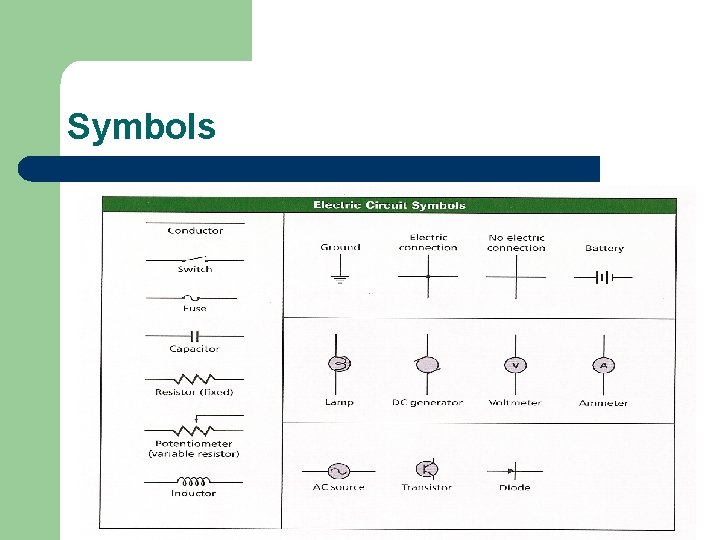
Symbols
Sources l l http: //en. wikipedia. org/wiki/Electronic_circuit http: //en. wikipedia. org/wiki/Resistor http: //www. ndted. org/Education. Resources/Community. Colle ge/Eddy. Currents/Physics/currentflow. htm http: //www. mi. mun. ca/users/cchaulk/eltk 1100 /ivse. htm
- Slides: 12