
Electrical characterization of a superconducting hot spot microbolometer

Electrical characterization of a superconducting hot spot microbolometer S. Cibella, R. Leoni, G. Torrioli, M. G. Castellano, A. Coppa, F. Mattioli IFN-CNR, Roma, Italy
Outline THz technology n Antenna-coupled superconducting microbolometers n Basic principles n Detector fabrication n Electronic readout n I-V characteristic measurements n NEP measurements n Conclusions n
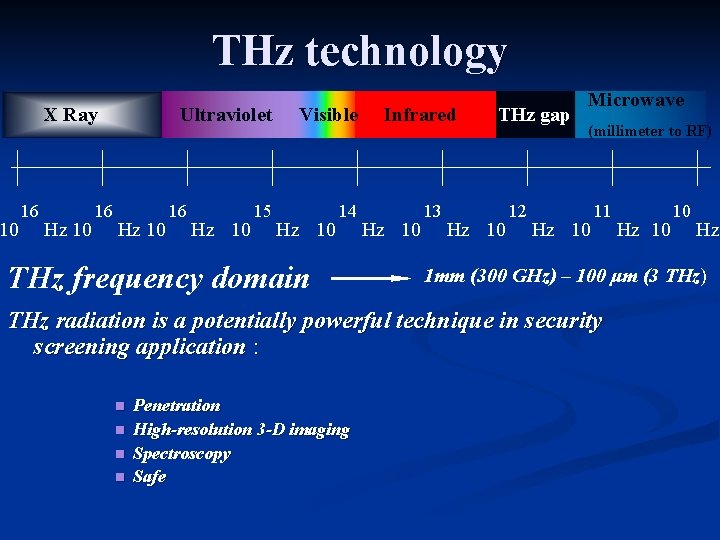
THz technology X Ray 10 16 Hz 10 16 Ultraviolet Hz 10 16 Hz 10 15 Visible Hz 10 14 THz frequency domain Infrared Hz 10 13 THz gap Hz 10 12 Microwave (millimeter to RF) Hz 10 11 n n n Penetration High-resolution 3 -D imaging Spectroscopy Safe Hz 1 mm (300 GHz) – 100 μm (3 THz) THz radiation is a potentially powerful technique in security screening application : n Hz 10 10
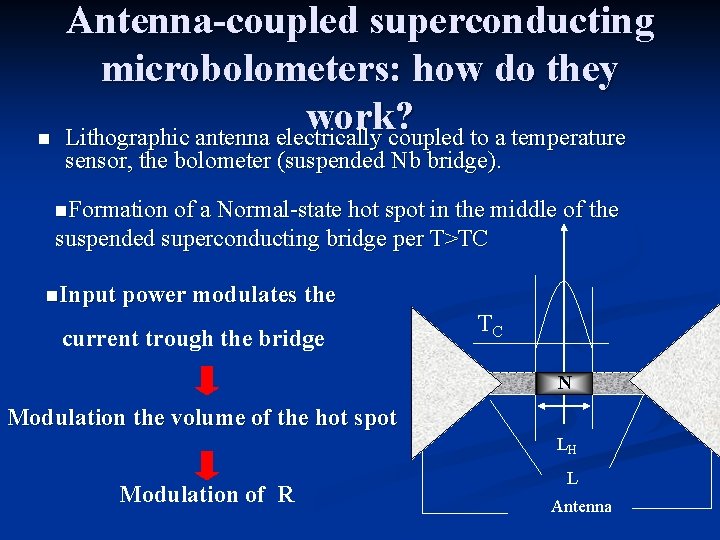
n Antenna-coupled superconducting microbolometers: how do they work? Lithographic antenna electrically coupled to a temperature sensor, the bolometer (suspended Nb bridge). n. Formation of a Normal-state hot spot in the middle of the suspended superconducting bridge per T>TC n. Input power modulates the current trough the bridge TC N Modulation the volume of the hot spot LH Modulation of R L Antenna
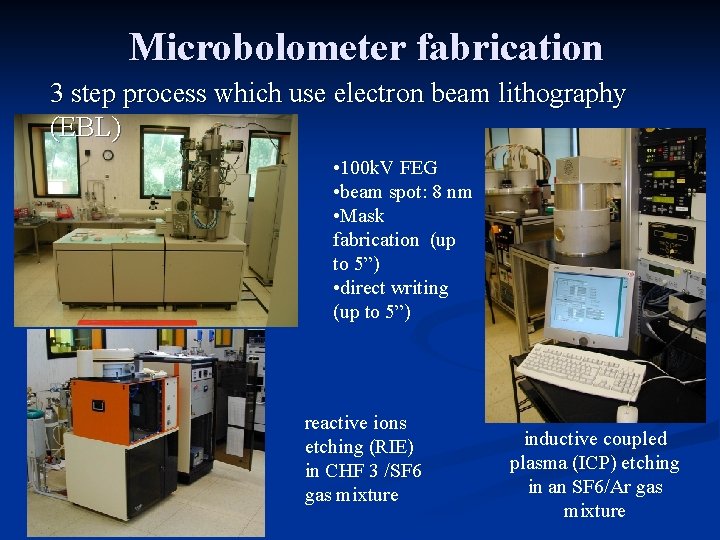
Microbolometer fabrication 3 step process which use electron beam lithography (EBL) • 100 k. V FEG • beam spot: 8 nm • Mask fabrication (up to 5”) • direct writing (up to 5”) reactive ions etching (RIE) in CHF 3 /SF 6 gas mixture inductive coupled plasma (ICP) etching in an SF 6/Ar gas mixture
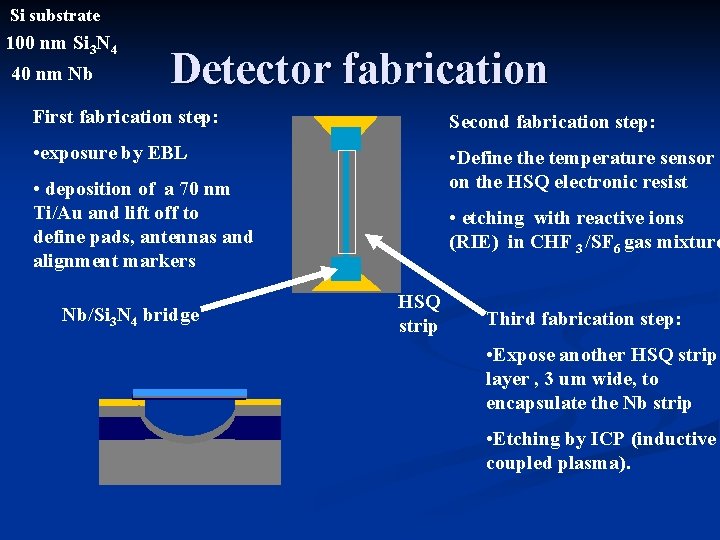
Si substrate 100 nm Si 3 N 4 40 nm Nb Detector fabrication First fabrication step: Second fabrication step: • exposure by EBL • Define the temperature sensor on the HSQ electronic resist • deposition of a 70 nm Ti/Au and lift off to define pads, antennas and alignment markers Nb/Si 3 N 4 bridge • etching with reactive ions (RIE) in CHF 3 /SF 6 gas mixture HSQ strip Third fabrication step: • Expose another HSQ strip layer , 3 um wide, to encapsulate the Nb strip • Etching by ICP (inductive coupled plasma).
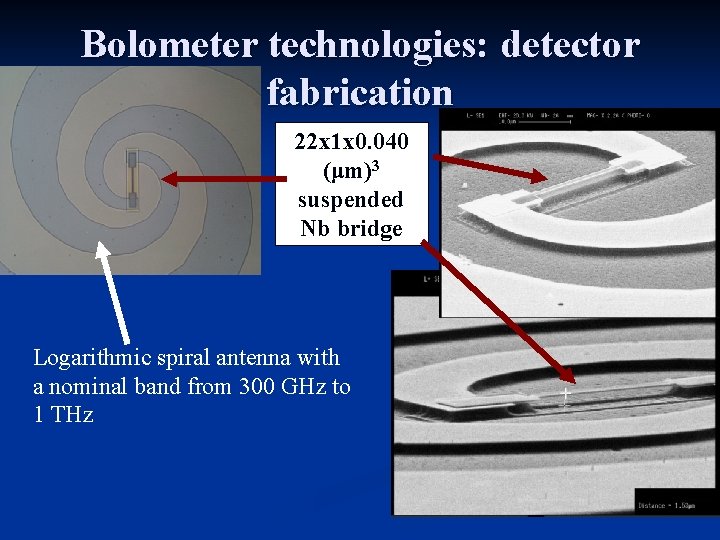
Bolometer technologies: detector fabrication 22 x 1 x 0. 040 (μm)3 suspended Nb bridge Logarithmic spiral antenna with a nominal band from 300 GHz to 1 THz
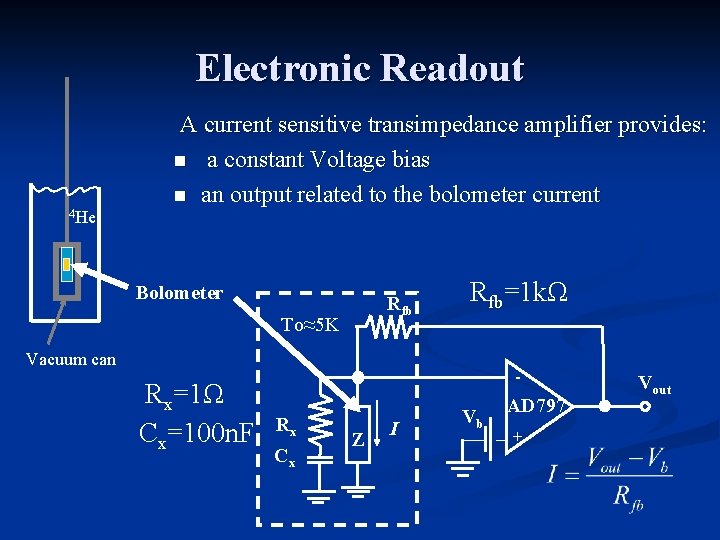
Electronic Readout 4 He A current sensitive transimpedance amplifier provides: n a constant Voltage bias n an output related to the bolometer current Bolometer Rfb To≈5 K Rfb=1 kΩ Vacuum can Rx=1Ω Cx=100 n. F - Rx Cx Z I Vb AD 797 + Vout

I-V characteristics I V 0 V Linear part: ohmic behavior of the bridge in its normal state
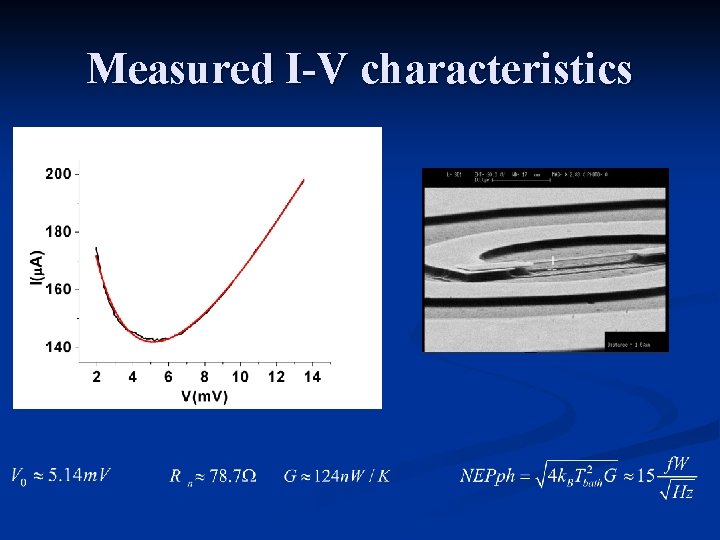
Measured I-V characteristics
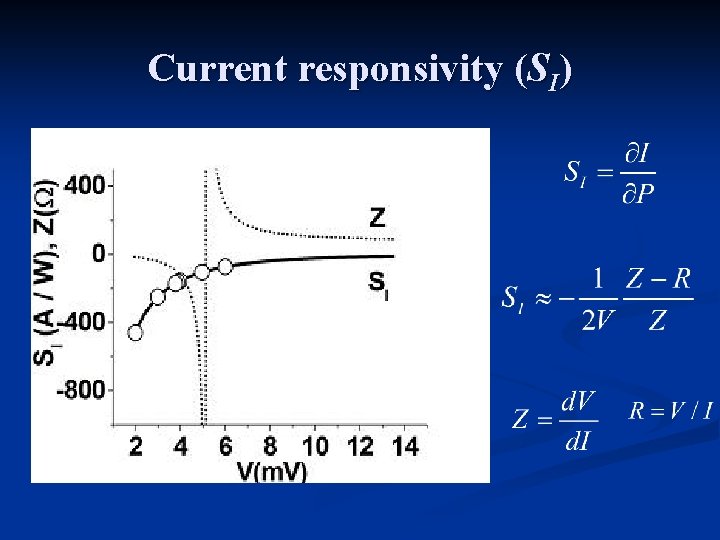
Current responsivity (SI)
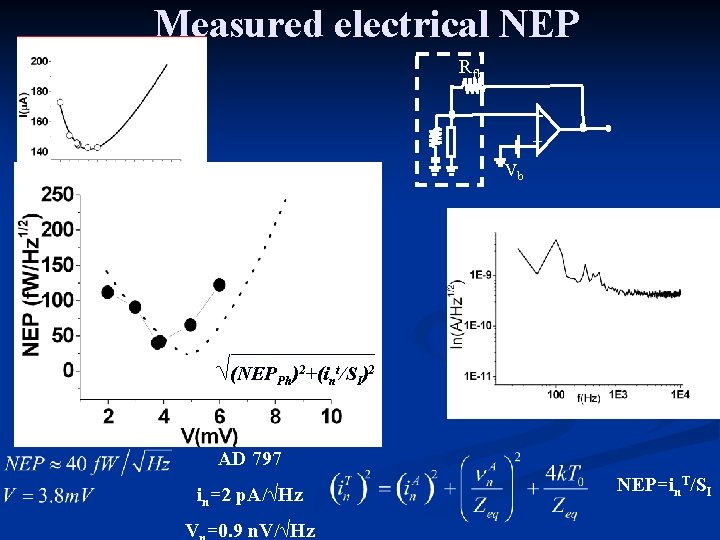
Measured electrical NEP Rfb + Vb √(NEPPh)2+(int/SI)2 AD 797 in=2 p. A/√Hz V =0. 9 n. V/√Hz NEP=in. T/SI
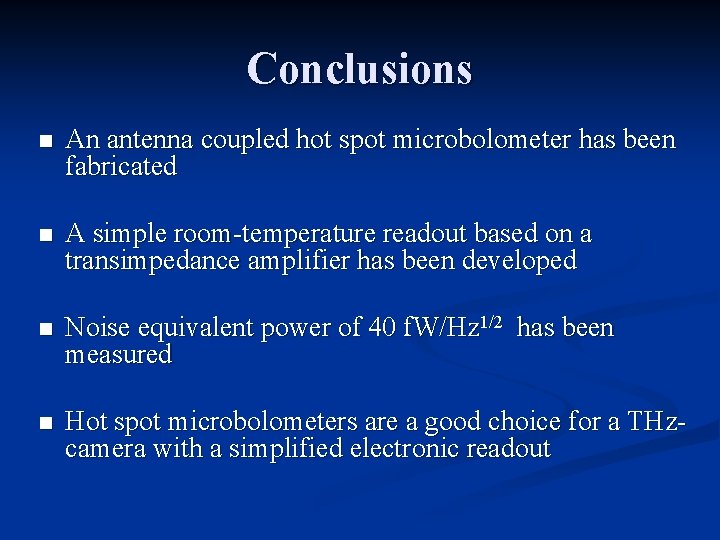
Conclusions n An antenna coupled hot spot microbolometer has been fabricated n A simple room-temperature readout based on a transimpedance amplifier has been developed n Noise equivalent power of 40 f. W/Hz 1/2 has been measured n Hot spot microbolometers are a good choice for a THzcamera with a simplified electronic readout
- Slides: 13