
Electrical Appliances and Power Learning Objectives l To
Electrical Appliances and Power
Learning Objectives l To be able to calculate power, and cost of electricity l To be able to apply these calculations to help explain the efficiency of devices l To be able to apply this knowledge to complete exam style questions
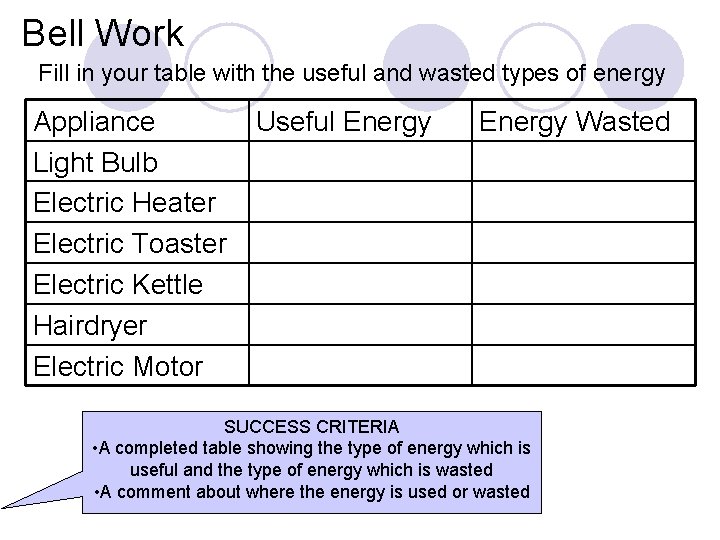
Bell Work Fill in your table with the useful and wasted types of energy Appliance Light Bulb Electric Heater Electric Toaster Electric Kettle Hairdryer Electric Motor Useful Energy Wasted SUCCESS CRITERIA • A completed table showing the type of energy which is useful and the type of energy which is wasted • A comment about where the energy is used or wasted
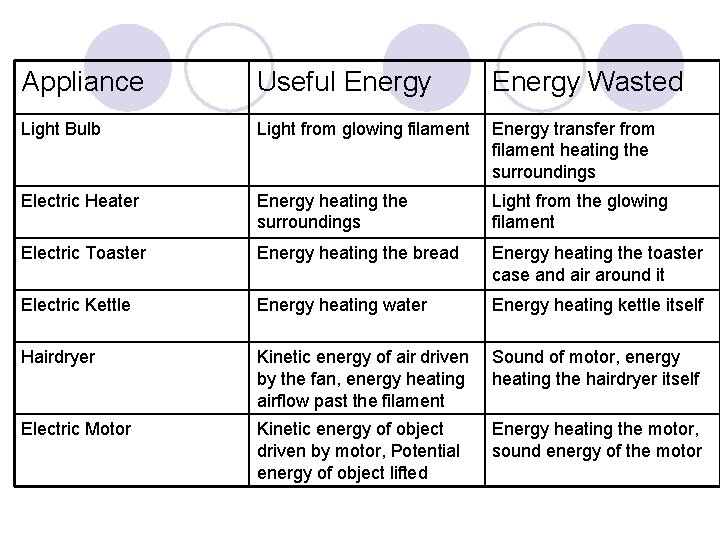
Appliance Useful Energy Wasted Light Bulb Light from glowing filament Energy transfer from filament heating the surroundings Electric Heater Energy heating the surroundings Light from the glowing filament Electric Toaster Energy heating the bread Energy heating the toaster case and air around it Electric Kettle Energy heating water Energy heating kettle itself Hairdryer Kinetic energy of air driven by the fan, energy heating airflow past the filament Sound of motor, energy heating the hairdryer itself Electric Motor Kinetic energy of object driven by motor, Potential energy of object lifted Energy heating the motor, sound energy of the motor
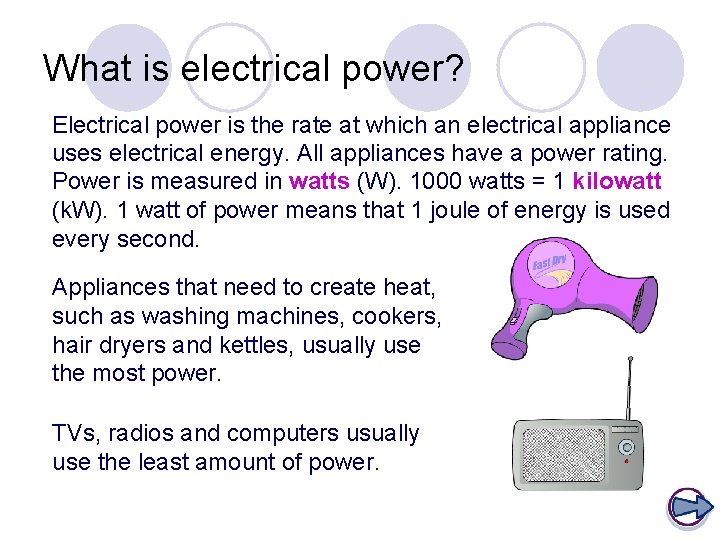
What is electrical power? Electrical power is the rate at which an electrical appliance uses electrical energy. All appliances have a power rating. Power is measured in watts (W). 1000 watts = 1 kilowatt (k. W). 1 watt of power means that 1 joule of energy is used every second. Appliances that need to create heat, such as washing machines, cookers, hair dryers and kettles, usually use the most power. TVs, radios and computers usually use the least amount of power.
What is the formula for electrical power? In electrical devices, power can be calculated using the formula: power = current x voltage P = Ix. V What are the units of power, current and voltage? l Power is measured in watts (W) or kilowatts (k. W). l Current is measured in amps (A). l Voltage is measured in volts (V).

Can I use a formula triangle? A formula triangle helps you to rearrange a formula. The formula triangle for P = IV is shown below. Cover up whatever quantity you are trying to find to leave the calculation required. So to find current (I), cover up I… x …which gives the formula… P I = V
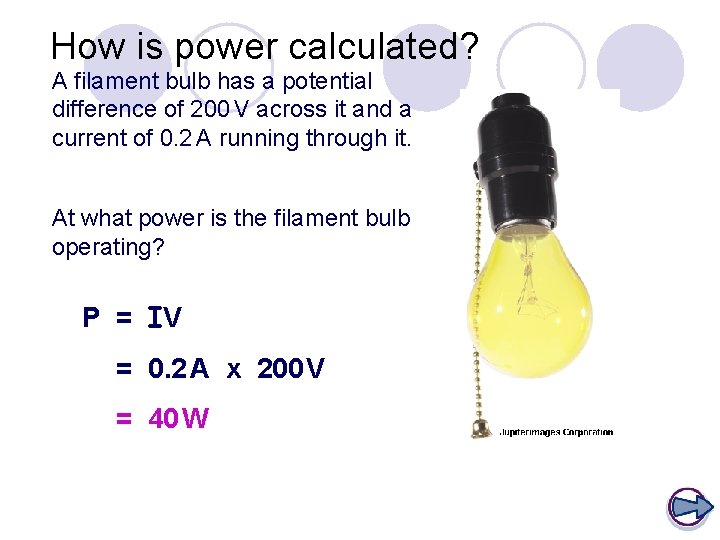
How is power calculated? A filament bulb has a potential difference of 200 V across it and a current of 0. 2 A running through it. At what power is the filament bulb operating? P = IV = 0. 2 A x 200 V = 40 W
Mini Review
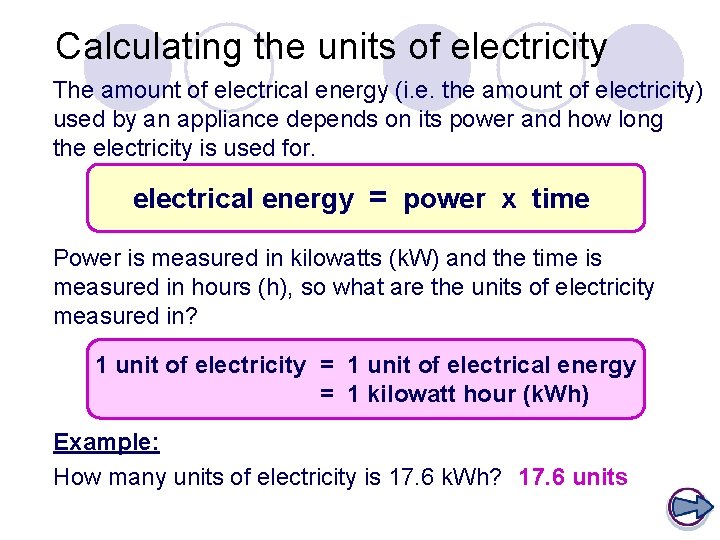
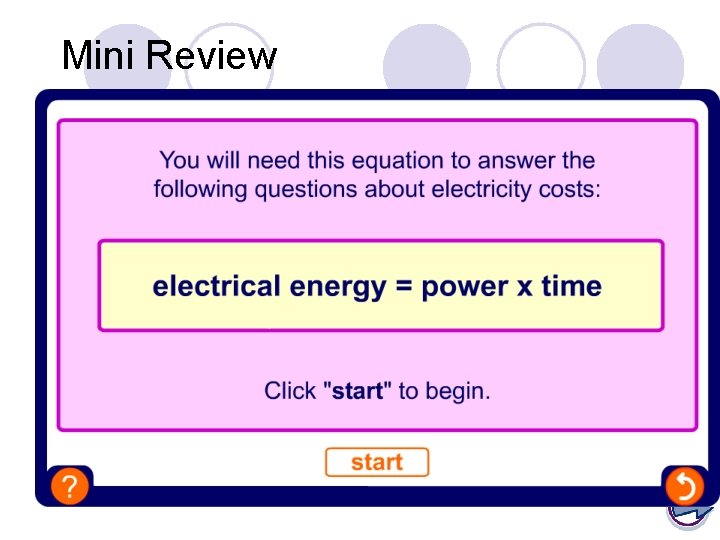
Calculating the units of electricity The amount of electrical energy (i. e. the amount of electricity) used by an appliance depends on its power and how long the electricity is used for. electrical energy = power x time Power is measured in kilowatts (k. W) and the time is measured in hours (h), so what are the units of electricity measured in? 1 unit of electricity = 1 unit of electrical energy = 1 kilowatt hour (k. Wh) Example: How many units of electricity is 17. 6 k. Wh? 17. 6 units
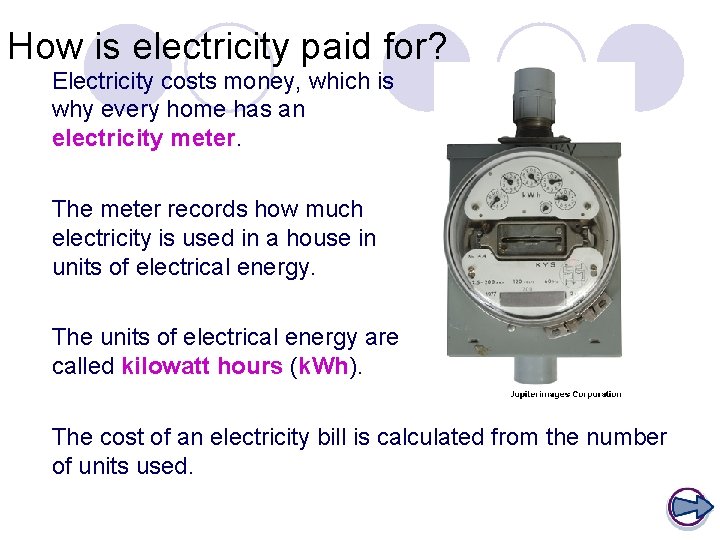
How is electricity paid for? Electricity costs money, which is why every home has an electricity meter. The meter records how much electricity is used in a house in units of electrical energy. The units of electrical energy are called kilowatt hours (k. Wh). The cost of an electricity bill is calculated from the number of units used.
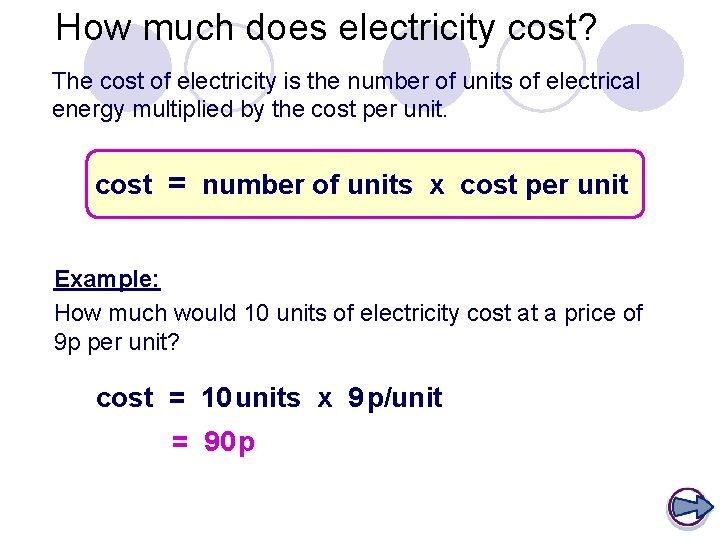
How much does electricity cost? The cost of electricity is the number of units of electrical energy multiplied by the cost per unit. cost = number of units x cost per unit Example: How much would 10 units of electricity cost at a price of 9 p per unit? cost = 10 units x 9 p/unit = 90 p
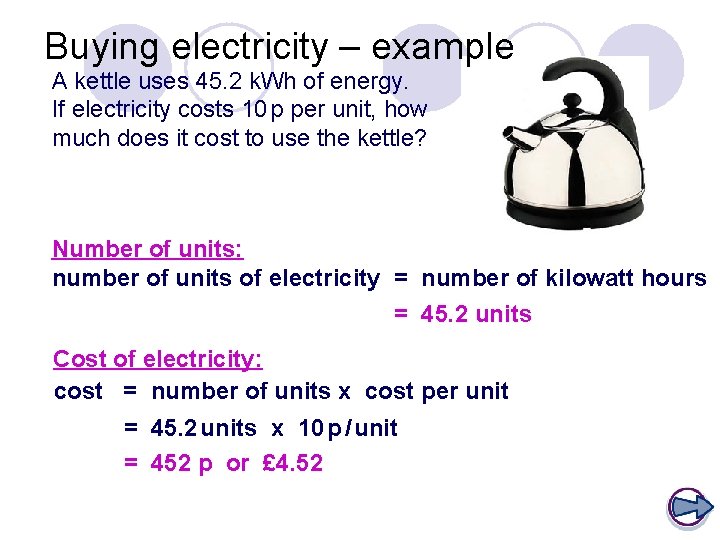
Buying electricity – example A kettle uses 45. 2 k. Wh of energy. If electricity costs 10 p per unit, how much does it cost to use the kettle? Number of units: number of units of electricity = number of kilowatt hours = 45. 2 units Cost of electricity: cost = number of units x cost per unit = 45. 2 units x 10 p / unit = 452 p or £ 4. 52
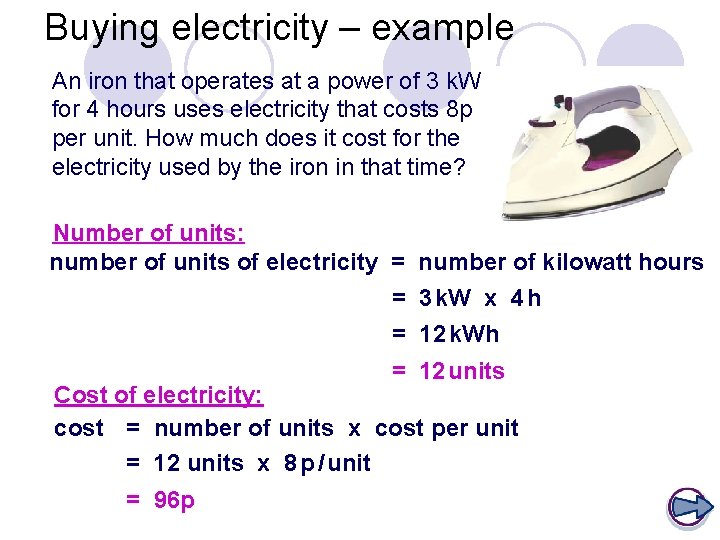
Buying electricity – example An iron that operates at a power of 3 k. W for 4 hours uses electricity that costs 8 p per unit. How much does it cost for the electricity used by the iron in that time? Number of units: number of units of electricity = number of kilowatt hours = 3 k. W x 4 h = 12 k. Wh = 12 units Cost of electricity: cost = number of units x cost per unit = 12 units x 8 p / unit = 96 p
Mini Review
Construct your Knowledge – Power of a Motor l You are going to be watching a simulation of an electric motor. Firstly you need to calculate the power of the motor when lifting 100 gm. l What values do you need to write down from the simulation to calculate this? Next we will be recapping efficiency in order to calculate the efficiency of a motor!
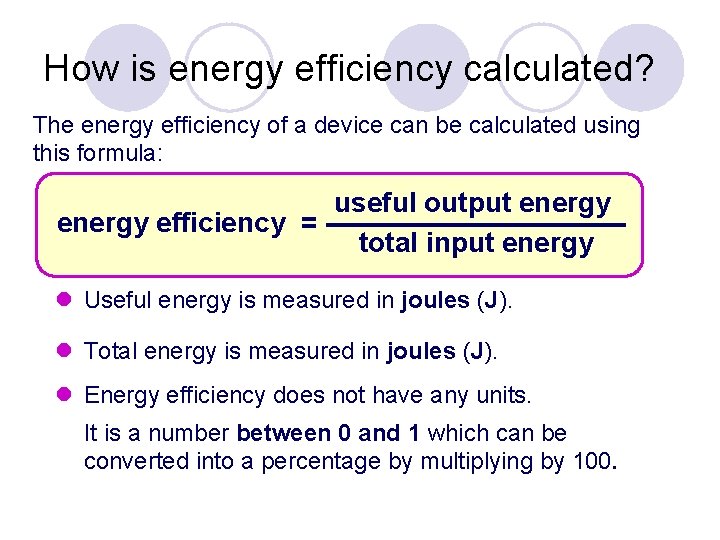
How is energy efficiency calculated? The energy efficiency of a device can be calculated using this formula: useful output energy efficiency = total input energy l Useful energy is measured in joules (J). l Total energy is measured in joules (J). l Energy efficiency does not have any units. It is a number between 0 and 1 which can be converted into a percentage by multiplying by 100.
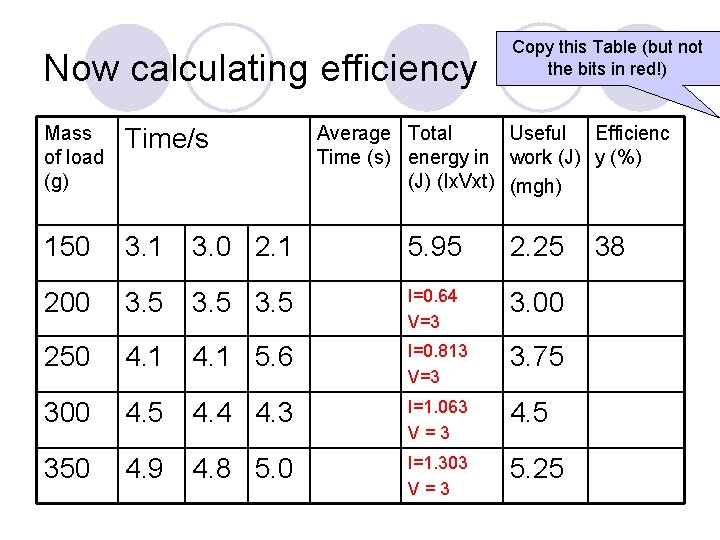
Now calculating efficiency Copy this Table (but not the bits in red!) Mass of load (g) Time/s Average Total Useful Efficienc Time (s) energy in work (J) y (%) (J) (Ix. Vxt) (mgh) 150 3. 1 3. 0 2. 1 5. 95 2. 25 200 3. 5 I=0. 64 V=3 3. 00 250 4. 1 5. 6 I=0. 813 V=3 3. 75 300 4. 5 4. 4 4. 3 I=1. 063 V=3 4. 5 350 4. 9 4. 8 5. 0 I=1. 303 V=3 5. 25 38
Mini Review – Think Pair Share • How does the efficiency of the motor change with different amounts of weight? l Try and explain this in terms of energy
Apply your knowledge l Complete exam style questions
Review l To be able to calculate power, and cost of electricity l To be able to apply these calculations to help explain the efficiency of devices l To be able to apply this knowledge to complete exam style questions
Review l Create your own question with answers (make it as difficult as you can but remember you have to give the correct answers with the correct calculations) These will be used for revision next week so make them good!
- Slides: 22