
Electrical and Computer Engineering Welcome ECE at WPI
- Slides: 27
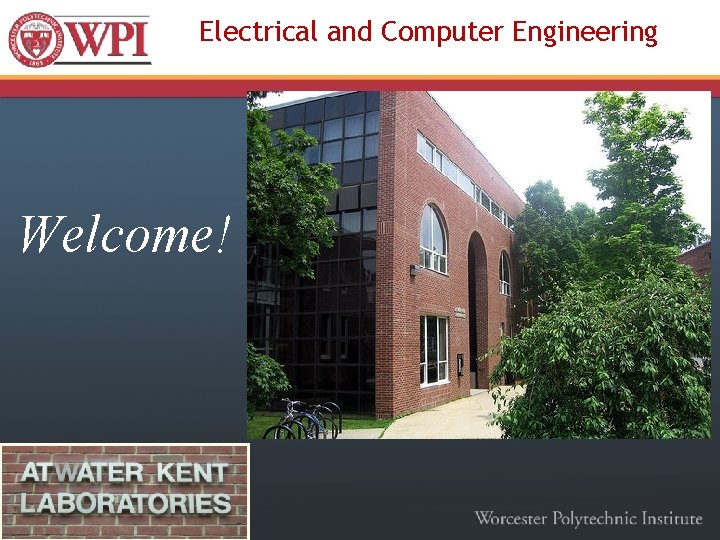
Electrical and Computer Engineering Welcome!
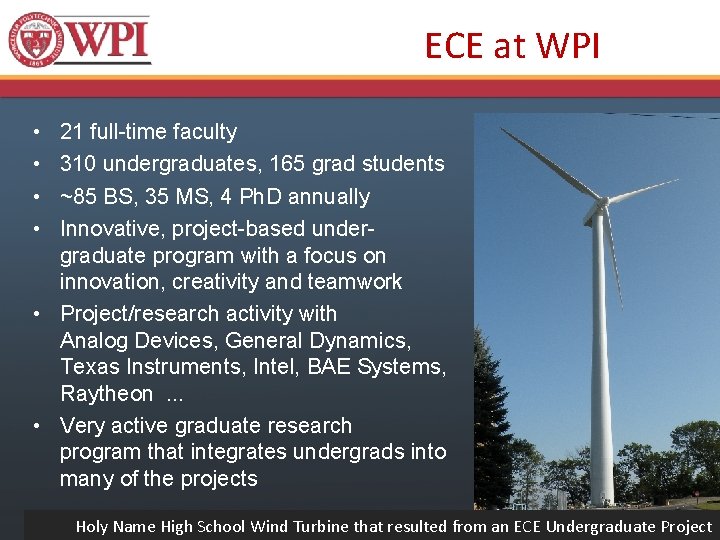
ECE at WPI • • 21 full-time faculty 310 undergraduates, 165 grad students ~85 BS, 35 MS, 4 Ph. D annually Innovative, project-based undergraduate program with a focus on innovation, creativity and teamwork • Project/research activity with Analog Devices, General Dynamics, Texas Instruments, Intel, BAE Systems, Raytheon. . . • Very active graduate research program that integrates undergrads into many of the projects Holy Name High School Wind Turbine that resulted from an ECE Undergraduate Project
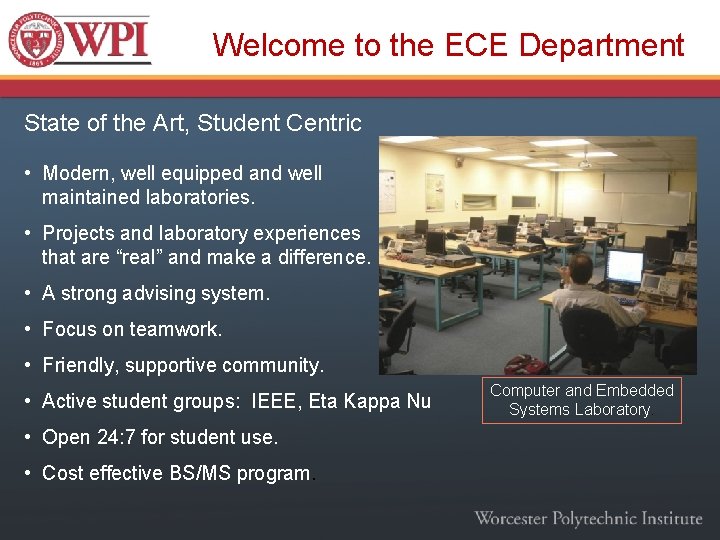
Welcome to the ECE Department State of the Art, Student Centric • Modern, well equipped and well maintained laboratories. • Projects and laboratory experiences that are “real” and make a difference. • A strong advising system. • Focus on teamwork. • Friendly, supportive community. • Active student groups: IEEE, Eta Kappa Nu • Open 24: 7 for student use. • Cost effective BS/MS program. Computer and Embedded Systems Laboratory.
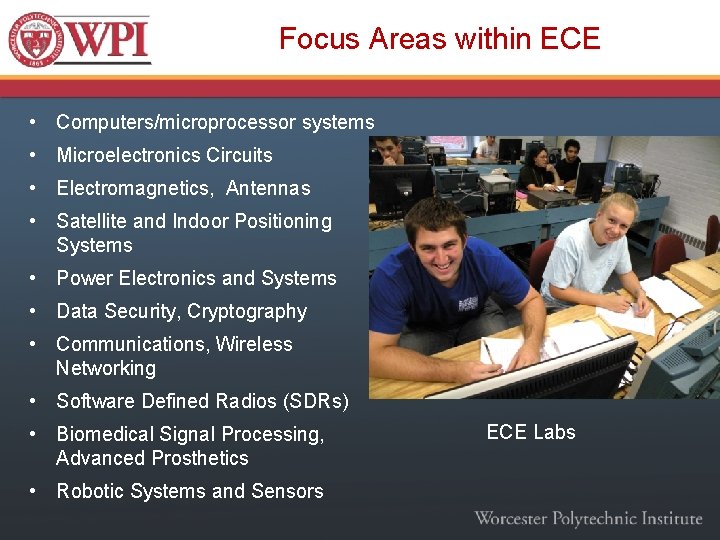
Focus Areas within ECE • Computers/microprocessor systems • Microelectronics Circuits • Electromagnetics, Antennas • Satellite and Indoor Positioning Systems • Power Electronics and Systems • Data Security, Cryptography • Communications, Wireless Networking • Software Defined Radios (SDRs) • Biomedical Signal Processing, Advanced Prosthetics • Robotic Systems and Sensors ECE Labs
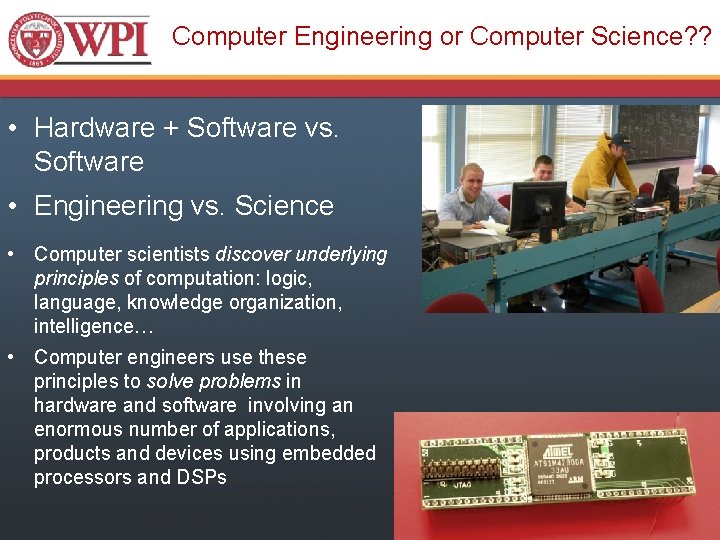
Computer Engineering or Computer Science? ? • Hardware + Software vs. Software • Engineering vs. Science • Computer scientists discover underlying principles of computation: logic, language, knowledge organization, intelligence… • Computer engineers use these principles to solve problems in hardware and software involving an enormous number of applications, products and devices using embedded processors and DSPs
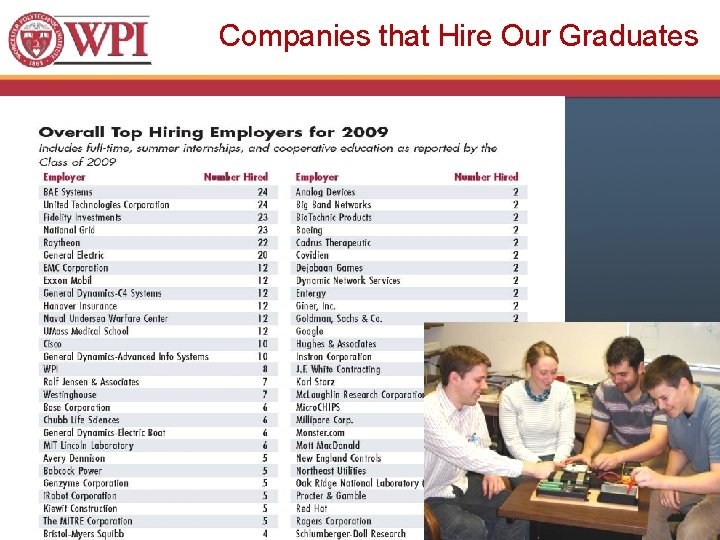
Companies that Hire Our Graduates Project Presentation Day Preparation
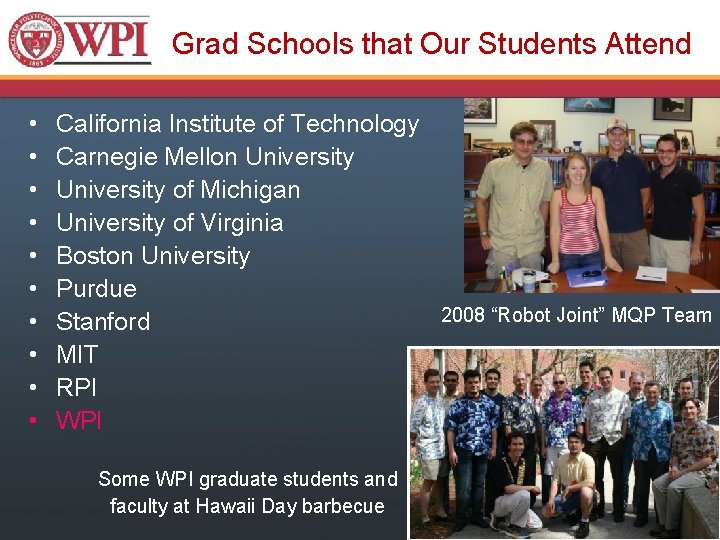
Grad Schools that Our Students Attend • • • California Institute of Technology Carnegie Mellon University of Michigan University of Virginia Boston University Purdue Stanford MIT RPI WPI Some WPI graduate students and faculty at Hawaii Day barbecue 2008 “Robot Joint” MQP Team
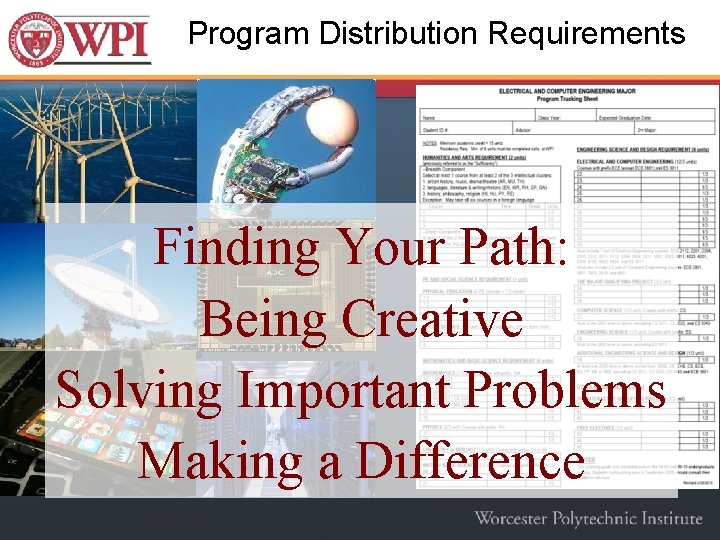
Program Distribution Requirements Finding Your Path: Being Creative Solving Important Problems Making a Difference
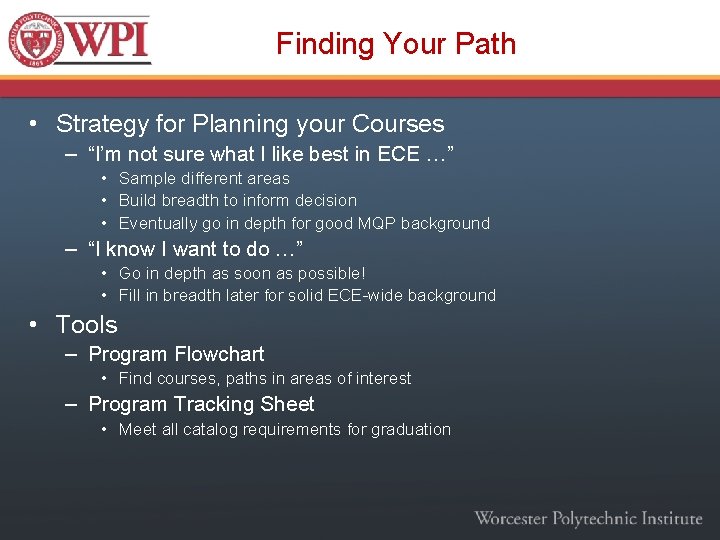
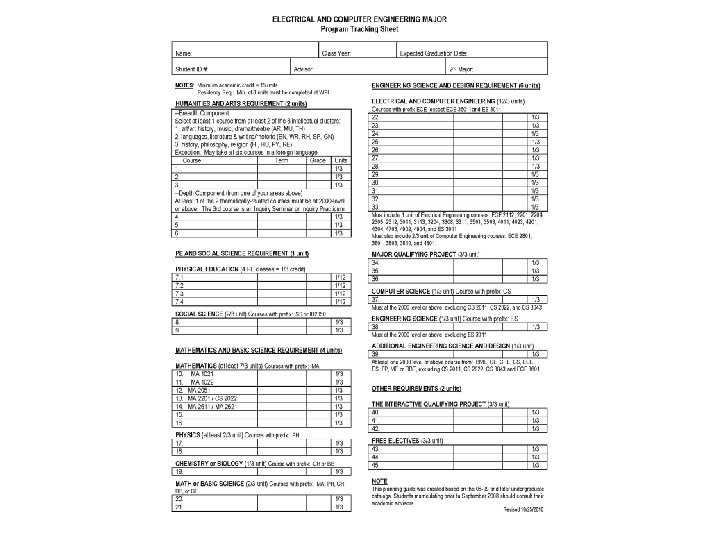
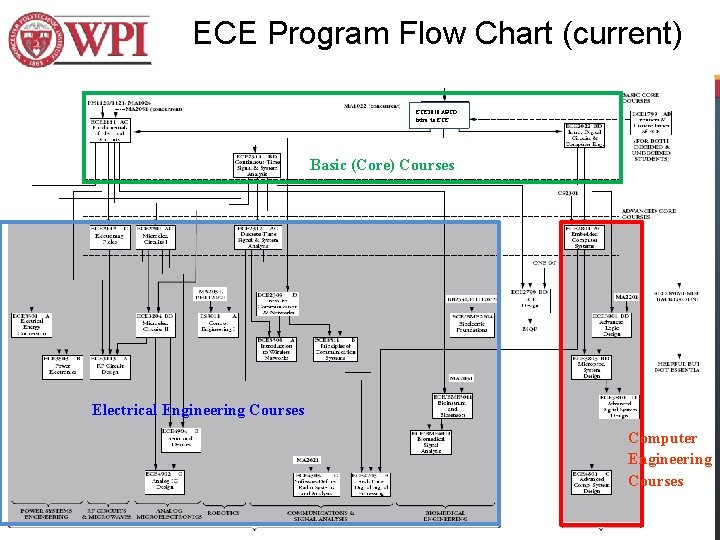
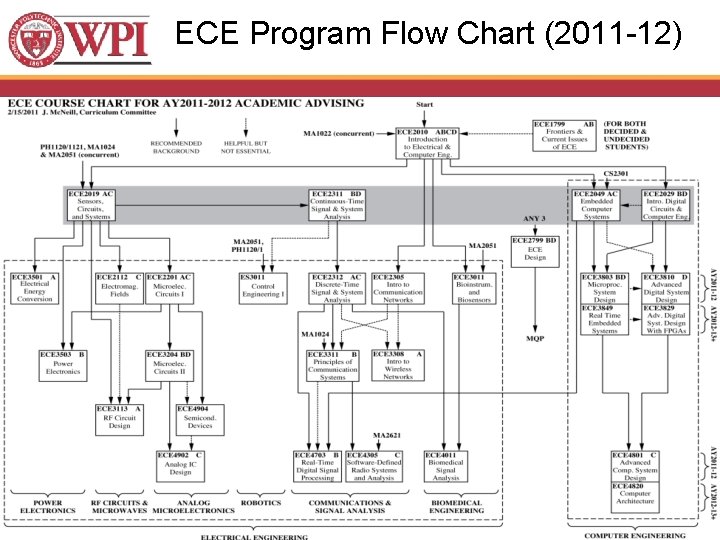
Finding Your Path • Strategy for Planning your Courses – “I’m not sure what I like best in ECE …” • Sample different areas • Build breadth to inform decision • Eventually go in depth for good MQP background – “I know I want to do …” • Go in depth as soon as possible! • Fill in breadth later for solid ECE-wide background • Tools – Program Flowchart • Find courses, paths in areas of interest – Program Tracking Sheet • Meet all catalog requirements for graduation
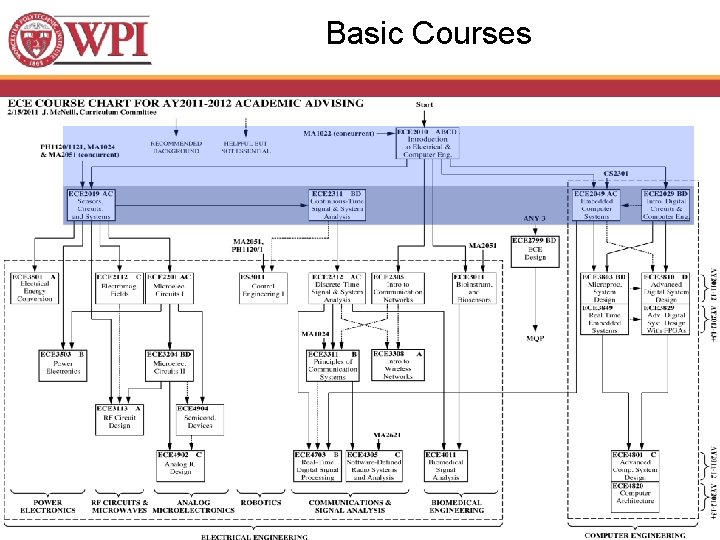
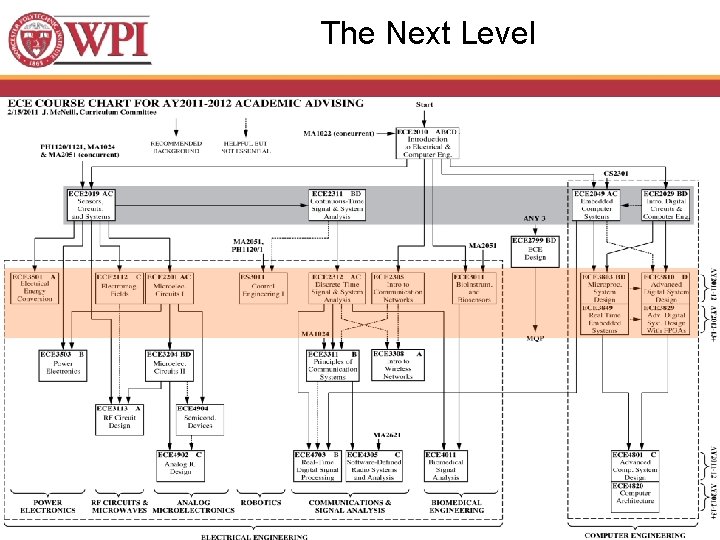
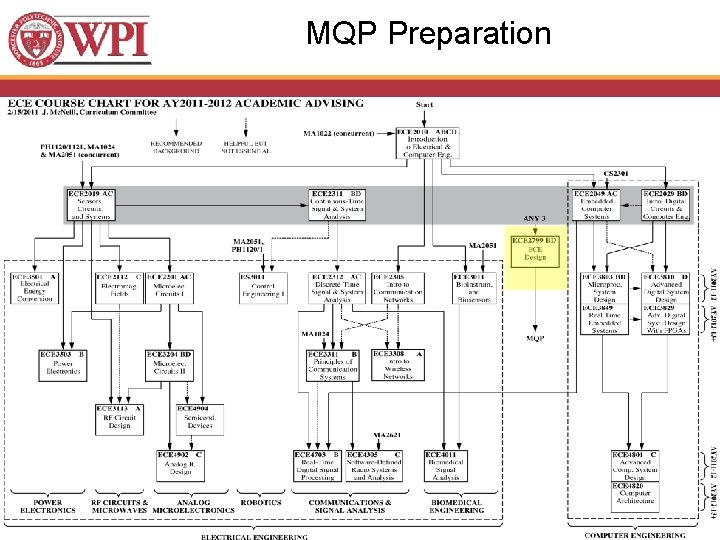
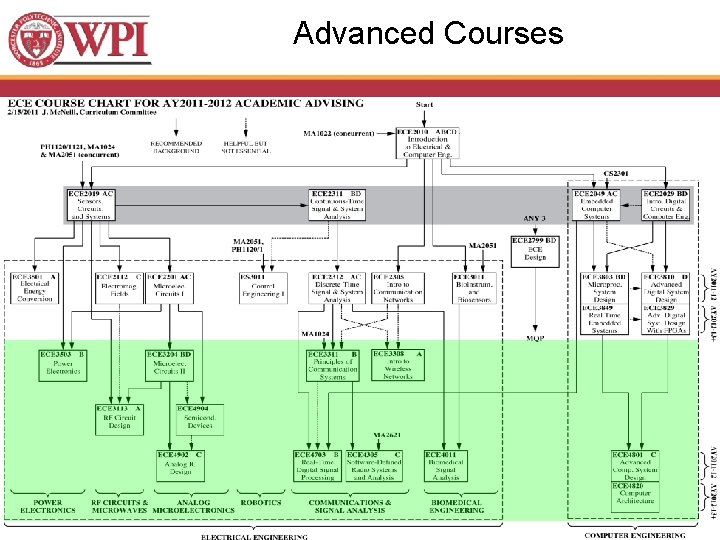
ECE Program Flow Chart (current) ECE 2010 ABCD Intro. to ECE Basic (Core) Courses Electrical Engineering Courses Computer Engineering Courses
ECE Program Flow Chart (2011 -12)
Basic Courses
The Next Level
MQP Preparation
Advanced Courses
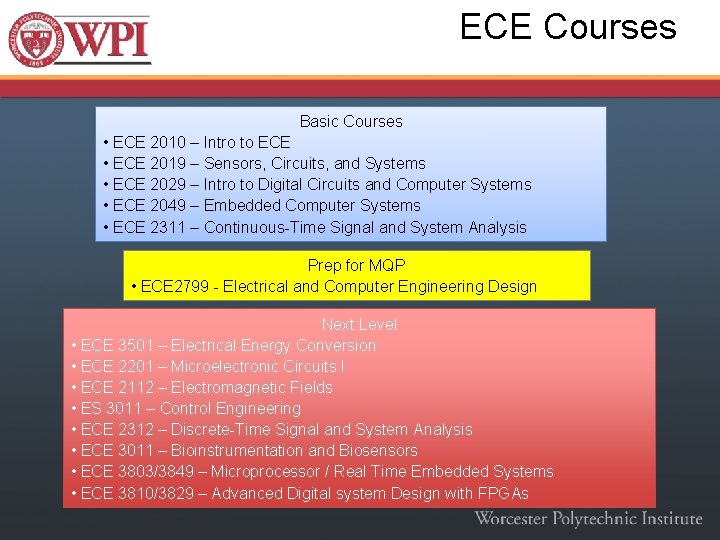
ECE Courses Basic Courses • ECE 2010 – Intro to ECE • ECE 2019 – Sensors, Circuits, and Systems • ECE 2029 – Intro to Digital Circuits and Computer Systems • ECE 2049 – Embedded Computer Systems • ECE 2311 – Continuous-Time Signal and System Analysis Prep for MQP • ECE 2799 - Electrical and Computer Engineering Design Next Level • ECE 3501 – Electrical Energy Conversion • ECE 2201 – Microelectronic Circuits I • ECE 2112 – Electromagnetic Fields • ES 3011 – Control Engineering • ECE 2312 – Discrete-Time Signal and System Analysis • ECE 3011 – Bioinstrumentation and Biosensors • ECE 3803/3849 – Microprocessor / Real Time Embedded Systems • ECE 3810/3829 – Advanced Digital system Design with FPGAs
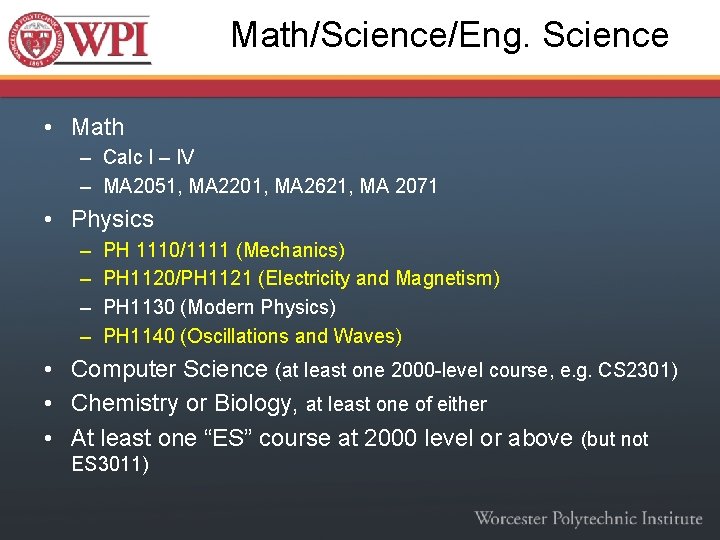
Math/Science/Eng. Science • Math – Calc I – IV – MA 2051, MA 2201, MA 2621, MA 2071 • Physics – – PH 1110/1111 (Mechanics) PH 1120/PH 1121 (Electricity and Magnetism) PH 1130 (Modern Physics) PH 1140 (Oscillations and Waves) • Computer Science (at least one 2000 -level course, e. g. CS 2301) • Chemistry or Biology, at least one of either • At least one “ES” course at 2000 level or above (but not ES 3011)
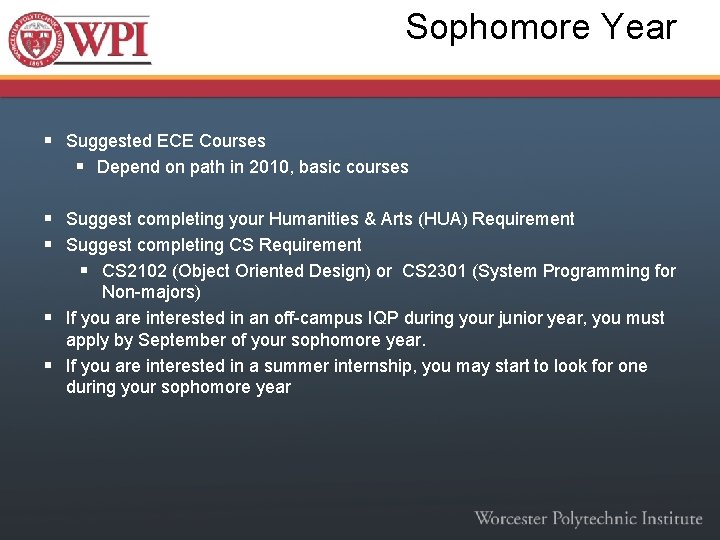
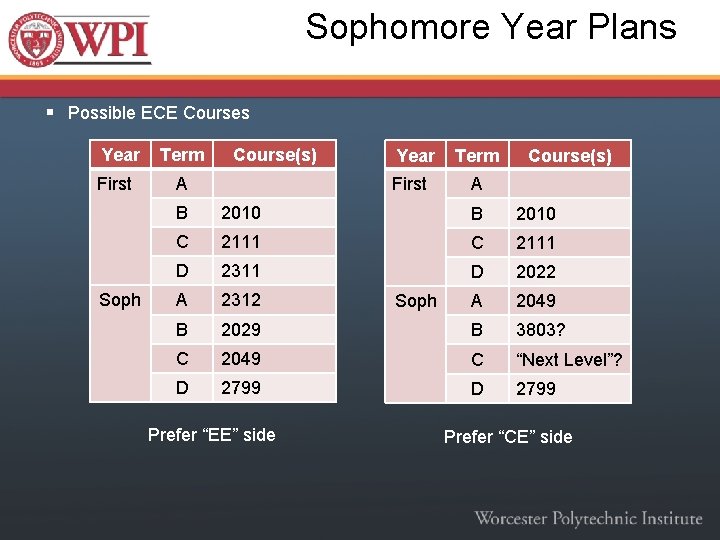
Sophomore Year § Suggested ECE Courses § Depend on path in 2010, basic courses § Suggest completing your Humanities & Arts (HUA) Requirement § Suggest completing CS Requirement § CS 2102 (Object Oriented Design) or CS 2301 (System Programming for Non-majors) § If you are interested in an off-campus IQP during your junior year, you must apply by September of your sophomore year. § If you are interested in a summer internship, you may start to look for one during your sophomore year
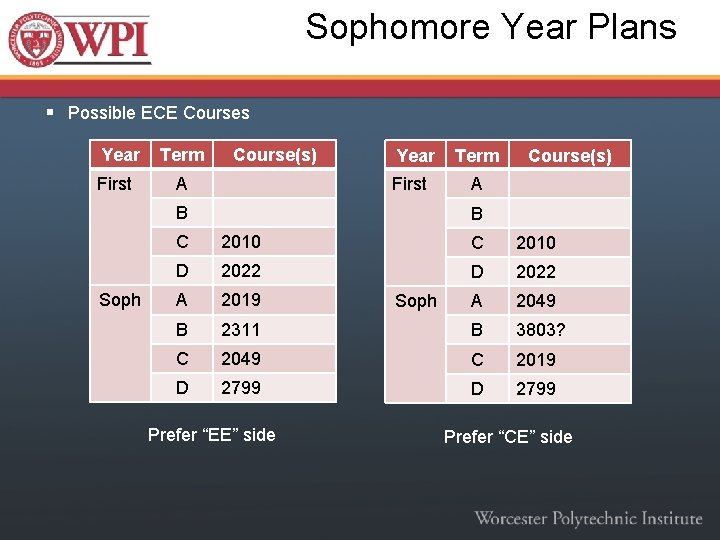
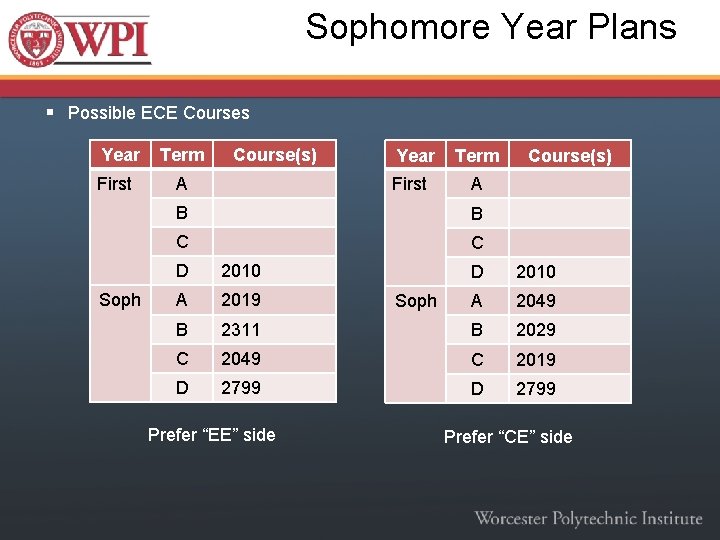
Sophomore Year Plans § Possible ECE Courses Year First Term Course(s) A Year First B Soph Term Course(s) A B C 2010 D 2022 A 2019 A 2049 B 2311 B 3803? C 2049 C 2019 D 2799 Prefer “EE” side Soph Prefer “CE” side
Sophomore Year Plans § Possible ECE Courses Year First Soph Term Course(s) A Year First Term A B B C C D 2010 A 2019 B Course(s) D 2010 A 2049 2311 B 2029 C 2049 C 2019 D 2799 Prefer “EE” side Soph Prefer “CE” side
Sophomore Year Plans § Possible ECE Courses Year First Soph Term Course(s) A Year First Term Course(s) A B 2010 C 2111 D 2311 D 2022 A 2312 A 2049 B 2029 B 3803? C 2049 C “Next Level”? D 2799 Prefer “EE” side Soph Prefer “CE” side
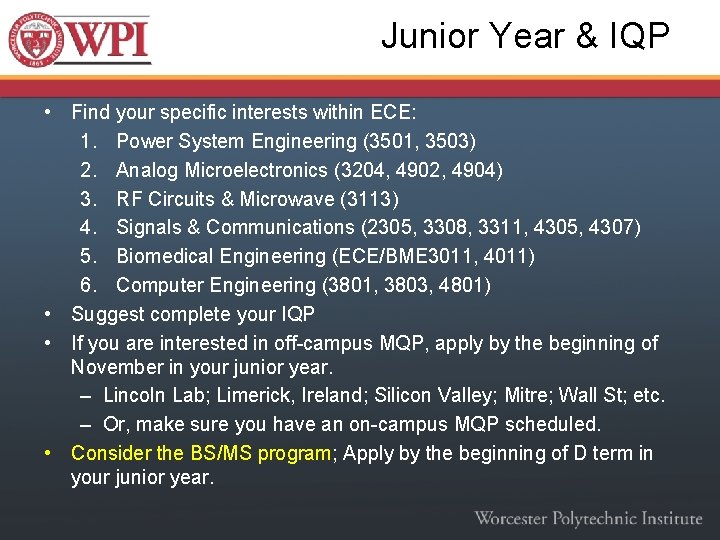
Junior Year & IQP • Find your specific interests within ECE: 1. Power System Engineering (3501, 3503) 2. Analog Microelectronics (3204, 4902, 4904) 3. RF Circuits & Microwave (3113) 4. Signals & Communications (2305, 3308, 3311, 4305, 4307) 5. Biomedical Engineering (ECE/BME 3011, 4011) 6. Computer Engineering (3801, 3803, 4801) • Suggest complete your IQP • If you are interested in off-campus MQP, apply by the beginning of November in your junior year. – Lincoln Lab; Limerick, Ireland; Silicon Valley; Mitre; Wall St; etc. – Or, make sure you have an on-campus MQP scheduled. • Consider the BS/MS program; Apply by the beginning of D term in your junior year.
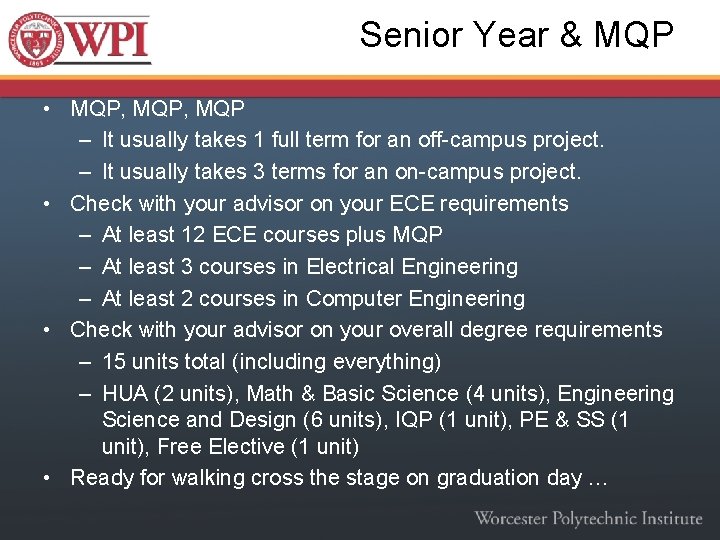
Senior Year & MQP • MQP, MQP – It usually takes 1 full term for an off-campus project. – It usually takes 3 terms for an on-campus project. • Check with your advisor on your ECE requirements – At least 12 ECE courses plus MQP – At least 3 courses in Electrical Engineering – At least 2 courses in Computer Engineering • Check with your advisor on your overall degree requirements – 15 units total (including everything) – HUA (2 units), Math & Basic Science (4 units), Engineering Science and Design (6 units), IQP (1 unit), PE & SS (1 unit), Free Elective (1 unit) • Ready for walking cross the stage on graduation day …
25
Questions - Feel Free to Contact Us • Prof. John Orr, orr@wpi. edu, AK 214 • Prof. Xinming Huang, xhuang@ece. wpi. edu, AK 216 • Prof. Fred Looft, fjlooft@wpi. edu, Department Head, AK 202 • Ms. Stacie Murray, smurray@ece. wpi. edu, UG Admin, AK 202 • And feel free to contact any ECE faculty at anytime
27