
Electrical Activity in the Nervous System MK Mathew


- Slides: 27
Electrical Activity in the Nervous System MK Mathew NCBS, TIFR UAS – GKVK Campus Bangalore IBRO Course in Neuroscience Center for Cognitive Neuroscience & Semantics, University of Latvia Riga, Latvia August 21 -August 29, 2013
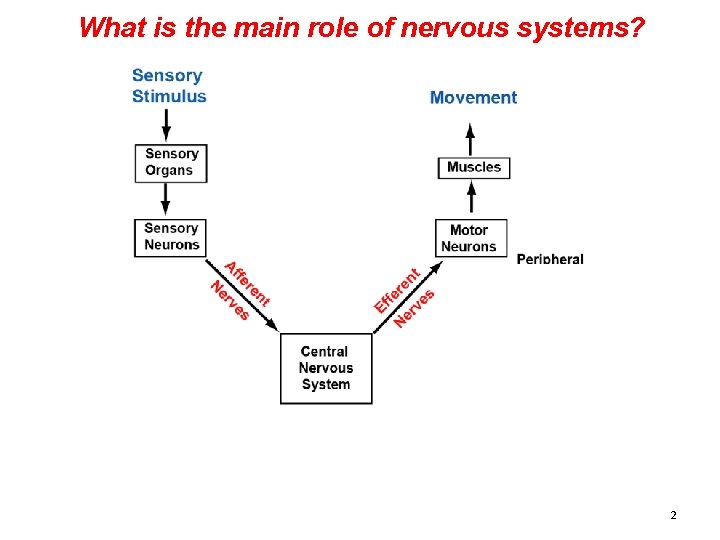
What is the main role of nervous systems? 2
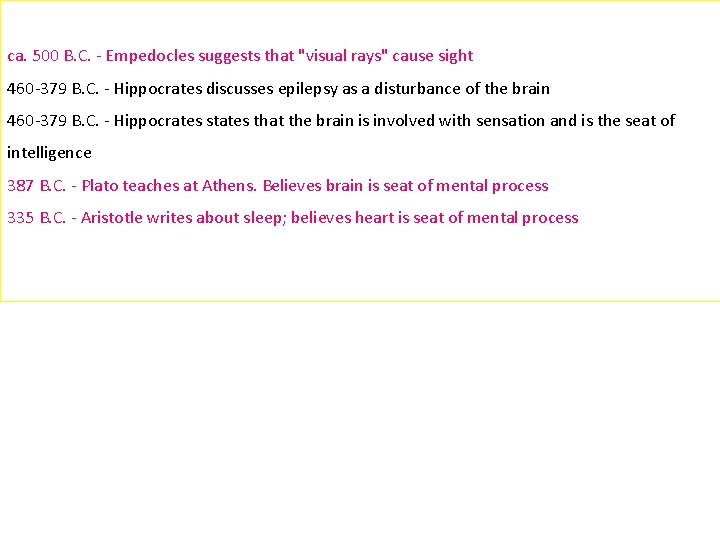
ca. 500 B. C. - Empedocles suggests that "visual rays" cause sight 460 -379 B. C. - Hippocrates discusses epilepsy as a disturbance of the brain 460 -379 B. C. - Hippocrates states that the brain is involved with sensation and is the seat of intelligence 387 B. C. - Plato teaches at Athens. Believes brain is seat of mental process 335 B. C. - Aristotle writes about sleep; believes heart is seat of mental process
Kitab al-Manazir Abu ‘Ali al-Hasan ibn al-Haytham
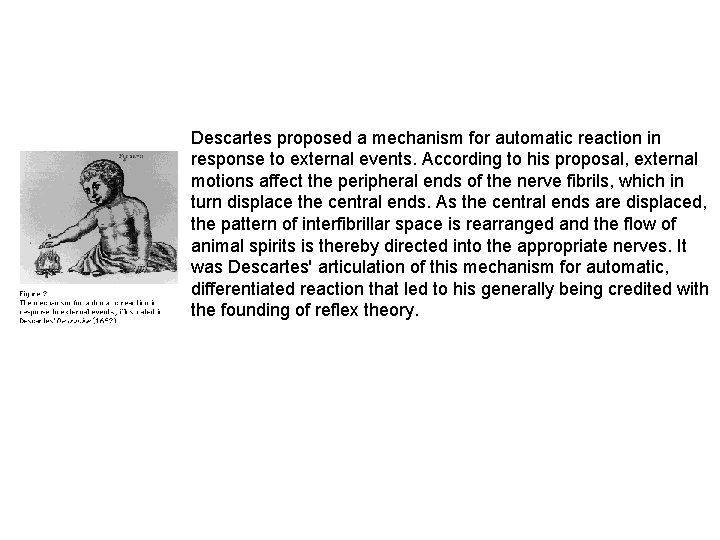
Descartes proposed a mechanism for automatic reaction in response to external events. According to his proposal, external motions affect the peripheral ends of the nerve fibrils, which in turn displace the central ends. As the central ends are displaced, the pattern of interfibrillar space is rearranged and the flow of animal spirits is thereby directed into the appropriate nerves. It was Descartes' articulation of this mechanism for automatic, differentiated reaction that led to his generally being credited with the founding of reflex theory.
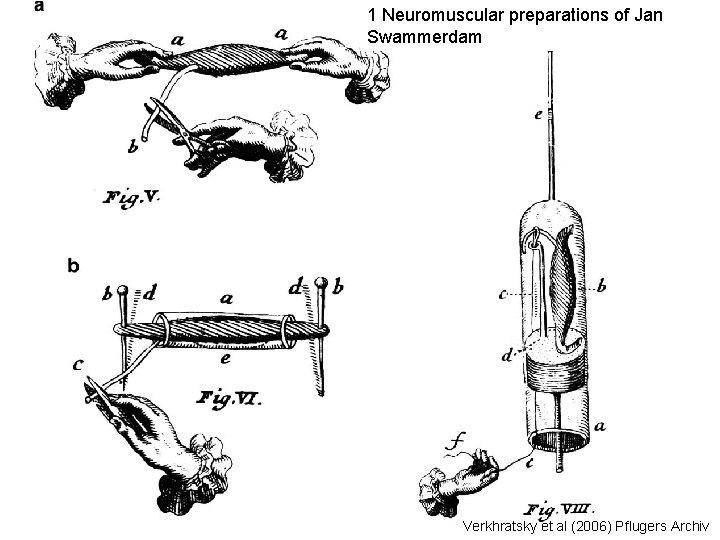
Antoni van Leeuwenhoek (1632– 1723): ‘Often and not without pleasure, I have observedthe structure of the nerves to be composed of very slender vessels of an indescribable fineness, running length-wise to form the nerve’ Felice Fontana (1730 – 1805): Carried out nerve dissections at 700 X magnification with fine needles. Found that nerves were composed of fine cylinders. These were transparent, homogeneous, not empty, as I had found them in previous occasions. Swammerdam (1738): Showed that muscle contraction did not involve any change in volume – ie no animal spirits or corpuscles were flooding into it and causing the contraction.
1 Neuromuscular preparations of Jan Swammerdam Verkhratsky et al (2006) Pflugers Archiv
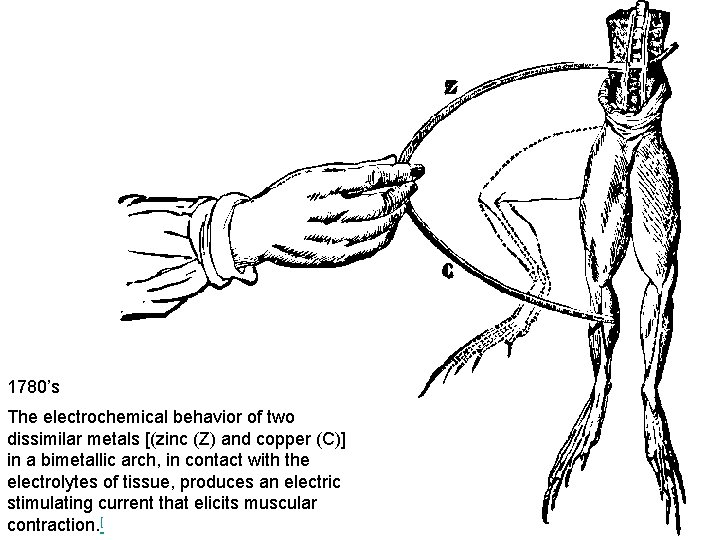
1780’s The electrochemical behavior of two dissimilar metals [(zinc (Z) and copper (C)] in a bimetallic arch, in contact with the electrolytes of tissue, produces an electric stimulating current that elicits muscular contraction. [
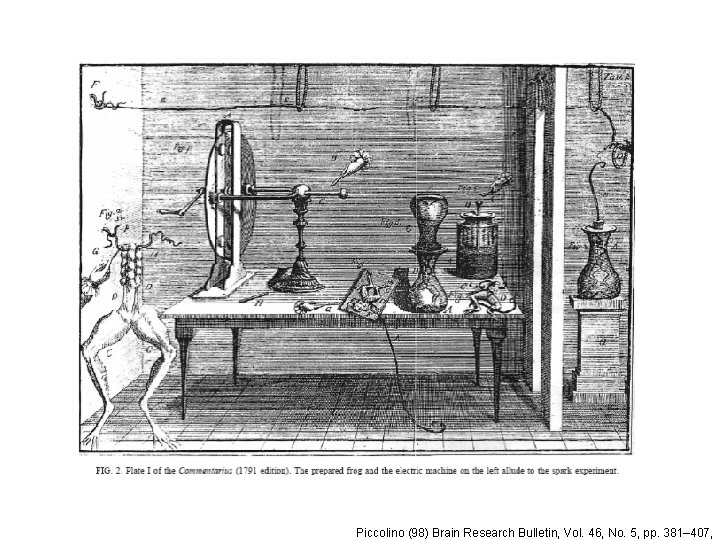
Piccolino (98) Brain Research Bulletin, Vol. 46, No. 5, pp. 381– 407,
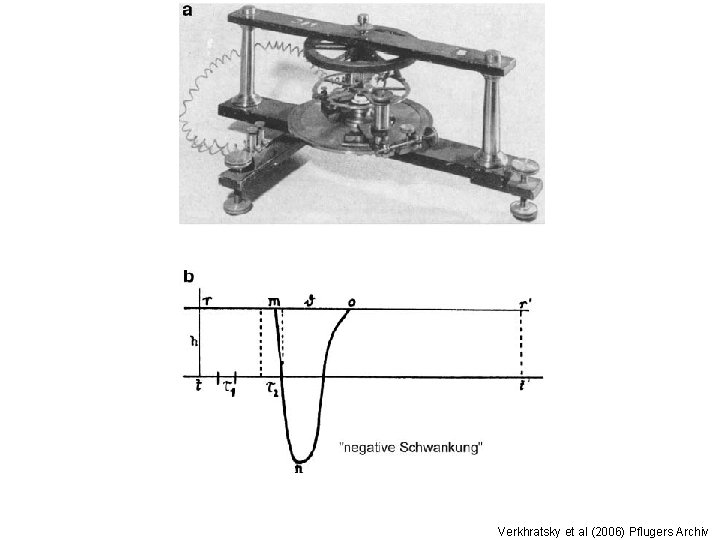
1780’s Galavni’s experiments with “Animal Electricity” establish that nerves are conductors of electricity and not of fluid, establishing the basis for neurophysiology 1848 Emile Du-Bois Reymond (1818 - 1896) discovered the nerve injury current and the negative" variation (the nerve action potential).
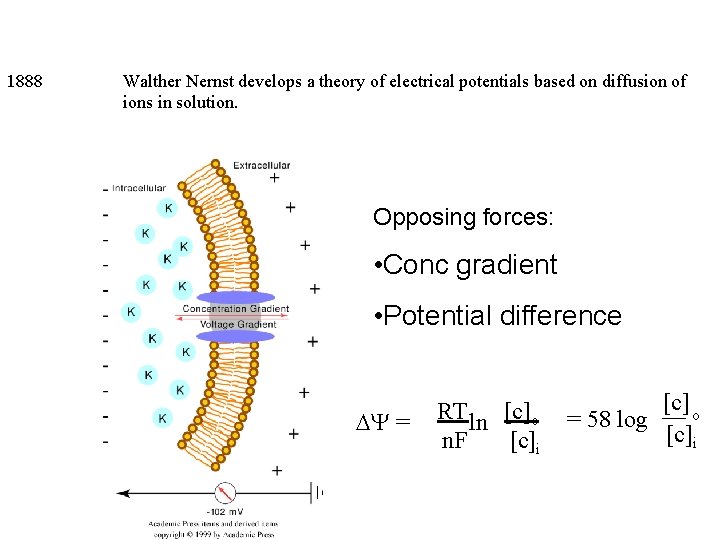
1888 Walther Nernst develops a theory of electrical potentials based on diffusion of ions in solution. Opposing forces: • Conc gradient • Potential difference DY = RT ln [c]o n. F [c]i [c] o __ = 58 log [c]i
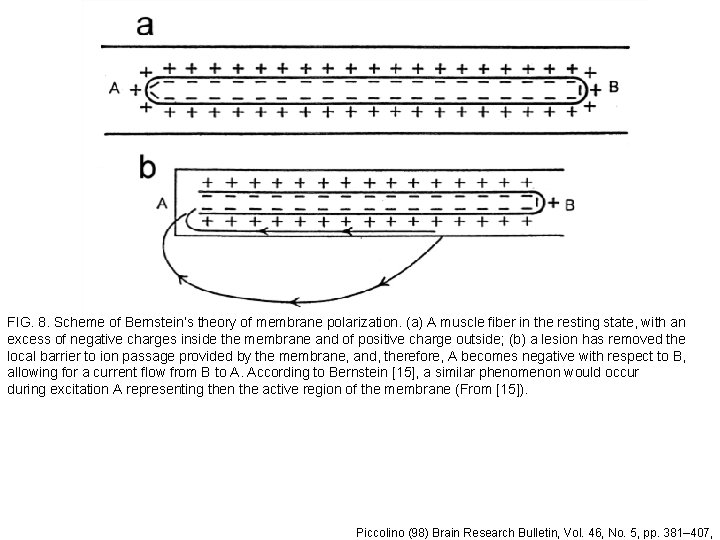
FIG. 8. Scheme of Bernstein’s theory of membrane polarization. (a) A muscle fiber in the resting state, with an excess of negative charges inside the membrane and of positive charge outside; (b) a lesion has removed the local barrier to ion passage provided by the membrane, and, therefore, A becomes negative with respect to B, allowing for a current flow from B to A. According to Bernstein [15], a similar phenomenon would occur during excitation A representing then the active region of the membrane (From [15]). Piccolino (98) Brain Research Bulletin, Vol. 46, No. 5, pp. 381– 407,
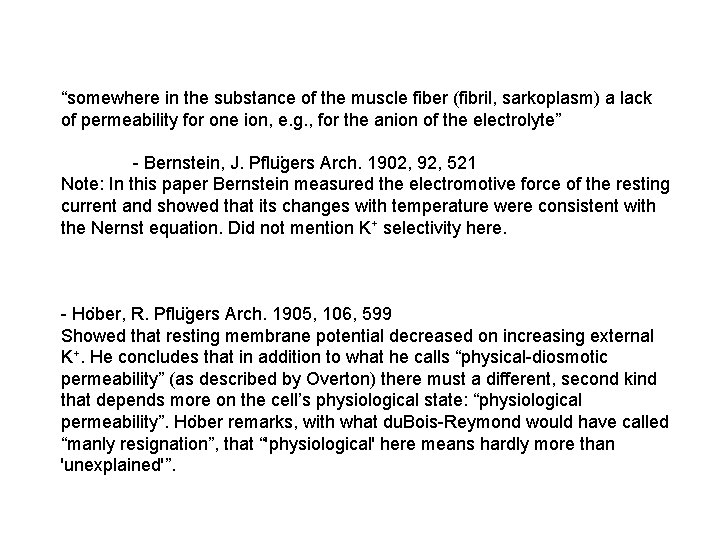
“somewhere in the substance of the muscle fiber (fibril, sarkoplasm) a lack of permeability for one ion, e. g. , for the anion of the electrolyte” - Bernstein, J. Pflu gers Arch. 1902, 92, 521 Note: In this paper Bernstein measured the electromotive force of the resting current and showed that its changes with temperature were consistent with the Nernst equation. Did not mention K+ selectivity here. - Ho ber, R. Pflu gers Arch. 1905, 106, 599 Showed that resting membrane potential decreased on increasing external K+. He concludes that in addition to what he calls “physical-diosmotic permeability” (as described by Overton) there must a different, second kind that depends more on the cell’s physiological state: “physiological permeability”. Ho ber remarks, with what du. Bois-Reymond would have called “manly resignation”, that “'physiological' here means hardly more than 'unexplained'”.
Verkhratsky et al (2006) Pflugers Archiv
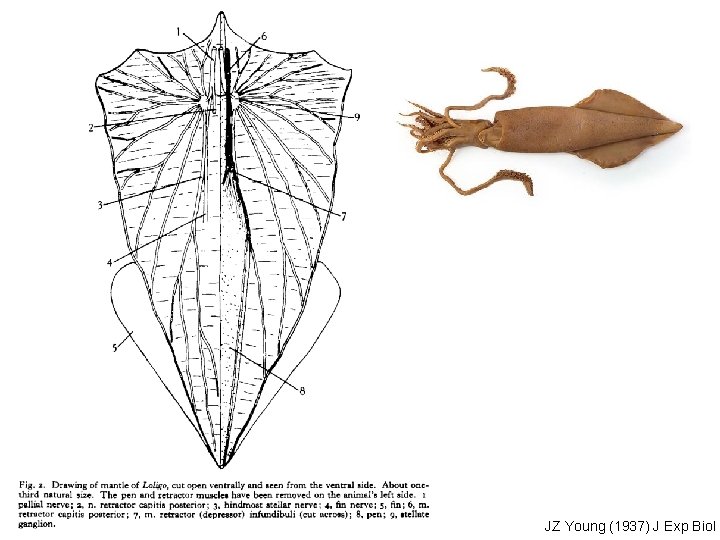
JZ Young (1937) J Exp Biol
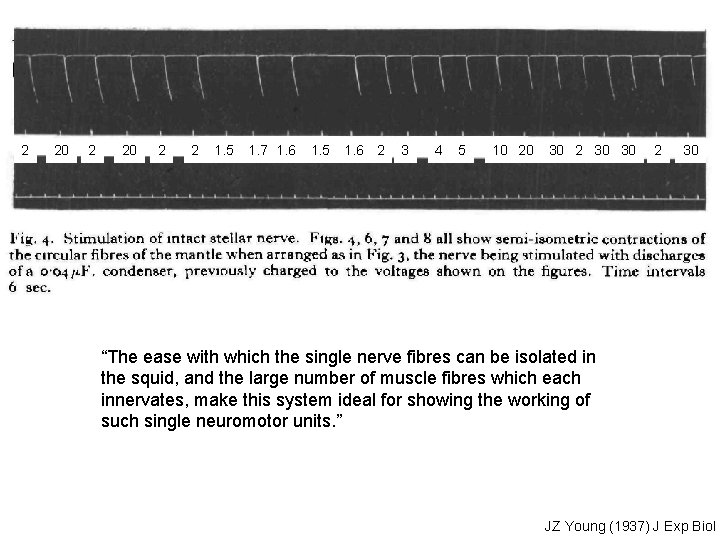
2 20 2 2 1. 5 1. 7 1. 6 1. 5 1. 6 2 3 4 5 10 20 JZ 30 Young 2 30(1937) 30 J 2 Exp 30 Biol “The ease with which the single nerve fibres can be isolated in the squid, and the large number of muscle fibres which each innervates, make this system ideal for showing the working of such single neuromotor units. ” JZ Young (1937) J Exp Biol
1780’s Galavni’s experiments with “Animal Electricity” establish that nerves are conductors of electricity and not of fluid, establishing the basis for neurophysiology 1848 Emile Du-Bois Reymond (1818 - 1896) discovered the nerve injury current and the negative" variation (the nerve action potential). 1888 Walther Nernst develops a theory of electrical potentials based on diffusion of ions in solution. 1896 Bernstein proposes K+ selective membrane to explain Resting Potential 1902 Bernstein predicted massive increase in non-selective membrane permeability during an action potential. This was subsequently referred to as the Bernstein Hypothesis. 1937 JZ Young introduces the squid axon as a preparation for electrphysiology
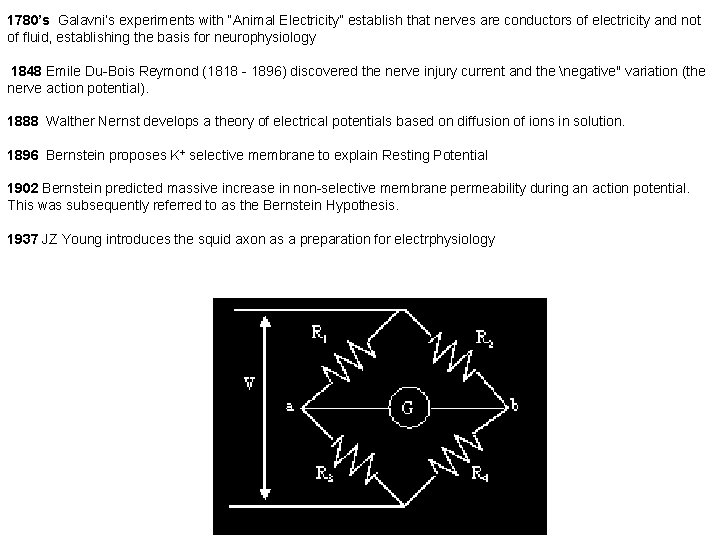
1780’s Galavni’s experiments with “Animal Electricity” establish that nerves are conductors of electricity and not of fluid, establishing the basis for neurophysiology 1848 Emile Du-Bois Reymond (1818 - 1896) discovered the nerve injury current and the negative" variation (the nerve action potential). 1888 Walther Nernst develops a theory of electrical potentials based on diffusion of ions in solution. 1896 Bernstein proposes K+ selective membrane to explain Resting Potential 1902 Bernstein predicted massive increase in non-selective membrane permeability during an action potential. This was subsequently referred to as the Bernstein Hypothesis. 1937 JZ Young introduces the squid axon as a preparation for electrphysiology
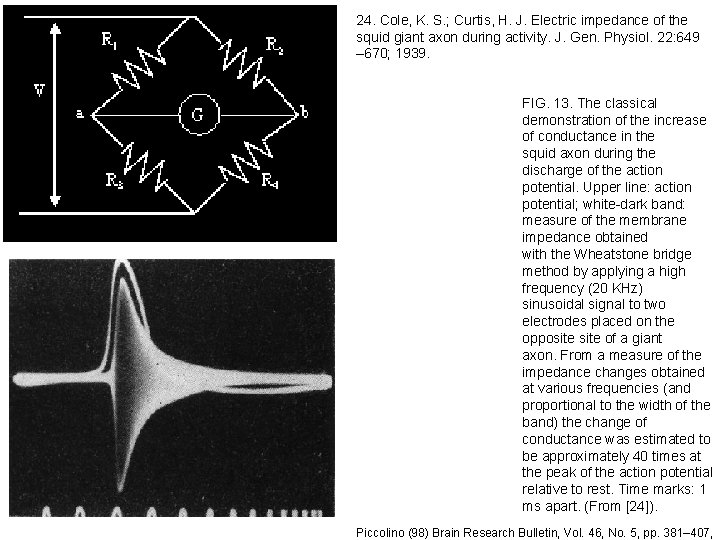
24. Cole, K. S. ; Curtis, H. J. Electric impedance of the squid giant axon during activity. J. Gen. Physiol. 22: 649 – 670; 1939. FIG. 13. The classical demonstration of the increase of conductance in the squid axon during the discharge of the action potential. Upper line: action potential; white-dark band: measure of the membrane impedance obtained with the Wheatstone bridge method by applying a high frequency (20 KHz) sinusoidal signal to two electrodes placed on the opposite of a giant axon. From a measure of the impedance changes obtained at various frequencies (and proportional to the width of the band) the change of conductance was estimated to be approximately 40 times at the peak of the action potential relative to rest. Time marks: 1 ms apart. (From [24]). Piccolino (98) Brain Research Bulletin, Vol. 46, No. 5, pp. 381– 407,
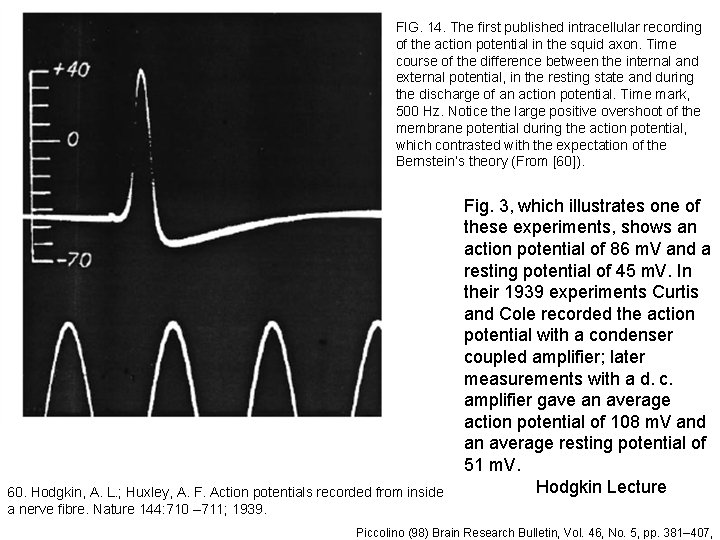
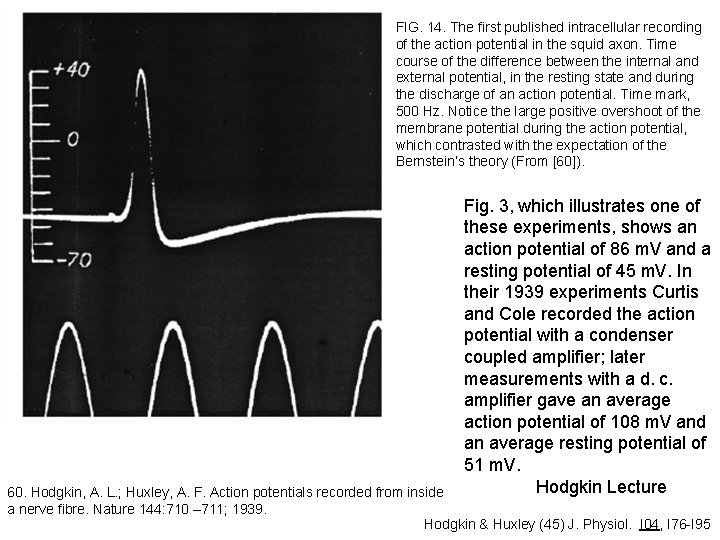
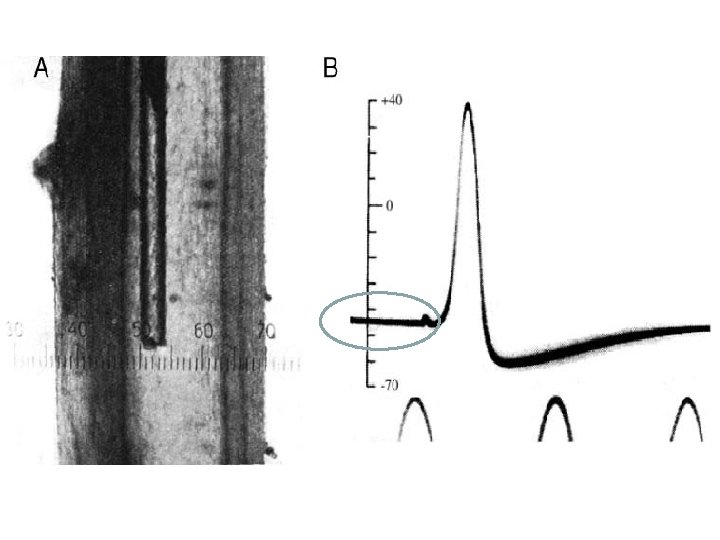
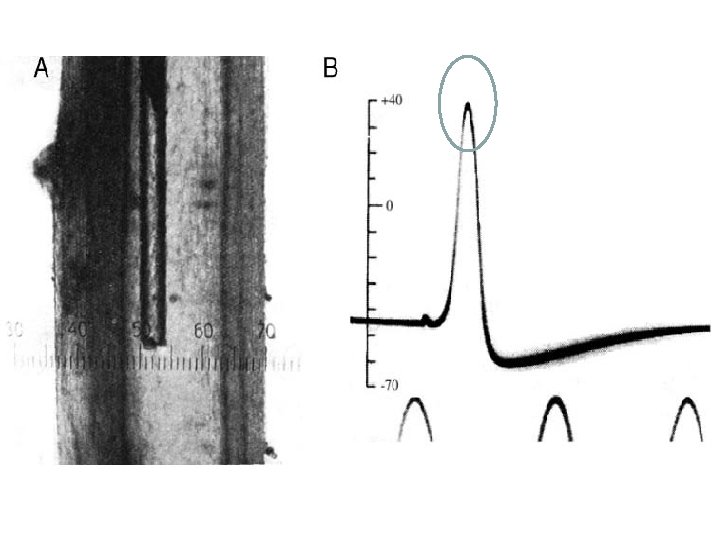
FIG. 14. The first published intracellular recording of the action potential in the squid axon. Time course of the difference between the internal and external potential, in the resting state and during the discharge of an action potential. Time mark, 500 Hz. Notice the large positive overshoot of the membrane potential during the action potential, which contrasted with the expectation of the Bernstein’s theory (From [60]). 60. Hodgkin, A. L. ; Huxley, A. F. Action potentials recorded from inside a nerve fibre. Nature 144: 710 – 711; 1939. Fig. 3, which illustrates one of these experiments, shows an action potential of 86 m. V and a resting potential of 45 m. V. In their 1939 experiments Curtis and Cole recorded the action potential with a condenser coupled amplifier; later measurements with a d. c. amplifier gave an average action potential of 108 m. V and an average resting potential of 51 m. V. Hodgkin Lecture Piccolino (98) Brain Research Bulletin, Vol. 46, No. 5, pp. 381– 407,
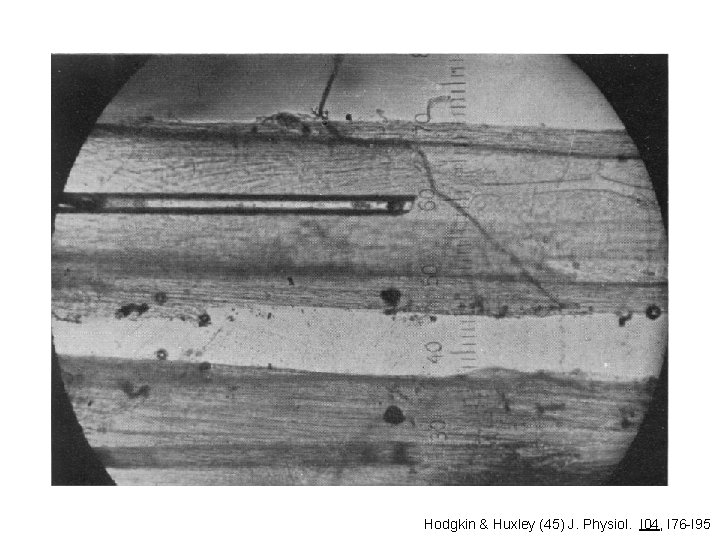
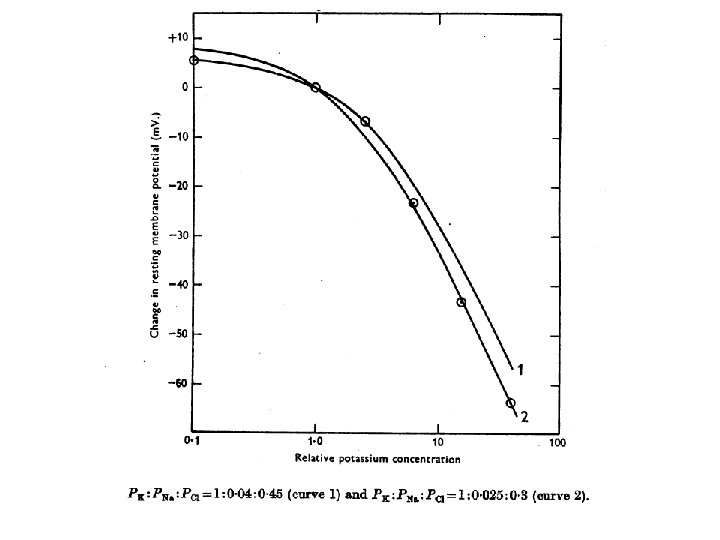
Hodgkin & Huxley (45) J. Physiol. I 04, I 76 -I 95
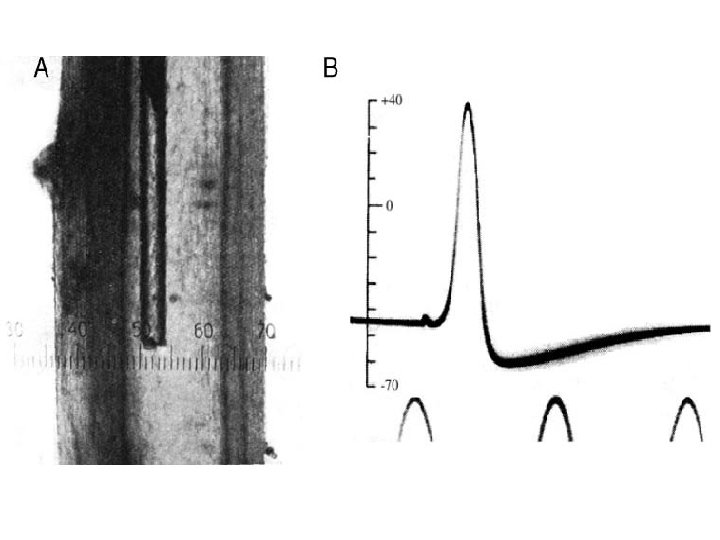
FIG. 14. The first published intracellular recording of the action potential in the squid axon. Time course of the difference between the internal and external potential, in the resting state and during the discharge of an action potential. Time mark, 500 Hz. Notice the large positive overshoot of the membrane potential during the action potential, which contrasted with the expectation of the Bernstein’s theory (From [60]). Fig. 3, which illustrates one of these experiments, shows an action potential of 86 m. V and a resting potential of 45 m. V. In their 1939 experiments Curtis and Cole recorded the action potential with a condenser coupled amplifier; later measurements with a d. c. amplifier gave an average action potential of 108 m. V and an average resting potential of 51 m. V. Hodgkin Lecture 60. Hodgkin, A. L. ; Huxley, A. F. Action potentials recorded from inside a nerve fibre. Nature 144: 710 – 711; 1939. Hodgkin & Huxley (45) J. Physiol. I 04, I 76 -I 95
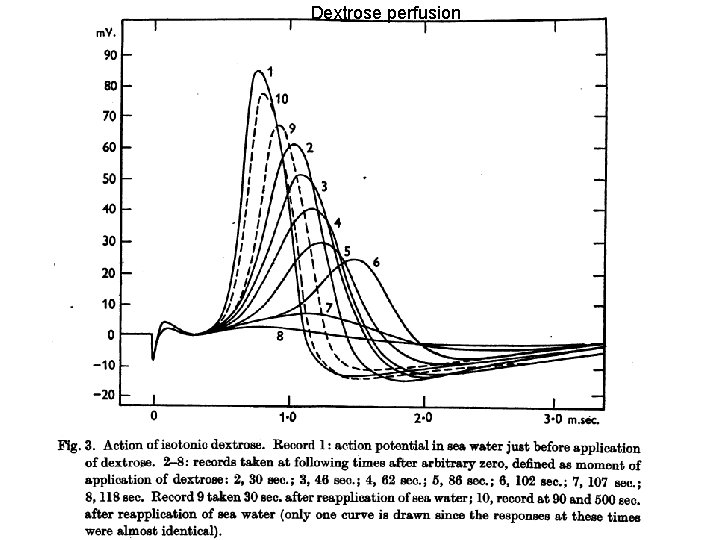
Dextrose perfusion