
Electric Utility Power Systems Generation of Electricity 1
- Slides: 10
Electric Utility Power Systems Generation of Electricity 1
Demand of an Electrical System • The total power drawn by a customer of a large utility system fluctuates between wide limits, depending on the time, day, and season. • Example of demand: 15 GW (15000 MW) in the winter and 10 GW in the summer. Both peaks at about 17: 00 (5: 00 pm)! • Base load of the system: The minimum demand for power throughout the year. The base load demand has to be fed 100% of the time. • Peak load: The annual maximum demand. This may occur for only 0. 1% of the time. • Intermediate loads: The demand between the two extremes. It has to be fed for less than 100% of the time. 2
Three Types of Generating Stations • Base-Power Stations: Deliver full power at all times. Examples: Nuclear stations and coal-fired stations. • Intermediate-Power Stations: They can respond relatively quickly to changes in demand by adding or removing one or more generating units. Examples hydropower stations. • Peak-Generating Stations: They deliver power for brief intervals during the day. Examples generators equipped with movers such as diesel or gas engines. 3
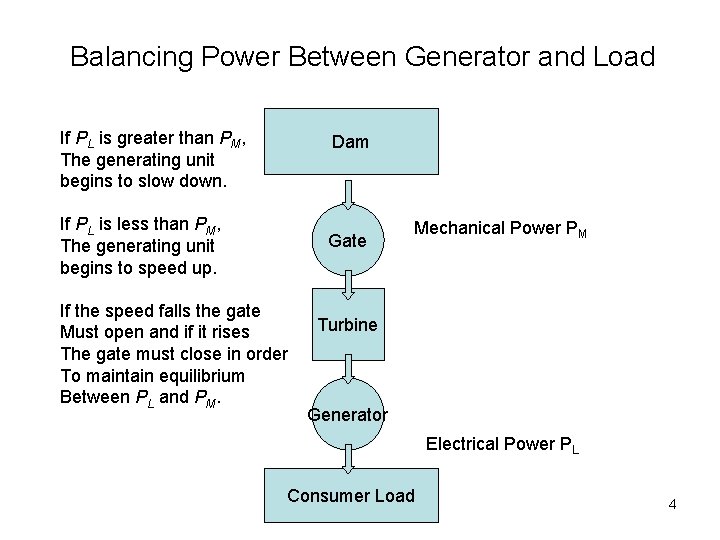
Balancing Power Between Generator and Load If PL is greater than PM, The generating unit begins to slow down. Dam If PL is less than PM, The generating unit begins to speed up. Gate If the speed falls the gate Must open and if it rises The gate must close in order To maintain equilibrium Between PL and PM. Mechanical Power PM Turbine Generator Electrical Power PL Consumer Load 4
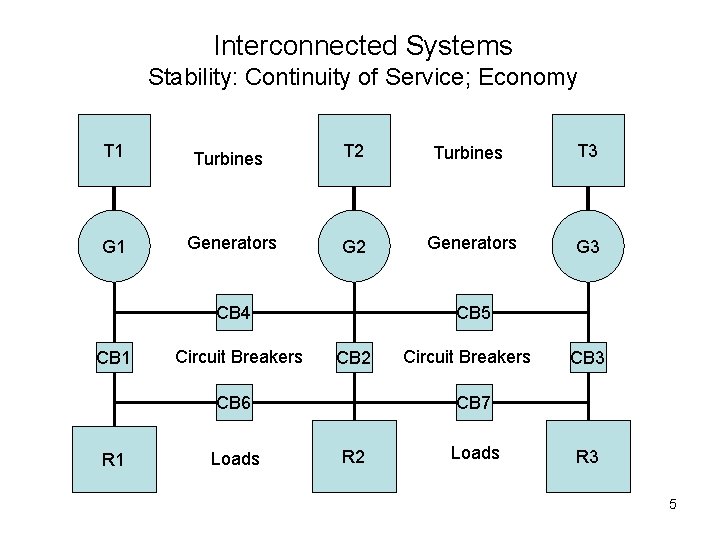
Interconnected Systems Stability: Continuity of Service; Economy T 1 Turbines T 2 Turbines T 3 G 1 Generators G 2 Generators G 3 CB 4 CB 1 Circuit Breakers CB 5 CB 2 CB 6 R 1 Loads Circuit Breakers CB 3 CB 7 R 2 Loads R 3 5
Outage or Contingency • A major disturbance of system creates a state of emergency. The sudden loss of an important load or a permanent short-circuit on a transmission line makes a major outage. • If a big load is suddenly lost, all the turbines begin to speed up and the frequency increases everywhere in the system. • However, if a generator is disconnected, the speed of the remaining generators decreases because they suddenly have to carry the entire load. The frequency will decrease (sometimes it reaches 5 Hz). In such case, one or more load should be shut down. Such load shedding is done by frequency-sensitive relays that open selected circuit breakers as the frequency falls. For example, on a 60 -Hz system the circuit breakers shed 15% of the system when the frequency drops to 59. 3 Hz. Another 15% when the frequency drops to 58. 9 Hz. Load shedding must be done in less than one second to save loads. 6
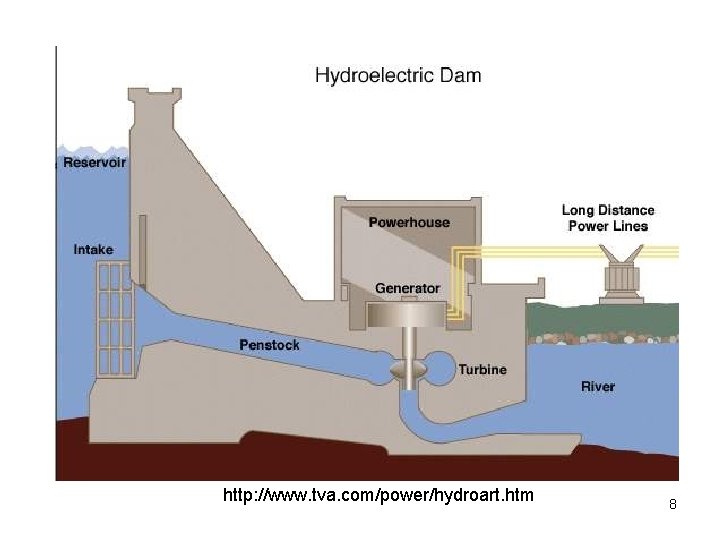
Hydropower Generating Stations • The power that can be extracted from a waterfall depends upon its height and rate of flow: P = 9. 8 qh, where P is the available power in k. W, q is the water rate of flow in m 3/s, h is the head of water (m). • Hydropower stations are divided into three groups: – High-Head Development: in excess of 300 m. – Medium-Head Development: Between 30 and 300 m. – Low-Head Development: Less than 30 m. • A hydropower installation consists of: – – Dam: Made of earth or concrete and built across river beds or reservoirs. Waterways: Conduits that lead water from dam to the generating plant. Draft Tube: Carefully designed vertical channels. 7 Power House: Synchronous generators; transformers; circuit breakers. 7
http: //www. tva. com/power/hydroart. htm 8
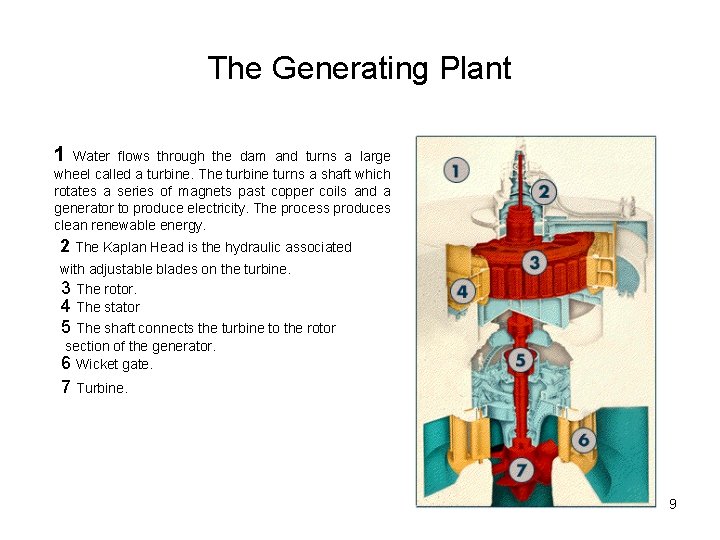
The Generating Plant 1 Water flows through the dam and turns a large wheel called a turbine. The turbine turns a shaft which rotates a series of magnets past copper coils and a generator to produce electricity. The process produces clean renewable energy. 2 The Kaplan Head is the hydraulic associated with adjustable blades on the turbine. 3 The rotor. 4 The stator 5 The shaft connects the turbine to the rotor section of the generator. 6 Wicket gate. 7 Turbine. 9
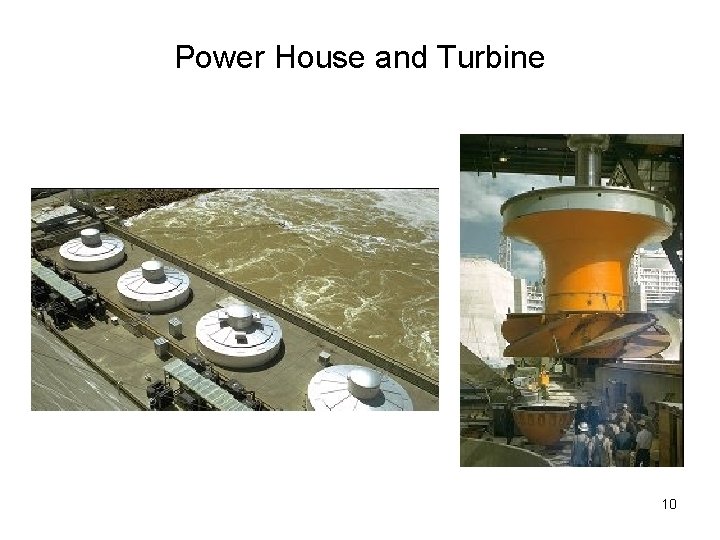
Power House and Turbine 10