
Electric Potential and Currents The Electric Battery Volta
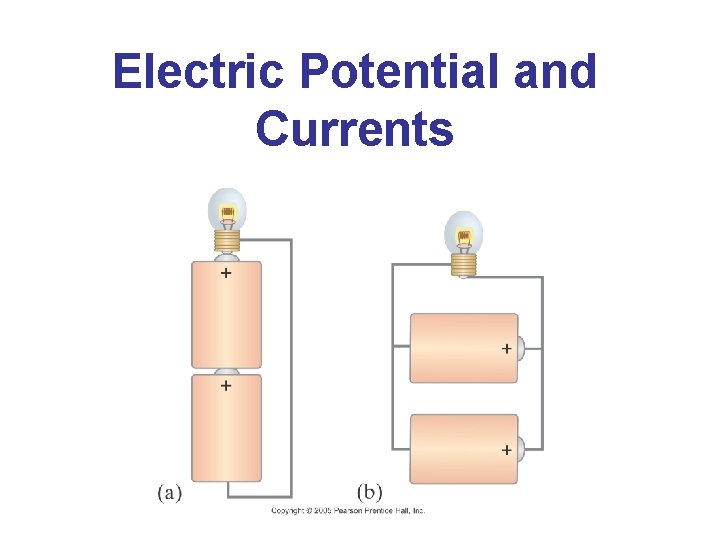
Electric Potential and Currents
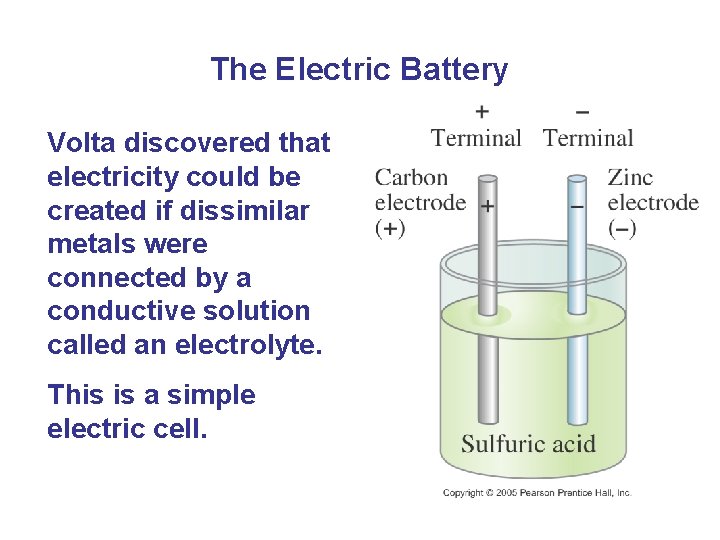
The Electric Battery Volta discovered that electricity could be created if dissimilar metals were connected by a conductive solution called an electrolyte. This is a simple electric cell.
The Electric Battery A battery transforms chemical energy into electrical energy. Chemical reactions within the cell create a potential difference between the terminals by slowly dissolving them. This potential difference can be maintained even if a current is kept flowing, until one or the other terminal is completely dissolved.
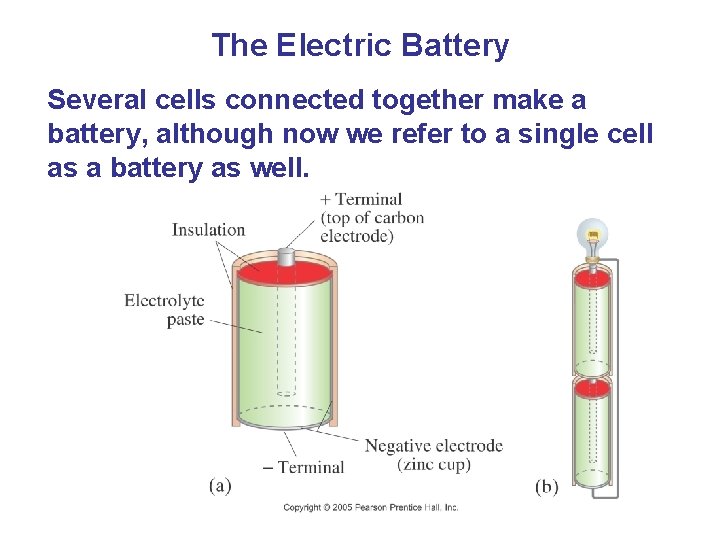
The Electric Battery Several cells connected together make a battery, although now we refer to a single cell as a battery as well.

Electric Current Electric current is the rate of flow of charge through a conductor: Unit of electric current: the ampere, A. 1 A = 1 C/s.
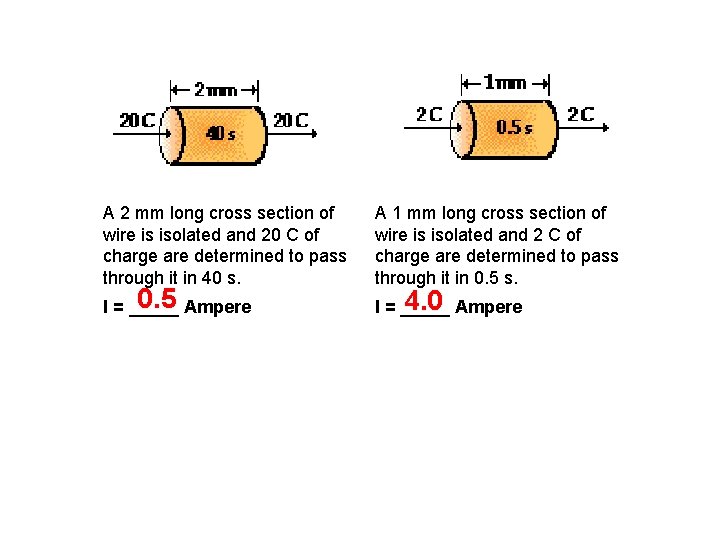
A 2 mm long cross section of wire is isolated and 20 C of charge are determined to pass through it in 40 s. 0. 5 Ampere I = _____ A 1 mm long cross section of wire is isolated and 2 C of charge are determined to pass through it in 0. 5 s. 4. 0 Ampere I = _____
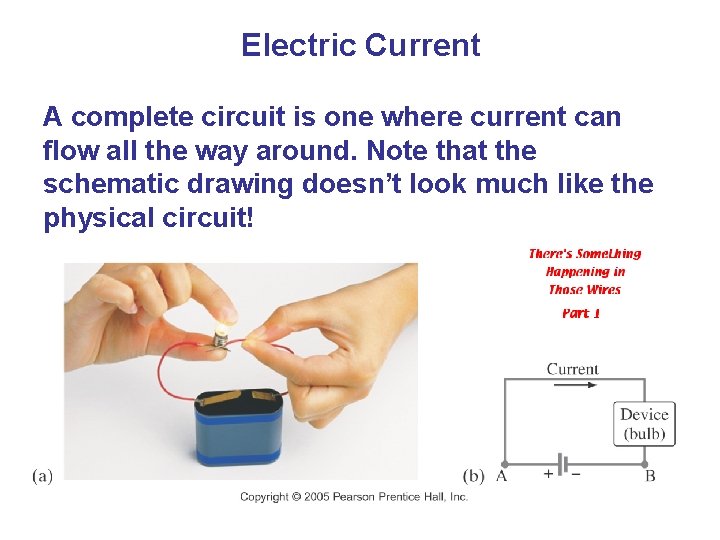
Electric Current A complete circuit is one where current can flow all the way around. Note that the schematic drawing doesn’t look much like the physical circuit!
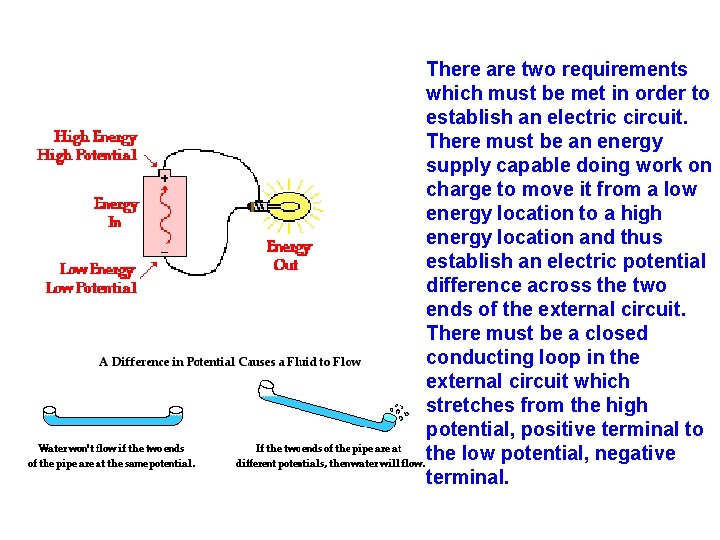
There are two requirements which must be met in order to establish an electric circuit. There must be an energy supply capable doing work on charge to move it from a low energy location to a high energy location and thus establish an electric potential difference across the two ends of the external circuit. There must be a closed conducting loop in the external circuit which stretches from the high potential, positive terminal to the low potential, negative terminal.
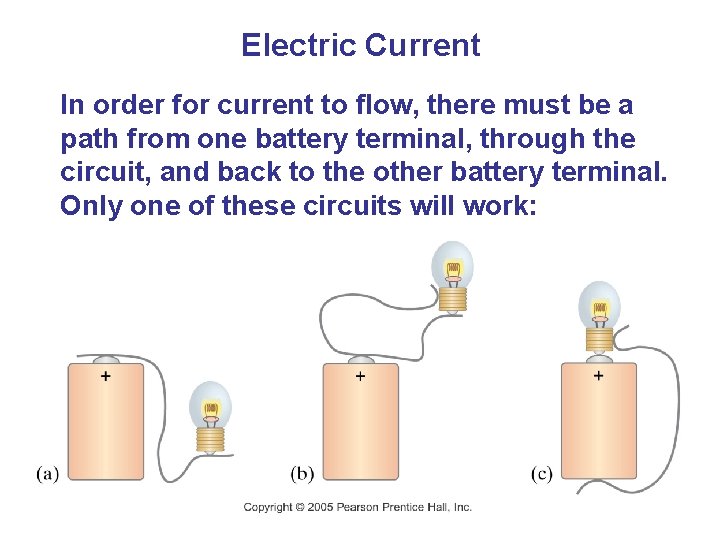
Electric Current In order for current to flow, there must be a path from one battery terminal, through the circuit, and back to the other battery terminal. Only one of these circuits will work:
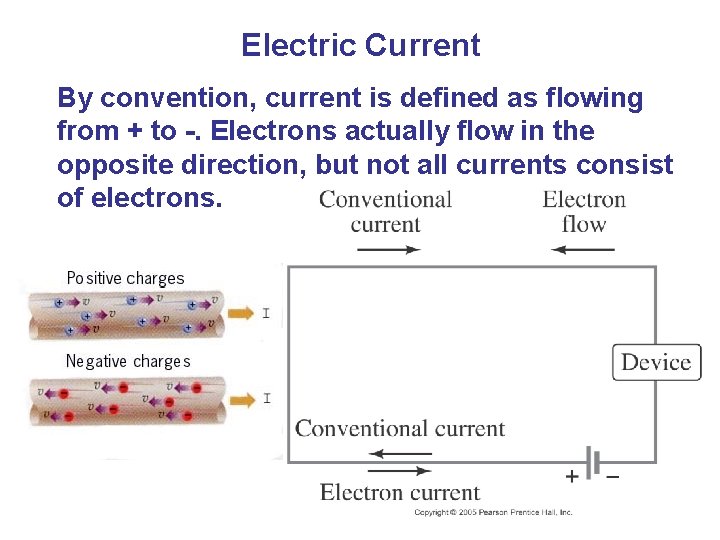
Electric Current By convention, current is defined as flowing from + to -. Electrons actually flow in the opposite direction, but not all currents consist of electrons.
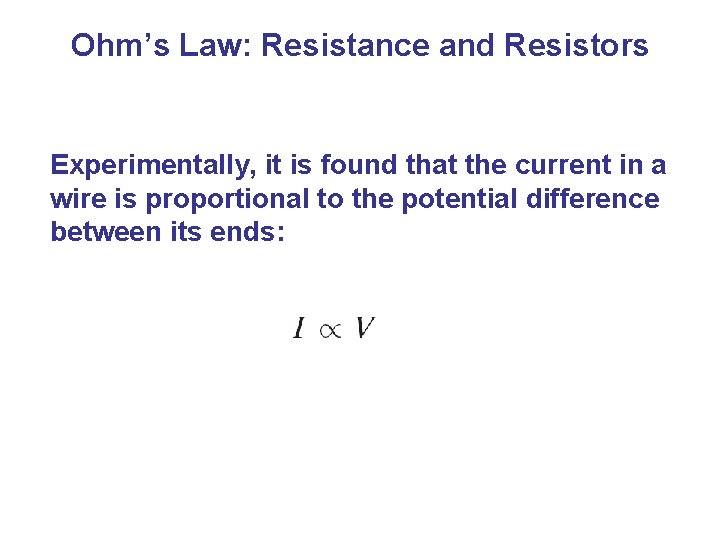
Ohm’s Law: Resistance and Resistors Experimentally, it is found that the current in a wire is proportional to the potential difference between its ends:
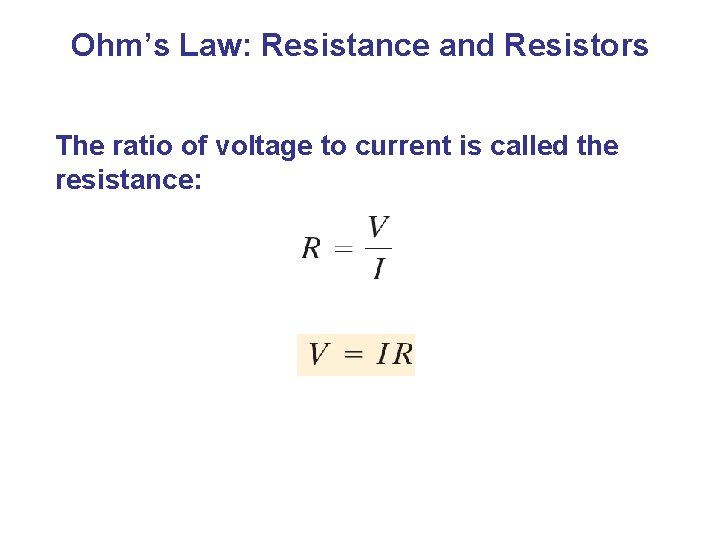
Ohm’s Law: Resistance and Resistors The ratio of voltage to current is called the resistance:
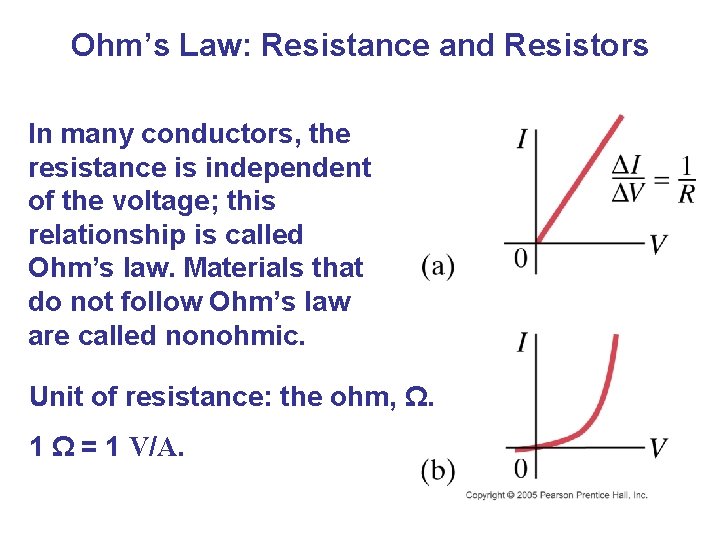
Ohm’s Law: Resistance and Resistors In many conductors, the resistance is independent of the voltage; this relationship is called Ohm’s law. Materials that do not follow Ohm’s law are called nonohmic. Unit of resistance: the ohm, Ω. 1 Ω = 1 V/A.
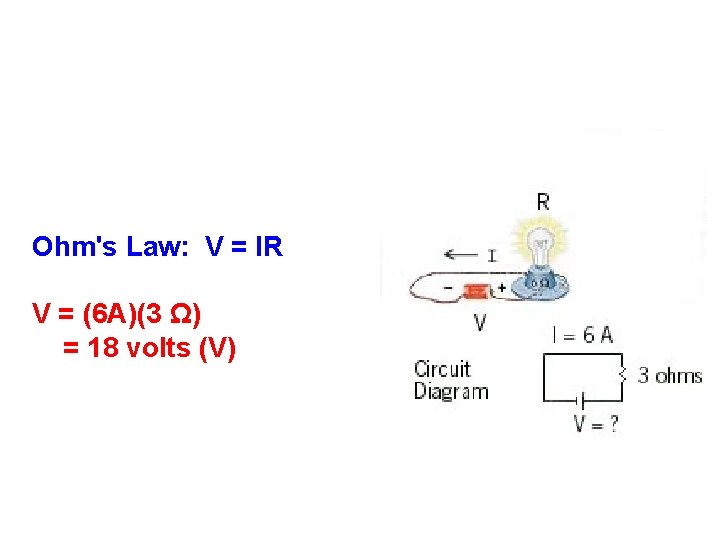
Ohm's Law: V = IR V = (6 A)(3 Ω) = 18 volts (V)
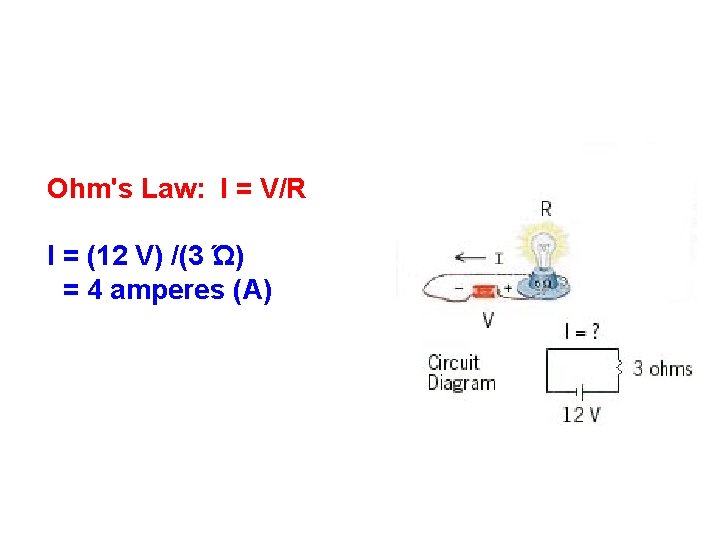
Ohm's Law: I = V/R I = (12 V) /(3 Ώ) = 4 amperes (A)
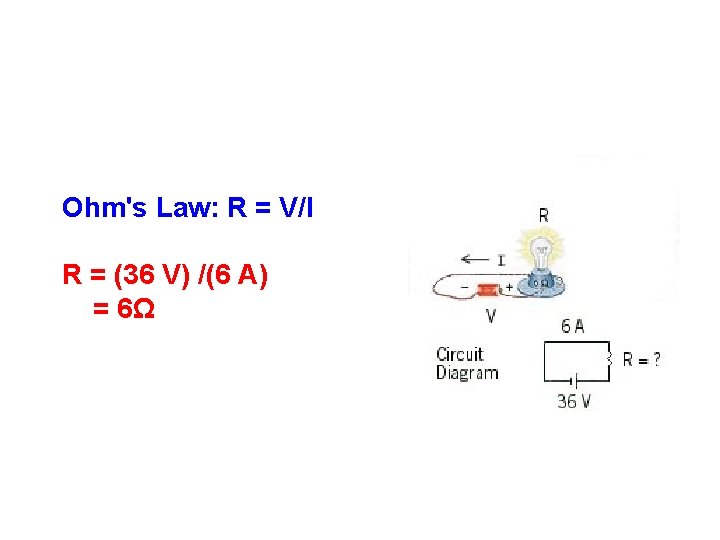
Ohm's Law: R = V/I R = (36 V) /(6 A) = 6Ω
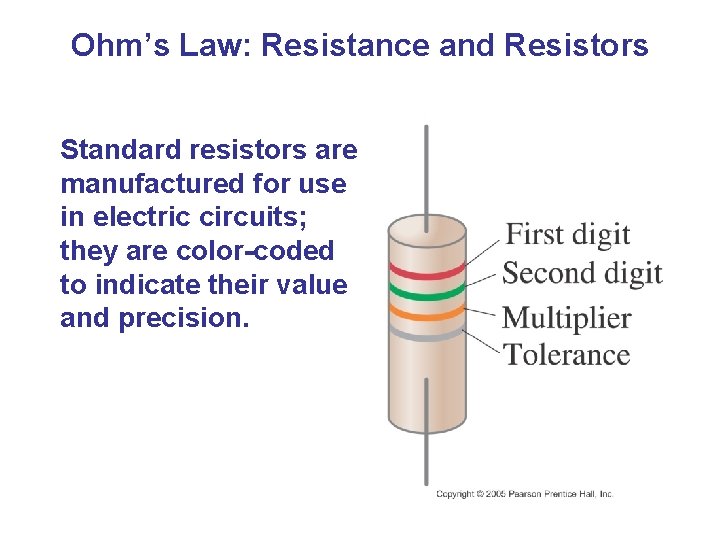
Ohm’s Law: Resistance and Resistors Standard resistors are manufactured for use in electric circuits; they are color-coded to indicate their value and precision.
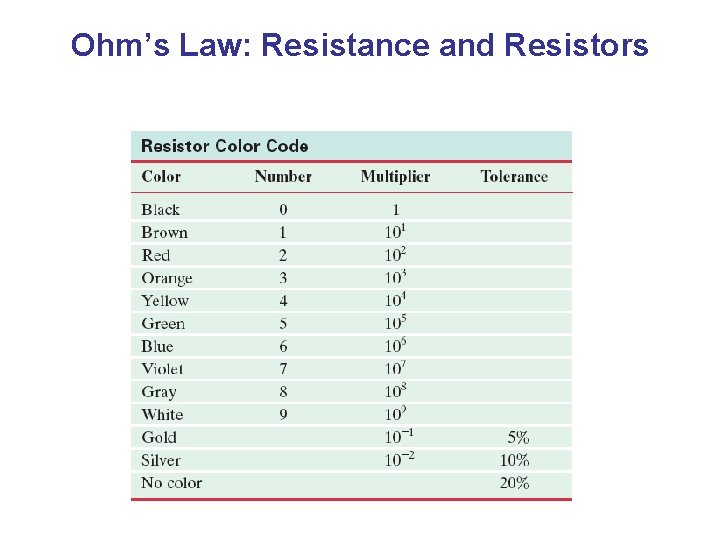
Ohm’s Law: Resistance and Resistors
Ohm’s Law: Resistance and Resistors Some clarifications: • Batteries maintain a (nearly) constant potential difference; the current varies. • Resistance is a property of a material or device. • Current is not a vector but it does have a direction. • Current and charge do not get used up. Whatever charge goes in one end of a circuit comes out the other end.
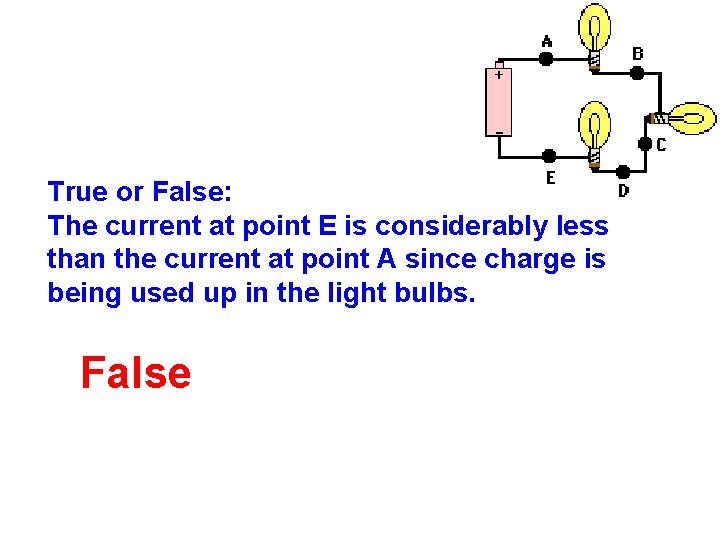
True or False: The current at point E is considerably less than the current at point A since charge is being used up in the light bulbs. False
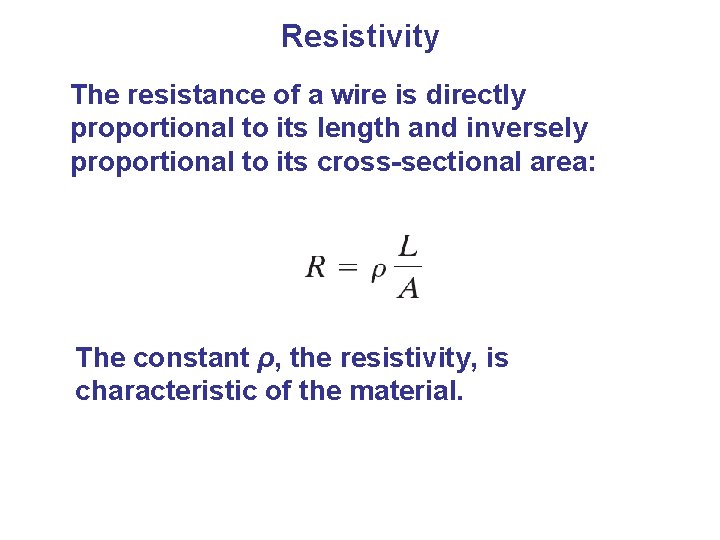
Resistivity The resistance of a wire is directly proportional to its length and inversely proportional to its cross-sectional area: The constant ρ, the resistivity, is characteristic of the material.
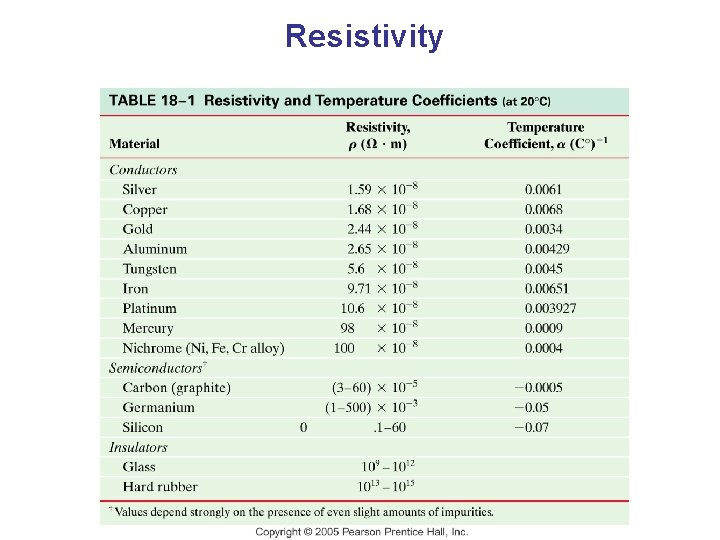
Resistivity
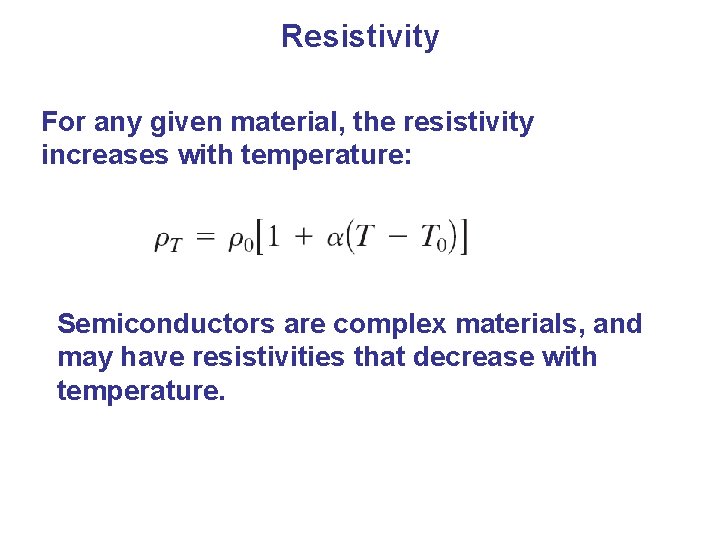
Resistivity For any given material, the resistivity increases with temperature: Semiconductors are complex materials, and may have resistivities that decrease with temperature.
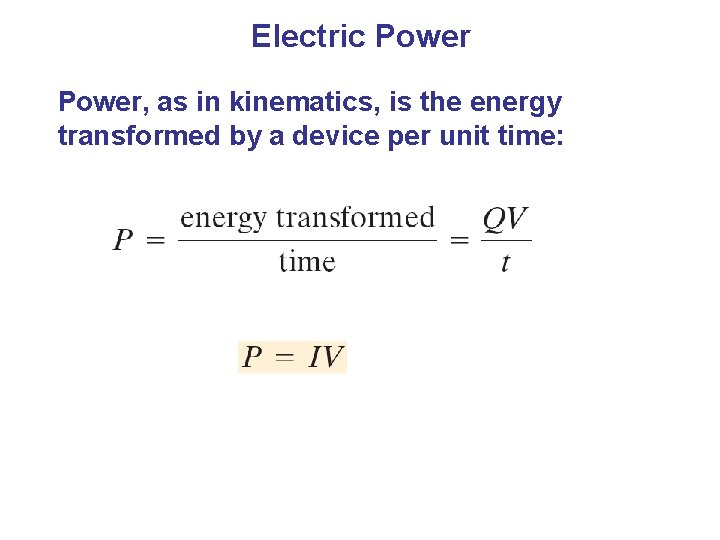
Electric Power, as in kinematics, is the energy transformed by a device per unit time:
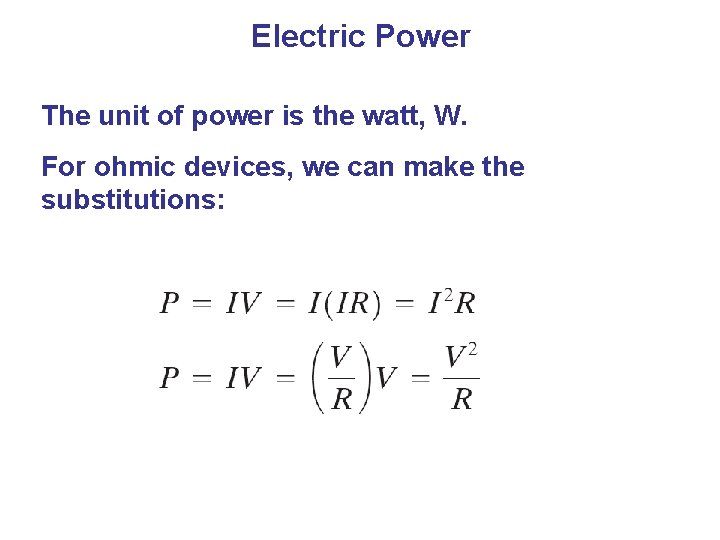
Electric Power The unit of power is the watt, W. For ohmic devices, we can make the substitutions:
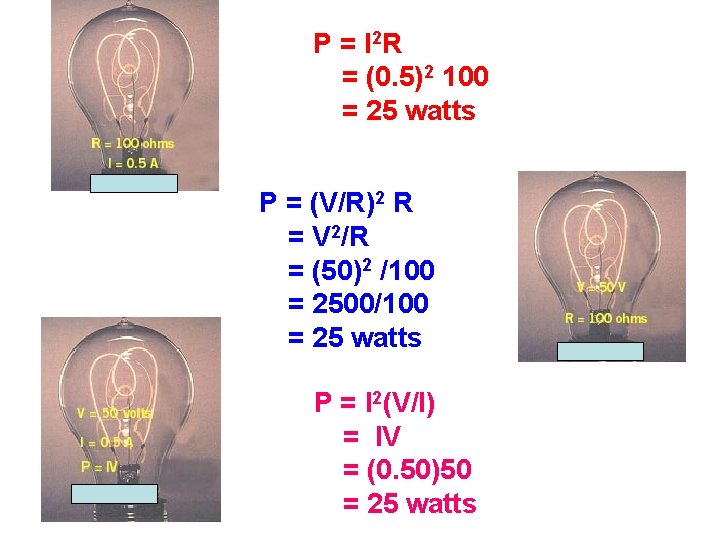
P = I 2 R = (0. 5)2 100 = 25 watts P = (V/R)2 R = V 2/R = (50)2 /100 = 2500/100 = 25 watts P = I 2(V/I) = IV = (0. 50)50 = 25 watts
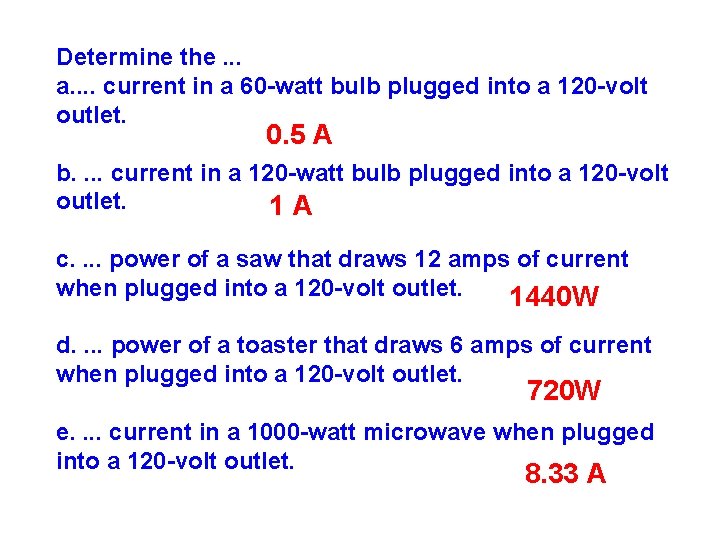
Determine the. . . a. . current in a 60 -watt bulb plugged into a 120 -volt outlet. 0. 5 A b. . current in a 120 -watt bulb plugged into a 120 -volt outlet. 1 A c. . power of a saw that draws 12 amps of current when plugged into a 120 -volt outlet. 1440 W d. . power of a toaster that draws 6 amps of current when plugged into a 120 -volt outlet. 720 W e. . current in a 1000 -watt microwave when plugged into a 120 -volt outlet. 8. 33 A
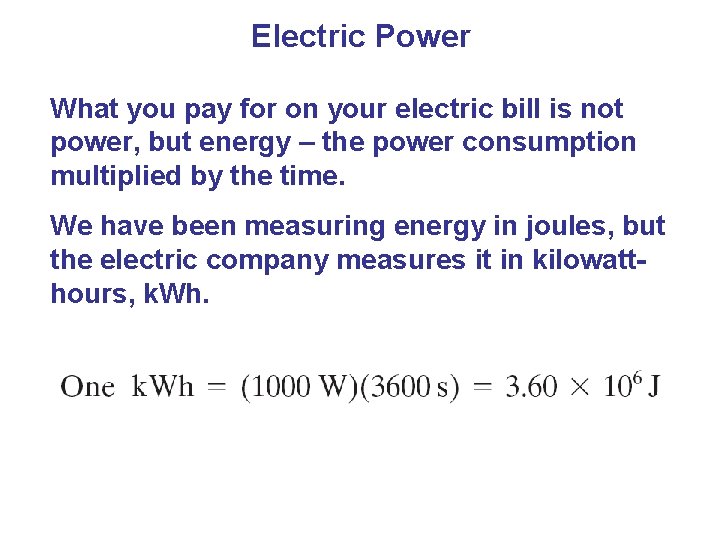
Electric Power What you pay for on your electric bill is not power, but energy – the power consumption multiplied by the time. We have been measuring energy in joules, but the electric company measures it in kilowatthours, k. Wh.
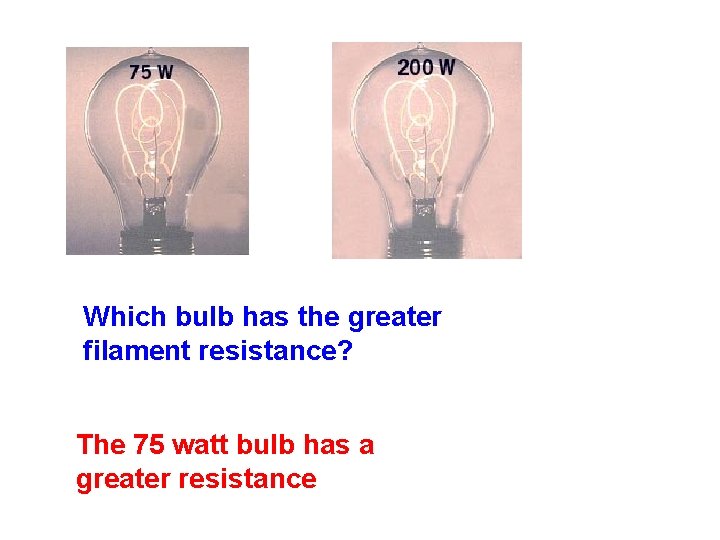
Which bulb has the greater filament resistance? The 75 watt bulb has a greater resistance
Power in Household Circuits The wires used in homes to carry electricity have very low resistance. However, if the current is high enough, the power will increase and the wires can become hot enough to start a fire. To avoid this, we use fuses or circuit breakers, which disconnect when the current goes above a predetermined value.
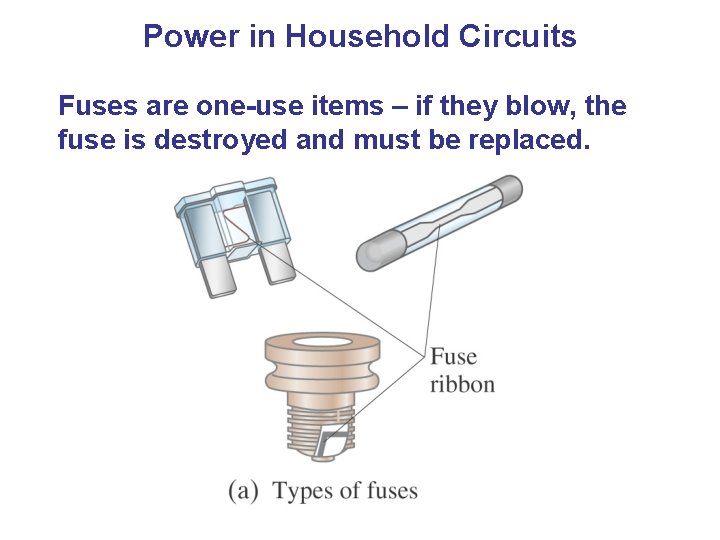
Power in Household Circuits Fuses are one-use items – if they blow, the fuse is destroyed and must be replaced.
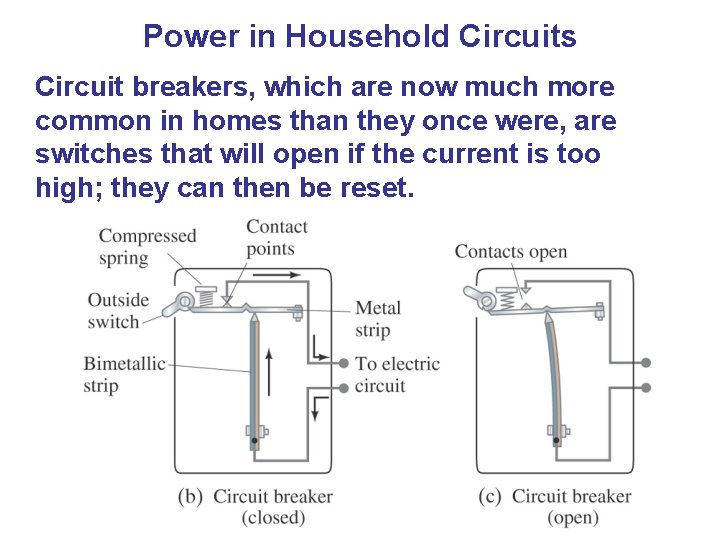
Power in Household Circuits Circuit breakers, which are now much more common in homes than they once were, are switches that will open if the current is too high; they can then be reset.

Alternating Current from a battery flows steadily in one direction (direct current, DC). Current from a power plant varies sinusoidally (alternating current, AC).
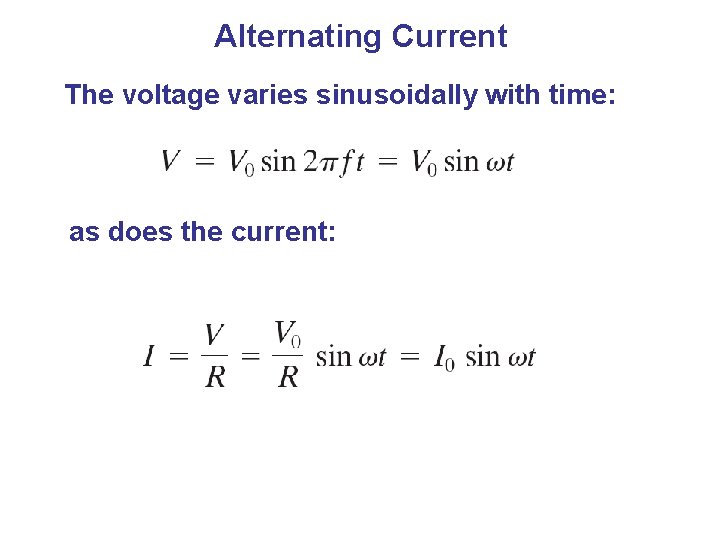
Alternating Current The voltage varies sinusoidally with time: as does the current:

Alternating Current Multiplying the current and the voltage gives the power:
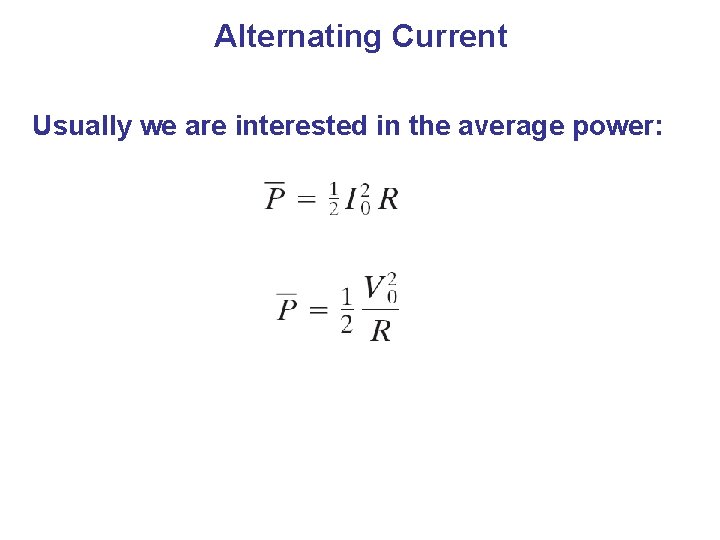
Alternating Current Usually we are interested in the average power:
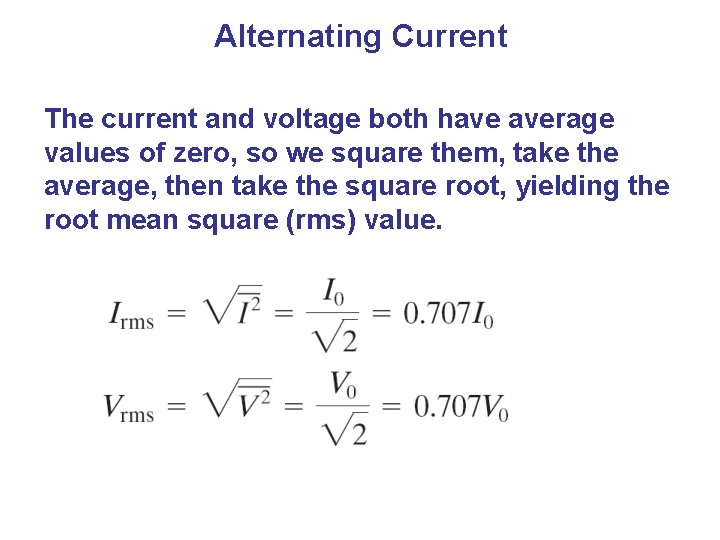
Alternating Current The current and voltage both have average values of zero, so we square them, take the average, then take the square root, yielding the root mean square (rms) value.
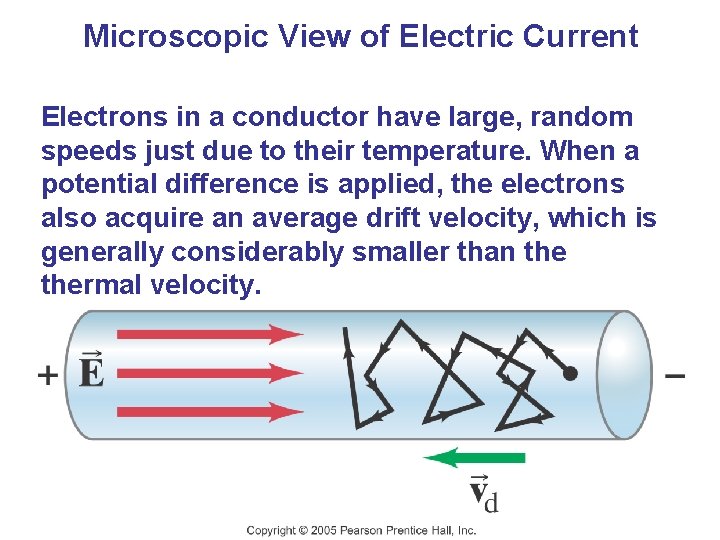
Microscopic View of Electric Current Electrons in a conductor have large, random speeds just due to their temperature. When a potential difference is applied, the electrons also acquire an average drift velocity, which is generally considerably smaller than thermal velocity.
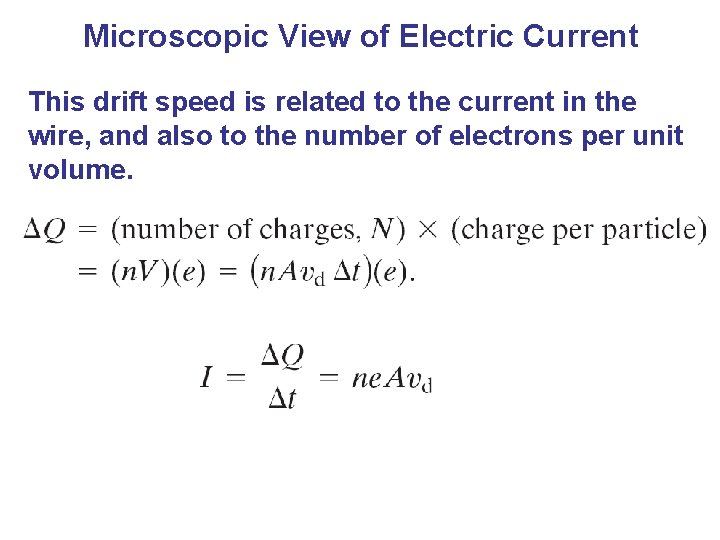
Microscopic View of Electric Current This drift speed is related to the current in the wire, and also to the number of electrons per unit volume.
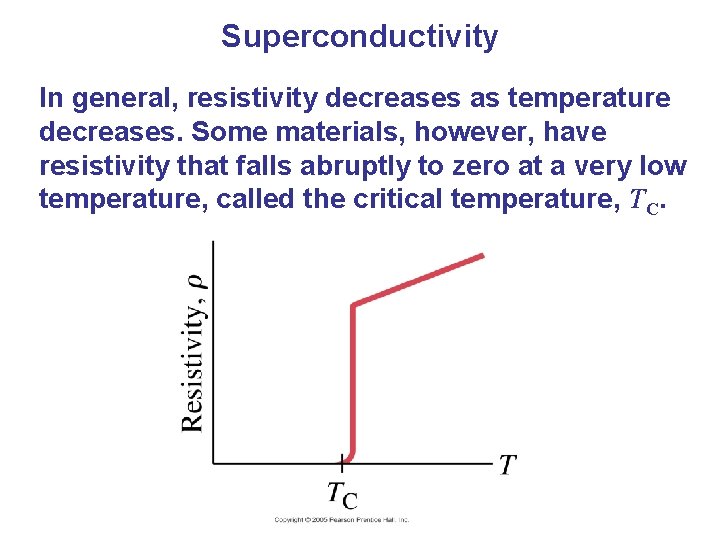
Superconductivity In general, resistivity decreases as temperature decreases. Some materials, however, have resistivity that falls abruptly to zero at a very low temperature, called the critical temperature, TC.
Superconductivity Experiments have shown that currents, once started, can flow through these materials for years without decreasing even without a potential difference. Critical temperatures are low; for many years no material was found to be superconducting above 23 K. More recently, novel materials have been found to be superconducting below 90 K, and work on higher temperature superconductors is continuing.
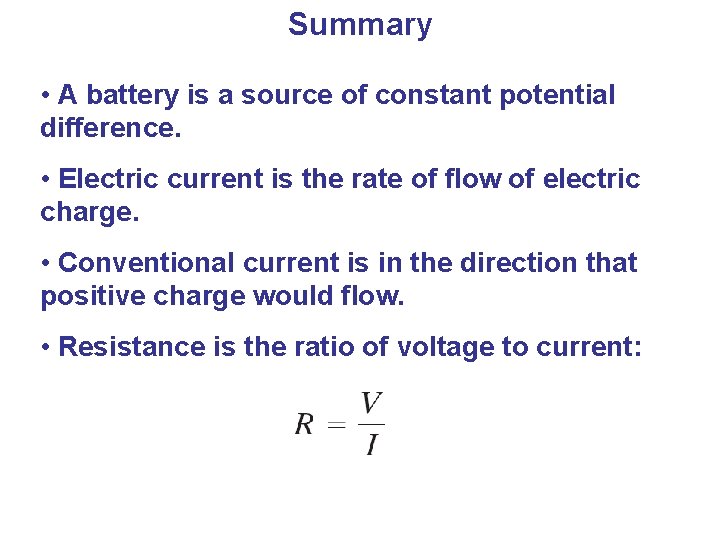
Summary • A battery is a source of constant potential difference. • Electric current is the rate of flow of electric charge. • Conventional current is in the direction that positive charge would flow. • Resistance is the ratio of voltage to current:
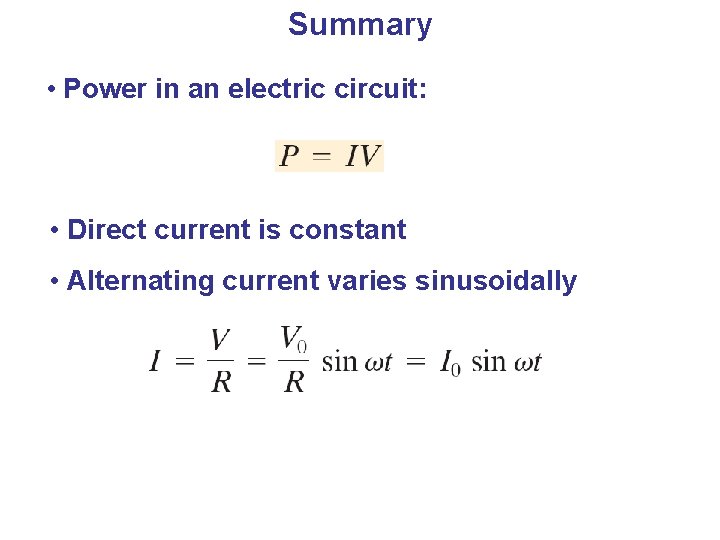
Summary • Power in an electric circuit: • Direct current is constant • Alternating current varies sinusoidally

Summary • Ohmic materials have constant resistance, independent of voltage. • Resistance is determined by shape and material: • ρ is the resistivity.
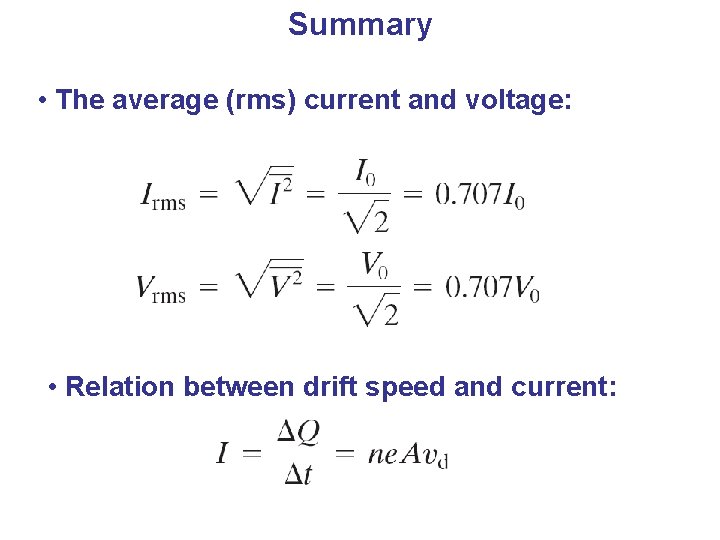
Summary • The average (rms) current and voltage: • Relation between drift speed and current:
- Slides: 45