
Electric Machine Design Course Three Phase Power Converter


- Slides: 26
Electric Machine Design Course Three Phase Power Converter Control Strategies for Three Machine Types Lecture # 3 Mod 3 Copyright: JR Hendershot 2012 280
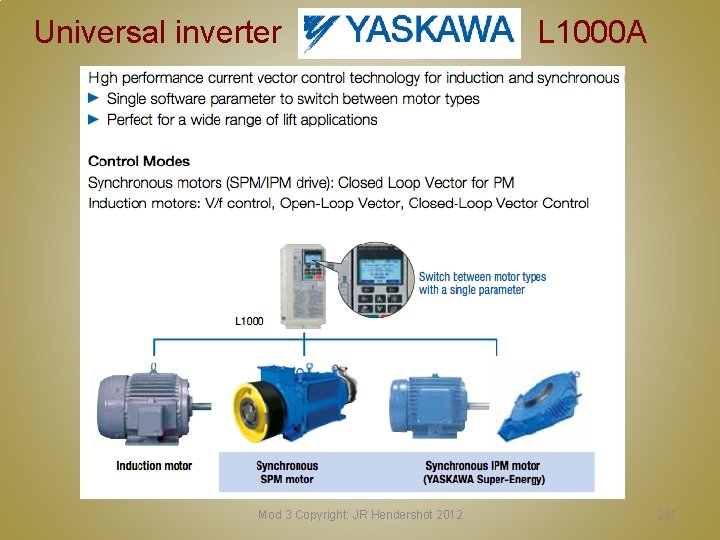
Universal inverter Mod 3 Copyright: JR Hendershot 2012 L 1000 A 281
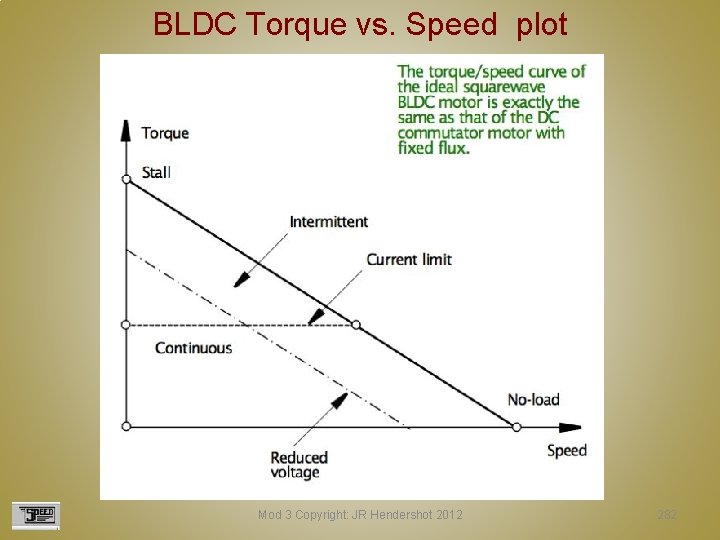
BLDC Torque vs. Speed plot Mod 3 Copyright: JR Hendershot 2012 282
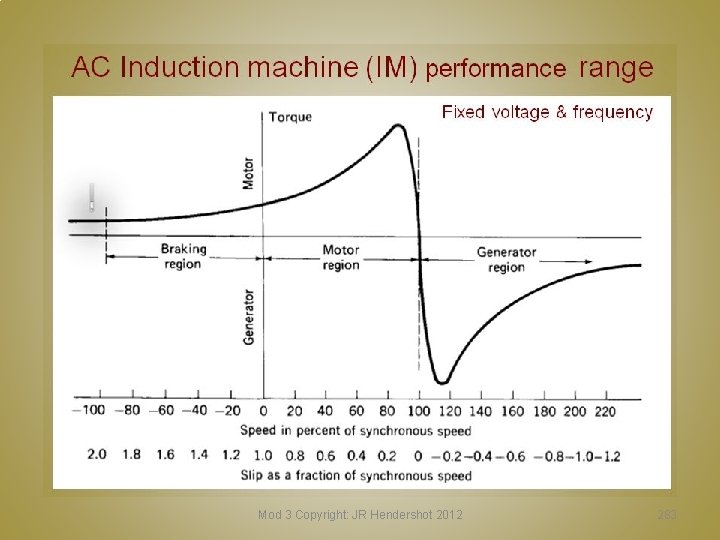
Mod 3 Copyright: JR Hendershot 2012 283
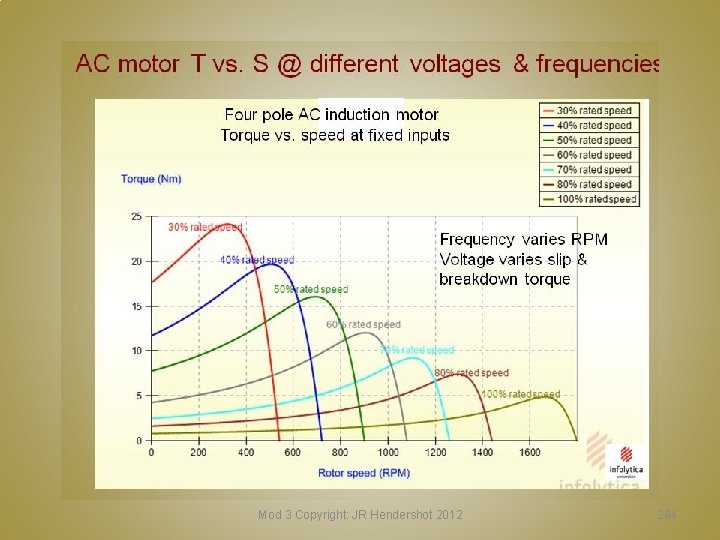
Mod 3 Copyright: JR Hendershot 2012 284
Introduction to the control of motors with PM rotors First brushless motor used about (40) or so years ago were trapezoidal driven for simplicity and low cost. This close represented a PMDC motor. This (6) step or “trap” drive method is by far the most widely used with multiple billions shipped around the world during the past 40 years. (Hard disc drives alone use 0. 6 billion trap driven brushless motors each year! In addition each drive uses at least one DC brushless cooling fan) It is reasonable to suggest that the total world production of trap driven PM brushless motors exceeds all other motors combined each year for all of the last 15 or more years. (Probable nearly two to three times as many) Historically, the second most popular brushless drive has been the current hysteresis sine drive with 180 degree phase commutation all three phases producing simultaneous torque. For high performance machine applications (name changed to PMSM) the d & q current flux vector sine drives have replaced the hysteresis sine drives. (Perhaps a few single digit millions sold last year at most, as of 2012) Mod 3 Copyright: JR Hendershot 2012 285
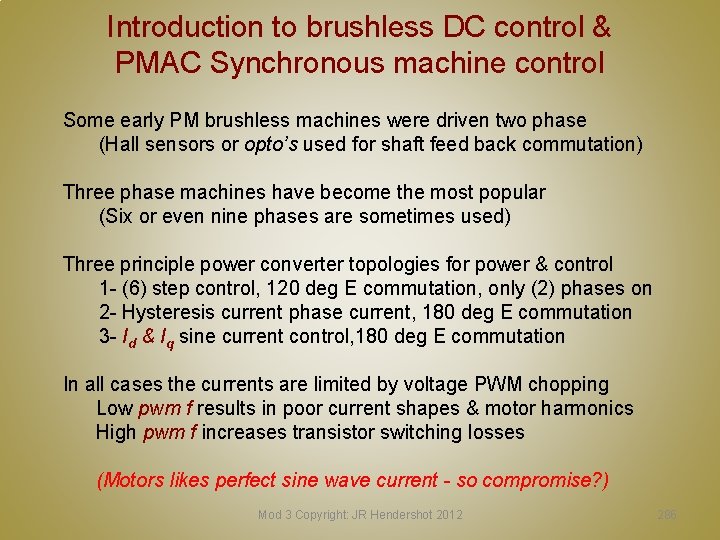
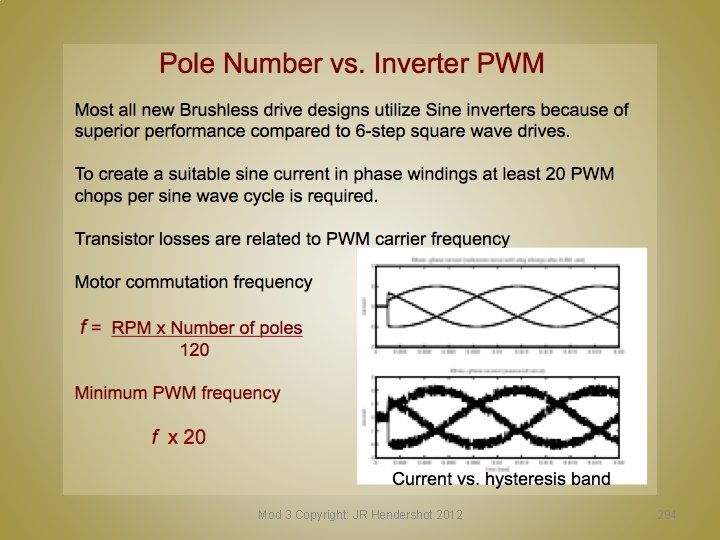
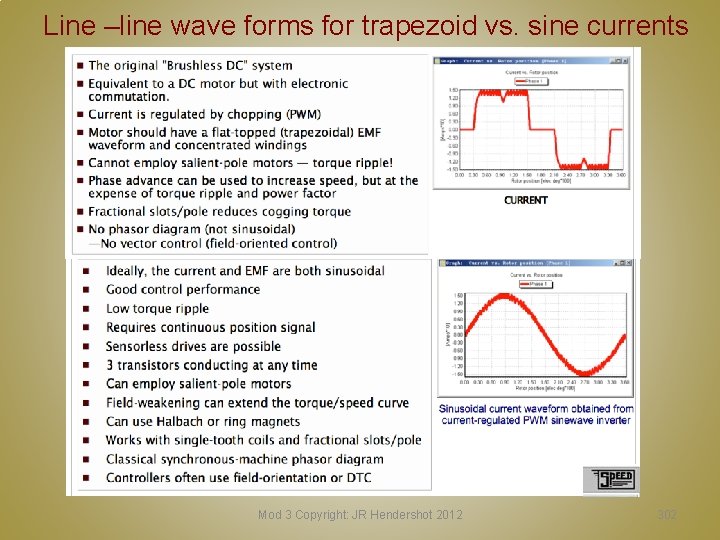
Introduction to brushless DC control & PMAC Synchronous machine control Some early PM brushless machines were driven two phase (Hall sensors or opto’s used for shaft feed back commutation) Three phase machines have become the most popular (Six or even nine phases are sometimes used) Three principle power converter topologies for power & control 1 - (6) step control, 120 deg E commutation, only (2) phases on 2 - Hysteresis current phase current, 180 deg E commutation 3 - Id & Iq sine current control, 180 deg E commutation In all cases the currents are limited by voltage PWM chopping Low pwm f results in poor current shapes & motor harmonics High pwm f increases transistor switching losses (Motors likes perfect sine wave current - so compromise? ) Mod 3 Copyright: JR Hendershot 2012 286
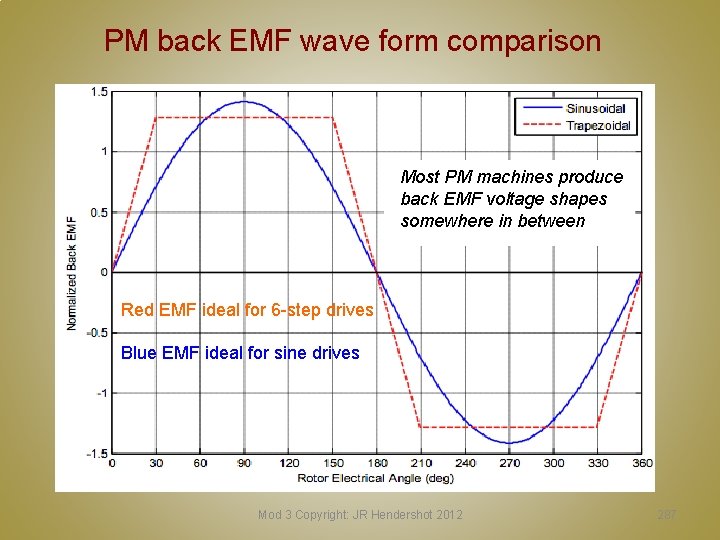
PM back EMF wave form comparison Most PM machines produce back EMF voltage shapes somewhere in between Red EMF ideal for 6 -step drives Blue EMF ideal for sine drives Mod 3 Copyright: JR Hendershot 2012 287
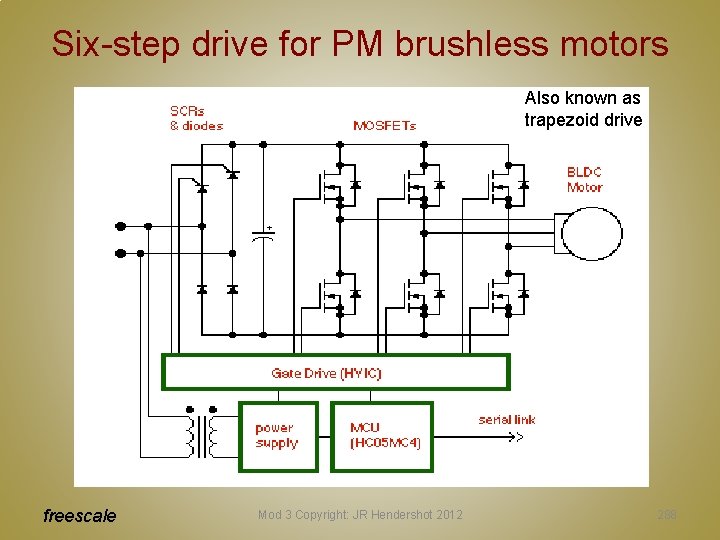
Six-step drive for PM brushless motors Also known as trapezoid drive freescale Mod 3 Copyright: JR Hendershot 2012 288
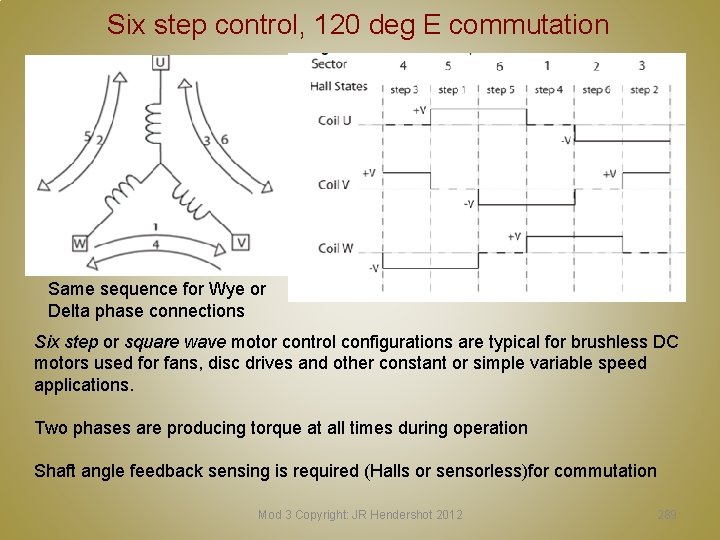
Six step control, 120 deg E commutation Same sequence for Wye or Delta phase connections Six step or square wave motor control configurations are typical for brushless DC motors used for fans, disc drives and other constant or simple variable speed applications. Two phases are producing torque at all times during operation Shaft angle feedback sensing is required (Halls or sensorless)for commutation Mod 3 Copyright: JR Hendershot 2012 289
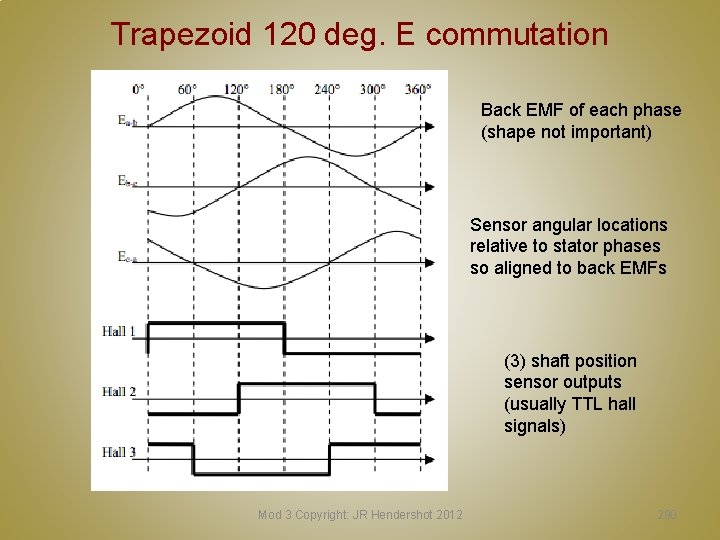
Trapezoid 120 deg. E commutation Back EMF of each phase (shape not important) Sensor angular locations relative to stator phases so aligned to back EMFs (3) shaft position sensor outputs (usually TTL hall signals) Mod 3 Copyright: JR Hendershot 2012 290
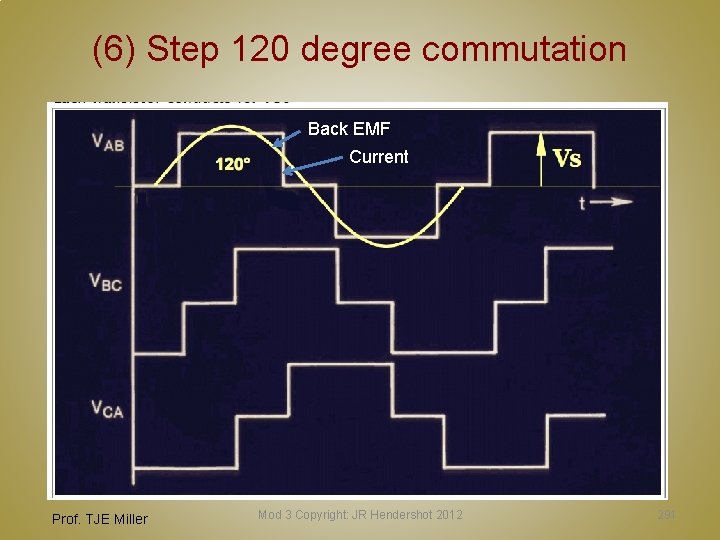
(6) Step 120 degree commutation Back EMF Current Prof. TJE Miller Mod 3 Copyright: JR Hendershot 2012 291
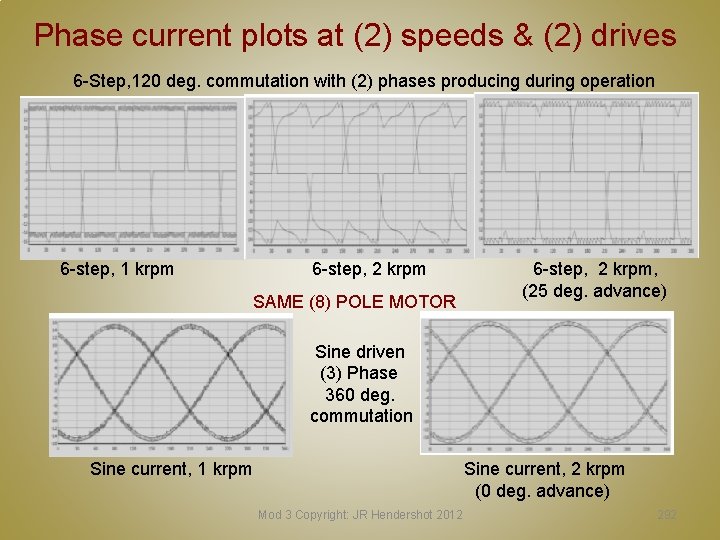
Phase current plots at (2) speeds & (2) drives 6 -Step, 120 deg. commutation with (2) phases producing during operation 6 -step, 1 krpm 6 -step, 2 krpm SAME (8) POLE MOTOR 6 -step, 2 krpm, (25 deg. advance) Sine driven (3) Phase 360 deg. commutation Sine current, 1 krpm Sine current, 2 krpm (0 deg. advance) Mod 3 Copyright: JR Hendershot 2012 292
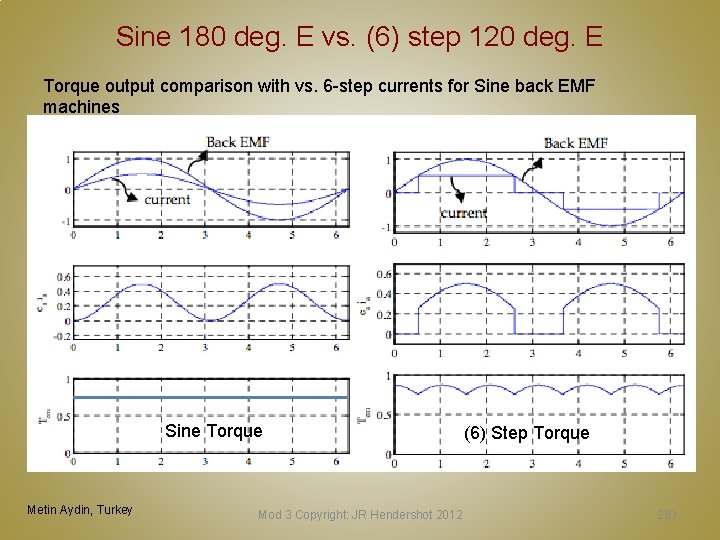
Sine 180 deg. E vs. (6) step 120 deg. E Torque output comparison with vs. 6 -step currents for Sine back EMF machines Sine Torque Metin Aydin, Turkey Mod 3 Copyright: JR Hendershot 2012 (6) Step Torque 293
TITLE Mod 3 Copyright: JR Hendershot 2012 294
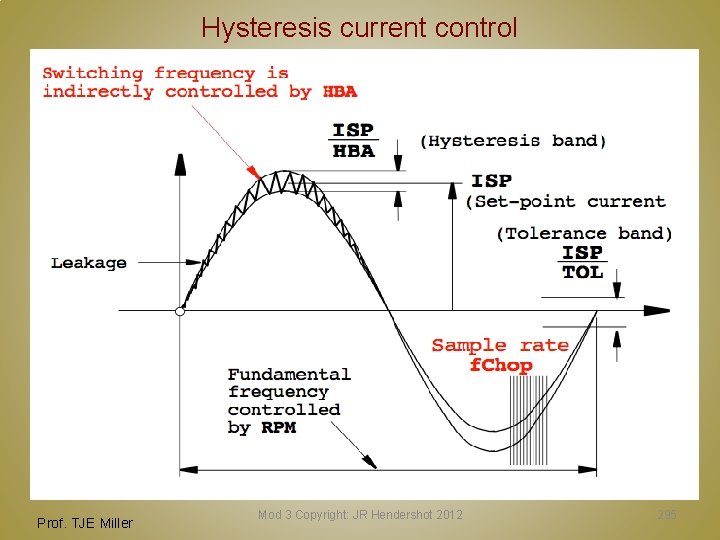
Hysteresis current control Prof. TJE Miller Mod 3 Copyright: JR Hendershot 2012 295
Vector Control (FOC) for PM machines FOC (field oriented control) overcomes limitations of other drives Trapezoid controllers limit the motor low speed accuracy Hysteresis current control at high speeds yields reduced efficiencies FOC controls the current vectors and voltages at the D & Q axes and maintains a constant quadrature field independent of the PI controller bandwidth. The stator phase currents are transformed into D & Q current vectors & compared with zero & the torque reference. Any errors are inputs to two PI blocks. They generate signals to the D-Q reference plane and then are transformed to the stator domain. Then the stator phase currents are generated from the PWM signals to control torque. Mod 3 Copyright: JR Hendershot 2012 296
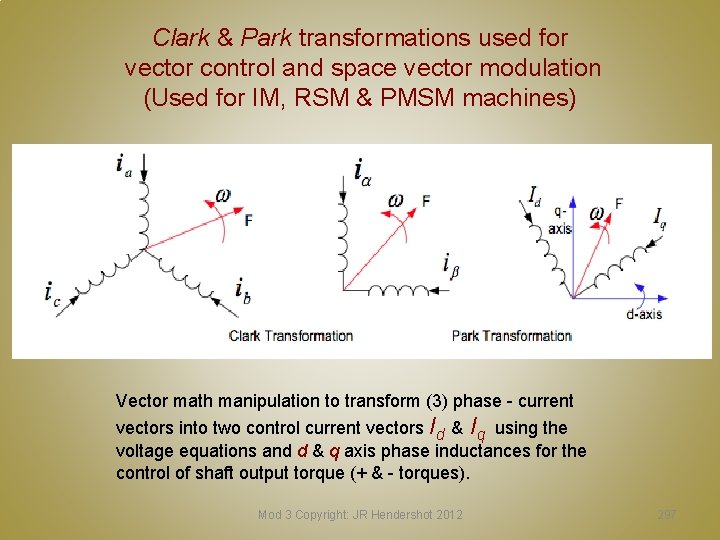
Clark & Park transformations used for vector control and space vector modulation (Used for IM, RSM & PMSM machines) Vector math manipulation to transform (3) phase - current vectors into two control current vectors Id & Iq using the voltage equations and d & q axis phase inductances for the control of shaft output torque (+ & - torques). Mod 3 Copyright: JR Hendershot 2012 297
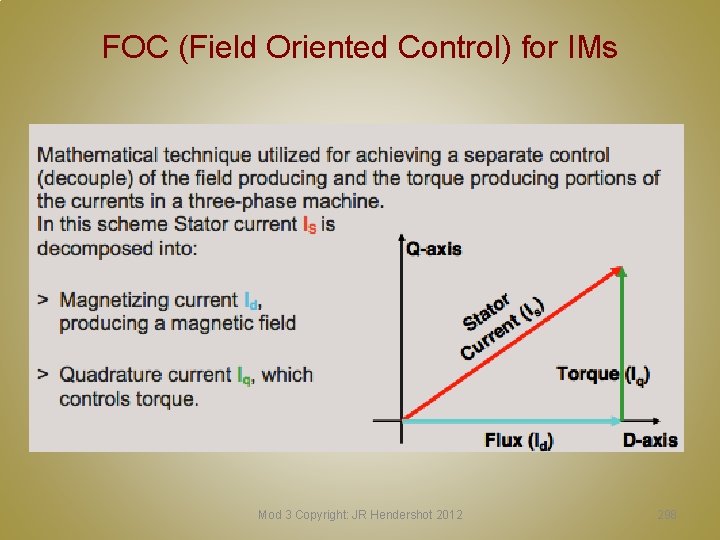
FOC (Field Oriented Control) for IMs Mod 3 Copyright: JR Hendershot 2012 298
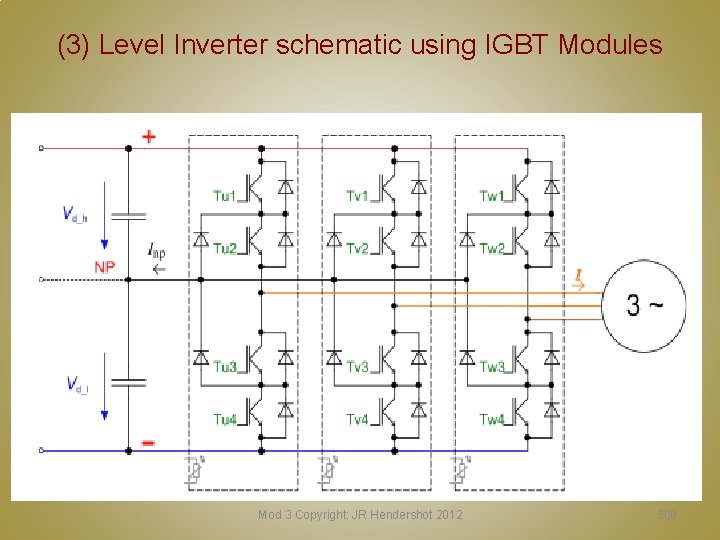
Advantages of Multilevel converters for motor control 1. They are suitable for medium to high power applications. 2. They are an ideal interface between a utility & renewable energy sources 3. Their efficiency is very high (>98%) because of the minimum switching (f) 4. They can improve the power quality and dynamic stability for utility systems. 5. Switching stress and EMI are low. 6. Because of their modular and simple structure, they can be stacked up to an almost unlimited number of levels. Mod 3 Copyright: JR Hendershot 2012 299
(3) Level Inverter schematic using IGBT Modules Mod 3 Copyright: JR Hendershot 2012 300
How useful is this to the electric machine designer? The engineering team assigned to develop the electronic power converter: Details are most important for choosing the lowest cost and most functional drive topology to meet the specification. Assuming this team must perform initial motor-drive commissioning, this topic is most important for using Simulink and perhaps Opal-RT plus other tools to get everything running up to spec smoothly. The engineers who actually design the motor or generator: Interesting technical stuff but detailed knowledge of inverter topologies does little of anything to assist in the actual machine design details. Machine sizing, material selections, number of poles, number of slots, phase winding layout, wire gage, turns/coil, insulation system, magnetic circuit cross section, yoke and teeth dimensions, rotor design, loss analysis and of course the list of mechanical design details plus thermal analysis and cooling design Mod 3 Copyright: JR Hendershot 2012 301
Line –line wave forms for trapezoid vs. sine currents Mod 3 Copyright: JR Hendershot 2012 302
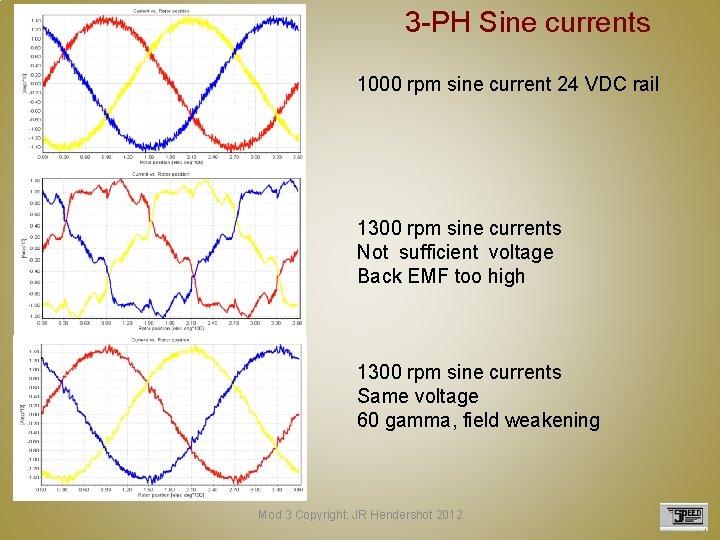
3 -PH Sine currents 1000 rpm sine current 24 VDC rail 1300 rpm sine currents Not sufficient voltage Back EMF too high 1300 rpm sine currents Same voltage 60 gamma, field weakening Mod 3 Copyright: JR Hendershot 2012 303
Circle diagram analysis of sine driven motor drive capabilities Useful study machine torque vs speed limits and inverter usage. For most PMSMs circles are used For sine RSMs the circles become ellipse shaped Non sine EMFs cause circle distortions Prof. TJE Miller Mod 3 Copyright: JR Hendershot 2012 304
Title Mod 3 Copyright: JR Hendershot 2012 305