
Electric Machine Design Course PM Synchronous Generator Design




- Slides: 19
Electric Machine Design Course PM Synchronous Generator Design Principles Lecture # 32 Mod 32 Copyright: JR Hendershot 2012 320
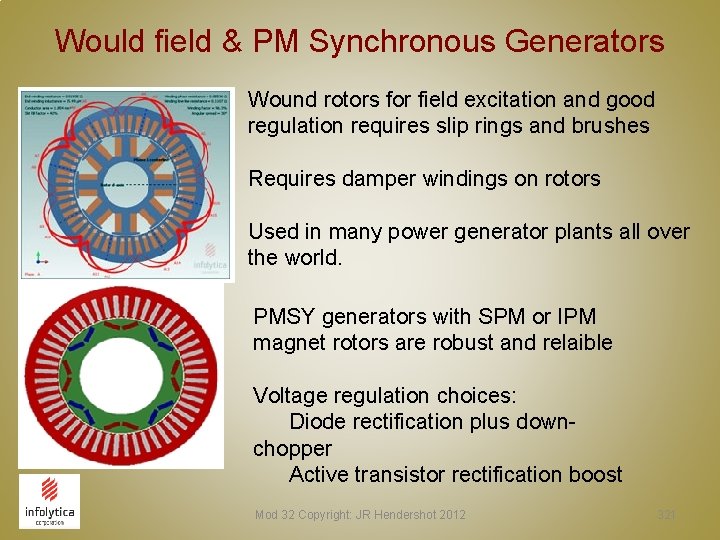
Would field & PM Synchronous Generators Wound rotors for field excitation and good regulation requires slip rings and brushes Requires damper windings on rotors Used in many power generator plants all over the world. PMSY generators with SPM or IPM magnet rotors are robust and relaible Voltage regulation choices: Diode rectification plus downchopper Active transistor rectification boost Mod 32 Copyright: JR Hendershot 2012 321
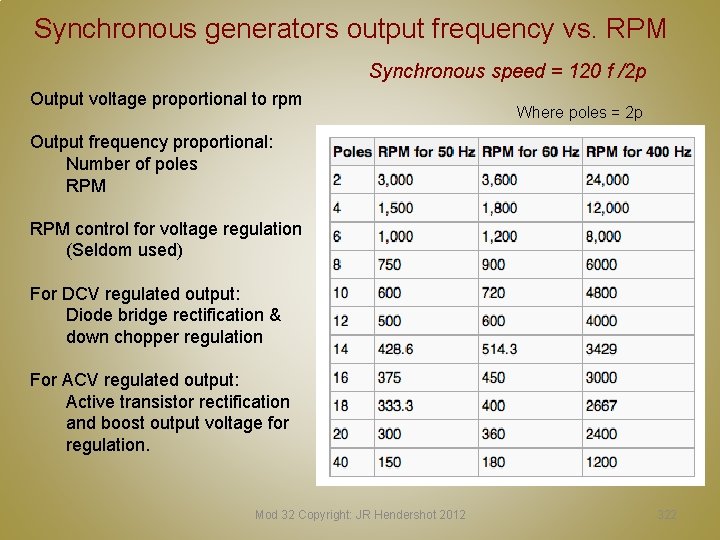
Synchronous generators output frequency vs. RPM Synchronous speed = 120 f /2 p Output voltage proportional to rpm Where poles = 2 p Output frequency proportional: Number of poles RPM control for voltage regulation (Seldom used) For DCV regulated output: Diode bridge rectification & down chopper regulation For ACV regulated output: Active transistor rectification and boost output voltage for regulation. Mod 32 Copyright: JR Hendershot 2012 322
SPM & IPM Synchronous Generators SPM (surface mounted magnets) - Best choice for linearity (Minimum voltage drop/Amp - Magnets on poles likely with require O. D. mechanical retention, such as a sleeve or fiber wrap in tension IPM (interior mounted pole magnets) - Best choice for short circuit fault protection - Magnets are self contained by rotor lamination - Output voltage drop with load current which lowers output powder density Mod 32 Copyright: JR Hendershot 2012 323
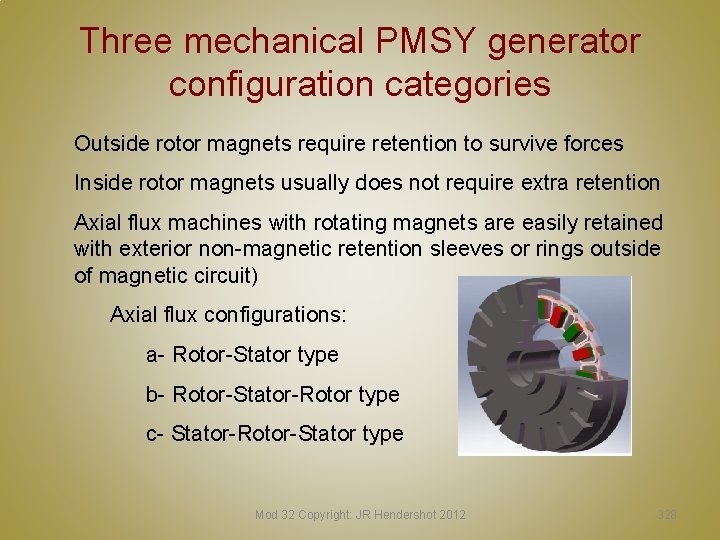
PM synchronous generator configurations Inside rotor with magnets configured for SPM or IPM - SPM requires OD magnet retention Outside rotor with magnets inside rotor cup easily retained. This cup can be deep drawn with flux ring on OD to increase rotor yoke cross section Axial flux configurations with natural non-magnetic retention of magnets on rotor OD Rotor-Stator-Rotor or Stator-Rotor-Stator types Mod 32 Copyright: JR Hendershot 2012 324
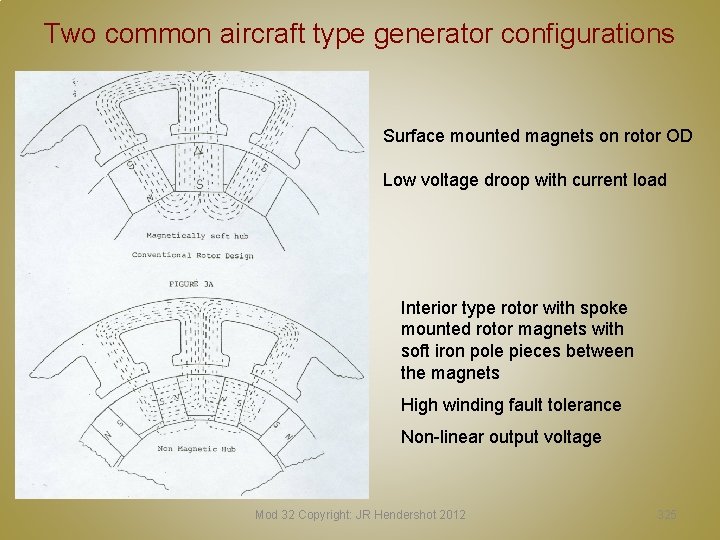
Two common aircraft type generator configurations Surface mounted magnets on rotor OD Low voltage droop with current load Interior type rotor with spoke mounted rotor magnets with soft iron pole pieces between the magnets High winding fault tolerance Non-linear output voltage Mod 32 Copyright: JR Hendershot 2012 325
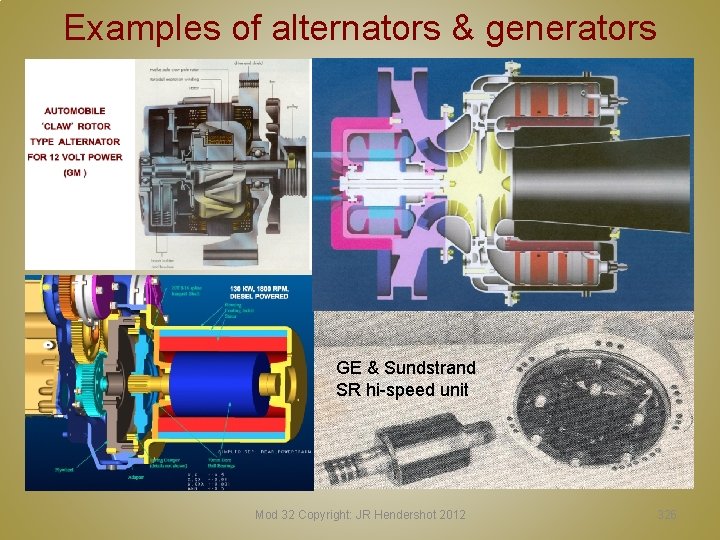
Examples of alternators & generators GE & Sundstrand SR hi-speed unit Mod 32 Copyright: JR Hendershot 2012 326
Two types of PM generators 1 -Surface mounted rotor magnet configuration Best choice for minimum voltage droop as function of current. (due to reduction of flux linkage) 2 -Interior mounted rotor magnet configuration Best choice for short circuit fault protection but exhibits lower machine power density Mod 32 Copyright: JR Hendershot 2012 327
Three mechanical PMSY generator configuration categories Outside rotor magnets require retention to survive forces Inside rotor magnets usually does not require extra retention Axial flux machines with rotating magnets are easily retained with exterior non-magnetic retention sleeves or rings outside of magnetic circuit) Axial flux configurations: a- Rotor-Stator type b- Rotor-Stator-Rotor type c- Stator-Rotor-Stator type Mod 32 Copyright: JR Hendershot 2012 328
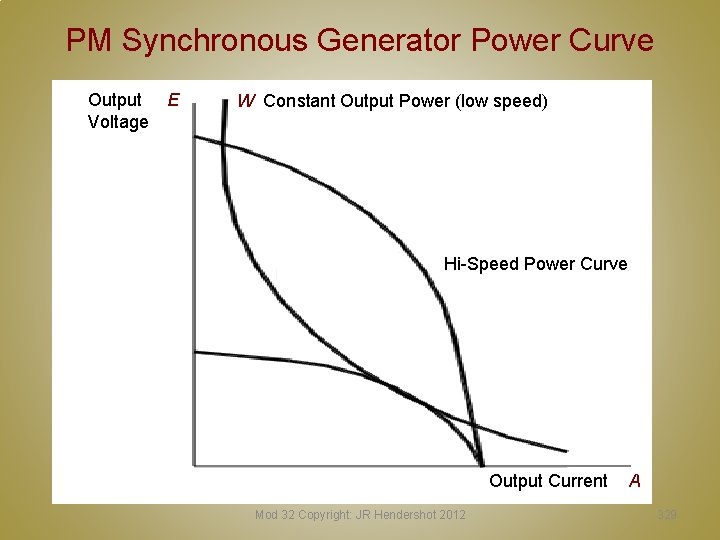
PM Synchronous Generator Power Curve Output Voltage E W Constant Output Power (low speed) Hi-Speed Power Curve Output Current Mod 32 Copyright: JR Hendershot 2012 A 329
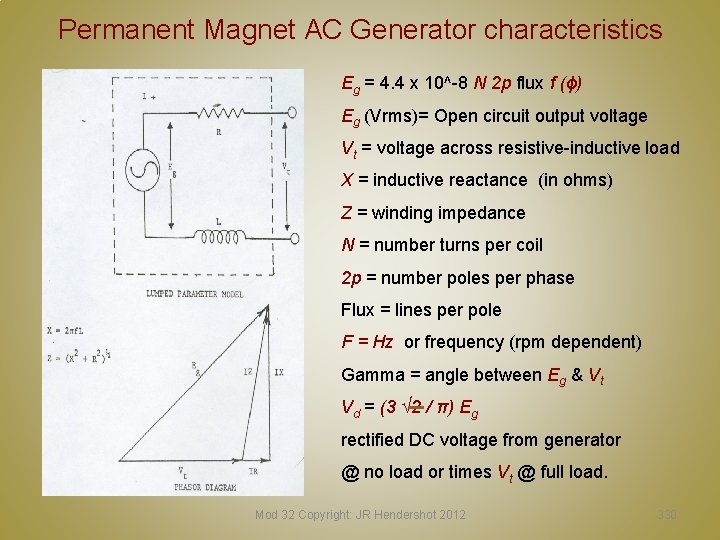
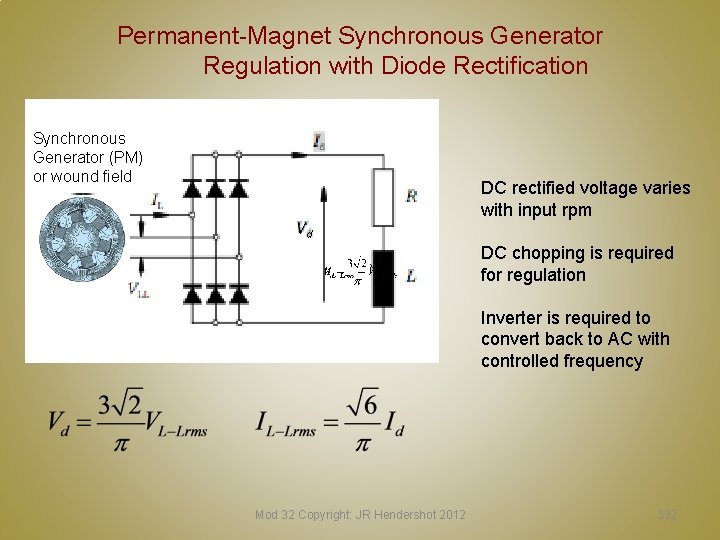
Permanent Magnet AC Generator characteristics Eg = 4. 4 x 10^-8 N 2 p flux f (ϕ) Eg (Vrms)= Open circuit output voltage Vt = voltage across resistive-inductive load X = inductive reactance (in ohms) Z = winding impedance N = number turns per coil 2 p = number poles per phase Flux = lines per pole F = Hz or frequency (rpm dependent) Gamma = angle between Eg & Vt Vd = (3 √ 2 / π) Eg rectified DC voltage from generator @ no load or times Vt @ full load. Mod 32 Copyright: JR Hendershot 2012 330
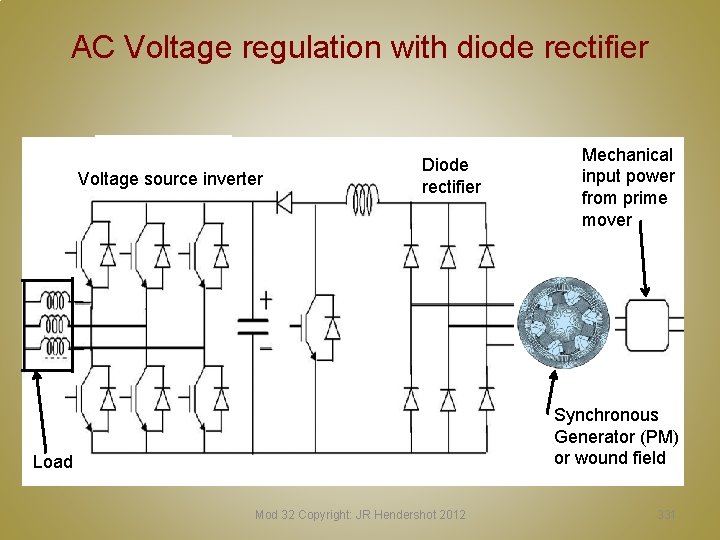
AC Voltage regulation with diode rectifier Voltage source inverter Diode rectifier Mechanical input power from prime mover Synchronous Generator (PM) or wound field Load Mod 32 Copyright: JR Hendershot 2012 331
Permanent-Magnet Synchronous Generator Regulation with Diode Rectification Synchronous Generator (PM) or wound field Vd DC rectified voltage varies with input rpm DC chopping is required for regulation Inverter is required to convert back to AC with controlled frequency Mod 32 Copyright: JR Hendershot 2012 332
Permanent-Magnet Synchronous Generator Theory Load types: Open Circuit, Short Circuit, Infinite Bus (grid), Diode Rectifier, passive Impedance & Active Rectifier (transistors) For Diode rectifier with down chopper for regulation the EMF is designed to be 25% to 50% higher the regulated DC voltage. For active transistor rectification-voltage regulation, the EMF is designed to be 25% to 50% lower than the regulated DC voltage. (sometimes known as a boost regulator) SPM generators exhibit very little voltage drop with load. IPM generators can exhibit considerable voltage drop with load PM motors generate if commutation is 180 deg from motoring Mod 32 Copyright: JR Hendershot 2012 333
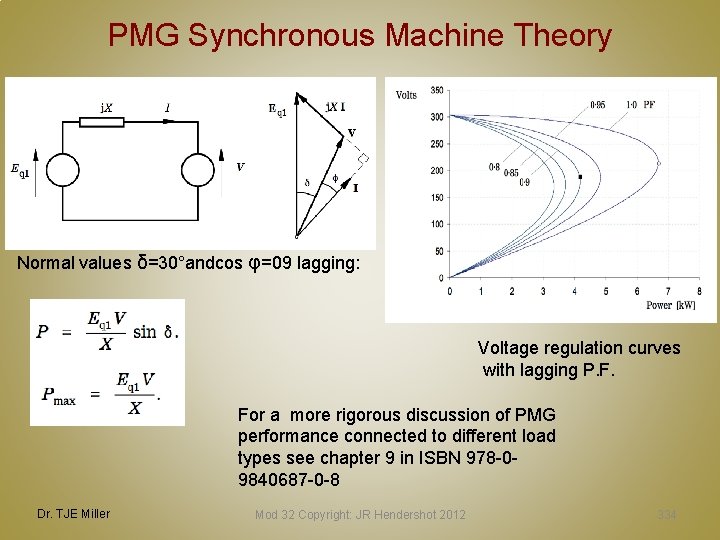
PMG Synchronous Machine Theory Normal values δ=30°andcos φ=09 lagging: Voltage regulation curves with lagging P. F. For a more rigorous discussion of PMG performance connected to different load types see chapter 9 in ISBN 978 -09840687 -0 -8 Dr. TJE Miller Mod 32 Copyright: JR Hendershot 2012 334
Title Mod 32 Copyright: JR Hendershot 2012 335
Title Mod 32 Copyright: JR Hendershot 2012 336
Title Mod 32 Copyright: JR Hendershot 2012 337
Title Mod 32 Copyright: JR Hendershot 2012 338