
Electric Machine Design Course Permanent Magnet Rotor Design




- Slides: 31
Electric Machine Design Course Permanent Magnet Rotor Design (SPM & IPM) Lecture # 29 Mod 29 Copyright: JR Hendershot 2012 290
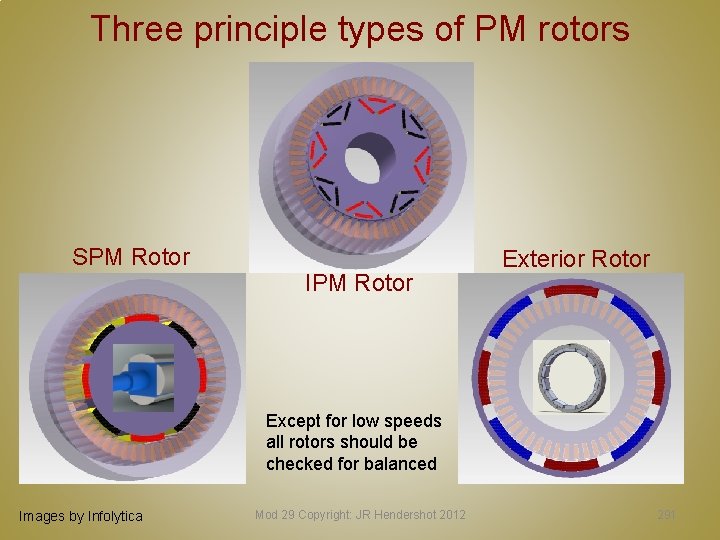
Three principle types of PM rotors SPM Rotor IPM Rotor Exterior Rotor Except for low speeds all rotors should be checked for balanced Images by Infolytica Mod 29 Copyright: JR Hendershot 2012 291
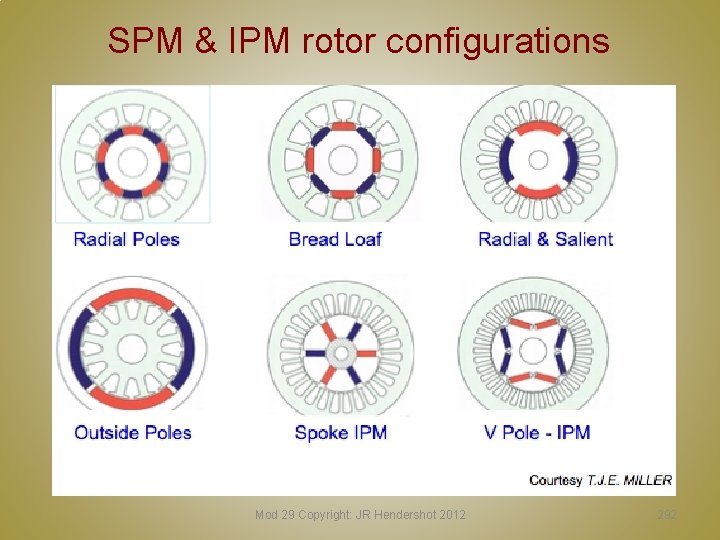
SPM & IPM rotor configurations Mod 29 Copyright: JR Hendershot 2012 292
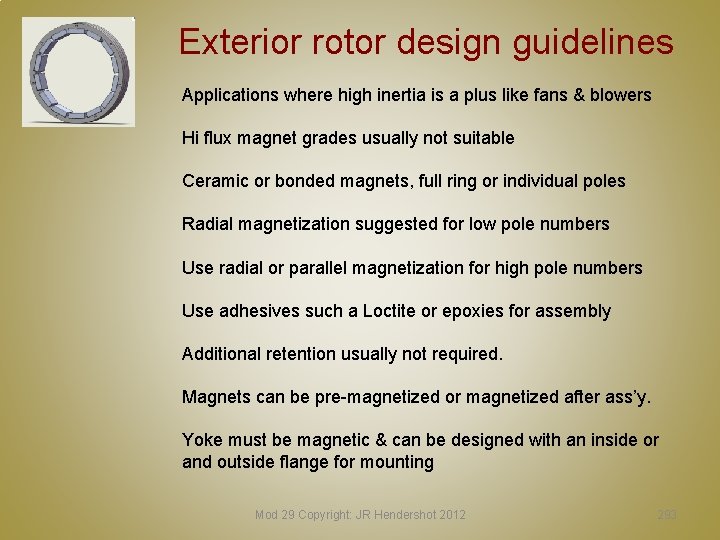
Exterior rotor design guidelines Applications where high inertia is a plus like fans & blowers Hi flux magnet grades usually not suitable Ceramic or bonded magnets, full ring or individual poles Radial magnetization suggested for low pole numbers Use radial or parallel magnetization for high pole numbers Use adhesives such a Loctite or epoxies for assembly Additional retention usually not required. Magnets can be pre-magnetized or magnetized after ass’y. Yoke must be magnetic & can be designed with an inside or and outside flange for mounting Mod 29 Copyright: JR Hendershot 2012 293
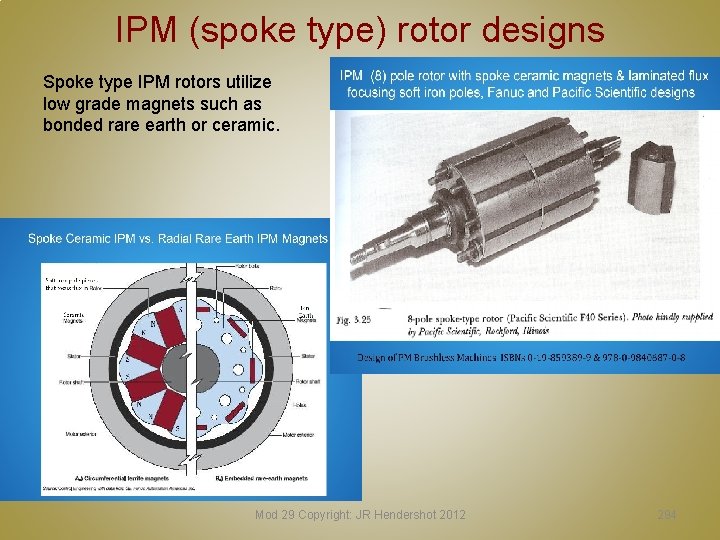
IPM (spoke type) rotor designs Spoke type IPM rotors utilize low grade magnets such as bonded rare earth or ceramic. Mod 29 Copyright: JR Hendershot 2012 294
SPM rotor design guidelines Used for servos & generators for high performance Rare earth magnets best suited SPM rotors Bonded, molded or sintered magnets are most cost effective Full rings, arcs or bread-loaf magnets can be used Magnets can be pre-magnetized or magnetized after ass’y Magnetization: radial for rings & parallel for separate poles Laminated cores might be required to reduce eddy currents Use adhesives such a Loctite or epoxies for assembly Magnet retention is required to withstand centrifugal forces at speeds or against shock forces in some applications Mod 29 Copyright: JR Hendershot 2012 295
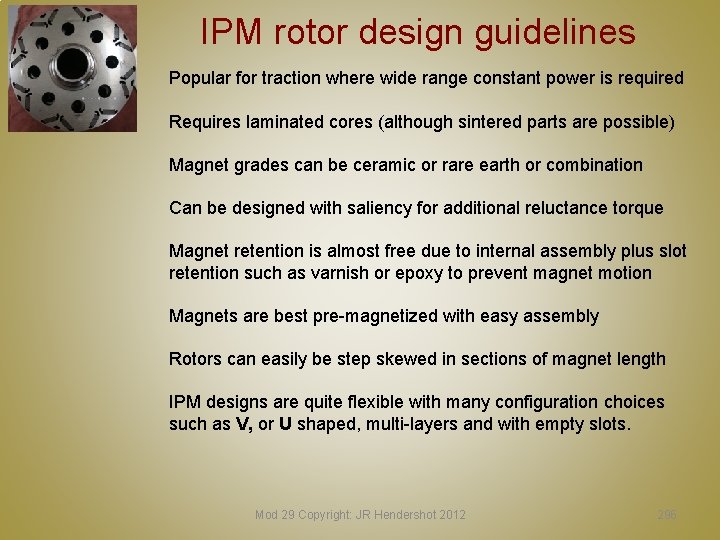
IPM rotor design guidelines Popular for traction where wide range constant power is required Requires laminated cores (although sintered parts are possible) Magnet grades can be ceramic or rare earth or combination Can be designed with saliency for additional reluctance torque Magnet retention is almost free due to internal assembly plus slot retention such as varnish or epoxy to prevent magnet motion Magnets are best pre-magnetized with easy assembly Rotors can easily be step skewed in sections of magnet length IPM designs are quite flexible with many configuration choices such as V, or U shaped, multi-layers and with empty slots. Mod 29 Copyright: JR Hendershot 2012 296
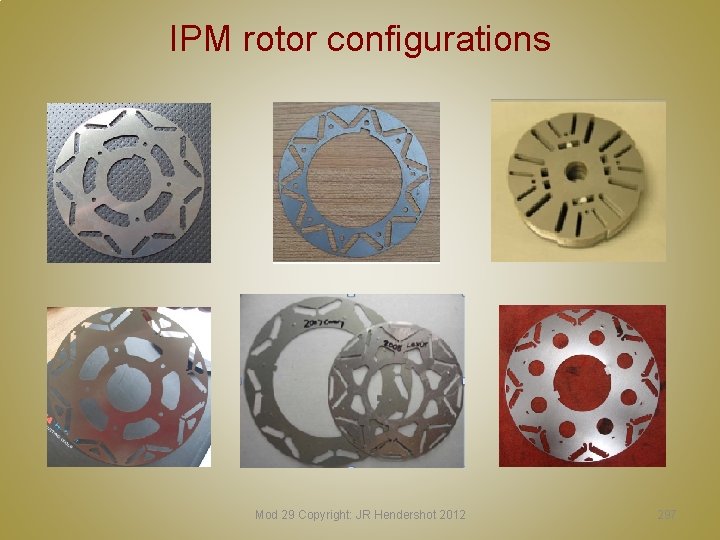
IPM rotor configurations Mod 29 Copyright: JR Hendershot 2012 297
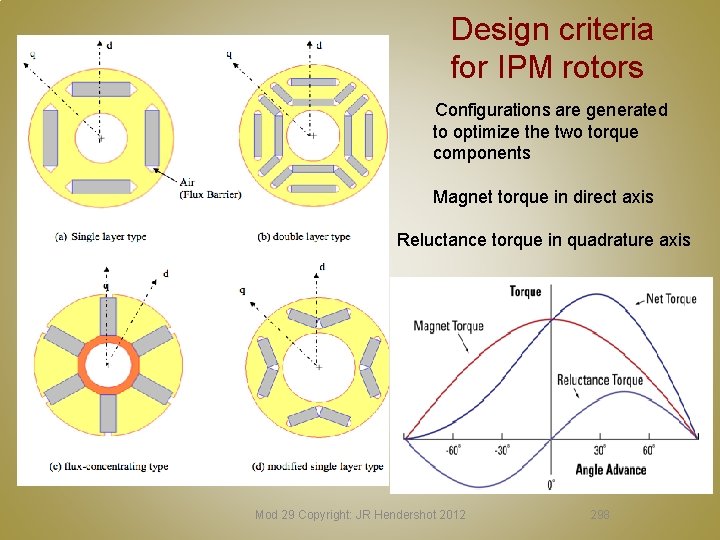
Design criteria for IPM rotors Configurations are generated to optimize the two torque components Magnet torque in direct axis Reluctance torque in quadrature axis Mod 29 Copyright: JR Hendershot 2012 298
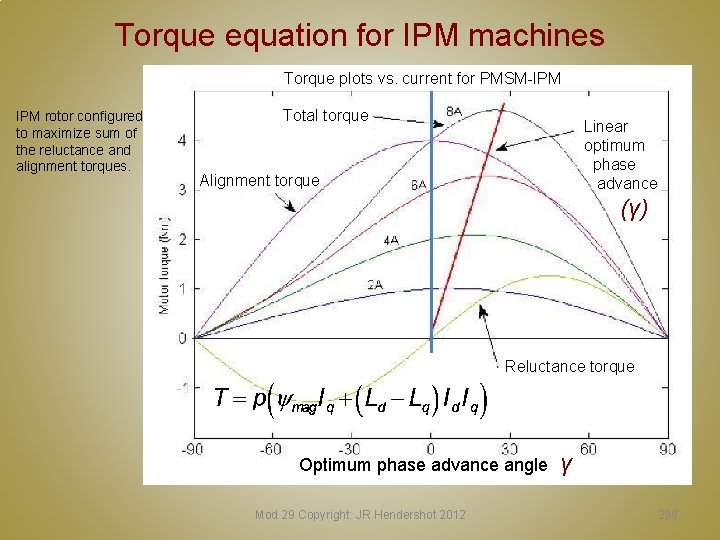
Torque equation for IPM machines Torque plots vs. current for PMSM-IPM rotor configured to maximize sum of the reluctance and alignment torques. Total torque Linear optimum phase advance Alignment torque (γ) Reluctance torque Optimum phase advance angle Mod 29 Copyright: JR Hendershot 2012 γ 299
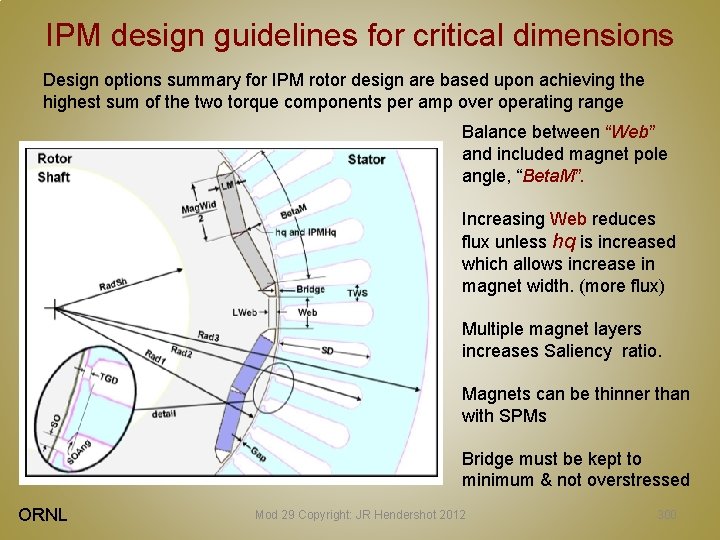
IPM design guidelines for critical dimensions Design options summary for IPM rotor design are based upon achieving the highest sum of the two torque components per amp over operating range Balance between “Web” and included magnet pole angle, “Beta. M”. Increasing Web reduces flux unless hq is increased which allows increase in magnet width. (more flux) Multiple magnet layers increases Saliency ratio. Magnets can be thinner than with SPMs Bridge must be kept to minimum & not overstressed ORNL Mod 29 Copyright: JR Hendershot 2012 300
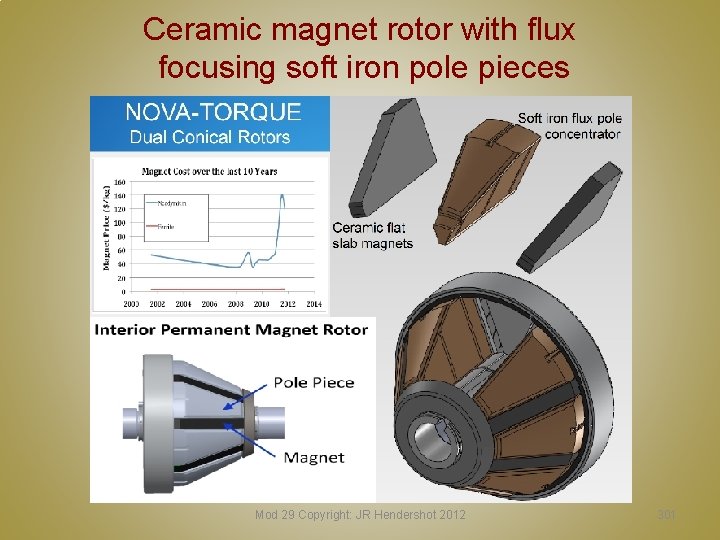
Ceramic magnet rotor with flux focusing soft iron pole pieces Mod 29 Copyright: JR Hendershot 2012 301
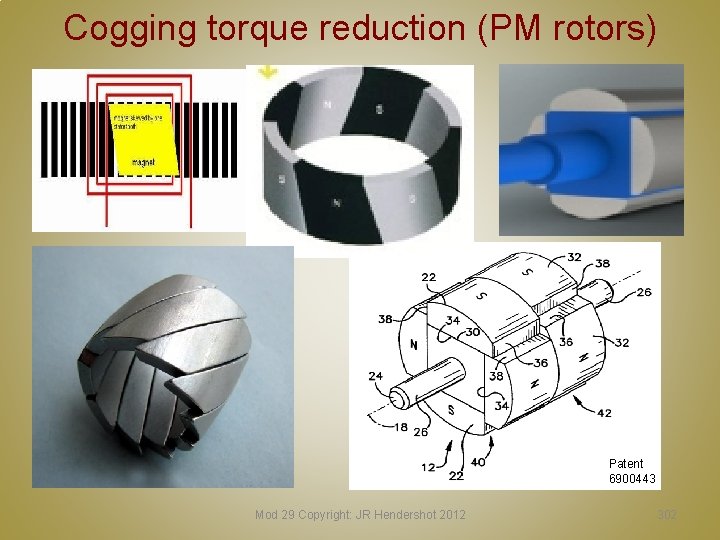
Cogging torque reduction (PM rotors) Patent 6900443 Mod 29 Copyright: JR Hendershot 2012 302
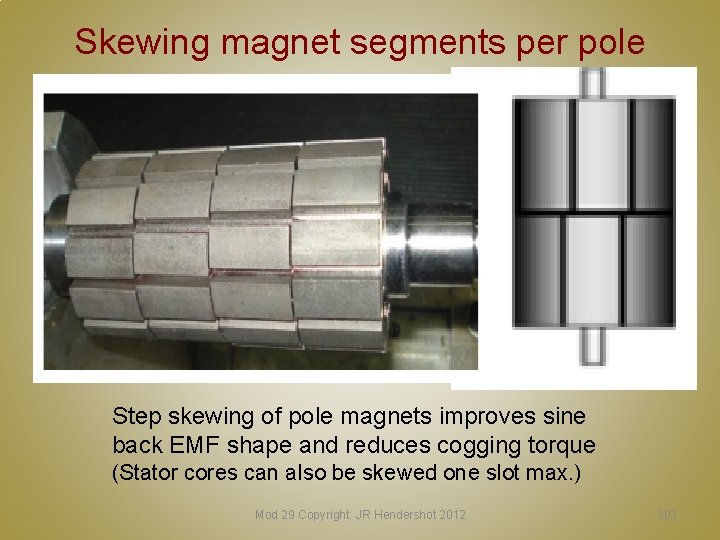
Skewing magnet segments per pole Step skewing of pole magnets improves sine back EMF shape and reduces cogging torque (Stator cores can also be skewed one slot max. ) Mod 29 Copyright: JR Hendershot 2012 303
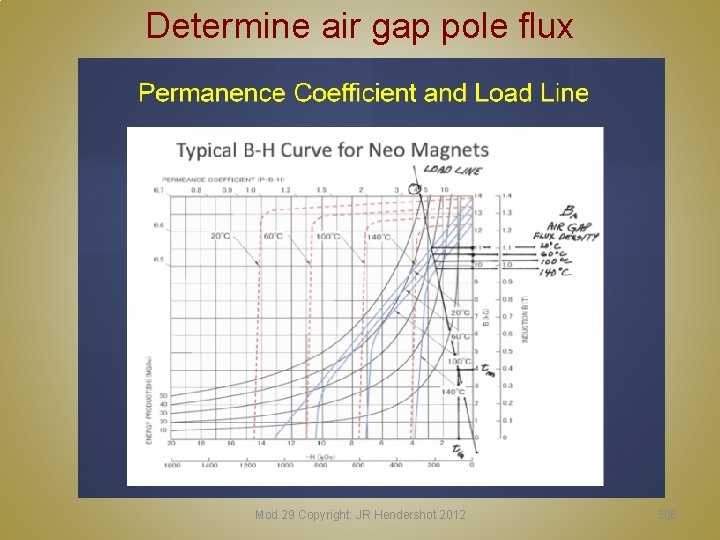
Initial PM brushless rotor design process Machine sizing is assumed to be completed given the following selections: - Pole, slot & phase selection, IPM, SPM or exterior rotor type. - Initial estimate of rotor (stator OD given) plus estimated air gap. - Cooling method and performance spec in hand - Supply voltage & current control method, trapezoid, hysteresis or Id & Iq First step is to estimate the effective rotor flux provided by the magnets Final rotor flux values, leakage and distribution come from FEA analysis Initial flux estimate is essential to proceed with stator design. The working load line of the magnets is first estimated and plotted as the permeance coefficient (on the magnet B-H curve (from manufacturer). Permeance Coefficient (Pc) – Known as the load-line or B/H or "operating slope" of the magnets Ignoring flux leakage or stator slotting effects Pc = Lm/g Where Lm = magnet thickness & g = magnetic air gap length Mod 29 Copyright: JR Hendershot 2012 304
Air-gap thickness & Magnet thickness Air gap thickness depends upon manufacturing tolerances. Core of stator is not usually machined or ground SPM rotor can have stack up tolerances from magnets If a magnet containment sleeve is required the magnetic gap must be increased to accommodate the sleeve thickness The magnetic open circuit load line (the permeance coefficient) is the ratio of the magnet thickness to the magnetic air gap. The useful gap flux (Bm) is highly dependent upon this load line. The peak de-mag phase current is limited by this load line also. Permeance coefficient should never be less than (3) and as close to (8) if magnet cost is permitted. The de-mag protection is an important function to the load line. Mod 29 Copyright: JR Hendershot 2012 305
Determine air gap pole flux Mod 29 Copyright: JR Hendershot 2012 306
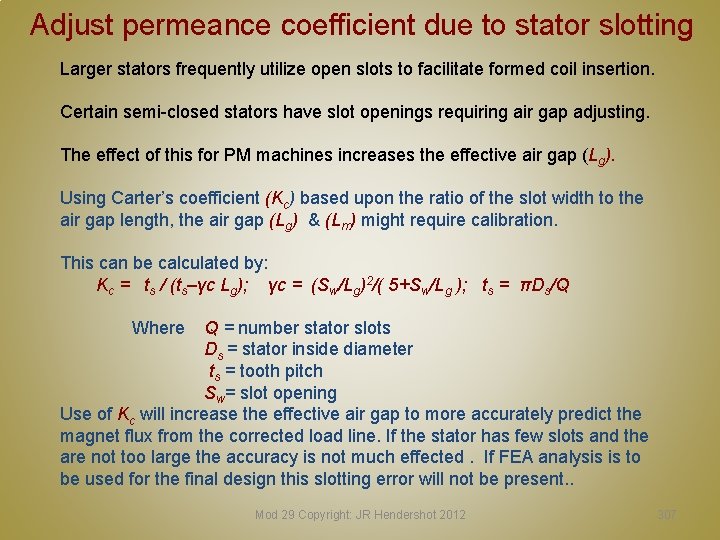
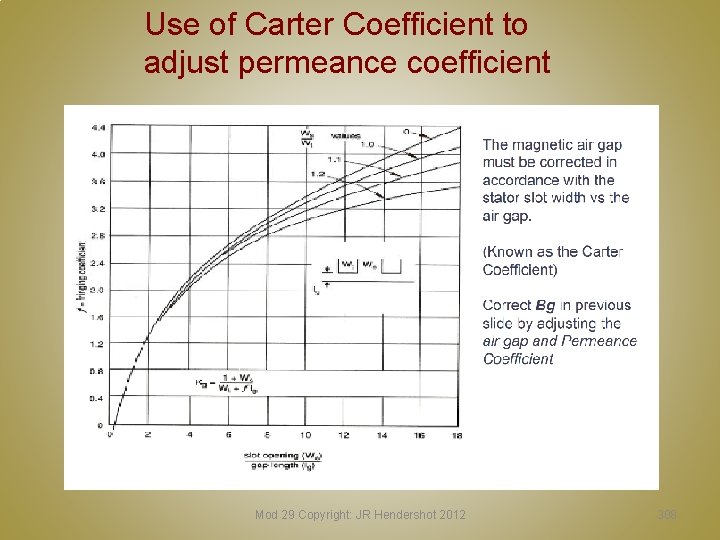
Adjust permeance coefficient due to stator slotting Larger stators frequently utilize open slots to facilitate formed coil insertion. Certain semi-closed stators have slot openings requiring air gap adjusting. The effect of this for PM machines increases the effective air gap (Lg). Using Carter’s coefficient (Kc) based upon the ratio of the slot width to the air gap length, the air gap (Lg) & (Lm) might require calibration. This can be calculated by: Kc = ts / (ts–γc Lg); γc = (Sw/Lg)2/( 5+Sw/Lg ); ts = πDs/Q Where Q = number stator slots Ds = stator inside diameter ts = tooth pitch Sw= slot opening Use of Kc will increase the effective air gap to more accurately predict the magnet flux from the corrected load line. If the stator has few slots and the are not too large the accuracy is not much effected. If FEA analysis is to be used for the final design this slotting error will not be present. . Mod 29 Copyright: JR Hendershot 2012 307
Use of Carter Coefficient to adjust permeance coefficient Mod 29 Copyright: JR Hendershot 2012 308
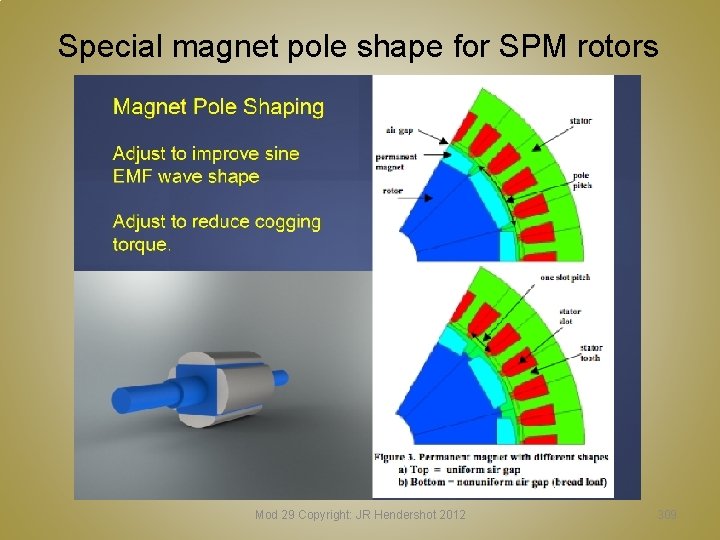
Special magnet pole shape for SPM rotors Mod 29 Copyright: JR Hendershot 2012 309
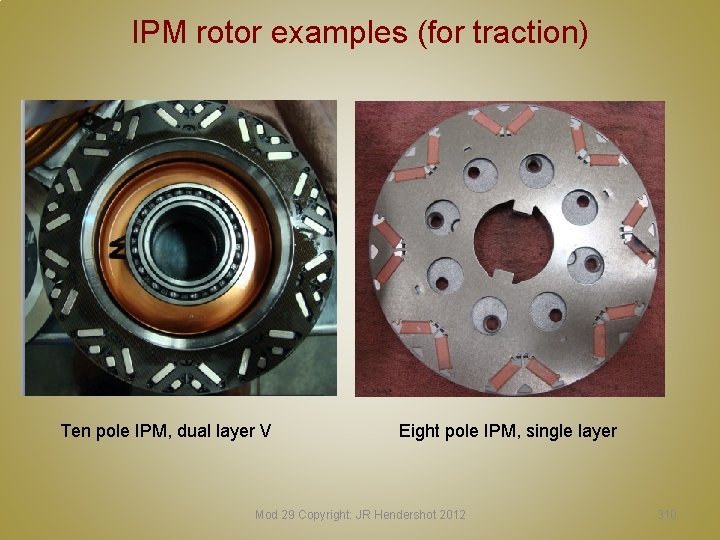
IPM rotor examples (for traction) Ten pole IPM, dual layer V Eight pole IPM, single layer Mod 29 Copyright: JR Hendershot 2012 310
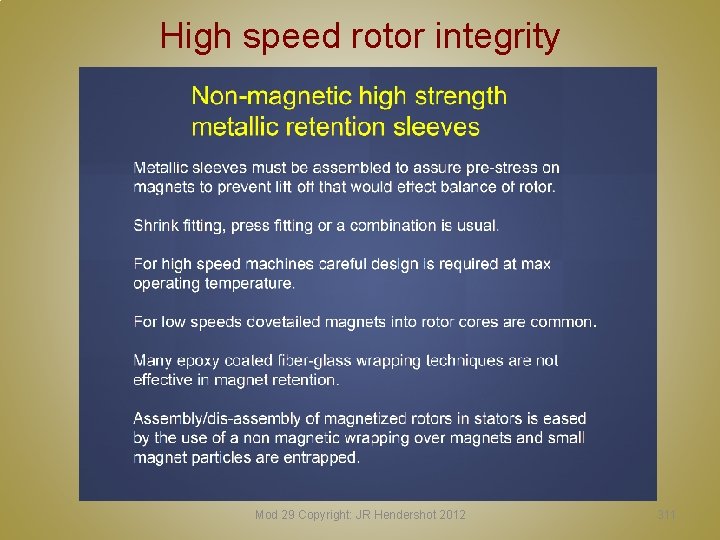
High speed rotor integrity Mod 29 Copyright: JR Hendershot 2012 311
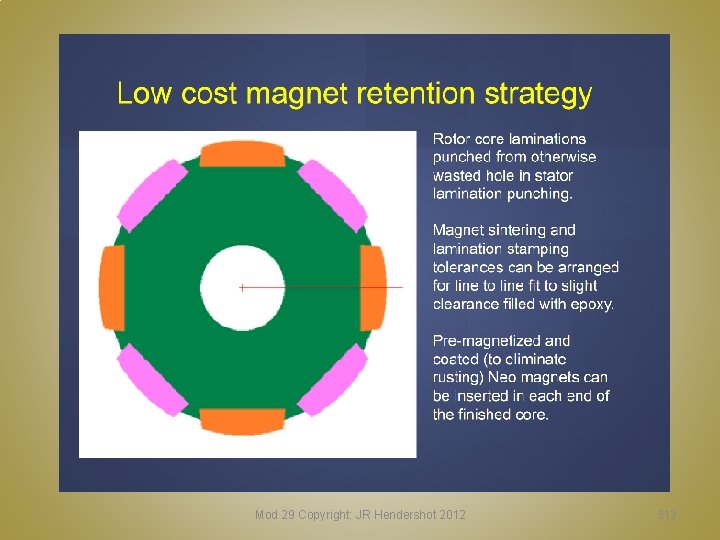
Mod 29 Copyright: JR Hendershot 2012 312
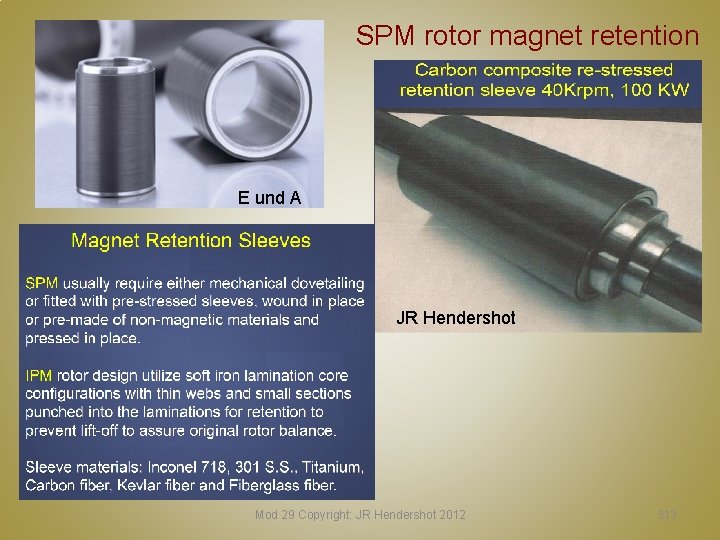
SPM rotor magnet retention E und A JR Hendershot Mod 29 Copyright: JR Hendershot 2012 313
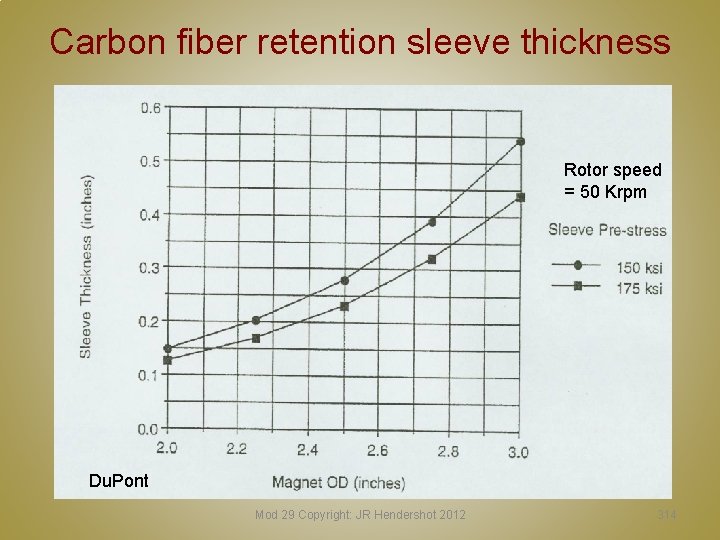
Carbon fiber retention sleeve thickness Rotor speed = 50 Krpm Du. Pont Mod 29 Copyright: JR Hendershot 2012 314
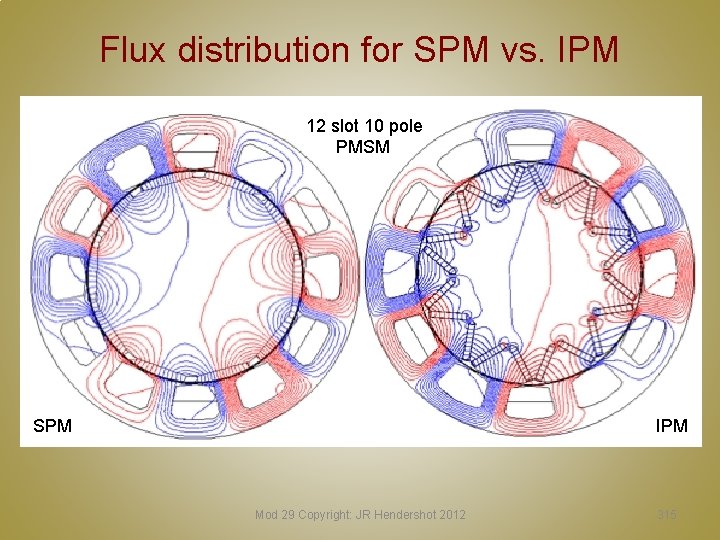
Flux distribution for SPM vs. IPM 12 slot 10 pole PMSM SPM IPM Mod 29 Copyright: JR Hendershot 2012 315
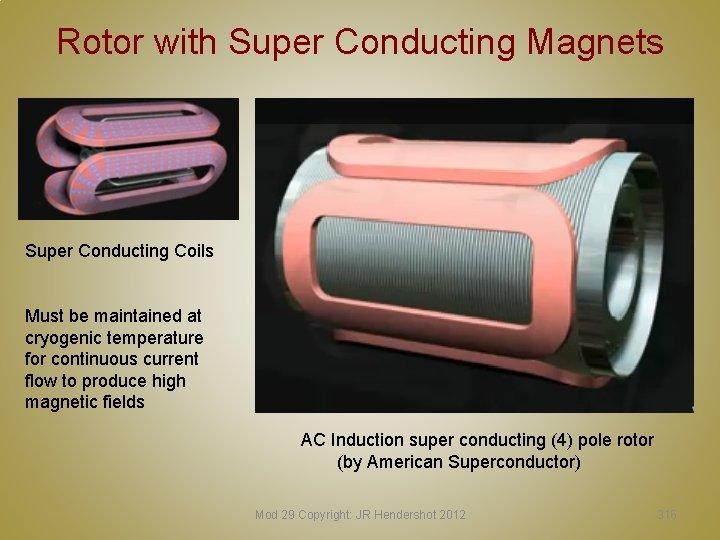
Rotor with Super Conducting Magnets Super Conducting Coils Must be maintained at cryogenic temperature for continuous current flow to produce high magnetic fields AC Induction super conducting (4) pole rotor (by American Superconductor) Mod 29 Copyright: JR Hendershot 2012 316
TITLE Mod 29 Copyright: JR Hendershot 2012 317
TITLE Mod 29 Copyright: JR Hendershot 2012 318
TITLE Mod 29 Copyright: JR Hendershot 2012 319
TITLE Mod 29 Copyright: JR Hendershot 2012 320