
Electric Machine Design Course Performance Calculations for Inverter

![End leakage coefficients An approximate expression Ref. [1] Boldea q: Stator slots/pole/phase b: (coil](https://slidetodoc.com/presentation_image/babd399f7cd51d2dc1c7c2e8c645f038/image-11.jpg "End leakage coefficients An approximate expression Ref. [1] Boldea q: Stator slots/pole/phase b: (coil")
![Rotor differential inductance Zigzag belt Ref. [1] Boldea p: Pole number Nr: Number of](https://slidetodoc.com/presentation_image/babd399f7cd51d2dc1c7c2e8c645f038/image-13.jpg "Rotor differential inductance Zigzag belt Ref. [1] Boldea p: Pole number Nr: Number of")




- Slides: 22
Electric Machine Design Course Performance Calculations for Inverter Fed Induction Machines Lecture # 22 Mod 22 Copyright: JR Hendershot 2012 210
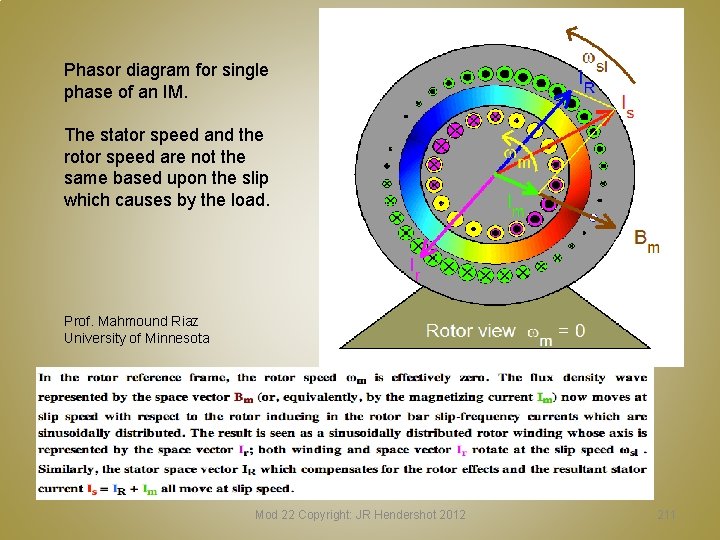
Phasor diagram for single phase of an IM. The stator speed and the rotor speed are not the same based upon the slip which causes by the load. Prof. Mahmound Riaz University of Minnesota Mod 22 Copyright: JR Hendershot 2012 211
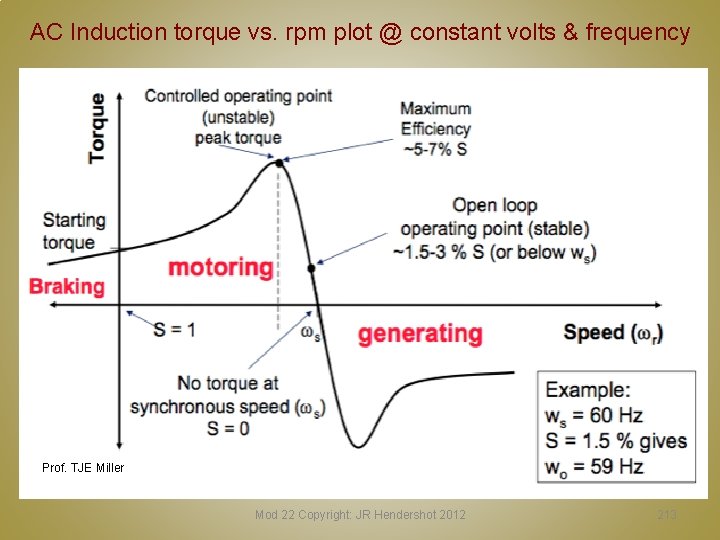
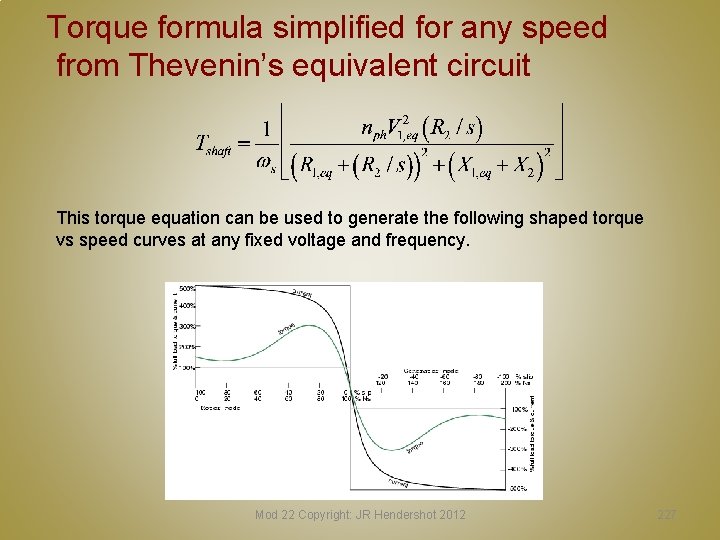
AC Induction torque vs. rpm plot @ constant volts & frequency Prof. TJE Miller Mod 22 Copyright: JR Hendershot 2012 213
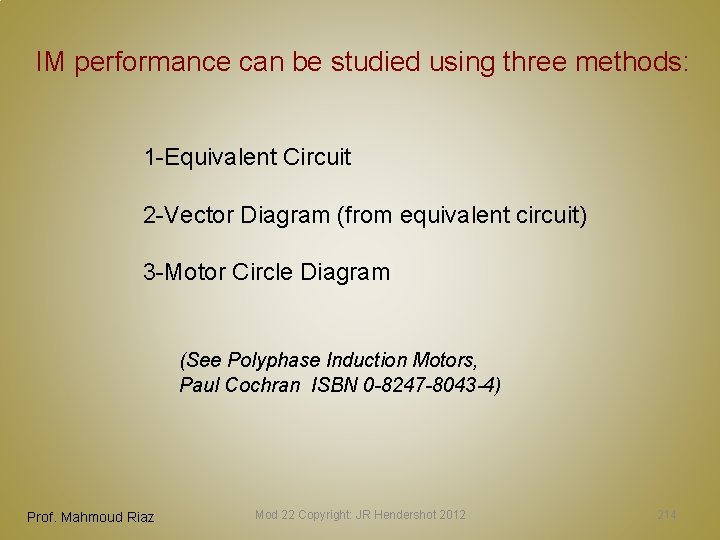
IM performance can be studied using three methods: 1 -Equivalent Circuit 2 -Vector Diagram (from equivalent circuit) 3 -Motor Circle Diagram (See Polyphase Induction Motors, Paul Cochran ISBN 0 -8247 -8043 -4) Prof. Mahmoud Riaz Mod 22 Copyright: JR Hendershot 2012 214
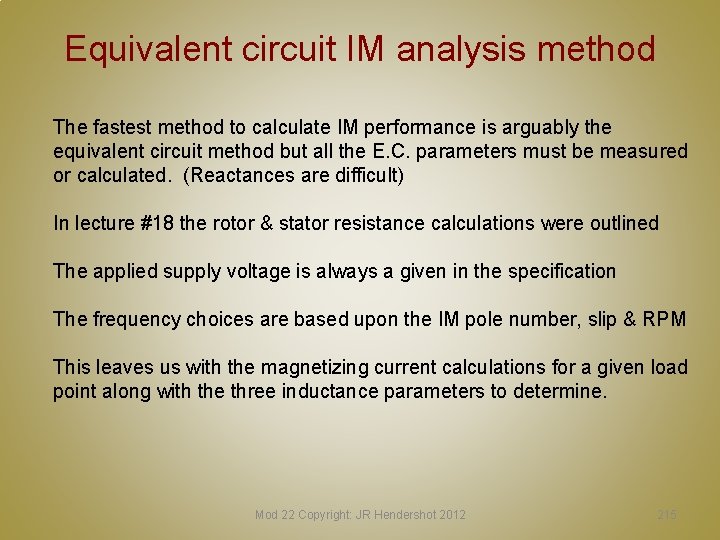
Equivalent circuit IM analysis method The fastest method to calculate IM performance is arguably the equivalent circuit method but all the E. C. parameters must be measured or calculated. (Reactances are difficult) In lecture #18 the rotor & stator resistance calculations were outlined The applied supply voltage is always a given in the specification The frequency choices are based upon the IM pole number, slip & RPM This leaves us with the magnetizing current calculations for a given load point along with the three inductance parameters to determine. Mod 22 Copyright: JR Hendershot 2012 215
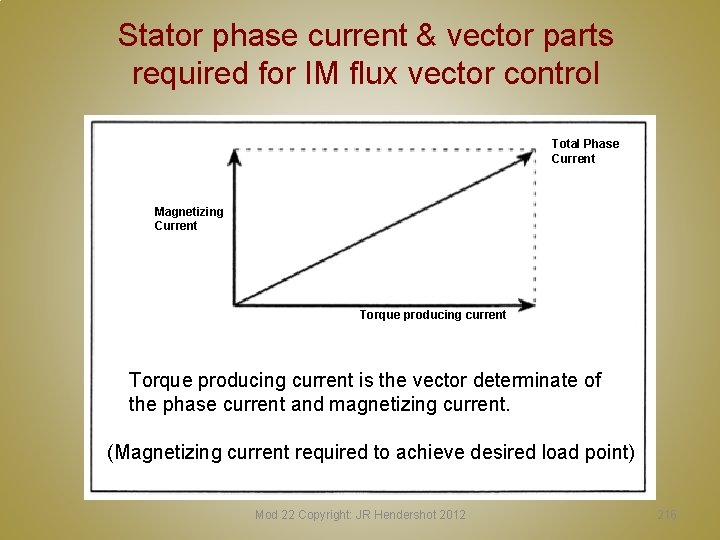
Stator phase current & vector parts required for IM flux vector control Total Phase Current Magnetizing Current Torque producing current is the vector determinate of the phase current and magnetizing current. (Magnetizing current required to achieve desired load point) Mod 22 Copyright: JR Hendershot 2012 216
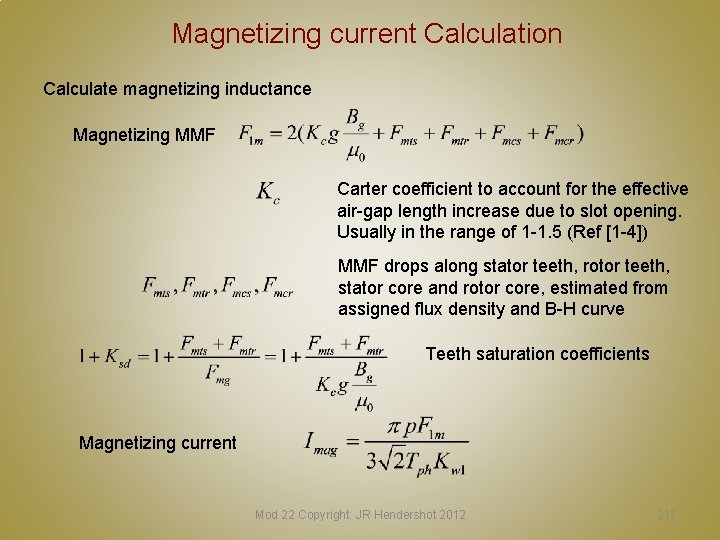
Magnetizing current Calculation Calculate magnetizing inductance Magnetizing MMF Carter coefficient to account for the effective air-gap length increase due to slot opening. Usually in the range of 1 -1. 5 (Ref [1 -4]) MMF drops along stator teeth, rotor teeth, stator core and rotor core, estimated from assigned flux density and B-H curve Teeth saturation coefficients Magnetizing current Mod 22 Copyright: JR Hendershot 2012 217
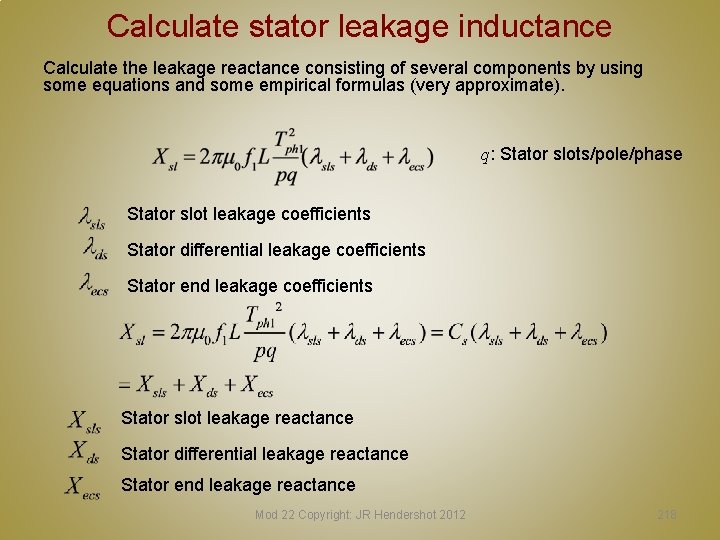
Calculate stator leakage inductance Calculate the leakage reactance consisting of several components by using some equations and some empirical formulas (very approximate). q: Stator slots/pole/phase Stator slot leakage coefficients Stator differential leakage coefficients Stator end leakage coefficients Stator slot leakage reactance Stator differential leakage reactance Stator end leakage reactance Mod 22 Copyright: JR Hendershot 2012 218
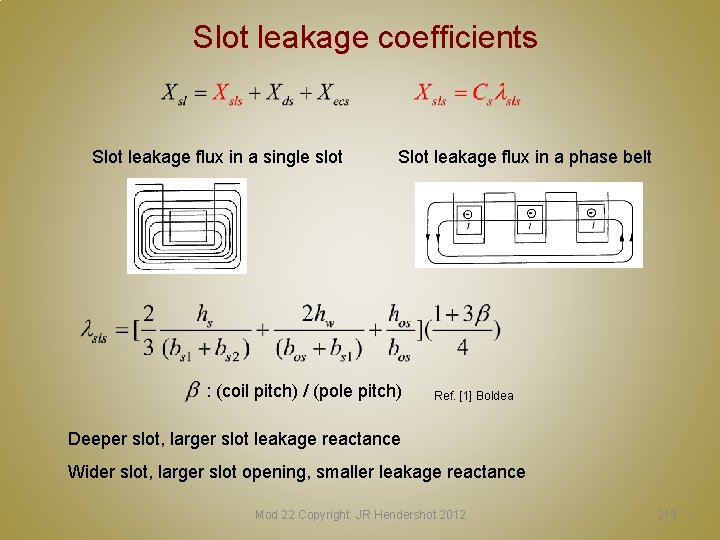
Slot leakage coefficients Slot leakage flux in a single slot Slot leakage flux in a phase belt : (coil pitch) / (pole pitch) Ref. [1] Boldea Deeper slot, larger slot leakage reactance Wider slot, larger slot opening, smaller leakage reactance Mod 22 Copyright: JR Hendershot 2012 219
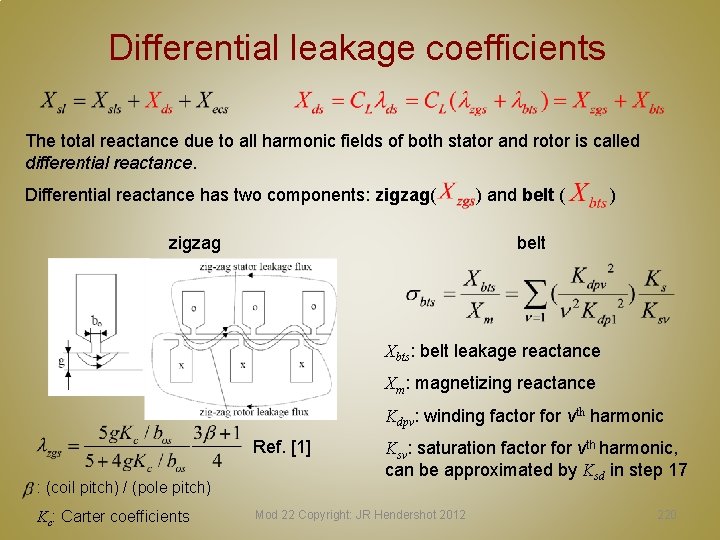
Differential leakage coefficients The total reactance due to all harmonic fields of both stator and rotor is called differential reactance. Differential reactance has two components: zigzag( zigzag ) and belt ( ) belt Xbts: belt leakage reactance Xm: magnetizing reactance Kdpv: winding factor for vth harmonic Ref. [1] : (coil pitch) / (pole pitch) Kc: Carter coefficients Ksv: saturation factor for vth harmonic, can be approximated by Ksd in step 17 Mod 22 Copyright: JR Hendershot 2012 220
End leakage coefficients An approximate expression Ref. [1] Boldea q: Stator slots/pole/phase b: (coil pitch) / (pole pitch) lend: End connection length of a coil L: Machine axial length Mod 22 Copyright: JR Hendershot 2012 221
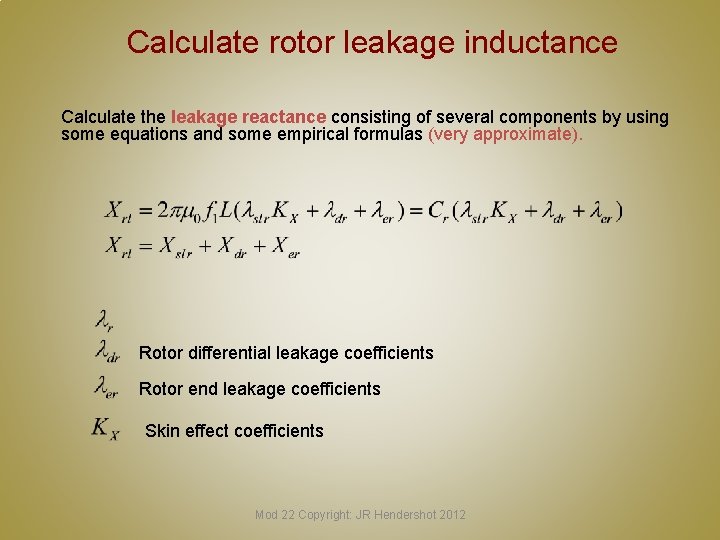
Calculate rotor leakage inductance Calculate the leakage reactance consisting of several components by using some equations and some empirical formulas (very approximate). Rotor differential leakage coefficients Rotor end leakage coefficients Skin effect coefficients Mod 22 Copyright: JR Hendershot 2012
Rotor differential inductance Zigzag belt Ref. [1] Boldea p: Pole number Nr: Number of rotor slots tr: Rotor slot pitch Mod 22 Copyright: JR Hendershot 2012 223
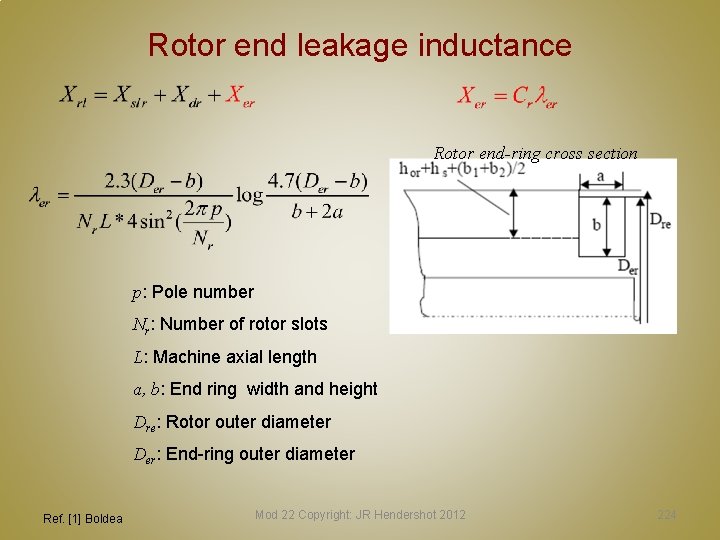
Rotor end leakage inductance Rotor end-ring cross section p: Pole number Nr: Number of rotor slots L: Machine axial length a, b: End ring width and height Dre: Rotor outer diameter Der: End-ring outer diameter Ref. [1] Boldea Mod 22 Copyright: JR Hendershot 2012 224
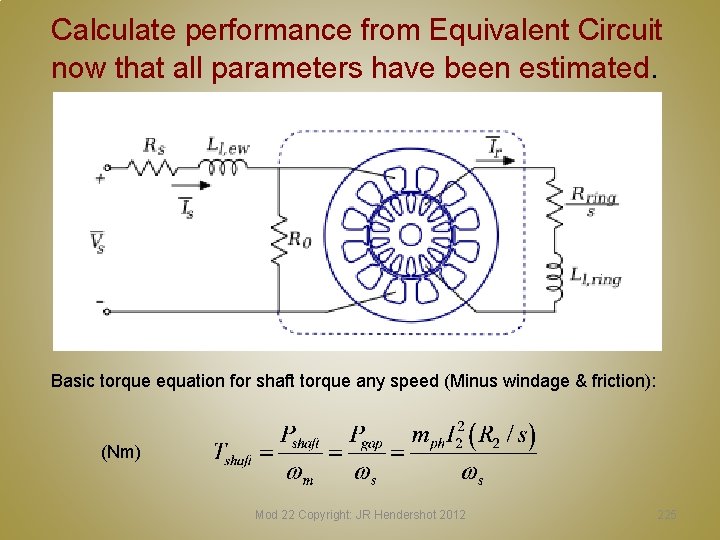
Calculate performance from Equivalent Circuit now that all parameters have been estimated. Basic torque equation for shaft torque any speed (Minus windage & friction): (Nm) Mod 22 Copyright: JR Hendershot 2012 225
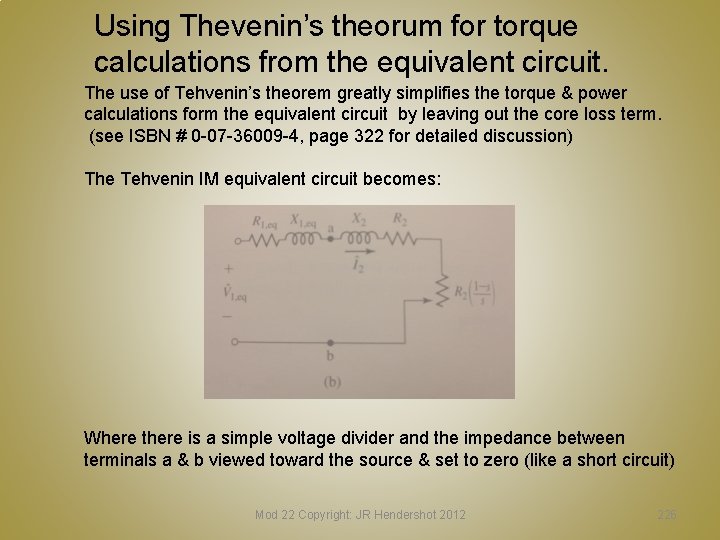
Using Thevenin’s theorum for torque calculations from the equivalent circuit. The use of Tehvenin’s theorem greatly simplifies the torque & power calculations form the equivalent circuit by leaving out the core loss term. (see ISBN # 0 -07 -36009 -4, page 322 for detailed discussion) The Tehvenin IM equivalent circuit becomes: Where there is a simple voltage divider and the impedance between terminals a & b viewed toward the source & set to zero (like a short circuit) Mod 22 Copyright: JR Hendershot 2012 226
Torque formula simplified for any speed from Thevenin’s equivalent circuit This torque equation can be used to generate the following shaped torque vs speed curves at any fixed voltage and frequency. Mod 22 Copyright: JR Hendershot 2012 227
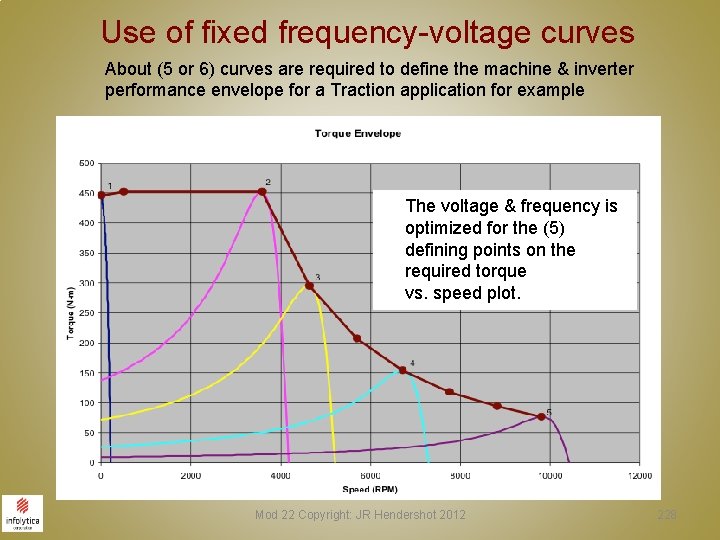
Use of fixed frequency-voltage curves About (5 or 6) curves are required to define the machine & inverter performance envelope for a Traction application for example The voltage & frequency is optimized for the (5) defining points on the required torque vs. speed plot. Mod 22 Copyright: JR Hendershot 2012 228
Mod 22 Copyright: JR Hendershot 2012 229
Mod 21 Copyright: JR Hendershot 2012 230
Mod 22 Copyright: JR Hendershot 2012 231
Mod 22 Copyright: JR Hendershot 2012 232