
Electric Machine Design Course Equivalent Circuit Parameters Measurements

- Slides: 19
Electric Machine Design Course Equivalent Circuit Parameters. , Measurements and Torque vs. Speed Plots Lecture # 19 Mod 19 Copyright: JR Hendershot 2012 180
Measurements of IM equivalent circuit parameters The classic and oldest method for calculating the performance of the AC induction machine is by use of single phase equivalent circuits. This method is used for three principle purposes : For teaching and understanding the principles of IMs E. E. Engineering teams commissioning an IM machine with an inverter for the first time to optimize all software parameters to achieve the required output performance of the system. Before availability of simulation tools, The E. C. was used to predict performance curve results during the design process. All E. Q. Parameter values were initially calculated Validation based upon parameter measurements. Mod 19 Copyright: JR Hendershot 2012 181
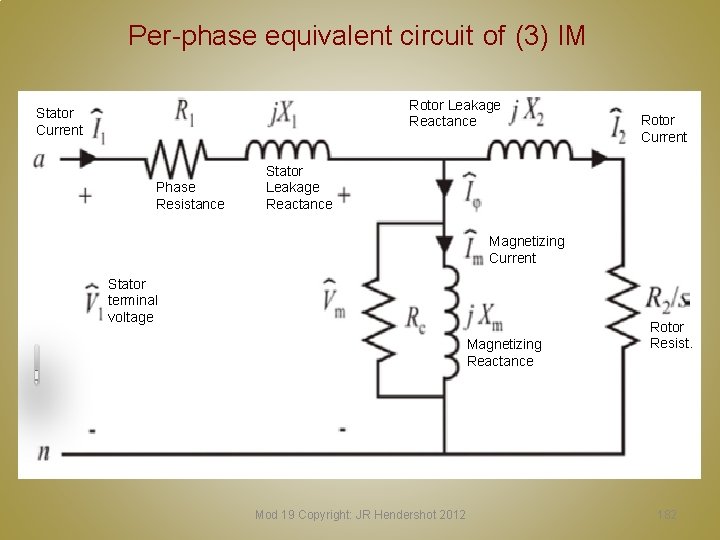
Per-phase equivalent circuit of (3) IM Rotor Leakage Reactance Stator Current Phase Resistance Rotor Current Stator Leakage Reactance Magnetizing Current Stator terminal voltage Magnetizing Reactance Mod 19 Copyright: JR Hendershot 2012 Rotor Resist. 182
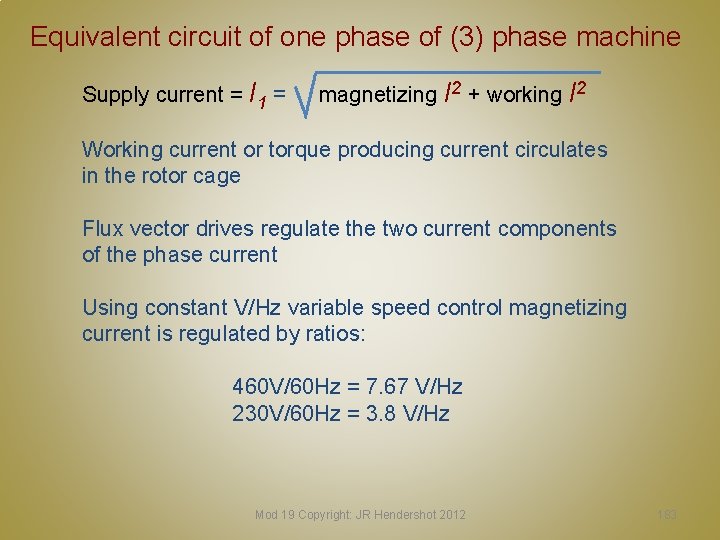
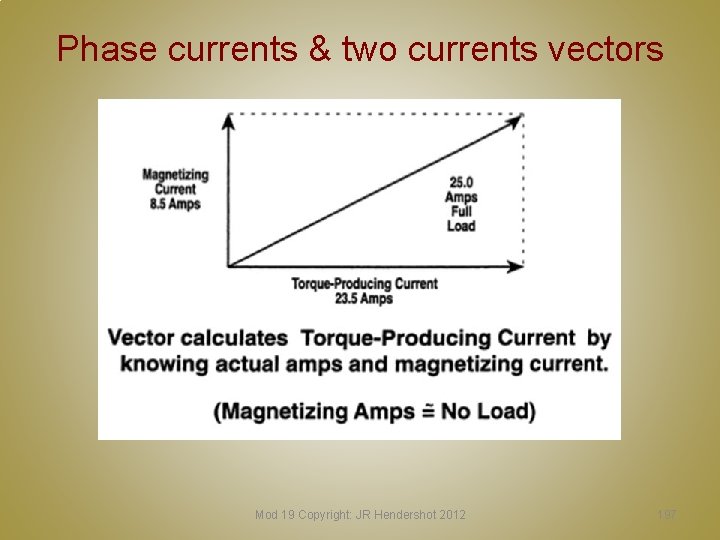
Equivalent circuit of one phase of (3) phase machine Supply current = I 1 = magnetizing I 2 + working I 2 Working current or torque producing current circulates in the rotor cage Flux vector drives regulate the two current components of the phase current Using constant V/Hz variable speed control magnetizing current is regulated by ratios: 460 V/60 Hz = 7. 67 V/Hz 230 V/60 Hz = 3. 8 V/Hz Mod 19 Copyright: JR Hendershot 2012 183
The equivalent circuit parameter (ECP) measurements for AC induction machines Three standard test for AC induction motor parameters DC Test (Line to Line Resistance) No-Load Test Locked-Rotor Test Mod 19 Copyright: JR Hendershot 2012 184
DC Test for phase resistance The stator phase resistance (RS). Apply a DC voltage across stator windings. Measure DC voltage and current Line to line values/2 = phase values (RS) = voltage / current Mod 19 Copyright: JR Hendershot 2012 185
No-Load Test Conduct no load motor test with uncouples shaft Apply (3) balanced AC voltages to terminals @ rated f. Measure current, voltage & input power Record total losses (core, ohmic, windage & friction) Mod 19 Copyright: JR Hendershot 2012 186
Blocked Rotor Test Block rotor shaft to prevent rotation Apply (3) balanced AC voltages @ 0. 25 f. Adjust AC voltage to produce rate current Measure Voltage, current and input power Mod 19 Copyright: JR Hendershot 2012
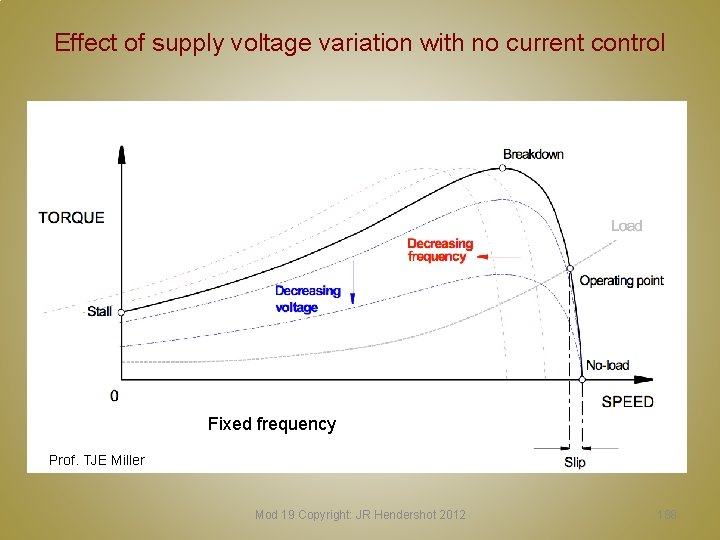
Effect of supply voltage variation with no current control Fixed frequency Prof. TJE Miller Mod 19 Copyright: JR Hendershot 2012 188
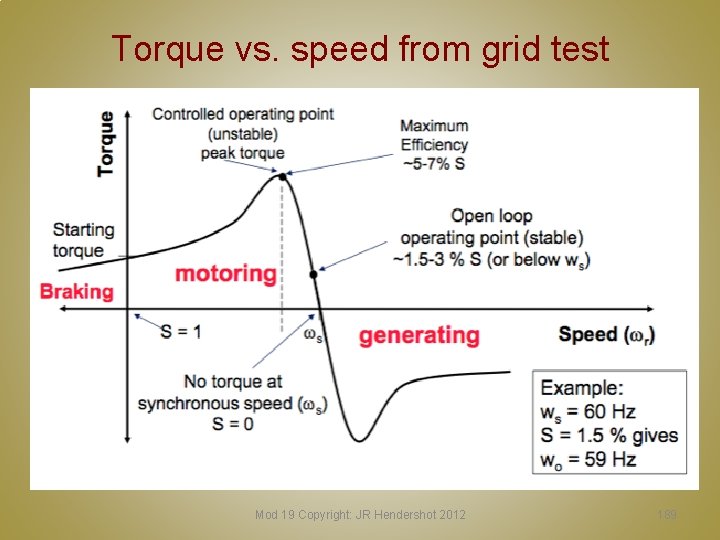
Torque vs. speed from grid test Mod 19 Copyright: JR Hendershot 2012 189
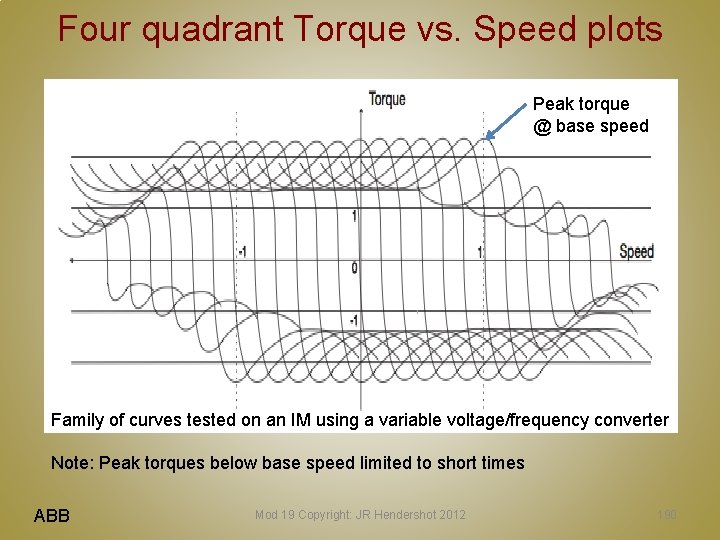
Four quadrant Torque vs. Speed plots Peak torque @ base speed Family of curves tested on an IM using a variable voltage/frequency converter Note: Peak torques below base speed limited to short times ABB Mod 19 Copyright: JR Hendershot 2012 190
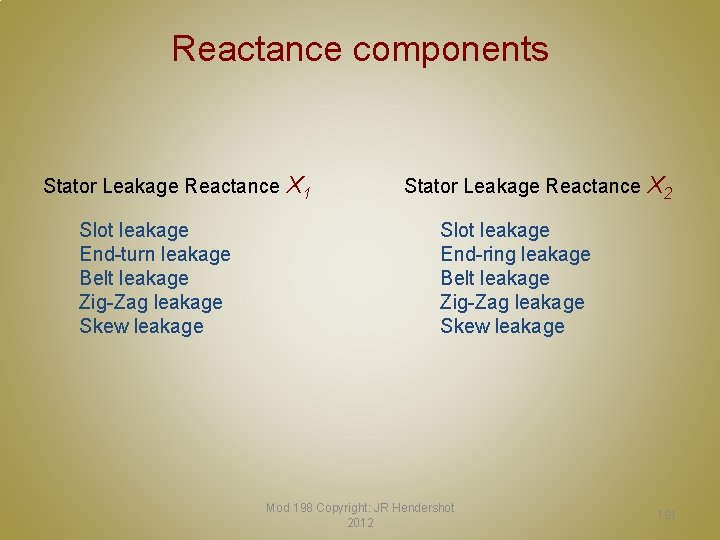
Reactance components Stator Leakage Reactance X 1 Slot leakage End-turn leakage Belt leakage Zig-Zag leakage Skew leakage Stator Leakage Reactance X 2 Slot leakage End-ring leakage Belt leakage Zig-Zag leakage Skew leakage Mod 198 Copyright: JR Hendershot 2012 191
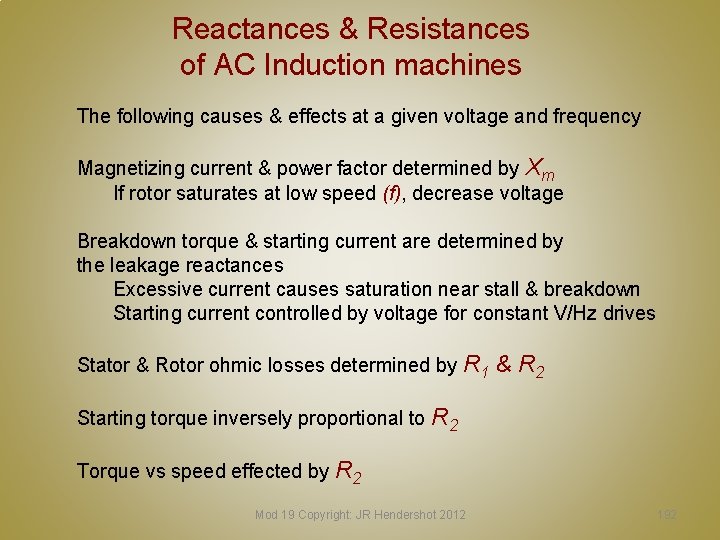
Reactances & Resistances of AC Induction machines The following causes & effects at a given voltage and frequency Magnetizing current & power factor determined by Xm If rotor saturates at low speed (f), decrease voltage Breakdown torque & starting current are determined by the leakage reactances Excessive current causes saturation near stall & breakdown Starting current controlled by voltage for constant V/Hz drives Stator & Rotor ohmic losses determined by R 1 & R 2 Starting torque inversely proportional to R 2 Torque vs speed effected by R 2 Mod 19 Copyright: JR Hendershot 2012 192
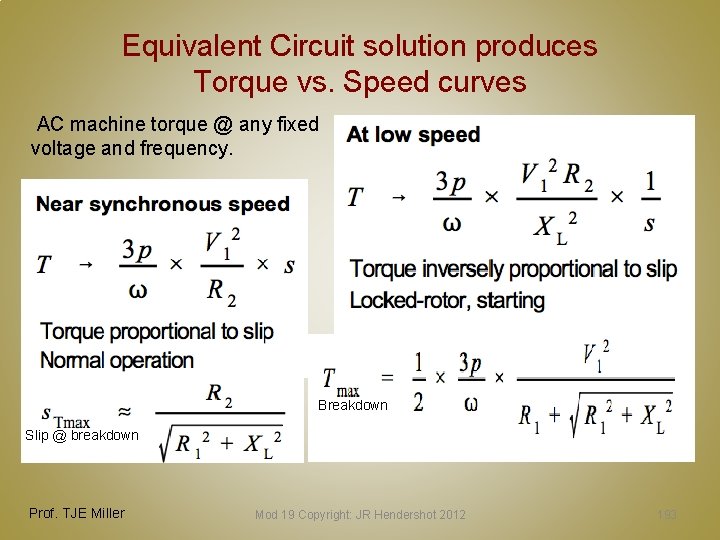
Equivalent Circuit solution produces Torque vs. Speed curves AC machine torque @ any fixed voltage and frequency. Breakdown Slip @ breakdown Prof. TJE Miller Mod 19 Copyright: JR Hendershot 2012 193
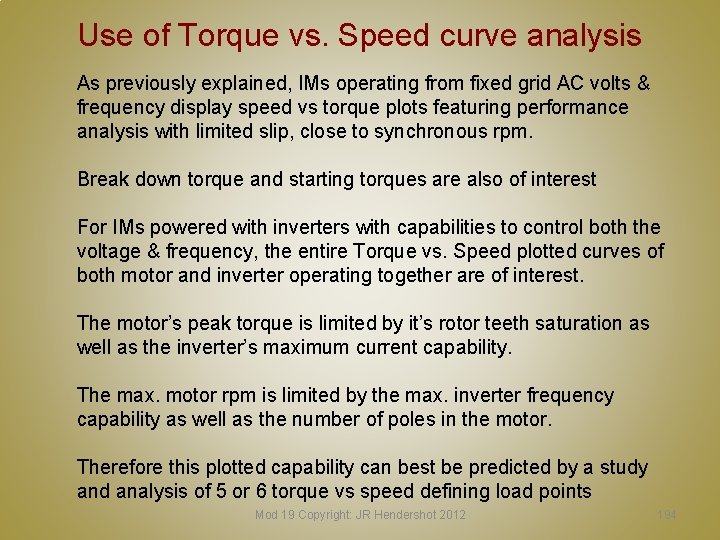
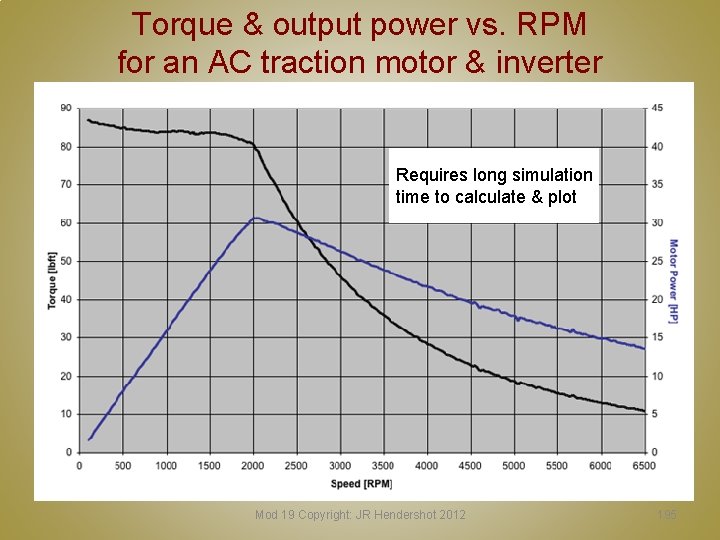
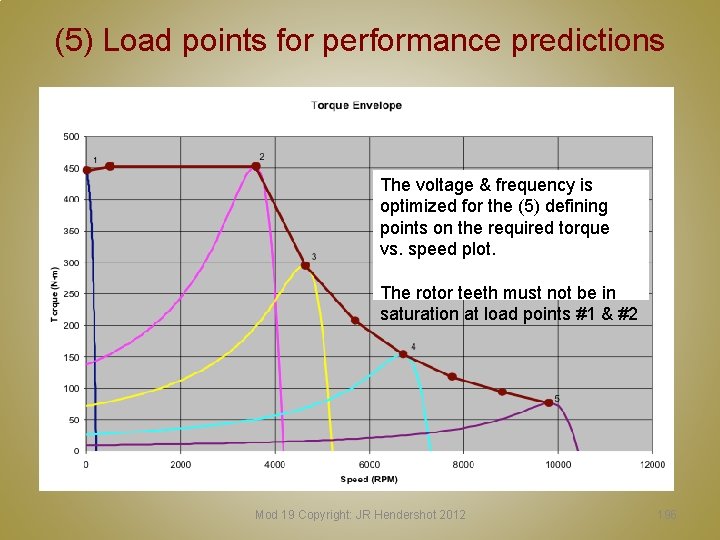
Use of Torque vs. Speed curve analysis As previously explained, IMs operating from fixed grid AC volts & frequency display speed vs torque plots featuring performance analysis with limited slip, close to synchronous rpm. Break down torque and starting torques are also of interest For IMs powered with inverters with capabilities to control both the voltage & frequency, the entire Torque vs. Speed plotted curves of both motor and inverter operating together are of interest. The motor’s peak torque is limited by it’s rotor teeth saturation as well as the inverter’s maximum current capability. The max. motor rpm is limited by the max. inverter frequency capability as well as the number of poles in the motor. Therefore this plotted capability can best be predicted by a study and analysis of 5 or 6 torque vs speed defining load points Mod 19 Copyright: JR Hendershot 2012 194
Torque & output power vs. RPM for an AC traction motor & inverter Requires long simulation time to calculate & plot Mod 19 Copyright: JR Hendershot 2012 195
(5) Load points for performance predictions The voltage & frequency is optimized for the (5) defining points on the required torque vs. speed plot. The rotor teeth must not be in saturation at load points #1 & #2 Mod 19 Copyright: JR Hendershot 2012 196
Phase currents & two currents vectors Mod 19 Copyright: JR Hendershot 2012 197
Title Mod 19 Copyright: JR Hendershot 2012 198