
Electric Generators and Motors 1 Electric Generators and
- Slides: 18
Electric Generators and Motors 1 Electric Generators and Motors
Electric Generators and Motors 2 Introductory Question n If you connect an ordinary electric motor in a circuit with a lightbulb, is there a chance that spinning the motor will cause the lightbulb to light up? A. Yes No B.
Electric Generators and Motors 3 Observations about Electric Generators and Motors A generator requires a mechanical power n A generator provides electric power n A motor requires electric power n A motor provides mechanical power n Generators aren’t common in daily life n But motors are widely used n
Electric Generators and Motors 4 4 Questions about Electric Generators and Motors How can a moving magnet produce electricity? n How can electricity produce a moving magnet? n How can a motor operate on DC power? n How can some motors use aluminum rotors? n
Electric Generators and Motors 5 Question 1 n How can a moving magnet produce electricity?
Electric Generators and Motors 6 Generating Electricity n A changing magnetic field produces an electric field n and can induces current in a conductor. n n Moving magnets have changing magnetic fields and can propel currents in coils, n so that mechanical power becomes electrical power. n
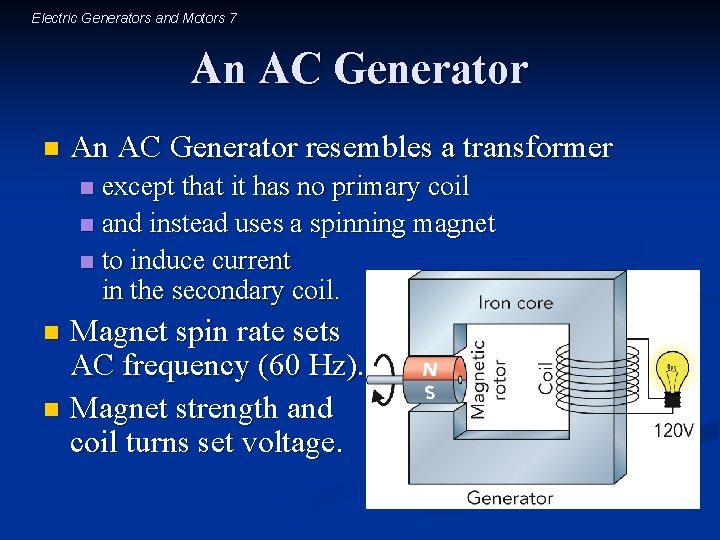
Electric Generators and Motors 7 An AC Generator n An AC Generator resembles a transformer except that it has no primary coil n and instead uses a spinning magnet n to induce current in the secondary coil. n Magnet spin rate sets AC frequency (60 Hz). n Magnet strength and coil turns set voltage. n
Electric Generators and Motors 8 Question 2 n How can electricity produce a moving magnet?
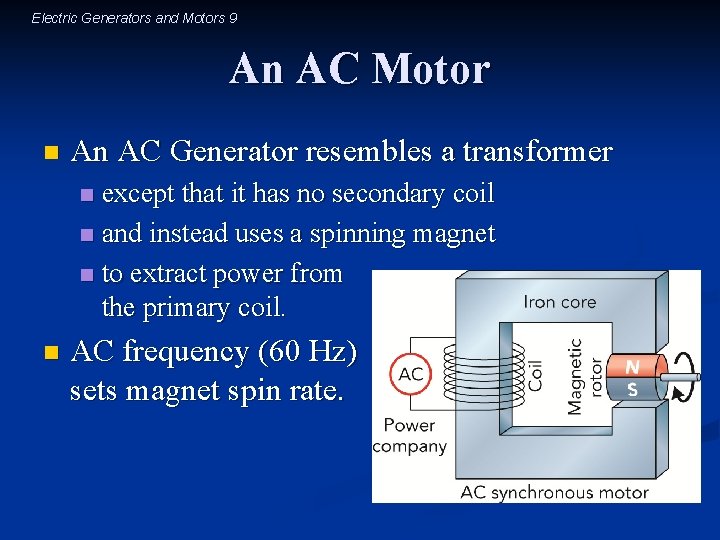
Electric Generators and Motors 9 An AC Motor n An AC Generator resembles a transformer except that it has no secondary coil n and instead uses a spinning magnet n to extract power from the primary coil. n n AC frequency (60 Hz) sets magnet spin rate.
Electric Generators and Motors 10 Introductory Question (revisited) n If you connect an ordinary electric motor in a circuit with a lightbulb, is there a chance that spinning the motor will cause the lightbulb to light up? A. Yes No B.
Electric Generators and Motors 11 Question 3 n How can a motor operate on DC power? Can a motor consist only of permanent magnets? n Are permanent magnets an endless source of energy? n
Electric Generators and Motors 12 A Permanent Magnet Motor? n A motor comprised only of permanent magnets will move as like poles repel and opposites attract n and then settle down at minimum potential energy. n Unless something alters its poles, that motor will never move again. n Electromagnets operating on DC power behave like permanent magnets, so DC alone can’t keep a motor turning for long. n
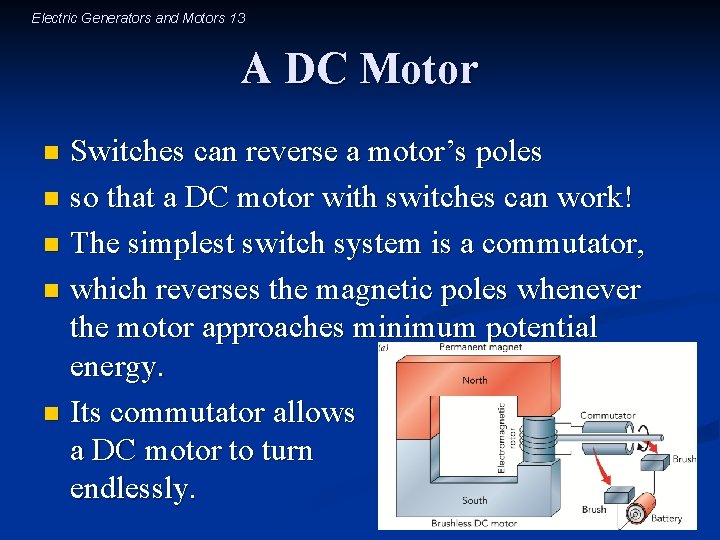
Electric Generators and Motors 13 A DC Motor Switches can reverse a motor’s poles n so that a DC motor with switches can work! n The simplest switch system is a commutator, n which reverses the magnetic poles whenever the motor approaches minimum potential energy. n Its commutator allows a DC motor to turn endlessly. n
Electric Generators and Motors 14 Question 4 n How can some motors use aluminum rotors? n Aluminum is nonmagnetic, so how can it work?
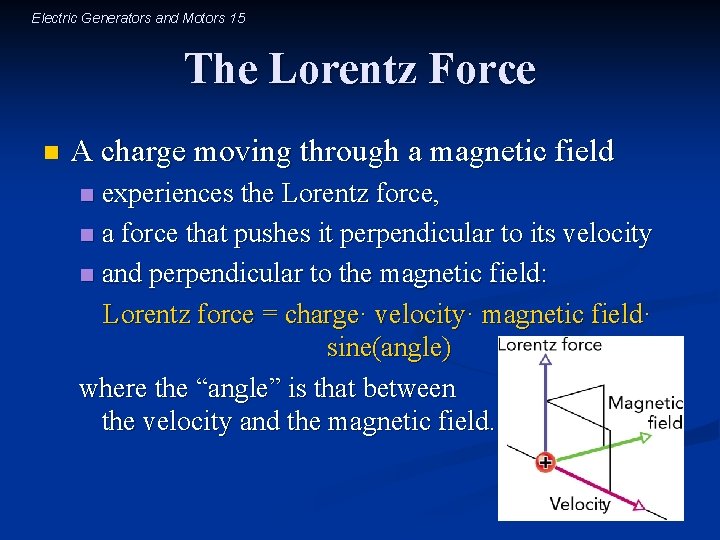
Electric Generators and Motors 15 The Lorentz Force n A charge moving through a magnetic field experiences the Lorentz force, n a force that pushes it perpendicular to its velocity n and perpendicular to the magnetic field: Lorentz force = charge· velocity· magnetic field· sine(angle) where the “angle” is that between the velocity and the magnetic field. n
Electric Generators and Motors 16 Induction and Lorentz Force n When a magnetic field moves past a conductor, it induces current in that conductor n and that current experiences the Lorentz force. n n The current and conductor experience a force n that pulls them with the moving magnetic field. A moving magnet tends to drag metals with it. n This effect can be used to make a motor. n
Electric Generators and Motors 17 AC Induction Motor Stationary AC electromagnets can produce a magnetic field that circles a conducting rotor. n Currents induced in that rotor n experience the Lorentz force n and are pushed along with the rotating field. n The rotor spins almost as fast as the field circles. n This system is known as an AC induction motor. n
Electric Generators and Motors 18 Summary about Electric Generators and Motors Generators using moving magnets to turn mechanical power into electrical power n Motors use moving magnets to turn electrical power into mechanical power n Induction motors depend on the Lorentz force to allow electromagnets to spin a nonmagnetic metal rotor. n