
ELECTRIC FORCE AND ELECTRIC FIELDS PES 1000 PHYSICS

- Slides: 11
ELECTRIC FORCE AND ELECTRIC FIELDS PES 1000 – PHYSICS IN EVERYDAY LIFE
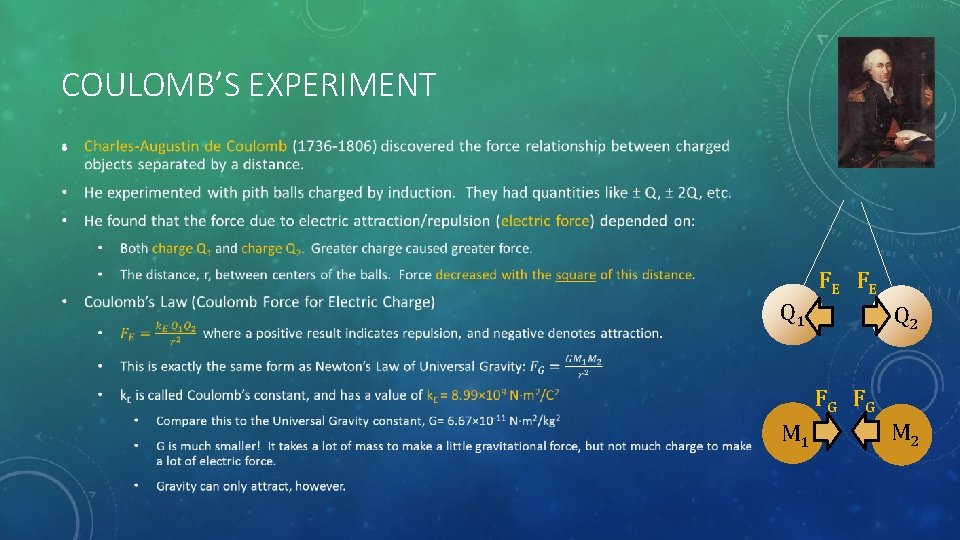
COULOMB’S EXPERIMENT • Q 1 FE FE Q 2 FG FG M 1 M 2
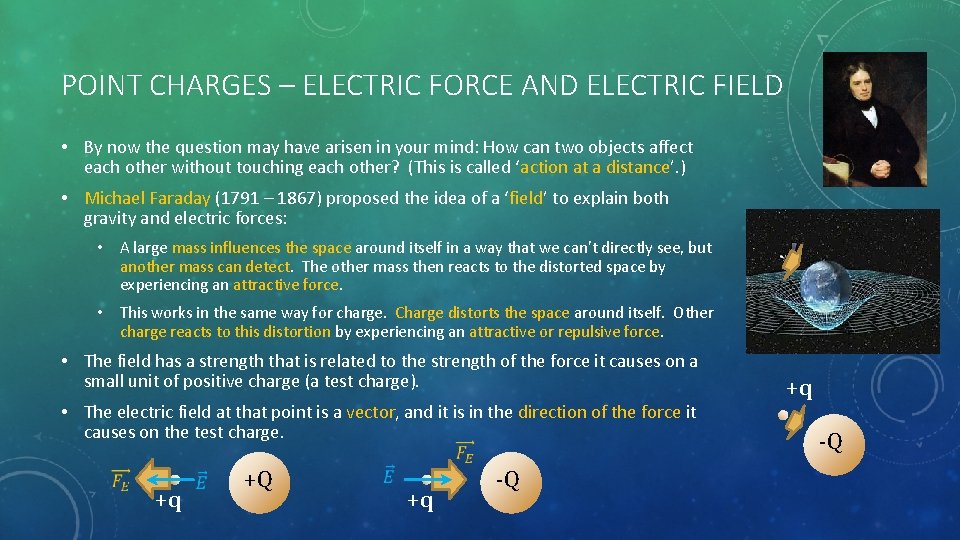
POINT CHARGES – ELECTRIC FORCE AND ELECTRIC FIELD • By now the question may have arisen in your mind: How can two objects affect each other without touching each other? (This is called ‘action at a distance’. ) • Michael Faraday (1791 – 1867) proposed the idea of a ‘field’ to explain both gravity and electric forces: • A large mass influences the space around itself in a way that we can’t directly see, but another mass can detect. The other mass then reacts to the distorted space by experiencing an attractive force. • This works in the same way for charge. Charge distorts the space around itself. Other charge reacts to this distortion by experiencing an attractive or repulsive force. • The field has a strength that is related to the strength of the force it causes on a small unit of positive charge (a test charge). • The electric field at that point is a vector, and it is in the direction of the force it causes on the test charge. +q +Q +q -Q
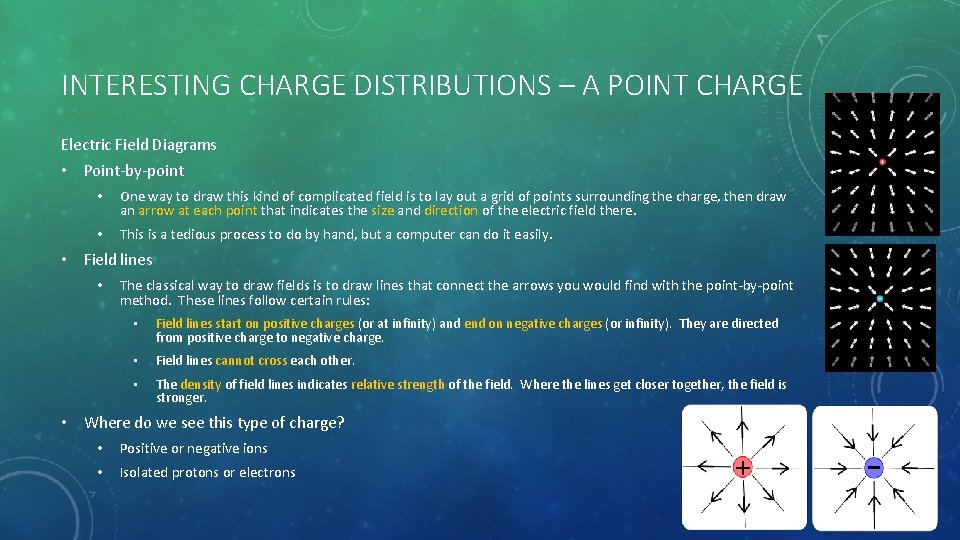
INTERESTING CHARGE DISTRIBUTIONS – A POINT CHARGE Electric Field Diagrams • Point-by-point • One way to draw this kind of complicated field is to lay out a grid of points surrounding the charge, then draw an arrow at each point that indicates the size and direction of the electric field there. • This is a tedious process to do by hand, but a computer can do it easily. • Field lines • The classical way to draw fields is to draw lines that connect the arrows you would find with the point-by-point method. These lines follow certain rules: • Field lines start on positive charges (or at infinity) and end on negative charges (or infinity). They are directed from positive charge to negative charge. • Field lines cannot cross each other. • The density of field lines indicates relative strength of the field. Where the lines get closer together, the field is stronger. • Where do we see this type of charge? • Positive or negative ions • Isolated protons or electrons
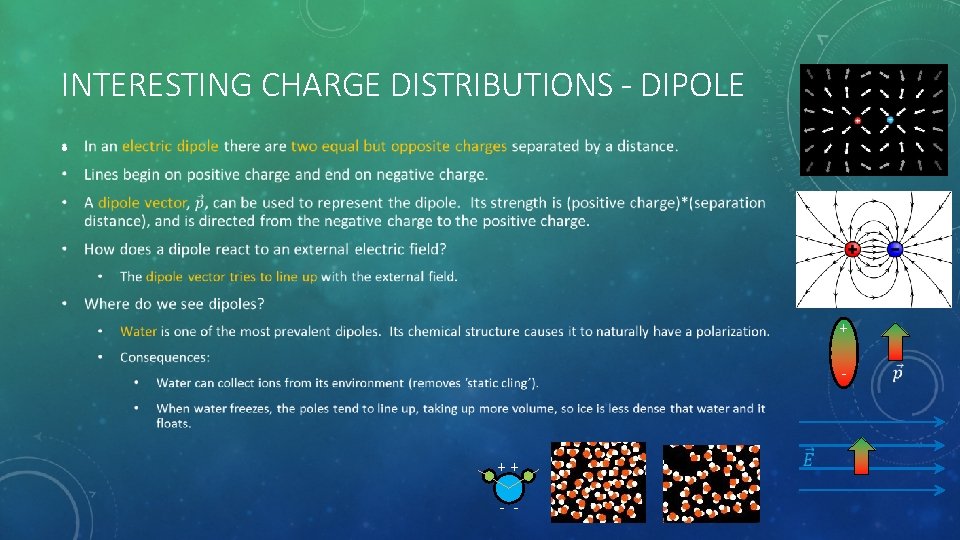
INTERESTING CHARGE DISTRIBUTIONS - DIPOLE • + - ++ - -
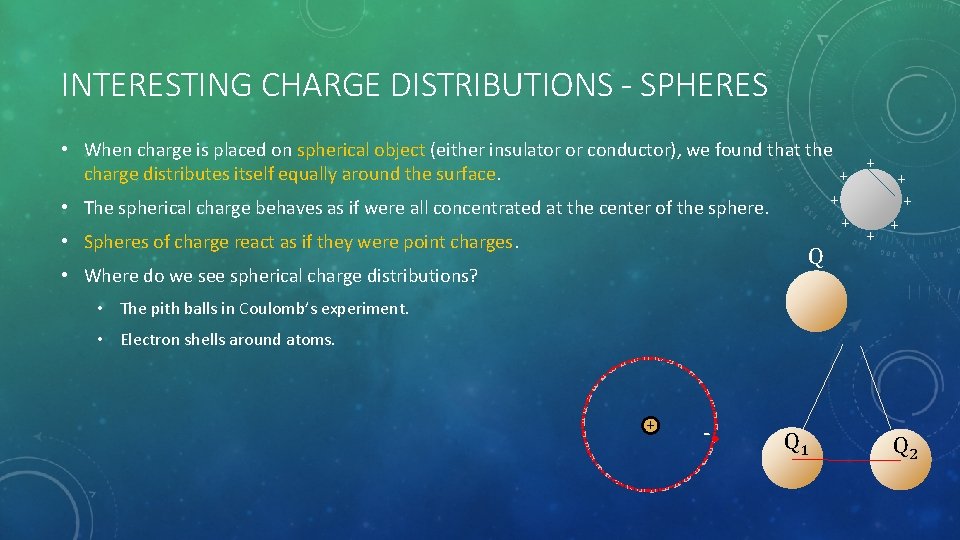
INTERESTING CHARGE DISTRIBUTIONS - SPHERES • When charge is placed on spherical object (either insulator or conductor), we found that the + charge distributes itself equally around the surface. + + • The spherical charge behaves as if were all concentrated at the center of the sphere. • Spheres of charge react as if they were point charges. + Q • Where do we see spherical charge distributions? + + • The pith balls in Coulomb’s experiment. • Electron shells around atoms. + - Q 1 Q 2
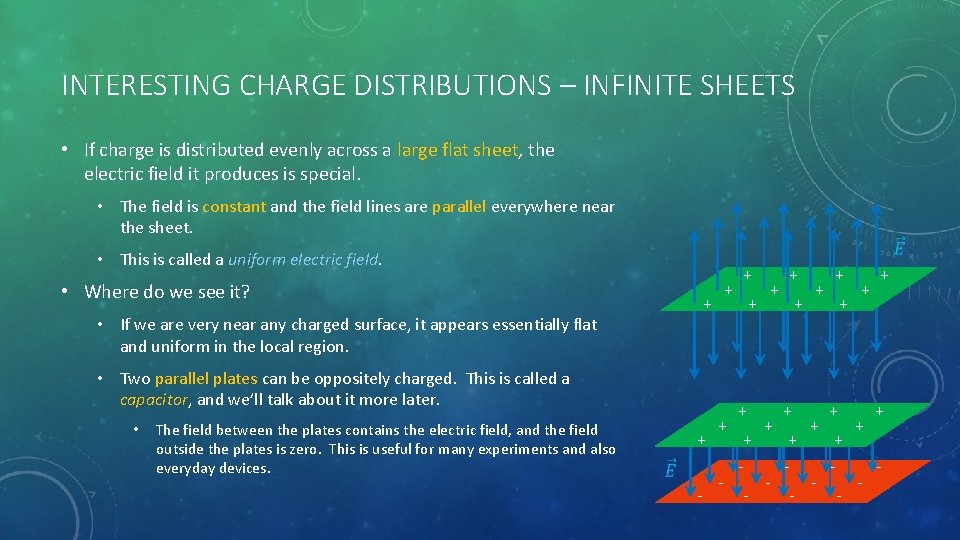
INTERESTING CHARGE DISTRIBUTIONS – INFINITE SHEETS • If charge is distributed evenly across a large flat sheet, the electric field it produces is special. • The field is constant and the field lines are parallel everywhere near the sheet. • This is called a uniform electric field. • Where do we see it? + • If we are very near any charged surface, it appears essentially flat and uniform in the local region. • Two parallel plates can be oppositely charged. This is called a capacitor, and we’ll talk about it more later. • The field between the plates contains the electric field, and the field outside the plates is zero. This is useful for many experiments and also everyday devices. + - + + - + + + + -
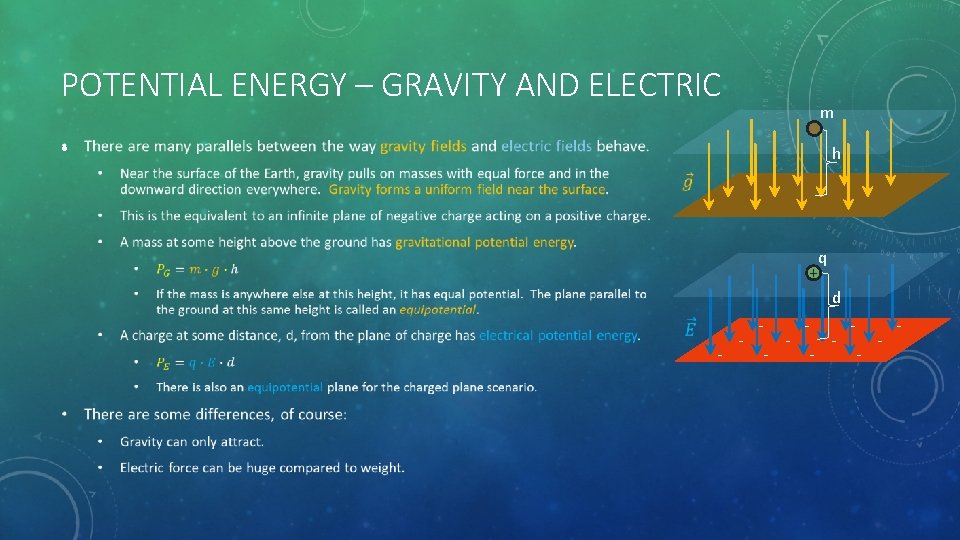
POTENTIAL ENERGY – GRAVITY AND ELECTRIC m • h q + d - - - - -
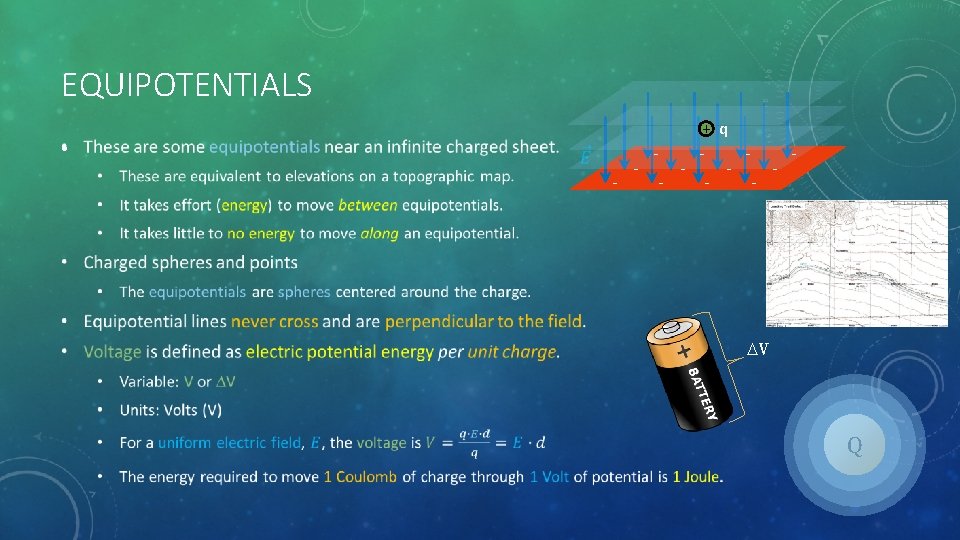
EQUIPOTENTIALS • + q - DV Q
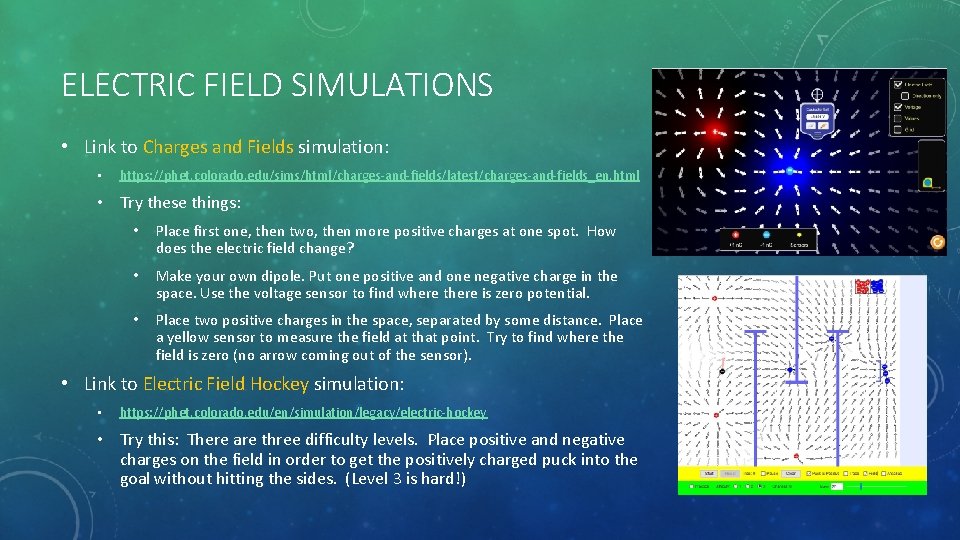
ELECTRIC FIELD SIMULATIONS • Link to Charges and Fields simulation: • https: //phet. colorado. edu/sims/html/charges-and-fields/latest/charges-and-fields_en. html • Try these things: • Place first one, then two, then more positive charges at one spot. How does the electric field change? • Make your own dipole. Put one positive and one negative charge in the space. Use the voltage sensor to find where there is zero potential. • Place two positive charges in the space, separated by some distance. Place a yellow sensor to measure the field at that point. Try to find where the field is zero (no arrow coming out of the sensor). • Link to Electric Field Hockey simulation: • https: //phet. colorado. edu/en/simulation/legacy/electric-hockey • Try this: There are three difficulty levels. Place positive and negative charges on the field in order to get the positively charged puck into the goal without hitting the sides. (Level 3 is hard!)
CONCLUSION • Electric charge influences the space around itself. Other charge is able to interact with that space by means of attractive or repulsive force. • The electric field at any point is the direction a force would be on a positive charge at that point. • The electric field in the region around a charge can be illustrated using field lines. • Some distributions of charge have interesting electric fields. These include points, spheres, and sheets of charge. • Equipotentials are surfaces that have the same electric potential energy for a given charge there. It takes little energy to move along one, but significant energy to move between equipotentials. • Voltage is the electric potential energy per unit charge, and characterizes the motivation for a charge to move.