
Electric Fields From Continuous Distributions of Charge Up
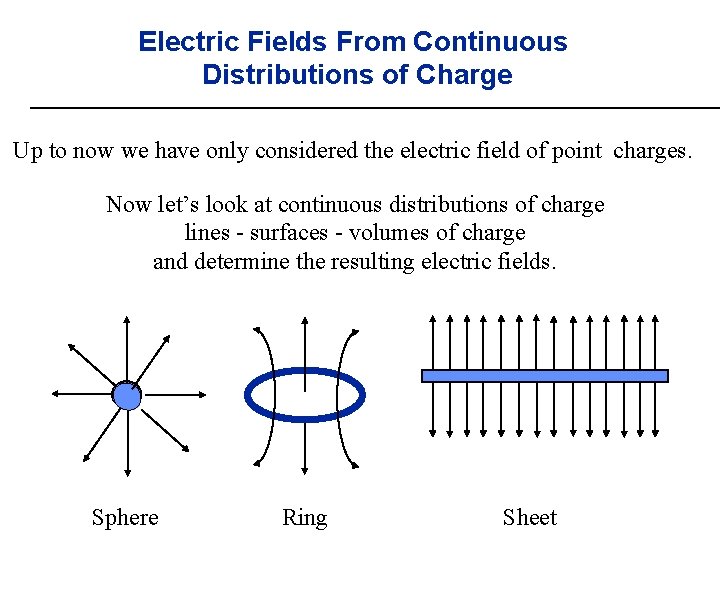
Electric Fields From Continuous Distributions of Charge Up to now we have only considered the electric field of point charges. Now let’s look at continuous distributions of charge lines - surfaces - volumes of charge and determine the resulting electric fields. Sphere Ring Sheet
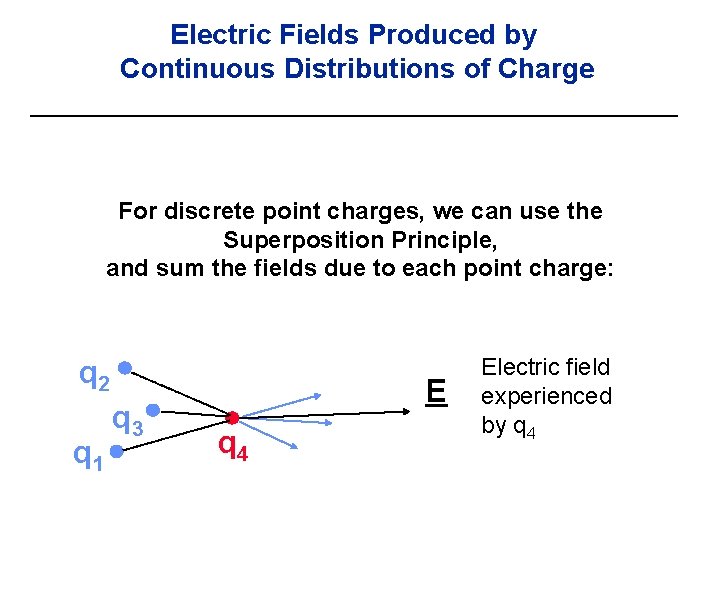
Electric Fields Produced by Continuous Distributions of Charge For discrete point charges, we can use the Superposition Principle, and sum the fields due to each point charge: q 2 q 1 q 3 E q 4 Electric field experienced by q 4
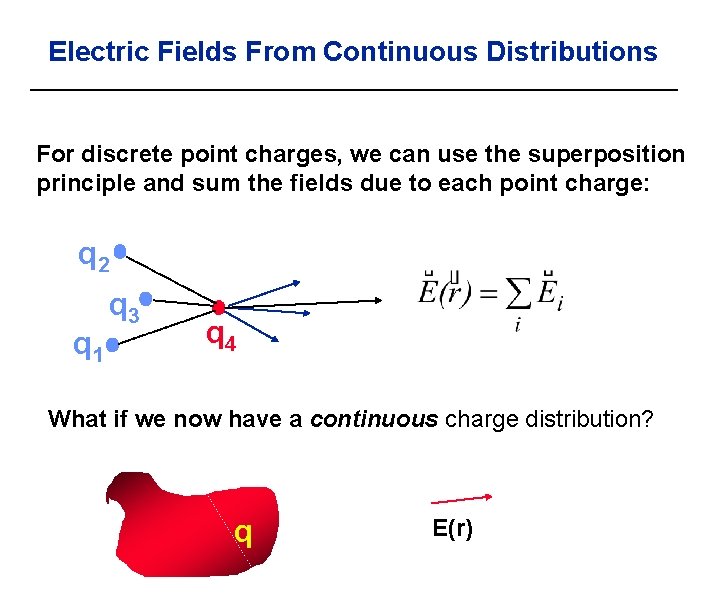
Electric Fields From Continuous Distributions For discrete point charges, we can use the superposition principle and sum the fields due to each point charge: q 2 q 1 q 3 q 4 What if we now have a continuous charge distribution? q E(r)
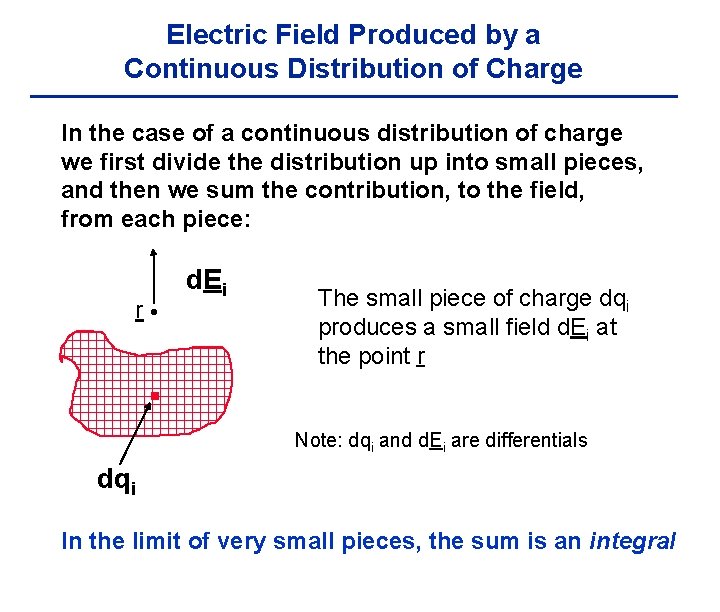
Electric Field Produced by a Continuous Distribution of Charge In the case of a continuous distribution of charge we first divide the distribution up into small pieces, and then we sum the contribution, to the field, from each piece: r d. Ei The small piece of charge dqi produces a small field d. Ei at the point r Note: dqi and d. Ei are differentials dqi In the limit of very small pieces, the sum is an integral

Electric Field Produced by a Continuous Distribution of Charge In the case of a continuous distribution of charge we first divide the distribution up into small pieces, and then we sum the contribution, to the field, from each piece: In the limit of very small pieces, the sum is an integral r dqi d. Ei Each dq: Then: E = d. Ei For very small pieces:
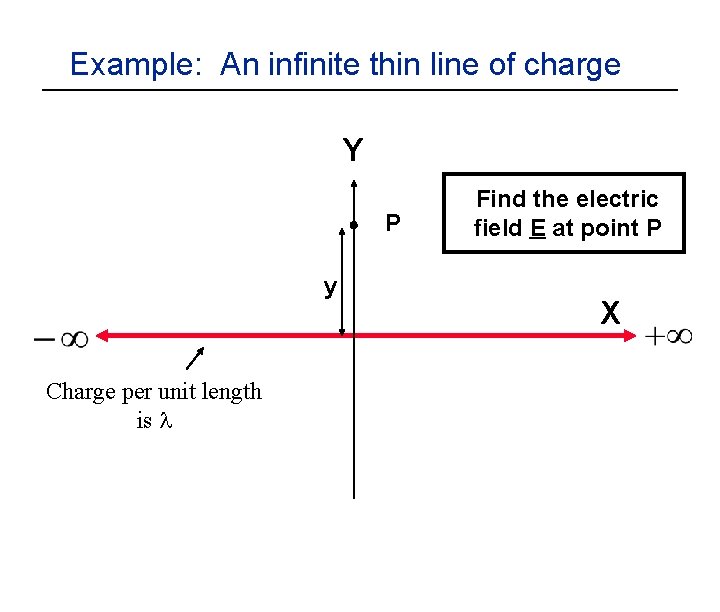
Example: An infinite thin line of charge Y P y Charge per unit length is Find the electric field E at point P X
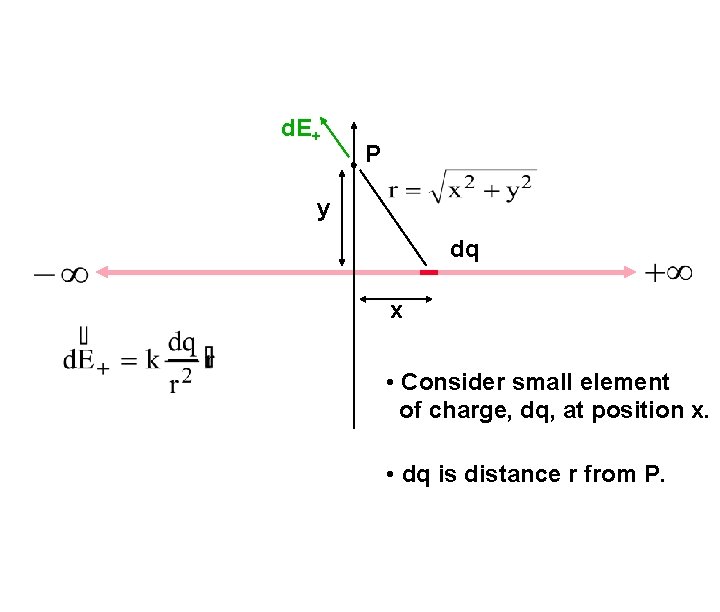
d. E+ P y dq x • Consider small element of charge, dq, at position x. • dq is distance r from P.
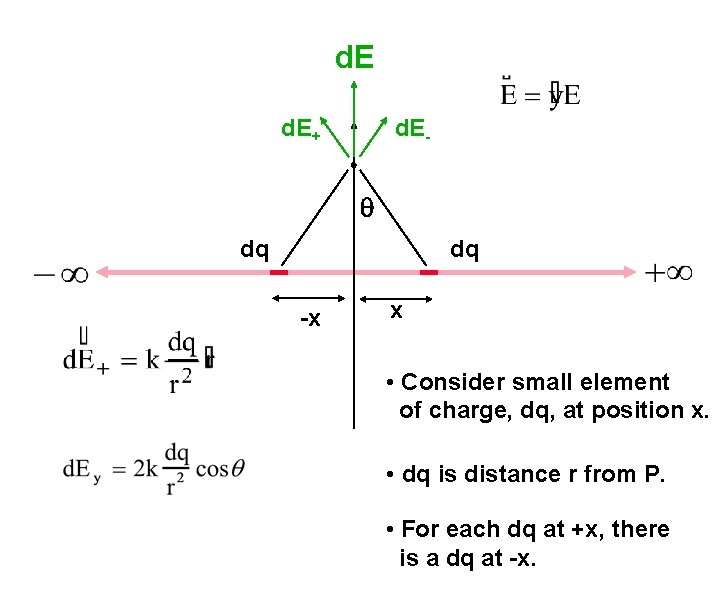
d. E+ d. E- q dq dq -x x • Consider small element of charge, dq, at position x. • dq is distance r from P. • For each dq at +x, there is a dq at -x.
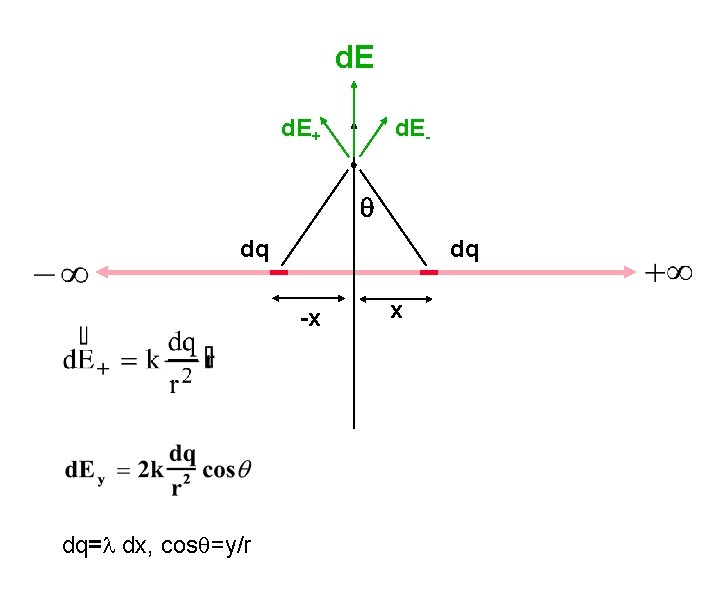
d. E+ d. E- q dq dq -x dq= dx, cosq=y/r x
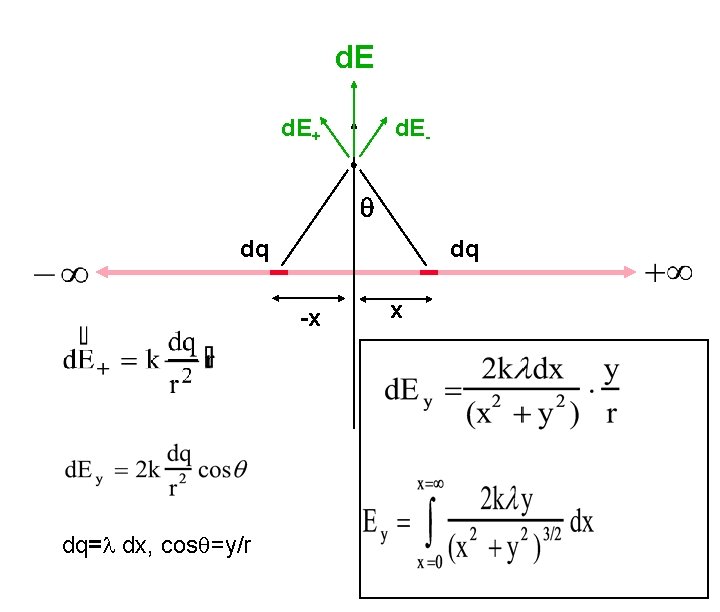
d. E+ d. E- q dq dq -x dq= dx, cosq=y/r x
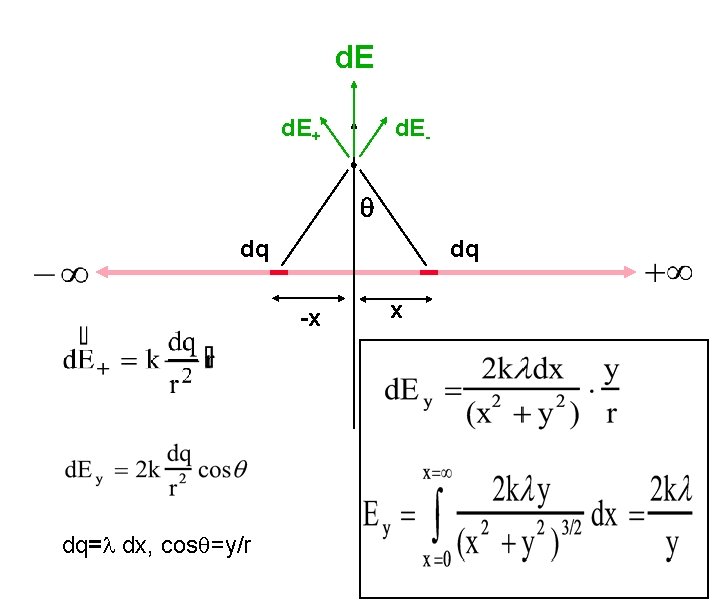
d. E+ d. E- q dq dq -x dq= dx, cosq=y/r x
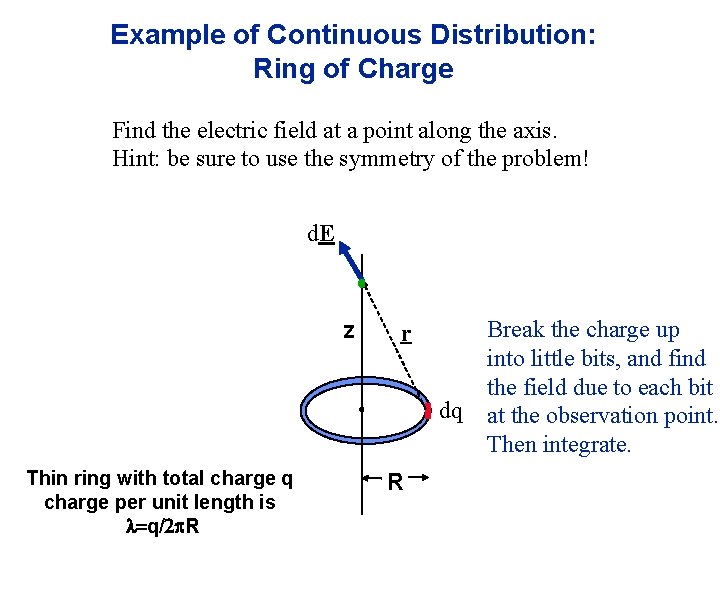
Example of Continuous Distribution: Ring of Charge Find the electric field at a point along the axis. Hint: be sure to use the symmetry of the problem! d. E z r dq Thin ring with total charge q charge per unit length is l=q/2 p. R R Break the charge up into little bits, and find the field due to each bit at the observation point. Then integrate.
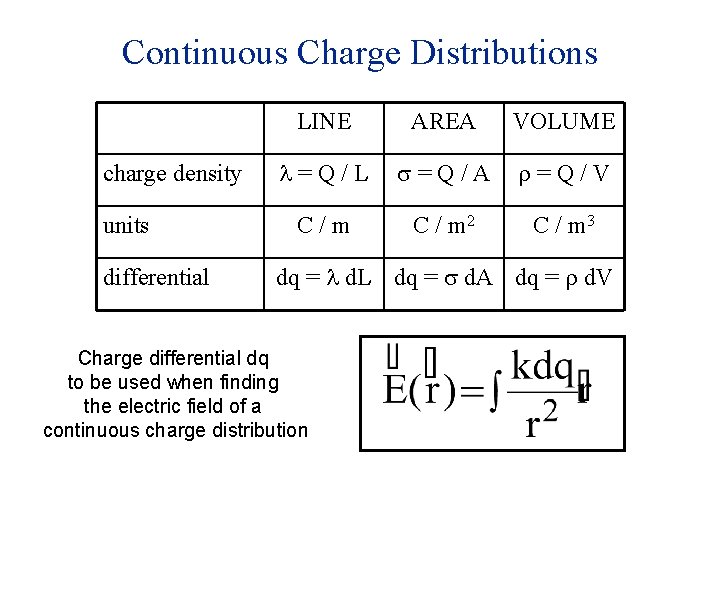
Continuous Charge Distributions charge density units differential LINE AREA VOLUME =Q/L =Q/A =Q/V C/m C / m 2 C / m 3 dq = d. L dq = d. A dq = d. V Charge differential dq to be used when finding the electric field of a continuous charge distribution
- Slides: 13