
Electric field gradient calculations by quantum chemical methods
Electric field gradient calculations by quantum chemical methods Vladimír Kellö Department of Physical and Theoretical Chemistry, Comenius University, SK-842 15 Bratislava, Slovakia
The electric field at the given nucleus X, produced by all electrons and other nuclei of the molecule, is not uniform and has a non-vanishing gradient. EFG, which from the point of view of the given nucleus is a measure of the inhomogeneity of the external electric field, is a molecular property of the first order and can be determined from the knowledge of the electronic wave function and positions of other nuclei. CERN, September 2010 'EFG' 2
Accurate ab initio calculations Electron correlation effects: Ø CCSD(T) Relativistic effects: Ø DKH 2, sf. IOTC Saturated basis set of atomic functions Ø Large uncontracted (mostly) bases Computer program: Ø MOLCAS (University of Lund, Sweden) CERN, September 2010 'EFG' 3
All properties other than energy can be considered as resulting from the action of some perturbation operator. Derivatives of energy with respect to the perturbation strength parameter define atomic and molecular properties of the given order e. g. • 1 st order: electric moments, electric field gradient, the Hellman-Fyenman force, … • 2 nd order: electric polarizabilities, force constants, geometry derivatives of the 1 st order properties, … CERN, September 2010 'EFG' 4
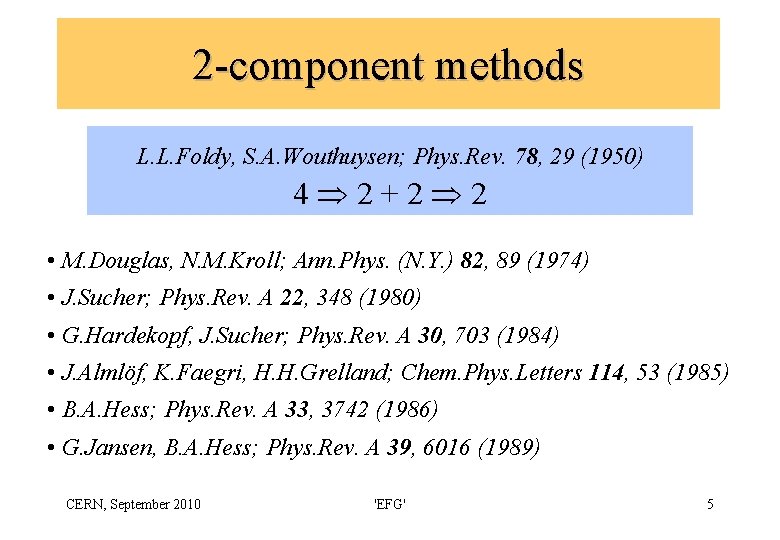
2 -component methods L. L. Foldy, S. A. Wouthuysen; Phys. Rev. 78, 29 (1950) 4 2+2 2 • M. Douglas, N. M. Kroll; Ann. Phys. (N. Y. ) 82, 89 (1974) • J. Sucher; Phys. Rev. A 22, 348 (1980) • G. Hardekopf, J. Sucher; Phys. Rev. A 30, 703 (1984) • J. Almlöf, K. Faegri, H. H. Grelland; Chem. Phys. Letters 114, 53 (1985) • B. A. Hess; Phys. Rev. A 33, 3742 (1986) • G. Jansen, B. A. Hess; Phys. Rev. A 39, 6016 (1989) CERN, September 2010 'EFG' 5
In 2 -component relativistic calculations • Should the perturbation be added at the level of the 4 -component theory and then reduced to the 2 -component approximation? • Can the perturbation be added a posteriori to the given 2 -component Hamiltonian? The difference between the two ways of handling the perturbation makes what is known as the change of picture contribution. A. Messiah, Quantum Mechanics, North-Holland, Amsterdam, 1969, Vol. II p. 943 CERN, September 2010 'EFG' 6
The transformation of the 4 -component Hamiltonian to some 2 -component form requires that all other operators should be transformed in the same way. The first consideration of this problem in the framework of the DKH method was done for dipole moments of Cu. H, Ag. H, and Au. H. V. Kellö, A. J. Sadlej, B. A. Hess; J. Chem. Phys. 105, 1995 (1996) • The change of picture effect for the dipole moment operator is negligible CERN, September 2010 'EFG' 7
Should the change of picture be taken into account? • YES: The change of picture is the 2 effect M. Barysz, A. J. Sadlej; Theor. Chim. Acc. 97, 260 (1997) M. Barysz; Pol. J. Chem. 74, 1329 (2000) K. G. Dyall; Int. J. Quantum Chem. 78, 412 (2000) • NO: In spite of being of the order of 2, the change of picture negligibly affects the valence-determined properties V. Kellö, A. J. Sadlej, B. A. Hess; J. Chem. Phys. 105, 1995 (1996) • YES: Important for operators which assume large values in the vicinity of nuclei, e. g. electric field gradient V. Kellö, A. J. Sadlej; Int. J. Quantum Chem. 68, 159 (1998) CERN, September 2010 'EFG' 8
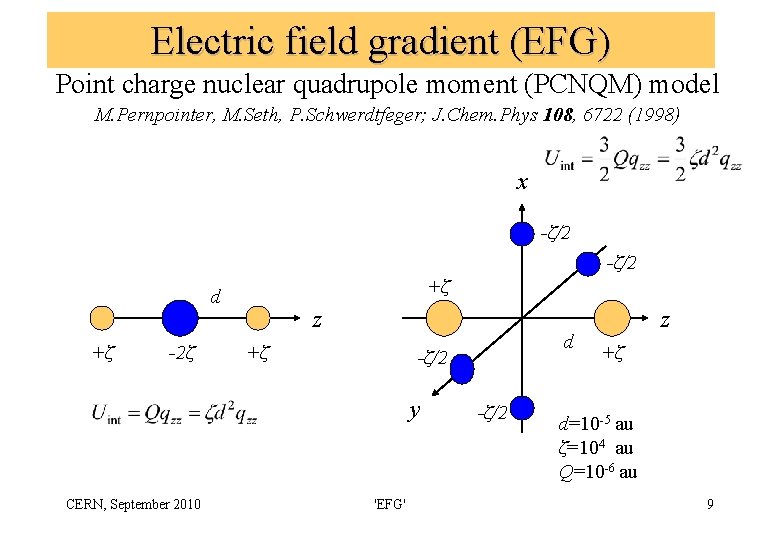
Electric field gradient (EFG) Point charge nuclear quadrupole moment (PCNQM) model M. Pernpointer, M. Seth, P. Schwerdtfeger; J. Chem. Phys 108, 6722 (1998) x -ζ/2 +ζ d +ζ -2ζ z +ζ y CERN, September 2010 d -ζ/2 'EFG' -ζ/2 z +ζ d=10 -5 au ζ=104 au Q=10 -6 au 9
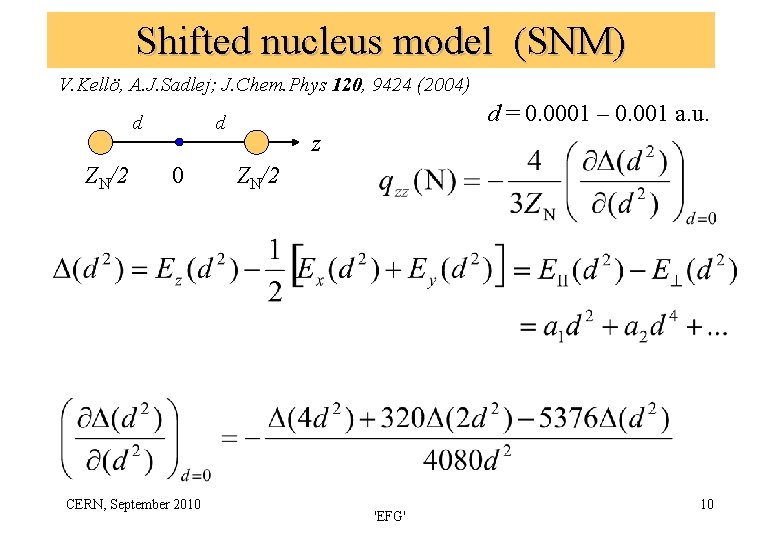
Shifted nucleus model (SNM) V. Kellö, A. J. Sadlej; J. Chem. Phys 120, 9424 (2004) ZN/2 d = 0. 0001 – 0. 001 a. u. d d 0 CERN, September 2010 z ZN/2 'EFG' 10
The important difference between the SN approach and the PCNQM model is that the value ZN is a priori known. Thus the SN approach is a one-parameter method and its performance can be easily tested. The explicit transformation of EFG operator within the DKH approach taking picture-change effects analytically into account R. Mastalerz, G. Barone, R. Lindh, M. Reiher; J. Chem. Phys. 127, 074105 (2007) CERN, September 2010 'EFG' 11
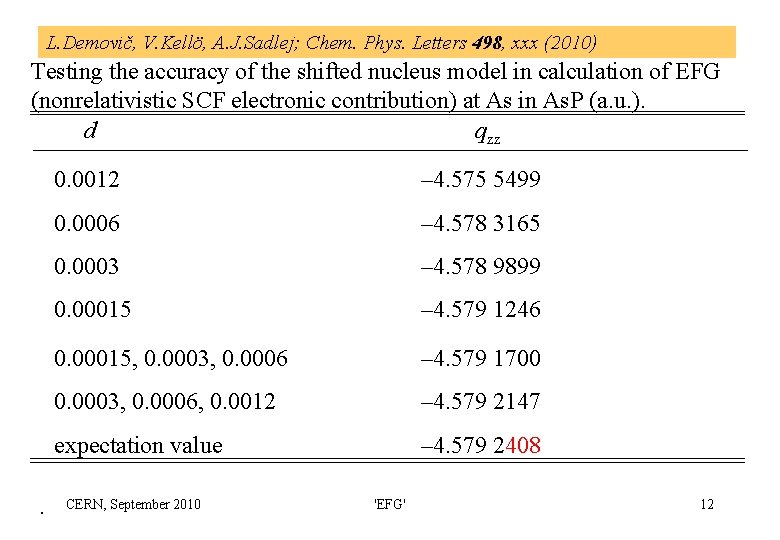
L. Demovič, V. Kellö, A. J. Sadlej; Chem. Phys. Letters 498, xxx (2010) Testing the accuracy of the shifted nucleus model in calculation of EFG (nonrelativistic SCF electronic contribution) at As in As. P (a. u. ). d qzz . 0. 0012 – 4. 575 5499 0. 0006 – 4. 578 3165 0. 0003 – 4. 578 9899 0. 00015 – 4. 579 1246 0. 00015, 0. 0003, 0. 0006 – 4. 579 1700 0. 0003, 0. 0006, 0. 0012 – 4. 579 2147 expectation value – 4. 579 2408 CERN, September 2010 'EFG' 12
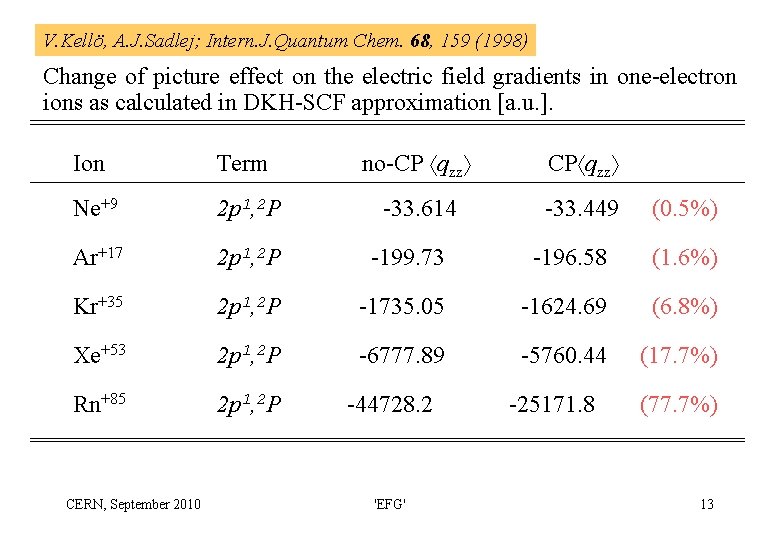
V. Kellö, A. J. Sadlej; Intern. J. Quantum Chem. 68, 159 (1998) Change of picture effect on the electric field gradients in one-electron ions as calculated in DKH-SCF approximation [a. u. ]. Ion Term no-CP qzz Ne+9 2 p 1, 2 P -33. 614 -33. 449 Ar+17 2 p 1, 2 P -199. 73 -196. 58 (1. 6%) Kr+35 2 p 1, 2 P -1735. 05 -1624. 69 (6. 8%) Xe+53 2 p 1, 2 P -6777. 89 -5760. 44 (17. 7%) Rn+85 2 p 1, 2 P CERN, September 2010 -44728. 2 'EFG' -25171. 8 (0. 5%) (77. 7%) 13
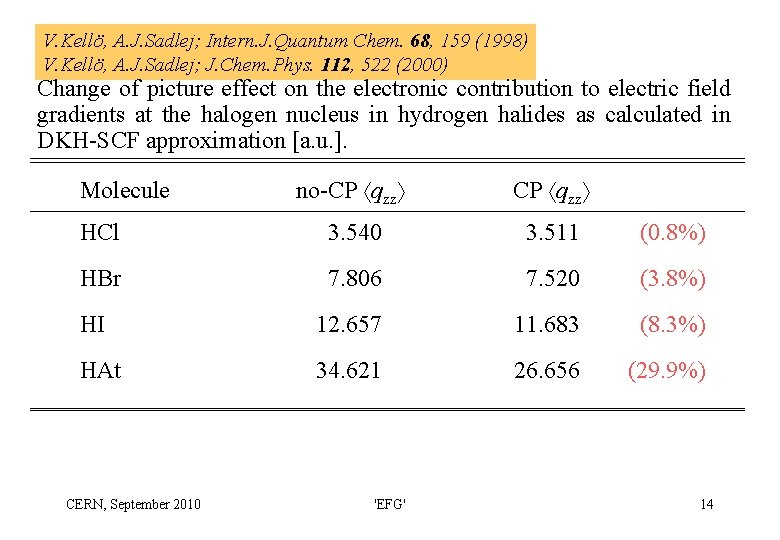
V. Kellö, A. J. Sadlej; Intern. J. Quantum Chem. 68, 159 (1998) V. Kellö, A. J. Sadlej; J. Chem. Phys. 112, 522 (2000) Change of picture effect on the electronic contribution to electric field gradients at the halogen nucleus in hydrogen halides as calculated in DKH-SCF approximation [a. u. ]. no-CP qzz HCl 3. 540 3. 511 (0. 8%) HBr 7. 806 7. 520 (3. 8%) HI 12. 657 11. 683 (8. 3%) HAt 34. 621 26. 656 (29. 9%) Molecule CERN, September 2010 'EFG' 14
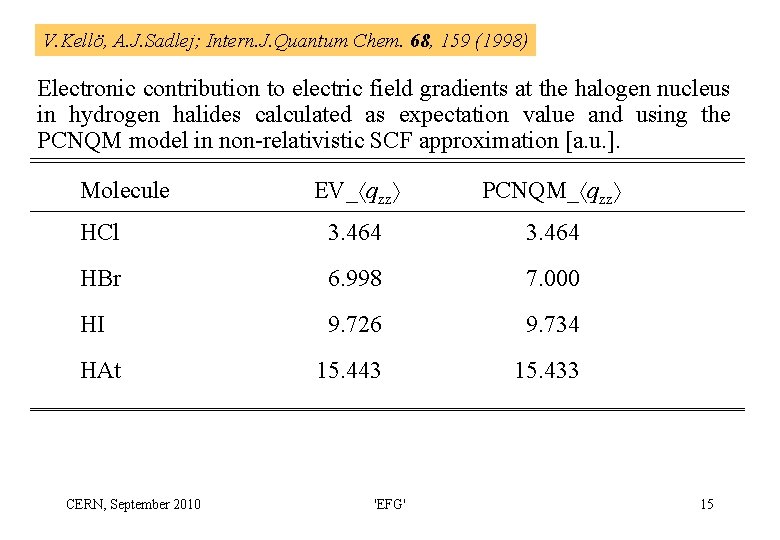
V. Kellö, A. J. Sadlej; Intern. J. Quantum Chem. 68, 159 (1998) Electronic contribution to electric field gradients at the halogen nucleus in hydrogen halides calculated as expectation value and using the PCNQM model in non-relativistic SCF approximation [a. u. ]. EV_ qzz PCNQM_ qzz HCl 3. 464 HBr 6. 998 7. 000 HI 9. 726 9. 734 15. 443 15. 433 Molecule HAt CERN, September 2010 'EFG' 15
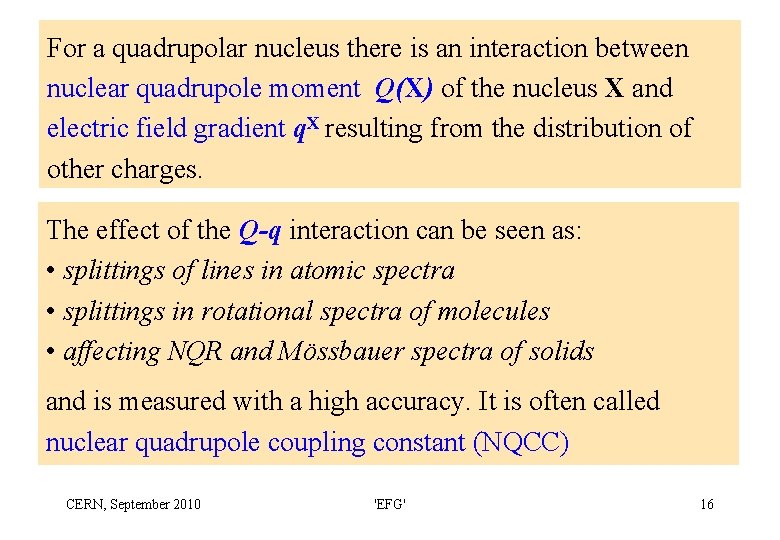
For a quadrupolar nucleus there is an interaction between nuclear quadrupole moment Q(X) of the nucleus X and electric field gradient q. X resulting from the distribution of other charges. The effect of the Q-q interaction can be seen as: • splittings of lines in atomic spectra • splittings in rotational spectra of molecules • affecting NQR and Mössbauer spectra of solids and is measured with a high accuracy. It is often called nuclear quadrupole coupling constant (NQCC) CERN, September 2010 'EFG' 16
Hence, by combining the experimental and theoretical results one can obtain NQM values, which, according to the source of the experimental data, are referred to as: • Atomic • Molecular • Solid-state It does not happen frequently that molecular spectroscopic data combined with accurate quantum chemical calculations can be of great help in as remote an area as nuclear physics. The determination of nuclear quadrupole moments (NQM) from molecular spectroscopic data gives one such rare example and its high accuracy surpass that of other methods. CERN, September 2010 'EFG' 17
Ø The main competitor of this method was the mesonic way, based on measuring the hyper-structure of essentially Coulombic energy levels of μ or π mesons near the nucleus studied. No such experiments have been published for almost three decades, however, these mesonic NQM values still stand as the benchmark ones for heavier elements. Ø Low-precision determinations of NQM are available from: • nuclear Coulomb scattering • nuclear rotational energy levels • nuclear theory CERN, September 2010 'EFG' 18
The knowledge of reliable NQM is of considerable interest in: Ø chemical and solid state spectroscopy; NQR, NMR, Mössbauer Ø nuclear physics for testing nuclear models for stable isotopes. 1992 P. Pyykkö, Z. Naturforsch. 47 a, 189 (1992) 2001 P. Pyykkö, Mol. Phys. 99, 1617 (2001) 2008 P. Pyykkö, Mol. Phys. 106, 1965 (2008) CERN, September 2010 'EFG' 19
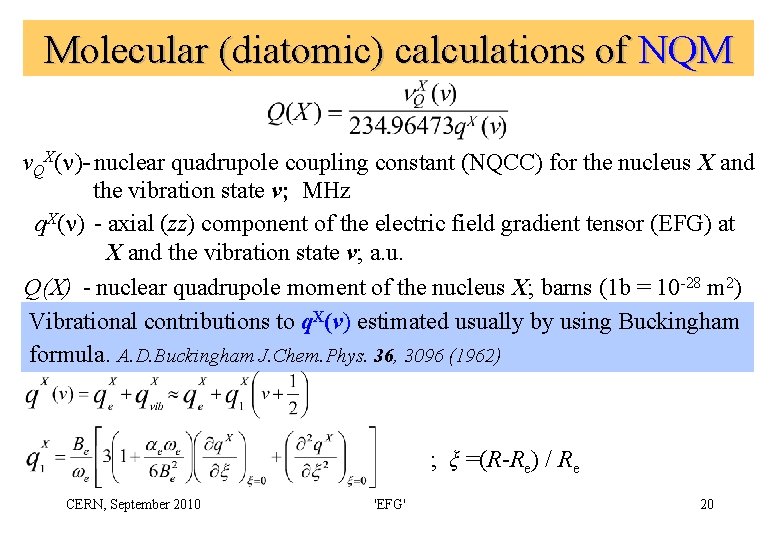
Molecular (diatomic) calculations of NQM v. QX( )- nuclear quadrupole coupling constant (NQCC) for the nucleus X and the vibration state v; MHz q. X( ) - axial (zz) component of the electric field gradient tensor (EFG) at X and the vibration state v; a. u. Q(X) - nuclear quadrupole moment of the nucleus X; barns (1 b = 10 -28 m 2) Vibrational contributions to q. X(v) estimated usually by using Buckingham formula. A. D. Buckingham J. Chem. Phys. 36, 3096 (1962) ; ξ =(R-Re) / Re CERN, September 2010 'EFG' 20
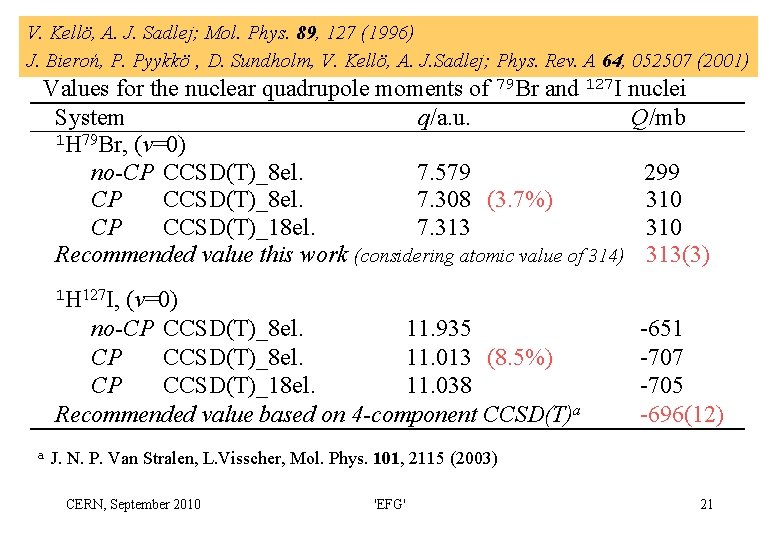
V. Kellö, A. J. Sadlej; Mol. Phys. 89, 127 (1996) J. Bieroń, P. Pyykkö , D. Sundholm, V. Kellö, A. J. Sadlej; Phys. Rev. A 64, 052507 (2001) Values for the nuclear quadrupole moments of 79 Br and 127 I nuclei System q/a. u. Q/mb 1 H 79 Br, (v=0) no-CP CCSD(T)_8 el. 7. 579 299 CP CCSD(T)_8 el. 7. 308 (3. 7%) 310 CP CCSD(T)_18 el. 7. 313 310 Recommended value this work (considering atomic value of 314) 313(3) 1 H 127 I, (v=0) no-CP CCSD(T)_8 el. 11. 935 CP CCSD(T)_8 el. 11. 013 (8. 5%) CP CCSD(T)_18 el. 11. 038 Recommended value based on 4 -component CCSD(T)a a -651 -707 -705 -696(12) J. N. P. Van Stralen, L. Visscher, Mol. Phys. 101, 2115 (2003) CERN, September 2010 'EFG' 21
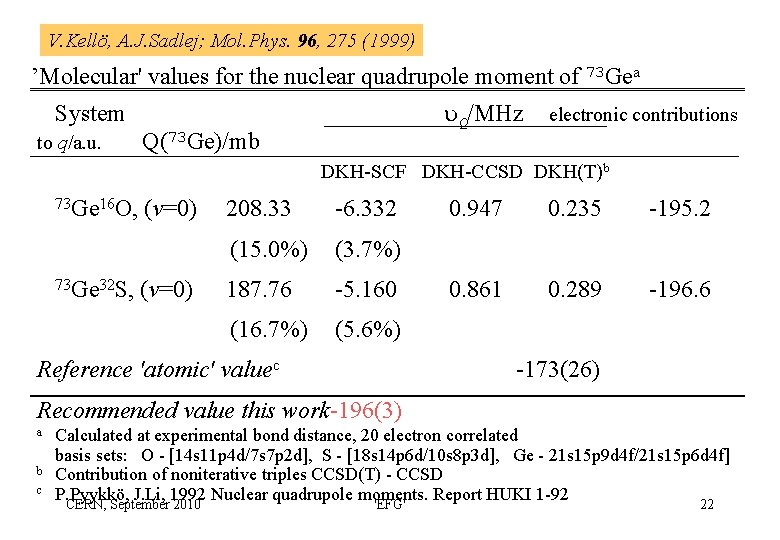
V. Kellö, A. J. Sadlej; Mol. Phys. 96, 275 (1999) ’Molecular' values for the nuclear quadrupole moment of 73 Gea Q/MHz System to q/a. u. Q(73 Ge)/mb electronic contributions DKH-SCF DKH-CCSD DKH(T)b 73 Ge 16 O, 73 Ge 32 S, (v=0) 208. 33 -6. 332 (15. 0%) (3. 7%) 187. 76 -5. 160 (16. 7%) (5. 6%) Reference 'atomic' valuec 0. 947 0. 235 -195. 2 0. 861 0. 289 -196. 6 -173(26) Recommended value this work-196(3) a b c Calculated at experimental bond distance, 20 electron correlated basis sets: O - [14 s 11 p 4 d/7 s 7 p 2 d], S - [18 s 14 p 6 d/10 s 8 p 3 d], Ge - 21 s 15 p 9 d 4 f/21 s 15 p 6 d 4 f] Contribution of noniterative triples CCSD(T) - CCSD P. Pyykkö, J. Li, 1992 Nuclear quadrupole moments. Report HUKI 1 -92 CERN, September 2010 'EFG' 22
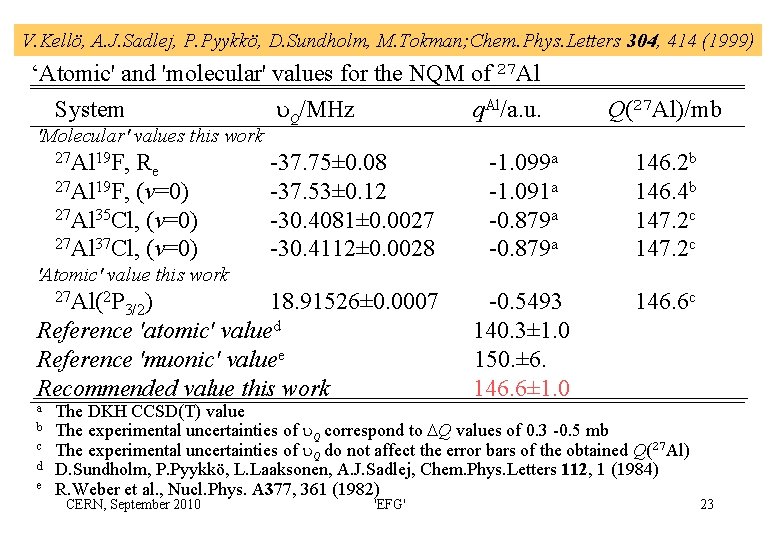
V. Kellö, A. J. Sadlej, P. Pyykkö, D. Sundholm, M. Tokman; Chem. Phys. Letters 304, 414 (1999) ‘Atomic' and 'molecular' values for the NQM of 27 Al System 'Molecular' values this work 27 Al 19 F, Re 27 Al 19 F, (v=0) 27 Al 35 Cl, (v=0) 27 Al 37 Cl, (v=0) Q/MHz q. Al/a. u. -37. 75± 0. 08 -37. 53± 0. 12 -30. 4081± 0. 0027 -30. 4112± 0. 0028 Q(27 Al)/mb -1. 099 a -1. 091 a -0. 879 a 146. 2 b 146. 4 b 147. 2 c -0. 5493 140. 3± 1. 0 150. ± 6. 146. 6± 1. 0 146. 6 c 'Atomic' value this work 27 Al(2 P 18. 91526± 0. 0007 Reference 'atomic' valued Reference 'muonic' valuee Recommended value this work a b c d e 3/2) The DKH CCSD(T) value The experimental uncertainties of Q correspond to Q values of 0. 3 -0. 5 mb The experimental uncertainties of Q do not affect the error bars of the obtained Q(27 Al) D. Sundholm, P. Pyykkö, L. Laaksonen, A. J. Sadlej, Chem. Phys. Letters 112, 1 (1984) R. Weber et al. , Nucl. Phys. A 377, 361 (1982) CERN, September 2010 'EFG' 23
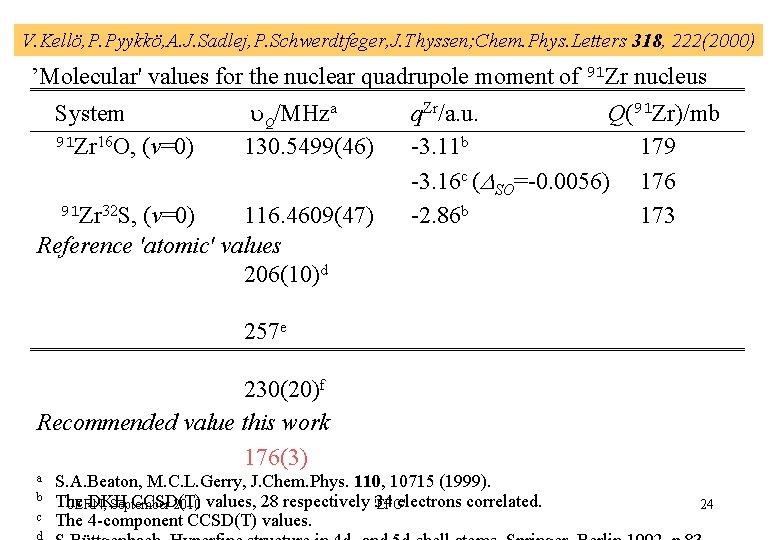
V. Kellö, P. Pyykkö, A. J. Sadlej, P. Schwerdtfeger, J. Thyssen; Chem. Phys. Letters 318, 222(2000) ’Molecular' values for the nuclear quadrupole moment of 91 Zr nucleus System 91 Zr 16 O, (v=0) Q/MHza 130. 5499(46) 91 Zr 32 S, (v=0) 116. 4609(47) Reference 'atomic' values 206(10)d q. Zr/a. u. Q(91 Zr)/mb -3. 11 b 179 -3. 16 c ( SO=-0. 0056) 176 -2. 86 b 173 257 e 230(20)f Recommended value this work 176(3) a b c S. A. Beaton, M. C. L. Gerry, J. Chem. Phys. 110, 10715 (1999). The DKH CCSD(T) 34 electrons correlated. CERN, September 2010 values, 28 respectively 'EFG' The 4 -component CCSD(T) values. 24
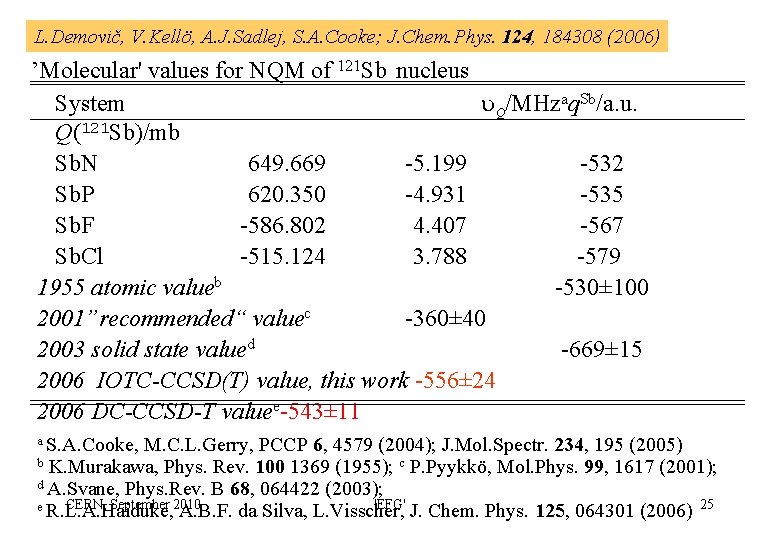
L. Demovič, V. Kellö, A. J. Sadlej, S. A. Cooke; J. Chem. Phys. 124, 184308 (2006) ’Molecular' values for NQM of 121 Sb nucleus System Q/MHzaq. Sb/a. u. Q(121 Sb)/mb Sb. N 649. 669 -5. 199 -532 Sb. P 620. 350 -4. 931 -535 Sb. F -586. 802 4. 407 -567 Sb. Cl -515. 124 3. 788 -579 1955 atomic valueb -530± 100 2001”recommended“ valuec -360± 40 2003 solid state valued -669± 15 2006 IOTC-CCSD(T) value, this work -556± 24 2006 DC-CCSD-T valuee-543± 11 a S. A. Cooke, M. C. L. Gerry, PCCP 6, 4579 (2004); J. Mol. Spectr. 234, 195 (2005) b K. Murakawa, Phys. Rev. 100 1369 (1955); c P. Pyykkö, Mol. Phys. 99, 1617 (2001); d A. Svane, Phys. Rev. B 68, 064422 (2003); CERN, September 2010 'EFG' e R. L. A. Haiduke, A. B. F. da Silva, L. Visscher, J. Chem. Phys. 125, 064301 (2006) 25
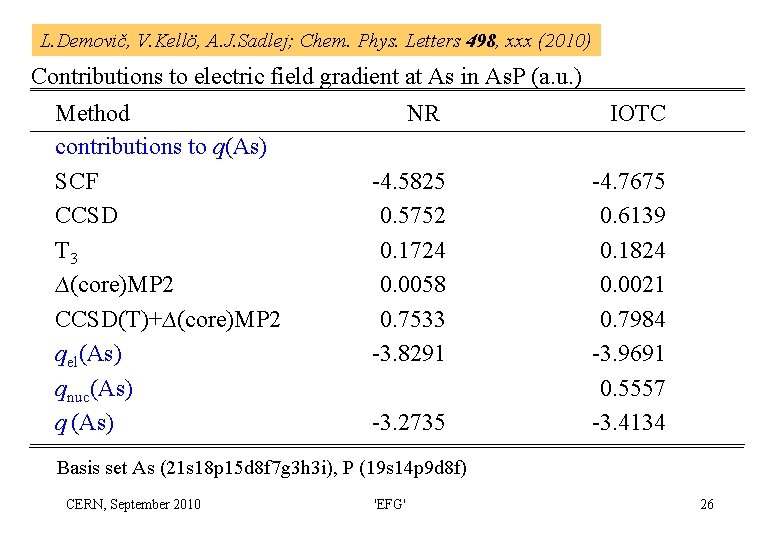
L. Demovič, V. Kellö, A. J. Sadlej; Chem. Phys. Letters 498, xxx (2010) Contributions to electric field gradient at As in As. P (a. u. ) Method contributions to q(As) SCF CCSD T 3 ∆(core)MP 2 CCSD(T)+∆(core)MP 2 qel(As) qnuc(As) q (As) NR IOTC -4. 5825 0. 5752 0. 1724 0. 0058 0. 7533 -3. 8291 -4. 7675 0. 6139 0. 1824 0. 0021 0. 7984 -3. 9691 0. 5557 -3. 4134 -3. 2735 Basis set As (21 s 18 p 15 d 8 f 7 g 3 h 3 i), P (19 s 14 p 9 d 8 f) CERN, September 2010 'EFG' 26

L. Demovič, V. Kellö, A. J. Sadlej; Chem. Phys. Letters 498, xxx (2010) Molecular value of Q(75 As) and comparison with other data. Q/mb Present value 311± 2 Reference ‘atomic’ value a 300± 50 Reference ‘muonic’ value b 314± 6 a B. Effenberger, W. Kunold, W. Oesterle, M. Schneider, L. M. Simons, R. Abela, J. Wüest, Z. Phys. A 309, 77 (1982). b M. Voss, W. Weiss, R. Winkler, Physica B+C 123, 21(1983). CERN, September 2010 'EFG' 27
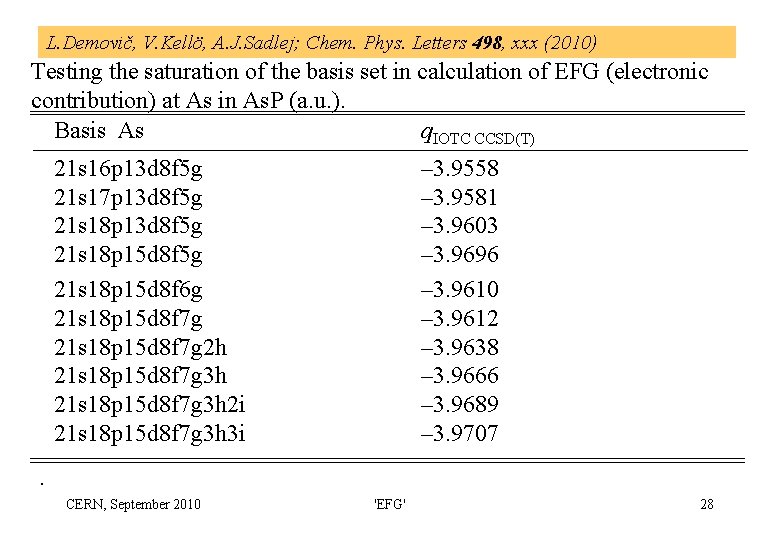
L. Demovič, V. Kellö, A. J. Sadlej; Chem. Phys. Letters 498, xxx (2010) Testing the saturation of the basis set in calculation of EFG (electronic contribution) at As in As. P (a. u. ). Basis As q. IOTC CCSD(T) 21 s 16 p 13 d 8 f 5 g 21 s 17 p 13 d 8 f 5 g 21 s 18 p 15 d 8 f 6 g 21 s 18 p 15 d 8 f 7 g 2 h 21 s 18 p 15 d 8 f 7 g 3 h 2 i 21 s 18 p 15 d 8 f 7 g 3 h 3 i – 3. 9558 – 3. 9581 – 3. 9603 – 3. 9696 – 3. 9610 – 3. 9612 – 3. 9638 – 3. 9666 – 3. 9689 – 3. 9707 . CERN, September 2010 'EFG' 28
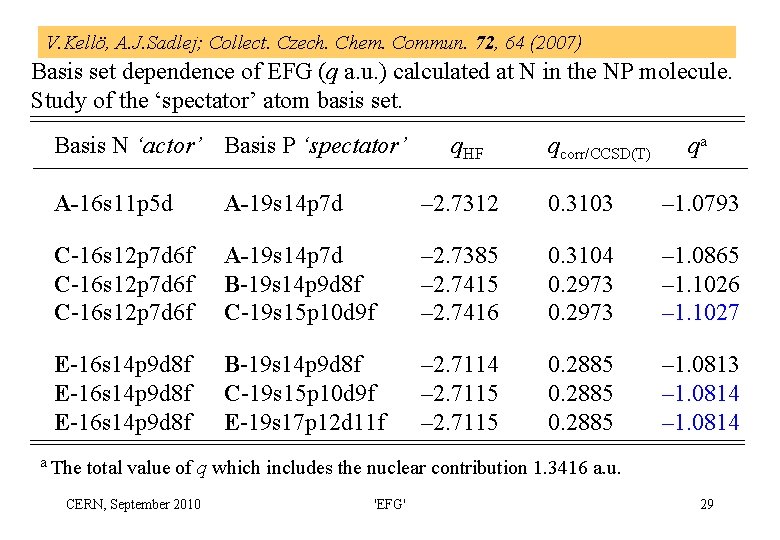
V. Kellö, A. J. Sadlej; Collect. Czech. Chem. Commun. 72, 64 (2007) Basis set dependence of EFG (q a. u. ) calculated at N in the NP molecule. Study of the ‘spectator’ atom basis set. Basis N ‘actor’ Basis P ‘spectator’ q. HF qcorr/CCSD(T) qa A-16 s 11 p 5 d A-19 s 14 p 7 d – 2. 7312 0. 3103 – 1. 0793 C-16 s 12 p 7 d 6 f A-19 s 14 p 7 d B-19 s 14 p 9 d 8 f C-19 s 15 p 10 d 9 f – 2. 7385 – 2. 7416 0. 3104 0. 2973 – 1. 0865 – 1. 1026 – 1. 1027 E-16 s 14 p 9 d 8 f B-19 s 14 p 9 d 8 f C-19 s 15 p 10 d 9 f E-19 s 17 p 12 d 11 f – 2. 7114 – 2. 7115 0. 2885 – 1. 0813 – 1. 0814 a The total value of q which includes the nuclear contribution 1. 3416 a. u. CERN, September 2010 'EFG' 29
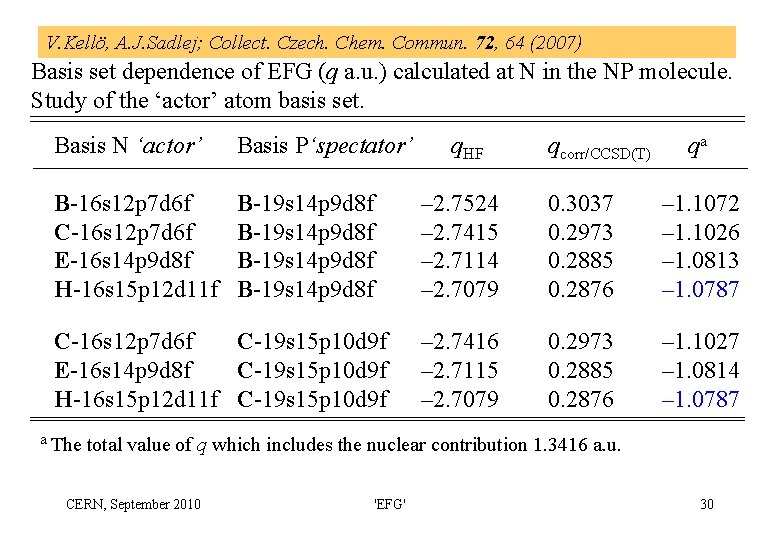
V. Kellö, A. J. Sadlej; Collect. Czech. Chem. Commun. 72, 64 (2007) Basis set dependence of EFG (q a. u. ) calculated at N in the NP molecule. Study of the ‘actor’ atom basis set. Basis N ‘actor’ Basis P‘spectator’ B-16 s 12 p 7 d 6 f C-16 s 12 p 7 d 6 f E-16 s 14 p 9 d 8 f H-16 s 15 p 12 d 11 f B-19 s 14 p 9 d 8 f C-16 s 12 p 7 d 6 f C-19 s 15 p 10 d 9 f E-16 s 14 p 9 d 8 f C-19 s 15 p 10 d 9 f H-16 s 15 p 12 d 11 f C-19 s 15 p 10 d 9 f a The q. HF qcorr/CCSD(T) qa – 2. 7524 – 2. 7415 – 2. 7114 – 2. 7079 0. 3037 0. 2973 0. 2885 0. 2876 – 1. 1072 – 1. 1026 – 1. 0813 – 1. 0787 – 2. 7416 – 2. 7115 – 2. 7079 0. 2973 0. 2885 0. 2876 – 1. 1027 – 1. 0814 – 1. 0787 total value of q which includes the nuclear contribution 1. 3416 a. u. CERN, September 2010 'EFG' 30
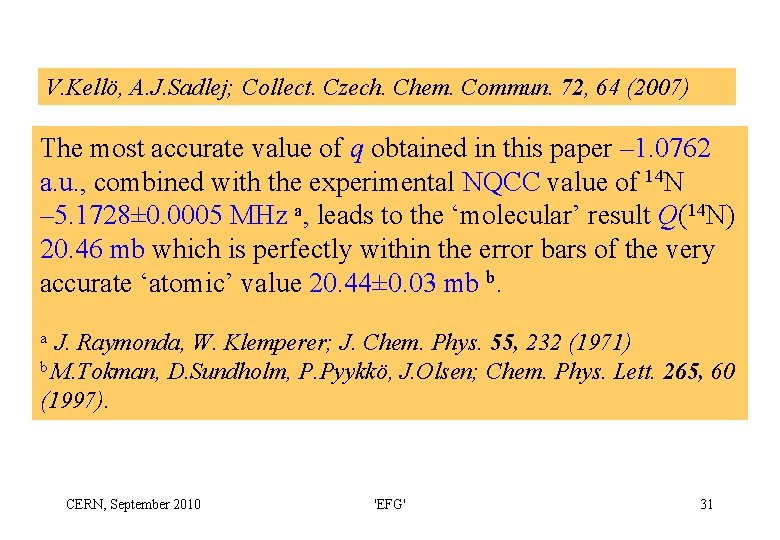
V. Kellö, A. J. Sadlej; Collect. Czech. Chem. Commun. 72, 64 (2007) The most accurate value of q obtained in this paper – 1. 0762 a. u. , combined with the experimental NQCC value of 14 N – 5. 1728± 0. 0005 MHz a, leads to the ‘molecular’ result Q(14 N) 20. 46 mb which is perfectly within the error bars of the very accurate ‘atomic’ value 20. 44± 0. 03 mb b. J. Raymonda, W. Klemperer; J. Chem. Phys. 55, 232 (1971) b M. Tokman, D. Sundholm, P. Pyykkö, J. Olsen; Chem. Phys. Lett. 265, 60 (1997). a CERN, September 2010 'EFG' 31
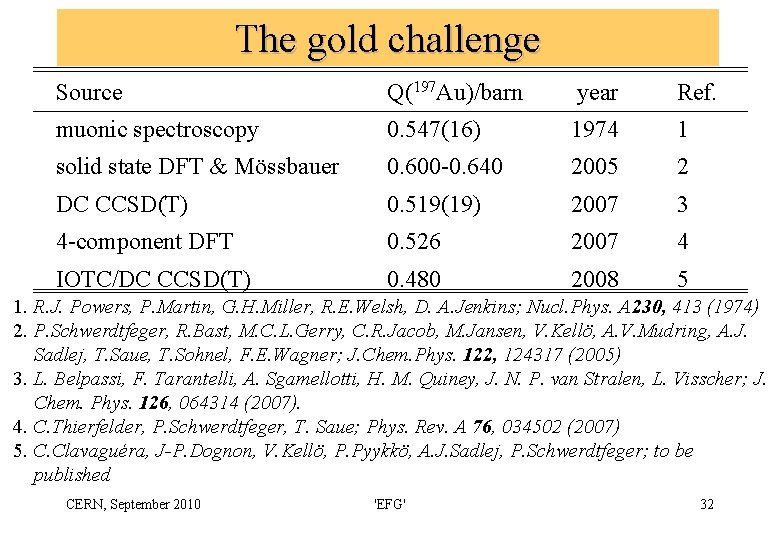
The gold challenge Source Q(197 Au)/barn year Ref. muonic spectroscopy 0. 547(16) 1974 1 solid state DFT & Mössbauer 0. 600 -0. 640 2005 2 DC CCSD(T) 0. 519(19) 2007 3 4 -component DFT 0. 526 2007 4 IOTC/DC CCSD(T) 0. 480 2008 5 1. R. J. Powers, P. Martin, G. H. Miller, R. E. Welsh, D. A. Jenkins; Nucl. Phys. A 230, 413 (1974) 2. P. Schwerdtfeger, R. Bast, M. C. L. Gerry, C. R. Jacob, M. Jansen, V. Kellö, A. V. Mudring, A. J. Sadlej, T. Saue, T. Sohnel, F. E. Wagner; J. Chem. Phys. 122, 124317 (2005) 3. L. Belpassi, F. Tarantelli, A. Sgamellotti, H. M. Quiney, J. N. P. van Stralen, L. Visscher; J. Chem. Phys. 126, 064314 (2007). 4. C. Thierfelder, P. Schwerdtfeger, T. Saue; Phys. Rev. A 76, 034502 (2007) 5. C. Clavaguéra, J-P. Dognon, V. Kellö, P. Pyykkö, A. J. Sadlej, P. Schwerdtfeger; to be published CERN, September 2010 'EFG' 32
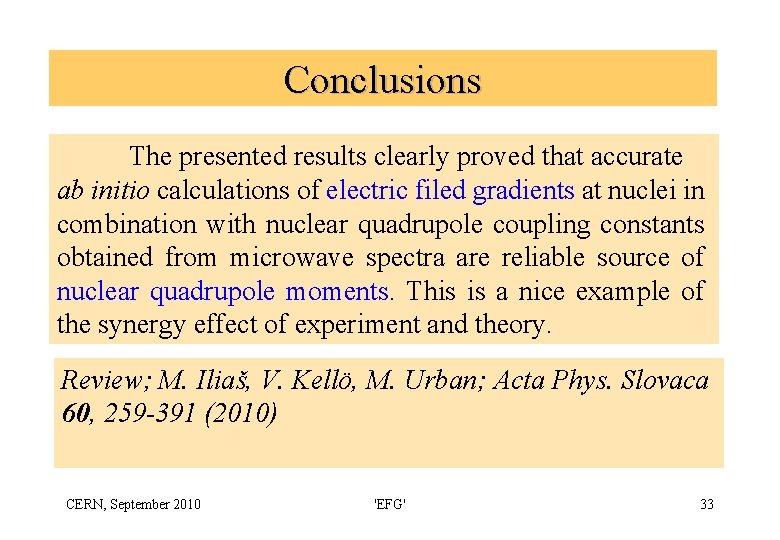
Conclusions The presented results clearly proved that accurate ab initio calculations of electric filed gradients at nuclei in combination with nuclear quadrupole coupling constants obtained from microwave spectra are reliable source of nuclear quadrupole moments. This is a nice example of the synergy effect of experiment and theory. Review; M. Iliaš, V. Kellö, M. Urban; Acta Phys. Slovaca 60, 259 -391 (2010) CERN, September 2010 'EFG' 33

My thanks to: Andrzej Sadlej Pekka Pyykkö, Helsinki Steve Cooke, Denton Peter Schwerdtfeger, Auckland Miroslav Urban, Bratislava Lukáš Demovič, Bratislava for the financial support: Slovak Research & Development Agency, LPP-0110 -07; Slovak Grant Agency, VEGA 1/0428/09; Research & Development Operational Programme funded by the ERDF, ITMS 26240120025. CERN, September 2010 'EFG' 34

Thank you for your attention CERN, September 2010 'EFG' 35
- Slides: 35