
Electric dipoles An electric dipole is a pair
- Slides: 11
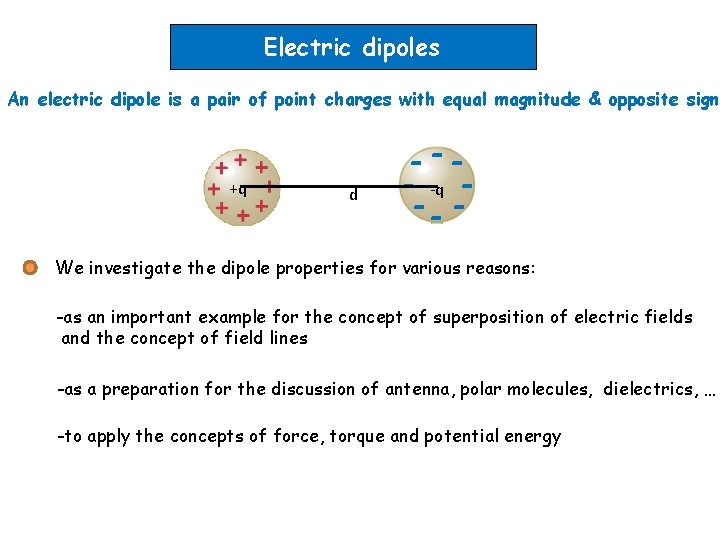
Electric dipoles An electric dipole is a pair of point charges with equal magnitude & opposite sign +q d --- -q -- - We investigate the dipole properties for various reasons: -as an important example for the concept of superposition of electric fields and the concept of field lines -as a preparation for the discussion of antenna, polar molecules, dielectrics, … -to apply the concepts of force, torque and potential energy
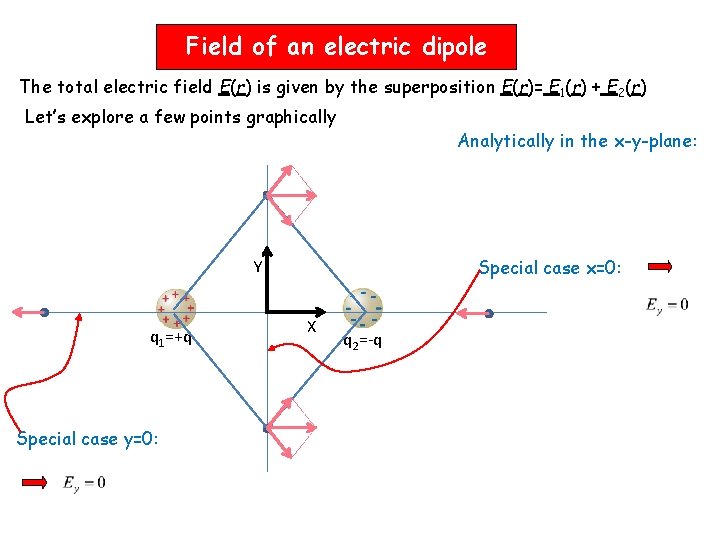
Field of an electric dipole The total electric field E(r) is given by the superposition E(r)= E 1(r) + E 2(r) Let’s explore a few points graphically Analytically in the x-y-plane: Special case x=0: Y q 1=+q Special case y=0: X q 2=-q
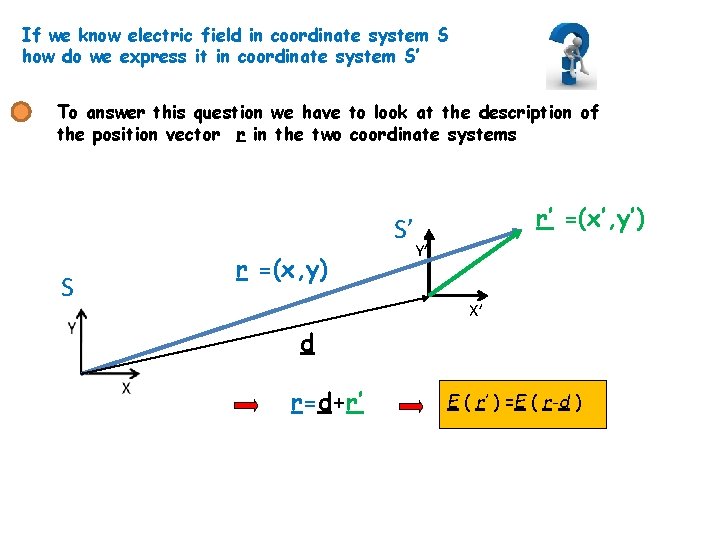
If we know electric field in coordinate system S how do we express it in coordinate system S’ To answer this question we have to look at the description of the position vector r in the two coordinate systems S’ S r =(x, y) r’ =(x’, y’) Y’ X’ d r=d+r’ E ( r’ ) =E ( r-d )
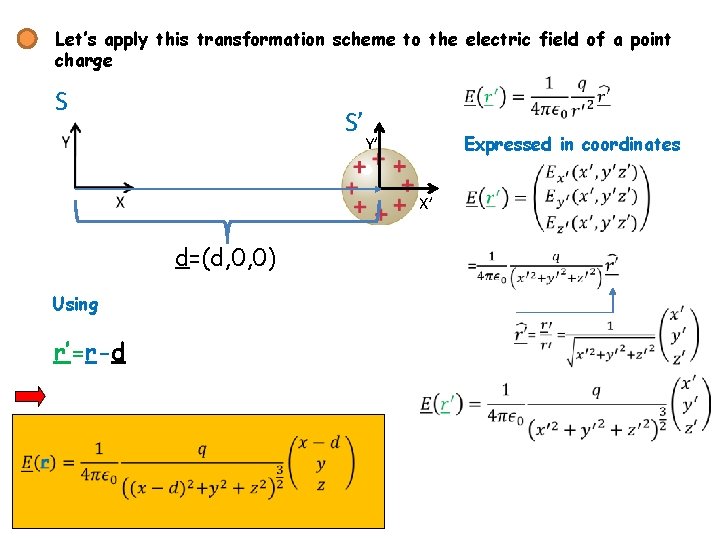
Let’s apply this transformation scheme to the electric field of a point charge S S’ Expressed in coordinates Y’ X’ d=(d, 0, 0) Using r’=r-d
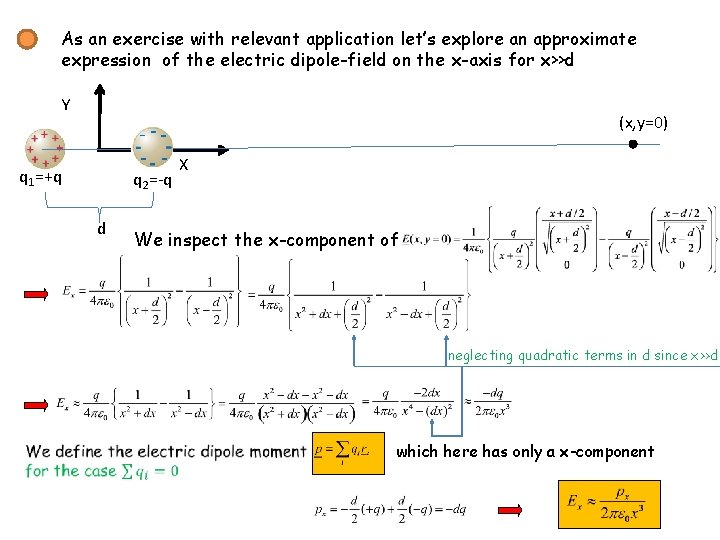
As an exercise with relevant application let’s explore an approximate expression of the electric dipole-field on the x-axis for x>>d Y (x, y=0) q 1=+q q 2=-q d X We inspect the x-component of neglecting quadratic terms in d since x>>d which here has only a x-component
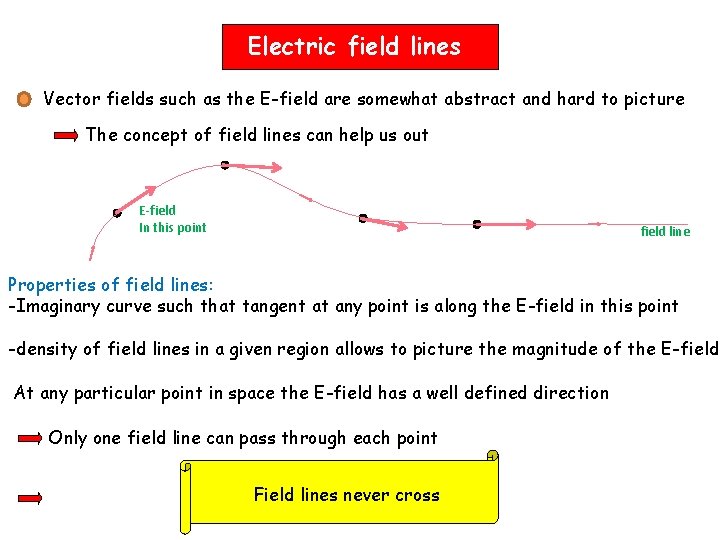
Electric field lines Vector fields such as the E-field are somewhat abstract and hard to picture The concept of field lines can help us out E-field In this point field line Properties of field lines: -Imaginary curve such that tangent at any point is along the E-field in this point -density of field lines in a given region allows to picture the magnitude of the E-field At any particular point in space the E-field has a well defined direction Only one field line can pass through each point Field lines never cross
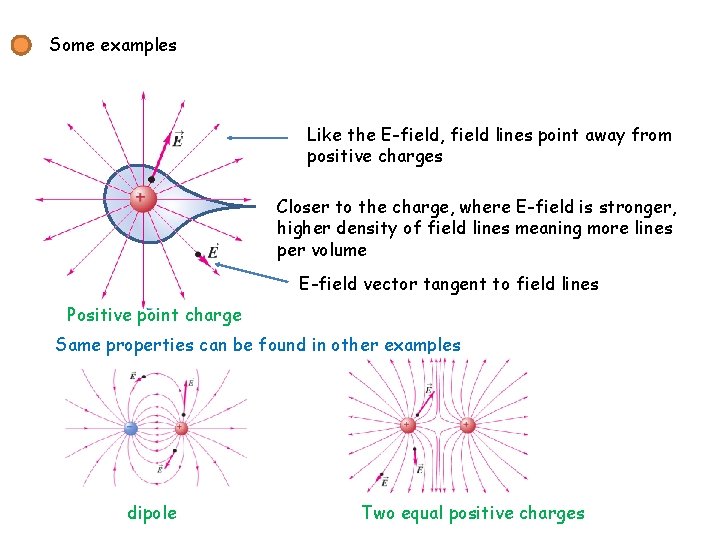
Some examples Like the E-field, field lines point away from positive charges Closer to the charge, where E-field is stronger, higher density of field lines meaning more lines per volume E-field vector tangent to field lines Positive point charge Same properties can be found in other examples dipole Two equal positive charges
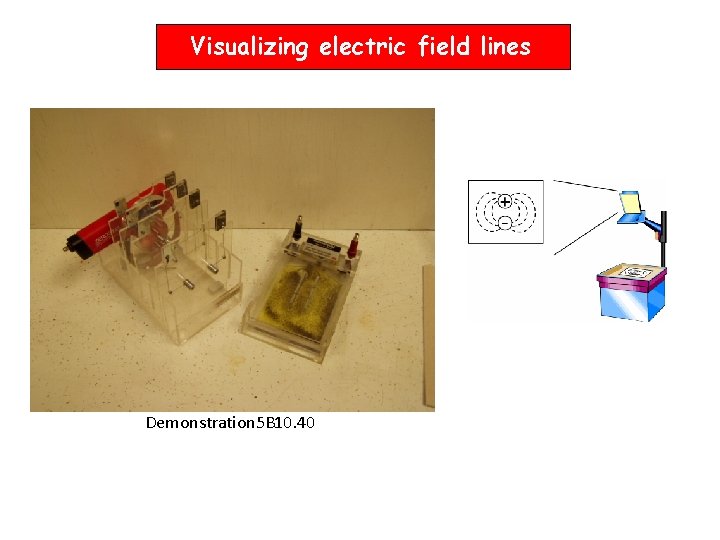
Visualizing electric field lines Demonstration 5 B 10. 40
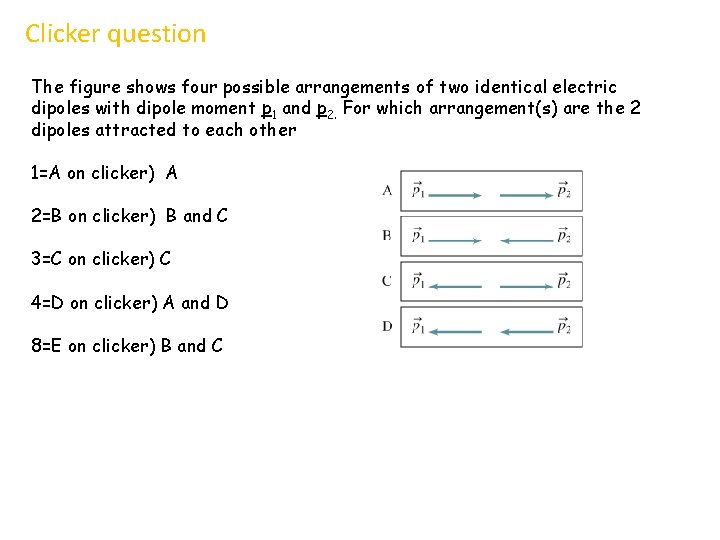
Clicker question The figure shows four possible arrangements of two identical electric dipoles with dipole moment p 1 and p 2. For which arrangement(s) are the 2 dipoles attracted to each other 1=A on clicker) A 2=B on clicker) B and C 3=C on clicker) C 4=D on clicker) A and D 8=E on clicker) B and C
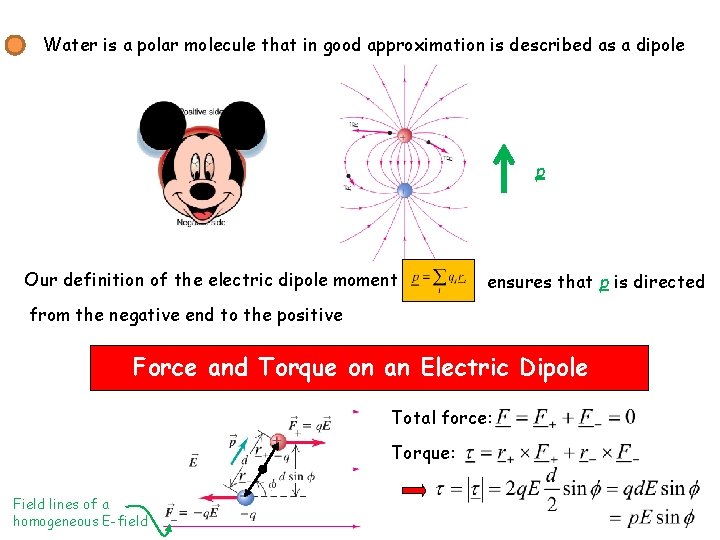
Water is a polar molecule that in good approximation is described as a dipole p Our definition of the electric dipole moment ensures that p is directed from the negative end to the positive Force and Torque on an Electric Dipole Total force: Torque: Field lines of a homogeneous E-field
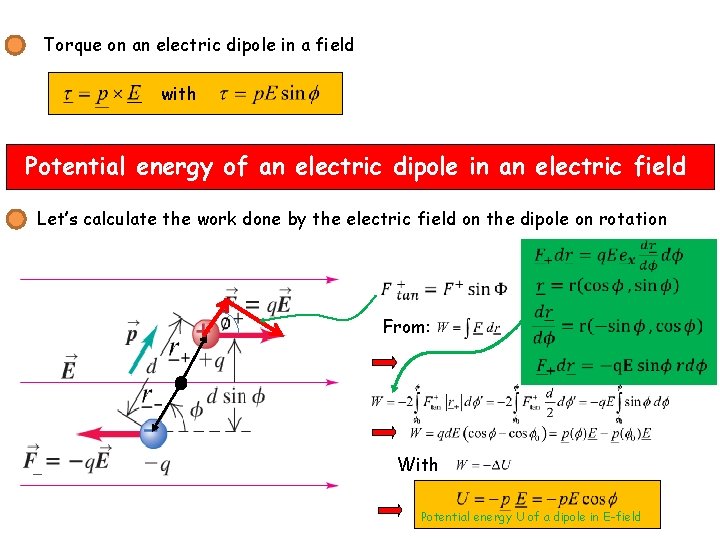
Torque on an electric dipole in a field with Potential energy of an electric dipole in an electric field Let’s calculate the work done by the electric field on the dipole on rotation From: With Potential energy U of a dipole in E-field