
Electric Current What is electrical current When electrical

- Slides: 16
Electric Current
What is electrical current? • When electrical charges move, they are known as electric current • Electrical current is the flow of electrons through a substance (a conductor). • Usually, it is the flow of electrons through wires
Conductors and Insulators: • Conductors - materials through which charges move easily – metals (especially copper and aluminum) • Insulators - materials through which charges will not move easily – glass, dry wood, most plastics, rubber, dry air
The two types of electrical current: • Direct Current (DC) – electrons flow only in one direction (battery powered devices) • Alternating Current (AC) – electrons move back and forth (plug-in outlet devices)
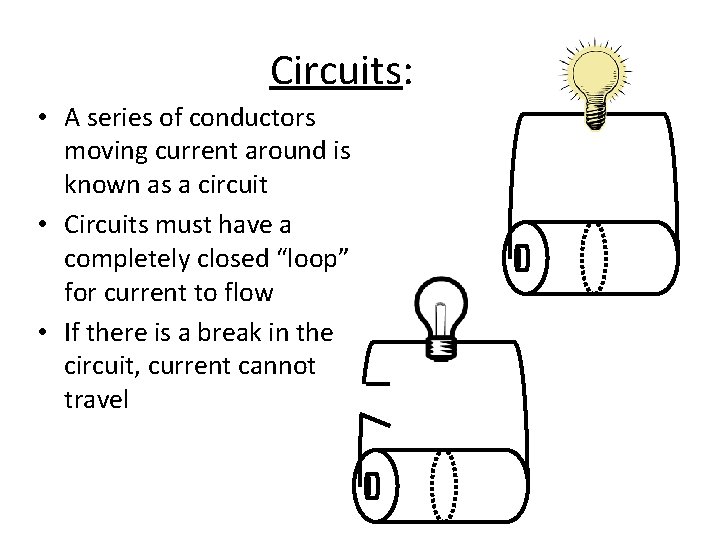
Circuits: • A series of conductors moving current around is known as a circuit • Circuits must have a completely closed “loop” for current to flow • If there is a break in the circuit, current cannot travel
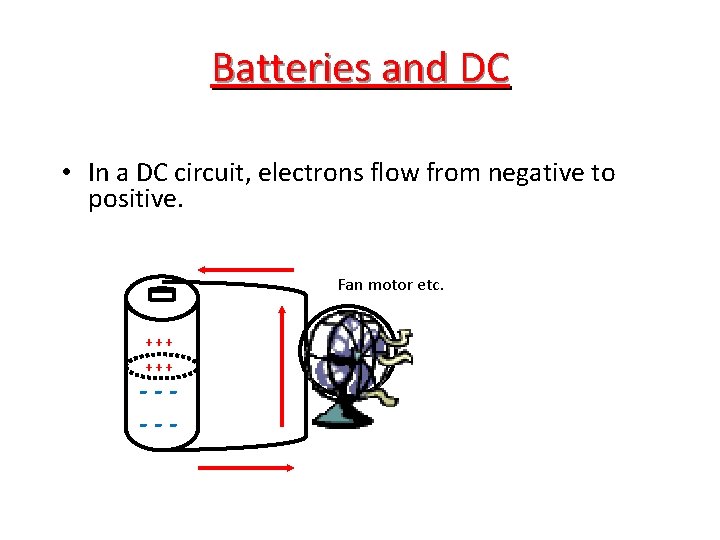
Batteries and DC • In a DC circuit, electrons flow from negative to positive. Fan motor etc. +++ -----
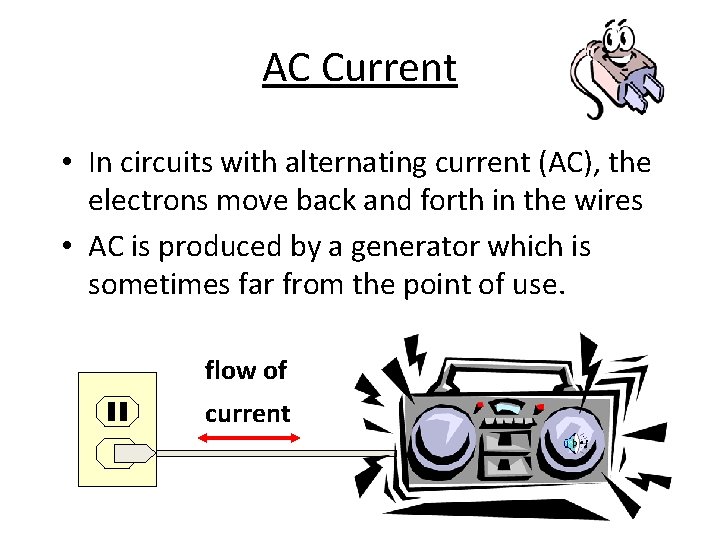
AC Current • In circuits with alternating current (AC), the electrons move back and forth in the wires • AC is produced by a generator which is sometimes far from the point of use. flow of current
Properties of Electrical Current: • Voltage (V) – a measurement of the amount of force driving electrical current through a circuit • Voltage is measured in volts (V) • Voltage is also known as electric potential
Properties of Electrical Current: • Current (I) – a measurement of the amount of electricity flowing through a circuit • Current is measured in Amperes (A or Amps) • more voltage more current
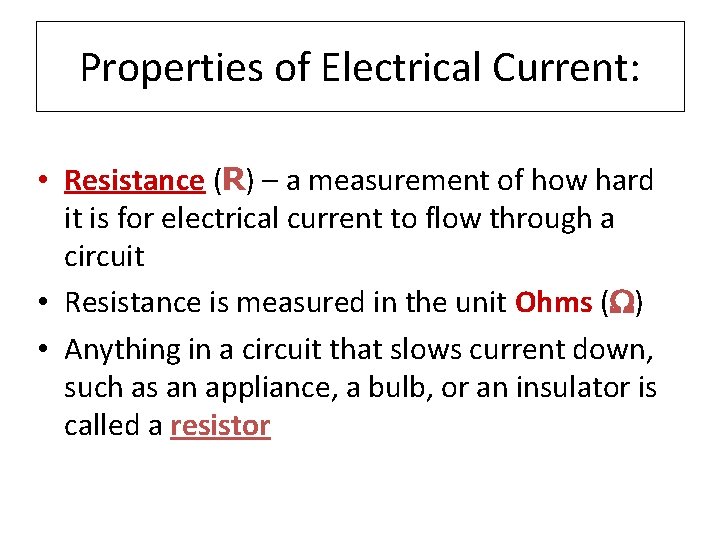
Properties of Electrical Current: • Resistance (R) – a measurement of how hard it is for electrical current to flow through a circuit • Resistance is measured in the unit Ohms ( ) • Anything in a circuit that slows current down, such as an appliance, a bulb, or an insulator is called a resistor
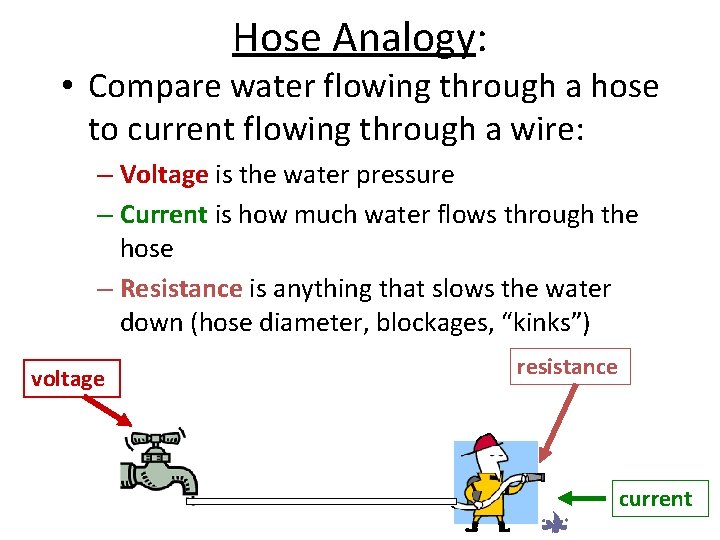
Hose Analogy: • Compare water flowing through a hose to current flowing through a wire: – Voltage is the water pressure – Current is how much water flows through the hose – Resistance is anything that slows the water down (hose diameter, blockages, “kinks”) voltage resistance current
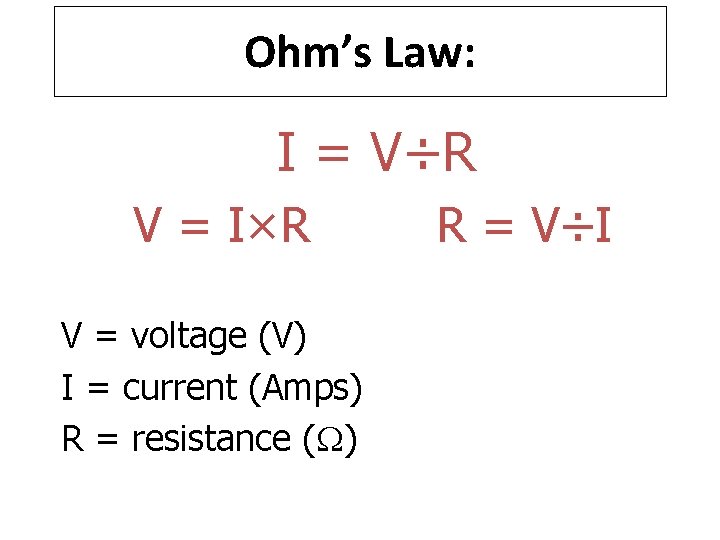
Ohm’s Law: I = V÷R V = I×R V = voltage (V) I = current (Amps) R = resistance ( ) R = V÷I
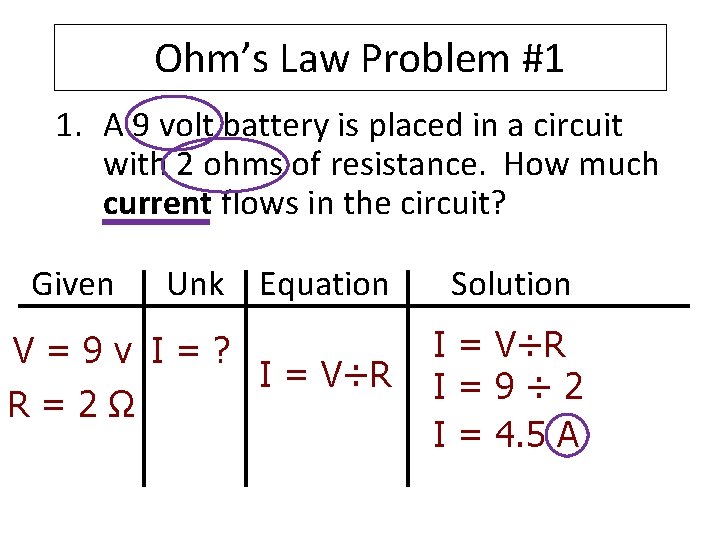
Ohm’s Law Problem #1 1. A 9 volt battery is placed in a circuit with 2 ohms of resistance. How much current flows in the circuit? Given Unk Equation V=9 v I=? I = V÷R R=2Ω Solution I = V÷R I=9÷ 2 I = 4. 5 A
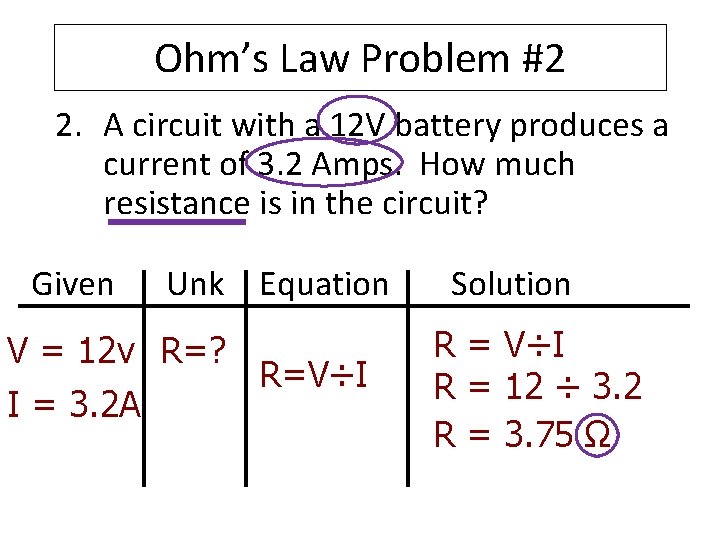
Ohm’s Law Problem #2 2. A circuit with a 12 V battery produces a current of 3. 2 Amps. How much resistance is in the circuit? Given Unk Equation V = 12 v R=? R=V÷I I = 3. 2 A Solution R = V÷I R = 12 ÷ 3. 2 R = 3. 75 Ω
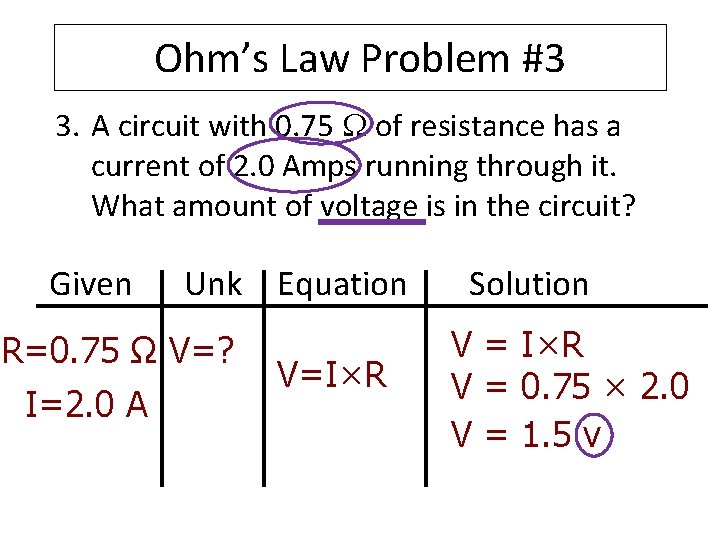
Ohm’s Law Problem #3 3. A circuit with 0. 75 of resistance has a current of 2. 0 Amps running through it. What amount of voltage is in the circuit? Given Unk Equation R=0. 75 Ω V=? I=2. 0 A V=I×R Solution V = I×R V = 0. 75 × 2. 0 V = 1. 5 v
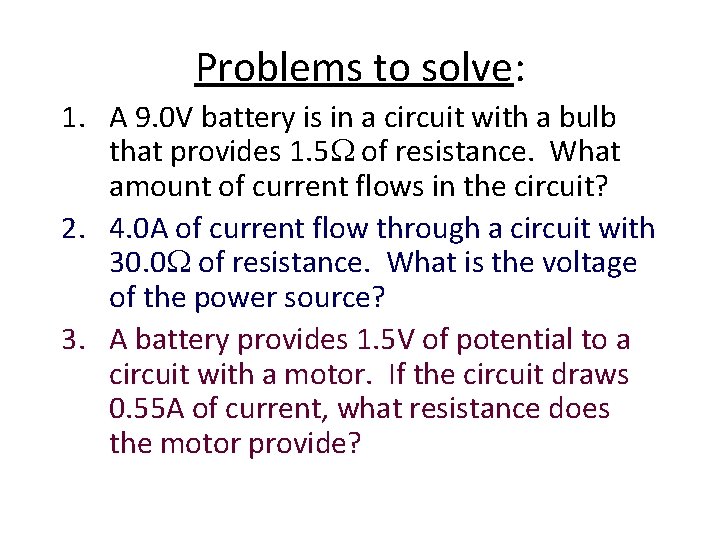
Problems to solve: 1. A 9. 0 V battery is in a circuit with a bulb that provides 1. 5 of resistance. What amount of current flows in the circuit? 2. 4. 0 A of current flow through a circuit with 30. 0 of resistance. What is the voltage of the power source? 3. A battery provides 1. 5 V of potential to a circuit with a motor. If the circuit draws 0. 55 A of current, what resistance does the motor provide?