
Electric current Physics 114 12252021 Lecture V 1
- Slides: 29
Electric current Physics 114 12/25/2021 Lecture V 1
Up to this point • Static situation – charges are not moving – Coulombs force = charge * electric field – Deeper look in the properties of the electric field Gauss’s law – Potential energy= charge * electric potential – Electric potential – integral of electric field – Electric field = gradient of the electric potential • Next – dymanics = moving charges = electric current 12/25/2021 Lecture V 2
Concepts • Primary concepts: – Electric current – Resistor and resistivity – Electric circuit 12/25/2021 Lecture V 3
Laws • Ohm’s law • Power in electric circuits 12/25/2021 Lecture V 4
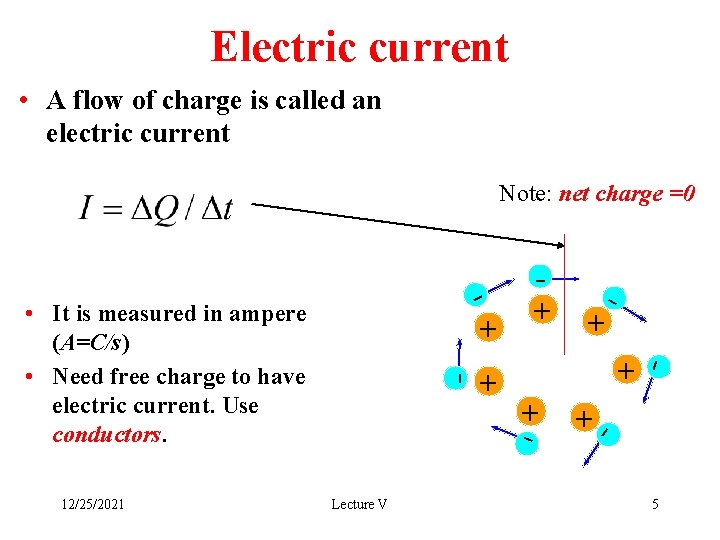
Electric current • A flow of charge is called an electric current Note: net charge =0 + - + + - Lecture V + - 12/25/2021 + + - • It is measured in ampere (A=C/s) • Need free charge to have electric current. Use conductors. + 5
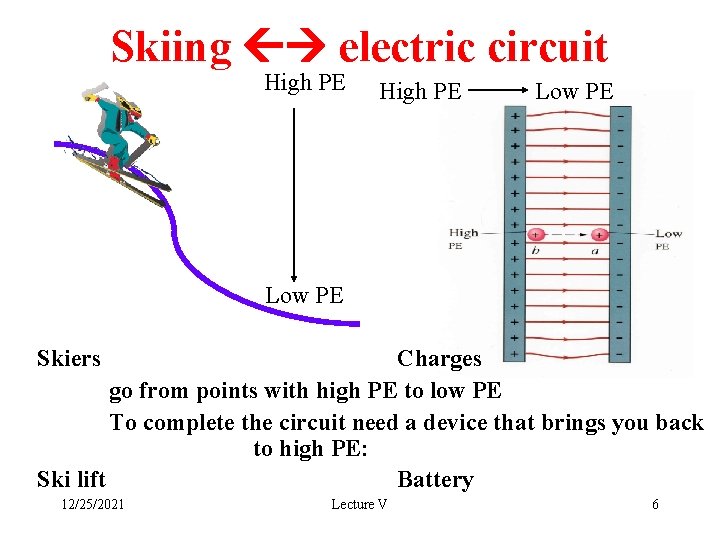
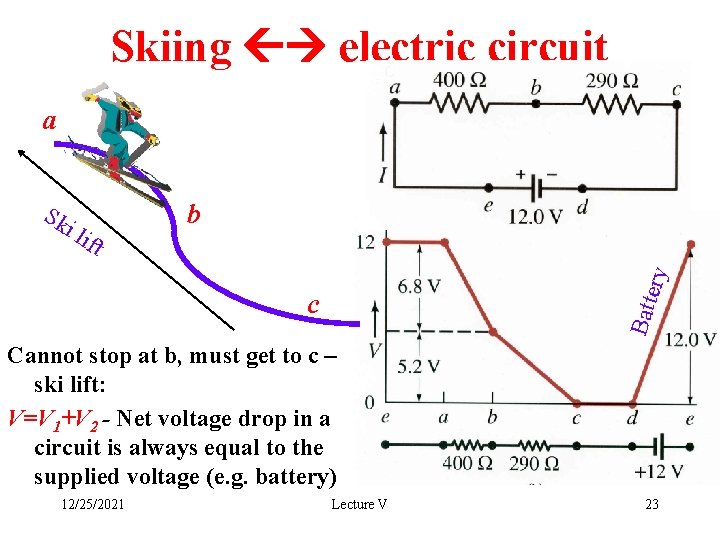
Skiing electric circuit High PE Low PE Skiers Charges go from points with high PE to low PE To complete the circuit need a device that brings you back to high PE: Ski lift Battery 12/25/2021 Lecture V 6
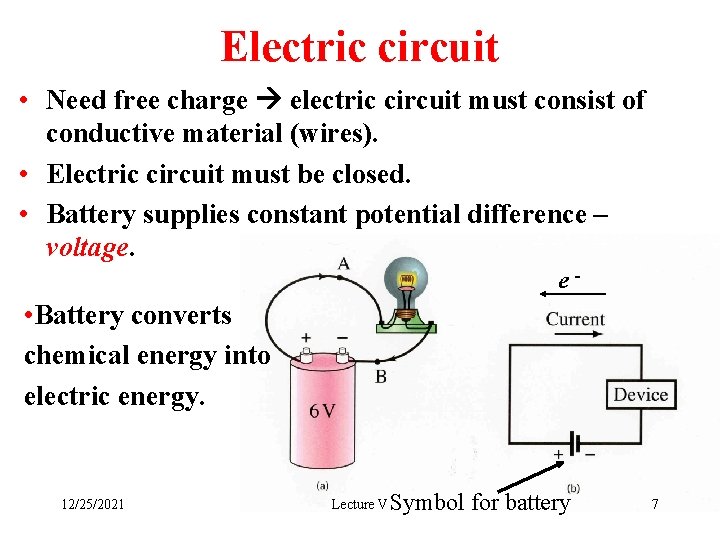
Electric circuit • Need free charge electric circuit must consist of conductive material (wires). • Electric circuit must be closed. • Battery supplies constant potential difference – voltage. e- • Battery converts chemical energy into electric energy. 12/25/2021 Lecture V Symbol for battery 7
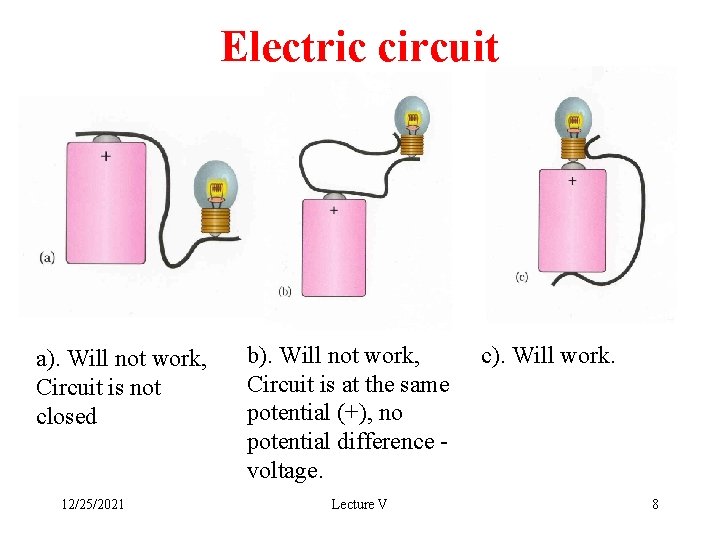
Electric circuit a). Will not work, Circuit is not closed 12/25/2021 b). Will not work, Circuit is at the same potential (+), no potential difference voltage. Lecture V c). Will work. 8
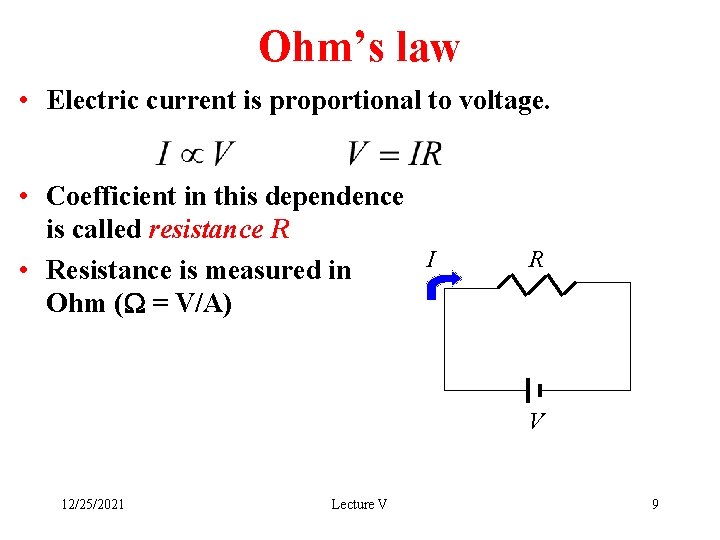
Ohm’s law • Electric current is proportional to voltage. • Coefficient in this dependence is called resistance R I • Resistance is measured in Ohm (W = V/A) R V 12/25/2021 Lecture V 9
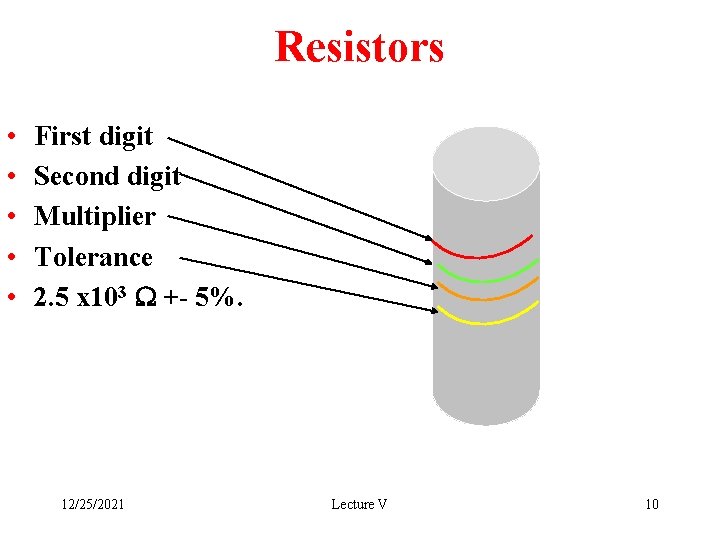
Resistors • • • First digit Second digit Multiplier Tolerance 2. 5 x 10³ W +- 5%. 12/25/2021 Lecture V 10
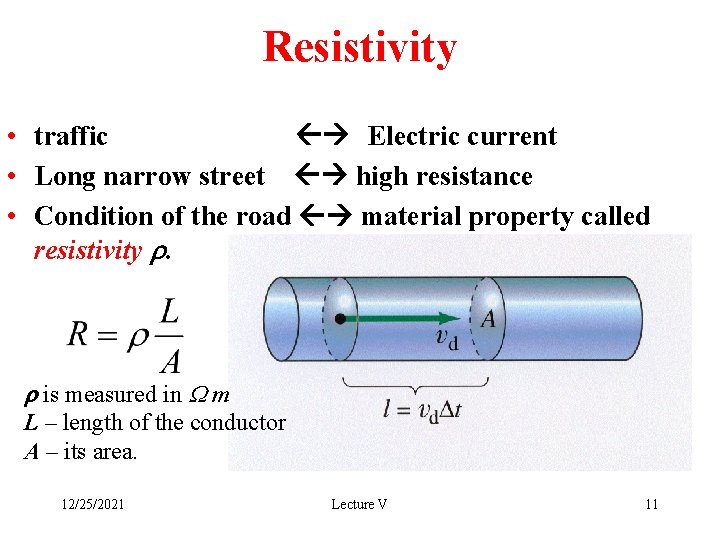
Resistivity • traffic Electric current • Long narrow street high resistance • Condition of the road material property called resistivity r. r is measured in W m L – length of the conductor A – its area. 12/25/2021 Lecture V 11
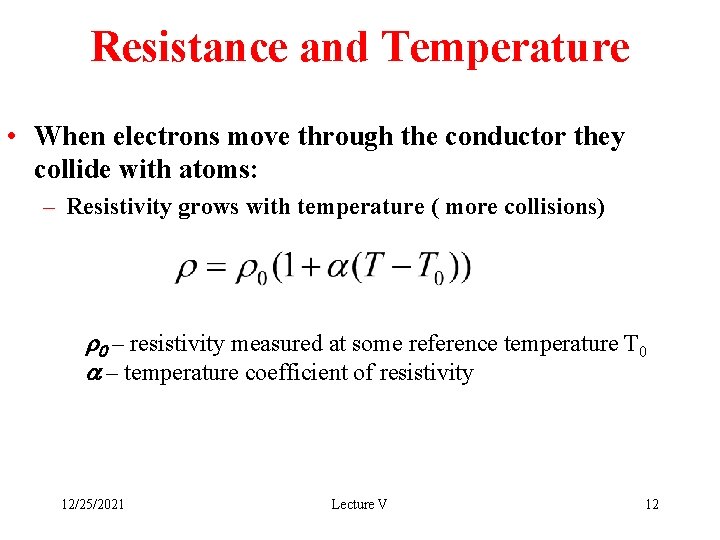
Resistance and Temperature • When electrons move through the conductor they collide with atoms: – Resistivity grows with temperature ( more collisions) r 0 – resistivity measured at some reference temperature T 0 a – temperature coefficient of resistivity 12/25/2021 Lecture V 12
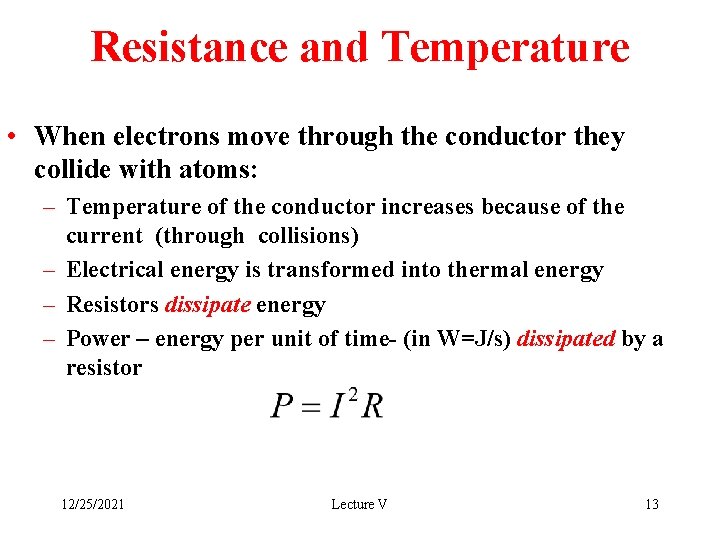
Resistance and Temperature • When electrons move through the conductor they collide with atoms: – Temperature of the conductor increases because of the current (through collisions) – Electrical energy is transformed into thermal energy – Resistors dissipate energy – Power – energy per unit of time- (in W=J/s) dissipated by a resistor 12/25/2021 Lecture V 13
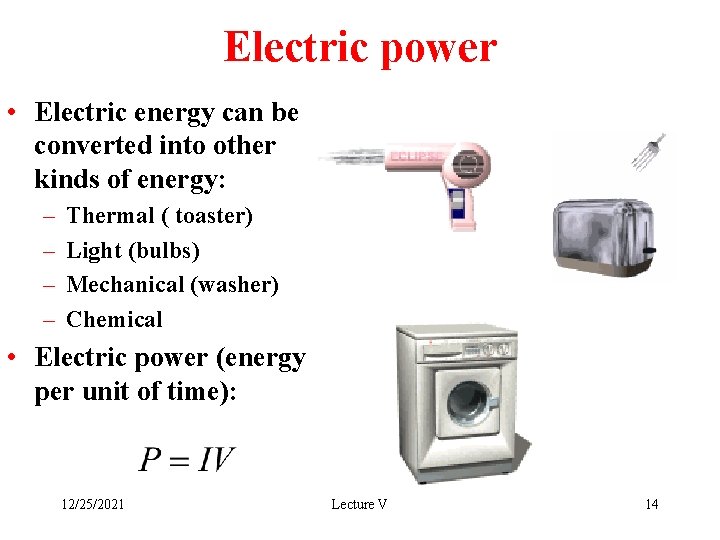
Electric power • Electric energy can be converted into other kinds of energy: – – Thermal ( toaster) Light (bulbs) Mechanical (washer) Chemical • Electric power (energy per unit of time): 12/25/2021 Lecture V 14
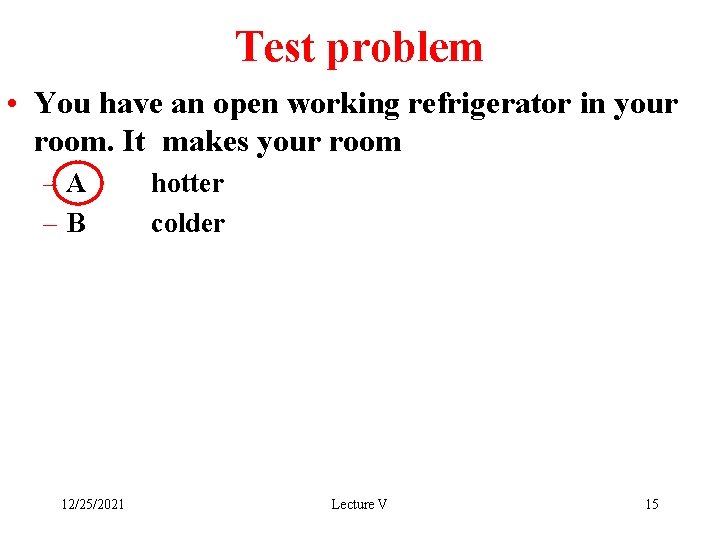
Test problem • You have an open working refrigerator in your room. It makes your room –A –B 12/25/2021 hotter colder Lecture V 15
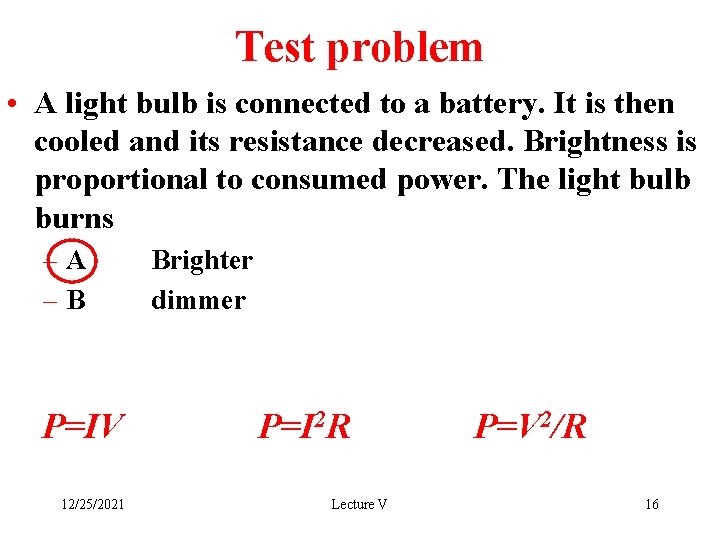
Test problem • A light bulb is connected to a battery. It is then cooled and its resistance decreased. Brightness is proportional to consumed power. The light bulb burns –A –B P=IV 12/25/2021 Brighter dimmer P=I 2 R Lecture V P=V 2/R 16
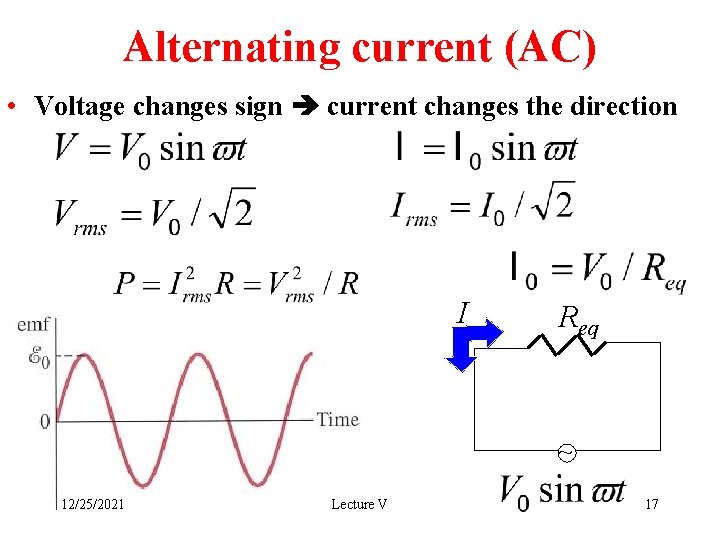
Alternating current (AC) • Voltage changes sign current changes the direction I Req ~ 12/25/2021 Lecture V 17
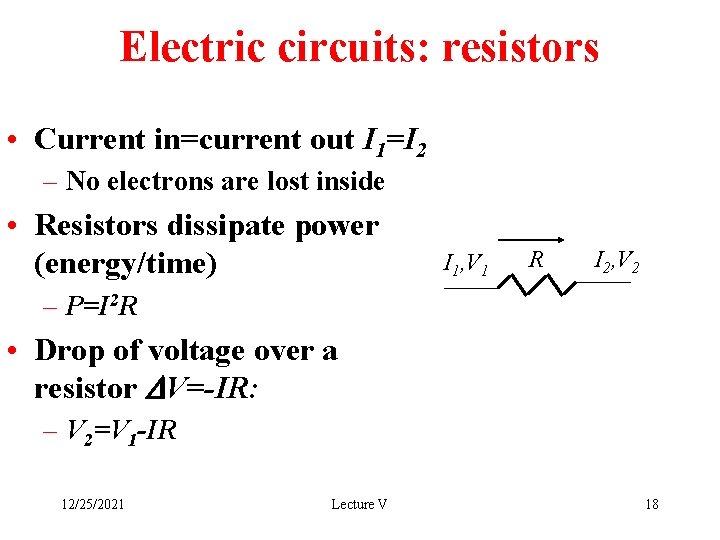
Electric circuits: resistors • Current in=current out I 1=I 2 – No electrons are lost inside • Resistors dissipate power (energy/time) I 1, V 1 R I 2, V 2 – P=I 2 R • Drop of voltage over a resistor DV=-IR: – V 2=V 1 -IR 12/25/2021 Lecture V 18
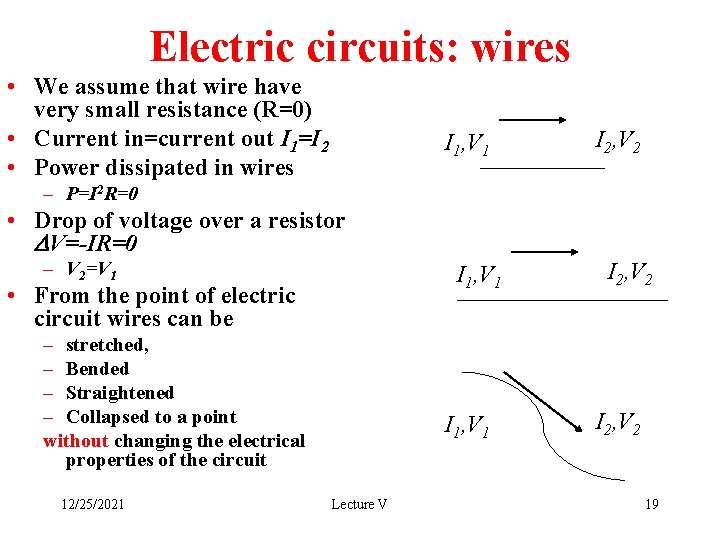
Electric circuits: wires • We assume that wire have very small resistance (R=0) • Current in=current out I 1=I 2 • Power dissipated in wires I 1, V 1 I 2, V 2 – P=I 2 R=0 • Drop of voltage over a resistor DV=-IR=0 – V 2=V 1 I 1, V 1 • From the point of electric circuit wires can be – stretched, – Bended – Straightened – Collapsed to a point without changing the electrical properties of the circuit 12/25/2021 I 1, V 1 Lecture V I 2, V 2 19
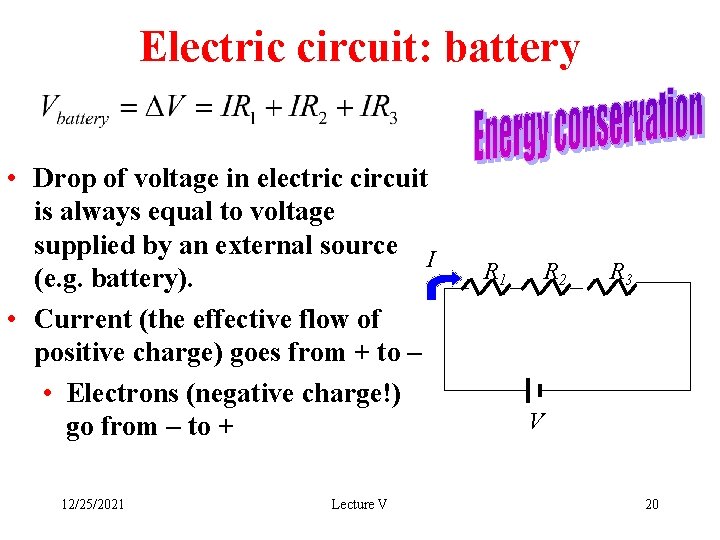
Electric circuit: battery • Drop of voltage in electric circuit is always equal to voltage supplied by an external source I (e. g. battery). • Current (the effective flow of positive charge) goes from + to – • Electrons (negative charge!) go from – to + 12/25/2021 Lecture V R 1 R 2 R 3 V 20
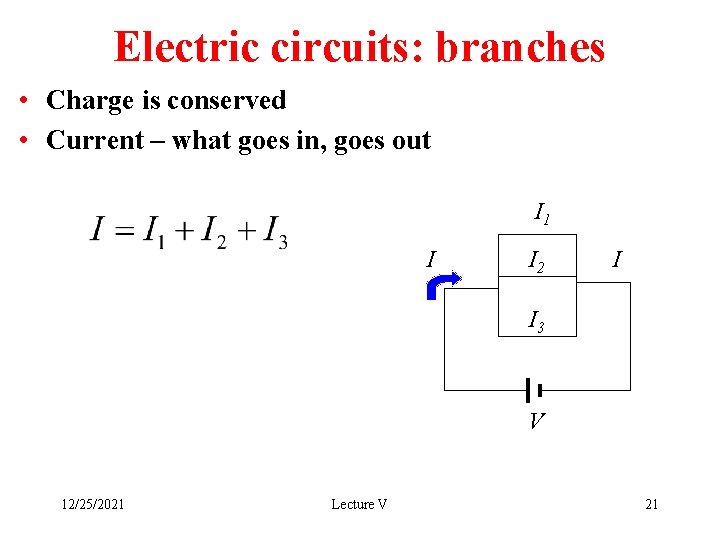
Electric circuits: branches • Charge is conserved • Current – what goes in, goes out I 1 I I 2 I I 3 V 12/25/2021 Lecture V 21
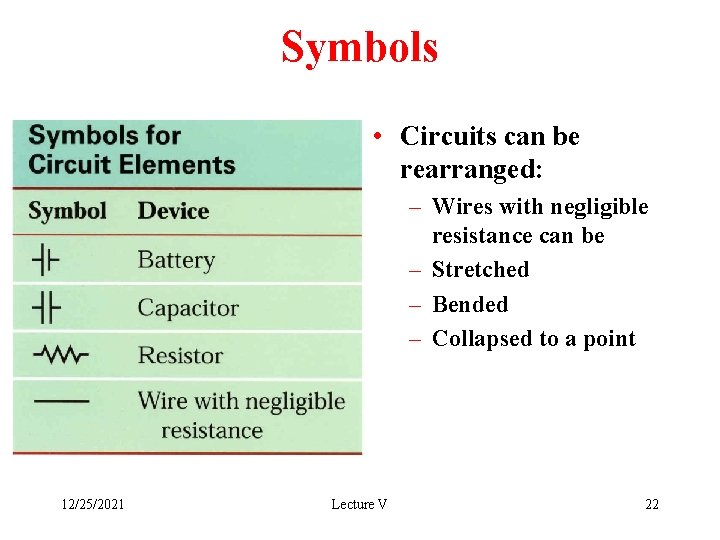
Symbols • Circuits can be rearranged: – Wires with negligible resistance can be – Stretched – Bended – Collapsed to a point 12/25/2021 Lecture V 22
Skiing electric circuit a i li ft b ery Sk Batt c Cannot stop at b, must get to c – ski lift: V=V 1+V 2 - Net voltage drop in a circuit is always equal to the supplied voltage (e. g. battery) 12/25/2021 Lecture V 23
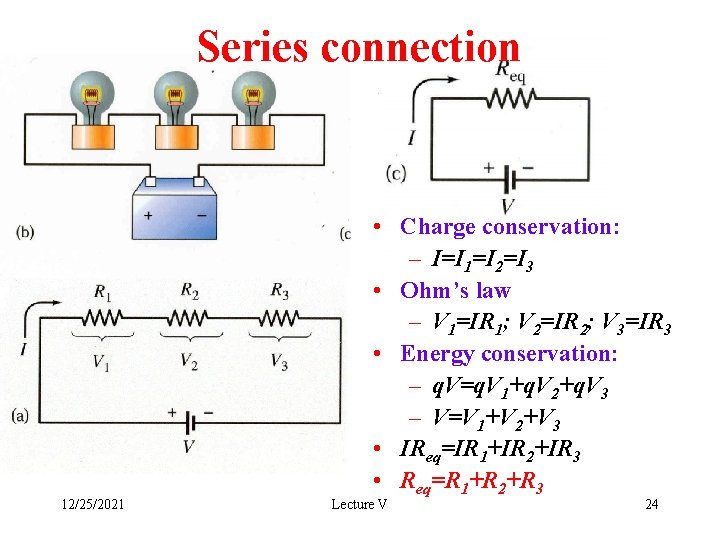
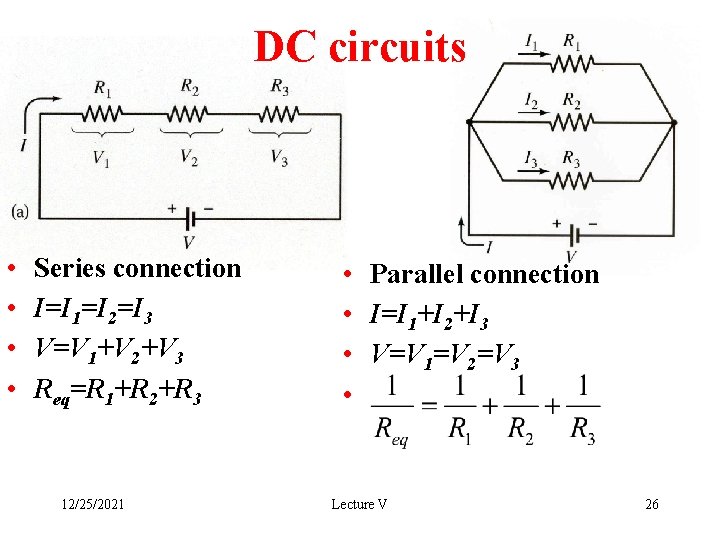
Series connection 12/25/2021 • Charge conservation: – I=I 1=I 2=I 3 • Ohm’s law – V 1=IR 1; V 2=IR 2; V 3=IR 3 • Energy conservation: – q. V=q. V 1+q. V 2+q. V 3 – V=V 1+V 2+V 3 • IReq=IR 1+IR 2+IR 3 • Req=R 1+R 2+R 3 Lecture V 24
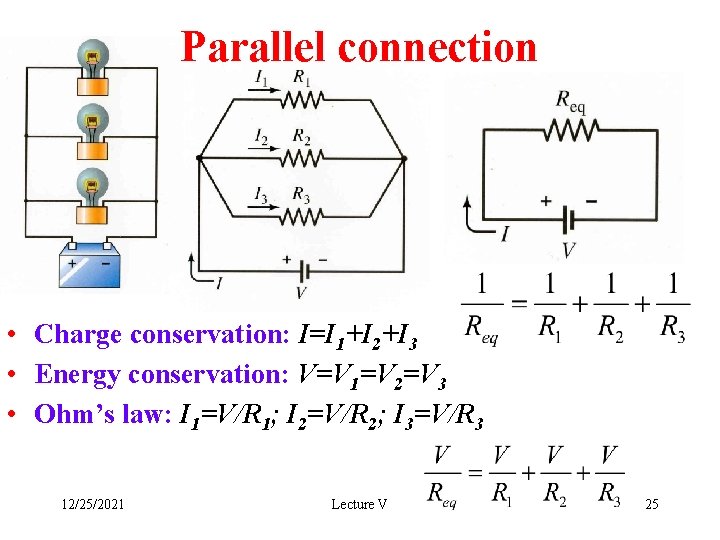
Parallel connection • Charge conservation: I=I 1+I 2+I 3 • Energy conservation: V=V 1=V 2=V 3 • Ohm’s law: I 1=V/R 1; I 2=V/R 2; I 3=V/R 3 12/25/2021 Lecture V 25
DC circuits • • Series connection I=I 1=I 2=I 3 V=V 1+V 2+V 3 Req=R 1+R 2+R 3 12/25/2021 • Parallel connection • I=I 1+I 2+I 3 • V=V 1=V 2=V 3 • Lecture V 26
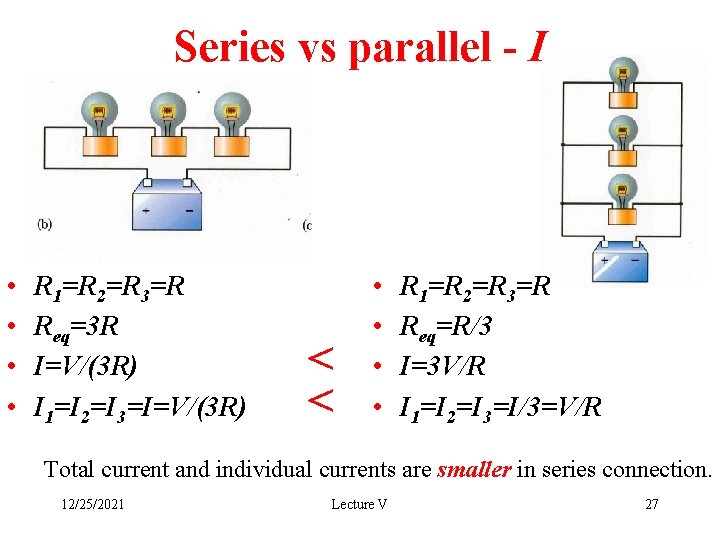
Series vs parallel - I • • R 1=R 2=R 3=R Req=3 R I=V/(3 R) I 1=I 2=I 3=I=V/(3 R) < < • • R 1=R 2=R 3=R Req=R/3 I=3 V/R I 1=I 2=I 3=I/3=V/R Total current and individual currents are smaller in series connection. 12/25/2021 Lecture V 27
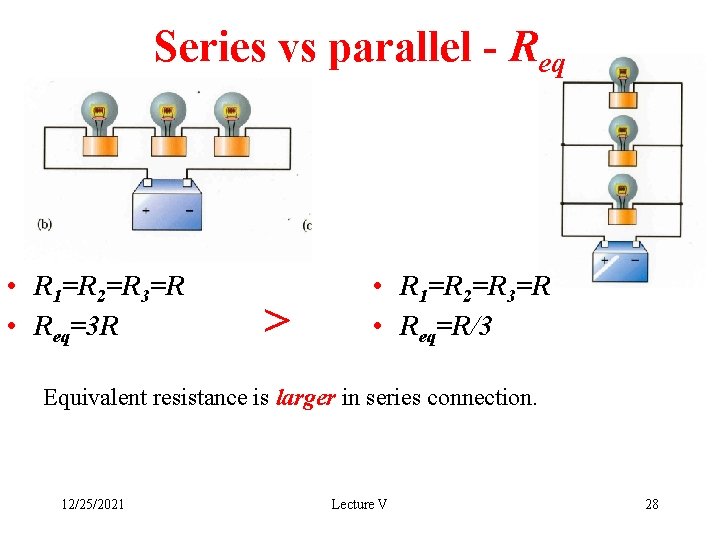
Series vs parallel - Req • R 1=R 2=R 3=R • Req=3 R > • R 1=R 2=R 3=R • Req=R/3 Equivalent resistance is larger in series connection. 12/25/2021 Lecture V 28
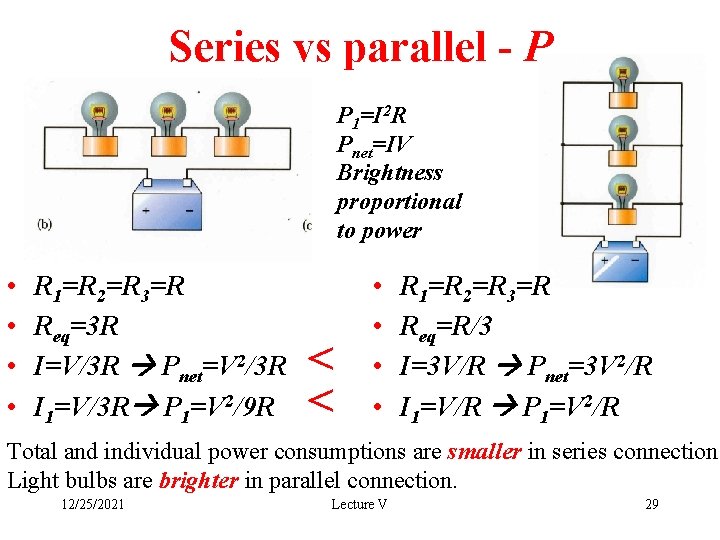
Series vs parallel - P P 1=I 2 R Pnet=IV Brightness proportional to power • • R 1=R 2=R 3=R Req=3 R I=V/3 R Pnet=V 2/3 R I 1=V/3 R P 1=V 2/9 R < < • • R 1=R 2=R 3=R Req=R/3 I=3 V/R Pnet=3 V 2/R I 1=V/R P 1=V 2/R Total and individual power consumptions are smaller in series connection. Light bulbs are brighter in parallel connection. 12/25/2021 Lecture V 29