
Electric Circuits Physics Current Resistance and Ohms Law

- Slides: 64
Electric Circuits Physics
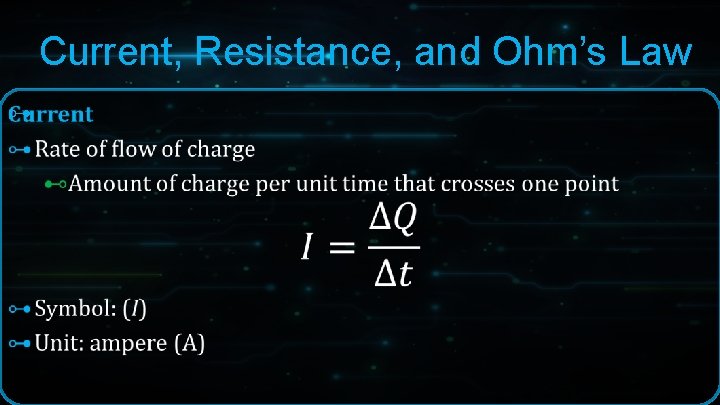
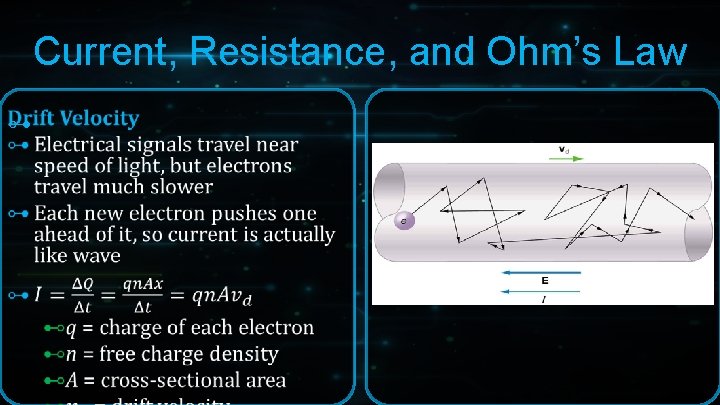
Current, Resistance, and Ohm’s Law ⊶
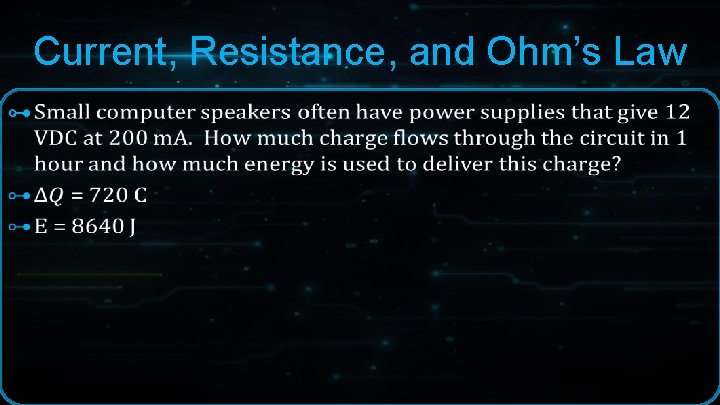
Current, Resistance, and Ohm’s Law ⊶
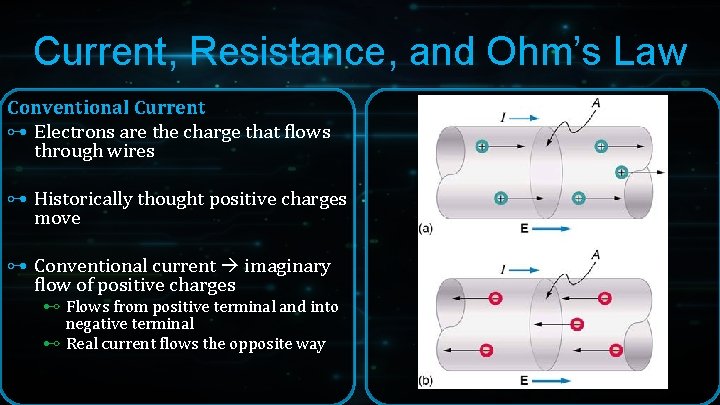
Current, Resistance, and Ohm’s Law Conventional Current ⊶ Electrons are the charge that flows through wires ⊶ Historically thought positive charges move ⊶ Conventional current imaginary flow of positive charges ⊷ Flows from positive terminal and into negative terminal ⊷ Real current flows the opposite way
Current, Resistance, and Ohm’s Law ⊶
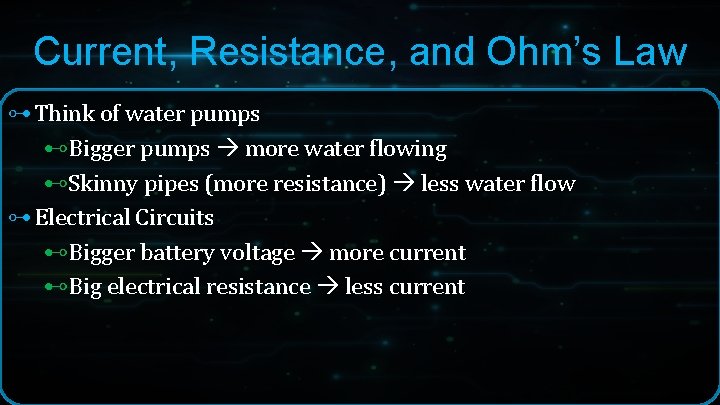
Current, Resistance, and Ohm’s Law ⊶ Think of water pumps ⊷Bigger pumps more water flowing ⊷Skinny pipes (more resistance) less water flow ⊶ Electrical Circuits ⊷Bigger battery voltage more current ⊷Big electrical resistance less current
Current, Resistance, and Ohm’s Law ⊶
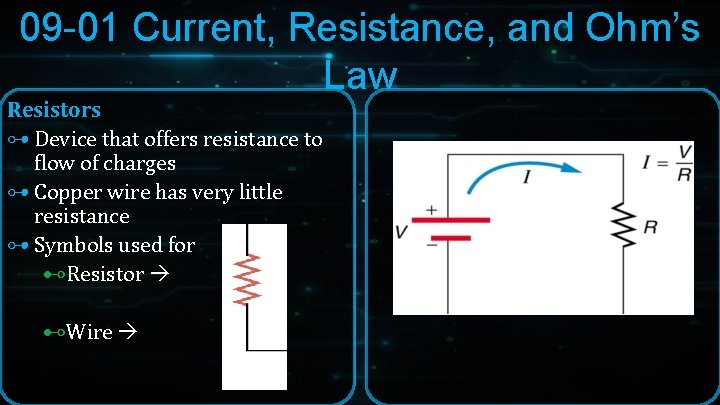
09 -01 Current, Resistance, and Ohm’s Law Resistors ⊶ Device that offers resistance to flow of charges ⊶ Copper wire has very little resistance ⊶ Symbols used for ⊷Resistor ⊷Wire
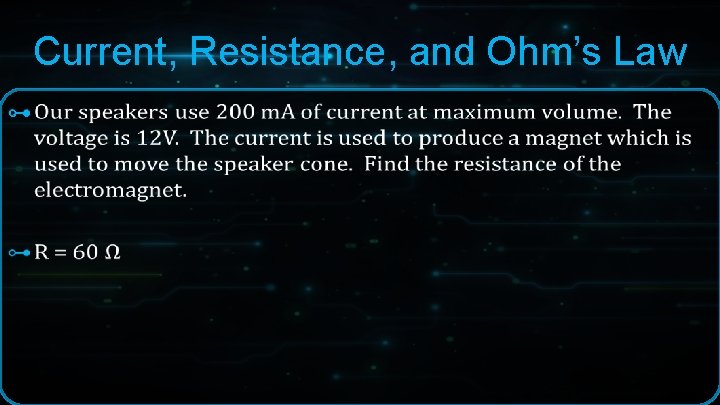
Current, Resistance, and Ohm’s Law ⊶
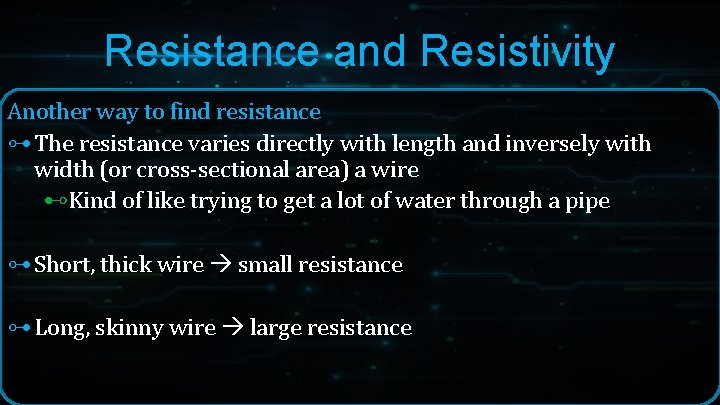
Resistance and Resistivity Another way to find resistance ⊶ The resistance varies directly with length and inversely with width (or cross-sectional area) a wire ⊷Kind of like trying to get a lot of water through a pipe ⊶ Short, thick wire small resistance ⊶ Long, skinny wire large resistance
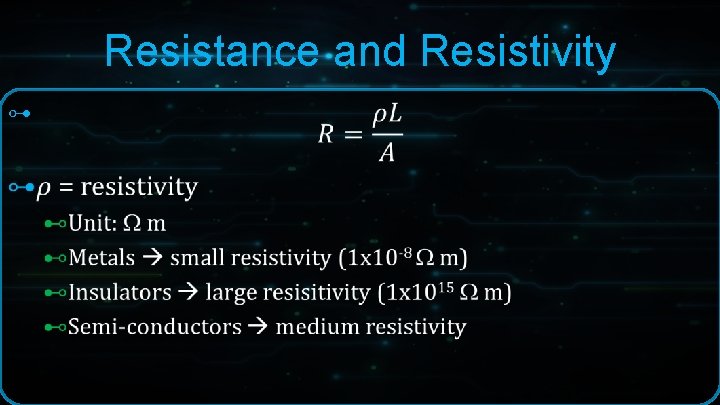
Resistance and Resistivity ⊶
Resistance and Resistivity ⊶
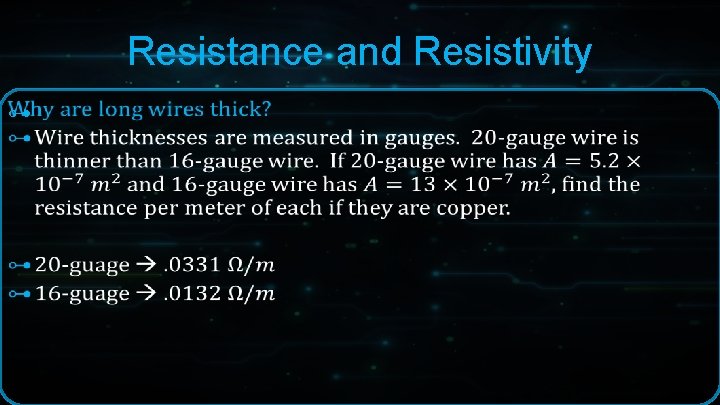
Resistance and Resistivity ⊶
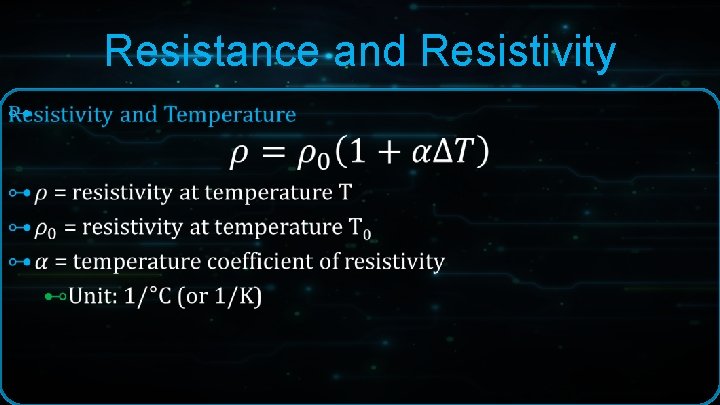
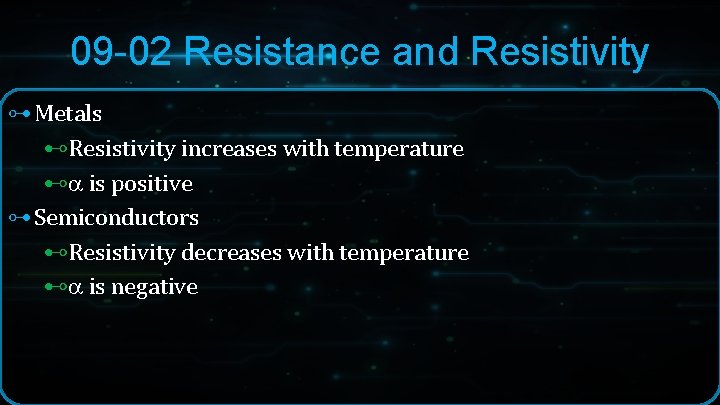
09 -02 Resistance and Resistivity ⊶ Metals ⊷Resistivity increases with temperature ⊷ is positive ⊶ Semiconductors ⊷Resistivity decreases with temperature ⊷ is negative
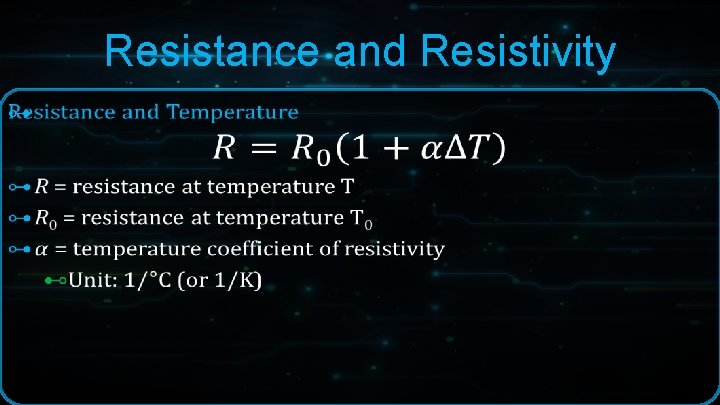
Resistance and Resistivity ⊶
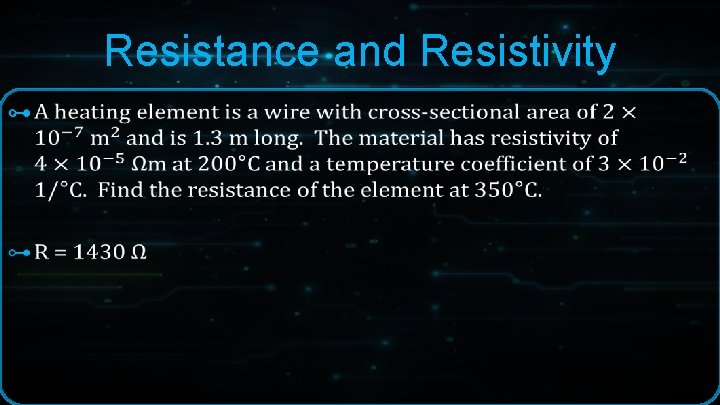
Resistance and Resistivity ⊶
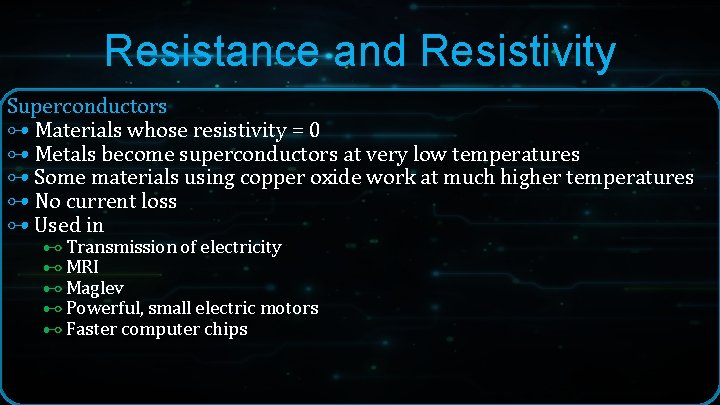
Resistance and Resistivity Superconductors ⊶ Materials whose resistivity = 0 ⊶ Metals become superconductors at very low temperatures ⊶ Some materials using copper oxide work at much higher temperatures ⊶ No current loss ⊶ Used in ⊷ Transmission of electricity ⊷ MRI ⊷ Maglev ⊷ Powerful, small electric motors ⊷ Faster computer chips
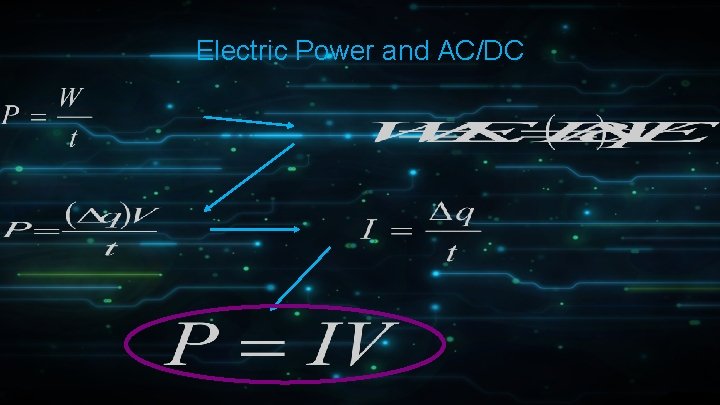
Electric Power and AC/DC
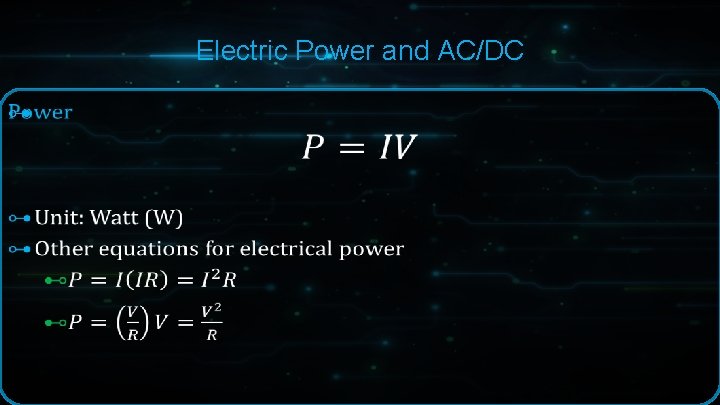
Electric Power and AC/DC ⊶
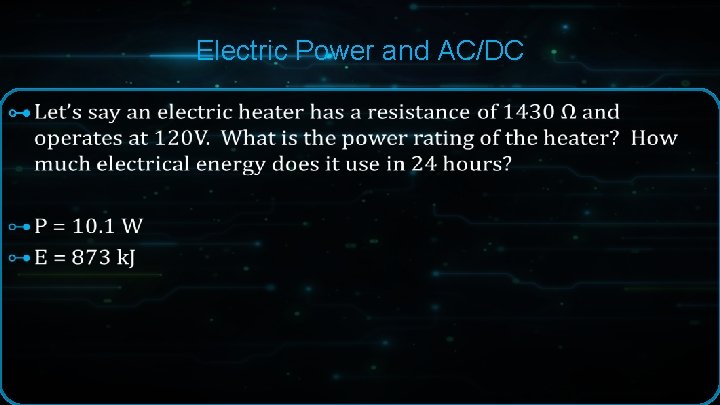
Electric Power and AC/DC ⊶
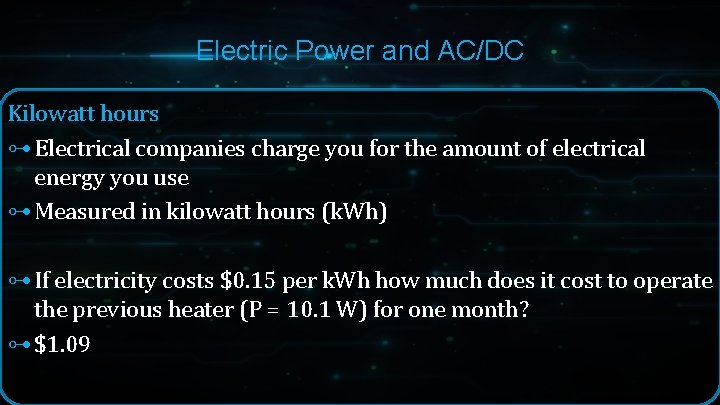
Electric Power and AC/DC Kilowatt hours ⊶ Electrical companies charge you for the amount of electrical energy you use ⊶ Measured in kilowatt hours (k. Wh) ⊶ If electricity costs $0. 15 per k. Wh how much does it cost to operate the previous heater (P = 10. 1 W) for one month? ⊶ $1. 09
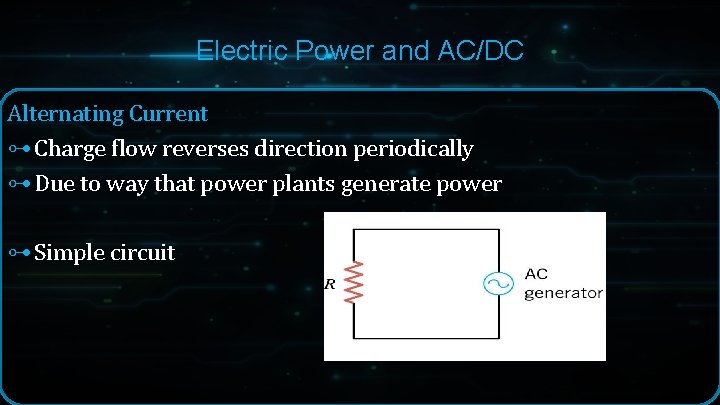
Electric Power and AC/DC Alternating Current ⊶ Charge flow reverses direction periodically ⊶ Due to way that power plants generate power ⊶ Simple circuit
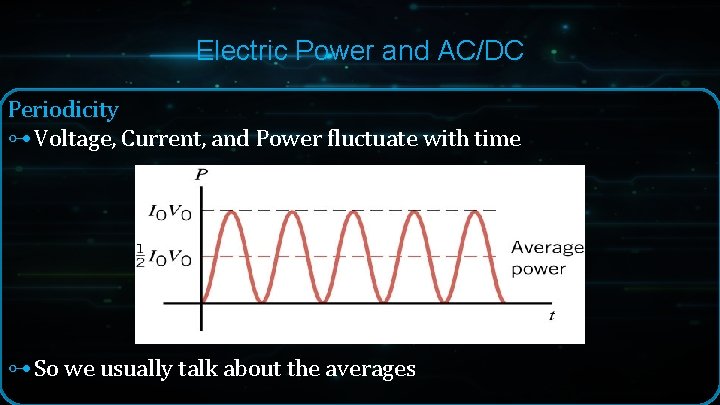
Electric Power and AC/DC Periodicity ⊶ Voltage, Current, and Power fluctuate with time ⊶ So we usually talk about the averages
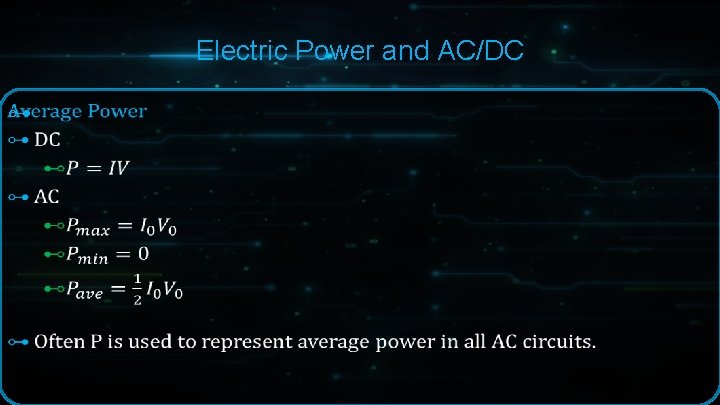
Electric Power and AC/DC ⊶
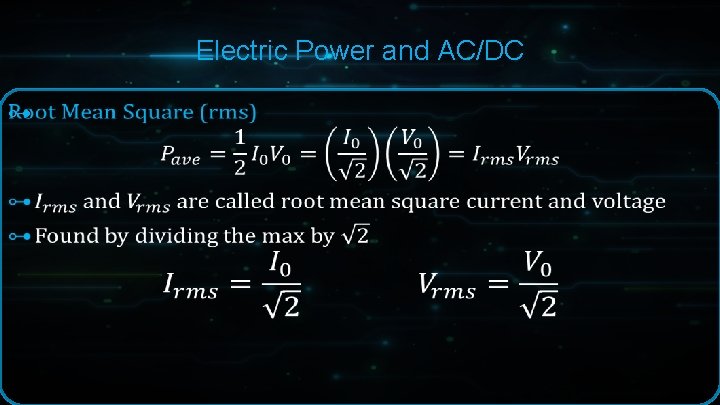
Electric Power and AC/DC ⊶
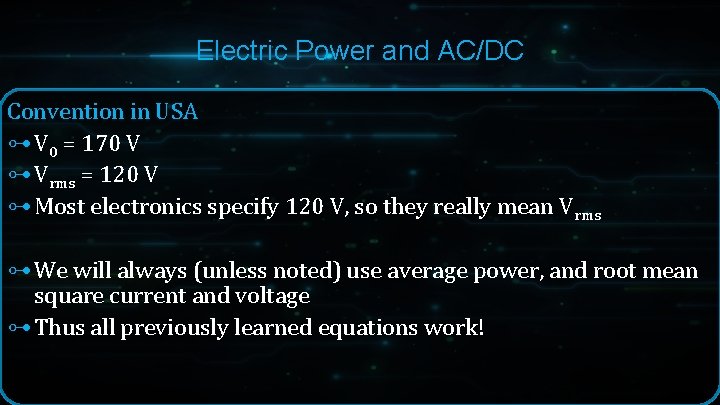
Electric Power and AC/DC Convention in USA ⊶ V 0 = 170 V ⊶ Vrms = 120 V ⊶ Most electronics specify 120 V, so they really mean Vrms ⊶ We will always (unless noted) use average power, and root mean square current and voltage ⊶ Thus all previously learned equations work!
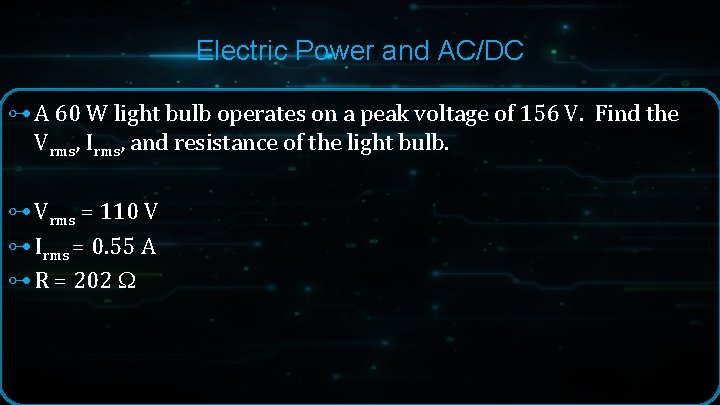
Electric Power and AC/DC ⊶ A 60 W light bulb operates on a peak voltage of 156 V. Find the Vrms, Irms, and resistance of the light bulb. ⊶ Vrms = 110 V ⊶ Irms = 0. 55 A ⊶ R = 202
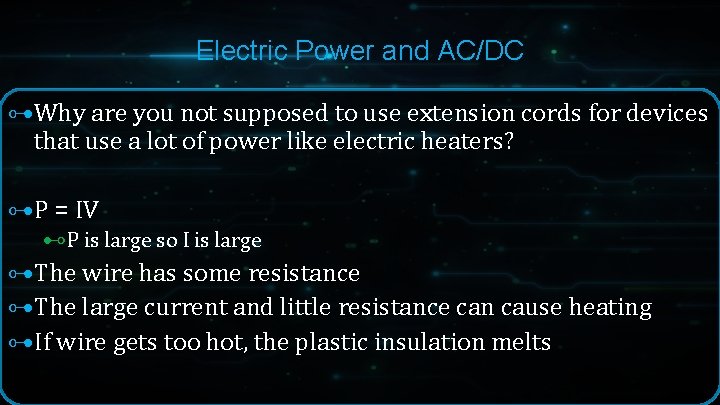
Electric Power and AC/DC ⊶Why are you not supposed to use extension cords for devices that use a lot of power like electric heaters? ⊶P = IV ⊷P is large so I is large ⊶The wire has some resistance ⊶The large current and little resistance can cause heating ⊶If wire gets too hot, the plastic insulation melts
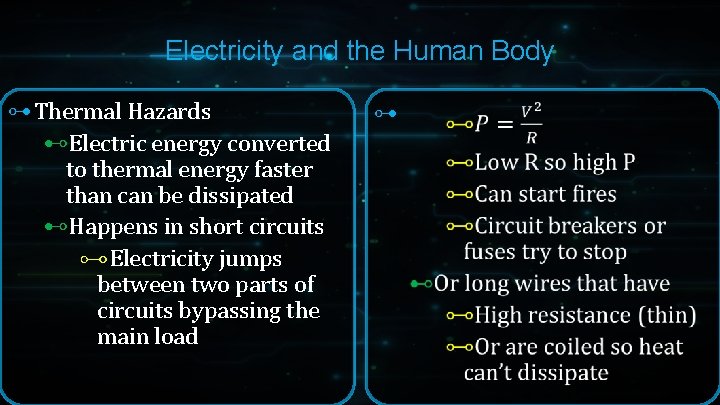
Electricity and the Human Body ⊶ Thermal Hazards ⊷Electric energy converted to thermal energy faster than can be dissipated ⊷Happens in short circuits ⧟Electricity jumps between two parts of circuits bypassing the main load ⊶
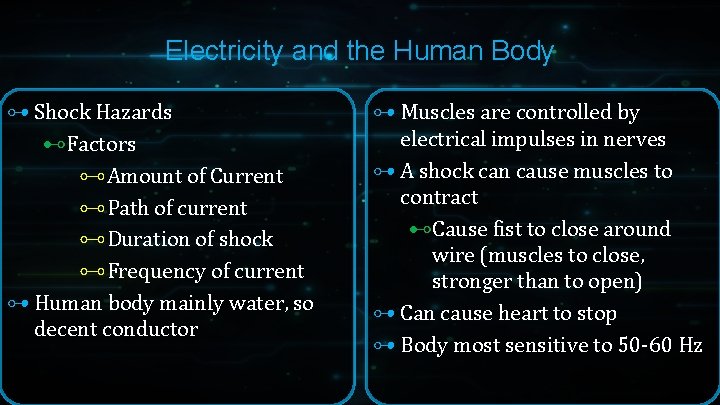
Electricity and the Human Body ⊶ Shock Hazards ⊷Factors ⧟Amount of Current ⧟Path of current ⧟Duration of shock ⧟Frequency of current ⊶ Human body mainly water, so decent conductor ⊶ Muscles are controlled by electrical impulses in nerves ⊶ A shock can cause muscles to contract ⊷Cause fist to close around wire (muscles to close, stronger than to open) ⊶ Can cause heart to stop ⊶ Body most sensitive to 50 -60 Hz
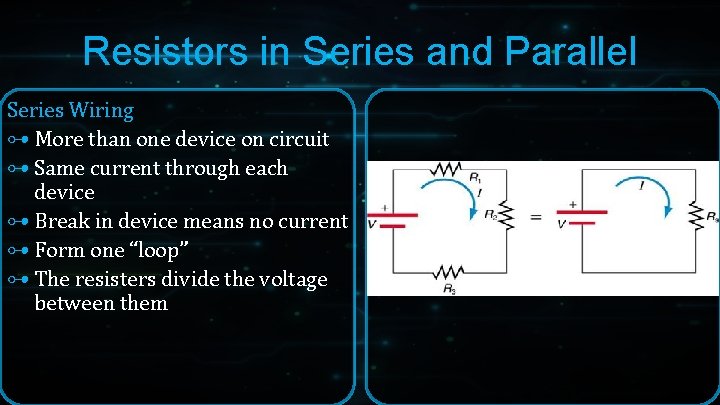
Resistors in Series and Parallel Series Wiring ⊶ More than one device on circuit ⊶ Same current through each device ⊶ Break in device means no current ⊶ Form one “loop” ⊶ The resisters divide the voltage between them
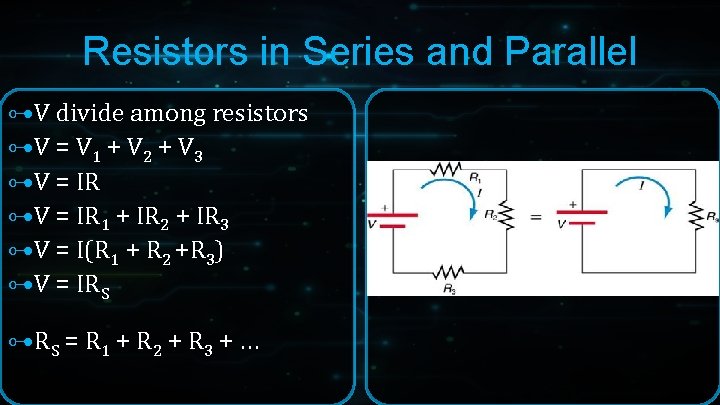
Resistors in Series and Parallel ⊶V divide among resistors ⊶V = V 1 + V 2 + V 3 ⊶V = IR 1 + IR 2 + IR 3 ⊶V = I(R 1 + R 2 +R 3) ⊶V = IRS ⊶ RS = R 1 + R 2 + R 3 + …
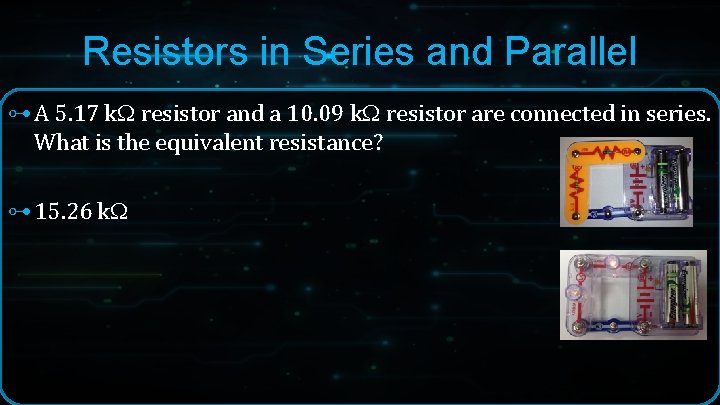
Resistors in Series and Parallel ⊶ A 5. 17 k resistor and a 10. 09 k resistor are connected in series. What is the equivalent resistance? ⊶ 15. 26 k
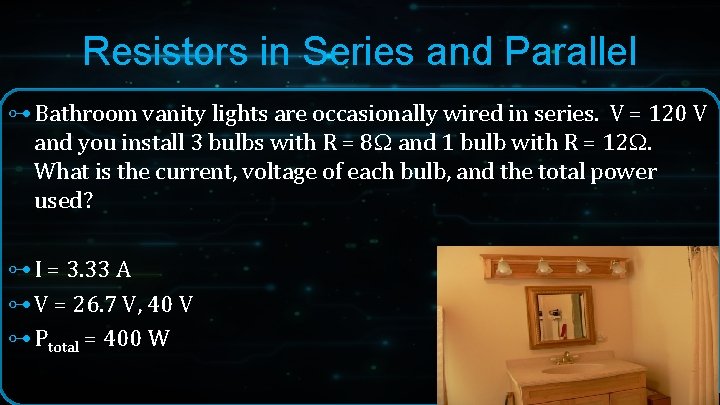
Resistors in Series and Parallel ⊶ Bathroom vanity lights are occasionally wired in series. V = 120 V and you install 3 bulbs with R = 8 and 1 bulb with R = 12. What is the current, voltage of each bulb, and the total power used? ⊶ I = 3. 33 A ⊶ V = 26. 7 V, 40 V ⊶ Ptotal = 400 W
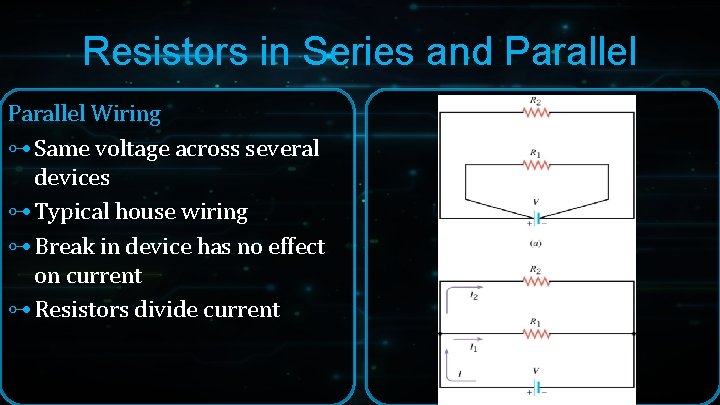
Resistors in Series and Parallel Wiring ⊶ Same voltage across several devices ⊶ Typical house wiring ⊶ Break in device has no effect on current ⊶ Resistors divide current
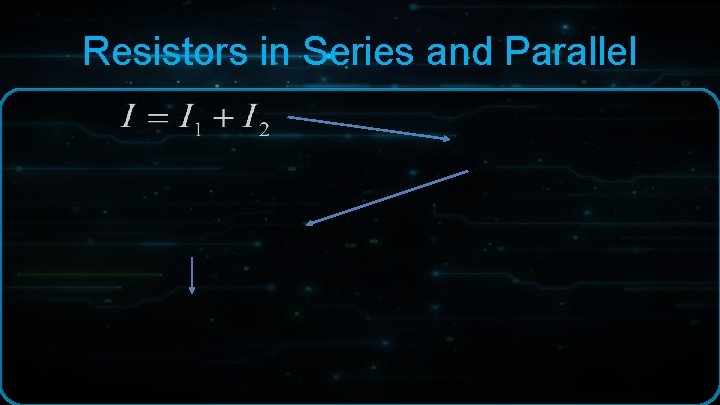
Resistors in Series and Parallel Derivation ⊶ Each branch draws current as if the other wasn’t there ⊶ Each branch draws less current than the power supply gives ⊶R = V / I ⊶ Overall circuit: Large I Small R ⊷Smaller resistance than either branch
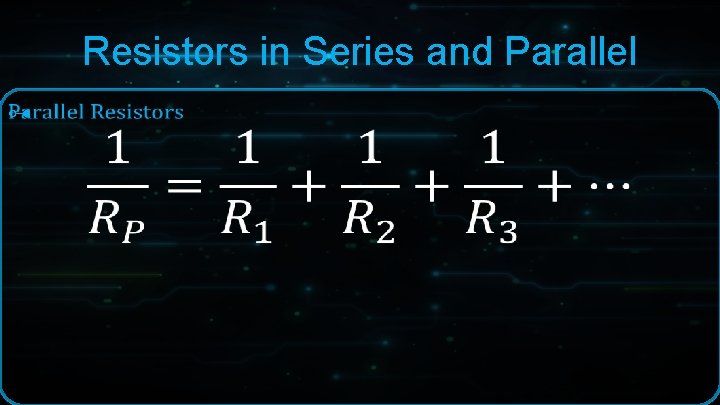
Resistors in Series and Parallel
Resistors in Series and Parallel ⊶
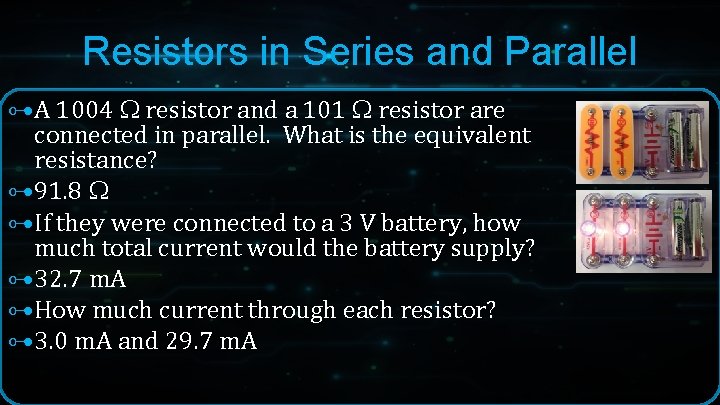
Resistors in Series and Parallel ⊶A 1004 resistor and a 101 resistor are connected in parallel. What is the equivalent resistance? ⊶ 91. 8 ⊶If they were connected to a 3 V battery, how much total current would the battery supply? ⊶ 32. 7 m. A ⊶How much current through each resistor? ⊶ 3. 0 m. A and 29. 7 m. A
Resistors in Series and Parallel Circuits Wired Partially in Series and Partially in Parallel ⊶ Simplify any series portions of each branch ⊶ Simplify the parallel circuitry of the branches ⊶ If necessary simplify any remaining series
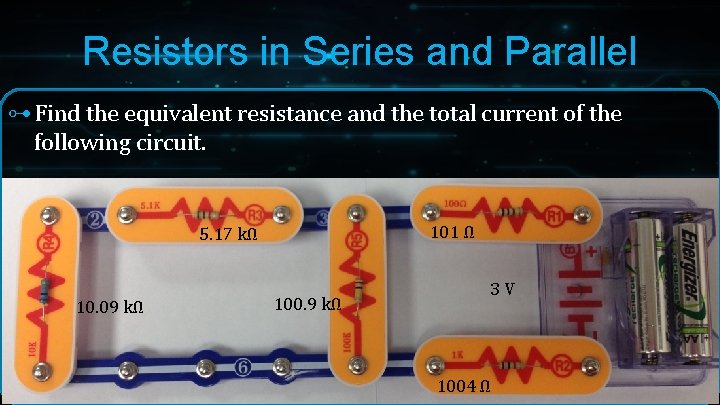
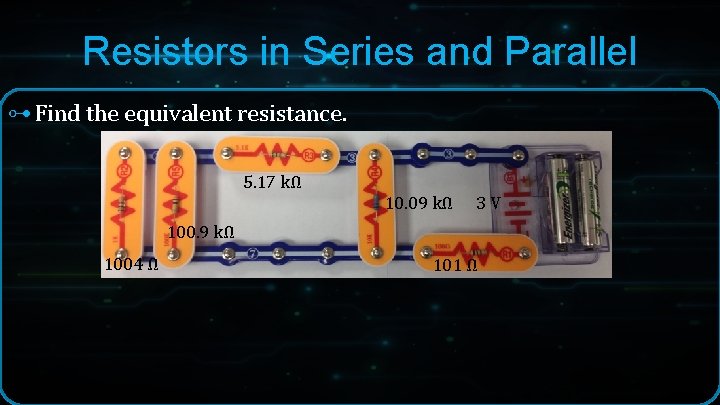
Resistors in Series and Parallel ⊶ Find the equivalent resistance and the total current of the following circuit. 101 Ω 5. 17 kΩ 10. 09 kΩ 100. 9 kΩ 3 V 1004 Ω
Resistors in Series and Parallel ⊶ Find the equivalent resistance. 5. 17 kΩ 10. 09 kΩ 3 V 100. 9 kΩ 1004 Ω 101 Ω
Electromotive Force: Terminal Voltage ⊶ Emf ⊷Electromotive force ⊷Not really a force ⊷Really voltage produced that could drive a current
Electromotive Force: Terminal Voltage Internal Resistance ⊶ Batteries and generators have resistance ⊶ In batteries due to chemicals ⊶ In generators due to wires and other components ⊶ Internal resistance is connected in series with the equivalent resistance of the circuit
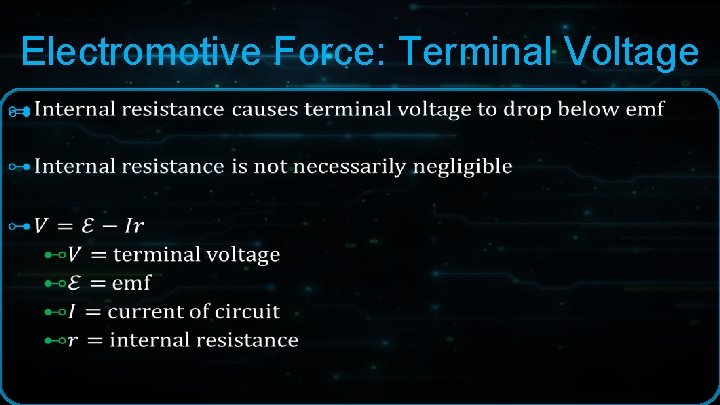
Electromotive Force: Terminal Voltage ⊶
Electromotive Force: Terminal Voltage ⊶ A string of 20 Christmas light are connected in series with a 3. 0 V battery. Each light has a resistance of 10 . The terminal voltage is measured as 2. 0 V. What is the internal resistance of the battery? ⊶ 100
Electromotive Force: Terminal Voltage ⊶ A battery has an internal resistance of 0. 02 and an emf of 1. 5 V. If the battery is connected with five 15 light bulbs connected in parallel, what is the terminal voltage of the battery? ⊶ 1. 49 V
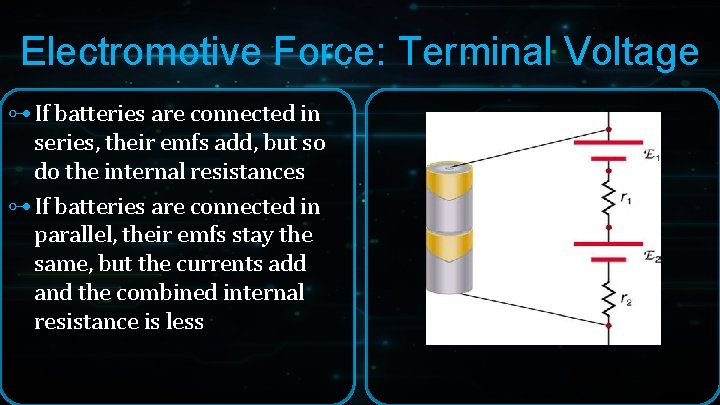
Electromotive Force: Terminal Voltage ⊶ If batteries are connected in series, their emfs add, but so do the internal resistances ⊶ If batteries are connected in parallel, their emfs stay the same, but the currents add and the combined internal resistance is less
Kirchhoff’s Rules ⊶
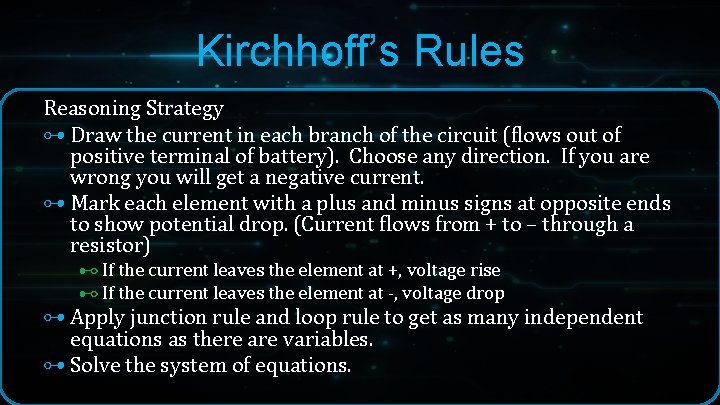
Kirchhoff’s Rules Reasoning Strategy ⊶ Draw the current in each branch of the circuit (flows out of positive terminal of battery). Choose any direction. If you are wrong you will get a negative current. ⊶ Mark each element with a plus and minus signs at opposite ends to show potential drop. (Current flows from + to – through a resistor) ⊷ If the current leaves the element at +, voltage rise ⊷ If the current leaves the element at -, voltage drop ⊶ Apply junction rule and loop rule to get as many independent equations as there are variables. ⊶ Solve the system of equations.
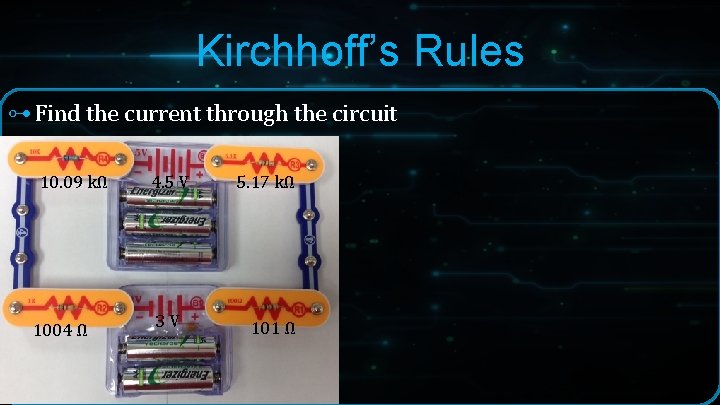
Kirchhoff’s Rules ⊶ Find the current through the circuit 10. 09 kΩ 1004 Ω 4. 5 V 3 V 5. 17 kΩ 101 Ω
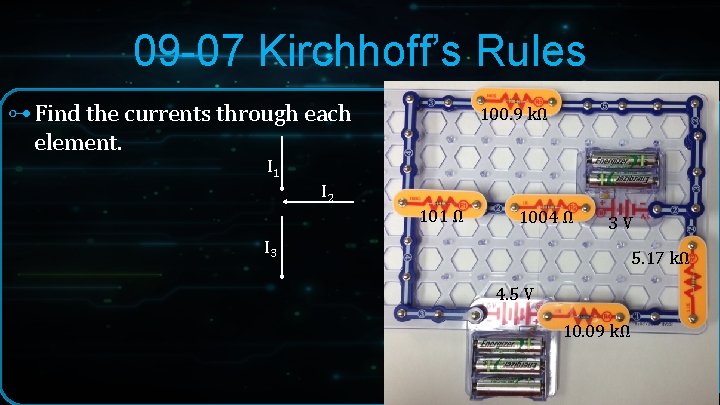
09 -07 Kirchhoff’s Rules ⊶ Find the currents through each element. 100. 9 kΩ I 1 I 2 101 Ω 1004 Ω 3 V I 3 5. 17 kΩ 4. 5 V 10. 09 kΩ
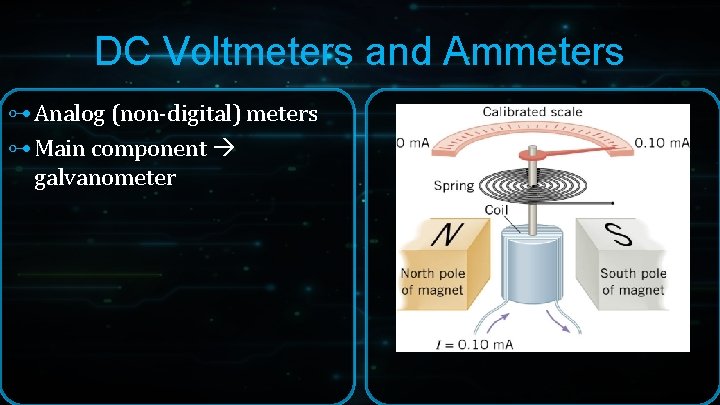
DC Voltmeters and Ammeters ⊶ Analog (non-digital) meters ⊶ Main component galvanometer
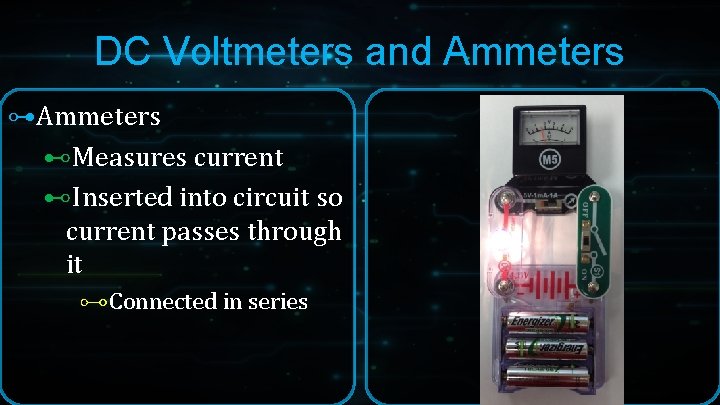
DC Voltmeters and Ammeters ⊶Ammeters ⊷Measures current ⊷Inserted into circuit so current passes through it ⧟Connected in series
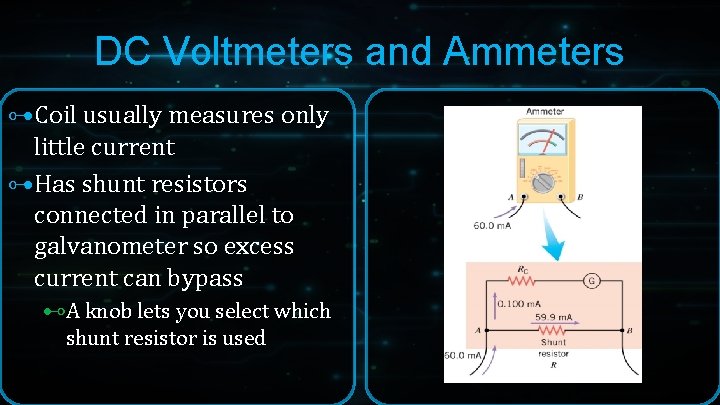
DC Voltmeters and Ammeters ⊶Coil usually measures only little current ⊶Has shunt resistors connected in parallel to galvanometer so excess current can bypass ⊷A knob lets you select which shunt resistor is used
DC Voltmeters and Ammeters ⊶ Problems with Ammeters ⊷The resistance of the coil and shunt resistors add to the resistance of the circuit ⊷This reduces the current in the circuit ⊷Ideal ammeter has no resistance ⧟Real-life good ammeters have small resistance so as only cause a negligible change in current
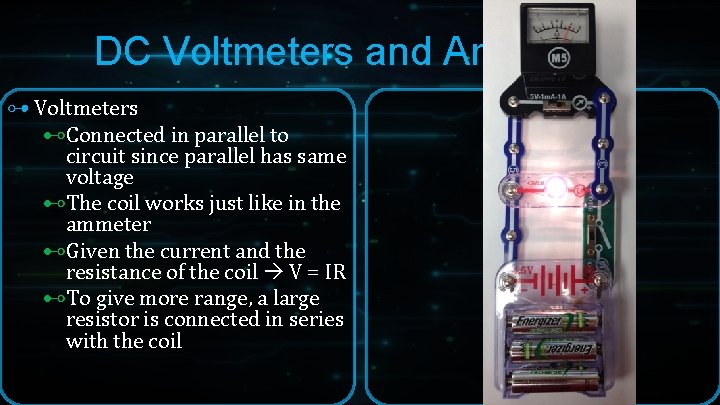
DC Voltmeters and Ammeters ⊶ Voltmeters ⊷Connected in parallel to circuit since parallel has same voltage ⊷The coil works just like in the ammeter ⊷Given the current and the resistance of the coil V = IR ⊷To give more range, a large resistor is connected in series with the coil
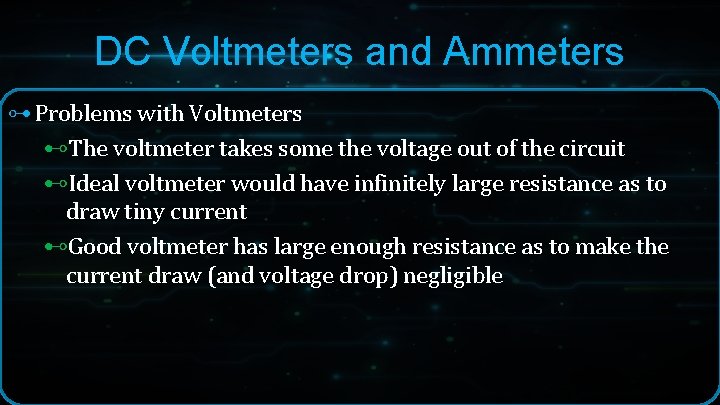
DC Voltmeters and Ammeters ⊶ Problems with Voltmeters ⊷The voltmeter takes some the voltage out of the circuit ⊷Ideal voltmeter would have infinitely large resistance as to draw tiny current ⊷Good voltmeter has large enough resistance as to make the current draw (and voltage drop) negligible
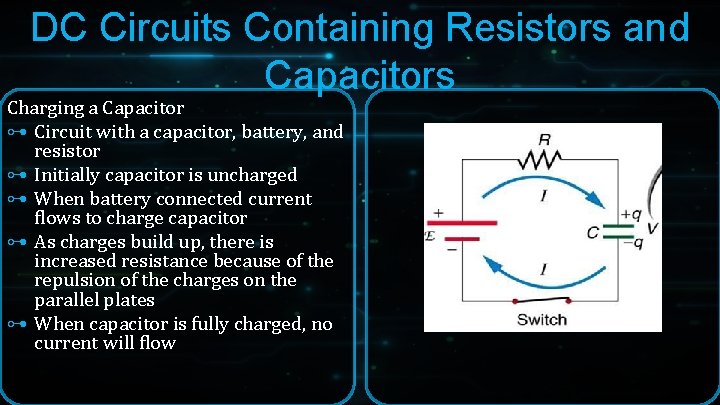
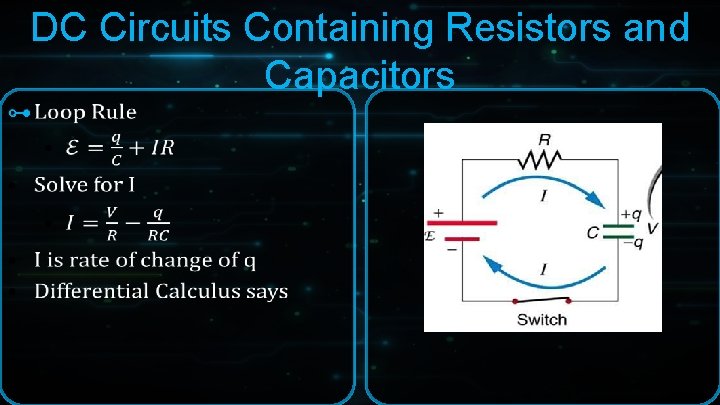
DC Circuits Containing Resistors and Capacitors Charging a Capacitor ⊶ Circuit with a capacitor, battery, and resistor ⊶ Initially capacitor is uncharged ⊶ When battery connected current flows to charge capacitor ⊶ As charges build up, there is increased resistance because of the repulsion of the charges on the parallel plates ⊶ When capacitor is fully charged, no current will flow
DC Circuits Containing Resistors and Capacitors ⊶
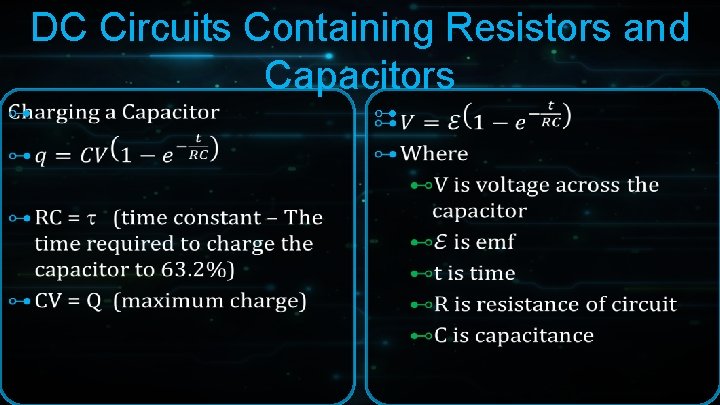
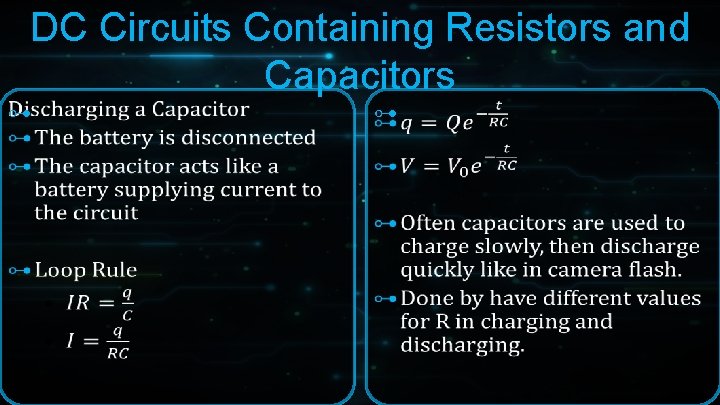
DC Circuits Containing Resistors and Capacitors ⊶ ⊶
DC Circuits Containing Resistors and Capacitors ⊶ ⊶
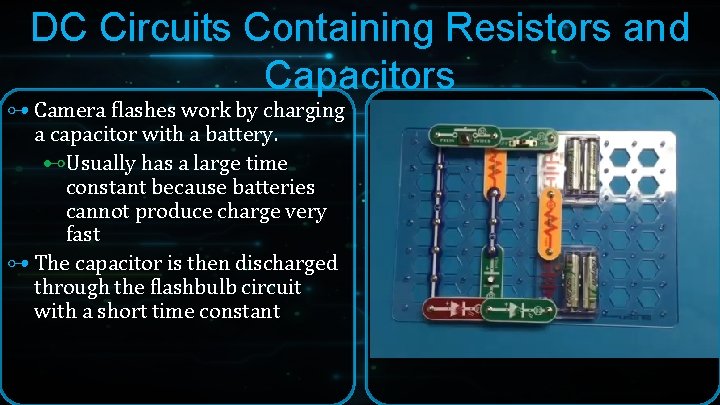
DC Circuits Containing Resistors and Capacitors ⊶ Camera flashes work by charging a capacitor with a battery. ⊷Usually has a large time constant because batteries cannot produce charge very fast ⊶ The capacitor is then discharged through the flashbulb circuit with a short time constant
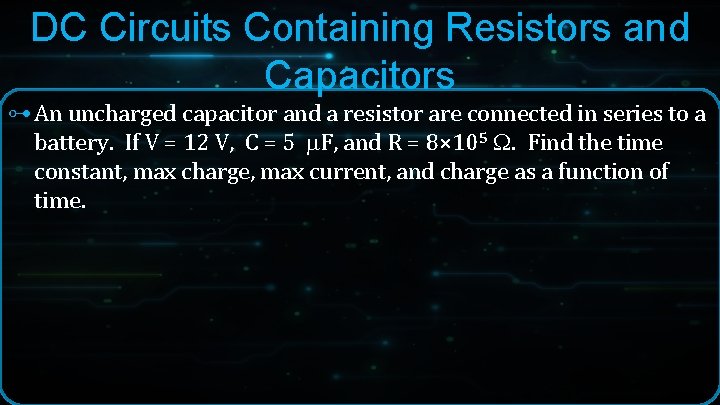
DC Circuits Containing Resistors and Capacitors ⊶ An uncharged capacitor and a resistor are connected in series to a battery. If V = 12 V, C = 5 F, and R = 8× 10⁵ . Find the time constant, max charge, max current, and charge as a function of time.