
ELECTRIC CIRCUIT ANALYSIS I Chapter 15 Series Parallel






- Slides: 29
ELECTRIC CIRCUIT ANALYSIS - I Chapter 15 – Series & Parallel ac Circuits Lecture 20 by Moeen Ghiyas 03/01/2022 1
Chapter 15 – Series & Parallel ac Circuits TODAY’S lesson
Today’s Lesson Contents � (Series ac Circuits) � Voltage Divider Rule � Frequency Response of R-C Circuit � Summary of Series ac Circuits 03/01/2022 3
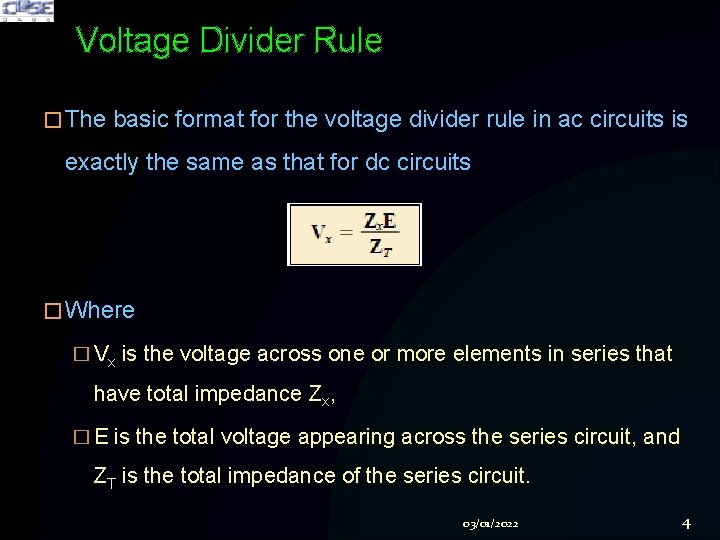
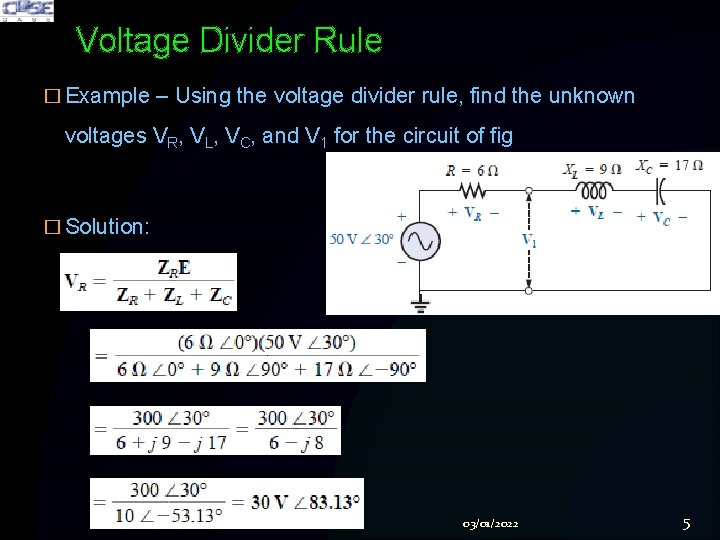
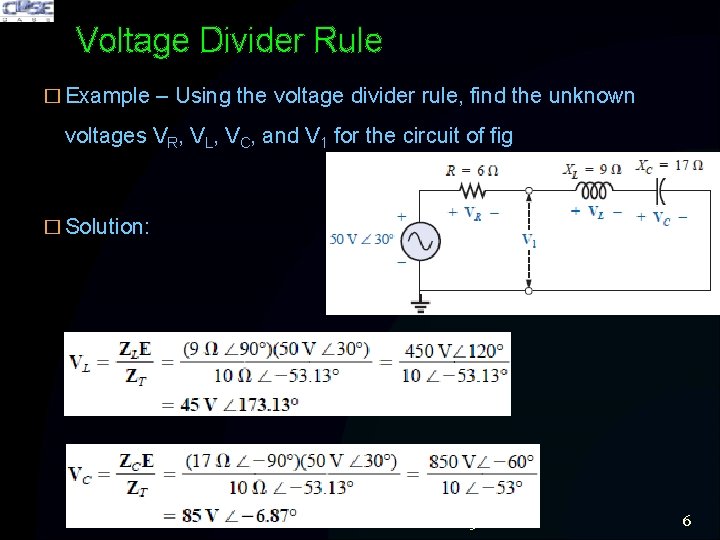
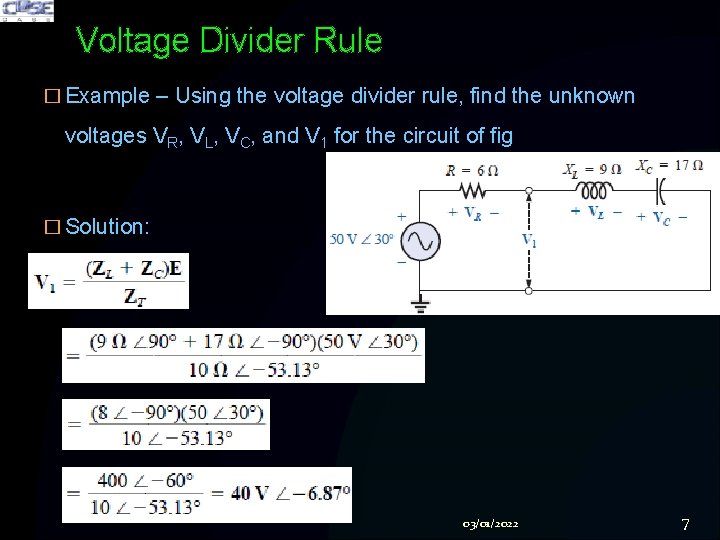
Voltage Divider Rule �The basic format for the voltage divider rule in ac circuits is exactly the same as that for dc circuits �Where � Vx is the voltage across one or more elements in series that have total impedance Zx, � E is the total voltage appearing across the series circuit, and ZT is the total impedance of the series circuit. 03/01/2022 4
Voltage Divider Rule � Example – Using the voltage divider rule, find the unknown voltages VR, VL, VC, and V 1 for the circuit of fig � Solution: 03/01/2022 5
Voltage Divider Rule � Example – Using the voltage divider rule, find the unknown voltages VR, VL, VC, and V 1 for the circuit of fig � Solution: 03/01/2022 6
Voltage Divider Rule � Example – Using the voltage divider rule, find the unknown voltages VR, VL, VC, and V 1 for the circuit of fig � Solution: 03/01/2022 7
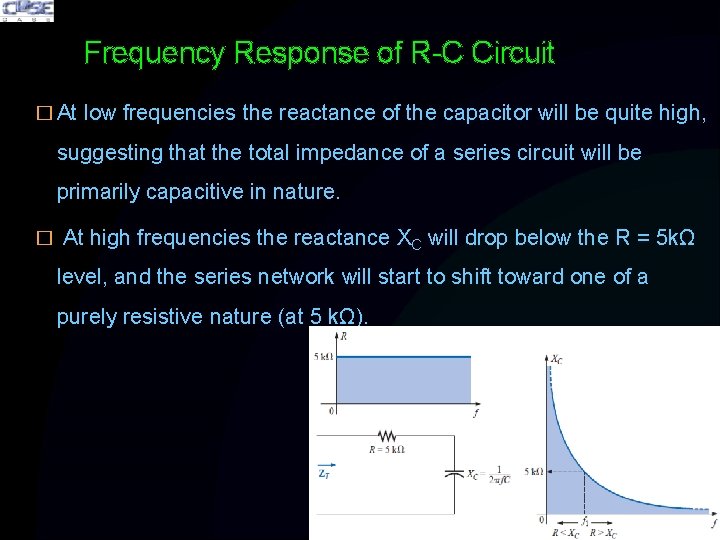
Frequency Response of R-C Circuit �Let us first recall the impedance-versus-frequency curve of each element
Frequency Response of R-C Circuit � At low frequencies the reactance of the capacitor will be quite high, suggesting that the total impedance of a series circuit will be primarily capacitive in nature. � At high frequencies the reactance XC will drop below the R = 5 kΩ level, and the series network will start to shift toward one of a purely resistive nature (at 5 kΩ).
Frequency Response of R-C Circuit � Frequency at which XC = R can be determined in following manner: � Since XC = 1/ωC = 1/2πf. C, � Thus frequency at which XC = R is � which for the network of interest is • For frequencies • Less than f 1: XC > R • Greater than f 1: R > XC
Frequency Response of R-C Circuit � To examine the effect of frequency on the response of an R-C series configuration, let us first determine how the impedance of the circuit ZT will vary with frequency for the specified frequency range � The magnitude of the source is fixed at 10 V in the given circuit, but the frequency range of analysis will extend from zero to 20 k. Hz.
Frequency Response of R-C Circuit �We already know by now that the total impedance is determined by following equation: �In rectangular form �In polar form �Also remember
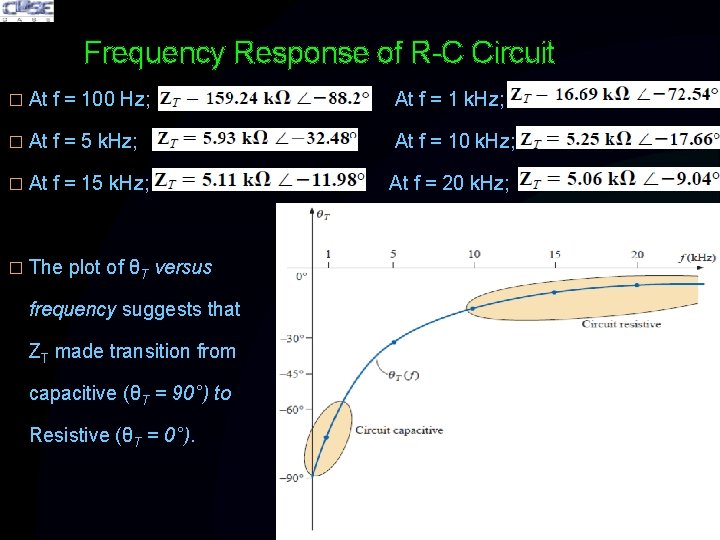
Frequency Response of R-C Circuit � At f = 100 Hz; � At f = 1 k. Hz; � At f = 5 k. Hz; Close to ZC = 159. 16 kΩ /_ 90° if circuit was purely capacitive (R = 0Ω) at 100 hz � At f = 10 k. Hz; � At f = 15 k. Hz; � At f = 20 k. Hz; Note ZT at f = 20 k. Hz is approaching 5 kΩ. Also, note phase angle is approaching a pure resistive network (0°).
Frequency Response of R-C Circuit � At f = 100 Hz; At f = 1 k. Hz; � At f = 5 k. Hz; At f = 10 k. Hz; � At f = 15 k. Hz; � A plot of ZT versus frequency At f = 20 k. Hz;
Frequency Response of R-C Circuit � At f = 100 Hz; At f = 1 k. Hz; � At f = 5 k. Hz; At f = 10 k. Hz; � At f = 15 k. Hz; � The plot of θT versus frequency suggests that ZT made transition from capacitive (θT = 90°) to Resistive (θT = 0°). At f = 20 k. Hz;
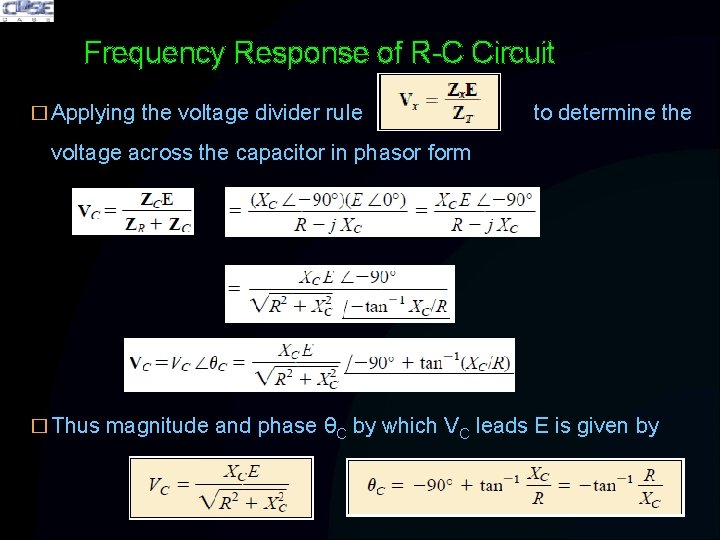
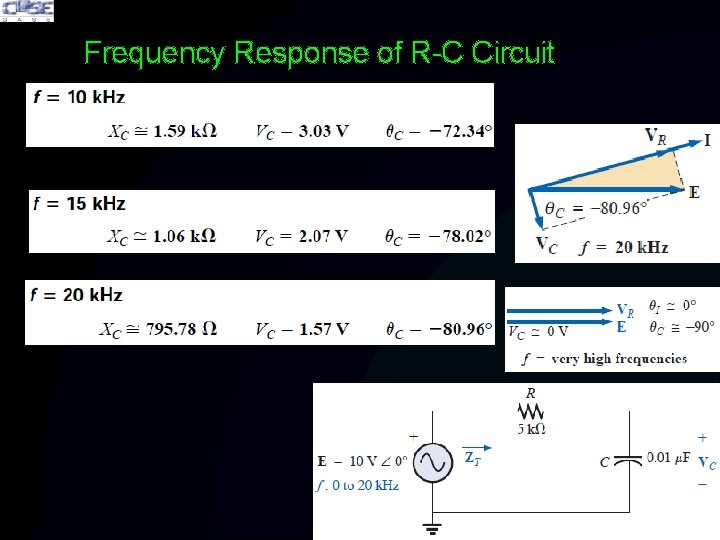
Frequency Response of R-C Circuit � Applying the voltage divider rule to determine the voltage across the capacitor in phasor form � Thus magnitude and phase θC by which VC leads E is given by
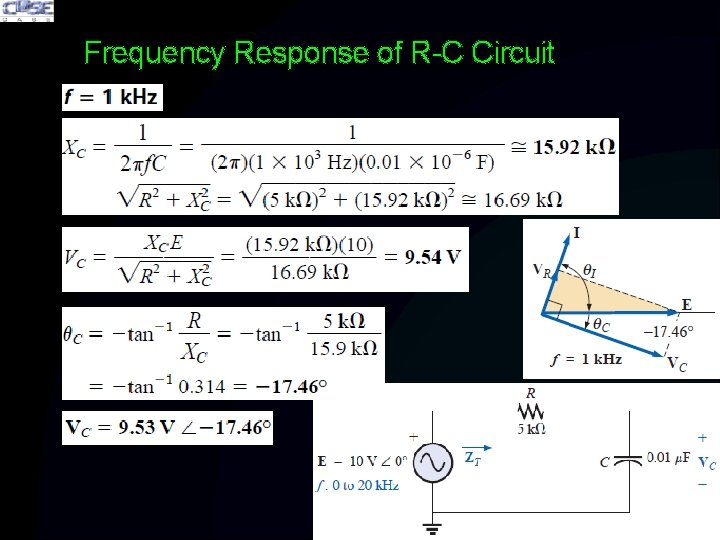
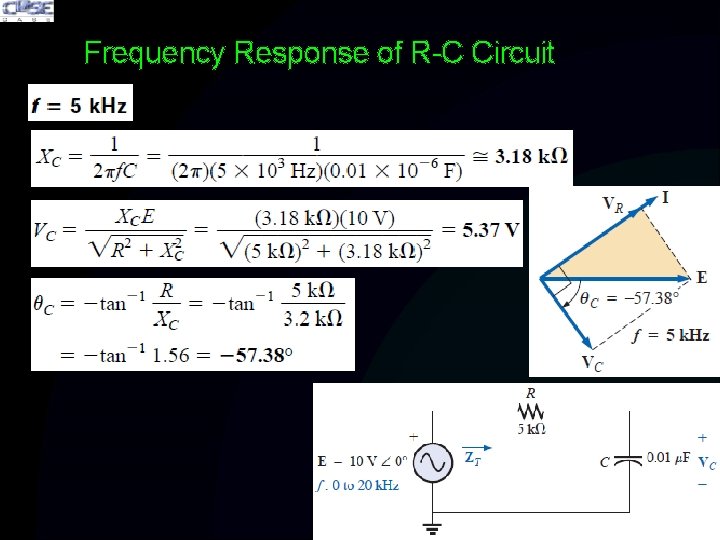
Frequency Response of R-C Circuit � To determine the frequency response, XC must be calculated for each frequency of interest � Applying the open-circuit equivalent
Frequency Response of R-C Circuit
Frequency Response of R-C Circuit
Frequency Response of R-C Circuit
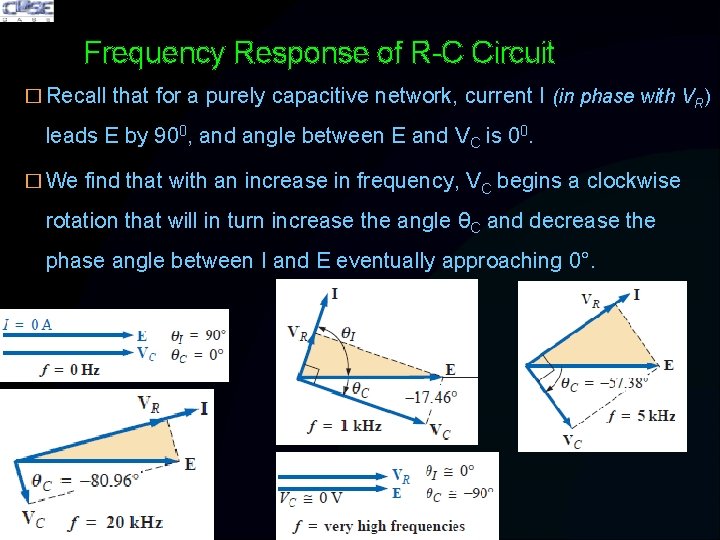
Frequency Response of R-C Circuit � Recall that for a purely capacitive network, current I (in phase with VR) leads E by 900, and angle between E and VC is 00. � We find that with an increase in frequency, VC begins a clockwise rotation that will in turn increase the angle θC and decrease the phase angle between I and E eventually approaching 0°.
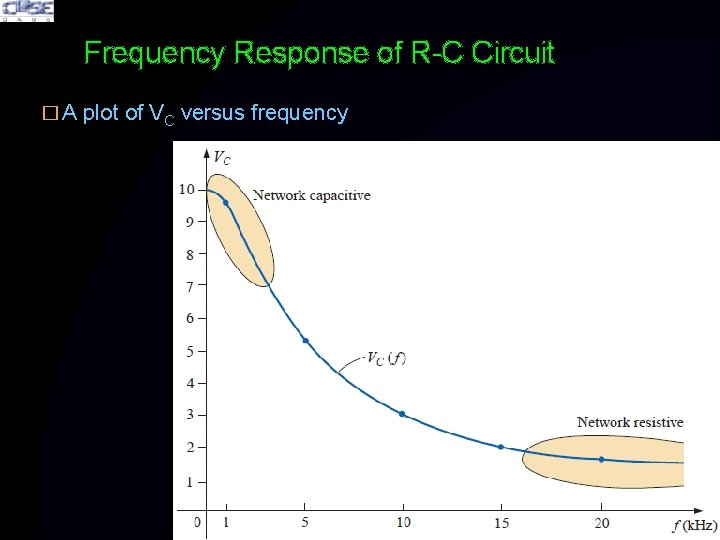
Frequency Response of R-C Circuit � A plot of VC versus frequency
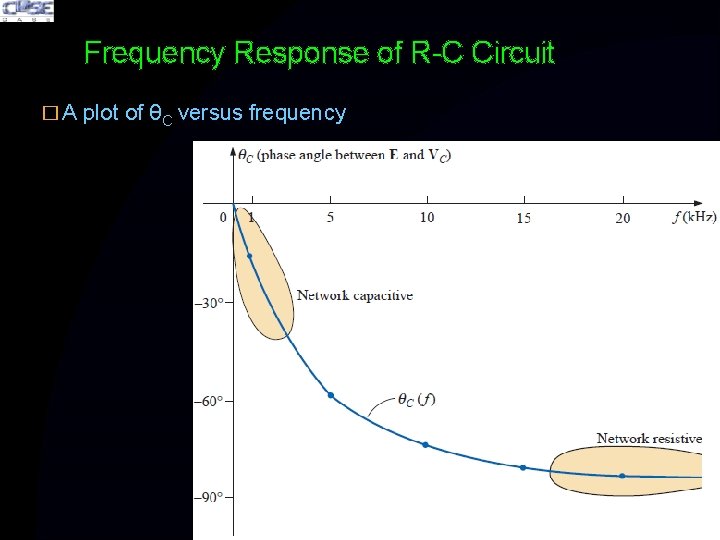
Frequency Response of R-C Circuit � A plot of θC versus frequency
Frequency Response of R-C Circuit � An R-C circuit can be used as a filter to determine which frequencies will have the greatest impact on the stage to follow. � From our current analysis, it is obvious that any network connected across the capacitor will receive the greatest potential level at low frequencies and be effectively “shorted out” at very high frequencies. � Thus R-C circuit can be used as a low pass filter.
Frequency Response of R-C Circuit � The analysis of a series R-L circuit would proceed in much the same manner as for R-C circuit, � except that XL and VL would increase with frequency and the angle between I and E would approach 90° (voltage leading the current) rather than 0°. � If VL were plotted versus frequency, VL would approach E, and XL would eventually attain a level at which the open circuit equivalent would be appropriate.
Summary on Series ac Circuits � For series ac circuits with reactive elements: 1. The total impedance will be frequency dependent. 2. The impedance of any one element can be greater than the total impedance of the network. 3. The inductive and capacitive reactance's are always in direct opposition on an impedance diagram. 4. Depending on the frequency applied, the same circuit can be either predominantly inductive or predominantly capacitive. 5. The magnitude of the voltage across any one element can be greater than the applied voltage. 03/01/2022 26
Summary on Series ac Circuits � For series ac circuits with reactive elements: 6. At lower frequencies the capacitive elements will usually have the most impact on the total impedance, while at high frequencies the inductive elements will usually have the most impact. 7. The larger the resistive element of a circuit compared to the net reactive impedance, the closer the power factor is to unity. 03/01/2022 27
Summary / Conclusion � (Series ac Circuits) � Voltage Divider Rule � Frequency Response of R-C Circuit � Summary of Series ac Circuits
03/01/2022 29