
ELECTRIC CIRCUIT ANALYSIS I Chapter 11 Magnetic Circuits





- Slides: 43
ELECTRIC CIRCUIT ANALYSIS - I Chapter 11 – Magnetic Circuits Lecture 3 by Moeen Ghiyas 17/12/2021 1
TODAY’S LECTURE CONTENTS �Ampere’s Circuital Law – (Applying KVL) �The Flux Φ – (Applying KCL) �Series Magnetic Circuits �Air Gaps �Series-Parallel Magnetic Circuits �Determining Flux Φ �Applications
Ampere’s Circuital Law – KVL 17/12/2021 3
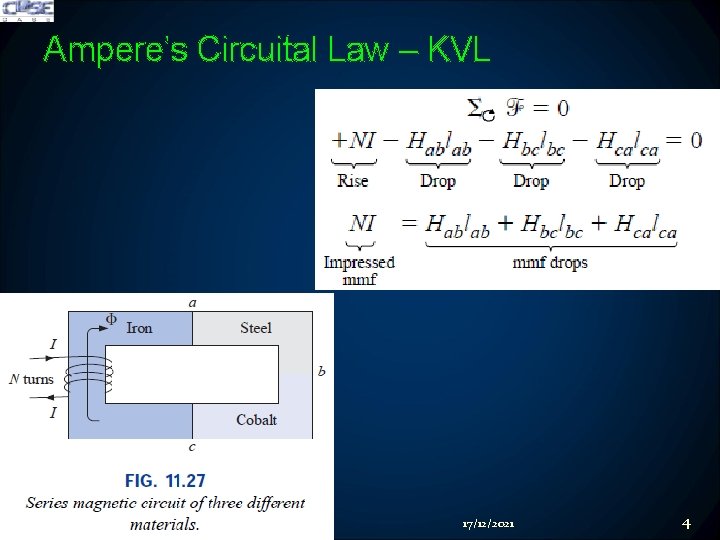
Ampere’s Circuital Law – KVL 17/12/2021 4
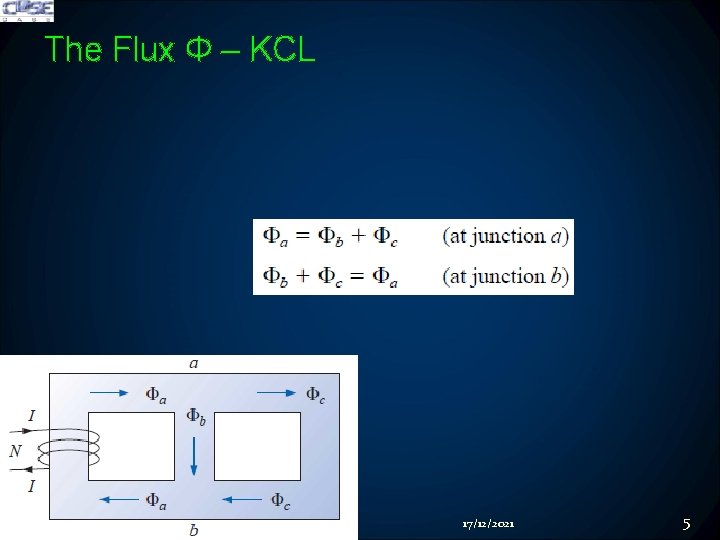
The Flux Φ – KCL 17/12/2021 5
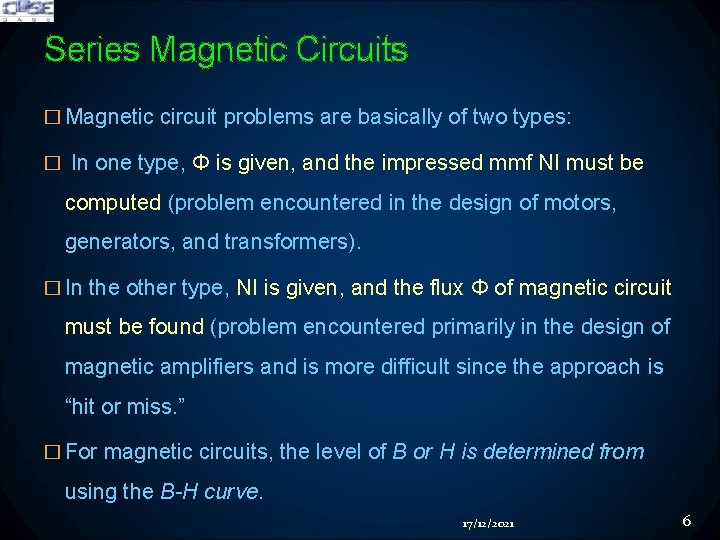
Series Magnetic Circuits � Magnetic circuit problems are basically of two types: � In one type, Φ is given, and the impressed mmf NI must be computed (problem encountered in the design of motors, generators, and transformers). � In the other type, NI is given, and the flux Φ of magnetic circuit must be found (problem encountered primarily in the design of magnetic amplifiers and is more difficult since the approach is “hit or miss. ” � For magnetic circuits, the level of B or H is determined from using the B-H curve. 17/12/2021 6
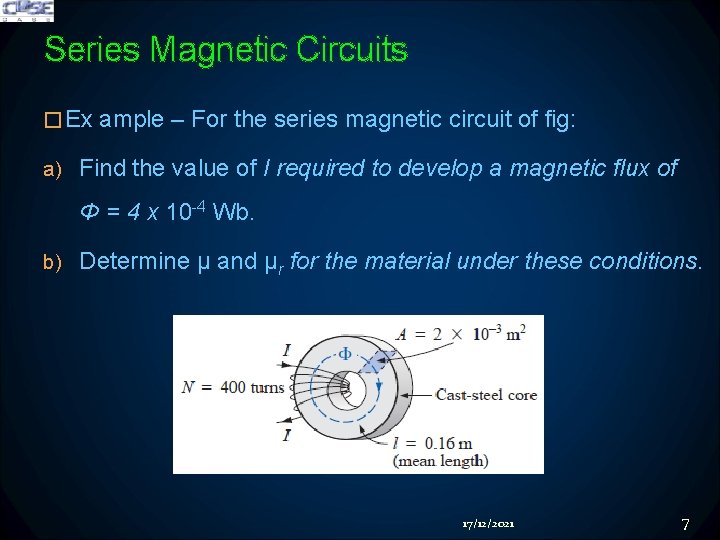
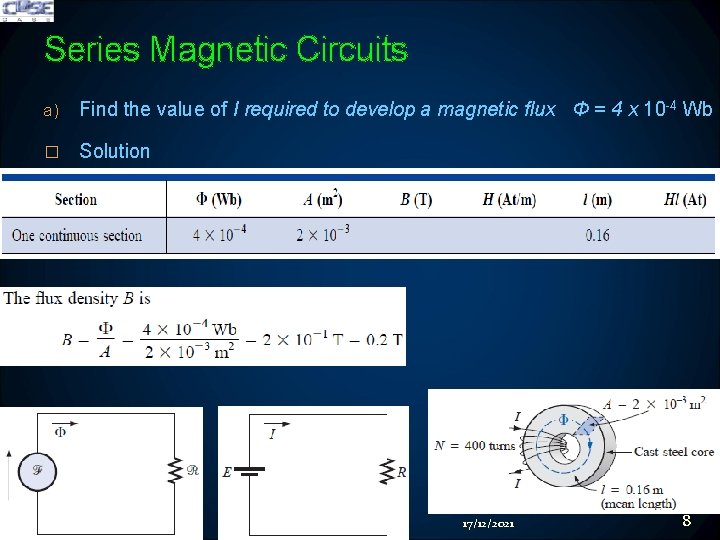
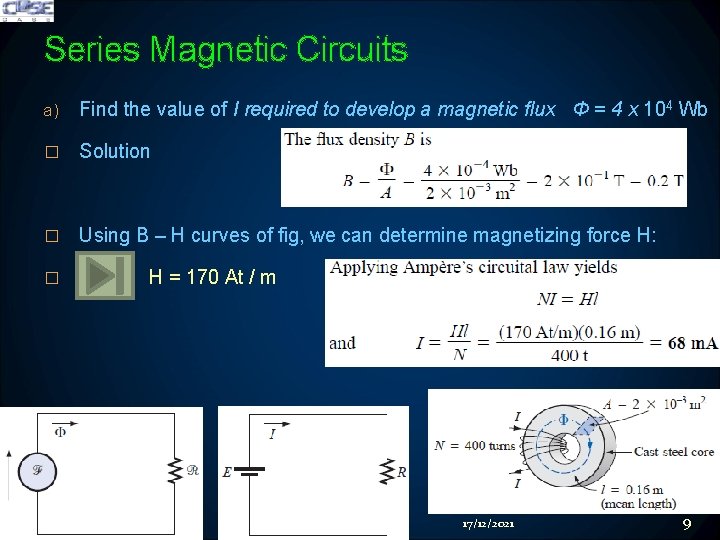
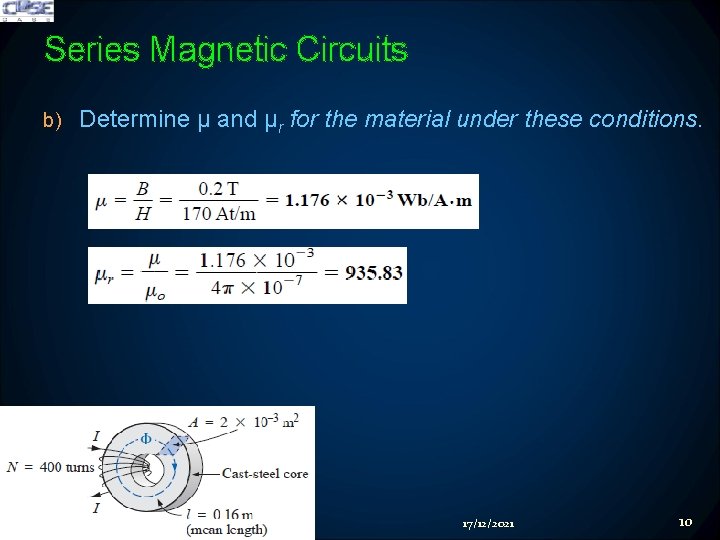
Series Magnetic Circuits � Ex ample – For the series magnetic circuit of fig: a) Find the value of I required to develop a magnetic flux of Φ = 4 x 10 -4 Wb. b) Determine μ and μr for the material under these conditions. 17/12/2021 7
Series Magnetic Circuits a) Find the value of I required to develop a magnetic flux Φ = 4 x 10 -4 Wb � Solution 17/12/2021 8
Series Magnetic Circuits a) Find the value of I required to develop a magnetic flux Φ = 4 x 10⁴ Wb � Solution � Using B – H curves of fig, we can determine magnetizing force H: � . H = 170 At / m 17/12/2021 9
Series Magnetic Circuits b) Determine μ and μr for the material under these conditions. 17/12/2021 10
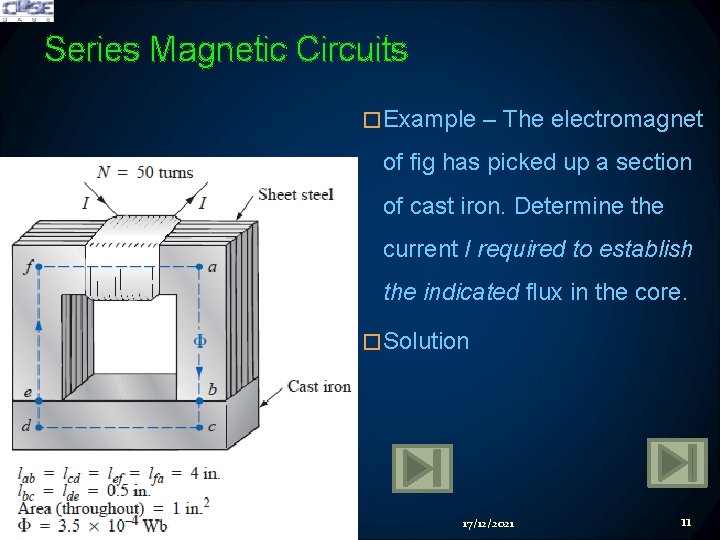
Series Magnetic Circuits �Example – The electromagnet of fig has picked up a section of cast iron. Determine the current I required to establish the indicated flux in the core. �Solution 17/12/2021 11
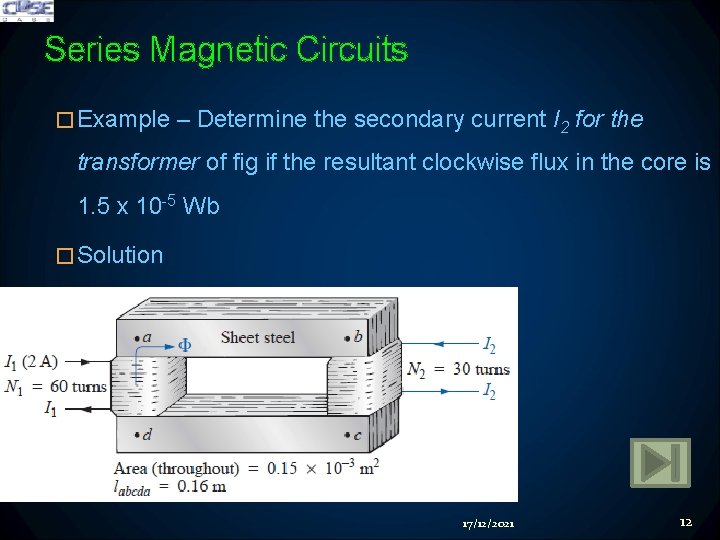
Series Magnetic Circuits �Example – Determine the secondary current I 2 for the transformer of fig if the resultant clockwise flux in the core is 1. 5 x 10 -5 Wb �Solution 17/12/2021 12
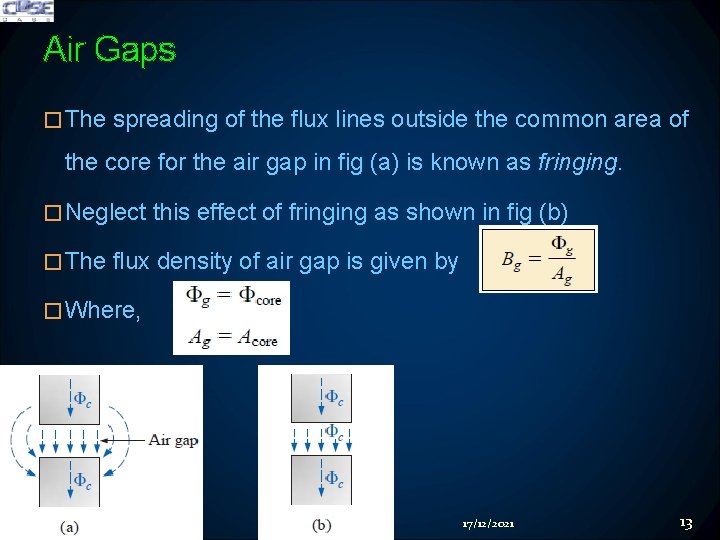
Air Gaps �The spreading of the flux lines outside the common area of the core for the air gap in fig (a) is known as fringing. �Neglect this effect of fringing as shown in fig (b) �The flux density of air gap is given by �Where, 17/12/2021 13
Air Gaps �For most practical applications, the permeability of air is taken to be equal to that of free space. The magnetizing force of the air gap is then determined by �and the mmf drop across the air gap is equal to Hglg. An equation for Hg is as follows: 17/12/2021 14
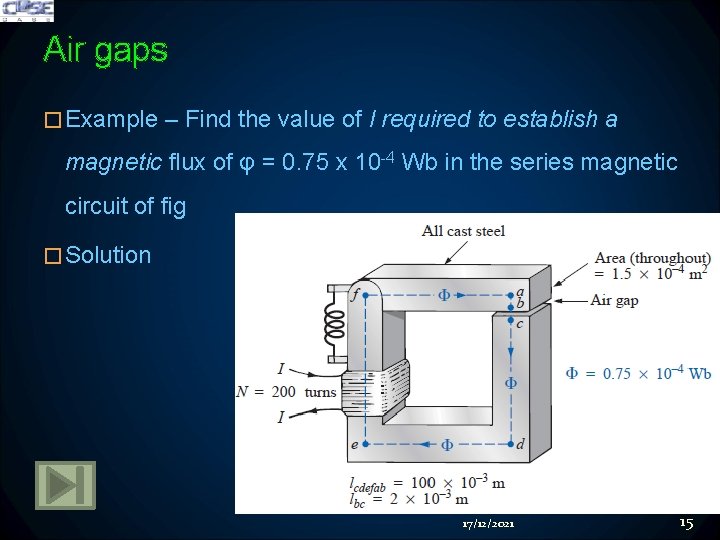
Air gaps �Example – Find the value of I required to establish a magnetic flux of φ = 0. 75 x 10 -4 Wb in the series magnetic circuit of fig �Solution 17/12/2021 15
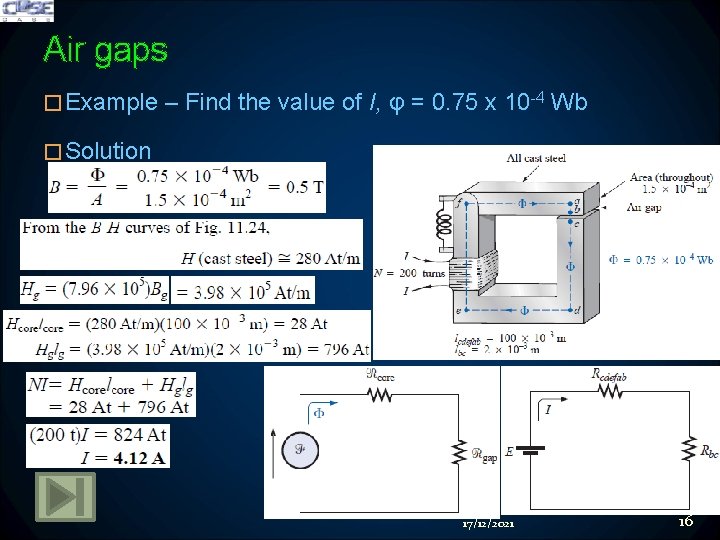
Air gaps �Example – Find the value of I, φ = 0. 75 x 10 -4 Wb �Solution 17/12/2021 16
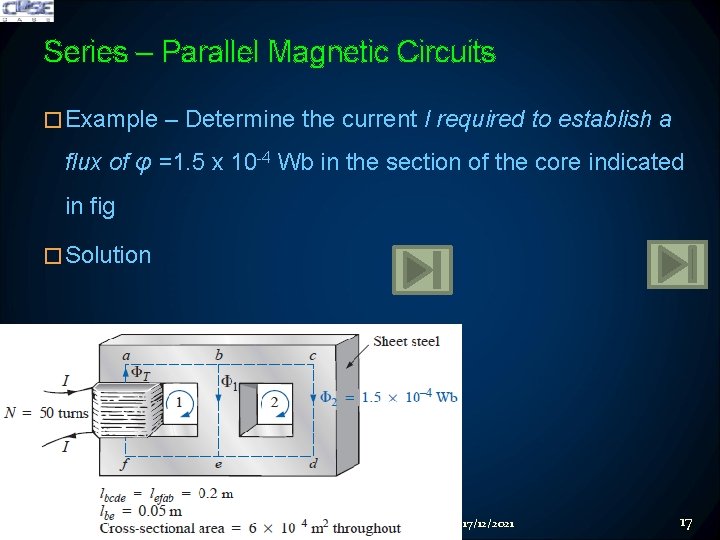
Series – Parallel Magnetic Circuits �Example – Determine the current I required to establish a flux of φ =1. 5 x 10 -4 Wb in the section of the core indicated in fig �Solution 17/12/2021 17
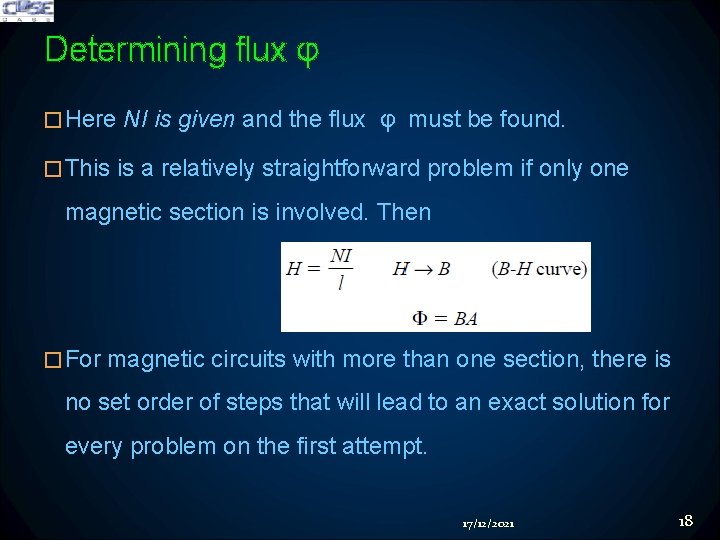
Determining flux φ �Here NI is given and the flux φ must be found. �This is a relatively straightforward problem if only one magnetic section is involved. Then �For magnetic circuits with more than one section, there is no set order of steps that will lead to an exact solution for every problem on the first attempt. 17/12/2021 18
Determining flux φ �We must find the impressed mmf for a calculated guess of flux φ and then compare this with specified value of mmf. �For most applications, a value within ± 5% of the actual Φ or specified NI is acceptable. �We can make a reasonable guess at the value of Φ if we realize that the maximum mmf drop appears across the material with the smallest permeability if the length and area of each material are the same. 17/12/2021 19
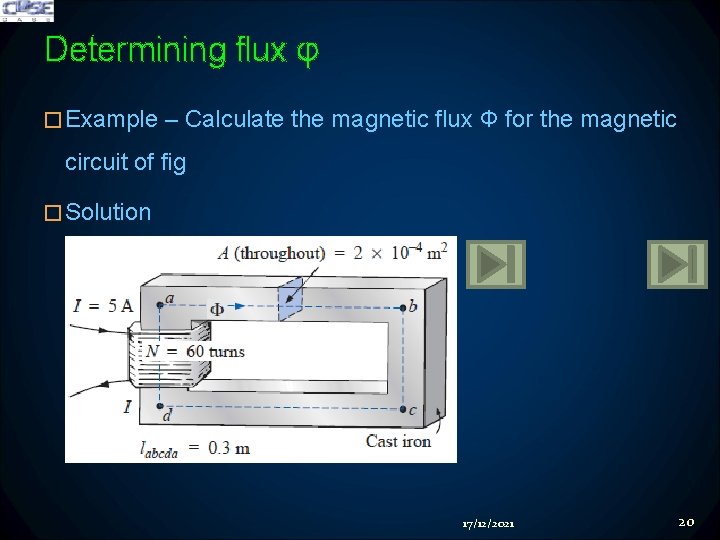
Determining flux φ �Example – Calculate the magnetic flux Φ for the magnetic circuit of fig �Solution 17/12/2021 20
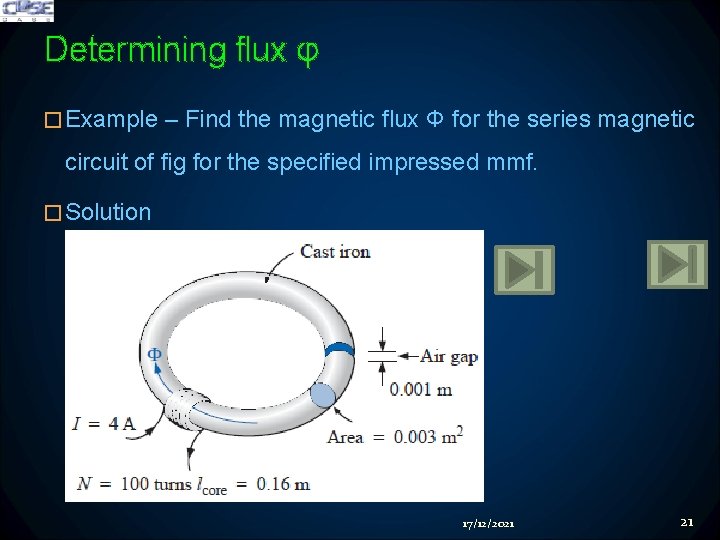
Determining flux φ �Example – Find the magnetic flux Φ for the series magnetic circuit of fig for the specified impressed mmf. �Solution 17/12/2021 21
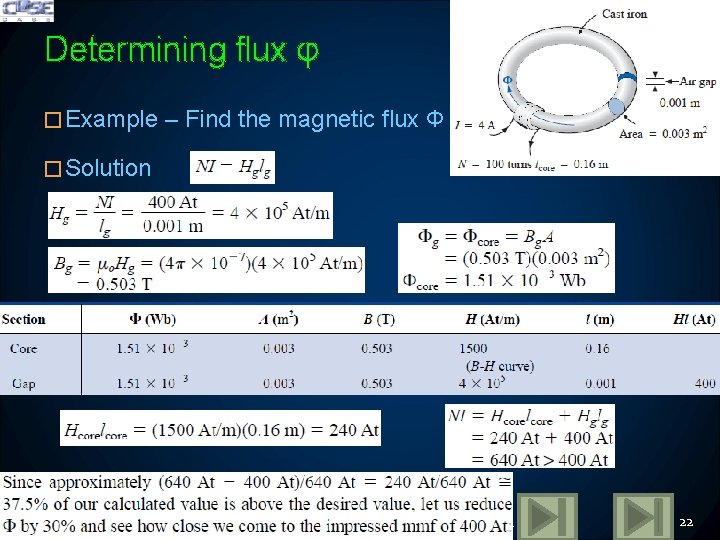
Determining flux φ �Example – Find the magnetic flux Φ �Solution 17/12/2021 22
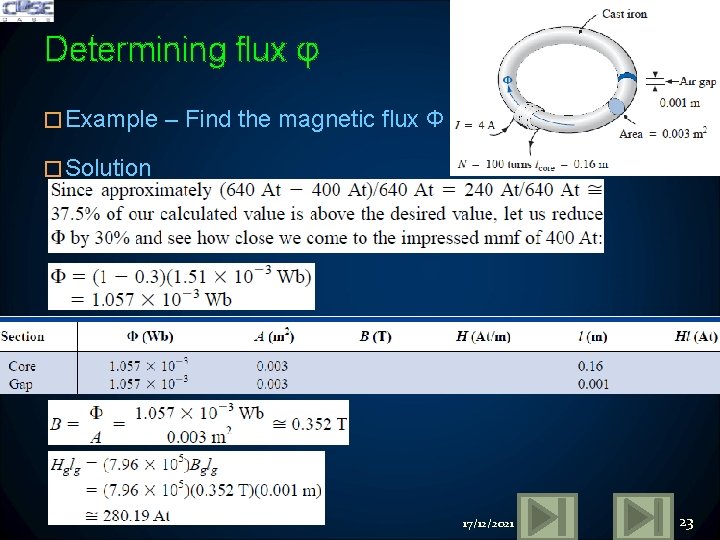
Determining flux φ �Example – Find the magnetic flux Φ �Solution 17/12/2021 23
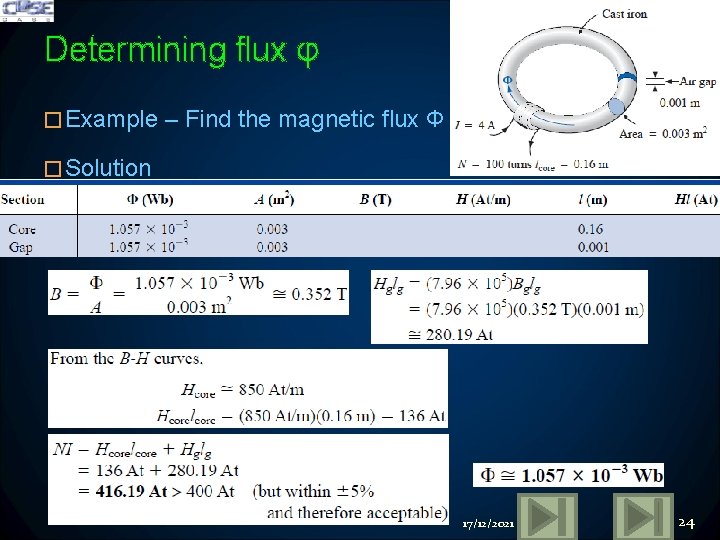
Determining flux φ �Example – Find the magnetic flux Φ �Solution 17/12/2021 24
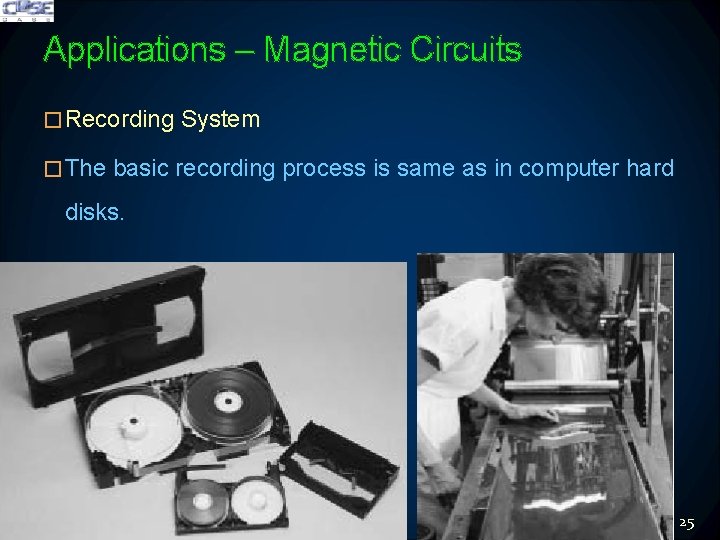
Applications – Magnetic Circuits � Recording System � The basic recording process is same as in computer hard disks. � 0. 003 m 2 �A � �� 17/12/2021 25
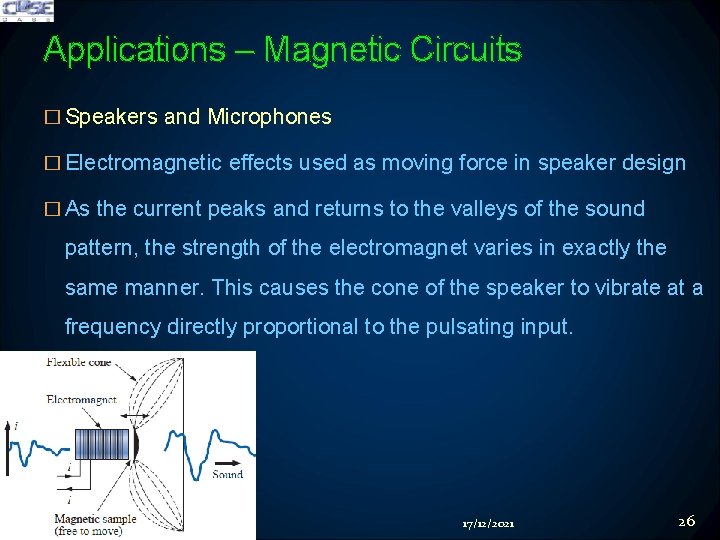
Applications – Magnetic Circuits � Speakers and Microphones � Electromagnetic effects used as moving force in speaker design � As the current peaks and returns to the valleys of the sound pattern, the strength of the electromagnet varies in exactly the same manner. This causes the cone of the speaker to vibrate at a frequency directly proportional to the pulsating input. 17/12/2021 26
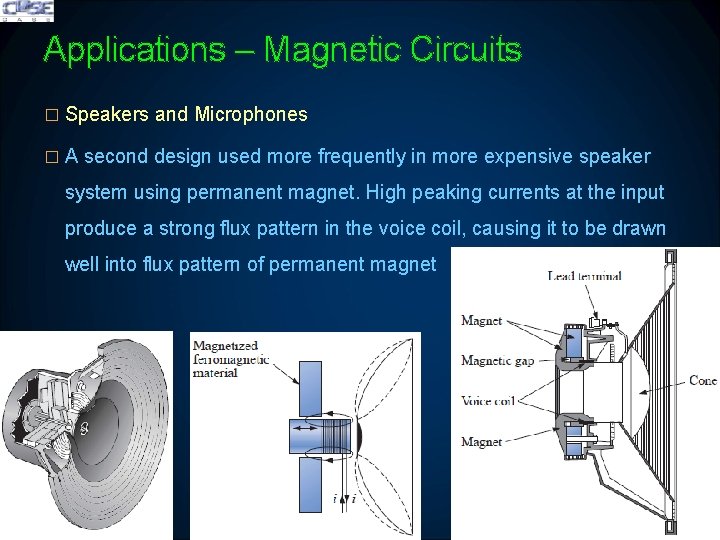
Applications – Magnetic Circuits � Speakers and Microphones � A second design used more frequently in more expensive speaker system using permanent magnet. High peaking currents at the input produce a strong flux pattern in the voice coil, causing it to be drawn well into flux pattern of permanent magnet 17/12/2021 27
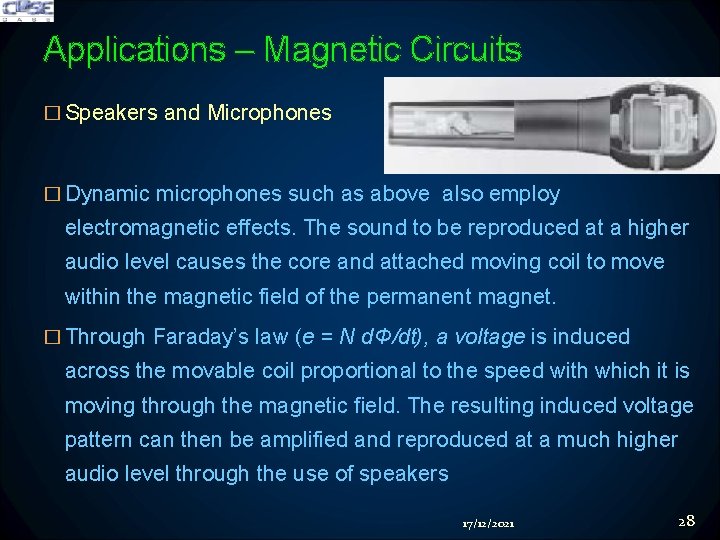
Applications – Magnetic Circuits � Speakers and Microphones � Dynamic microphones such as above also employ electromagnetic effects. The sound to be reproduced at a higher audio level causes the core and attached moving coil to move within the magnetic field of the permanent magnet. � Through Faraday’s law (e = N dΦ/dt), a voltage is induced across the movable coil proportional to the speed with which it is moving through the magnetic field. The resulting induced voltage pattern can then be amplified and reproduced at a much higher audio level through the use of speakers 17/12/2021 28
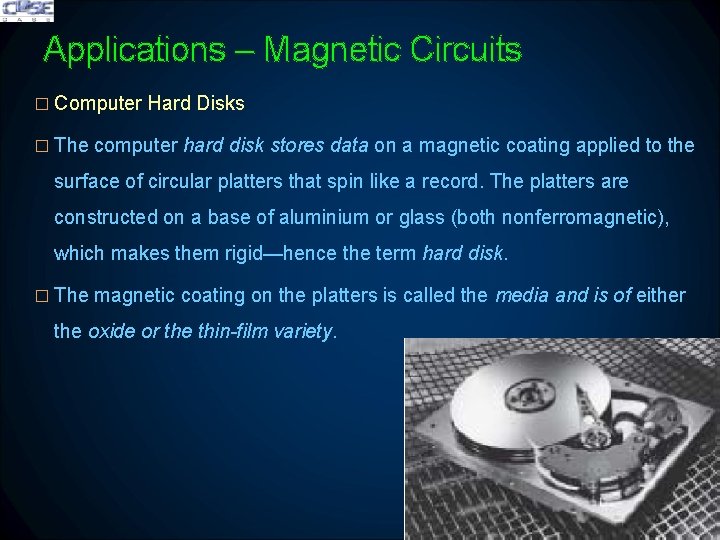
Applications – Magnetic Circuits � Computer Hard Disks � The computer hard disk stores data on a magnetic coating applied to the surface of circular platters that spin like a record. The platters are constructed on a base of aluminium or glass (both nonferromagnetic), which makes them rigid—hence the term hard disk. � The magnetic coating on the platters is called the media and is of either the oxide or the thin-film variety. 17/12/2021 29
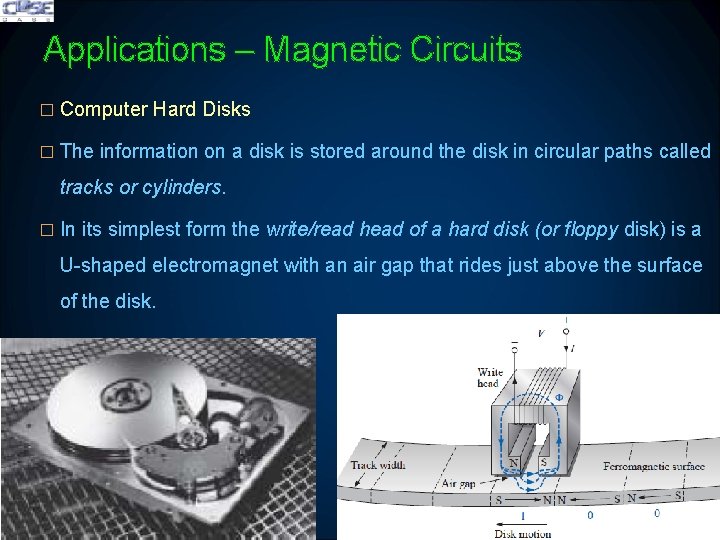
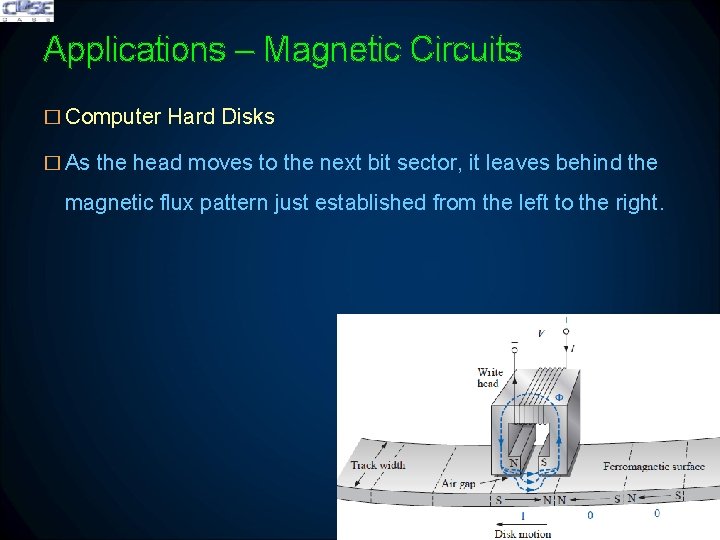
Applications – Magnetic Circuits � Computer Hard Disks � The information on a disk is stored around the disk in circular paths called tracks or cylinders. � In its simplest form the write/read head of a hard disk (or floppy disk) is a U-shaped electromagnet with an air gap that rides just above the surface of the disk. 17/12/2021 30
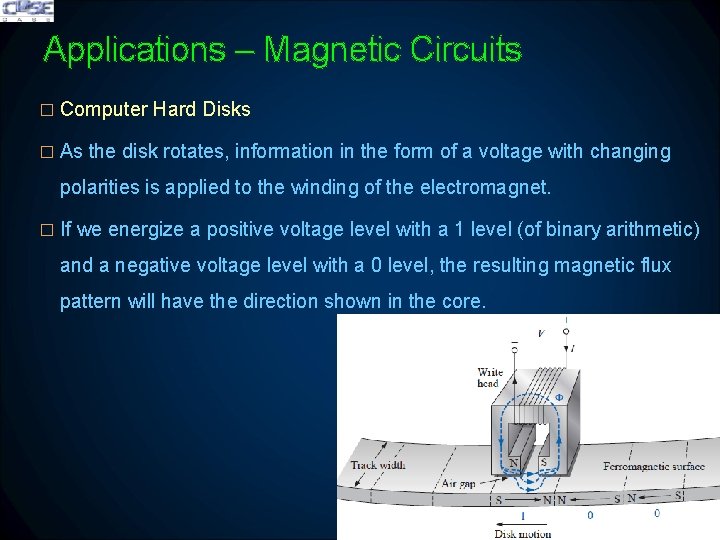
Applications – Magnetic Circuits � Computer Hard Disks � As the disk rotates, information in the form of a voltage with changing polarities is applied to the winding of the electromagnet. � If we energize a positive voltage level with a 1 level (of binary arithmetic) and a negative voltage level with a 0 level, the resulting magnetic flux pattern will have the direction shown in the core. 17/12/2021 31
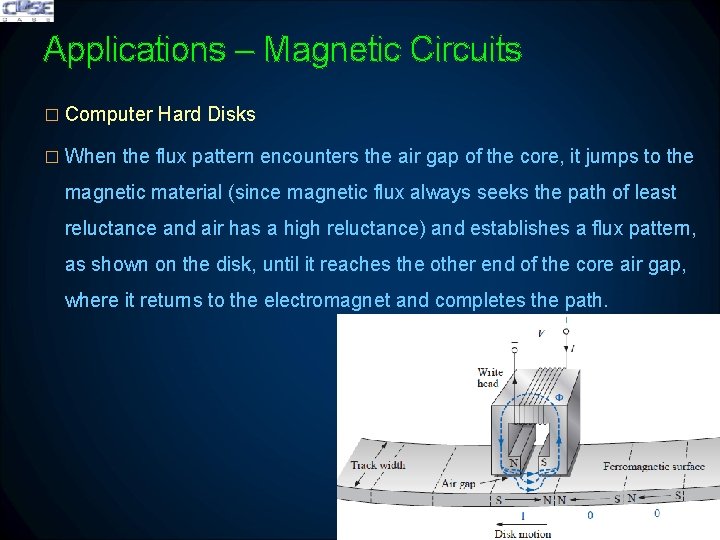
Applications – Magnetic Circuits � Computer Hard Disks � When the flux pattern encounters the air gap of the core, it jumps to the magnetic material (since magnetic flux always seeks the path of least reluctance and air has a high reluctance) and establishes a flux pattern, as shown on the disk, until it reaches the other end of the core air gap, where it returns to the electromagnet and completes the path. 17/12/2021 32
Applications – Magnetic Circuits � Computer Hard Disks � As the head moves to the next bit sector, it leaves behind the magnetic flux pattern just established from the left to the right. 17/12/2021 33
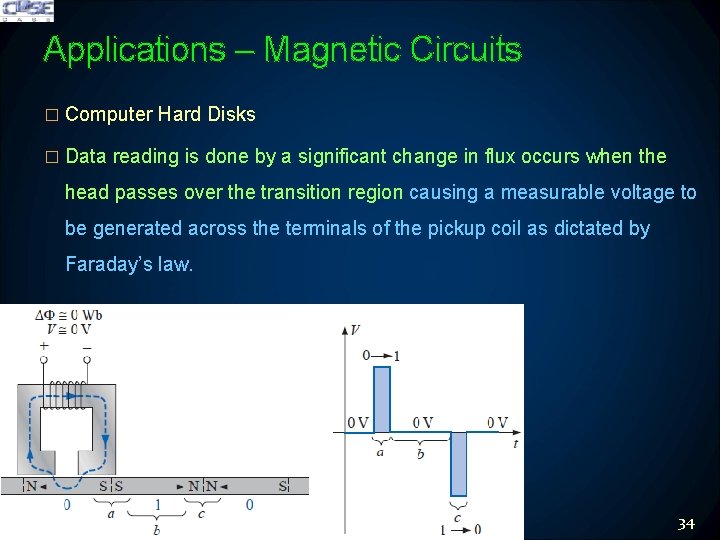
Applications – Magnetic Circuits � Computer Hard Disks � Data reading is done by a significant change in flux occurs when the head passes over the transition region causing a measurable voltage to be generated across the terminals of the pickup coil as dictated by Faraday’s law. 17/12/2021 34
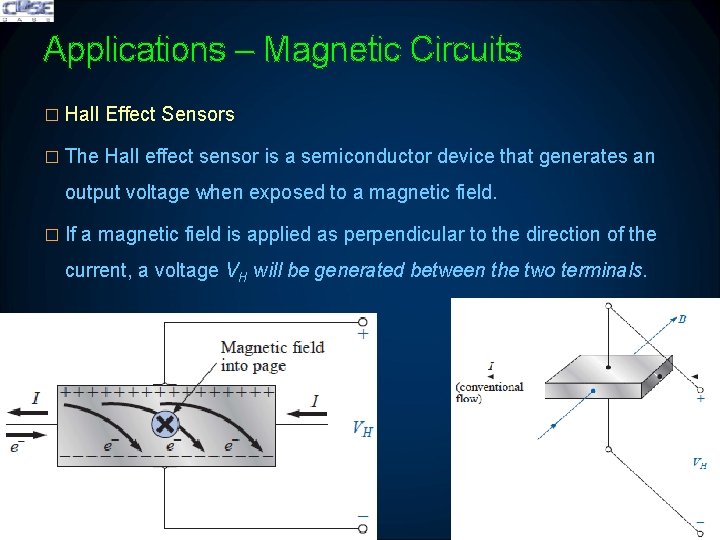
Applications – Magnetic Circuits � Hall Effect Sensors � The Hall effect sensor is a semiconductor device that generates an output voltage when exposed to a magnetic field. � If a magnetic field is applied as perpendicular to the direction of the current, a voltage VH will be generated between the two terminals. 17/12/2021 35
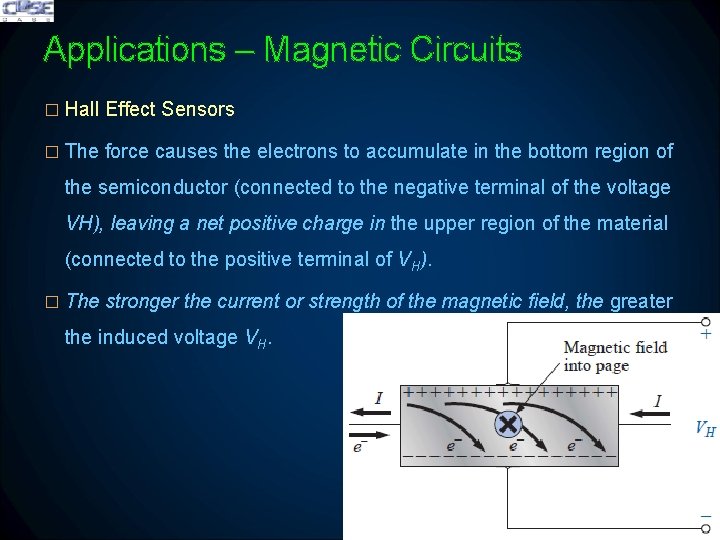
Applications – Magnetic Circuits � Hall Effect Sensors � The force causes the electrons to accumulate in the bottom region of the semiconductor (connected to the negative terminal of the voltage VH), leaving a net positive charge in the upper region of the material (connected to the positive terminal of VH). � The stronger the current or strength of the magnetic field, the greater the induced voltage VH. 17/12/2021 36
Applications – Magnetic Circuits � Hall Effect Sensors � The most widespread use of hall effect is as a trigger for an alarm system in large department stores, where theft is often a difficult problem. � A magnetic strip attached to the merchandise sounds an alarm when a customer passes through the exit gates without paying for the product. � The sensor, control current, and monitoring system are housed in the exit fence and react to the presence of the magnetic field as the product leaves the store. � When the product is paid for, the cashier removes the strip or demagnetizes the strip by applying a magnetizing force that reduces the residual magnetism in the strip to essentially zero. 17/12/2021 37
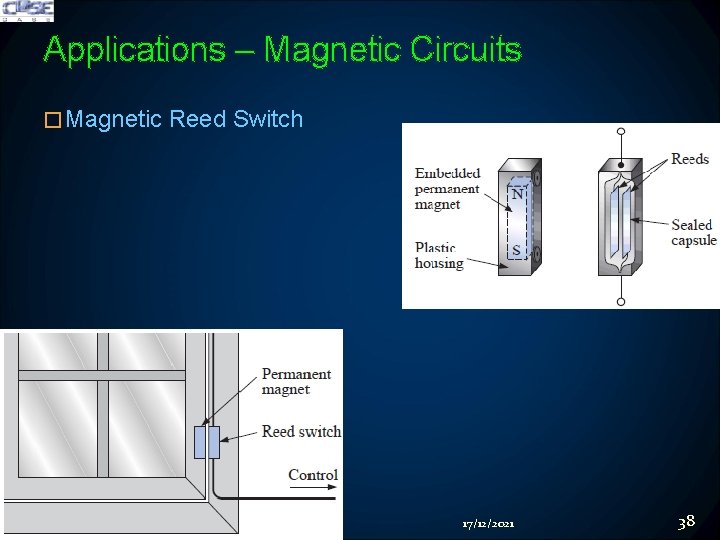
Applications – Magnetic Circuits �Magnetic Reed Switch 17/12/2021 38
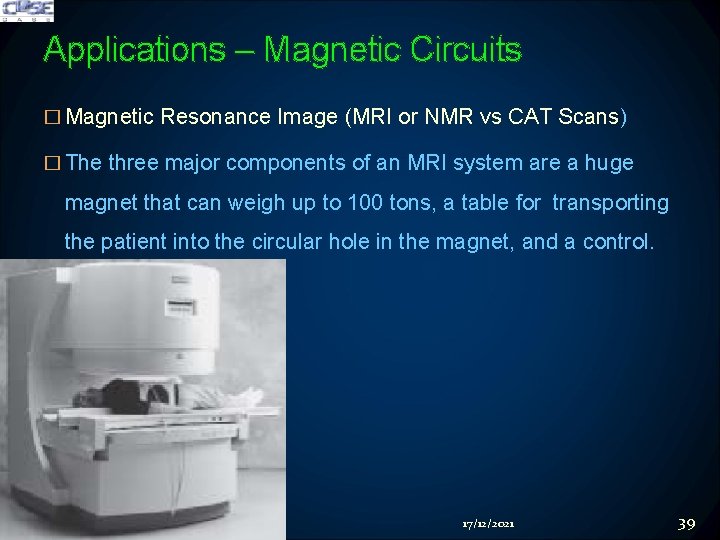
Applications – Magnetic Circuits � Magnetic Resonance Image (MRI or NMR vs CAT Scans) � The three major components of an MRI system are a huge magnet that can weigh up to 100 tons, a table for transporting the patient into the circular hole in the magnet, and a control. 17/12/2021 39
Applications – Magnetic Circuits � Magnetic Resonance Image (MRI or NMR vs CAT Scans) � A strong magnetic field that causes the nuclei of certain atoms in the body to line up. � Radio waves of different frequencies are then applied to the patient in the region of interest, and if the frequency of the wave matches the natural frequency of the atom, the nuclei will be set into a state of resonance and will absorb energy from the applied signal. 17/12/2021 40
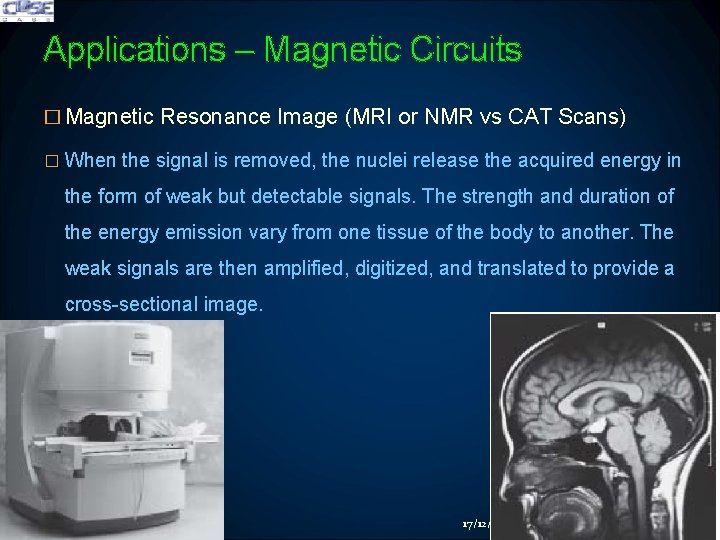
Applications – Magnetic Circuits � Magnetic Resonance Image (MRI or NMR vs CAT Scans) � When the signal is removed, the nuclei release the acquired energy in the form of weak but detectable signals. The strength and duration of the energy emission vary from one tissue of the body to another. The weak signals are then amplified, digitized, and translated to provide a cross-sectional image. 17/12/2021 41
Summary / Conclusion �Ampere’s Circuital Law – (Applying KVL) �The Flux Φ – (Applying KCL) �Series Magnetic Circuits �Air Gaps �Series-Parallel Magnetic Circuits �Determining Flux Φ �Applications
17/12/2021 43