
Electoral Reforms Financing of Elections and Political Parties

- Slides: 21
Electoral Reforms: Financing of Elections and Political Parties Presenter Name: Gurpreet Presentation Date: 13 th 2014 Rakshak Foundation. All Rights Reserved. Singh July, 2014
Contents v Introduction v Main Problems v Goals and Objectives v Learning from international experience ü Germany ü France model Model v Recommendations v References 2014 Rakshak Foundation. All Rights Reserved. 2
Introduction Electoral reform is change in electoral systems to improve how public desires are expressed in election results. These reforms can include following: Ø Voting Systems • First past the post • Proportional representation • Two round system Ø Vote-Counting procedures Ø Ballot design and Voting equipment Ø Election Monitoring rules Ø Financing of elections and political parties 2014 Rakshak Foundation. All Rights Reserved.
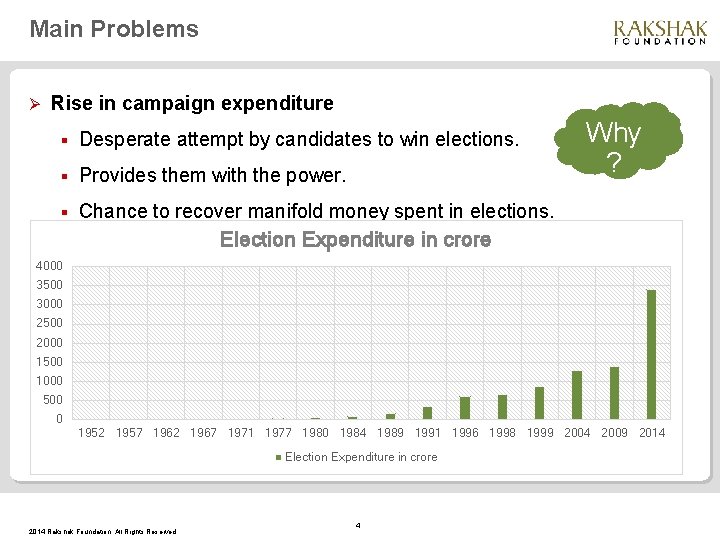
Main Problems Ø Rise in campaign expenditure § Desperate attempt by candidates to win elections. § Provides them with the power. § Chance to recover manifold money spent in elections. Why ? Election Expenditure in crore 4000 3500 3000 2500 2000 1500 1000 500 0 1952 1957 1962 1967 1971 1977 1980 1984 1989 1991 1996 1998 1999 2004 2009 2014 Election Expenditure in crore 2014 Rakshak Foundation. All Rights Reserved. 4
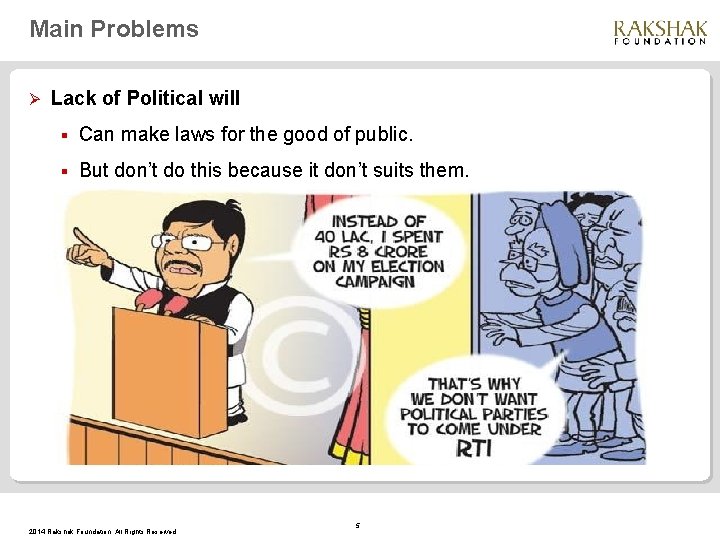
Main Problems Ø Lack of Political will § Can make laws for the good of public. § But don’t do this because it don’t suits them. 2014 Rakshak Foundation. All Rights Reserved. 5
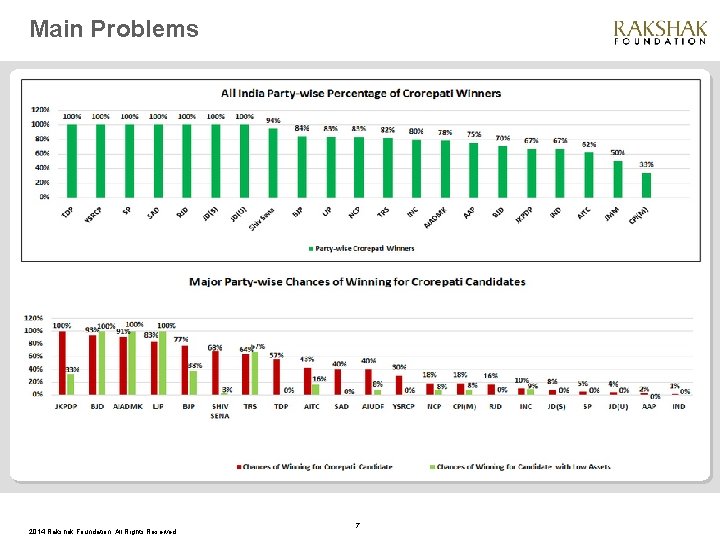
Main Problems Ø Merit of no consequence § Select candidates not on basis of merit but winnability factor. § Give tickets to candidates who can spend more money in elections. § Enhances corruption and election expenses § Crorepati Winners : Out of the 542 winners analysed , 443(82%) are crorepatis. Out of 521 winners analysed during Lok Sabha 2009 elections , 300 (58%) winners were crorepatis. § Chances of Winning for Crorepati Candidates : The chances of winning for a crorepati candidate in the Lok Sabha 2014 elections are 20% whereas for a candidate with low assets (<Rs. 1 crore) it is 2%. 2014 Rakshak Foundation. All Rights Reserved. 6
Main Problems 2014 Rakshak Foundation. All Rights Reserved. 7
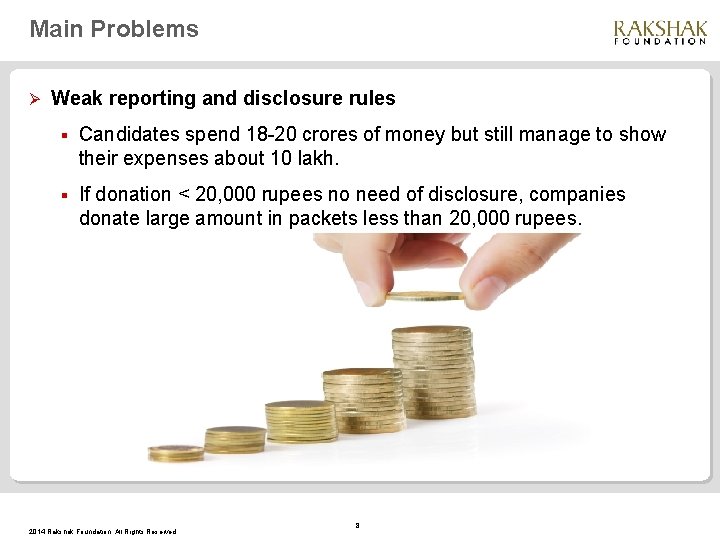
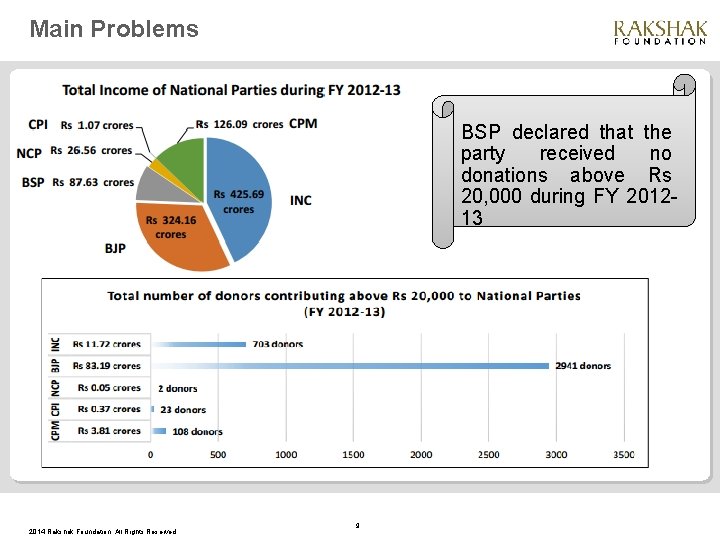
Main Problems Ø Weak reporting and disclosure rules § Candidates spend 18 -20 crores of money but still manage to show their expenses about 10 lakh. § If donation < 20, 000 rupees no need of disclosure, companies donate large amount in packets less than 20, 000 rupees. 2014 Rakshak Foundation. All Rights Reserved. 8
Main Problems BSP declared that the party received no donations above Rs 20, 000 during FY 201213 2014 Rakshak Foundation. All Rights Reserved. 9
Objectives v The Main Objective of this Project is suggesting some strict reporting rules to lessen the use of money in elections. v To bring transparency in the donations received by the political parties especially in the corporate funding. v Suggestions to enhance the individual donations. v To study state funding in detail and discuss its advantages and limitations. 2014 Rakshak Foundation. All Rights Reserved. 10
Germany Model Ø Public funding • Given to parties having vote share of 0. 5% in national election or 1% in state election. • Ceiling of 133 million euros. • Funding of 0. 70 euros for 1 vote. Ø Private funding • No limit • Donations from charitable agencies not allowed. • Individuals can claim tax credit of some percentage of donation. 2014 Rakshak Foundation. All Rights Reserved. 11
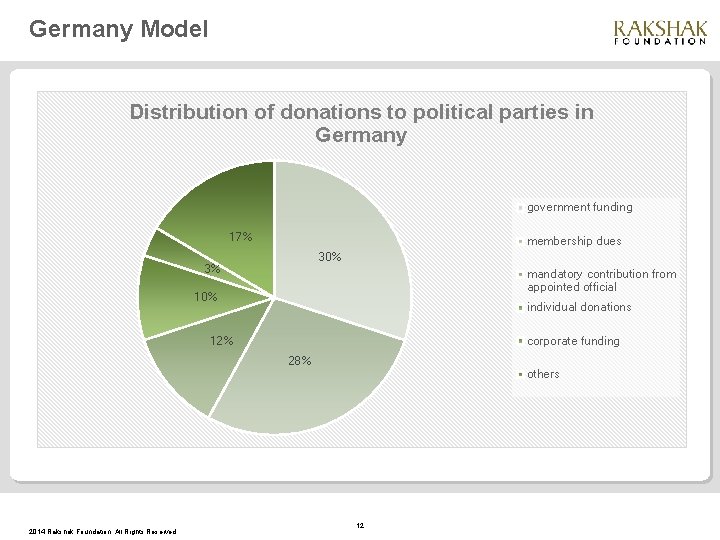
Germany Model Distribution of donations to political parties in Germany government funding 17% membership dues 30% 3% mandatory contribution from appointed official 10% individual donations corporate funding 12% 28% 2014 Rakshak Foundation. All Rights Reserved. others 12
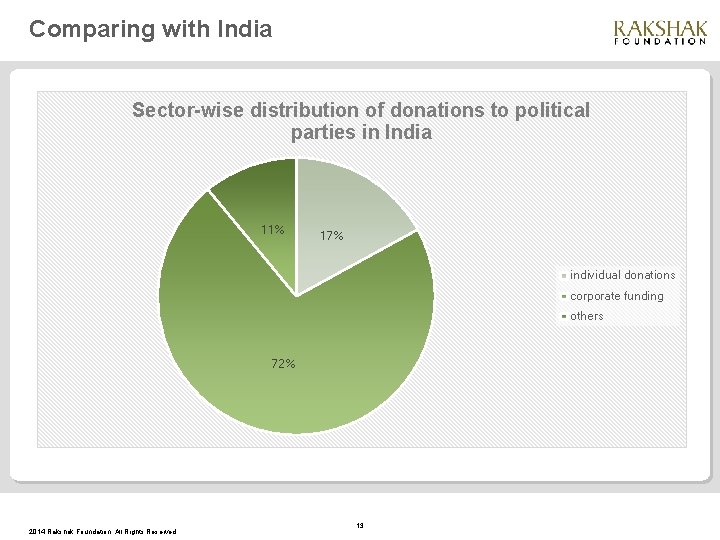
Comparing with India Sector-wise distribution of donations to political parties in India 11% 17% individual donations corporate funding others 72% 2014 Rakshak Foundation. All Rights Reserved. 13
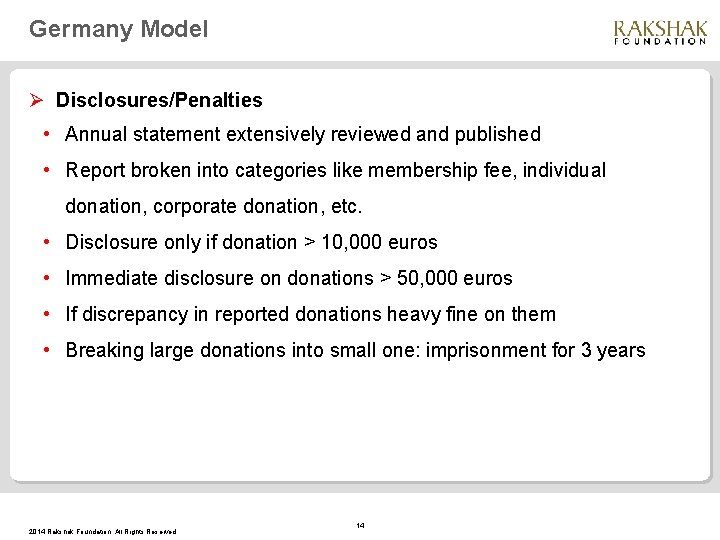
Germany Model Ø Disclosures/Penalties • Annual statement extensively reviewed and published • Report broken into categories like membership fee, individual donation, corporate donation, etc. • Disclosure only if donation > 10, 000 euros • Immediate disclosure on donations > 50, 000 euros • If discrepancy in reported donations heavy fine on them • Breaking large donations into small one: imprisonment for 3 years 2014 Rakshak Foundation. All Rights Reserved. 14
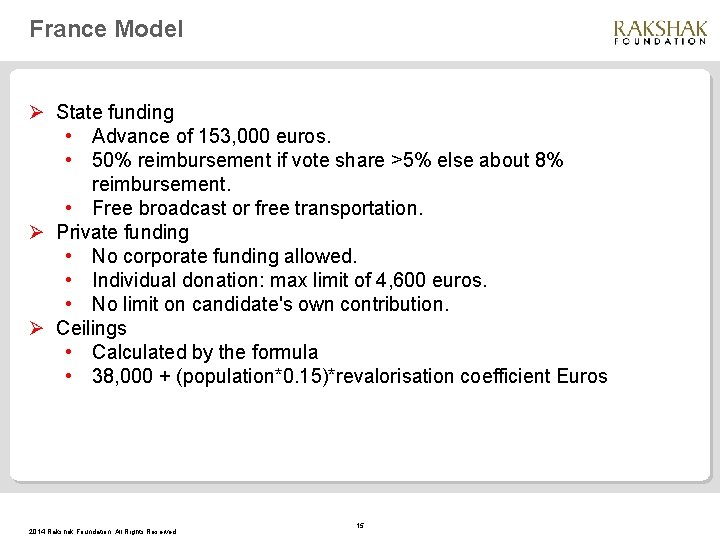
France Model Ø State funding • Advance of 153, 000 euros. • 50% reimbursement if vote share >5% else about 8% reimbursement. • Free broadcast or free transportation. Ø Private funding • No corporate funding allowed. • Individual donation: max limit of 4, 600 euros. • No limit on candidate's own contribution. Ø Ceilings • Calculated by the formula • 38, 000 + (population*0. 15)*revalorisation coefficient Euros 2014 Rakshak Foundation. All Rights Reserved. 15
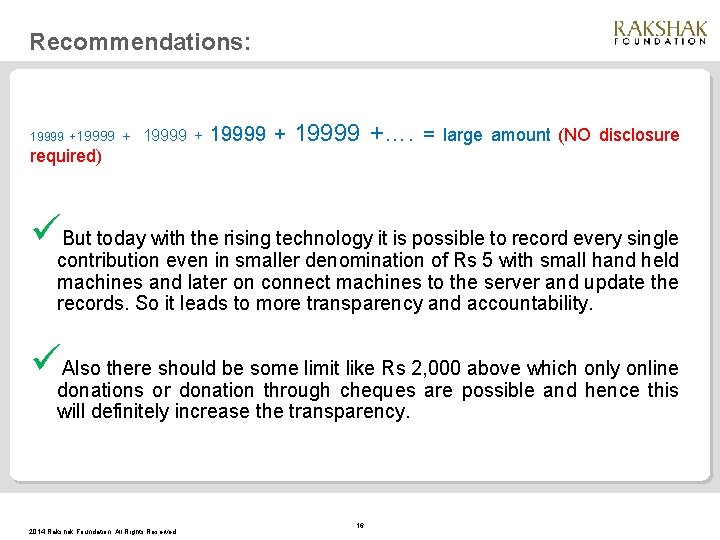
Recommendations: 19999 + required) 19999 +…. = large amount (NO disclosure üBut today with the rising technology it is possible to record every single contribution even in smaller denomination of Rs 5 with small hand held machines and later on connect machines to the server and update the records. So it leads to more transparency and accountability. üAlso there should be some limit like Rs 2, 000 above which only online donations or donation through cheques are possible and hence this will definitely increase the transparency. 2014 Rakshak Foundation. All Rights Reserved. 16
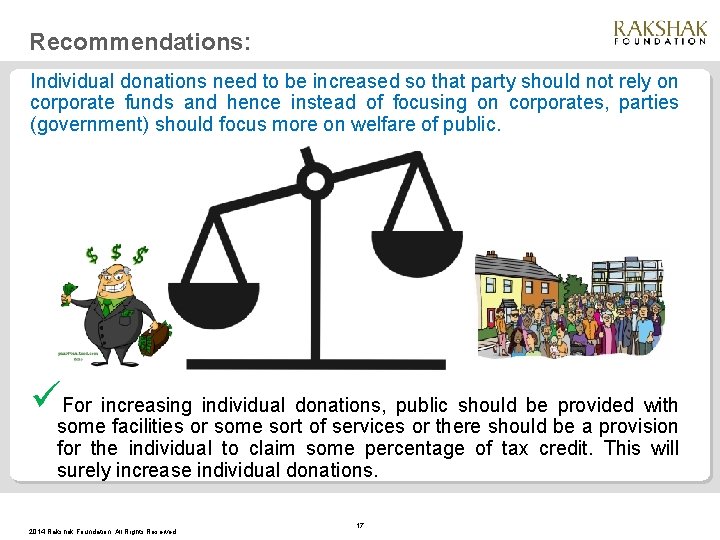
Recommendations: Individual donations need to be increased so that party should not rely on corporate funds and hence instead of focusing on corporates, parties (government) should focus more on welfare of public. üFor increasing individual donations, public should be provided with some facilities or some sort of services or there should be a provision for the individual to claim some percentage of tax credit. This will surely increase individual donations. 2014 Rakshak Foundation. All Rights Reserved. 17
Recommendations: Candidates spend up to 20 crores but still manage to show their expenses about 10 lakhs. Freebies are banned but still candidates distribute freebies in form of alcohol, drugs, etc. how’s this possible? weak expenditure monitoring that is mainly due to less man power and also political pressure. üIncrease the manpower. If not permanent, then just hire temporary manpower that would include mainly people who are unemployed for the period of election. These people would also be more efficient as they would be from the society itself and they will not face any political pressure. 2014 Rakshak Foundation. All Rights Reserved. 18
Recommendations: Strict reporting, disclosure rules should be there and parties or candidates not following them should be penalized heavily. üRoutine verification/auditing of the return of expenses and make them public. üif there is discrepancy in the actual donations of party that is monitored and the reported donations then the party need to pay a fine three times the difference between actual and reported donation. üIf someone tries to break a large amount of donation into small packets, strict action should be taken against him/her may be imprisonment. 2014 Rakshak Foundation. All Rights Reserved. 19
Recommendations: üIn a period of 5 year political parties are getting donations and funds continuously and it gets more and more difficult to monitor this and hence leads to great unaccountable money. Suggestion: donations can only be done to the parties in the preceding year of elections, so that it becomes easy to monitor all these transactions. üMedia should play active role in terms of reporting as it is playing in other policy issues. 2014 Rakshak Foundation. All Rights Reserved. 20
2014 Rakshak Foundation. All Rights Reserved. 21