
Elections and Voting 12 Learning Objectives 12 12
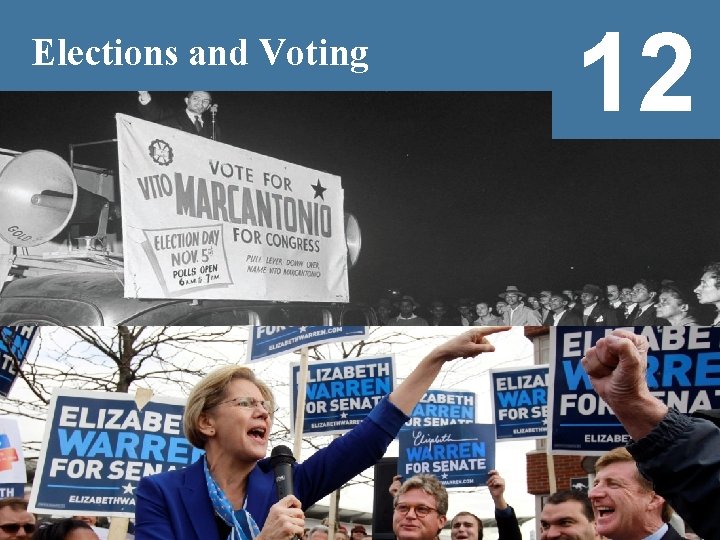
Elections and Voting 12
Learning Objectives 12 12. 1 Trace the roots of American elections, and distinguish among the four different types of elections 12. 2 Outline the electoral procedures for presidential and general elections
Learning Objectives 12 12. 3 Compare and contrast congressional and presidential elections, and explain the incumbency advantage 12. 4 Identify seven factors that influence voter choice
Learning Objectives 12 12. 5 Identify six factors that affect voter turnout 12. 6 Explain why voter turnout is low, and evaluate methods for improving voter turnout
Roots of American Elections ¤ Purposes of Elections ¤ Types of Elections 12. 1
Purposes of Elections 12. 1 ¤ Popular election n Provides unique legitimacy to government n Proof of popular sovereignty, or consent of the governed n Electorate, or citizens eligible to vote, judge those in power ¤ Fill public offices n Elections provide voters a choice in policy n Winners claim a mandate, or command from the voters to enact their policy platform
Types of Elections ¤ Primary Elections n Closed primaries n Open primaries – crossover voting n Runoff primary ¤ General Election 12. 1
Types of Elections ¤ Initiative and Referendum Initiative placed on ballot by citizens Referendum placed on ballot by legislature ¤ Recall 12. 1
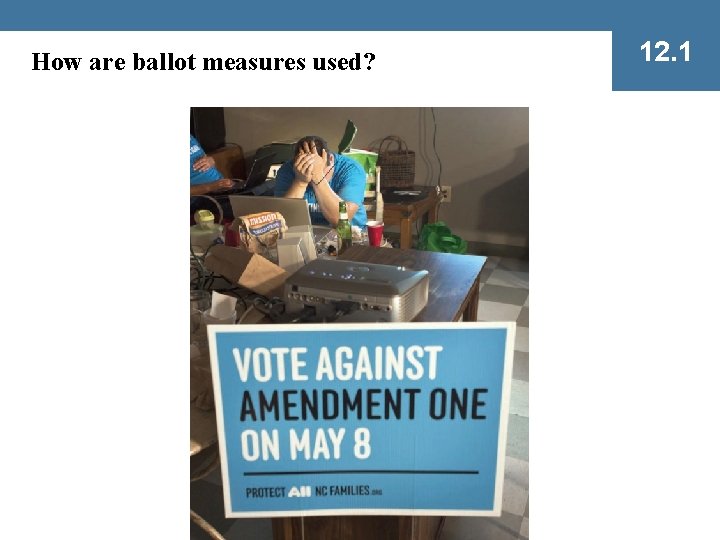
How are ballot measures used? 12. 1
12. 1 When state lawmakers place a proposal on the ballot for voter approval, it is called a: a. Open primary b. Initiative c. Referendum d. Recall 12. 1
12. 1 When state lawmakers place a proposal on the ballot for voter approval, it is called a: a. Open primary b. Initiative c. Referendum d. Recall 12. 1
Presidential Elections 12. 2 ¤ Primaries and Caucuses ¤ Electing a President: The Electoral College
Primaries and Caucuses ¤ Methods to select delegates n Winner-take-all primary n Proportional representation primary n Caucus ¤ Selecting a system ¤ Frontloading 12. 2
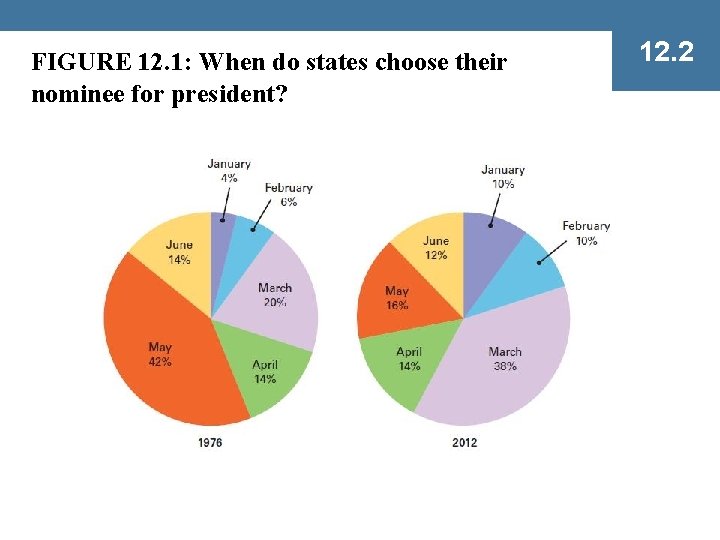
FIGURE 12. 1: When do states choose their nominee for president? 12. 2
Electing a President: The Electoral College ¤ Historical challenges n Thomas Jefferson and Aaron Burr, 1800 n John Quincy Adams and Andrew Jackson, 1824 n George W. Bush and Al Gore, 2000 12. 2
Electing a President: The Electoral College 12. 2 ¤ Should the Electoral College be reformed? n Abolish in favor of popular vote n Congressional district plan
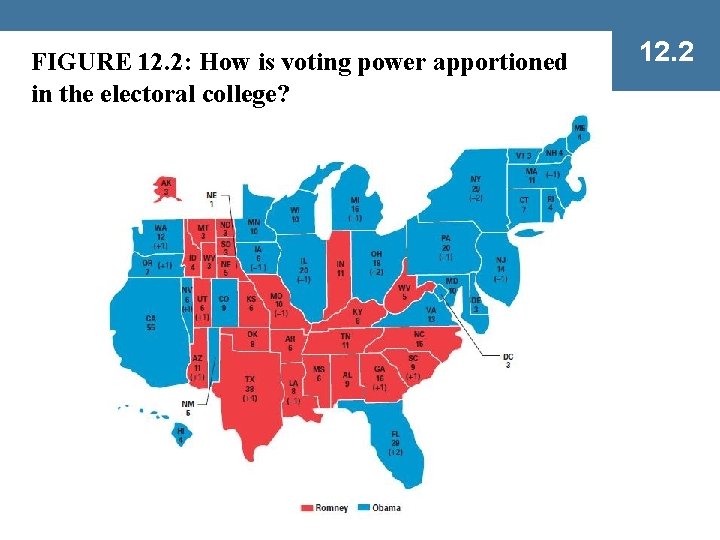
FIGURE 12. 2: How is voting power apportioned in the electoral college? 12. 2
12. 2 The numbers of electors from each 12. 2 state to the Electoral College is: a. Equivalent to the number of representatives b. Equivalent to the number of representatives and senators c. Equivalent to the number of congressional districts a candidate wins, plus two bonus electors for the overall popular vote winner d. None of the above
12. 2 The numbers of electors from each 12. 2 state to the Electoral College is: a. Equivalent to the number of representatives b. Equivalent to the number of representatives and senators c. Equivalent to the number of congressional districts a candidate wins, plus two bonus electors for the overall popular vote winner d. None of the above
Congressional Elections ¤ The Incumbency Advantage ¤ Why Incumbents Lose 12. 3
The Incumbency Advantage ¤ Staff Support ¤ Visibility ¤ Scare-off effect 12. 3
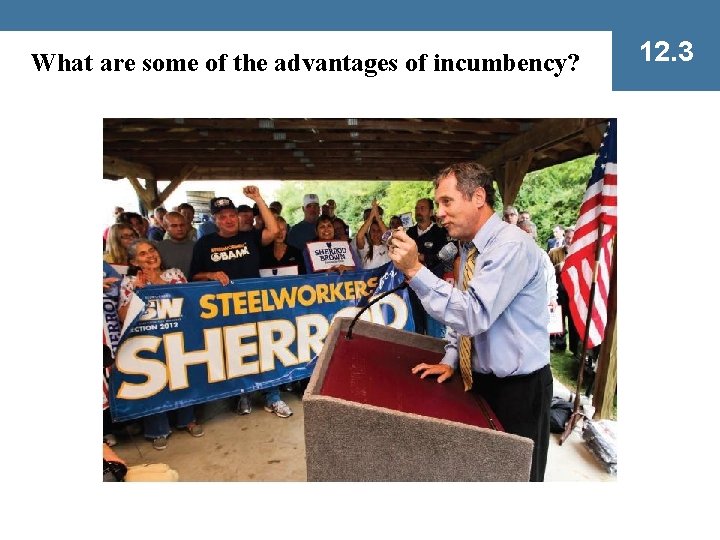
What are some of the advantages of incumbency? 12. 3
Why Incumbents Lose ¤ ¤ Redistricting Scandals Presidential Coattails Mid-Term Elections 12. 3
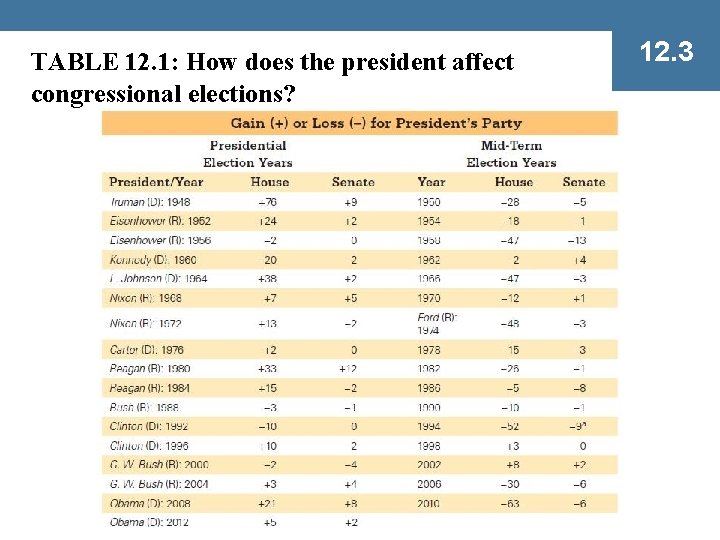
TABLE 12. 1: How does the president affect congressional elections? 12. 3
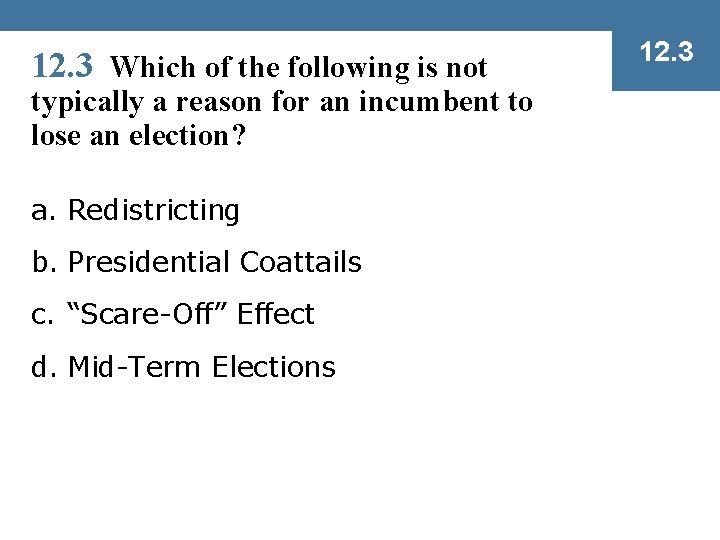
12. 3 Which of the following is not typically a reason for an incumbent to lose an election? a. Redistricting b. Presidential Coattails c. “Scare-Off” Effect d. Mid-Term Elections 12. 3
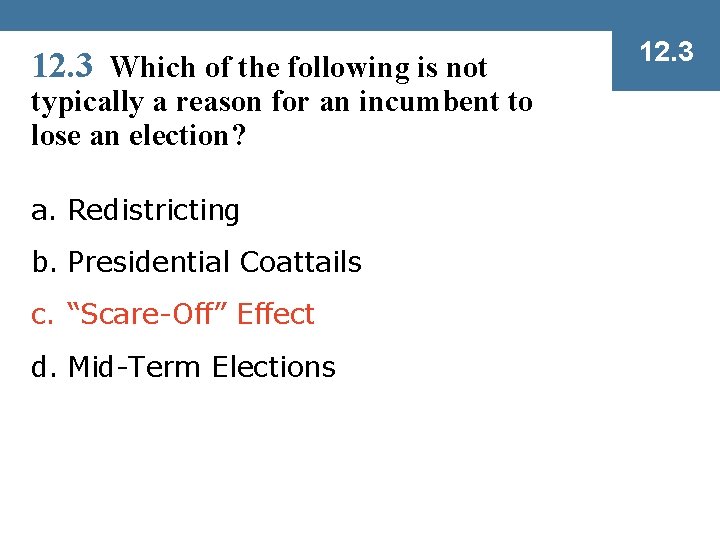
12. 3 Which of the following is not typically a reason for an incumbent to lose an election? a. Redistricting b. Presidential Coattails c. “Scare-Off” Effect d. Mid-Term Elections 12. 3
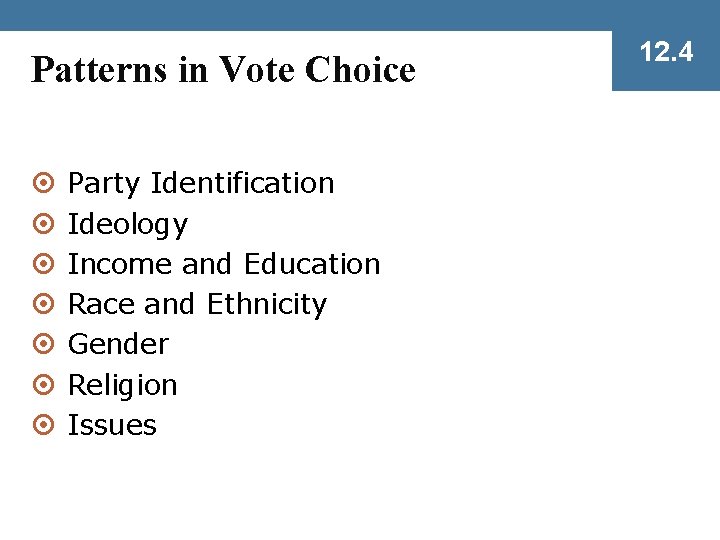
Patterns in Vote Choice ¤ ¤ ¤ ¤ Party Identification Ideology Income and Education Race and Ethnicity Gender Religion Issues 12. 4
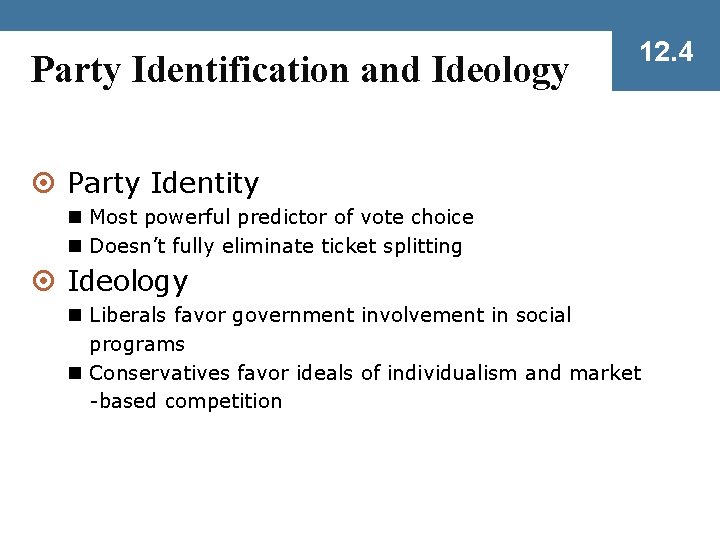
Party Identification and Ideology 12. 4 ¤ Party Identity n Most powerful predictor of vote choice n Doesn’t fully eliminate ticket splitting ¤ Ideology n Liberals favor government involvement in social programs n Conservatives favor ideals of individualism and market -based competition
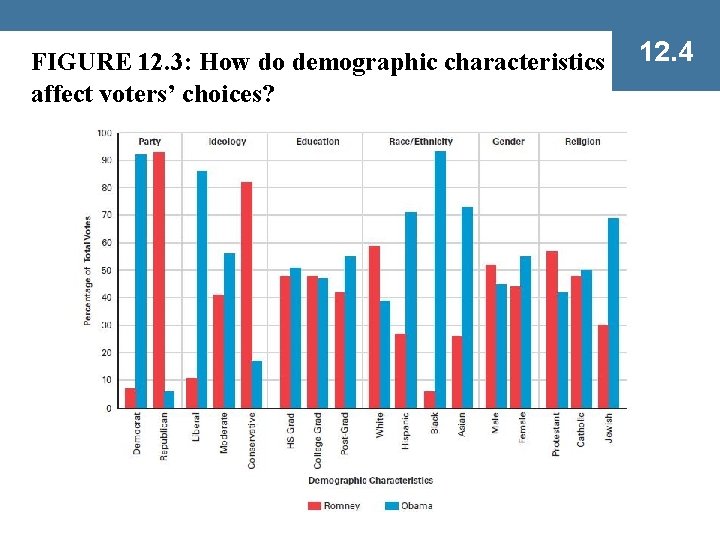
FIGURE 12. 3: How do demographic characteristics affect voters’ choices? 12. 4
Income and Education ¤ Lower income voters n Tend to vote Democratic ¤ Higher income voters n Tend to vote Republican ¤ Education n Most educated and least educated tend to vote Democratic n Voters in the middle, such as those with a bachelor’s degree, tend to vote Republican 12. 4
Race, Ethnicity and Gender ¤ Race n Whites more likely to vote Republican n African Americans and Hispanics more likely to vote Democratic ¤ Gender n Women more likely to vote Democratic n Men more likely to vote Republican 12. 4
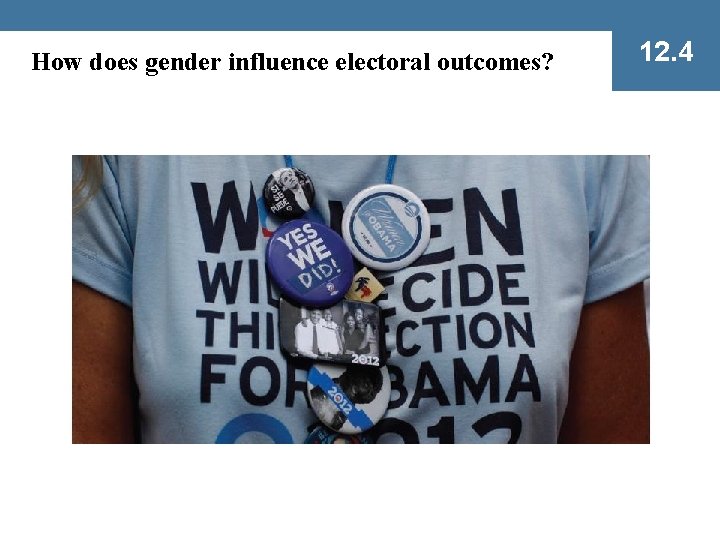
How does gender influence electoral outcomes? 12. 4
Religion and other Issues ¤ Religion n Jewish voters strong Democratic Party supporters n Protestants more likely to vote Republican n Catholics divided – social justice versus abortion ¤ Other Issues n Economy often key issue n Retrospective judgment versus prospective judgment 12. 4
12. 4 When voters reward or punish a political party at the polls based on paast achievements or failures, they are using what? a. Ticket-splitting b. Retrospective judgment c. Prospective judgment d. None of the above 12. 4
12. 4 When voters reward or punish a political party at the polls based on past achievements or failures, they are using what? a. Ticket-splitting b. Retrospective judgment c. Prospective judgment d. None of the above 12. 4
Voter Turnout ¤ ¤ ¤ Income and Education Race and Ethnicity Gender Age Civic Engagement Interest in Politics 12. 5
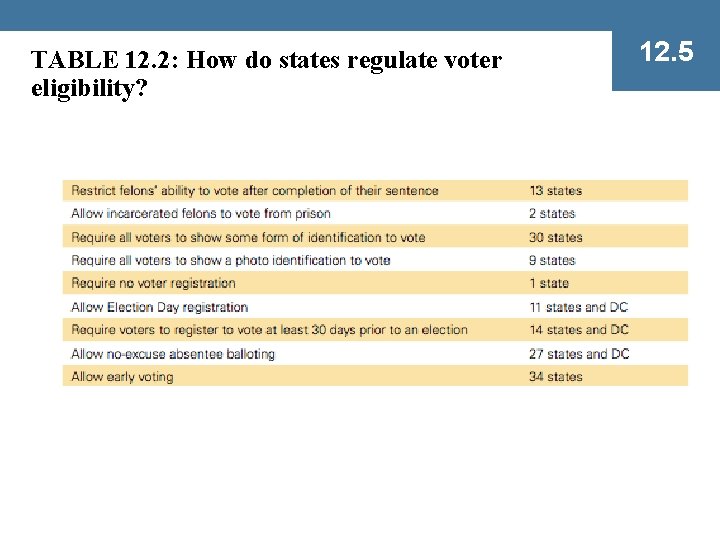
TABLE 12. 2: How do states regulate voter eligibility? 12. 5
Income and Education, Race and Ethnicity ¤ Income and Education ¤ Race and Ethnicity 12. 5
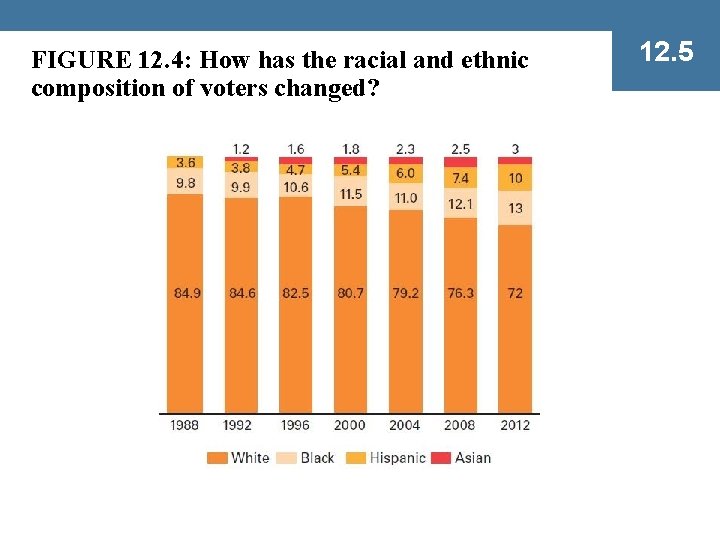
FIGURE 12. 4: How has the racial and ethnic composition of voters changed? 12. 5
Gender, Age, Civic Engagement and Interest in Politics ¤ ¤ Gender Age Civic Engagement Interest in Politics 12. 5
12. 5 All of these are a factor in voter turnout except: a. Age and race b. Income end education c. Geographic location d. All of the above 12. 5
12. 5 All of these are a factor in voter turnout except: a. Age and race b. Income end education c. Geographic location d. All of the above 12. 5
Toward Reform: Problems with Voter Turnout ¤ Why Don’t Americans Turn Out? ¤ Ways to Improve Voter Turnout 12. 6
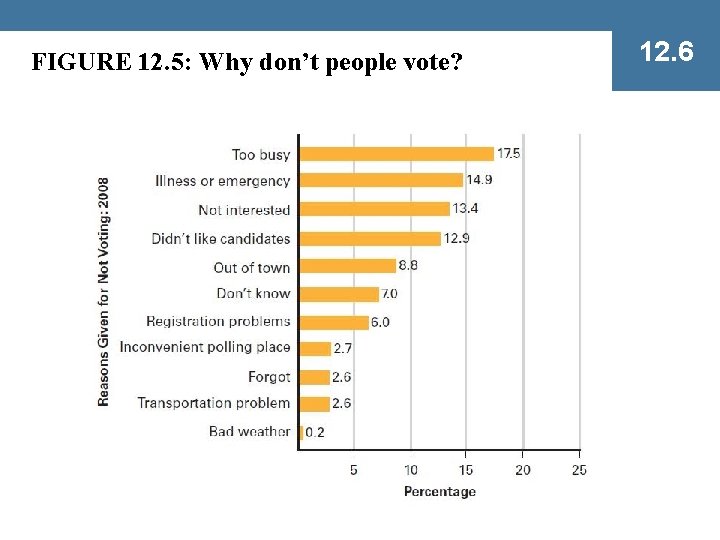
FIGURE 12. 5: Why don’t people vote? 12. 6
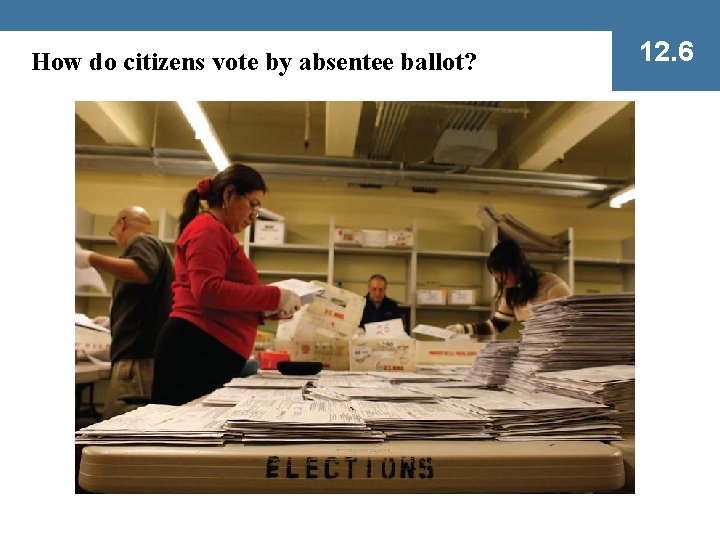
How do citizens vote by absentee ballot? 12. 6
Ways to Improve Voter Turnout ¤ ¤ ¤ Make Election Day a Holiday Enable Early Voting Permit Mail and Online Voting Make Registration Easier Modernize the Ballot Strengthen Parties 12. 6
12. 6 The most frequently cited reason Americans give for failing to vote is: a. Distrust in government and voter cynicism b. Overwhelming number of elections c. Difficulty with voter registration d. Conflicts with work or family 12. 6
12. 6 The most frequently cited reason Americans give for failing to vote is: a. Distrust in government and voter cynicism b. Overwhelming number of elections c. Difficulty with voter registration d. Conflicts with work or family 12. 6
Discussion Question Why don’t more Americans vote? What changes to election procedures might increase voter turnout? What factors influence how Americans make their voting choices? 12
- Slides: 49